
Higgins M.D. Quantitative textural measurement in igneous and metamorphic petrology
Подождите немного. Документ загружается.

per unit volume. In deformed rocks the energy associated with lattice defects
is typically two to four orders of magnitude greater than that associated with
excess surface area (e.g. Duyster & Stockhert, 2001). During uniform defor-
mation equilibrium may be reached between these processes, giving a constant
crystal shape that depends on the deformation style and rate, and the tem-
perature and fluid content. Of course, such information may be masked by
subsequent deformation under different conditions. Deformation mechanisms
have been discussed briefly in Section 3.2.5. Recovery of surface energy by
coarsening (ripening) has also been discussed with reference to crystal size
(see Section 3.2.4). However, the role of lattice defects has yet to be discussed.
Lattice defects have excess energy compared to other parts of the crystal
lattice, hence will be removed during relaxation. Recovery of such lattice
defects close to the edge of a crystal can occur by grain boundary migration
(Kruhl & Nega, 1996). A suitably located defect can be eliminated by removal
of that part of the grain and reconstitution of the atoms into the adjacent grain
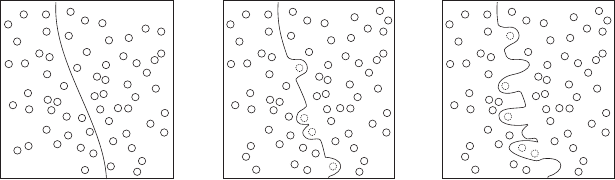
(Figure 4.3). The overall effect is a migration of the grain boundary and the
bulging of one grain into another, leading to a sutured grain boundary. The
energy expended in creating a larger grain surface area is less than the energy
recovered from the elimination of the defect.
4.2.3 Dihedral angles of crystals in rocks
So far the shape of isolated crystals has been discussed, but in most rocks
crystals touch. If such a material is completely solid then four crystals meet at
most crystal corners and three meet along most crystal edges. In the plane
normal to the edge the angle of the traces of the crystal boundaries is the
dihedral angle (DA).
(b) (c)(a)
Crystal 1
Crystal 2
Figure 4.3 Schematic development of sutured grain boundaries between
two crystals. (a) Initial state after deformation. Circles are lattice defects.
(b) Bulging of the crystal boundary removes a defect from the adjoining
crystal. The new boundary is then close enough to capture other defects.
(c) The process will continue while it is energetically favourable to make more
grain surface and lose lattice defects.
4.2 Brief review of theory 139
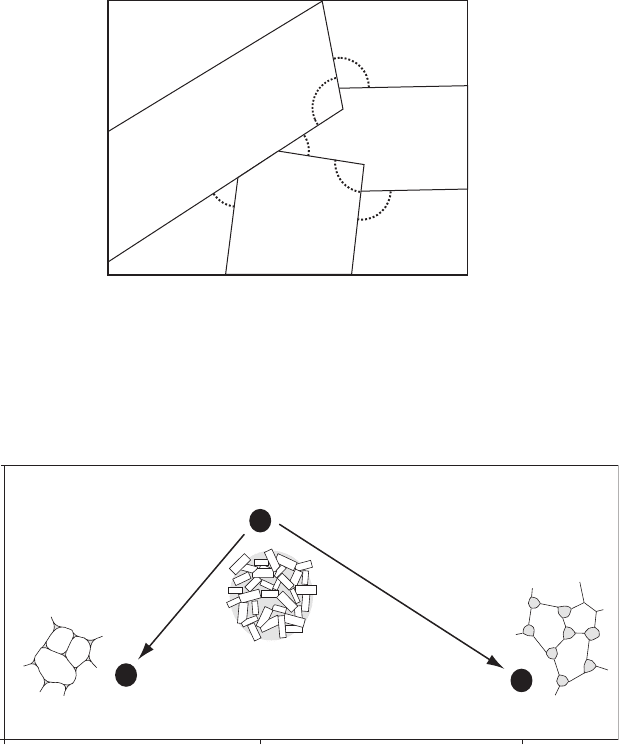
Crystals will grow unimpeded in magma or liquid until they impinge
another crystal (Figure 4.4). The impingement DAs for such textures are
very variable but the population of DAs has a mean of 608 (Figure 4.5). This
texture is regarded as the departure point for further textural development in
solidifying systems (Holness et al., 2005). Such textures should be developed in
simple magmatic systems without magma flow or imposed stress. They may
also develop in some hydrothermal ore deposits and chemical sediments.
Liq
A
B
C
B
A
C
Figure 4.4 Impingement angles in growth textures. Here, three different
phases (A, B and C) have grown from a liquid without equilibration and
a portion of the liquid remains (Liq). Some of the many dih edral angles
associated with each phase are shown by arcs. In a simple growth texture
like this these dihedral angles are referred to as impingement angles.
60 120
median angle (°)
Solid-state equilibrium
0
0
Impingement
(growth textures)
Melt-present equilibration
Sub-solidus equilibration
40
standard deviation
Melt-present equilibrium
Figure 4.5 Changes of the median and standard deviation of dihedral angles
from initial impingement (growth) textures in response to melt-present and
sub-solidus equilibration (from Holness et al., 2005).
140 Grain shape
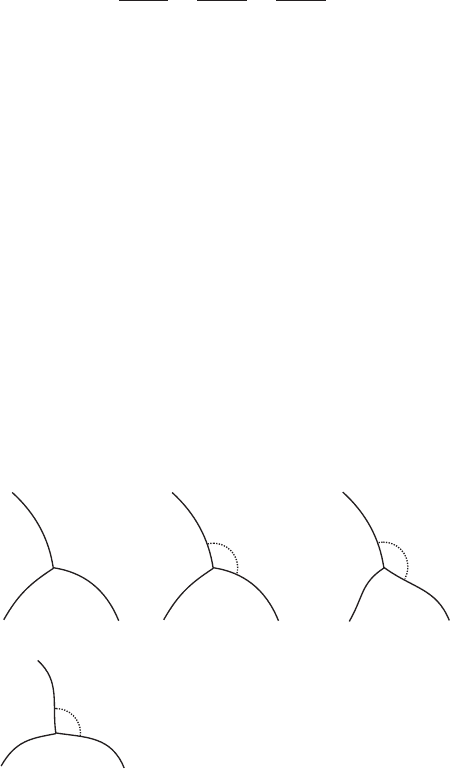
At equilibrium the DA reflects the difference in surface energy (interfacial
tension) between the phases. If three phases are isotropic and meet at an edge,
then (Smith, 1948, Smith, 1964)
g
1
sin a
1
¼
g
2
sin a
2
¼
g
3
sin a
3
where g
1
, etc. are the surface energies between the phases along a grain
boundary, and a
1
, etc. are the DA between the phases on the opposite side of
theedge(Figure4.6a).Liquidsareisotropic,butallmineralsarephysically
anisotropic, hence the surface energy varies with direction and even at equili-
brium there will be a range of DAs (Herring, 1951b, Laporte & Provost, 2000).
Experimental work suggests that the degree of anisotropy broadly correlates
with the overall symmetry of the minerals: it is lowest in isometric minerals like
spinel and highest in monoclinic minerals like diopside (Laporte & Watson,
1995, Schafer & Foley, 2002). Some studies have shown that true F-faces
(Figure 4.1) may form where one of the phases is a fluid, leading to further
complexity in the anisotropy of surface energy (Cmiral et al., 1998, Kruhl &
Peternell, 2002) although this may not always be the case (Hiraga et al., 2001).
In a polymineralic rock many different mineral combinations are possible,
eachwiththeirownrangeofequilibriumDAs(Figures4.6b,c,d).
(c)
A
A
B
130°
A(A–B
)
(d)
A
A
C
100°
A(A–C
)
A(B–B
)
A(C–C )
A(B–C
)
(b)
A
A
A
A(A–A )
120°
(a)
X
Y
Z
γ
2
γ
3
γ
1
α
1
α
3
α
2
Three other
combinations
are possible:
Figure 4.6 Equilibrium dihedral angles in a three-phase system. (a) If three
different isotropic phases X, Y, Z, meet at an edge then the DAs a
1
, a
2
, a
3
are
simply related to the interfacial energies of the grain boundaries g
1
, g
2
and g
3
.
(b) If the rock is monomineralic then the mean equilibrium DA will be 1208.
The DAs will be variable because the surface energy of minerals is not
isotropic. (c, d) Here, the rock has three phases A, B and C, one of which
may be a liquid. In this case the equilibrium DA for each mineral varies with
the na ture of its neighbours, as well as the anisotropy. In a three-phase rock,
six different combinations are possible, of which three are shown.
4.2 Brief review of theory 141
Clearly, surface energies are important in the development of texture and
their values should be determined. Such values may be calculated for crystals
in a vacuum, an uninteresting value for most geological studies. DAs can
provide useful estimates of the ratios of surface energies (Kretz, 1966b,
Vernon, 1968, Hiraga et al ., 2002), but it is much more complicated to measure
the actual surface energies. Surveys in materials science suggest that values
are of the order of 1 Jm
2
for many contacts between crystalline materials
(Sutton & Balluffi, 1996). The surface energy of olivine–olivine contacts was
determined from a mantle sample to have a maximum value of 1.4 Jm
2
for the greatest degree of crystal misorientation (Duyster & Stockhert, 2001).
Surface energies between solids and liquids are much lower than these values,
because the liquid is structurally isotropic. Mungall and Su (2005) found
that the surface energy between sulphide and silicate liquids was 0.5–0.6 Jm
2
.
They note that the surface energy of silicate mineral–silicate liquid contacts
should be much lower.
Dihedral angles can be used as a measure of the degree of textural equili-
brium in a rock (Elliott & Cheadle, 1997, Holness et al., 2005). A rock is in
textural equilibrium if ‘the surface topology of the grains is in mechanical and
thermodynamic equilibrium’ (Elliott et al., 1997). If a rock has coarsened in a
stress-free environment then it will have approached textural equilibrium (see
Section 3.2.4). The attainment of textural equilibrium can be assessed from
the distribution of grain sizes, from the curvature of the grains, or from the
distribution of DAs. In general DAs are the most sensitive to equilibration and
grain shape and size the last to respond (Laporte & Provost, 2000). In a rock
composedofonlyonephasethemeanDAis1208 (Figure4.6b).Ifseveral
phases are in equilibrium then the DA for a particular mineral will depend on
itsneighbours(Figures4.6c,d)inadditiontotheanisotropyofsurfaceenergy
(Kretz, 1966b, Vernon, 1968, Elliott et al., 1997, Holness et al., 2005).
DAs are of particular interest where one of the phases is a liquid, which is
isotropic. In this case the DA is a measure of the wetability of the surface by the
liquid: if we consider again our ideal rock, composed of one isotropic mineral,
then if the DA between the solid phase and a liquid is less than 608 then the
liquid will form an interconnected network along three-phase junctions. This
means that the connectivity threshold of the melt is zero. A survey by Smith
(1964) suggests that this is the case for some minerals, aggregates of which are
permeable even at very low degrees of melting. Conversely, if the DA is greater
than 608 then the liquid will aggregate at the intersections of grains, and the
connectivity threshold is much higher.
Calculation of rates of textural equilibration or coarsening requires absolute
values of surface energies, which cannot be determined from DAs. However,
142 Grain shape
approximate values estimated from an assessment of relevant experimental
studies (Sutton & Balluffi, 1996, Holness & Siklos, 2000), suggest that textural
equilibrium over a scale of millimetres could be achieved in partially molten
silicate rock over tens of years.
A number of experimental studies have suggested that at equilibrium there
is a minimum-energy melt fraction (MEMF) in a partially molten rock that
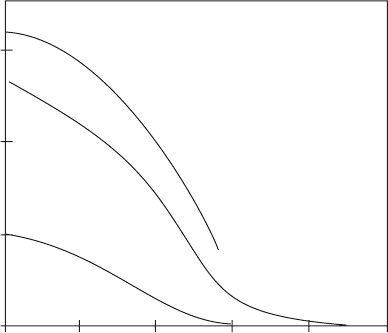
depends on the DA (Figure 4.7; Jurewicz & Watson, 1985, Ikeda et al., 2002).
If the actual amount of melt is less than the equilibrium melt fraction then melt
will be drawn into the crystal aggregate. However, if the material contains
more melt than the equilibrium fraction, then the melt will be expelled and
segregate outside the aggregate. These effects could cause the commonly
observed clustering of crystals.
4.3 Methodology
4.3.1 Three-dimensional analytical methods
Grain shape is a property of the surface of the grain. It can be examined
precisely using three-dimensional methods, if the grain surface can be sepa-
rated perfectly from adjoining grains by physical or analytical means. This is
the best way to look at the development of faces in minerals, and complex
shapes such as dendrites. It is also necessary if there is a significant range in
dihedral angle (°)
equilibrium melt fraction (vol%)
020406080100
0
10
20
30
Laporte & Watson
(1995) – bcc model
Jurewicz &
Watson (1985)
Bulau et al. (1979)
Beere (1975)
Park & Yoon (1985)
Figure 4.7 Minimum-energy melt fraction in partially molten rocks at
equilibrium against dihedral angle (modified from Beere, 1975, Bulau et al.,
1979, Jurewicz & Watson, 1985, Park & Yoon, 1985, Lapor te & Watson,
1995, Ikeda et al., 2002).
4.3 Methodology 143
grain shape within a sample, for example for different grain sizes. The following
3-D methods have been used:
*
The shape of individual grains can be determined by serial sectioning (see
Section 2.2.1).
*
In transparent materials, such as volcanic glasses, the shape of crystals can be
measured directly with a regular or confocal microscope (see Section 2.2.2).
*
X-ray tomography can be used to determine the shape of grains if adjoining grains
can be separated (see Section 2.2.3).
*
The shape of grains is preserved if they can be extracted intact from rocks by
mechanicaldisintegrationorpartialsolution(seeSections2.5and2.6).Natural
weathering can sometimes lead to the extraction of measurable grains (Higgins, 1999).
*
Rocks commonly fracture along zones of weakne ss, which may include crystal
surfaces or schistosity in clasts. Hence, aspects of the shape of individual grains can
be commonly measured from such special sections exposed on irregular fractured
blocks. This is particularly useful for tabular grains.
4.3.2 Section and surface analytical methods
It is not always possible to separate grains either chemically, mechanically or
analytically for 3-D analysis. In these cases two-dimensional intersection or
projection methods may give better results. Larger objects may be sectioned
individually along special directions: this is important for looking at internal
surfaces. However, generally the outlines of many grains are examined statis-
tically and the mean shape determined. These methods may not be applicable
if a range of shapes is present.
The shape of grains can be determined from images acquired from rock
surfaces, slabs and sections, using a variety of techniques described in
Section 2.5. Such images are processed manually or automatically to produce
classified images (see Section 2.6). Finally, the classified images are processed
to extract grain outline parameters. If the section is examined using techniques
that can reveal the orientation of the crystal lattice, such as polarised light
microscopy or EBSD, then the relationship between the shape and the lattice
orientation can be determined.
Commonly data from many grains with different orientations are combined
and the results interpreted in terms of grain shape. However, some shape
parameters are difficult to measure by these methods and it may be better
to examine grains with special orientations that are parallel or normal to the
plane of the section. For crystals such orientations may be identified using
optical methods such as birefringence and twinning. A universal stage can also
be used to rotate crystals into the useful orientations (see Section 5.5.1).
144 Grain shape
Changes in the shape of a crystal during its lifetime may be observed
from zoning patterns, or surfaces rich in inclusions inside the crystal
(Sempels, 1978, Vavra, 1993). Such patterns are best revealed by regular
optical methods, backscattered electron images (see Section 2.5.2.1), catho-
doluminescence (see Section 2.5.2.3), Nomarski interference (DIC; see
Section 2.5.3.3) or laser inferometry methods (Pearce et al., 1987). Of course,
important solution events may remove earlier history, so the story may
be fragmentary. For quantitative studies of changes in morphology it may
be necessary to use sections with special orientations (Pearce et al., 1987,
Sturm, 2004).
4.3.3 Extraction of overall grain shape parameters
4.3.3.1 Overall axial ratios
Grains can have very complex shapes but for some purposes all that is needed,
or all that can be currently determined, are the overall shape in terms of its
aspect ratio. There are a number of different definitions (see Figure 3.26).
*
The dimensions of the smallest parallelepiped that encloses the grain. The aspect ratio
then has three parameters: the short, intermediate, and long dimensions (S : I : L).
*
The dimensions of a triaxial ellipsoid with the same moments of inertia as the grain.
The aspect ratio is then the ratio of the minor (short) : intermediate : major (long)
axes (S : I : L).
The aspect ratio of either model can be precisely determined from three-
dimensional data for each grain. The limitations of three-dimensional methods
have been described above; hence it may be necessary to use two-dimensional
data from intersections or projections. For practical reasons it is easier
to divide the total aspect ratio into the ratios S/I and I/L, both of which vary
from 0 to 1.
In sedimentology the SIL values are commonly reduced to a single para-
meter, the sphericity:
sphericity ¼
ffiffiffiffiffiffiffiffiffiffiffiffiffiffiffiffi
ðIS=L
2
Þ
3
q
Sphericity has a value of one for a sphere and decreases towards zero for more
elongate clasts.
4.3.3.2 Intersection data
If grain shapes are convex, constant in shape and simple then parts of the
overall aspect ratio may be estimated statistically from grain intersections
4.3 Methodology 145
using the distribution of the ratio of intersection widths and lengths (w/l),
supplemented with other data where necessary. Obviously such methods
cannot be used for concave or branching crystal forms, which must be mea-
sured by 3-D methods such as X-ray tomography or serial sectioning (see
Section 2.2).
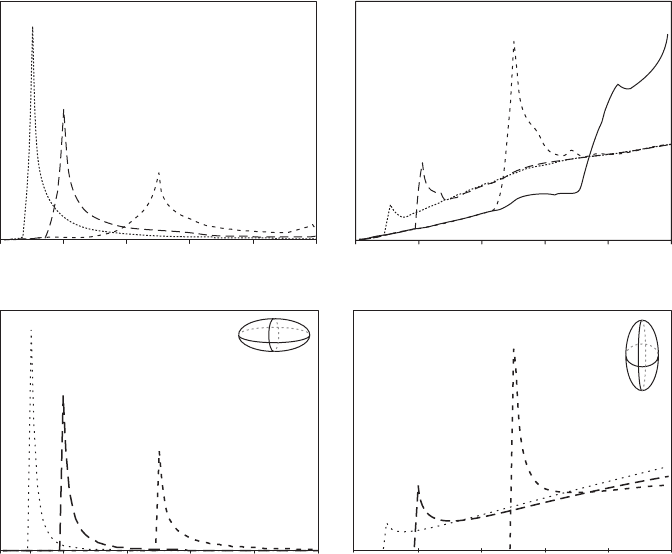
One simple method of estimating S : I : L is derived from a model of grains as
parallelepipeds (Higgins, 1994). For tablet-shaped grains with no preferred
orientation(massive)themodeofthew/lisequaltoS/I(Figure4.8a).For
prisms the results are not so easy to interpret: w/l ratios have a wide distribu-
tionwithonlyaminorpeakatS/L(Figure4.8b).Amodelbasedonellipsoids
0 0.2 0.4 0.6 0.8 1.0
1:1:1
1:1:2
1:1:5
1:1:10
(b) Cube and prisms
0 0.2 0.4 0.6 0.8 1.0
1:2:2
1:5:5
1:10:10
(a) Tablets
frequency
intersection width / intersection length
intersection minor axis
/ intersection major axis
0
frequency
(c) Oblate ellipsoids
0.2 0.4 0.6 0.8 1.0
1:2:2
1:5:5
1:10:10
1:1:2
1:1:5
1:1:10
(d) Prolate ellipsoids
0.20 0.4 0.6 0.8 1.0
Figure 4.8 (a, b) Distribution of intersection width/length for randomly
oriented planes intersecting a parallelepip ed (after Higgins, 1994).
Intersection dimensions are those of the smallest rectangle that can be fitted
around the intersection. Representative crystal intersections are shown in
Figure 3.27. (c) Intersections of a randomly oriented plane with an oblate
ellipsoid (disc shaped; this study). (d) Intersections of a randomly oriented
plane with a prolate ellipsoid (rugby/American football shaped; this study).
146 Grain shape

rather than parallelepipeds has a broadly similar distribution of intersection
minor axis/intersection major axis ratios, equivalent to w/l. For oblate ellip-
soids the ratio S/I (ellipsoid minor axis/ellipsoid intermediate axis) can be
determined from the mode of the intersection minor axis/intersection major
axisratios(Figure4.8c).Asforprisms,theshapeofprolateellipsoidscannot
be determined from the distributions of the intersection minor axis/intersec-
tionmajoraxisratios(Figure4.8d).
Rocks with strong fabrics may have different w/l modal values depending
on the orientation of the section with respect to the foliation or lineation
(Table 4.1).
If a sample has a strong foliation or lineation and a section parallel to
the fabric is available than the ratio I/L can be determined also. However,
more commonly the ratio I/L must be determined from the distribution of the
w/l ratios. Higgins (1994) showed that for parallelepipeds this ratio can be
estimated from the w/l distributions as follows:
I=L ¼ 0:5 þðmean w=l mode w=lÞ=standard deviation w=l
However, this equation does not give accurate results for near equant shapes.
Garrido et al.(2001) did a very similar modelling of parallelepipeds and
found a graphical relationship between the mean w/l, mode w/l and I/L. The
following equation was derived from their graph.
I=L ¼ðmean w=l þ 1:09ðmode w=lÞ
2
1:49ðmode w=lÞþ0:056Þ=0:126
Table 4.1 Modal values of different intersection parameters for populations
of parallelepipeds with different fabrics (Higgins, 1994). S ¼ short dimension,
I ¼ intermediate dimension, L ¼ long dimension. For some orientations of strong
fabrics values are invariant: these are shown in bold italic type.
Fabric type and
section orientati on
Mode of
intersection
length (l)
Mode of
intersection
width (w)
Mode of
intersection
width/length (w/l)
Massive I S S/I
Foliated – normal I S S/I
Foliated – parallel L I I/L
Lineated – normal I S S/I
Lineated – parallel L I I/L
F and L – normal I S S/I
F and L – parallel L I I/L
4.3 Methodology 147
Both methods need an accurate estimate of the mode w/l which is not easily
available for most measured CSDs. In many cases it is best to measure I/L
from crystals with special orientations (see Sections 4.3.1 and 4.3.2).
As was mentioned before the shape of prismatic crystals is not easily
determined from w/l distributions. The best way to determine the shape of
prismatic crystals is from the examination of crystals with special orientations:
that is, with the long axis parallel to the section.
Some stereological methods for calculating crystal size distributions
(e.g. CSDCorrections; Higgins, 2000) require also an estimate of the degree
of rounding of crystals. For the models described above this parameter just
modifies the shape model used for the conversion by combining intersections
from parallelepipeds and ellipsoids.
4.3.3.3 Projection data
In some situations grain outlines are seen in projection and not in section. For
instance, grains may be completely contained within a thin section. The pro-
jected outline width/length (w/l) can be used to determine aspects of the overall
aspect ratio, as for intersection data, but the relationships are different. The
parallelepiped model assumes that blocks are randomly oriented. Tablets have
broad distributions of projected w/l that cannot be used to determine the
aspectratioofthegrains(Figure4.9a).However,prismshavewelldefined
w/lpeaksforwhichthemode¼I/L(Figure4.9b).Forshapesbetweentablets
and prisms the S/I ratio is not easily accessible and is best determined from
grains with special orientations.
A model based on randomly oriented ellipsoid grains gives similar, but not
identical results to the parallelepiped model: for oblate ellipsoids the modal
projected minor axis/projected major axis has a peak at I/S, but it is narrow,
withfewintersections(Figure4.9c).Hence,inpracticeitisnotpossibleto
determine the value of I/S for such shapes. However, for prolate ellipsoids the
peak at I/L is well defined and the mode is easily measurable in real situations
(Figure4.9d).TheI/Sratiooftriaxialellipsoidsisnoteasilyaccessiblefrom
projection data.
If grains are deposited as a layer just one grain deep then their outlines
can be easily imaged and measured. Here, the grains are not randomly
oriented, but lie with the I–L plane horizontal. In this situation, the value
of the w/l will be exactly equal to I/L, however S/I is not accessible from
the image. If all grains are assumed to have the same composition then the
total mass of the sample can be used to estimate the value of S/I (Mora &
Kwan, 2000).
148 Grain shape