
Holik H. (ed.) Handbook of Paper and Board
Подождите немного. Документ загружается.


They largely contribute to the pick strength of the coating. The amount of binder
employed in the coating can be reduced if large proportions of synthetic co-binder
are employed. Generally speaking, two parts of co-binder can be used to replace
one part of binder. They also increase the water resistance of coatings. Once they
have formed a film, they become firmly integrated within the structure of the
coating and are no longer soluble in water.
3.6.9.3.5.2 Insolubilizers
There are many chemically different types of insolubilizers or crosslinkers, but
they all have the same function – to add water resistance to the coated paper
surface. Water resistance is particularly important in offset printing, but also for
wallpaper, label paper, poster paper and in the storage of board packages. In dou-
ble-coated boards, crosslinkers are used in the precoating to impart water resis-
tance against the topcoat. The water resistance can be measured as wet rub and
wet pick or seen as less pick, print mottle, or binder migration. The water sensitiv-
ity of paper and board coating originates from the fact that water-soluble binders
tend to lose their binding power in contact with water and dissolve. This water
sensitivity of binders can be described as the amount of O-atoms in the molecule
(in hydroxy and carboxyl groups). The water sensitivity can be decreased by cross-
linking the soluble binders with insolubilizers or by building an insoluble net
around the binders.
Traditional insolubilizers in paper and board coating are based on formaldehyde
and its amino compounds (melamine, urea) or on glyoxal. Imidazoline derivatives
are also used as crosslinkers. Next-generation insolubilizers are based on zirco-
nium; the product most widely used is ammonium zirconium carbonate (AZC).
Glyoxal is the simplest aliphatic dialdehyde. It is an effective crosslinker of
starch, and gives the coating an immediate curing. The crosslinking mechanism is
a reaction with the hydroxy groups. Glyoxal first reacts with one starch molecule
and then with another one, leading to crosslinking of two starch molecules.
Glyoxal is a less effective crosslinking agent for synthetic water-soluble binders.
Some of its derivatives, such as condensate products with urea or ethylene urea
can be used here. Glyoxal is ineffective at pH >8.5. Difficulties have resulted with
viscosity build-ups due to crosslinking in the wet form.
Melamine-formaldehyde (MF) and urea-formaldehyde (UF) resins have been
used in paper coating since 1940. In the 1970s, methylated MF and UF resins for
the most part replaced these resins. Melamine-formaldehyde (MF) resins and urea-
formaldehyde (UF) resins have reactive imino- (>NH) and methylol (>N–CH
2
–OH)
groups. Methylated MF and UF resins have also some functional methoxymethyl
groups (>N–CH
2
–O–CH
3
). These groups undergo reactions with paper coating
binders: the hydroxy group of starch and polyvinyl alcohol, and the carboxyl groups
of latexes. Both UF and MF resins can also self-condensate. The reaction of MF/
UF and their derivatives is an acid catalyzed condensation reaction, which requires
a certain temperature and pH. The curing reaction takes up to two weeks to
complete.
3 Chemical Additives122

Environmental pressures against formaldehyde-based resins, higher pH in coat-
ing formulation, and the need for faster curing are the reasons why ammonium
zirconium carbonate (AZC) is more and more used in the paper industry. AZC
reacts with carboxyl and hydroxy groups in the coating, hydroxy groups in starch
and PVA, carboxyl groups in latexes, and oxidized starch. The reaction takes place
when ammonia is evaporated and water is removed on drying. AZC forms cova-
lent bonds with carboxyl groups and weaker hydrogen bonds with hydroxy groups.
High pH does not affect the reaction. Other zirconium-based crosslinkers are po-
tassium zirconium carbonate and zirconium acetate. The reaction mechanism is sim-
ilar for all these products.
In coatings the amount and type of binder present determines the addition level
of crosslinkers. It is recommended to use 5%-10 % crosslinker based on total dry
binder. In general, starch-based coatings require a higher amount than coatings
based on synthetic binders. It is important to optimize the dosage of crosslinker.
An excessive amount can result in cracking problems or even in increased, instead
of decreased, solubility of water-soluble coating components. A crosslinker should
be added to the coating color as the last ingredient.
3.6.9.3.5.3 Tinting (Shading)
In many cases, the yellowish color of the coating clay does not satisfy market
requirements. Apart from the addition of pigments such as titanium dioxide,
which increase brightness, blue-violet dyes (shading dyes ) are often used at a con-
centration of about 2 g per 100 kg of pigment to attain a bluish white coating
surface which appears brighter to the eye. Not only basic dyes, but also consider-
ably more lightfast direct dyes and pigments may be used. If the brightness re-
quired is very high, optical brighteners are also added.
3.6.9.3.5.4 Optical Brightening Agents (OBA)
The brightness of paper and board has increased dramatically during recent years.
The brightness of pulp, fillers and coating pigments is not high enough to reach
these brightness targets. Therefore there is a need to use a coating additive called
an optical brightener. These products are also known under the names optical
whitening agents, optical bleaching agents, or fluorescent whitening agents
(FWA).
Fluorescence is a phenomenon where the molecules of a fluorescent substance
become electronically excited by absorbing light energy and then emit this energy
at a higher wavelength. Fluorescence is usually restricted to compounds with large
conjugated systems containing p-electrons. Most of the OBAs on the market are
derivatives of bis(triazinylamino)stilbene. Only the trans-isomer exhibits strong
fluorescence, the cis-isomer is nonfluorescent. The OBAs used in the paper in-
dustry are natrium salts and are thus water soluble. There are three types of optical
brighteners used in the paper industry, all based on the stilbene molecule. The
main difference is the number of solubilizing sulfonic groups. Disulfonated OBAs
3.6 Functional Chemicals 123

have two sulfonic groups; the two other substituents could be hydrophilic groups.
This OBA has a very good affinity but limited solubility and is mostly used in the
wet-end. The most commonly used OBAs are the tetrasulfonated types. Tetra-
sulfonated OBAs are versatile products because of their characteristics of medium
affinity and good solubility. They can be used in most applications in the paper
industry: wet-end, size-press, and coating. The hexasulfonated OBAs are special-
ties used mostly in coatings where high brightness is required.
OBAs absorb ultraviolet radiant energy at 300–360 nm and re-emit the energy in
the visible range, mainly in the blue wavelength region. This increases the amount
of light emitted, resulting in higher brightness or whiteness. Because the reflected
light is bluish, the yellow shade of paper is compensated, contributing to making
the paper look still whiter. Whiteness is defined as the measured reflectance of
light across the visible spectrum including color components. Brightness again is
defined as the reflectance of light at the wavelength 457 nm without color in the
measurement. To measure the brightness or whiteness of paper and board con-
taining OBAs requires an instrument having a known amount of UV in the illumi-
nation. The test method used increasingly is the CIE whiteness (SCAN method
P66) instead of the traditional ISO brightness, which does not define the illumi-
nant. An increase in OBAs at lower concentrations results in an increase in white-
ness · As the concentration goes up to 1.5 parts of dry pigment there is no more
gain in whiteness when adding more tetrasulfonated OBA. This is called the sat-
uration point or the graying point. The hexasulfonated OBA actually has no gray-
ing point because of its high solubility.
3.6.9.3.5.5 OBA Carrier
Optical brighteners work only when they are fixed to a carrier. A good carrier is
linear and contains OH- or other hydrophilic groups. Linearity increases the con-
tact between the carrier and OBA so that physical bonds (such as hydrogen bonds
and van der Waals forces) can be formed between the OBA and the hydrophilic
groups of the carrier. Carriers in a coating color are, among others, starch, CMC, or
PVA. By adding one of these products in coating color, higher brightness can be
achieved.
UV exposure causes yellowing of brightened paper, but a good carrier increases
the light stability. Furthermore the carrier has an influence on the migration of
OBA; the more efficient the carrier, the better the resistance of OBA to the mi-
gration.
3.6.9.3.5.6 Influencing Opacity
The main contribution to opacity has to come from the pigments. Synthetic prod-
ucts are usually less opaque than natural products and this can be a problem,
especially when coating ULWC (ultra light weight) grades of paper. Products with a
very pronounced thickening effect are only added in small quantities, so they
hardly have any effect on opacity.
3 Chemical Additives124

3.6.9.3.5.7 Influencing Smoothness and Gloss
The gloss of paper largely depends on its smoothness. High gloss depends on the
evenness of the topology of the paper surface. Like all hydrocolloids, co-binders
and thickeners have an effect on the smoothness and the gloss of the paper. They
are able to migrate in the wet coating, and migration can lead to them becoming
unevenly distributed on the surface. They can also absorb water and swell, which
also impairs the smoothness of the paper. Synthetic co-binders are usually less
detrimental to gloss than natural products. One of the reasons for this is that
natural products are able to absorb moisture and swell after they are dried,
whereas acrylic polymers are much less sensitive to moisture once they have dried
to form a film. Another reason is that acrylic polymers are highly thermoplastic,
and respond very well to calendering. The films formed by natural products are
thermosetting, and so they are not deformed as easily under heat and pressure in
the calender nip.
3.6.9.3.5.8 Influencing Porosity, Print Gloss and Glueability
The gloss of the printed paper is determined by the smoothness of the paper
surface and the ink holdout. In turn, the ink holdout is mainly determined by the
porosity and the chemical and physical structure of the coated surface. Coatings
need to be porous on a microscopic scale so that the soluble component of printing
inks is able to penetrate the paper and dry more quickly. The intensity and bril-
liance of the printed image and the ink consumption depend on the pigments
staying on the surface. The hydrophobicity of the coated surface and the surface
tension both influence the ink uptake.
Coatings that contain synthetic thickeners and co-binders are more hydrophobic
and take up more ink, but their porosity can have a detrimental effect on the print
gloss. Synthetic co-binders give rise to an open-pored structure, which can in-
crease the rate of ink absorption and give a lower print gloss. The task here is to
find the best compromise between the pore size distribution and the hydropho-
bicity of the coated surface in order to obtain the highest possible print gloss
without prolonging the drying time of the ink too much. An open-pored structure
is often highly desirable in multiple coats applied to board because this guarantees
high ink absorption.
Another important aspect governed by the porosity of the coating is the glue-
ability of coated board. Here the affinity of the adhesive also plays an important
role. High porosity can be obtained by using binders based on vinyl acetate, and it
is for this reason that large quantities of vinyl acetate binders are used in the
United States to coat folding boxboard, in spite of disadvantages such as low bind-
ing power, poor printability and build up of stickys in the wet-end of the paper or
board machine. The approach taken in Europe is to use styrene-acrylic and sty-
rene-butadiene binders, which give a more compact, less porous coating, and to
add special co-binders that form a porous film and aid glueability. The porosity of
the films formed by acrylic-based products and their compatibility with acrylic and
acetate-based adhesives give very good glueability when they are applied to folding
boxboard.
3.6 Functional Chemicals 125

3.6.9.3.5.9 Influencing Printability
The evenness of the printed image is a very important criterion for quality. The
acceptance of coated paper by printers depends on its runnability in the printing
process and its printability in terms of an even image that is free of defects.
The printability of paper is principally determined by the surface of the coating,
and its structure and topology, pore size and pore size distribution, chemical na-
ture, and homogeneity all play an important part in influencing the interaction
between paper and ink. The binder has the greatest influence on printability, but
co-binders and thickeners also play a part and they have to be adapted to the
printing process.
In offset litho, mottling is mainly caused by the uneven distribution of coating
ingredients at the surface of the coating. There are different types of mottling
depending on the causes and the way in which the mottling manifests itself. In
gravure printing, missing dots can be avoided if the paper has a very smooth
surface and a defined microscopic roughness.
In both printing processes, it can be assumed that co-binders and thickeners
with very high water retention will have a detrimental effect on print quality. Very
high water retention prolongs the drying time of the wet coating and the various
different ingredients in the coating migrate at different rates, which causes the
binder, co-binder, and thickener to become unevenly distributed. This patchiness
gives rise to mottling in offset litho printing processes. Low web speeds and low
drying capacity tend to exacerbate this problem. Excessively high water retention
can also give rise to a rough, uneven coating which can cause missing dots in
gravure printing.
There are no hard and fast rules with co-binders and thickeners when it comes
to avoiding mottling. All natural and synthetic products can cause mottling under
adverse conditions. Coatings that contain starch are known to have a high ten-
dency to mottle, even if starch is only contained in the precoat. Soy protein behaves
similarly. Synthetic products are not usually prone to mottling, although CMC can
give rise to missing dots in gravure printing processes.
3.6.9.4 Color Formulations
Special coating methods and coating colors have been developed for different
printing and converting processes. Manufacturers of coating chemicals, together
with their customers, have developed a large number of new pigment and binder
qualities plus additives to meet the highest quality requirements. Depending on
the quantities and grades of chemicals of different coating colors, their direct prod-
uct cost can vary within a wide range:
• Precoatings 300–400 € per t of coating (dry base)
• Top coatings 400–600 € per t
• LWC coating color 350–450 € per t
• Specialties 400–3000 € per t
3 Chemical Additives126

Very generally, a coating recipe consists of the following components (dry mate-
rials):
100 parts of pigments (clay, calcium carbonate, talc, TiO
2
)
0–0.3 parts of dispersant
5–12 parts of binders
0–1 parts of thickener
0–1 parts of lubricants (calcium stearate)
0–1 parts of optical brightening agent (OBA)
0.01–0.05 parts of shading dyes
0.01–0.1 parts of defoamer / deaerator
More details about coating color formulations depending on the specific paper
and board grades are mentioned in Section 7.6.
3.7
Process Chemicals [1–3, 9–11, 21–24]
Process chemicals are all additives which are used to solve or prevent problems in
the paper manufacturing process, to improve its efficiency and/or to provide eco-
logical advantages. For example these additives allow reduction in the consump-
tion of fresh water and energy, the prevention of foam and deposits, the improve-
ment of drainage and/or reduction in fiber losses. Their proportion related to all
chemical additives is only 10% (Fig. 3.3).
3.7.1
Retention and Drainage Aids (RDA)
The term retention refers to the holding back of the papermaking stock on the wire
during sheet formation and dewatering. The fibers are retained on the wire better
than the fillers and the fines, which may be washed through the wire and even
through the fiber mat formed. The most common retention parameters can be
defined as first-pass retention (FPR) and overall retention. First pass retention is the
ratio of the amount of solid material that leaves the headbox slice to the amount of
solid material that is contained in the paper web leaving the couch roll (typical
values are 40–70%). Overall retention is the ratio of the amount of solid material
that is sent to the wet-end of a paper machine to the amount that goes onto the reel
at the dry end of the machine (typical values are 90–98%).
3.7 Process Chemicals 127
3.7.1.1 Retention Aids
These increase adsorption of pigments (fillers) and fine particles onto the fibers so
that they are retained with the fibers. This adsorption must be able to resist the
high shear forces which arise in pipes and different apparatuses of modern high-
speed paper machines. In the early days of papermaking, common retention aids
were based on alum, which neutralizes charges on the furnish components. Later,
single polymers such as PEI (polyethylenimine) were introduced with patching as
the dominant mechanism. In single polymer and dual polymer systems (e.g. PEI +
PAM), high molecular weight polymers like PAM (polyacrylamides) cause bridg-
ing – which is considered to be the major mechanism. However, the latest develop-
ments, micro- and nanoparticle systems (e.g. PAM/bentonite, PEI/PAM/bento-
nite, silica gel/PAM), follow a complex flocculation mechanism. Since their in-
troduction in the early 1980s, the latter systems have been successfully applied.
Recently, organic microparticle systems have been introduced. Systems based on
polyethylene oxide (PEO) and phenolic resin or polyvinylformamide (PVF) copoly-
mers and polyvinglamine (PVAm) function according to the network flocculation
mechanism or at least by hydrogen bond interactions.
Retention aids can be divided into three main product groups according to their
chemical composition: inorganic salts such as aluminum sulfate and polyalumi-
num chloride (PAC), natural polymers such as cationic starch, and synthetic poly-
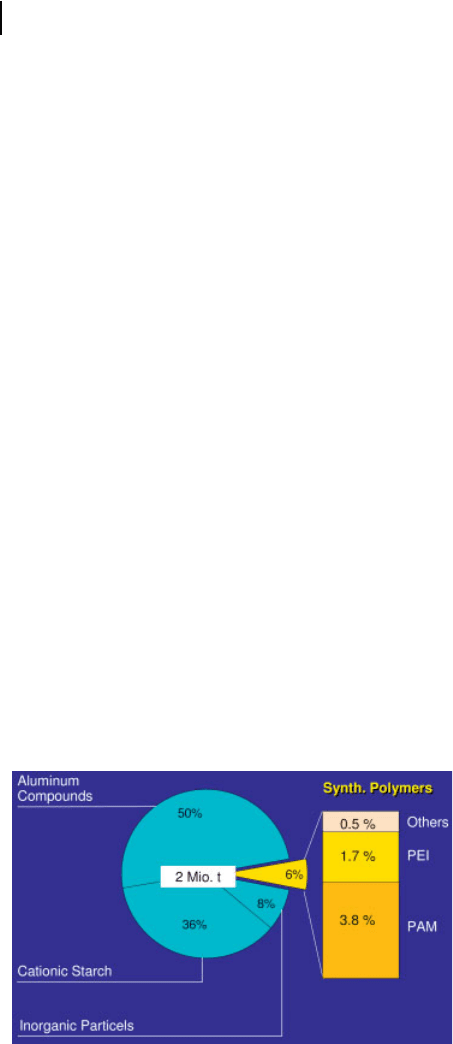
mers, high-molar-mass polyelectrolytes (Fig. 3.16). The most important members
of the last group are cationic, anionic or nonionic polyacrylamides and modified
polyethylenimines. There are also many smaller groups of products such as vari-
ous polyamines, poly-DADMAC and, most recently, polyvinylamines. The above
mentioned microparticle systems need, as a further compound, inorganic particles
like bentonite or silica gel. The worldwide consumption of RDAs is 2 V 10
6
tons
p.a., expressed as solids. It may come as a surprise that the aluminum compounds
occupy such a dominant position. However, it must be borne in mind that rosin
Fig. 3.16 Chemical classes of retention aids and their world
consumption in 2004 (mass shares of solid substances).
PEI = polyethylenimine, PAM = polyacrylamide.
3 Chemical Additives
128
sizing, where alum is needed, still plays a very important role, leading to the
market share for aluminium compounds being about 50%. Cationic starch has a
market share of 36% or 720 000 tonnes p.a. Again, it must be remembered that
cationic starch is also used to increase the dry strength of paper as well as to boost
retention. The market share for synthetic polymers is 6% or 120 000 tonnes p.a.
This figure seems very low, but the high efficiency of these polymers means that
they only need to be applied at rates as low as 100–500 g solids per tonne of paper.
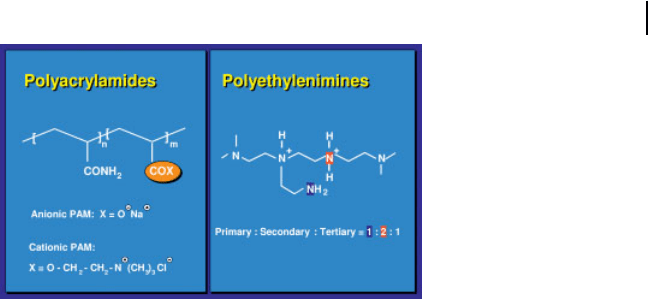
From the point of view of their chemistry, all retention aids are polymers, even
aluminum sulfate and PAC are present in the form of polynuclear complexes, the
structure of which depends on the pH. Polyacrylamide and polyethylenimine illus-
trate the common underlying chemical principle of all these products: a polar
structure with hydrogen bonds and ionic bonds and a high molar mass (Fig.
3.17).
3.7.1.2 Drainage Aids
These are chemical additives that improve the dewatering of the paper web along
the process, in forming, pressing and drying. The potential benefits include in-
creased machine speed and higher production rate, improved formation, and
lower dryer steam consumption. Improved drainage can lead to decreased headbox
consistency. This, in turn, decreases fiber flocculation. In general, most of the
agents that serve as retention aids and charge neutralizers can also be used as
drainage aids, but their charge density (meq g
–1
) and their molar mass (g mol
–1
) in
interaction with the other wet-end conditions influence their drainage efficiency
significantly. Therefore drainage aids are mainly based on the same chemistry as
retention aids and are expressed in the common term RDA. The specific benefits
that can be obtained can be illustrated with reference to a modified polyethyleni-
mine with a charge density of 6.5 meq g
–1
and a molar mass of 2 V 10
6
gmol
–1
.
Besides the improvement of fiber, fines and filler retention on the wire, the drain-
age acceleration on the wire and especially the water release in the press and dryer
Fig. 3.17 Chemical structure of retention aids.
3.7 Process Chemicals
129
section lead to an increase of 3 to 10% in productivity and a similar saving of
specific energy.
RDAs also act in synergy with other chemical additives such as deaerators,
which boosts the overall performance of other wet-end chemicals and reduces
their consumption. With improved retention as well as with the fixation of colloi-
dal dissolved substances much cleaner white-water is obtained with a COD reduc-
tion and over all less deposits are achieved. Consequently a higher degree of proc-
ess water closure, less volume of waste water and an improved PM runnability can
be obtained. The waste water is also more easily treated.
3.7.2
Fixing Agents
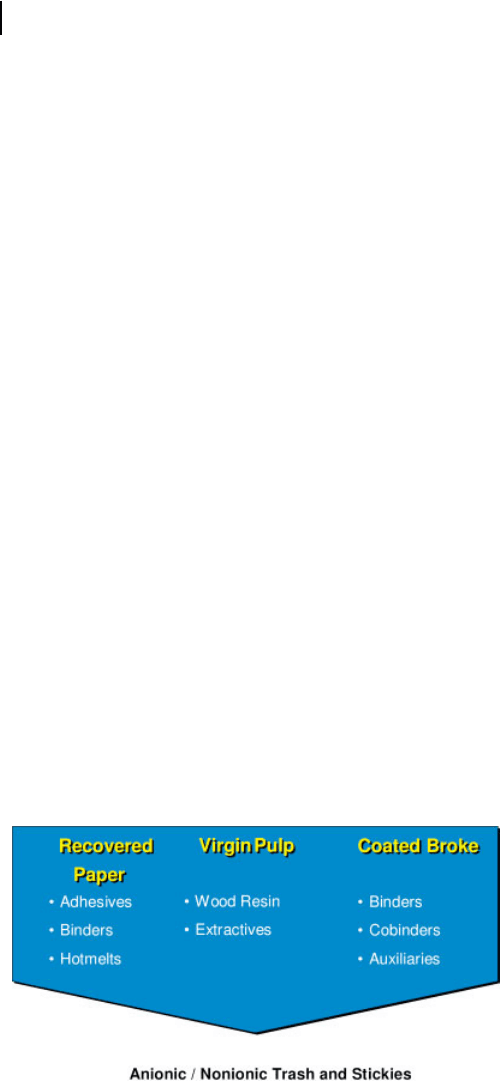
In the production and processing of chemical, semichemical and mechanical
pulps and recovered paper, various inorganic and organic substances are accumu-
lated in dissolved or colloidal dissolved form. Other water-soluble substances enter
with the fresh water, fillers, recycled uncoated and coated paper broke and also by
chemical additives. As the process water circuits are increasingly closed, the con-
centration of these water-soluble and colloidal substances and finely dispersed
particles increases considerably and an additional contaminant load is thus im-
posed on the waste water. These substances interfere with the production process
by increasing build-ups and deposits, they reduce the efficiency of the chemical
additives, and impair the quality of the produced paper. Therefore these sub-
stances are also classed as detrimental substances (Fig. 3.18).
The use of highly cationic polymers is a common possibility to remove the load
of dissolved anionic substances by complex formation, fixation to the fibers and
subsequent discharge with the freshly produced paper. Besides the dissolved an-
ionic substances there is a variety of nondissolved, hydrophobic substances (parti-
cles) mainly coming from the raw materials, e.g. wood extractives, coating ad-
ditives, adhesives. By fixation of the particles to the fibers they can be removed
from the system before they build uncontrolled reactions with the paper stock and
Fig. 3.18 Sources of detrimental substances.
3 Chemical Additives
130

chemical additives or before they have a chance to form sticky agglomerates. The
most commonly used fixing agents in the paper making process can be divided
into six categories (Table 3.8). Apart from their chemical nature and molecular
structure, these polymers mainly differ through their charge density and molec-
ular weight. In general it can be stated that polymers with a combination of high
cationic charge density and high molecular weight perform best in terms of elim-
inating dissolved anionic material from a contaminated system. However, the den-
sity of accessible anionic charge, located on the surface of white pitch particles, is
usually much lower than the accessible anionic charge density of dissolved sub-
stances. Therefore a fixing reacting exclusively by a charge mechanism, is often
not efficient in controlling the bonding strength between white pitch particles and
fibers and minimizing the formation of white pitch agglomerates. Besides the
charge density, there is another molecular parameter which can be used to control
the bonding strength between fibers and particles. The modification of cationic
polymers with nonpolar hydrophobic groups is likely to influence the interaction
of the polymer with the hydrophobic particles. The modification of a partly hydro-
lysed PVAm (DH=30 %) and a PEI with hydrophobic functional groups is depicted
schematically in Fig. 3.19. In many cases, the use of a fixing agent in a mill has to
be seen in combination with other chemical additives e.g. retention aid, sizing
agent, dry strength resin, where their effectiveness will be significantly improved
by the fixative.
The most popular tests for quantifying the general contamination of a paper
machine system are COD (chemical oxygen demand), cationic demand and con-
ductivity. For specific insights regarding pitch contaminants there are other useful
tests. Turbidity of stock filtrate can serve to quantify the presence of colloidal dis-
solved material. Soxhlet extraction with dichloromethane (DCM) is commonly
used for quantitative pitch analysis of deposit and paper samples. The hemacyt-
ometer is frequently used to measure dispersed pitch. An optical laser counter can
Table 3.8 Fixing agents: categories, molecular weight and
charge density (source: BASF).
Molecular weight
[10
6
g mole
–1
]
Polymer Charge density
[meq g
–1
]
0.2–0.3 polyallyldimethylmethacrylate (polyDADMAC) ~ 6
< 0.05 dicyandiamide-formaldehyde-resins 1–2
3–5 cationic polyacrylamide (PAM) 1–5
0.05–0.2 polyamine (PAm) 6
0.8 modified polyethylenimine (PEI) 11
a
0.1–5 polyvinylamine (PVAm) 0–15
a
a
Charge density per g of cationic polymer without counter ion
measured at ph 7.0.
3.7 Process Chemicals 131