
Holik H. (ed.) Handbook of Paper and Board
Подождите немного. Документ загружается.


3.6.6.1 Melamine-Formaldehyde Resins
In most instances, melamine is made from a basic product such as cyanamide.
The melamine molecule is then condensed with formaldehyde to form a series of
methylol melamines, e.g. monomethylol melamine and hexamethylol melamine.
On introduction to a papermaking system, the melamine formaldehyde product
can crosslink with itself forming an ether link or a methylene link, as well as
crosslinking with a cellulose carboxyl group to form the covalent bond, both of
which contribute to wet strength. The advantages of the melamine-formaldehyde
resins are that they lead, with similar addition rates to UF-resins, to wet tensile
strength levels up to 50% and to even higher wet bursting strength. MF-resins also
provide a very high alkaline resistance, therefore such products are mainly used for
label papers and banknote base papers.
3.6.6.2 Urea-Formaldehyde Resins
The formation of aqueous solutions of urea-formaldehyde condensation products
involves the stepwise reaction of urea with formaldehyde, and the first step is
undertaken at pH 7–8 to form dimethylol urea. Further reaction to a controlled
degree with formaldehyde forms a condensation product in aqueous solution,
which can be stored and transported. Urea-formaldehyde and melamine-formal-
dehyde resins are delivered in aqueous solutions with solid contents of 12% (MF)
and 40% (UF) as well as in powder form (MF). They are mainly applied at the wet
end, but they can be also used via surface application in the paper machine. Suita-
ble feeding positions for the continuous wet-end addition are between the stock
consistency controller and the mixing pump, shortly before final stock dilution,
where an optimum of mixing is guaranteed. The UF-resins are the least expensive
ones. An important area of application is in the manufacture of sack paper for
shipping and cement packaging. With addition rates of 0.5 to 3%, calculated on
dry paper stock, a wet-strength level of up to 40% of the dry-strength figure can be
achieved.
3.6.6.3 Epoxidised Polyamide Resins
The chemistry of the production of polyamide resin is very similar to the original
process by which nylon was produced. In the Nylon 66 process a dicarboxylic acid,
such as adipic acid is reacted with a six carbon amine, for example hexamethylene-
diamine, to produce a synthetic fiber. In the case of polyamide resin, a dicarboxylic
acid is reacted or condensed with an amine such as diethylenetriamine to form an
amino polyamide. The secondary amine groups of this water soluble polymer are
then reacted with epichlorohydrin to form the aminopolyamide epichlorohydrin
intermediate. This is then crosslinked to build molecular weight whilst maintain-
ing solubility. The polymerization reaction is terminated by dilution and acidifi-
cation.
The amount of polyamide-epichlorohydrin resin required in hygienic paper pro-
duction is between 0.1 and 4% dry substance, calculated on the paper. These
3 Chemical Additives92

resins are supplied in the form of aqueous solutions with a solids content of 12 to
25%. They are effective in the pH range 5 to 8, although the best wet-strengthen-
ing effect is obtained in the neutral or slightly alkaline range; they are therefore
often called neutral wet-strength resins. In the majority of cases, PAE-resins are
added to the stock, preferably just before the last stock pump in front of the head-
box. This ensures that the fiber/resin bond is not impaired by high shear forces.
Depending on the amount added, the relative wet strength can be increased to over
35% without significantly reducing the absorbency of the paper. Wet-strength res-
ins in general also increase the dry strength of paper (i.e. tear and burst). They also
have favorable effects on the dry and wet abrasion resistance of paper. Additionally
the retention of fillers and fines is increased. A special effect of PAE-resins, even
with small quantities, is to form a coating on the crepe cylinder of a hygiene paper
machine to control the adhesion of the paper web on the cylinder.
The disadvantages are that the degree of whiteness is less stable than with UF
and MF resins, and the AOX problematic. Much effort was put into developing
“low-AOX” and recently also “AOX-free” polyamide-epichlorohydrin resins with
no detectable amount of byproducts. At the same time, chlorine-free wet-strength
agents have also been developed, e.g. modified glyoxals and polvinylamines, but
often with higher costs. In the longer term, workplace safety aspects could lead to
the application of these new products becoming successfully established in the
market.
3.6.6.4 Glyoxalated Polyacrylamide Resins
These products are prepared by crosslinking a low molecular weight polyacryla-
mide (PAM) with glyoxal. The PAM is normally a copolymer of acrylamide and a
quaternary ammonium cationic monomer which is prepared in aqueous solution.
This results in a cationic polymer which is attached to pulp fibers. The cationic
backbone is then crosslinked with sufficient glyoxal to react with most, but not all,
of the PAM backbone amide groups. On storage, the resin continues to crosslink
and can ultimately gel. In order to achieve the desired stability, paper mills dilute
the resin on receipt. At 25 °C, a 10% solution will gel in about 8 days, whereas a
6% solution will take about 65 days to gel at room temperature.
There is strong evidence that glyoxalated PAM imparts wet strength primarily
through covalent bond formation between the resin and the fibers. It can be taken
for granted that there is some intermolecular crosslinking within the resin but, in
order to function, there needs to be at least some fiber-resin-fiber bonds within the
fiber-fiber bonded area. The reaction of glyoxalated PAM with cellulose is rapid at
neutral pH 6–8 and even more rapid at acidic pH 4–6, resulting in 80–100% of the
potential wet strength. Ageing or curing of the paper gives little or no additional
wet strength. The reaction is reversible in the presence of water and a resin-treated
paper gradually loses wet strength on prolonged soaking. This temporary wet
strength can be sufficient for some paper grades, e.g. paper towels, and also dur-
ing the paper manufacturing process when the the sheet is passing through a size
press or coater. Glyoxalated PAM resins also contribute significantly to the dry
strength of treated paper.
3.6 Functional Chemicals 93

3.6.6.5 Other Wet-Strength Resins
• Polyethylenimine (PEI) was the first effective WSR used under neutral/alkaline
pH conditions in papermaking without influencing the absorbency of the paper.
The PEI manufacturing process is described in Section 3.7.1.1. The effective
mechanism of PEI formation is somewhat different from the resins. PEI devel-
ops wet strength without curing the paper and the level of wet strength that can
be attained is less than with the thermosetting resins. It has been proposed, that
PEI functions by creating stronger interatomic bonding, rather than by forming
homo- or co-crosslinked networks. The amine cationic groups responsible for
wet strength have dissociation constants of around 12 and the retention and
performance of PEI is best at pH 7–9. The reasons why PEI has not been used
more extensively as a wet-strength resin are higher costs than with thermoset-
ting resins and because it causes yellowing and loss of brightness in white print-
ing and writing papers.
• Polyvinylamines are a relatively new group of wet-strength resins. These products
are environmentally friendly, their use does not result in any negative ecological
impact (see also Section 3.6.5 on Dry Strength Resins). Their cost-performance
ratio is at present less favorable than the conventional WSR in most cases.
• Polyisocyanate is another new type of WSR, up to now with very little practical
use.
• Dialdehyde Starch (DAS) also has the potential for crosslinking cellulosic hydroxy
groups in paper to give temporary wet strength. DAS is essentially a highly
modified starch in which the vicinal hydroxy groups (at the C-2 and C-3 carbons)
are selectively attacked by periodic acid, severing the C-2 to C-3 bond to form
dialdehyde starch. The aldehyde groups are not present to any extent as free
aldehydes, but rather as hemiacetals or as hemialdals. Since the linkages in
these compounds are weak, dialdehyde starch reacts as if the aldehydes were
free, permitting its use as a reactive polyaldehyde capable of reaction through
hydroxy amino or imino groups.
3.6.7
Additives for Recovered Fiber Processing [5, 12]
For economic and environmental reasons the use of recovered paper as raw mate-
rial has already reached a high level and will grow further. For its preparation
specific chemicals are required, depending on the quality of the recovered papers
and the necessary properties of the produced paper grades.
3.6.7.1 Additives for Repulping
These chemicals are intended to facilitate the repulping of recovered papers, espe-
cially for mixed and brown grades e.g. packaging material, corrugated boxes. To
get an easier and faster defibration the addition of nonfoaming wetting agents
(e.g. nonionic surfactants) and dispersants is used. Wetting agents reduce the
surface tension. These products are predominantly surface active, such as sulfo-
3 Chemical Additives94

nated oils, alkyl sulfates, alkyl sulfonates, alkyl aryl sulfonates, or ethoxylated prod-
ucts based on nonylphenol. Dispersants used for repulping are mainly condensa-
tion products of formaldehyde and a naphthalene sulfonic acid as the sodium salt,
or the sodium salt of a polycarboxylic acid. These products have high dispersing
capacity for pitch, waxes, bitumen, etc. which otherwise would adversely affect the
whole repulping and papermaking process as well as the paper quality. The appli-
cation of such products preferably takes place in the pulper in undiluted form with
amounts of 0.1 to 0.5%, calculated on oven dry paper stock.
Repulping of wet-strength paper always requires more energy than repulping
normal unsized or sized paper. Depending on the type of wet-strength resin used,
different methods and chemicals are employed. When UF (urea formaldehyde)
resins or MF (melamine formaldehyde) resins have been used, repulping was
effected in an acid medium with sulfuric acid and/or alum at elevated temperature
above 60 °C in the pulper for 15–30 min. If the wet strength of the recovered paper
is based on polyamine-type chemicals, defibering of this paper also requires high-
energy pulping at an alkaline pH value >10 by addition of sodium hydroxide. Other
useful additives are hypohalous acid and persulfate salts.
3.6.7.2 Additives for Deinking
Newspapers, weekly and monthly magazines, brochures and office papers are used
as raw material to produce graphic papers, tissue or the top ply of white board. In
the “deinking process” first the printing ink has to be detached from the paper
surface then the released ink has to be removed from the pulp slurry, either by
flotation or by washing or by a combination of the two. Whereas in Europe flota-
tion is most commonly used and washing is only used for special deinked pulp
(DIP) qualities, in North America washing is more common.
The removal of ink from recovered paper is determined by the type of ink binder
and the chemicals used during pulping. For wood containing recovered paper
grades the most important chemical is sodium hydroxide (NaOH) with addition
rates of 0.5–2% (calculated on oven dry paper stock) to adjust the pH to 10–11.
NaOH eases the detachment of the ink particles from the fibers as saponifiable
binders in the ink are saponified by NaOH and the fibers swell substantially in this
environment. However, sodium hydroxide solution also causes yellowing of the
fibers, particularly of mechanical pulp. In order to prevent this, hydrogen peroxide
(H
2
O
2
) is used as a bleaching chemical, which also has a saponifying effect. In
addition, 1–5% water glass (sodium silicate) is added to stabilize the hydrogen per-
oxide and to prevent the ink particles from redepositing on the fiber.
Additionally 0.1–0.2% of a nonfoaming wetting agent (e.g. nonionic alkyphenol
polyethylene glycol ether) can support the removal of the ink particles from the
printed recovered paper. Since hydrogen peroxide is more effective at higher con-
centrations, the pulping process is carried out at stock consistencies of 12–20%
(high consistency pulper or drum pulper). Soaps and fatty acids are used in addition
rates of 0.5–1.2% as dirt collectors and flotation agents. They form calcium soaps
with hard water or with the calcium carbonate from the coating or filler of the
3.6 Functional Chemicals 95

recovered paper. Calcium chloride must be added if the water is not sufficiently
hard. For higher quality papers, further bleaching with sodium dithionite and/or
hydrogen peroxide may follow. Coated papers can be deinked more easily because
the inks are fixed only on top of the coating layer.
For woodfree recovered paper grades the dosage of deinking chemicals (NaOH,
soap, fatty acid, nonfoaming wetting agent) can usually be reduced substantially.
Because deinked pulp (DIP) is very often used in paper grades of high brightness,
bleaching with hydrogen peroxide, sodium dithionite and/or formamidine sulfinic
acid (FAS) is more important and bleaching is often performed in two or more
stages.
The effluent/white water quality has to be controlled very exactly. COD increases
with increasing pH. For flotation deinking of recovered paper the total chemical
costs have a relatively high proportion of 15–20% of the overall DIP production
costs. Yield rates up to 93% for newsprint production are attainable.
In wash deinking after saponification the ink particles together with pigments
and fillers of the recovered paper are removed by washing the pulp slurry through
wire supported by the addition of 0.1–0.5% of a dispersing agent. Here large
effluent streams are produced and solid losses are high, with yield rates of only 60
to 70% being not unusual. So flotation deinking, or a combined flotation-washing
process, is also gaining a foothold in North America.
3.6.8
Additives for Specialty Papers [13, 14]
Specific functional chemicals are indispensable in the production of specialty pa-
per grades. Such grades are expected to display a very heterogeneous range of
properties. Specialty paper grades account for only ca. 4% of worldwide paper
production, but the proportion of chemicals applied for their production is mostly
significantly higher than for conventional papers. A number of specialty papers
with their required properties and applied additives are described below .
3.6.8.1 Photographic Base Paper
Paper for photographs must carry a uniform emulsion coating, it must resist the
development solution in the development bath, it must be perfectly clean for a
clean image, and it cannot contain any inhibitors to the photochemical process like
iron, copper, or sulfur. It must even be free of radioactive traces, which cause
photographic reactions and spots in the image. The paper, which must have a
stable white color, is made of clean bleached pulp. The necessary high dry and wet
opacity will be obtained with titanium dioxide (TiO
2
), chalk and low molecular
weight polymers (e.g. polyacrylamides). In order to obtain resistance against the
reagents and rinsing water, including edge and dimensional stability, the base
paper needs a strong stock-sizing with behenyl diketene and high wet-strength
with polyamine-polyamide-epichlorohydrin resin. Additional the paper web is dip
sized with gelatin, polyvinyl alcohol (PVA), polyacryl amide (PAM), and modified
3 Chemical Additives96

starch before calendering. Most photographic papers for color prints are extrusion
coated with an opaque plastic film (e.g. polyethylene) to improve the imperme-
ability.
3.6.8.2 Banknote Papers
These papers have to avoid forgery, must be durable and resistant to wetting,
folding and aging. Therefore they are produced under alkaline conditions with
high wet and dry strength. To achieve these properties, polyamide-epichlorohydrin
resins, polyacrylamides and/or aminoplast resins are used, together with strong
stock sizing with AKD (alkyl keten dimer) and surface sizing with proteins plus
crosslinking agent (glutaraldehyde). For security reasons these papers will be
marked by mingle colored fibers with the paper stock and/or by using uncolored
reactive dyes, which create a certain color when they react with an acid or an
alkali.
3.6.8.3 Laminate Papers: Décor Paper, Pre-impregnated Foils
Décor paper is made for white or colored décor, often imitating wood finishes. It
needs a high wet and dry opacity and very high lightfastness, which is obtained by
using titanium dioxide (TiO
2
) plus low molar mass polymers (polyamine-poly-
amide-epichlorohydrin resins, polyacrylamides). Also high wet strength without
loss of absorbency is demanded and achieved by relatively high addition rates of
polyamine-polyamide-epichlorohydrin resins. Colored décor papers with very high
fastnesses are produced with inorganic and organic colored pigments.
Pre-impregnated foils are used where the surface requirements for resistance
and closedness do not require more expensive high-density laminates. The im-
pregnation will be made on the paper machine, using a modified size press. Typ-
ical resins for this application are UF (urea formaldehyde) or MF (melamine for-
maldehyde) resins with a very low content of free formaldehyde. To achieve good
flexibility and printability of these foils, additional polymer dispersions (e.g. sty-
rene acrylates) are used.
3.6.8.4 Filter Papers
There is a wide range of filter papers for various purposes. The use of porous paper
for filtering and separation ranges from the use of filter cartridges for engine
protection to dust pouches for vacuum cleaners and air conditioning, and from tea
bags and coffee filters to reagent carriers and filter disks for laboratory use. Their
common denominator is the requirement for a controlled, high porosity. Depend-
ing on the intended use, additional required characteristics are the resistance to
different media and/or temperatures, stiffness, and cleanliness. Specific character-
istics of filter papers are their resistance to flow, their filtration efficiency, and their
dust-holding capacity.
3.6 Functional Chemicals 97

The controlled porosity together with very high wet and dry strength is obtained
by using polyamine-polyamide-epichlorohydrin resins together with a low molar
mass polyacrylamide or polyethyleneimine, polyisocyanate, or polyvinylamine.
3.6.8.5 Imitation Parchment (Food Packaging)
Some of these papers have to be water-resistant and pore free, which is why micro-
crystalline wax, cationic styrene-acrylic emulsions, alkenyl succinic aldehyde
(ASA) plus cationic starch, and styrene-maleic-anhydride (SMA) are used. To
achieve resistance to oil and fat mainly perfluorinated alkyl acids, carboximethyl-
cellulose (CMC), alginates and stearyl-melamines are applied.
3.6.8.6 Aquarelle Board
These boards must be resistant to fading, neutral, and stable. The finish varies
from a coarse surface for painting to a very smooth surface for graphic work. High
opacity and uniform surface structure will be achieved by using chalk (calcium
carbonate) together with a low-molar-mass polymer e.g. modified polyethylenei-
mine, polyamine, polyvinylamine. Cationic styrene-acrylic emulsions plus carboxy
methyl cellulose (CMC), starch and/or low molar mass polyacrylamides or poly-
vinyl formamides lead to controlled uptake of water and oil as well as high stiffness
and rattle. For rub out resistance, surface sizing with starch and styrene-acrylic
emulsion is applied.
3.6.8.7 Carbonless Copying Paper
The dominating principle for carbonless copy is that an emulsion of a specific oil
e.g. diisopropylnaphthalene (DIPN) together with color formers (reactive dyes) is
encapsulated in microcapsules (e.g. gelatine, aminoplast resins) applied as a coat-
ing on the backside of the copying paper (CB-coated back). Through the pressure
of writing, the microcapsules are broken, and the color former solution flows to
wet the front side coating of a receiving sheet (CF-coated front). The front side
coating reacts with the color former, forming an image. The pressure sensitive
coloring side (CB) has to be resistant to abrasion. Microcapsules from gelatine or
polyurea or melamine-formaldehyde condensation products contain solvent e.g.
diisopropylnaphthaline (DIPN), or isopropyl-butylbiphenyl, or phenylmethane-
ethane plus reactive dyes (color former). Polymer dispersions of styrene-butadiene
are used as binder for the surface application of the microcapsules. The coating
formulation of the reactive receiving side (CF) consists of activated bentonite or
phenolic resin or zinc salicylate plus styrene-butadiene binder.
3.6.8.8 Ink-jet Papers
Ink-jet is a noncontact printing method, since no part of the printing device other
than ink contacts the paper at the moment of ink transfer. A sharp, detailed
3 Chemical Additives98

printed image (no wicking and bleeding), high color density and no strike-through
will be obtained by a hydrophilic paper surface using a coating color with silica gel,
polyvinylalcohol (PVA) and/or carboxy methyl cellulose (CMC) plus low-molar-
mass cationic polymer e.g. modified polyethyleneimine, polyvinylamine, conden-
sation product of organic amides with formaldehyde, polyacrylamide. The base
paper should be hard-sized with alkyl ketene dimer (AKD), or alkenyl succinic
aldehyde (ASA), or rosin size.
3.6.8.9 Fire-resistant Papers
Papers with fire-resistant properties are used for wallpaper, decoration paper, Chi-
nese/Japanese lamps and partition walls. Flame retardants are added either at the
wet end or by surface treatment in the paper production process. They either
release incombustible gases on heating, which prevent the entry of atmospheric
oxygen, or when heated produce a nonflammable melt that surrounds the paper.
Chemicals for this purpose include calcium chloride, magnesium chloride, dia-
mmonium ethyl phosphate, and mixtures of zinc borates, antimony oxides, and
organic haloid salts as well as inorganic bromides and oxybromides.
3.6.8.10 Anticorrosion Papers
These papers prevent the rusting of iron parts and the tarnishing of silver, alumi-
num, and copper. Generally they have to be produced in alkaline wet-end condi-
tions in the absence of any acid and alum. Additionally the paper has to be impreg-
nated or coated with chemicals that inhibit corrosion, e.g., sodium nitrite or so-
dium benzoate. The paper is coated by deposition of the chemicals from the vapor
phase.
3.6.8.11 Abrasive Base Papers
Abrasive papers which are coated with an abrasive grit in a binder are used for
belts in heavy grinding machines, as sheets for grinding by hand, in vibrating
hand-held grinding machines, or disks in rotary machines. There are specific
grades for wet grinding and for dry finishing by hand. The base paper must be
strong enough to resist the forces in use, give a good anchoring of the grit, and suit
the coating operation. High amounts of anionic and cationic starches, often to-
gether with carboxy methyl cellulose are used to obtain high strength properties.
Additional polymer dispersions based on styrene acrylates or styrene butadiene are
applied at the wet end of the paper machine and/or by on-machine or off-machine
impregnation. With wet-end addition of these polymers effective fixation and re-
tention in the paper stock with alum and/or cationic polymers e.g. polyethyleni-
mines, polyamines, polyvinylamines are necessary.
3.6 Functional Chemicals 99

3.6.8.12 Papers with Barrier Properties
Paper or board have almost no barrier properties against penetrants like moisture,
water vapor, oxygen and other gases, aroma, grease and fat. To provide protection
against outside influences as well as protection against loss of features from in-
side, a specific barrier coating is required. To make paper and board suitable as a
barrier packaging material, the barrier layer has to be applied either by wax im-
pregnation, lamination with films e.g. PE (polyethylene) or aluminum foil or the
extrusion of molten polymers, The most favorable and economic method is the on-
or off-machine coating of paper and board with an aqueous system, e.g. an aque-
ous polymer dispersion. According to the laws of Henry and Fick, polymers are
needed whose chemical nature is quite the opposite of the penetrant. So the most
hydrophobic polymers suit as a barrier against hydrophilic penetrants like mois-
ture vapor whereas the most hydrophilic polymers protect against hydrophobic
penetrants like oxygen or some solvents. Suitable polymer dispersions are based
on vinylidene chloride, acrylic esters, styrene-butadiene, polyurethane, polyethyl-
ene-acrylic acid, or acrylic acid-acrylonitrile. A minimum of water vapor and oxy-
gen transmission can be reached with polyvinylidene chloride. Acrylics offer an
excellent barrier against aromas like terpenes and hydrocarbons as well as fat and
a moderate oxygen barrier combined with good water resistance. As a barrier poly-
mer, styrene-butadiene (S/B) offers moderate moisture and vapor protection as
well as good water repellence. The aroma barrier to fruity esters is quite good. The
S/B coatings are readily sealable with high sealing strength, correlating with the
sealing temperature.
New in the market are hydrophobically modified styrene-butadiene dispersions
which show an outstanding moisture vapor barrier, very similar to the moisture
vapor barrier of a polyethylene film. The water resistance and the aroma barrier to
esters are also very good · The sealability of the modified S/B coat is better than the
unmodified one. Polyurethane (PUR) coatings have very high permeation resis-
tance to moisture and vapor. For aroma, they offer a moderate or even good barrier
against fruity esters and terpenes and an excellent barrier against hydrocarbons.
The fat and oil resistance is good. PUR has extraordinary sealing properties and
thermoactivability, which means, after thermal activation, the coating is cold seal-
able for about half a minute and afterwards no agglutination will occur. Polyethyl-
ene-acrylic acid is also a coating with excellent sealing properties and, in contrast
to PUR, offers a very good moisture and vapor barrier and an excellent aroma
barrier against fruity esters. The surface is highly water repellent. The aqueous
polymer solution based on polycarboxylic acid derivative is an excellent oxygen
barrier; it exceeds polvinyl dichloride (PVdC), but the coating is sensitive to water
and moisture. The aroma barrier is also very good as long as the coating is dry.
Very high grease and oil resistance together with water and alcohol repellency
are obtained by fluorinated acrylic copolymers which are completely miscible in
water. These products can be applied either by surface or by internal application.
3 Chemical Additives100
3.6.9
Additives for Paper and Board Coating [1–3, 15–21]
3.6.9.1 General Aspects
The paper coating process was first developed in the USA late in the 19th century,
but did not find broader application until the middle of the 20th century. Since that
time the European paper industry has become a leader in coating technology.
Coated papers suit the highest requirements as regards printability. In paper and
board coating an aqueous suspension, called coating color, is applied to one side of
the sheet (mainly in the case of board) or to both sides (mainly for printing papers).
After application of the required amount, the coating is dried and finished. In
finishing, the coated paper and board achieve their smoothness and gloss poten-
tial. Coating is done either in the paper machine (on-machine coating) or in a
separate step after the base paper production (off-machine coating). It is desirable
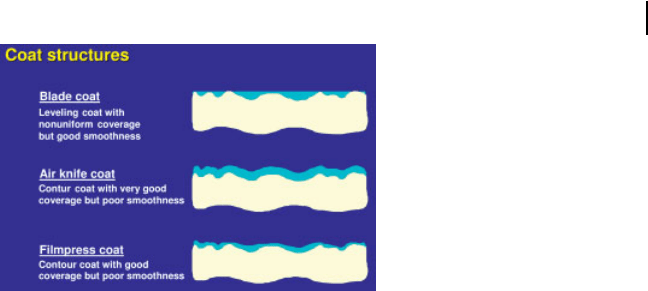
that, besides filling the cavities, the coating also covers the highest lying fibers on
the base paper surface (Fig. 3.11). There are methods that tend to favor filling of
the cavities while higher spots remain covered by only thin or practically no coat-
ing (equalizing or leveling coat, e.g. with blade equipment). Some other methods
give a coating of more or less uniform thickness, thus also covering the highest
spots on the base paper surface, yet the cavities remain only partially filled (con-
tour coat, e.g. roll applicators).
Coating colors consist of several components, white pigments (e.g. clay, calcium
carbonate, talc, titanium dioxide) and so-called binders (e.g. starch, latexes) being
the most important as regards volume and cost. Further specific additives influ-
ence and control the applicable solid content, the rheology, water retention and
immobilization of the coating color during the coating process (e.g. dispersant, co-
binders, thickeners), and others influence the physical and optical surface struc-
ture and properties of the coating layer (e.g. associative thickeners, lubricants,
hardening agents, fluorescent whitening agents, defoamers, degassing agents).
These components are described in more detail in Section 3.6.9.3.
Fig. 3.11 Coat structures of different coating systems.
3.6 Functional Chemicals
101