
Holik H. (ed.) Handbook of Paper and Board
Подождите немного. Документ загружается.


Water is an essential component of a coating color making it possible to mix the
components of a coating color, e. g., so that all the pigment particles are separated
from each other, which is impossible in the dry state. Water also makes it possible
to transport the color elsewhere and apply it onto the base paper so that the coating
color remains uniformly dispersed. As water evaporates from the coating layer, the
coating layer consolidates when the binder forms bridges between pigment parti-
cles and base paper. Coating colors should contain only as much water as the flow
properties need, in order to save energy and costs for drying. The solid contents of
the coating colors can be as high as about 70 wt.%.
The composition of coating colors resembles that of paints, containing similar
components. Of course, there are differences in detail: the additives may be totally
different, there are different kinds of binders, and paper coatings are white while
most paints are colored so the pigments are different, etc. One major difference
between paints and coating colors is the amount of binder: paints contain much
more binder than do coating colors. This is partly due to their different objectives:
The purpose of painting is to improve the looks of the surface to be painted, and
also to create a protective layer. This latter function demands that the paint layer
should be nonporous in most cases. This is achieved by using sufficient binder to
completely fill the spaces between the pigment particles.
As for the coating colors, other than to improve the looks of the paper, the
purpose of their application is to achieve the desired properties on the paper sur-
face, the most important being the printing properties. The coating layer should be
strong enough to resist the stresses of the printing process; the surface strength of
the coating dictates the allowable minimum amount of binder. For example, offset
printing inks are tacky, which requires a certain z-strength, or pick-strength, of the
coating. On the other hand, increasing the amount of binder has a negative effect
on several coating properties, and excess binder may cause quality concerns, e.g.,
low opacity and gloss, or glueability problems. Therefore adding more binder to
the coating than the surface strength requires should be avoided; there is also a
cost consideration. However, the coating process and base paper absorbency can
make high binder levels necessary.
3.6.9.2 Market Situation and Future Trends
The worldwide consumption of paper and board will grow by approximately 2 to
2.5% for the next two decades at least. The development and fast worldwide expan-
sion of electronic media has led to a certain shift in paper qualities and challenged
the development of new paper and board qualities. In particular, pigment coated
grades have participated most in this new competition in the area of communica-
tion and packaging. Because of their significantly better printability, their more
aesthetic attractiveness and their more valuable feel, the growth rate of coated
paper and board will be twice as high as that of paper and board in general (Table
3.1).
Printed paper is a cost efficient medium with a high capacity for information,
universally easily available and fully recyclable. Paper and board based packaging
3 Chemical Additives102
material is also cost efficient, aesthetically attractive and environmentally friendly.
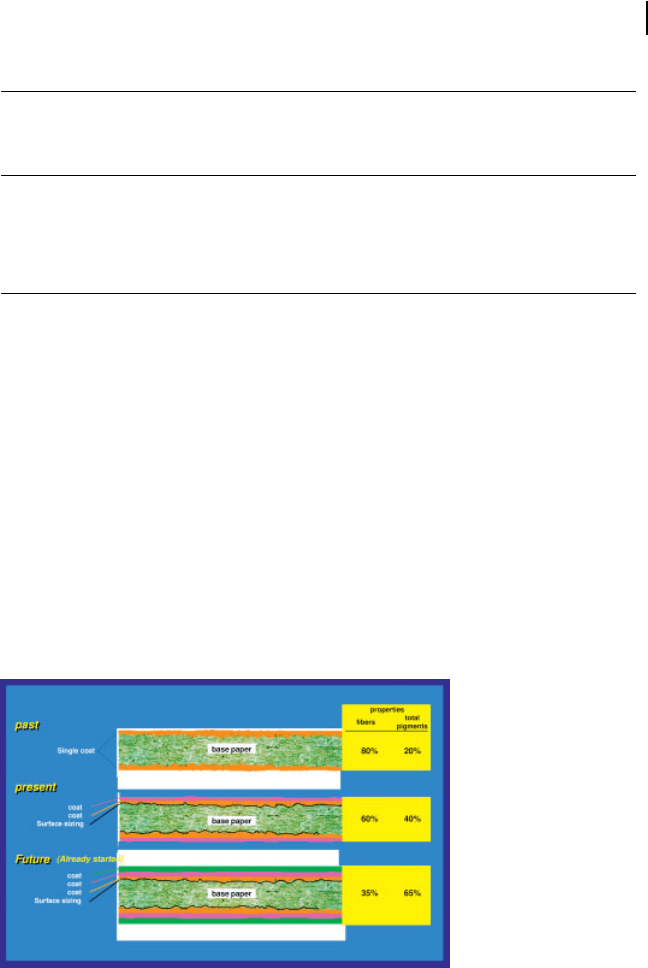
Most pigments are significantly cheaper than chemical pulps so increasing both
the proportion of coated paper in general and the coating layer(s) compared to
fibers (Fig. 3.12) is an important economic factor. In 2004 coated paper and board
accounted for 17% of the total worldwide paper production of 350 V 10
6
t and will
grow by 2014 to 21% of the then 430 V 10
6
t paper and board production. The
proportion of coated paper to board is ca. 80% to 20 % and the proportion of
coating layer compared to the total area weight for paper is significantly higher
(30–65%) than for board (5–20 %). The future trends for coated papers will involve
more specific paper products, further development of coating technology, ongoing
progress in printing technology, environmental issues, development of coating
color raw materials and the globalisation of paper companies.
Table 3.1 Further predicted overproportional growth of coated
paper and board production worldwide.
Production
(10
6
t)
1994 2004 2014 Growth rate
1994–2004
p. a.
Growth rate
2004–2014
p. a.
Paper and Board,
World
280 350 430 2.3% 2.1%
Coated 42 60 90 3.6% 4.2%
Share of total 15% 17% 21%
Fig. 3.12 Predicted increasing proportion of fillers and
coatings vs. fibers/base paper.
3.6 Functional Chemicals
103

3.6.9.3 Components of Coating Colors
3.6.9.3.1 Pigments
With respect to mass the most important component is the pigment with a total
amount of almost 18 V 10
6
t per year dry material worldwide. There may be only
one kind of pigment in a coating color, or more commonly a combination of
several types e.g. clay, calcium carbonate, talc, titanium dioxide (more details see
2.2.2). The share of pigment in the dry coating is about 85–95 wt. %.
3.6.9.3.2 Dispersants
In the dry form, pigment particles form clusters, in which the parts of the clusters
are more or less tightly attached to each other. More tightly attached ones are called
“aggregates”. Aggregates and primary particles together can also form clusters that
are less tightly bound – so-called “agglomerates” or “flocs”. The purpose of dis-
persing is to make a dispersion where neither agglomerates nor aggregates exist
and only primary particles are present. Primary particles are evenly distributed in
water, and the system stays stable for a certain time.
Disruption of aggregates, disaggregation, is typically an irreversible process, af-
ter which particles cannot be bound as tightly as they used to be. Instead of form-
ing aggregates, disaggregated particles tend to form agglomerates. Disruption of
agglomerates is called “deflocculation”. Deflocculation is a reversible process. Ag-
glomerates re-form when the force for deflocculation is removed.
The process of dispersion can be divided into three stages: wetting, disruption of
particle clusters and stabilization. Wetting means that all the external surfaces of
pigment particles must come into contact with water. Air must also be displaced
from the internal surfaces between pigment particles in agglomerates and ag-
gregates. Wetting is usually not a problem with paper pigments except for talc
which is not spontaneously wet by water. When talc is dispersed, a separate surfac-
tant is required to provide proper wetting. Disruption of particle clusters, disaggrega-
tion, is accomplished by mechanical energy. Disruption can be performed using
crushing mills, kneading mixers, or high-speed mixers. Crushing mills are needed
when the shear forces induced by mixers are not sufficient for disaggregation.
Although dispersing can be performed in mixers, there is a certain difference
between mixing and dispersing. Mixing does not change the size and surface area
of particles, while dispersing changes both. Stable pigment dispersions with the
highest solid content can be achieved only by using dispersants. When pigment
clusters are broken down by dispersing, the surface area of pigment in the disper-
sion increases, there is more surface for particles to interact with each other, and
the viscosity in the dispersion increases rapidly. Use of dispersants stabilizes de-
flocculated particles in the dispersion and hinders their interaction. The dispersant
must be mixed with water at once, when the breakdown of pigment clusters starts.
Only then can interaction and therefore reagglomeration of particles be avoided.
For this reason, dispersant is added to water at the beginning of dispersing, even
before the pigment is added.
3 Chemical Additives104

Reagglomeration is avoided if particles are kept far enough from each other. Two
general principles are considered as stabilization mechanisms: electrostatic stabili-
zation and steric stabilization. When both occur simultaneously, it is called “elec-
trosteric stabilization”. In electrostatic stabilization, the charges of particle surfaces
are made to be the same sign. Dispersant is adsorbed onto the particle surface, and
thus the surface gets a highly localized charge with the same sign as that of the
dispersant. A negative charge on the surface, when anionic dispersant is used,
creates a cloud of positive counterions around the particle (the so-called “electric”
or “ionic” double layer). The closer to the surface, the more localized are the coun-
terions. At a greater distance from the particle, in a continuous water phase, neg-
ative and positive ions are in balance. The counterion cloud acts as a stabilizer,
creating repulsive forces between particles. Electrostatic stabilization is the most
commonly used stabilization method in paper pigment dispersions. To act as a
good stabilizer, the dispersant must be highly charged. Examples of these kinds of
dispersants are salts of polyacrylic acid and polyphosphates. In steric stabilization,
particle surfaces are covered with uncharged polymer, the chain of which extends
into the water. When two particles with polymers on them approach each other,
they cannot approach too closely because the polymer chains would overlap, and
this is not entropically favored. Thus polymers create a steric hindrance against
particle interaction. Dispersants, which work as steric stabilizers, are also called
“protective colloids”. Examples of these are starches and polyvinylalcohols. A good
example of a dispersant, which works as an electrosteric stabilizer, is carboxy
methyl cellulose (CMC).
The viscosity minimum is the optimum dosage of dispersant. After the opti-
mum the viscosity is slowly increased. Viscosity decreases when dispersant is
added, due to the increased stability of the dispersion. The stability is a maximum
at the viscosity minimum. The viscosity starts to increase after the optimum be-
cause additional dispersant can no longer be adsorbed onto the pigment surface,
and thus stays in the water increasing its electrolyte concentration and decreasing
the stability. Overdosing of dispersant therefore must be avoided. Pigment type,
dispersant type, pH, and additional components all affect the dispersant dosage
required. The smaller the particle size the larger the total surface area of pigment,
and the more dispersant is needed for stabilization. Generally it can be said that
the required dispersant dosage is in the range 0.1 to 0.5% of dry pigment.
Today, the most commonly used pigment dispersants are polyacrylate salts. Usu-
ally they are low molecular weight polymerization products of acrylic acid, which
have been neutralized with sodium or ammonium hydroxide. They are very resis-
tant towards different types of attack like high pH, high temperature, or high shear
forces. Polyphosphates were previously used as dispersants. They are effective, but
lack hydrolytic stability during storage of the dispersion; they easily hydrolyze to
orthophosphates, which have no deflocculation power. This causes an increase in
the viscosity of the dispersion. The longer the polyphosphate chain, the more
effective it is as a dispersant. Tetrasodium pyrophosphate, Na
4
P
2
O
7
, is the simplest
polyphosphate that can be used as a dispersant. Sodium tripolyphosphate,
Na
5
P
3
O
10
, is widely used as a dispersant and as a builder in detergents. Other
3.6 Functional Chemicals 105

anionic polymeric dispersants are lignin sulfonic acid salts and formaldehyde con-
densation products with aromatic sulfonic acids. Because of the nature of sulfonic
acid, these types of dispersants bear the maximum anionicity over the whole pH
range typically used in pigment dispersions. Lignin sulfonates are made from
native lignin. Their effectiveness as a dispersant depends on their purity and de-
gree of sulfonation. Lignin sulfonates can be used as a dispersant with hydro-
phobic surfaces. Their disadvantages are poor thermal stability, tendency to foam
and they bring a high load of detrimental substances to the papermaking process.
Formaldehyde condensation products with aromatic sulfonic acids have an aro-
matic backbone and are also effective dispersants with hydrophobic surfaces.
Nonionic polymers, which can be used as stabilizers are, e.g., starches, polyvinyl
alcohols, and polyacrylamides. Nonionic polymers work as protective colloids;
their mechanism of stabilization is steric stabilization. Carboxy methyl cellulose
bears a small anionic charge along the chain. However, it is often considered to act
as a protective colloid. Actually, carboxy methyl cellulose can be considered to use
both its protective colloid properties and its charge in stabilizing, thus acting as an
electrosteric stabilizer.
The charge of pigment dispersants is usually anionic but, in some applications,
cationic dispersants are preferred. They are seldom needed in coating color pig-
ments, but they are beneficial in pigment dispersions meant for filler applications
or for specialty coating applications. Cationic dispersants are typically cationically
charged polymeric compounds e.g. modified polyethylenimines, polyvinylamines.
Usually they do not act as effectively as anionic dispersants.
3.6.9.3.3 Binders
Binders are the second most abundant component in the coating color after the
pigments with a total amount of approximately 3 V 10
6
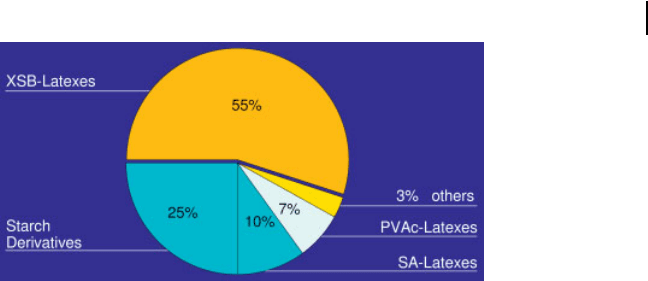
t of dry substances. Many
different binder types are used (Fig. 3.13). The most important aims for the appli-
cation of binders in coating colors are the binding of pigment particles to base
paper, the binding of pigment particles to each other, partial filling of voids be-
tween pigment particles (porous coating structure) and affecting the viscosity and
water retention of the coating color.
An ideal binder can be characterized by good binding power, good water reten-
tion properties, ease of mixing or dissolving in water, general ease of handling,
good compatibility with other coating components, low or desired effect on the
viscosity of the coating color, good mechanical and chemical durability, good opti-
cal and mechanical properties, nonodorous and harmless to health, low tendency
to foaming, resistant to bacteria, constant quality properties, low price and good
availability. Again, as with pigments, there is no single binder, which can meet all
these requirements. Latexes meet many of them; however, they often need a co-
binder or thickener to adjust the rheology and water retention to the desired
level.
There are three kinds of binders in coating, the (main) binder, the co-binder and
the sole-binder. A sole-binder is a single binder that alone can perform all the
3 Chemical Additives106
desired binder functions in a coating. Usually the binder systems consist of a
combination of two binders, in which the (main) binder is responsible for the
binding function. The co-binder is used to affect the rheology and water retention
properties of the coating color. Its dosage is smaller than that of the main
binder.
The binders can be classified by their origin and solubility in water:
• Soluble in water:
– Starches
– Proteins
– Cellulose derivatives: ethers e.g. carboxy methyl cellulose
– Polyvinyl alcohol (PVA, PVOH)
• Insoluble in water:
– Carboxylated styrene butadiene latexes (XSB Latex)
– Styrene acrylate latexes (SA Latex)
– Polyvinyl acetate latexes (PVAc Latex)
Water-soluble binders give better water retention for the coating layer than latexes
that are not soluble in water. They also affect the rheological properties of the
coating colors, making them more viscous, and also shear thinning (pseudo-plas-
tic) and thixotropic. Some synthetic co-binders have a similar effect. Carboxylation
of SB-Latex means incorporation of small amounts of unsaturated carboxylic acids
such as acrylic acid, methacrylic acid, maleic acid, to improve considerably the
compatability of these highly hydrophobic polymers with the other coating com-
ponents.
3.6.9.3.3.1 Derivatives of Natural Polymer Binders
In the initial phases of paper coating, i.e. the late 19th century till nearly the first
half of the 20th Century, these binder types were used exclusively. All are hydro-
Fig. 3.13 Market shares of binders for paper and board
coating in 2004 (total of ca. 3 V 10
6
t of dry materials world-
wide). PVAc = polyvinyl acetate, SA = styrene acrylate, XSB =
carboxylated styrene butadiene.
3.6 Functional Chemicals
107

philic. The most widely employed binders of this type are starch and its derivatives
with a consumption of approximately 800 000 tpa worldwide at present. Additional
natural binder types are cellulose ethers such as carboxymethyl cellulose, in the
United States, hydroxyethyl cellulose, soybean protein, and, to a very small extent,
casein and alginates. Natural binders act as protective colloids that prevent the
flocculation of the pigments; they increase the viscosity and water retention of
coating colors and give the coat a higher stiffness. Natural binders have a relatively
low water resistance (wet pick). They are mainly used in combination with syn-
thetic polymer binders and/or hardening agents (see Section 3.6.9.3.6).
Starch derivatives of various types are used in mixtures with other binders. For
example, oxidized starches are usually employed together with polymer disper-
sions. Hydrolyzed starches exhibit high stability in solution, good binding power,
and good flow behavior. Hydrolyzed, esterified starches exhibit good stability in
solution, high binding power, and increased reactivity towards wet-strength ad-
ditives (hardening agents) such as urea- or melamine- formaldehyde resins. Hy-
drolyzed, etherified starches exhibit the same properties as the esterified deriva-
tives. However, in contrast to the esterified derivatives, they can be used at pH
values above 8 without the risk of saponification. Starch derivatives that contain
phosphate and amino groups are compatible with cationogenic substances such as
satin white. The phosphate groups react with multivalent metal ions, such as alu-
minum ions, which leads to a certain degree of water resistance. The amino
groups react with aldehydes, which enhances the activity of hardening agents.
Cellulose Derivatives: Pure carboxymethyl cellulose (CMC) coats of 0.5–3 g m
–2
increase the grease resistance and printability of paper. Depending on the use,
various mixtures of low- and high-viscosity CMC are employed. Pigment-contain-
ing CMC coats, which can be applied on the size press, contain up to 10% semi-
technical, low-viscosity CMC or salt-free, purified CMC. CMC is usually processed
together with other natural or synthetic binders. Above all, CMC increases the
effectiveness of optical brighteners (see 3.6.9.3.5.5) and the water retention of the
coating mixture. Water retention is so high that the addition of other binders that
promote water retention in the coat is only necessary to a lesser extent. In general,
the amounts of CMC employed are 0.3–1.5% based on the pigment, and very low
viscosity types are preferred. This gives an adequate coating color viscosity, even if
the solids content of the coating color is high. Types of CMC that are soluble in
cold water are rapidly becoming established because they do not require dissolving
at elevated temperature. The presence of satin white pigment can cause strongly
interfering coagulations in the coating color.
Casein has been used as a central binder type in the past, but nowadays is of only
marginal importance in cast coatings. For its application it must be present in the
dissolved state. It is dissolved by the addition of alkali (e.g., ammonia, sodium
hydroxide, borax, or sodium carbonate) either separately in a cooker (up to 70 °C)
or with the pigment in a kneader. The casein concentration is limited to ca. 20 %
due to its high viscosity. The limit of processability is shifted to ca. 33% by the
addition of urea or dicyanodiamide, which reduces the viscosity and increases the
storage stability of casein solutions. The mixing of casein solutions with pigments,
3 Chemical Additives108

especially China Clay, can cause a “shock” phenomenon (a rapid increase of vis-
cosity).
Soybean protein is a very important binder type, especially in North America. It
has properties very similar to those of casein. Isolated soybean proteins are hydro-
lyzed, isoelectric proteins. They are used in the form of alpha and delta proteins
with four different viscosities (extra low, low, medium, and high). The viscosity
refers to the dissolved soybean protein, the solvent of choice being aqueous ammo-
nia (26 Bé). Proteins dissolved in this way exhibit very low sensitivity to water after
drying. Like casein, soybean protein is mostly used as a mixture with polymer
dispersions. This combination permits the preparation of coating colors with high
solids content and a relatively low viscosity. Solids contents of ca. 60%, suitable for
blade coaters, can be achieved.
3.6.9.3.3.2 Synthetic Latex Binders
The ongoing development of coating equipment and applicators in connection
with the increasing production speed (actual process up to 2.000 m min
–1
; pilot
coaters up to 3.300 m min
–1
) has forced the development of new binder types,
which meet the changed requirements better. In Europe the first styrene-butyl acryl-
ate dispersion (SBA) was polymerized by Badische Anilin- und Soda-Fabrik, today
BASF, in 1929. In the following years a partial substitution of the natural polymer
binders began and from the1950s onwards an extensive and continuous growth in
market demand has been observed. The corresponding pioneer work in the USA
took place in Dow Chemicals, where, from 1944 onwards, the production and
market introduction of carboxylated styrene-butadiene latexes (XSB) started. Polvinyl
acetate latexes (PVAc) as a coating binder were first researched and introduced to
the market in 1955, also in the USA, where a higher proportion than in other
world regions is still used. The actual worldwide market demand for these three
main types of synthetic coating binders comes to approximately 2 V 10
6
t p.a. as
dry material with approximately 75% XSB-, 15 % SA-, 7 % PVAc- and 3% other
latexes. These synthetic latex binders made it possible for the first time to attain a
high solid content at low viscosity, a prerequisite for modern high-speed coating
machines. In addition, polymer dispersions give the coat a higher water resistance,
better flexibility, higher gloss, and better printability. The products employed today
are aqueous dispersions of polymers, usually stabilized with anionic emulsifiers.
The solid content of the dispersions is generally ca. 50%. Very often, the polymers
are copolymers of several monomers, e.g., styrene, butadiene, acrylic esters, vinyl
acetate, and acrylonitrile. Apart from these main monomers small amounts of
auxiliary monomers, such as acrylamide, acrylic acid, maleic acid, and methacryla-
mine are also added to modify the dispersion properties.
Styrene-butadiene dispersions lead to varying film hardness, depending on the
proportion of styrene used. Approximately equal proportions of styrene and buta-
diene result in binders which provide a relatively soft film and a very good pigment
binding capacity. Disadvantages are the odor of the dispersion and the tendency of
the films to yellow when exposed to light. Acrylate dispersions are specialties and
3.6 Functional Chemicals 109

of high importance for impressive prints. Butyl acrylate is mainly copolymerized
with styrene or vinyl acetate. The ratio of the soft component (butyl acrylate) to the
hard one (styrene or vinyl acetate) determines the application characteristics of the
dispersion. In general, acrylate dispersions have an excellent brightness and age-
ing resistance and are less odorous. Apart from these two most important groups
of polymer dispersions, vinyl acetate homo- or copolymers have gained acceptance
in paper coating plants, especially in the USA. These products generally have a
lower binding power, but provide very hard and porous coats, and have an excellent
ageing resistance. Polymer dispersions based on methacrylates and copolymers of
vinyl acetate and ethylene are less important in paper coating.
In recent years the requirements for coating binders have become more and
more diverse. Changes in raw materials for paper production and/or production
process conditions as well as new requirements for paper characteristics and print-
ing technologies have forced the development of tailor-made binders with very spe-
cific property profiles. Such products are not generally different from XSB- or SBA-
latexes, as regards the principles of physics and chemistry. But with the know-how
of correlation and influence factors of monomers, functional monomers, process
auxiliaries, functional additives, process parameters and the interactions with dif-
ferent pigments, together with a flexible polymerization unit, it is possible to opti-
mize, very flexibly and quickly, a binder in respect of binding power, stiffness, print
evenness, print gloss, blister resistance, low yellowing and coater runnabilty.
Apart from the two-component systems, binder + co-binder, synthetic sole binders
which do not require a co-binder have been available since the early 1960s. Syn-
thetic binders are low-viscosity aqueous dispersions which usually do not influ-
ence properties such as viscosity and water retention that are important for the
flow behavior of the coating. For this reason, these “multipurpose dispersions” are
used alone in only a few cases. They are usually mixed with co-binders, which are
responsible for adjusting the flow properties of the coating color. On addition of
alkali, these products develop the required viscosity and water retention, but retain
their dispersion form. Special binders of this type have become popular, especially
for illustration paper that is produced in large amounts and used in rotogravure or
web offset printing. Table 3.2 lists the various binder systems, their influence on
the production of coating colors, the rheological properties of the coating color, and
the coating properties.
3.6.9.3.4 Additives Influencing the Properties and Processing of the Coating Color
It is desirable that coating colors have moderate pseudoplastic, shear thinning flow
behavior. Too drastic shear thinning can cause excessive water penetration into the
base paper and, accordingly, loss of binder. To adjust the rheological properties and
water retention of a coating color, synthetic co-binders and thickeners are used.
They have a profound effect on the runnability of a coating color, and hence of the
coating machine, on account of their thickening action, their characteristic rheol-
ogy at different shear rates, and their water retention. The mechanisms for dissolv-
ing, thickening, water retention, and rheology of synthetic co-binders are very
3 Chemical Additives110

similar to those of synthetic thickeners. Co-binders and thickeners can be roughly
divided into “natural” and “synthetic” products. Natural products are proteins (ca-
sein, soy protein) and polysaccharides (starch, alginates, cellulose ethers) and syn-
thetic products are e.g. acrylic copolymers, polyvinyl alcohol, polyvinyl acetate and
associative thickeners (Table 3.3).
3.6.9.3.4.1 Co-binders
These are primarily used to adjust the viscosity and water retention of coating
colors to the required levels and to modify their rheology according to the demands
of particular coating techniques. But they should also offer some additional advan-
tages over the thickeners in order to justify the higher recipe costs, e.g. binding
power, activation of optical brighteners (Table 3.4).
Natural products, like casein, starch, and soy protein used as main binders in the
past, also impart the necessary viscosity and water retention to coating colors.
However, they were unable to satisfy the increasing demands that were placed on
runnability and coating quality, and they have gradually been superseded by syn-
Table 3.2 Comparison of various Binder Systems
Binder system Production Rheological behavior Coating properties
Polymer dispersion alone
(rarely used)
simple mixing process usually unfavorable variable via type of disper-
sion; waterproof, glossy coat
attainable; no activation of
optical brighteners
Polymer dispersion +
watersoluble cobinder,
e.g., casein, starch,
CMC (very frequent)
mixing and dissolving
processes, sometimes
separately with heating
largely controllable
via cobinder
variable via single compo-
nents; limited water resis-
tance and gloss; full activa-
tion of optical brighteners
Polymer dispersion +
synthetic cobinder
(frequent)
integrated mixing/
dissolving processes,
no heating
controllable via
cobinder
limited variability; water-
proof and glossy coat attain-
able; full activation of opti-
cal brighteners
Polymer dispersion +
viscosity regulating additives
(in special cases)
integrated mixing/
dissolving processes,
no heating
limited controllability variable only via type of dis-
persion; good water resis-
tance and gloss, no activa-
tion of optical brighteners
Special dispersion
(for publication papers)
integrated dissolving/
mixing processes,
no heating
slight controllability limited variability; improved
water resistance with addi-
tives; good gloss attainable;
optical brighteners can be
activated only via auxiliary
components
3.6 Functional Chemicals 111