
Holik H. (ed.) Handbook of Paper and Board
Подождите немного. Документ загружается.


4.2.3
Screening and Fractionation
4.2.3.1 Screening
The objective of screening is the removal of interfering solid substances from the
suspension that differ from the fibers in size, shape and deformability. These can
be solid nonpaper particles like plastics or paper flakes and fiber bundles. The
suspension passes a screen with holes or slotted openings which are larger than
the fibers but smaller than most of the particles to be removed. The latter are
intended to be retained by the screen and extracted at the reject outlet together
with a certain amount of fiber suspension. Clearing devices rotate at a small dis-
tance over the screen surface generating pressure pulses and thus prevent the
sieve from plugging. These rotors should be not too aggressive in order to main-
tain lower strength nonpaper particles in a screenable size. The pressure differ-
ence across the screen may force deformable particles through the screen open-
ings. Cleanliness efficiency for soft stickies, for instance, is therefore lower than
for hard stickies of the same size. Increasing the pressure difference results in
further loss of efficiency for soft stickies removal compared to that for hard
stickies.
Screening is used in both primary and secondary fiber preparation. In the latter,
screening is done at several positions in the system with different kinds of ma-
chines with different kinds and sizes of openings. Pre-screening (first coarse
screening step) is integrated in the slushing systems followed by a (second) coarse
screening step and fine screening so more and more trash is removed step by step,
first the coarse and then the finer material. Thus the subsequent screening step
can operate safely and with low abrasion, even at the high demands of fine
screening.
Fiber loss from the reject of a screen is reduced by re-screening the first stage
reject in a second, third or even fourth stage. The reject of the last screen (tailing
screen) determines the fiber loss. A higher reject rate increases the cleanliness
efficiency of a screening system but increases the fiber loss. (Cleanliness efficiency
is the ratio of effective separation to the maximum separation theoretically possi-
ble). More stages in one screening system result in lower fiber loss but higher
investment costs. So screening is always a compromise between machinery outlay,
cleanliness efficiency, fiber loss, throughput and operating reliability.
4.2.3.1.1 Coarse Screening
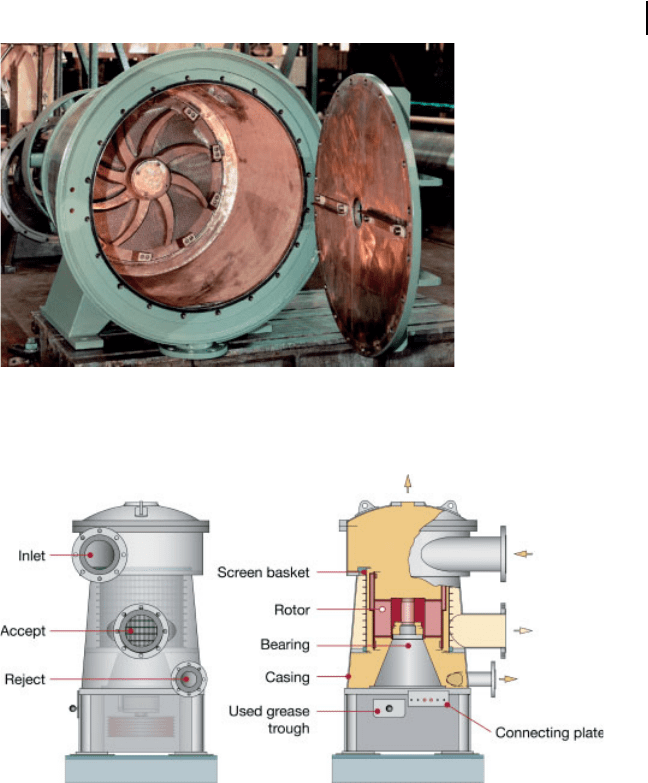
In coarse screening both disk and cylindrical screens are used. As shown in
Fig. 4.15 a disk screen consists of a conical housing, a screen plate, a vaned rotor,
and baffle bars. Screen hole diameters are about 2–4-mm, the peripheral rotor
speed is about 20–30 m s–1. Disk screens operate at consistencies below 6%. Due
to their effectiveness in flake defibering, disk screens are also used in the second
screening stage of a system with a cylindrical screen in the first stage to reduce loss
of paper flakes consisting of valuable fibers. Without deflaking the subsequent
4 Stock Preparation162
stages could not be operated reliably due to the enormous increase in flake content
from stage to stage.
The design principle of cylindrical screens in coarse screening is usually identi-
cal or similar to that of fine screens. The exception is a machine type with rotating
screen where the pulsing blades are stationary. This type of machine is only used
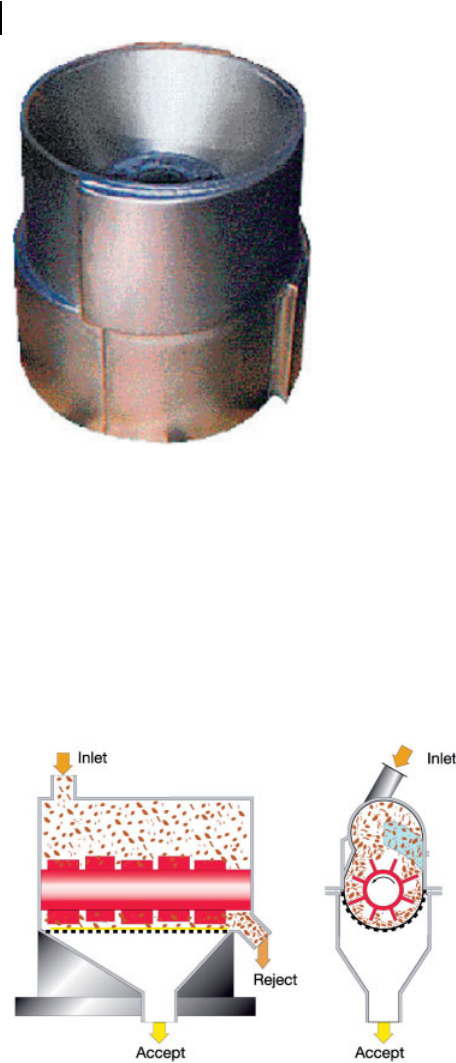
in coarse screening. Cylindrical screens consist of a housing, a rotor with clearing
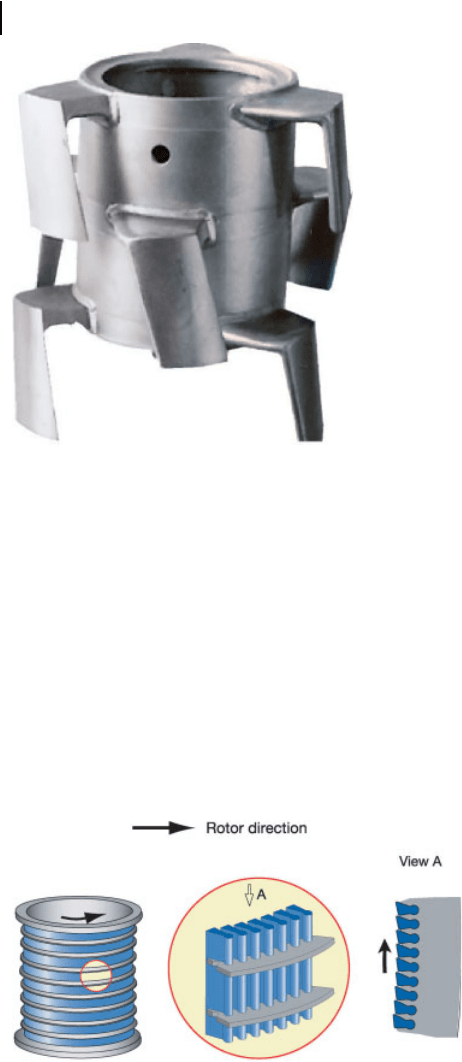
devices and a cylindrical sieve (Fig. 4.16). Depending on the trash content of the
suspension different types of rotors may be applied, one of is shown in Fig. 4.17.
The defibering effect of cylindrical screens is lower than that of disk screens and
Fig. 4.15 Opened disk screen (source: Voith).
Fig. 4.16 Cylindrical screen with conical
housing (source: Voith).
4.2 Main Unit Processes and Equipment
163
depends on the rotor type. Cylindrical screens are used for suspensions with low
flake content and operate at consistencies below about 5%.
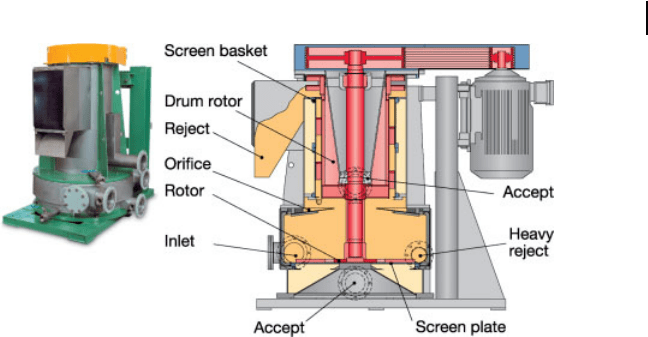
Final stage coarse screening machines must handle high trash content. On the
other hand low fiber loss and high cleanliness efficiency are required. The ma-
chine in Fig. 4.18 is not pressurized and operates at a consistency of about 1–4%
in the accept. Screen hole sizes are about 2 to 4 mm. Rotors fitted with vanes keep
the screen clear and transport the debris such as plastics to the outlet. During the
pass through the machine water sprays support the separation of fibers and debris
resulting in a low fiber content in the reject. Another type of tail screen (Fig. 4.19)
Fig. 4.17 Rotor for coarse screening
application (source: Voith).
Fig. 4.18 Final stage screen operating at ambient pressure
(source: Voith).
4 Stock Preparation
164
uses in its lower section a pressurized disk screen whereas the upper part is a
nonpressurized cylindrical screen, both usually equipped with holes. Pressurized
cylindrical screens are also used in the last stage to give lower flake and debris
content.
4.2.3.1.2 Fine Screening
For fine screening different types of cylindrical screens are used. They may differ
in the geometry of the housing (for uniform basket throughflow), the rotor shape
(influencing the pulse characteristics), the rotor position (at the entrance side of
the suspension into the screen or at the backside) and its circumferential speed,
the flow direction through the screen (centrifugal or centripetal), the kind and size
of slots, and the calculated suspension velocity through the screen orifices as well
as any special configuration to influence the suspension stream lines in the vicin-
ity of the apertures. Fine screening is done at low stock consistency of below 1.5 %.
The rotor is adjusted to the requirements of LC screening (Fig. 4.20), its circum-
ferential speed is 10–30 m s
–1
.
The screen baskets are slotted with widths of 0.1–0.4 mm. Some baskets are
milled, where the milling tool defines the slot width and the uniformity of width
across the whole basket. Others are bar-type baskets (Fig. 4.21) where individual
bars are affixed to mountings by welding, brazing or clamping. The distance be-
tween the bars is the slot width. The shape of the bars and the kind of mounting
define a profile angle at the slot entrance. Both profile angle and slot width
strongly affect the screening result: The smaller the slots and the lower the profile
angle, the better the cleanliness effect, and vice versa. On the other hand finer slots
and lower profile angle result in lower throughput and more thickening and frac-
tionation. To maintain the slot geometry as long as possible during operation,
abrasive particles should be removed from the suspension before screening. For
Fig. 4.19 Final stage screen with pressurized flat screen and
non-pressurized cylindrical screen (source: Voith).
4.2 Main Unit Processes and Equipment
165
that reason recovered paper processing systems mostly comprise LC cleaning
ahead of LC screening.
Final stage screens in fine screening have slotted screen baskets due to quality
requirements. Operation can be continuous or batch. Continuous operation of
such a screen results in higher cleanliness but also higher fiber loss compared to
batch operation. In batch operation flushing water washes out most of the fibers,
but a larger amount of debris passes the screen during the wash cycle. Figure 4.22
shows a final stage screen where part of the reject is recirculated in order to pre-
vent too high a thickening of the reject towards the outlet.
Each fine screening system comprises several stages, including a final stage
screen. The individual screen accepts and rejects in the various stages are intercon-
nected, depending on the requirements. Figure 4.23 shows feed forward, full or
Fig. 4.20 Foil rotor used in fine
screening (source: Voith).
Fig. 4.21 Schematic of a bar-type screen basket (source:
Voith).
4 Stock Preparation
166
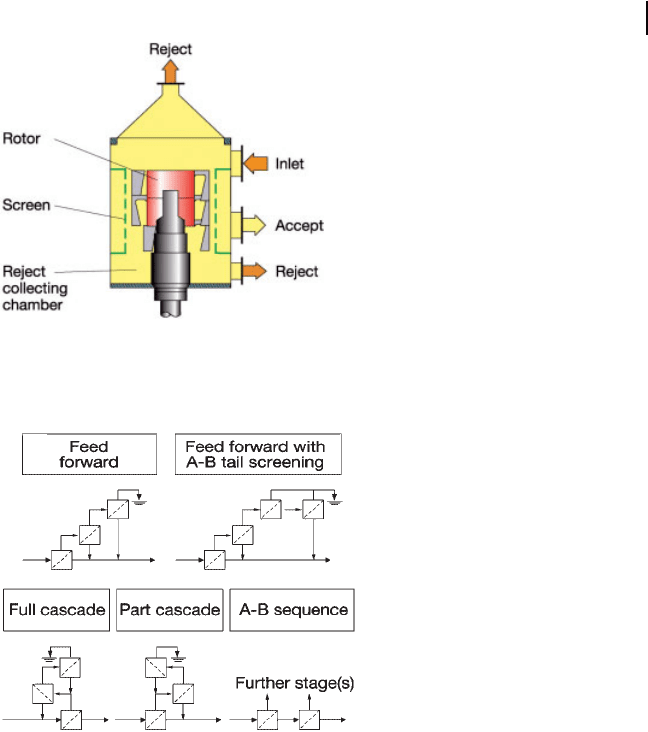
partial cascade operation schematics. In cascade systems a higher separation prob-
ability is given. Feed forward may be advantageous when debris particles tend to be
easily comminuted in screens or pumps during cascading. An arrangement in
series (A–B sequence) provides optimal cleanliness at low fiber loss. This sequence
can be applied in the primary, intermediate or final stage.
4.2.3.2 Fractionation
Screening is defined as the separation of debris from the fibers in a suspension. As
a principle the fiber fractions in the accept and reject should be the same as in the
inlet. In contrast to that, fractionation aims to separating certain fractions of fibers,
for instance long fibers from short fibers. The mass flow split in screening is about
5–25%, in fractionation higher, 30–40 %, due to the production requirements.
Fig. 4.22 Final stage screen in LC screening systems with
slotted basket for batch or continuous operation (source:
Voith).
Fig. 4.23 Screening systems for recycled fiber processing.
4.2 Main Unit Processes and Equipment
167

Fractionation is done both in flat screens and in cylindrical screens as used for
screening, with some differences as regards operating conditions and machine
parts. The resulting separation of long and short fibers is far from complete, many
long fibers are found in the short fiber fraction and vice versa, only a certain
enrichment of long or short fibers is possible. Operating and machinery parame-
ters that improve the fractionating effect are e.g. smaller openings (holes or slots),
lower or zero profile angle of slotted screens, and higher consistency. For improved
overall effect in some cases additional fractionation is done in cleaners.
With fractionation in screens the main debris flow goes with the stream en-
riched with long fibers. Here the debris has to be removed in a separate screening
step.
4.2.4
Centrifugal Cleaning
The objective of centrifugal cleaning is to remove from the suspension particles
that negatively affect paper quality or cause either excessive wear or plugging in
subsequent processing machines. For their efficient removal the particle density
must differ from that of water, and their size and shape from those of the desired
suspension components. Centrifugal cleaning complements other separation
methods like screening due to its different physical separation principle. In con-
trast to screening, hydrocyclone cleaning does not tend to deform softer parti-
cles.
Hydrocyclones are used in stock preparation of virgin pulp and of recovered
paper where they are even more important. Different hydrocyclone types exist for
operation at various consistencies depending on the location in the process, at
high consistency HC (2–5%) after slushing of the stock, or along the process line
at medium consistency MC (up to 2%) and at low consistency LC (0.5–1.5 %) at the
end of stock preparation and in the approach flow system. HW ( heavy weight)
cleaners may remove metal, glass, sand of particle sizes of about 10–100 mm up to
8–20 mm depending on the type, whereas LW (light weight) cleaners are effective
for light particle removal such as wax or plastic foam of similar size range.
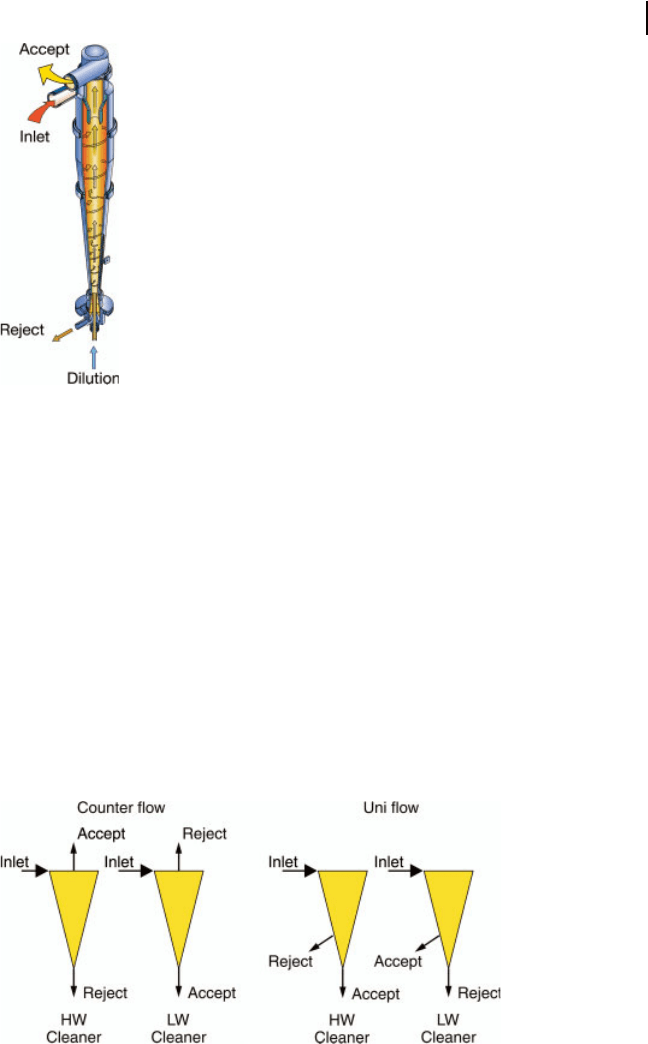
The separation takes place in the centrifugal field of so-called hydrocyclones
(Fig. 4.24) that is generated by the velocity of the entering suspension. Here the
heavy particles are forced to the outer wall (HW cleaners) whereas the light ones
are driven to the center (LW cleaners). The flow streams where the heavy or light
particles are accumulated are separated from the cleaned stock stream. The flow in
a hydrocyclone is a three-dimensional two-phase flow. The circumferential compo-
nent generates the centrifugal force, the axial component moves the solid particles
towards the cleaner outlet and the radial component of the suspension flow pro-
ceeds from the outside towards the center and vice versa.
Hydrocylone efficiency generally increases with
• Increased centrifugal acceleration, obtained by high tangential velocity and the
small diameter of the hydrocyclone. The velocity is dependent on the pressure
differential between inlet and accept.
4 Stock Preparation168
• Lower stock consistency, as the fiber network may restrict particle motion at
elevated consistencies.
• Appropriate reject removal without remixing of reject and accept streams.
• Particles with
– large density difference compared with water
– large size at comparable density
– favorable hydrodynamic shape (c
w
· A) at comparable density and size.
According to the flow directions of the reject and accept relative to the inlet hydro-
cyclones are called either counterflow or unidirectional flow cleaners (Fig. 4.25). In
counterflow inlet and accept or reject are at the top and reject or accept at the
bottom. Unidirectional flow is defined by the reject and accept connections being
opposite to the inlet.
Fig. 4.24 Low consistency heavy weight (LC HW) cleaner
(source: Voith).
Fig. 4.25 Counterflow and unidirectional flow hydrocyclones
for heavy weight (HW) and light weight (LW) particles
removal.
4.2 Main Unit Processes and Equipment
169
Usually hydrocyclones have three connections (3-way with inlet, accept, reject of
heavy or light weight particles). Some LC cleaners operate as 4-way cleaners (inlet,
accept, reject of heavy and reject of lightweight particles) or even 5-way cleaners
with an additional air outlet.
4.2.4.1 High Consistency (HC) Cleaners and Systems
HC cleaners are positioned after slushing and operate at consistencies of about
2–5%, sometimes up to 6 %. They are the largest cyclones used in the paper in-
dustry. They have use for pre-cleaning to remove heavy particles of more than
1 mm in size. Their density has to be significantly higher than 1 g m
–3
. These
particles may plug, wear or damage subsequent machinery and therefore they have
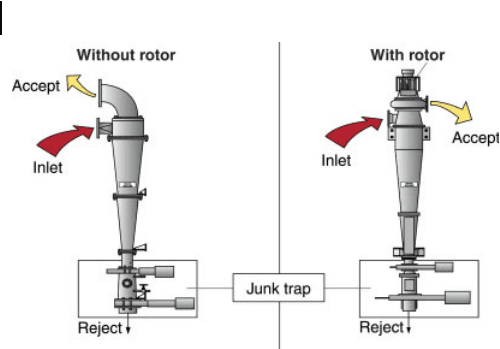
to be removed. HC cleaners are built with or without a rotor and are mostly based
on the counter flow principle. Reject discharge is batch-wise (mostly without a
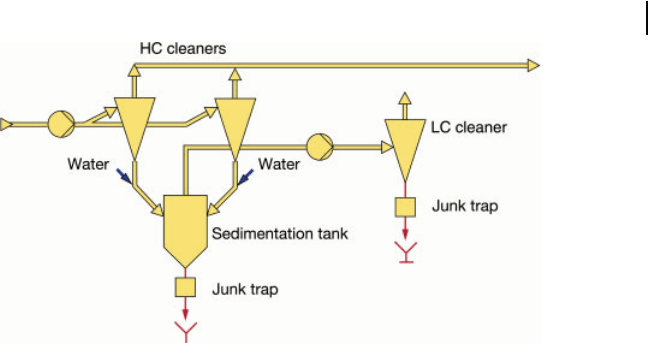
final stage) or continuous with a final stage reject discharge (Fig. 4.26). In the latter
case the HC cleaner reject is diluted and then finally cleaned. This system is shown
in Fig. 4.27.
4.2.4.2 Medium Consistency (MC) Cleaners
MC cleaners usually operate at consistencies of up to 2%, they are medium sized
and single stage cleaners with a junk trap. By removing glass, sand particles and
paper clips the subsequent machinery is protected from wear and reliable opera-
tion is ensured.
Fig. 4.26 High consistency (HC) cleaners with and without
rotor, both with junk trap for intermittent operation (source:
Voith).
4 Stock Preparation
170
4.2.4.3 Low Consistency (LC) Cleaners and Systems
LC cleaners operate at consistencies of 0.5 to 1.5% and they are smaller than the
HC or MC cleaners. HC cleaners are usually of the 3-way type. Due to the low
consistency and high centrifugal forces (small diameter and high circumferential
velocity) the removal effect is highest. On the other hand the energy demand per
ton of stock is high due to the above operating parameters. Reject outlet is con-
tinuous.
By removing fine sand particles heavy weight cleaners protect the fine slotted
baskets of the screens from wear and sand accumulation. During cleaning the
suspension thickens and is highest near the wall. Here the heavy particles are also
accumulated. To prevent the reject outlet from plugging and to reduce fiber con-
tent in the reject, dilution water is added at this position. The cleaner design must
ensure flow conditions in the reject outlet area where the dilution water does not
remix the separated heavy particles with the cleaned stock. Figure 4.28 shows
details of the reject area of a HW LC cleaner.
Light weight LC cleaners today are recommended mainly for wax and plastic
foam removal. They can also be advantageous when particles such as soft stickies
may be deformed or reduced in size in a screen. A precondition is that their
density should be lower than that of water.
A cleaner system consists of as many as four stages. The reject of the first stage
is diluted and cleaned in the second stage, the accept is fed back to the inlet of
stage one, the reject is diluted and cleaned in the third stage etc. This type of
system configuration is called a cleaner cascade system (Fig. 4.29). Individual
cleaners of one stage are connected to form cleaner batteries with a common
distributor feeding the inlets of all cleaners of the stage. Their accepts and rejects
flow to collector pipes (Fig. 4.30).
A special type of equipment is a centrifugal cleaner with rotating housing. Due
to high centrifugal acceleration and the flow conditions, the cleaner can remove
light particles with a density close to that of water.
Fig. 4.27 System with primary HC cleaning and second stage
low consistency (LC) cleaning (source: Voith).
4.2 Main Unit Processes and Equipment
171