
Holik H. (ed.) Handbook of Paper and Board
Подождите немного. Документ загружается.

these bigger bubbles would negatively affect the further process. By depressuriz-
ing the water small air bubbles with a narrow size range are generated, finely
distributed in the water.
• Flotation: The side stream of the aerated water is mixed with the main stream of
unclarified water and fed into a flotation tank. The fine air bubbles adhere to the
flocs and rise to the surface where they form a stable layer of sludge. For good
flotation results flow turbulences in the tank have to be kept to a minimum.
• Sludge removal, clarified water outlet: The formed stable sludge is removed
from the water surface and discharged. The clarified water exits from the bottom
of the tank.
The largest equipment in dissolved air flotation is the clarification tank. It can be
circular, rectangular, with or without built-in elements for flow guiding, and made
from metal or concrete. The design depends e.g. on the requirements placed on
the quality of the clarified water, the position in the process and the quantity of
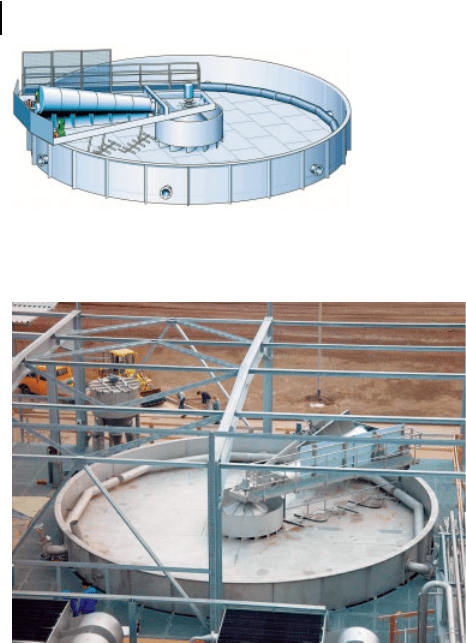
water to be clarified. Figures 4.41 and 4.42 show a schematic and a photograph of a
Fig. 4.41 Schematic of a tank for dissolved air flotation
(source: meri Entsorgungstechnik).
Fig. 4.42 Air flotation tank (source: meri Entsorgungstechnik).
4 Stock Preparation
182

circular tank for dissolved air flotation. They show the central feed of the mixed
streams of aerated and unclarified water, the sludge removal by a paddle, the dis-
charge to the tank center by a feeding screw, and the extraction of the clarified
water near the bottom at the periphery. The tanks can have diameters up to 25 m
and throughputs of up to 2500 m
3
h
–1
.
4.2.7
Bleaching of Secondary fibers
With bleaching in stock preparation systems the optical properties of secondary
fibers are improved: the brightness of the stock is increased and a possible color
shade is reduced.
There are two different bleaching principles (see Section 3.3):
• Oxidative bleaching, mainly with peroxide as the bleaching agent, for brightness
increase by fiber lightening.
• Reductive bleaching, with either (sodium) dithionite or FAS (formamidine sulfi-
nic acid) as the bleaching agent, for color value correction and brightness in-
crease by color stripping and fiber lightening.
The main parameters influencing the bleaching result are the type of chemical, its
dosage, pH value, temperature, and retention time.
Depending on the requirements of the finished stock either one or both bleach-
ing types are integrated in a stock preparation system (see Section 4.3). The
amount and type of bleaching agents have to be adjusted to the fiber composition
of the stock and to the desired properties of the finished stock.
Peroxide bleaching is carried out in the presence of NaOH, sodium silicate, and
sometimes chelating agents at elevated temperatures. The optimum dosage ratio
of NaOH and peroxide prevents yellowing and makes best use of the peroxide.
This ensures the best possible bleaching effect at the lowest chemical costs. This
kind of bleaching is most effective at high stock consistencies of about 30%.
Hence a combination with the dispersion system which operates at high con-
sistencies and temperatures is advisable, using the Disperger to admix the bleach-
ing agents to the stock. Dosage of peroxide is about 1 to 2% of 100 % active per-
oxide on oven dry pulp. The stock is then fed into a bleaching tower (downflow) to
ensure sufficient retention time, about 30 to 60 min for wood-containing and 30 to
90 min for woodfree stock, at elevated temperatures of about 60 to 90 °C and a pH
of 10 to 11. The brightness gain is about 4 to 11%ISO for woodfree stocks and 2 to
5%ISO for wood-containing stocks. These values depend strongly on the kind of
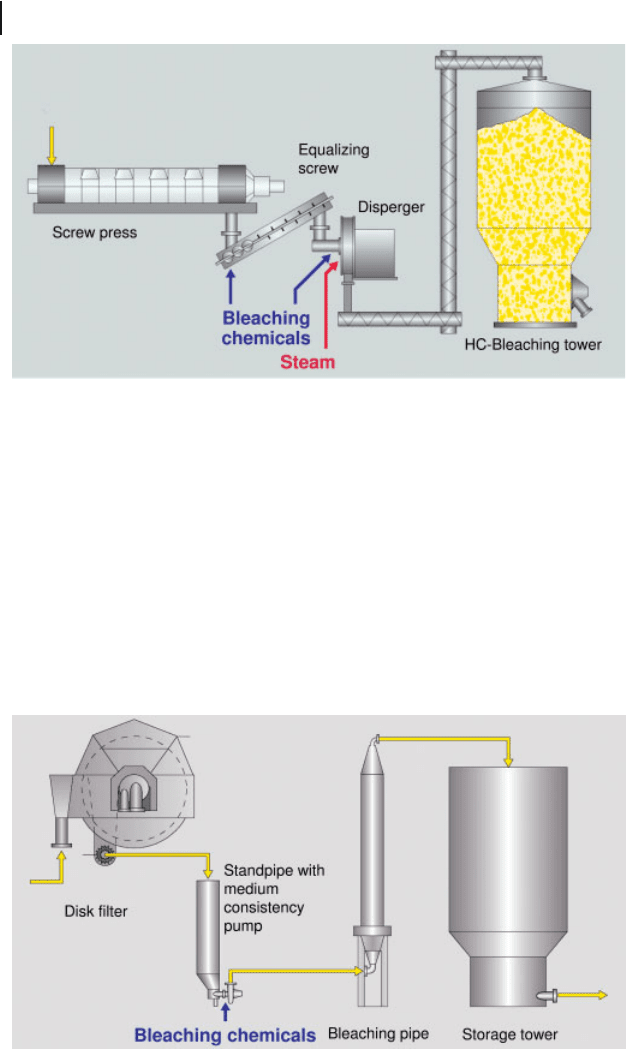
raw material and the bleaching conditions. A system for peroxide bleaching is
shown in Fig. 4.43.
Economic reductive bleaching of secondary fibers requires an oxygen-free stock
as dithionite is sensitive to the oxygen contained in the air. Therefore the stock has
to be deaerated which can be done sufficiently at a medium consistency of about
10 to 15%. FAS is less sensitive, thus operating consistency can be as high as 30 %
and a Disperger may be used for admixing of FAS. Best results are obtained when
4.2 Main Unit Processes and Equipment 183
operating the Disperger under pressure and at temperatures up to 120 °C. Both
agents are usually fed to the inlet of a medium consistency pump and admixed to
the stock in the pump. Dosage is 0.4 to 1.0% (dithionite) and 0.2 to 0.6 % (FAS).
The chemical reaction is much faster than with oxidative bleaching and hence
reductive bleaching can be carried out in a bleaching pipe or smaller tower (up-
flow) with a retention time of 15 to 60 min. The temperature is 60 °C (minimum)
to 95 °C, pH 6.5 to 7.5 (dithionite) and 10.0 to 10.5 (FAS). A system for reductive
bleaching is shown in Fig. 4.44.
Fig. 4.43 Peroxide bleaching system (source: Voith).
Fig. 4.44 Reductive bleaching system (source: Voith).
4 Stock Preparation
184

4.2.8
Washing
Washing is applied in stock preparation systems for recovered paper processing.
Here the objective of washing is to remove from the fiber suspension solid and/or
dissolved substances which may negatively affect the papermaking process or the
finished product quality. Dissolved and colloidal contaminants include e.g. organic
and inorganic substances contributing to COD and anionic trash. Solid particles
comprise fillers, coating and ink particles, microstickies and fines. Removal of ink
particles by washing (wash deinking) has been quite usual in the United States.
Washing is a filtrating-thickening process. To be washed out the particles have to
be smaller than about 30 mm. The washing effect is the greater the smaller the
particles, the lower the consistency at the washer entrance and the higher the
outlet consistency of the thickened suspension mat. The maximum theoretical
washing effect is given by the ratio filtrate flow/inlet flow. This theoretical number
cannot be obtained in practice as more particles are retained in the fiber mat than
corresponds to the above ratio due to a certain filtering effect.
The application of a washing unit and the kind and amount of substances to be
washed out depends on the raw material, the other unit processes applied in the
stock preparation system and the finished product requirements (see Section 4.3).
A washing stage in a system requires effective cleaning of the filtrate, usually by
nonselective flotation (see Section 4.2.6.2). This in turn means high solid loss from
the system. If desired the washing effect and thus the solid loss can be adjusted
e.g. by cleaning only part of the filtrate or adjusting the washer itself if possible.
The machinery used for washing consists mainly of disk thickeners and high
speed belt filters. Static filters such as inclined and curved screens, spray filters
and pressure screen type washers are also found. Disk thickeners are described in
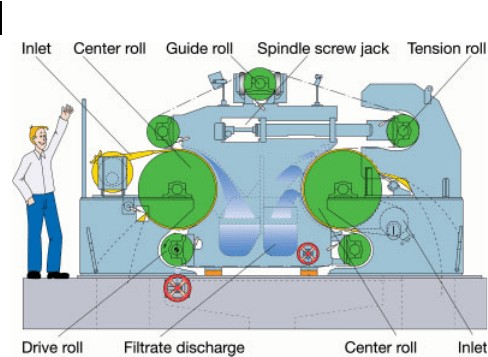
Section 4.2.9. An example of a high speed belt filter is shown in Fig. 4.45. Each
unit of this twin machine consists of an inlet feeding the suspension into the gap
formed by the center roll and the wire. The filtrate is collected and the washed
stock discharged. These machines operate at speeds of about 350 to 1000 m min
–1
.
The suspension is dewatered under the pressure exerted by the wire tension, leav-
ing the roll with a consistency of about 5 to 10%. Inlet consistency is about 0.7 to
1.5%. The washing effect can be adjusted over a wide range by the fiber mat
thickness i.e by its basis weight. The higher the basis weight the lower the washing
effect. The proportion of ash and fines in the filtrate also depends on the basis
weight as larger particles (as fines are, on average, compared to fillers) are better
retained than fillers when changing e.g. from very low basis weights of 20 to 40 or
50gm
–2
.
4.2 Main Unit Processes and Equipment 185
4.2.9
Dewatering
The objective of dewatering a fiber suspension in stock preparation is to separate
the solids in the suspension from the water and dissolved ingredients. The reasons
for dewatering the suspension are technological and economic. They are mainly
• to separate the water loops as regards chemical and contaminant load as well as
temperature
• to adjust stock consistency to a defined level required by specific unit operations
such as dispersing or bleaching
• to recover fibers from the white or waste water
• to increase consistency to the highest possible level when making wet laps or at
discharge of the rejects.
Dewatering is a filtration process where a suspension stream of consistency c
i
is
divided by a filter into a thickened part with a consistency of c
t
and a filtrate stream
of consistency c
f
. At the start of filtering the retention of the solids on the filter is
lowest. With time mat thickness increases, as does retention, which means that the
solids content in the filtrate decreases. Dewatering usually aims for zero consis-
tency in the filtrate, which in practice is not reached as retention is never 100%. In
contrast, washing takes advantage of this effect for solid/solid separation.
Various types of machines are used for dewatering in stock preparation: Drum
filters, belt filters, twin wire presses, disk filters, and screw presses, as well as static
filters such as inclined and curved screens. They can differ in several aspects such
as
• the driving forces for dewatering e. g. gravity, vacuum, wire tension over a
curved surface, mechanical pressing in a nip
Fig. 4.45 High speed belt filter (Variosplit) with two dewater-
ing units (source: Voith).
4 Stock Preparation
186
• the allowed inlet consistencies for ensuring safe operation, from 0.5% up to
more than 3.5%.
• the obtained outlet consistencies of a minimum 3% up to more than 30 %
• the filtrate consistency which may vary between ppm and % numbers.
Machinery selection is done according to technological and economic require-
ments.
4.2.9.1 Drum Thickeners
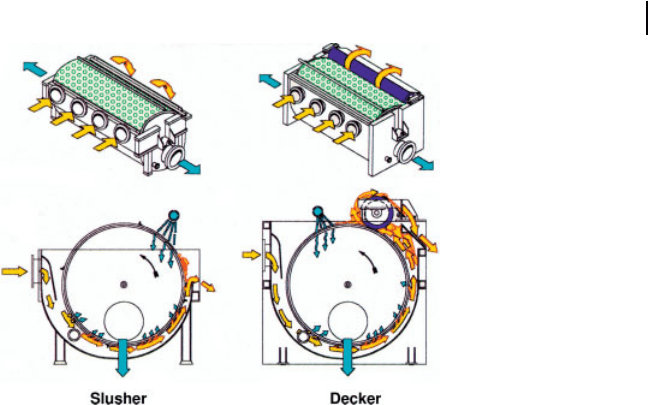
Drum thickeners (or slushers/deckers) comprise an open roll covered with a filter
wire, rotating in a vat filled with suspension (Fig. 4.46). The feed consistency may
vary between about 0.5 and 2.5%. A slusher is used when the required discharge
consistency is not more than about 3–4%. For higher outlet consistencies of about
5–6% a decker, which comprises an additional roll to press and further dewater the
filter mat before discharge, is used. As the cylinder rotates a mat is built up on the
outside of the filter drum. Here dewatering is governed by the differential head
between the suspension level in the vat and the filtrate level inside the drum. In
the case of a slusher the thickened stock overflows into a chute, in the case of a
decker the mat is removed from the couch roll by a doctor blade. The filtrate in the
drum is extracted from the inside through a hollow shaft.
4.2.9.2 Belt Filters, Twin Wire Presses
Here, in principle, the suspension is fed onto a horizontal moving wire and dewa-
tered by gravity or additionally by a vacuum placed under the wire. Dewatering
Fig. 4.46 Schematics of drum thickeners (source: Voith).
4.2 Main Unit Processes and Equipment
187
capacity can be further increased by a second wire covering the suspension and the
bottom wire. By guiding this sandwich over roll(s) of different diameter(s) D under
a tension S of the outer wire a dewatering pressure p is exerted: p = 2 S/D. The
highest dry content of the thickened stock is obtained when additional dewatering
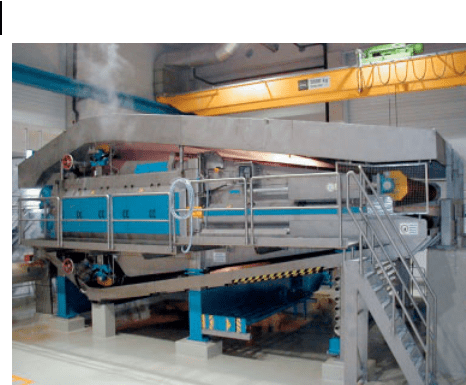
is done in one or several press nips. Twin wire presses (Fig. 4.47) make use of all
three principles and obtain high consistencies of about 25 to 50%.
4.2.9.3 Disk Thickener
The filtering elements in disk thickeners are hollow disks covered on both sides
with wires. Numerous disks are mounted closely and equally spaced on a hollow
shaft. The length of the machine is up to about 12 m with 3.0–5.5 m disk diameter.
The filter disks are immersed about halfway in the suspension in a trough. The
driving force for dewatering is the head differential between the suspension height
in the trough and the filtrate level. As the filter disks rotate (at 5–20 m min
–1
at the
circumference) a fiber mat builds up which continuously falls back to the trough
due to gravity and flow forces. Thus the trough consistency increases and the
thickened suspension exits over a weir. The filtrate is removed through the hollow
shaft. Its consistency is high as the fiber mat is continuously removed resulting in
low retention.
4.2.9.4 Disk Filters
Compared to disk thickeners disk filters (Fig. 4.48) additionally apply vacuum to
further increase the consistency, production, and retention. They are used for
white water cleaning in the paper machine water circuit (save-all) and for dewater-
ing of pulp suspensions in pulping. Typical consistencies are 0.5–1.3 % at the inlet
Fig. 4.47 Twin wire press (source: Andritz).
4 Stock Preparation
188
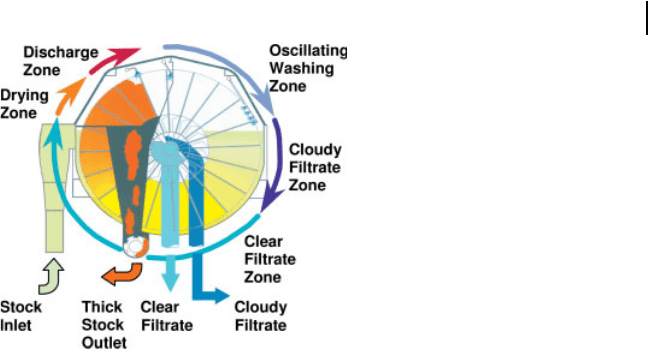
and up to 12–18% at discharge. The filter disks are similar in design to those in
disk thickeners. A filter mat builds up during rotation at the filter disk surface
supported by the vacuum generated by a “barometric leg” governed by the differ-
ential head of filtrate level in the filter and the outlet to the ambiance. Due to the
vacuum the mat remains fixed to the filter disks and is further dewatered after
having emerged from the suspension (“drying zone”). The thickened stock is re-
moved from the disks in the upper quadrant by knock-off showers and collected in
a conveyor via chutes between the disks. The disks are then cleaned by oscillating
cleaning showers before the filter area is re-immersed into the suspension, and
filtration starts again. In the beginning filtration takes place by gravity and the
filtrate consistency is high (cloudy filtrate) due to the thin fiber mat. Consistency
decreases with increasing filter mat thickness (clear filtrate) when a vacuum is
applied. The filtrate is divided into two streams by separating means in the filtrate
zone, the cleaner one being used for shower water. Sometimes a third stream
(superclear filtrate) is drawn off.
4.2.9.5 Screw Presses
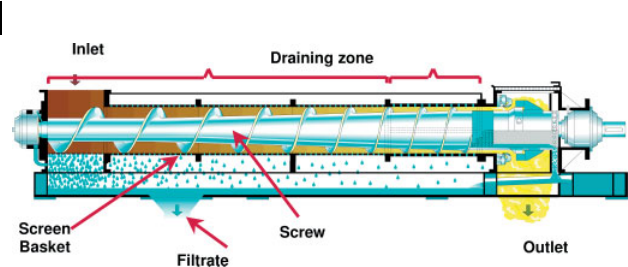
Screw presses comprise a housing, perforated (round holes or slots) screens, and a
rotating screw (Fig. 4.49). The stock is transported by the screw to the outlet, being
dewatered en route. The free volume between the screw body and the housing,
available during the transport, decreases in the axial direction by the increase in
the dewatering pressure. Reduction in the free volume can be achieved by decreas-
ing the screw pitch angle or screw rotor diameter and increasing the screw rotor
shaft diameter. Since the filter mat is continuously removed from the screen cylin-
der a high consistency and dewatering capacity is possible. On the other hand the
filtrate consistency is highest compared to all other dewatering methods. Screw
presses are also for dewatering in reject handling systems.
Fig. 4.48 Disk filter (source: Voith).
4.2 Main Unit Processes and Equipment
189
4.2.10
Dispersion
Depending on the furnish quality as well as on the requirements of the finished
product, the tasks of a dispersing system vary widely. They are e. g.
• to reduce the size of dirt specks to below the limit of visibility
• to reduce the size of stickies
• to break down coating and sizing particles
• to distribute wax finely
• to detach ink or toner particles from fibers
• to disintegrate fiber bundles
• to treat fibers mechanically and thermally
• to mix in bleaching agents
• to decontaminate the stock as regards microorganisms.
Dispersing is used in secondary fiber processing. It is located at the point of water
loop separation where the suspension is dewatered up to a consistency of about 25
to 35%. Often bleaching is done in combination with dispersing. For high quality
demands two dispersing steps may be applied in the process.
During dispersing high shear forces are applied to the debris particles to be
dispersed and also to the fibers. The shear forces have to exceed the strength of
these debris particles in order to reduce their size. Hence stock consistency must
be about 24 to 30% to ensure the transfer of the required amount of dispersing
energy, and the temperature has to be elevated to reduce their strength.
A dispersing system consists of three major process steps (Fig. 4.50):
• dewatering the suspension from 4 to 10% up to the required consistency of
about 22 to 35%
• heating the dewatered stock to a temperature of about 85–90 °C (at ambient
pressure) or higher (up to 130 °C under pressure)
• applying shear forces to disperse the stock.
Fig. 4.49 Screw press (source: Voith).
4 Stock Preparation
190
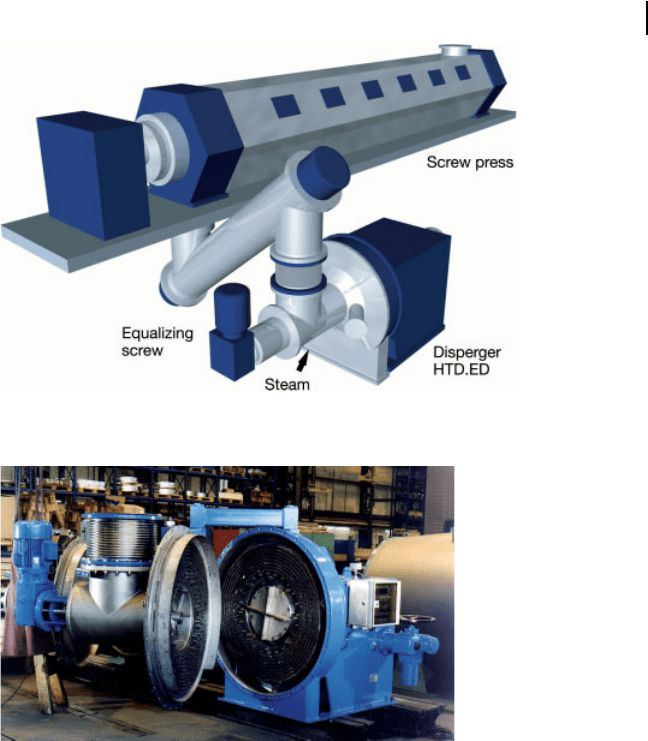
Dewatering of the suspension is done in a screw press – in some systems in a twin
wire press (see Section 4.2.9). The required stock temperature during dispersing is
obtained by direct steam heating which may be done either in a separate heating
screw or by steam fed directly into the disperser. Dispersing itself is done either in
a high-speed disk disperger (Fig. 4.51) or in a slow-running kneading disperger
(Fig. 4.52).
The fillings of a disk disperger (Fig. 4.53) usually have intermeshing teeth or
sometimes refiner-type bars. The rotor/stator element spacing is 1 mm or less,
peripheral speed is about 50 to 100 m s
–1
. The specific energy demand is 50 to
80 kWh t
–1
, in certain cases up to 150 kWh t
–1
. Disk dispergers are always operated
at elevated temperatures otherwise the loss in freeness would be considerable.
This effect may have use for HC refining of recycled fibers (see Section 4.2.5).
Fig. 4.50 Schematic of a Disperger system (source: Voith).
Fig. 4.51 Disk disperger (opened) showing the fillings
(source: Voith).
4.2 Main Unit Processes and Equipment
191