
Holik H. (ed.) Handbook of Paper and Board
Подождите немного. Документ загружается.


7
Coating of Paper and Board
Werner Kogler
†
and Werner J. Auhorn
7.1
Objectives of Coating [1]
The main purpose of coating is to improve the surface quality of paper or board.
The quality improvement can be aimed at optical properties such as brightness,
gloss or opacity, at tactile properties such as smoothness, but, most importantly, at
printability and print image quality.
The application of (usually white) pigments to the base paper surface enhances
the brightness of the paper. In addition, the opacity increases due to the high light
scattering of the pigments. This improves the optical appearance, because the
shine-through of the back side printing is reduced. Also, the coat layer evens out
the surface topography of the sheet, resulting in an improved smoothness, which
in turn gives a better gloss.
The coat layer reduces the penetration of ink into the paper sheet. Therefore, the
ink does not spread as much and the print image is clear and sharp. The print
density and the print gloss are enhanced, and the ink demand is reduced com-
pared to uncoated papers.
For specialty papers, the coat layer can have functional properties. Examples are
the thermosensitive layer of thermal papers or the capsule-containing coat layer of
carbonless papers.
The benefits of applying a coating layer become very apparent when comparing
paper surfaces with different coatings. The SEM (scanning electron microscope)
micrograph of an 80 g m
–2
woodfree base paper shows multiple layers of inter-
secting fibers (Fig. 7.1). The paper surface is characterized by hills and dales
formed by the fiber mesh. The voids between the fibers impair the smoothness
and uniformity of the paper surface. The next micrograph shows a precoated paper
at the same magnification for comparison. A precoating of just 10 g m
–2
per side
suffices to cover up the majority of voids and fiber crossings. This helps to smooth
and even out the paper surface. Paper surface quality can be further enhanced by
the application of a top coat. Coating the paper with another 12 g m
–2
per side
distinctly enhances the existing precoated surface quality, with a number of domi-
nant fiber structures and valleys still remaining visible. Subsequent calendering
Handbook of Paper and Board. H. Holik (Ed.)
Copyright © 2006 WILEY-VCH Verlag GmbH & Co. KGaA, Weinheim
ISBN: 3-527-30997-7
332
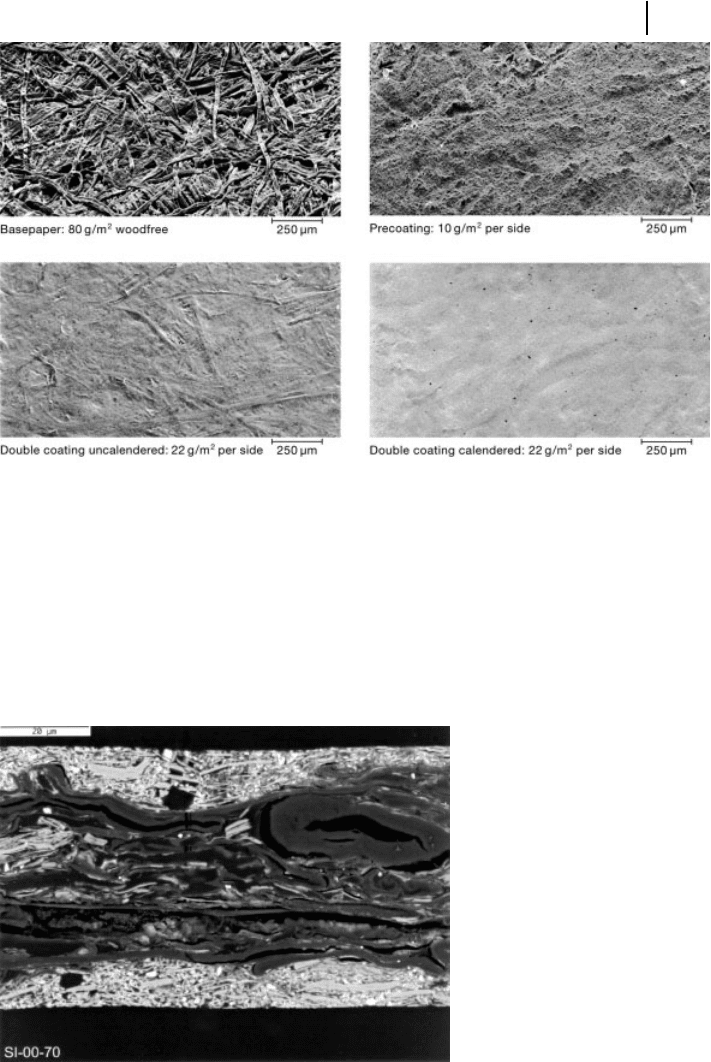
achieves an additional quality gain by enhancing smoothness and gloss. The re-
sulting surface is flat, with a minimum of irregularities. An electron microscope
picture of a microtome cut from a coated paper sample is shown in Fig. 7.2. In the
center of the sheet, the fibers can be seen. The lighter and more densely packed
structure on the outside of the paper sheet is the pigments of the coat layers. The
Fig. 7.1 Comparison of base paper, precoat, topcoat uncalen-
dered and topcoat calendered (source: Omya).
Fig. 7.2 Microtome cut of a coated paper sheet (source:
Voith).
7.1 Objectives of Coating
333

caliper of the coat layer varies according to the changing thickness of the base
sheet. The surface is smooth so, by coating, paper and board can be upgraded to a
higher quality level with added value. Furthermore, raw material costs are also an
important factor of coated papers and coating colors are in most cases cheaper
than chemical or mechanical pulp. So an optimum ratio of coating layer/fiber web
has to be found.
7.2
Requirements of Coated Papers for the Printing Process [1, 2, 4, 7–10]
Printed matters are used for advertising, news and information, transactions, edu-
cation, and entertainment. Here they are in competition with other communica-
tion media, such as radio and television, and the internet. Printing on packaging
paper and board has the functions of advertising, delivering information, and
showing data such as barcodes. So paper and board have to maintain their com-
petitiveness through continuous product development strongly supported by coat-
ing technology as a prerequisite for excellent print quality.
7.2.1
Printing Methods and Printing Ink Properties
For the various printing methods and the press constructions the major press
variables are paper feed, paper take-off, and drying. Table 7.1 shows the major
classes in different types of printing for different types of presses with the primary
product categories for each type of press. Offset printing methods comprise news-
paper offset, heatset offset and sheet fed offset. Newspaper offset printing today is
mainly coldset offset which needs no drying capacity in the presses. Web fed maga-
zine offset is heatset. Here drying is done by hot air. The type of paper feed relates
to the scale of printing and the paper or board basis weight. Large scale printing
and printing on low basis weight substrates is web fed.
The type of drying correlates to the demands that the printing method places on
the ink properties and the desired quality level of the final product. Inks that
contain a large proportion of solvent such as gravure, flexographic, and heatset
offset inks are typically dried through evaporating the solvent by air flow. Depend-
ing on the air temperature, drying may be done by “hot air” as in heatset offset,
“warm air” as in gravure, or “cold air” as in flexographic printing. The drying
mechanism can also be a function of the ink, as in oxidizing and polymerizing
inks. Polymerizing inks are mainly used in sheet fed offset, but it is likely that their
use in web fed printing will increase. News inks do not really dry during the one
day lifetime of newspapers.
The steps during printing include transfer of the ink to the plate, its transfer to
the receiving substrate or paper, and print drying. Mechanical printing uses the
rotary principle. This means that printing ink is transferred to the paper in a nip
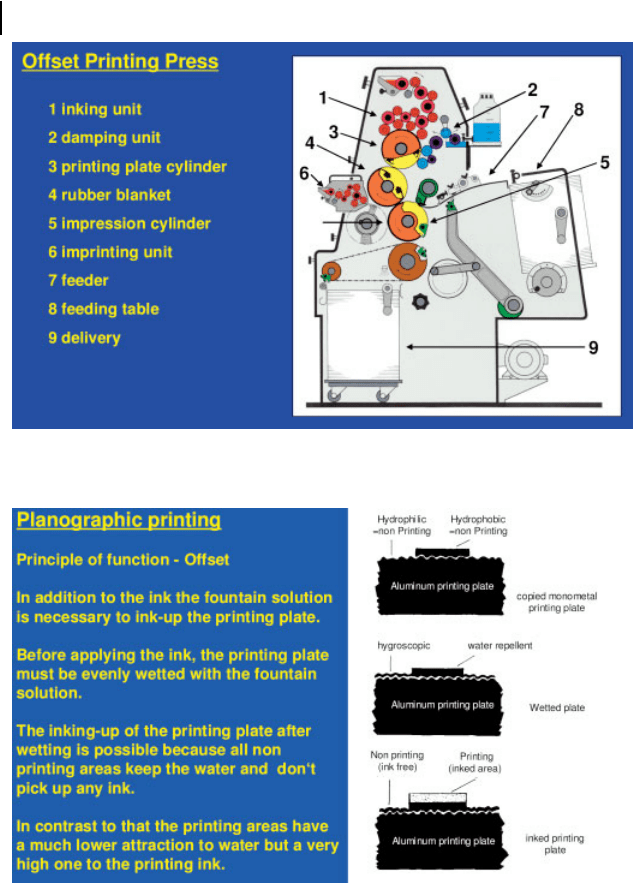
between two rotating cylinders (Fig. 7.3.). Ink transfer between flat surfaces or a
7 Coating of Paper and Board334

flat surface and a roller has also been used in the past. As the achievable speed is
less than in rotary printing this kind of printing has become obsolete.
In offset printing the ink is transferred to the paper from the printing plate using
a separate transfer cylinder – the offset or blanket cylinder. The characteristic of an
offset plate is, that the printing areas (image areas) and nonprinting areas (non-
image areas) are in the same plane. The printing and nonprinting areas are gen-
erated via the different wetting properties of two coatings on the printing plate
(Fig. 7.4.). Before applying the ink, the printing plate must be evenly wetted with
the fountain solution. The printing areas attract the fatty ink and the nonprinting
areas attract the water.
In letterpress, flexography, and hot stamping, the printing and nonprinting areas
form a geometrical profile in the z-direction of the plate surface (Fig. 7.5.). The
printing areas are above the mean depth of the profile, and the nonprinting areas
are below. Letterpress and flexography (“flexo”) differ in the characteristics of the
Table 7.1 Different types of printing processes (source:
P. Oittinen, H. Saarelma, Lab. of Media Technology, Helsinki
University of Technology).
Printing method Paper in Paper out Drying
Letterpress
(newspaper printing)
Web Newspaper No drying
(books, business forms) Sheet Sheet No drying
Web Form No drying
Web Book No drying
(small scale utility printing) Sheet Sheet No drying
Newspaper offset
(books, directories, business forms)
Web Newspaper,
book, form
Cold set; no drying
(normally)
Heat-set offset
(magazines, catalogs)
Web Cut & folded
sheet
(= signature)
Hot air drying
Sheet fed offset
(special interest magazines,
advertising, books)
Sheet Sheet No drying or UV-drying or
IR-drying
Gravure
(magazines, catalogues, packaging)
Web
Web
Signature
reel (Packaging)
Warm air drying
Newspaper flexo Web Newspaper No drying
Packaging flexo
(solid board, corrugated board,
paperback books, plastic films)
Sheet
Web
Sheet
Web
No drying
(Absorbent substrates)
Warm/cold air drying
Silk screen Sheet
Web
Object
Sheet
Web
Sheet
Object
Different drying methods;
no drying/UV/IR
7.2 Requirements of Coated Papers for the Printing Process 335
plates and the inks. In flexo, the plate profile is higher, and its polymeric material
is softer than in letterpress. Flexographic inks are two orders of magnitude less
viscous than letterpress inks. Under nip pressure, a softer plate conforms more
easily and achieves more contact with a rough printing substrate. This process is
necessary for ink transfer actually to occur. Squeezing of the inks toward the edge
of dots or characters allows one to recognize flexography and letterpress.
Fig. 7.3 Offset printing press (source: BASF).
Fig. 7.4 Planographic printing – principle of offset process
(source: BASF).
7 Coating of Paper and Board
336
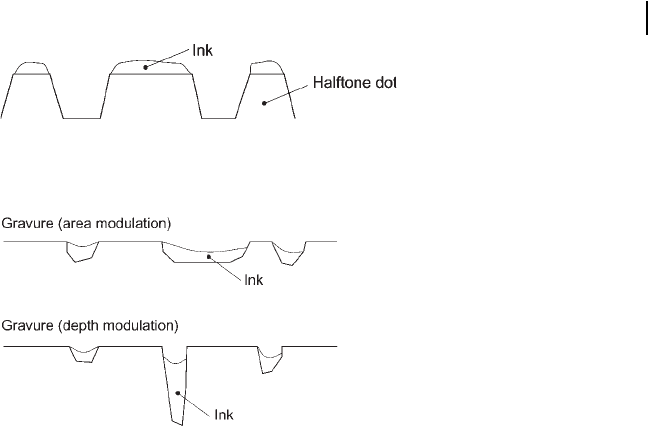
In the gravure technique, cells – a negative relief engraved or etched in a copper
layer on the printing cylinder – form the printing area. For better durability, copper
cylinders receive a subsequent chrome plating. Figure 7.6 shows that different
levels of darkness result in halftone image printing by varying the area of the cells
or by varying the depth of the cells. The two principles of gravure – area modula-
tion and depth modulation – are shown in a magnified cross direction view of the
printing cylinder.
Electronic printing – also synonymous with digital printing – consists of non-
impact processes. The printing methods differ considerably in the principles they
employ. Electrophotography is the most mature black-and-white nonimpact tech-
nology. In color technology photocopying was the impetus for early development.
Today high end color electrophotography challenges sheet-fed offset printing. At
the low end, higher complexity prevents color electrophotography from competing
with color ink-jet. The inks in electrophotographic printing are so called toners,
which are commonly powdered materials. The particle size is typically 5–10 mm
with a narrow size distribution. With an increase in resolution, particle sizes had to
be decreased. Approximately, the particle size is a fifth of a pixel size. Liquid toners
are applied when high resolution is required. Toner particles dispersed in a carrier
such as a kerosene-like solvent can be smaller than 1 mm. After transfer to the
paper, the carrier phase becomes superfluous. Toner particles consist primarily of
pigment to impart color, thermoplastic resins to bind the pigment to the paper, and
charging additives to enhance the charging capacity. Powdered toners are trans-
ferred by adhesive, electrical, and magnetic forces.
Fig. 7.5 Principle of letterpress and flexography (cross section
of a printing plate surface) (source: P. Oittinen, H. Saarelma,
Lab. of Media Technology Helsinki University of Technology).
Fig. 7.6 Two principles of gravure printing plates:
area modulation and depth modulation (cross section
of the printing cylinder surface) (source: P. Oittinen,
H. Saarelma, Lab. of Media Technology Helsinki University of
Technology).
7.2 Requirements of Coated Papers for the Printing Process
337

In ink-jet printing, a drop is the basic imaging element. Its principle is the gen-
eration of ink drops from a continuous stream of liquid emanating from a nozzle.
It needs very small nozzles through which the ink emerges in order to reach high
resolution. The ink should not clog the nozzles or form a crust when in the stand-
by state. In thermal DOD (drop on demand) ink-jet, rapid thermal gradients in the
heating period impose high demands on the thermal stability of the inks. A charac-
teristic of ink-jet inks compared with inks in other printing methods is that they
are very fluid. This is especially true for the continuous stream ink-jet method
where rapid drop formation requires viscosity near 1 mPa s. In thermal jetting,
viscosity is commonly less than 5 mPa s, 10 mPa s is the upper limit.
7.2.2
Properties of Coating Layer Surface versus Printing Method
The composition of the coating color is largely determined by the demands put on
the paper surface by the particular printing process. In the press room a faultless
runnability of the paper is demanded and the publisher asks for an excellent print
quality (printability).
Offset printing requires an especially well bound coat because considerable forces
in the z-direction (surface strength/pick strength plus internal bond) are exerted
by the highly viscous inks at the high printing speeds of today. To meet these
strength demands a high amount of coating binder is necessary. At the same time,
the coating must be sufficiently porous to permit fast, controlled absorption of the
printing ink without reducing the print gloss. Two further requirements are high
water resistance, and sufficiently fast absorption of the fountain solution. In gen-
eral, the coated paper must have adequate stiffness, resistance to blistering, good
dimensional stability, high brightness, no or low yellowing tendency, and good
aging resistance. The coated and printed paper has to be without waviness, mot-
tling and ink strike-through. Additional important printability properties are high
print gloss, even halftones, detailed tonal gradation, low ink consumption (high
density), sharp dots (controlled dot gain), fast ink drying for immediate process-
ing, controlled water/ink interference and low fiber roughening by the moistening
and the following drying process.
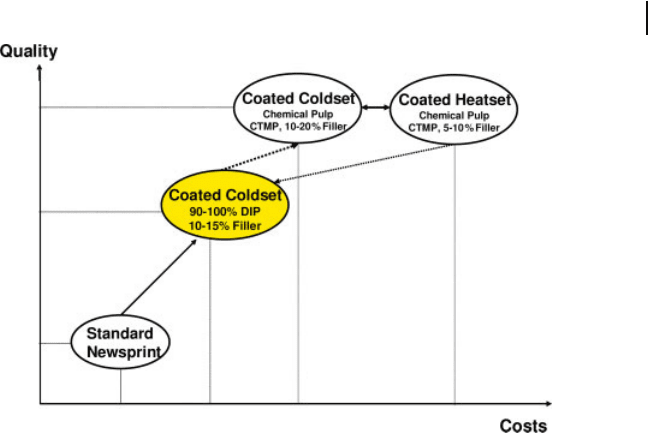
The importance of letterpress printing today is very much reduced by the cold-set
offset process, whereby most of the newspapers are printed. Conventional news-
papers are uncoated papers, based on recovered and deinked printing papers and/
or mechanical pulps. However, a coated surface of such a newspaper or another
base paper made from a relatively cheap furnish opens new applications for the
cold-set web-offset process with significant improved print quality and cost-per-
formance (Fig. 7.7).
Flexographic printing requires good ink absorbency, even fulltones without pat-
tern, high dot definition (no “shadow”), fast ink drying and good ink adhesion.
In rotogravure printing, the tensile forces between the printing cylinder and the
surface of the paper are very small, as solvent-containing, low viscous inks are
used. So rotogravure printing requires only very little pick strength of the paper
7 Coating of Paper and Board338
surface. For this reason, only a relative low amount of coating binder is needed.
For rotogravure printing good paper compressibility, a high degree of smoothness,
and adequate receptivity for the ink solvent are important.
Further important criteria for paper and board grades used for packaging in-
clude low odor, flexibility, fold crack stability, glue-ability, and grease resistance.
Coated specialty papers require specific properties, such as alkali resistance (la-
bels), washability (wallpaper), and solvent resistance (silicone release paper).
In electronic printing the runnability of a paper is critical, because of the elec-
tricity involved. The electrical conductivity of the paper should be sufficient so that
excessive accumulation of electricity on the paper does not occur despite charge
removal conductors in printing devices. Accumulation of charges causes sheets to
adhere to each other leading to jamming. Image quality requires electrical re-
sistivity in the paper, because the paper must hold the electrical field during trans-
fer of the toner. These two factors determine the tolerance range for paper re-
sistivity. All toner particles should be transferred to the paper from the photo-
conductor to prevent accumulation after the erasure step. Accumulation would
cause a ghost image on the next print. With the rise in moisture content, resistivity
drops exponentially. If the paper is too conductive, the toner spreads sideways
causing loss in detail. The moisture content of paper is critical, as is friction.
Friction must be within a specific range since the transportation occurs commonly
by friction. The thermal conditions in fusing determine the requirements on the
dimensional stability of the paper and the strength of the surface. A lack of dimen-
sional stability can cause curl, cockle, and image depletion in duplex printing.
Fig. 7.7 Upgrading of printing papers and improving cost-
performance by selection of base paper furnish, coating and
printing method (source: BASF).
7.2 Requirements of Coated Papers for the Printing Process
339

Softening of the paper surface in fusing may cause adhesion on the counter roll,
loosening particles from the surface and leading to accumulation on the rollers of
the printer. Good toner adhesion requires surface-chemical compatibility of paper
and toner. With an increase in the resolution of printing and the related decrease
in toner size, the smoothness requirements of the paper surface become increas-
ingly important.
In ink-jet printing, ink and paper interact very strongly. Because of the fluidity of
the inks and their high velocity of impact on the paper, ink-jet papers require
characteristics that are matched with the inks and the drop volumes. This is espe-
cially true at the higher end of the quality level. Ink-jet papers must be smooth so
that drops impacting on the paper spread evenly. Sufficient and even porosity
composed of small pores is necessary to absorb the solvent quickly and to counter-
act the spreading tendency. Dyes are trapped close to the surface of the paper. This
can be aided by cationic dye fixatives in the paper which capture the anionic dyes
and allow the colorless vehicle to be absorbed into the paper or coating. The use of
aqueous inks places demands on the dimensional stability of ink-jet papers. Cock-
ling and curling tendencies are critical factors. The impact of drops on paper
causes enlargement in area, typically by a factor of two. This, as well as the need to
decrease drop size, constrain efforts to raise resolution, although the commercially
implemented levels keep going up and have exceeded 1000 dpi. Printed pixels are
most visible in light tones where they are far apart. The use of more than three
colored inks helps to reduce the solvent that is transferred to the paper in multi-
color printing. This means supplementing the three process colors cyan, magenta,
and yellow with additional color inks such as orange and green which also brings
the advantage of a wider color gamut. Further requirements for ink-jet printability
are fast ink drying, good tonal stability (no color shifting), no bleeding and no
feathering.
7.3
Requirements of Base Papers/Board for Coating [4, 7, 8]
7.3.1
General Aspects
Coated papers are classified as wood-containing or mechanical papers, and fine
papers, which are also called woodfree, or WF papers. Wood-containing papers are
made of a fiber furnish such as groundwood or other mechanical pulps. Recycled
fibers (RCF) are also currently an important and steadily growing raw material for
coated base papers. Woodfree papers are made of a fiber furnish of only chemical
pulp, or only very little mechanical pulp (no more than 10% of the fiber material).
Typical mechanical coated papers are LWC papers (light weight coated) and ULWC
papers (ultra light weight coated), MWC papers (medium weight coated) and
HWC papers (high weight coated). Art printing papers are typical woodfree coated
paper for the highest printing quality (Fig. 7.8). Coated folding boxboard (FBB) is
7 Coating of Paper and Board340
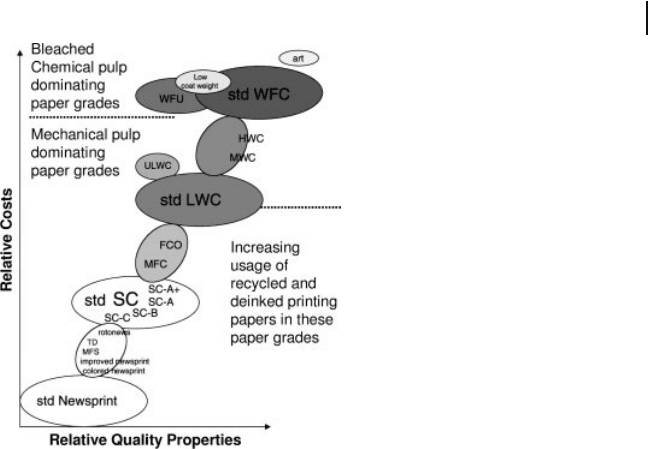
an example of coated board, which is used in selling packages for goods. In North
America and Japan there exists a classification system that is based on the bright-
ness of coated papers.
The base paper in coating must ensure trouble-free running of the coater, pro-
vide an optimal basis for paper finishing, and form a base for fixing the coating
layers demanded by the end users. The lower the basis weight the more important
are the properties of the base paper. Generally, the best coated paper surface is
achieved with the best and most uniform base paper. Variations in formation,
absorption, thickness, moisture, and roughness of the base paper have a great
influence on the properties and the uniformity of the coating layer. Nonuniform
coat weight distribution is the most important factor in generating uneven print
image, called mottling.
Further critical properties are paper web profiles in the machine and cross ma-
chine directions as regards basis weight, filler distribution, caliper and moisture.
The paper web has to be free from faults, holes and impurities, and have low fiber
roughening potential (for web offset grades), low porosity with a uniform pore
distribution, high smoothness, opacity and brightness, minimal two-sidedness,
sufficient tensile and tear strength, as well as sufficient stiffness. Stiffness is re-
lated to the bulk of the coated paper. Stiffness especially becomes a critical property
with low basis weights, high filler content and high coat weight, and in sheet
printing. By choosing coarse, bulky fibers, careful wet pressing and by calendering
as little as possible, bulk can be improved. In sheet-fed printing, the stiffness in the
cross machine direction is more critical. This can be influenced with fiber furnish
and by controlling fiber orientation with the jet:wire ratio in web forming.
Good internal bond strength is required both in heat-set web-offset (HSWO) and
sheet-fed offset. If the internal bond strength is good in HSWO, the blistering
Fig. 7.8 Range of printing papers
(quality versus cost) (source: Metso).
7.3 Requirements of Base Papers/Board for Coating
341