
Holik H. (ed.) Handbook of Paper and Board
Подождите немного. Документ загружается.


pack e.g. food, cigarettes, pharmaceuticals or cosmetics. Additionally a wide range
of specialty boards exists like artboard, gypsum board, playing-card board, book-
binders board etc. As the requirements for these board grades vary a lot the furnish
and the board machine design may differ accordingly. Some of the basic required
properties are:
• Mechanical properties like bending stiffness (bulk, Young’s modulus), to protect
the packed goods against damage.
• Flatness, plybond, creasability, punching, to ensure good runnability in convert-
ing and packaging lines.
• Resistance against moisture, gas and flavor, to protect the goods from quality
changes.
• Freeness from impurities like micro-organisms, toxic or mutagenous substrates,
taint or odor, to protect the goods against contamination.
• Brightness, gloss, roughness, printability of the surface, to ensure appealing
information, identification and promotion of the packed goods.
Paperboard mainly has a multi-ply structure to achieve the different product re-
quirements in the most economical and environmentally friendly way e.g. by ap-
plying various furnishes in the different plies. The surface plies (top and back
plies) have to ensure the strength properties (bending stiffness) and, together with
the coating, the required surface quality. With the inner plies (undertop and filler
plies) the bulk is optimized (affecting bending stiffness). Most cartonboards are
on-machine coated and calendered to obtain appealing surface characteristics.
Depending on the product and the geographic location of the board producer,
virgin or recycled fibers or both fiber types are used as raw material. In multi-ply
production the individual plies are formed on separate forming units and couched
together in wet condition. Forming of two layers in one forming unit is also done.
Different forming principles as described below have been and are applied either
uniquely or in combination with others.
In suction formers 3 to 11 cylinder formers in series with suction chambers
produce webs of about 25 to 100 g m
–2
each which are couched on a transfer felt,
thus building up the baseboard. The maximum speed is about 350 m min
–1
, the
maximum width is about 5 m. Cylinder formers without vacuum application are
limited to a maximum speed of about 150 m min
–1
.
In fourdriniers and hybrid formers each ply is formed on a separate fourdrinier
wire. Hybrid formers are used e.g. to produce the filler ply with the widest basis
weight range and highest basis weights which require extended dewatering ca-
pacity. The headbox and wire section have to be adapted to the high throughput
ratio and to the high surface quality requirements for coating and printing. The
maximum speed of a fourdrinier and of hybrid formers is about 1000 to
1200 m min
–1
.
As the fourdrinier wire sections have sufficient speed potential gap formers are
seldom used in cartonboard production. Nevertheless gap former installations can
be found for certain applications of specialty board like gypsum board.
6 Paper and Board Manufacturing322
The press sections of modern machines for cartonboard are designed for high
dewatering capacity, high bulk, smoothness and good runnability. This leads to
press concepts with typically three press nips, e.g. a first double-felted suction
press nip followed by a double felted shoe-press nip and finally an unfelted
smoothing press or a single felted roll press to enhance surface smoothness. Be-
tween the nips a closed web run ensures stable sheet transfer, independent of
speed and basis weight.
The dryer section consists of up to 100 drying cylinders in the pre-dryer section
and about 16 in the after-dryer section. One or two single-tier groups are followed
by double-tier drying groups. For good flatness of the finished product the top and
the bottom cylinder rows are heated separately to control curl tendency.
Starch or size can be applied in a film press or a pond size press to enhance
surface strength and bending stiffness. In this case an after-dryer section is re-
quired for baseboard drying.
Before coating, the roughness of the baseboard has to be reduced by calender-
ing. In modern board machines this is done by a heated hard-nip calender. As an
alternative soft-nip calenders can be used for reduced densification. The latest
development is the shoe-nip calender which combines long dwell time, low spe-
cific pressure and high roll surface temperature to achieve minimum roughness at
lowest densification. In Europe for machines below about 650 m min-1 the use of
a MG (machine glazed) cylinder is state of the art for high bulk, low roughness
board production. As the entering web dryness (about 60 to 70%) and exiting
(about 70 to 75%) web dry content is crucial for smoothness and bulk of the
baseboard the MG cylinder is often the bottle neck for machine speed increase.
Most likely it will be replaced in future by the shoe-nip calendering technology
(Section 6.9).
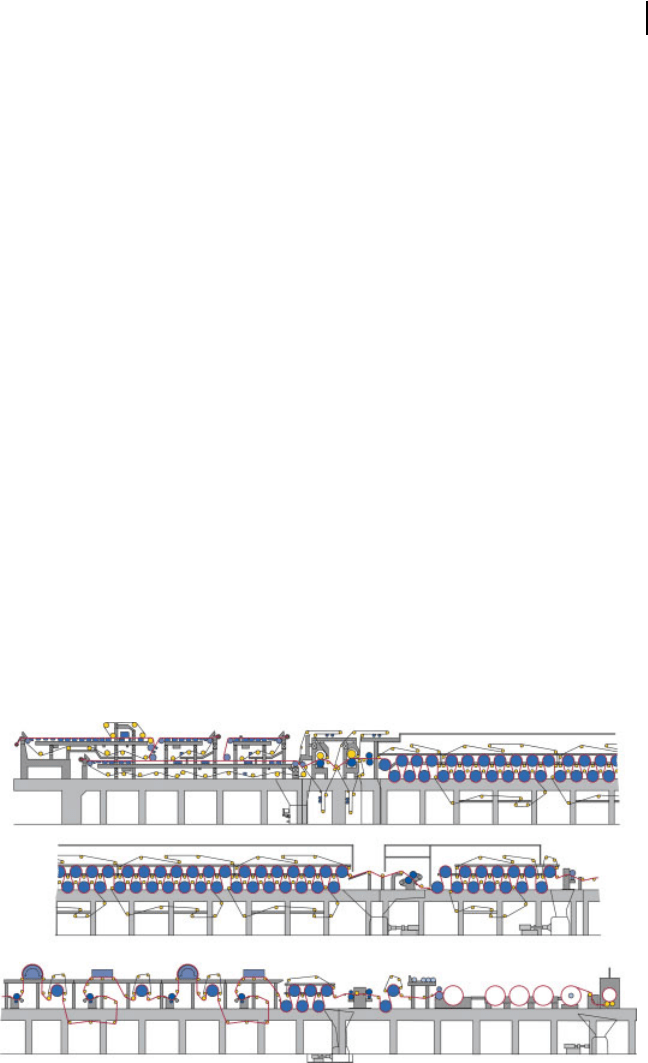
Fig. 6.83 State-of-the-art machine for board production
(source: Voith).
6.11 Paper and Board Machines
323

Virgin-fiber based cartonboard is mainly double coated on the top side and un-
coated or single coated on the back side. White-lined chipboard made of recycled
fibers is mainly triple-coated on the top side and uncoated or single-coated on the
back side, each layer with special tasks and coating formulations. Coating is done
by roll applicators or by free jet applicators for highest surface requirements and
machine speeds.
Final cartonboard post-calendering is mainly done with soft-nip calenders. The
Pope reeler can be used for reeling up to 3.5 m diameter, reelers with center torque
are applied for diameters of up to 4 m. A state-of-the-art board machine (Fig. 6.83)
with on-line coating and final calendering has a length of up to 350 m.
6.11.4
Tissue Machines
The bases for hygienic products are tissue grades with basis weights of 5 to
35gm
–2
. Consumer demands drive the tissue industry to ever more softness and
absorbency of the tissue grades used e.g. in the bathroom (toilet, facial) or in the
kitchen (towels). Softness can be increased by the proper selection of fiber furnish
and chemical additives or the proper machine concept and operation e.g. by low or
no wet pressing. On the other hand sufficient paper strength and economy of
production have to be regarded.
In former times tissue was made – and is still made in many places – on four-
driniers, later followed by suction breast rolls (Section 6.3.4) and since the 1970s by
gap formers. Since the 1990s the so-called crescent former is the most accepted
system. Today’s tissue forming section is a roll former where the headbox jet is
deposited in the wedge between two converging fabrics. One-, two- or even three-
layer headboxes are used, the latter for stratification of the tissue. The converging
fabrics can be either two forming wires or a forming wire and a felt (crescent
former). In this case the felt transfers the web directly to the dryer section. Web
formation is completed during the contact of the wire(s) on the forming roll. The
wire run in the forming section may be designed as a C-wrap or an S-wrap with the
headbox placed at the top or bottom position in both cases.
The dryer section in tissue machines consists of
either
• one large diameter tissue cylinder with an air impingement hood, where the web
is completely dried within less than half a second, and creped
or
• a tissue cylinder with air impingement hood where the web is only dried up to
about 70 to 80%, then wet creped and finally dried in a conventional after-drying
section
or today for high quality tissue production
• a through air dryer, which dries the web up to about 70 %, followed by a tissue
cylinder.
6 Paper and Board Manufacturing324
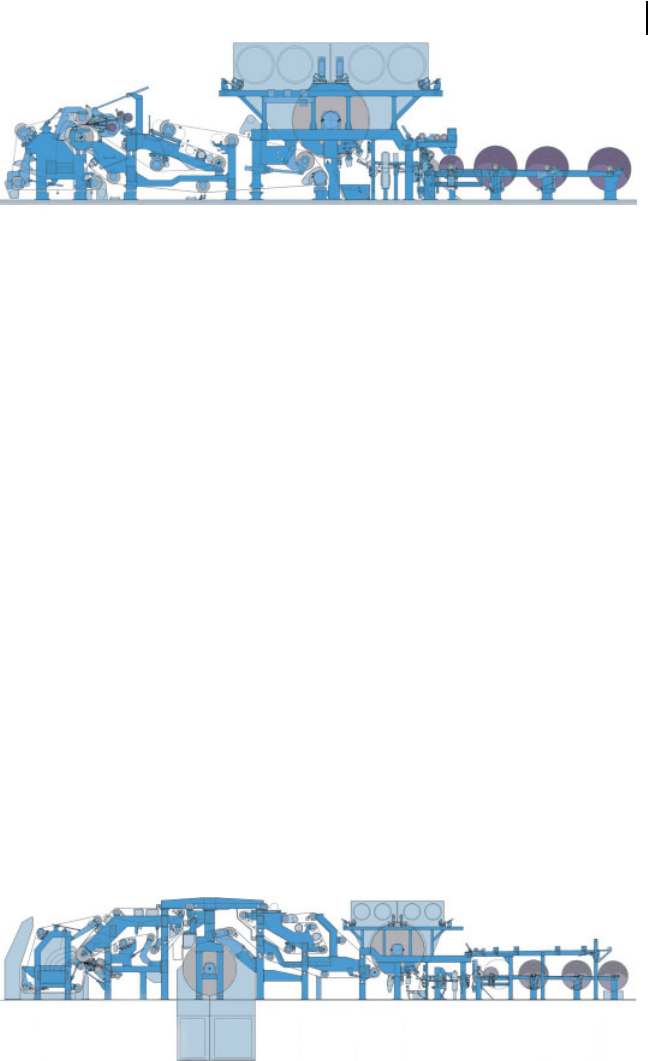
In a state-of-the-art conventional tissue machine (Fig. 6.84) the web is formed in a
gap former (wire plus felt), transferred (at a dry content of about 12 to15%) by the
felt to the dryer section where it is first pressed and mechanically dewatered (up to
about 38 to 40% dry content) by a shoe press acting against the tissue cylinder. In
older machines dewatering is done by one or two press rolls, one of them being a
suction press roll. The web is dried, by intense contact and impingement heating,
to about 95% dry content. Here the hood contributes up to about 60% of the
overall drying capacity. The web is then creped by a creping doctor and wound up.
During creping the web is reduced in length by about 10 to 20%.
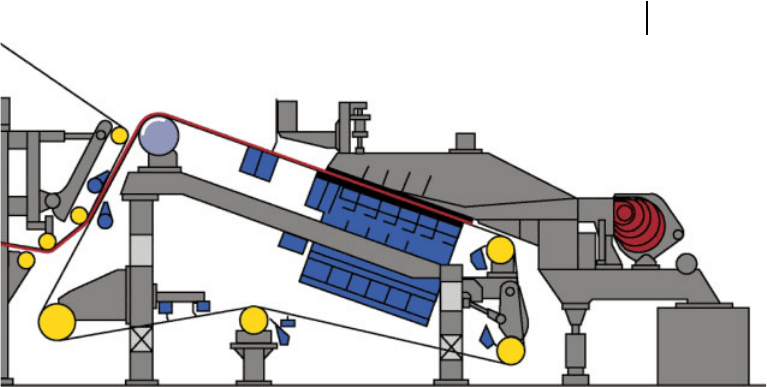
In a tissue machine for premium soft tissue production (Fig. 6.85) the formed
web is first dewatered and pre-dried (to about 70 to 80% dry content) in a through
air dryer without mechanical pressing. Here the through dryer replaces the press
nip dewatering in order to preserve the bulk. On the other hand this results in
substantially higher energy consumption for drying. The web is then transferred,
pressed and glued to the drying cylinder. The pressing impacts the web, mainly
locally, according to a special surface pattern of the transferring wire. Coating
agent application ensures good sticking of the web to the cylinder surface to obtain
the required characteristics at creping. Web length decrease by creping in this case
is only about 5%.
Finally the web is calendered off line for web caliper control and for surface
smoothness. The line load is low in order not to lose too much bulk.
Compared to other paper machines tissue machines are compact as regards
their widths (maximum 7.9 m) and lengths which are about 45 m for conventional
machines and about 60 m for a machine equipped with a through air dryer. Tissue
Fig. 6.85 Tissue machine with through air dryer for extra soft
tissue production (source: Andritz).
Fig. 6.84 Conventional tissue machine (source: Andritz).
6.11 Paper and Board Machines
325

machines are the fastest paper machines with a maximum speed today of about
2200 m min
–1
(in the forming section). Maximum production capacity is about
100 000 tpa.
6.11.5
Specialty Paper Machines
Peter Mirsberger
The category of specialty papers defines a very wide range of different paper grades
with a wide variety of specialized end uses and thus different and particular quality
demands. These require special production technologies and specific know-how.
Some of the required properties are very common and similar to commodity pa-
pers, but they are usually more distinct or with a closer tolerance. Such character-
istics include profile quality, formation, smoothness, strength, thickness, porosity,
and absorption. Some are very particular characteristics, such as wet strength,
electrical conductivity, pore size distribution, resistance to certain chemicals,
chemical reactivity, light proofness, heat resistance, and cleanliness.
Often specialty paper grades like photo, cigarette or label papers are cut into
small formats. Here the basis weight profile as well as the fiber orientation must
be as uniform as possible across the width so dilution water technology in the
headbox for CD profile control is standard on most paper machines for specialty
paper grades. Other important quality characteristics of specialty papers are MD/
CD tensile ratio and dimensional stability. Decor, inkjet and label papers for exam-
ple absorb a large amount of water during laminating, printing or gluing. Fibers,
however, swell in width more than in length when wetted. To achieve the best
dimensional stability the fibers of the sheet should be randomly oriented to obtain
a “square sheet”, i.e. the lowest possible MD/CD tensile ratio is required.
Not only are the quality requirements various but also the production of spe-
cialty papers covers a wide range of speed and basis weights. The basis weights
extend from 12 g m
–2
for tea bag paper up to 300 g m
–2
for specific photo base
papers. The speed range extends from 40 m min
–1
for banknote papers up to
1400 m min
–1
for thermal base paper, for example. Often, different grades are
produced on the same paper machine. Further characteristics are small tonnages
per grade, many grade changes and a dynamic grade development, i.e. new grades
are developed which can cope with new market demands, other grades disappear
from the market due to lack of demand. So flexibility is a key word – not only for
the production of these papers but also for the paper machine concepts.
The base sheet forming concept for specialty papers is the fourdrinier. It can be
used for the whole basis weight range and up to a machine speed of about
1200 m min
–1
. In order to achieve best results concerning formation and dimen-
sional stability Dandy rolls or hybrid formers and effective wire shaking units are
frequently used. New machines however can exceed the speed limit of fourdri-
niers, so gap former concepts are used in this case.
The basic raw material for specialty papers is wood pulp. There are however
grades like tea bag, plug wrap or filter paper where the required porosity, absorb-
6 Paper and Board Manufacturing326
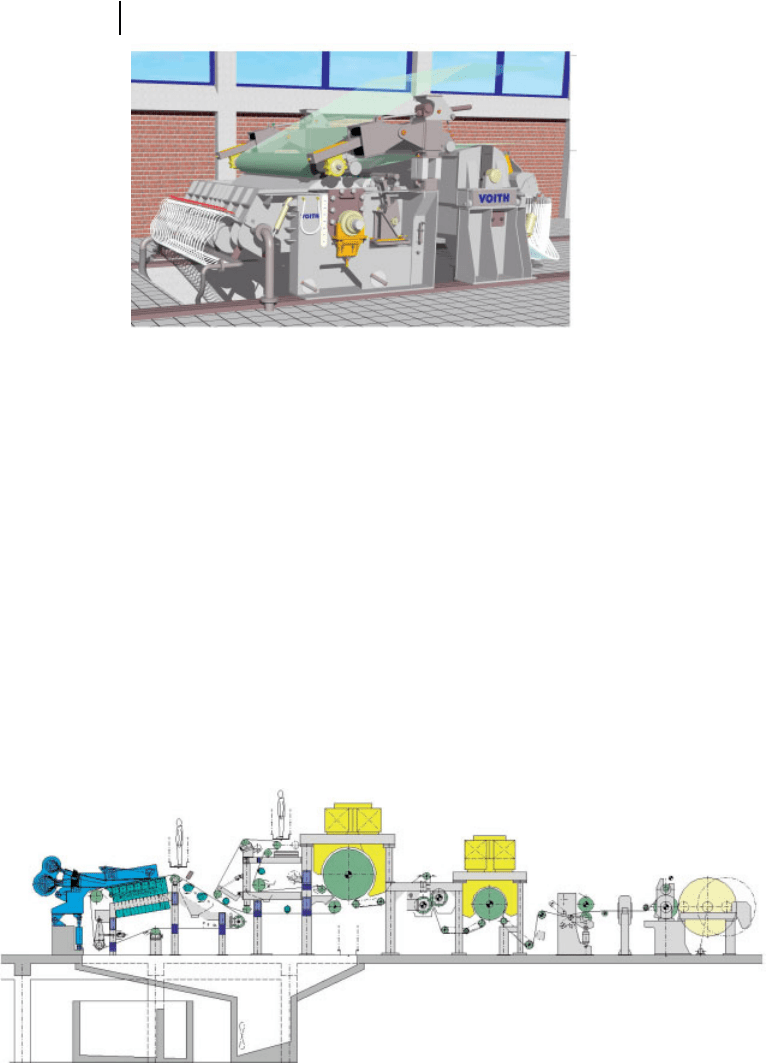
ency or bulk can only be achieved by using special plant fibers like abaca, sisal or
hemp or even synthetic fibers like rayon. These fibers are much longer than wood
pulp fibers. Due to their length and the demand for best formation and uniformity,
even at lowest machine speeds, the inclined wire sheet forming technology is used
for theses grades (Fig. 6.86). Extreme dilutions are necessary in order to avoid
reflocculation of the fibers and headbox consistencies even below 0.01% are run.
Overlay papers for high abrasion resistant surfaces such as flooring laminates are
produced with embedded fillers (up to 30% aluminum oxide) on a three-layer
former.
Another “old fashioned” well proven sheet forming technology which is found
in specialty paper production only is the cylinder mould former (Fig. 6.87). This
sheet forming technology is still used for the production of cotton based banknote
paper. The paper production on a cylinder mould former enables the application of
three key security features:
• The use of cotton as raw material gives the paper a unique feel.
• The multi-tone watermark has a wide tonal range going from light through a
number of shades to dark.
• The security thread can be fully embedded or windowed, i.e. the thread appears
at intervals in the surface of the banknote.
These security features together with more than a 200 years old tradition and
know-how make the cylinder mould former and cotton-based paper still the best
choice for banknotes.
The press sections in specialty paper machines need to be highly flexible. For
paper grades where only one smooth side is required, multi-roll press concepts
with two or three press nips and a closed sheet run can be used. For increased
dryness and improved runnability these press concepts can be equipped with a
Fig. 6.86 Inclined-wire forming technology (source: Voith).
6.11 Paper and Board Machines
327
shoe press. For grades like inkjet or bible paper low roughness figures on both
sides are required so a bottom-felted straight through press is added in order to
reduce the roughness on the top side and to control the roughness two-sided-
ness.
Depending on the requirements, all available drying concepts are used for the
production of specialty papers. The most common concept is the double tier ar-
rangement. Fast machines are equipped with single-tier dryer groups for improved
runnability. When highest smoothness and gloss values on only one side or low
CD elongation at rewetting for best dimensional stability are required, the wet web
is dried on a Yankee cylinder. If high bulk or high porosity is a must, as it is for
filter or tea bag papers for example (Fig. 6.88), the web is dried on a through air
dryer.
Specialty papers can be divided into uncoated and coated grades. The uncoated
grades are either machine finished, like cigarette papers or base papers for sub-
Fig. 6.88 Machine with inclined wire former and through air
dryer for tea bag paper production (source: Voith).
Fig. 6.87 Cylinder mold forming technology for banknote
paper production (source: Voith).
6 Paper and Board Manufacturing
328

sequent value adding off-machine process stages such as for photo base paper.
Coated grades can be subdivided into two groups:
1. Where the coat is needed for a certain special function, such as thermal or
carbonless papers.
2. Where the coat is needed for improved printability, such as label or cast coated
papers.
In both cases the base sheet is normally pre-coated on one or on both sides. By pre-
coating, the functional coat weight can be minimized or the final surface quality
can be improved. The most suitable and economical applicator for the pre-coat is
the on line film press. Both sides of the sheet can be coated simultaneously and
different applications are possible.
The application of the functional coat is more demanding. For coated commod-
ity grades, the quality generally increases with increasing coat weight. For coated
specialty papers like thermal or carbonless paper, however, the quality does not
improve further once a certain coat weight for the functional coat is reached at any
point. The optimum concerning uniform coverage and minimum coat weight is
achieved with the curtain coater: a perfect layer of coating color is applied on the
surface without any mechanical impact on the paper. Since the first commercial
installation in the mid-1990s the significant advantages of curtain coating have led
to more than 20 units being installed within the last 10 years. Due to better flex-
ibility and time efficiency the functional top coat is applied off line.
There is no typical calender concept for specialty papers. Each of the different
specialty paper grades has its own demands with regard to surface properties,
smoothness, densification, caliper, porosity, transparency, etc. Calendering of spe-
cialty papers, therefore, requires specific customized calender concepts. Thermal
base paper, carbonless and label paper are pre-calendered usually with one soft or
hard nip calender. For coated inkjet papers, two soft nips are necessary – one for
each side. The smooth surface of decor papers is achieved using calenders with
two or four soft nips. Here the printed side of the decor paper is in contact with the
heated roll surface up to four times, supported by steam application as well. A
combination of one hard nip for pre-calendering and a multi-nip calender stack for
the final calendering is used for photo base paper. Silicone base paper has the
highest demands concerning densification. The paper has an initial moisture of up
to 16% before running through 14 nips of a supercalender, the rolls of which are
heated up to 180 °C and loaded up to 400 N mm
–1
.
References
Section 6.4.1
1 U. Weise, J. Terho, H. Paulapuro, Stock
and water systems of the paper machine,
in Paper Making Science and Technology,
Book 8, Paper Making Part 1, Stock Prepa-
ration and Wet End, Fapet OY, Helsinki,
2000, Ch. 5, p.1.
2 A. Gommel, Advanced Wet End Process –
A New Engineering Concept for Approach
Flow Systems, Proceedings 28
th
EUCEPA
Conference, Lisbon, 2003, Session 3, p.126.
3 P. O. Meinander, Compact Wet End Sys-
tems are Proven State of the Art – Experi-
ence of Sixteen Installations, Proceedings
References
329

Scandinavian Paper Symposium 2002, Paper
8, p.1.
4 G.Ortner, OptiFeed-Konstantteil-Konzept,
Wochenblatt Papierfabrik. 6, 2004, 6, 280.
5 A. Fladenhofer, Stoff- und Wasserführung
bei Karton- und Verpackungspapierma-
schinen – Weniger ist oft mehr, Wochen-
blatt Papierfabrik. 2001, 17, 1102.
6 A. T. G Giorgis et al., Concentric mixing of
hardwood pulp and water, TAPPI Journal,
May 2004.
Section 6.10
W. Kaipf, Sensoreeling Technologie, Wochen-
blatt Papierfabrik. 19/1999, 19, 1246–1250.
O. Rudolph, M.-O. Stenitschka, Moderne
Wickeltechnik für den All-Online-Produk-
tionsprozess, ipw 6/2001 Science and Tech-
nology. Das Papier pp. 82–87.
D. R. Roisum, The Mechanics of Winding,
TAPPI Press, Atlanta, 1994.
Further Reading
Papermaking Part 1 and Part 2, Vol. 8 and 9 of
Papermaking Science and Technology, Ser.
Eds. J. Gullichsen, H. Paulapuro, ISBN
952-5216-00-4, Fapet Oy, Helsinki (Fin-
land), 2000.
R. Wiedeburg, information from Voith Tech-
nology Data Collection.
M. Schwarz, A. Gmeiner, Wet End Process
TM
– new technology solutions around the pa-
per machine wet end, twogether-Paper Tech-
nol. J. Voith Paper, 2000, 10, 7.
T.-Y. Hsu, T. Wei, Generation of streamwise
vortices in a slice knife model: can streaks
be generated at the slice exit?, TAPPI Jour-
nal, March 2004.
H. Holik, H. Hess, M. Tietz, Fluid mechanics
in the headbox – the key to improving pa-
per quality, TAPPI Engineeering Conference
Proceedings, San Francisco, September 1994,
p. 247.
R. Bluhm, A. Bubik, H. Holik, Multi-layer
and multi-ply paper production, EUCEPA
Conference Proceedings, Harrogate, May
1988, p. 161.
M. Kuoppamäki, A. Leinonen, H. Korhonen,
Forming developments for high-quality
LWC grades, Das Papier 2003-T39 pp.
H. Moser, V. Schmidt-Rohr, J. Grabscheid, W.
Eckl, DuoFormer TQv – a new twin wire
former, twogether-Paper Technol. J. Voith Pa-
per 2000, 10, 17.
J. Kenny, Forming advances promote better
clothing, Solutions! April 2003.
C. Kershaw, U. Berg. H. J. Struck, “Edge trim
installations in forming section: require-
ments – operation – performance, ipw
6/2004 pp.56.
H. Vomhoff, J. Gullbrand, New insights in
the mechanisms of rewetting, Das Papier
2004, T194 pp.
V. Lobosco, A rheological model of the fibre
network in wet pressing, Licentiate Thesis,
STFI Stockholm, December 2000.
J. Atkins, Single.nip shoe press: the single
choice, Solutions! July 2002, p.40.
T. Augscheller, Anwendung eines Ein-Nip-
Pressenkonzepts, Das Papier 2004, T203 pp.
R. Hansen, Precision engineering for the
press section, ipw 2003, 5, 22.
M. F. C. Lucisano, J. B. Petrini, A. R. Martin,
The role of evaporative dewatering in im-
pulse pressing, TAPPI Journal, March
2003.
H. Ruff, DuoCleaner – the optimal fabric and
felt cleaning system, twogether-Paper Tech-
nol. J. Voith Paper 2000, 10, 22.
T. Schlieckau, R. Mayer, New drying technol-
ogy for highspeed paper machines, iwp
2005, 1, 8
B. Johansson, New impingement dryer, ipw
2005, 1,18.
C. Haase, K. Ponweiser, More on impinge-
ment drying, ipw 2005, 1
, 21.
J. Nastrom, M. Soucy, G. Wedel, Advanced
stationary siphon system drives value to
the bottom line, Pulp & Paper Canada 2003,
104(5), T118.
J. Bottiglieri, Pushing performance limits
with dryer fabrics, Solutions! November
2003.
K. Juppi, J. Kaihorvirta, The effect of the
dryer section on paper quality, Pulp & Paper
Canada 2003, 104(5), T 131.
O. Timofeev, J. Keränen, H. Kiiskinen, Paper
curl induced by drying, Pulp & Paper
Canada 2002, 103(8), T 204.
J. Huyn, Ventilation measures in the paper
industry to reduce energy costs, illustrated
by an optimisation concept, ipw 2004, 2,
29.
X. Zou, D. Vidal, Film press for pigment
coating: a review, Pulp & Paper Canada
2003, 104(3), 25.
H. Holik, H. Hess, W. Schuwerk, CD caliper
control in calenders, TAPPI Engineering
References
330

Conference Proceedings, Atlanta, September
1989, p.95
D. W. Kawka, R. H. Crotogino, W. J. M. Dou-
glas, Effect of geometry and thermal
boundary conditions on calender roll ther-
mal deformation, TAPPI Journal, Decem-
ber 2002
D. W. Kawka, R. H. Crotogino, W. J. M. Dou-
glas, Effect of temperature and moisture
content on paper behaviour in the nip,
TAPPI Journal, December 2002.
D. W. Kawka, R. H. Crotogino, W. J. M. Dou-
glas, Calendering model for CD control,
TAPPI Journal, December 2002.
R. Burnett, S. J. l’Anson, The nature of
strength reduction when newsprint is cal-
endered, TAPPI Journal, March 2003.
P. Svenka, Die richtige Glätttechnik für gute
Bedruckbarkeit, Das Papier 2005,
T46 pp.
U. Begemann, Ausgewählte Aspekte der Be-
und Verdruckbarkeit aus Sicht des Papier-
maschinen-Lieferanten, Das Papier 2005,
T37 pp.
R. Banecki et al., Full-scope Papermaking So-
lution for Coated Magazine Papers, iwp
2005, 1, 34–39.
J. Atkins, The modern paper machine, Part 1:
bigger, better board machines, Solutions!,
November 2003, p.30.
J. Atkins, The modern paper machine, Part 2:
coated and fine paper, Solutions!, December
2003, p.31
M. Feichtinger, Blattbildungskonzepte für
Kartonmaschinen – Anforderungen und
Lösungen, Das Papier 2003, T30 pp.
A new quality concept in magazine paper!,
ipw Sonderausgabe April.
2004STORAENSO Langerbrugge Special,
special issue apr and ipw 2003.
Palm PM 6 in Wörth: Die weltgrößte Papier-
maschine, Sonderausgabe der apr, 2002.
B. Stützle, B. Kohl, Neuentwicklungen zur
Leistungssteigerung graphischer Papierma-
schinen, Das Papier 2004, T47 pp.
J. Atkins, A beginner’s guide to towel and tis-
sue, part 1 and part 2, Solutions!, Septem-
ber 2004, p. 32 and November 2004, p.30.
References
331