
Holik H. (ed.) Handbook of Paper and Board
Подождите немного. Документ загружается.


temperature increases. In this printing method, printing ink is dried by external
heat, while at the same time the remaining water in the base paper starts to evapo-
rate. If the internal strength and formation are poor, steam pressure inside the
paper web can rise locally causing bubbles, which is called “blistering”. No crack-
ing in the fold is very important in high-quality printed jobs with colorful printing.
The cracking tendency is higher with stiff mechanical pulp fibers (e.g. TMP) than
with chemical pulp fibers, but it remains a problem in WF papers – especially
those with high basis weights. Folding properties can be affected by pulp refining,
by pulp and pigment types, and by the amount of starch used in the coating
formulations.
The base sheet of board mostly consists of several layers (multiply), therefore
sufficient ply bond and crack fold are additional important parameters, besides a
uniform and bright surface, to achieve a good quality of coated board.
7.3.2
Specific Base Paper Properties Affecting Coating
Base paper characteristics have a strong effect on the quality of coated paper and
board and process economy. The main properties are as follows:
Strength Properties: To guarantee a good runnability of paper web in coating
different strength properties are needed. Because base paper is wetted in coating
units, it requires good temporary wet strength. Wet tensile strength, in principle, is
measured using similar methods as for measuring tensile strength, but the sample
is prepared differently. Other strength properties related to coating are tear strength
and edge tearing resistance as well as bursting strength
Basis weight, caliper, and moisture profiles in the cross and machine directions:
These have a strong influence on the uniformity of coating, e.g., calendering very
often controls caliper, which means that in the cross direction some parts of the
web are pressed more than others to reach a uniform caliper profile. These more
compressed parts will differ in porosity and smoothness of base paper, which
affects the coating amount. Caliper before coating can be measured on-line for
control. Basis weight variations usually cause caliper variations, they can be seen as
streaks in the machine direction. Moisture variation will affect coating amounts
with risks of wrinkles if moisture variations across the web are high. High mois-
ture before coating can affect coating color penetration and the gloss of coated
paper and, subsequently, ink settling in printing.
Porosity: If porosity is very high, absorption of coating is also high and coating
weight can increase dramatically and drying problems may also occur.
Formation: This property refers to small-scale basis weight variations in paper.
There are areas that are denser and less absorbent to the coating than other areas.
To reach uniform coating penetration, base paper requires even formation, other-
wise mottling may occur in printing.
Smoothness: Smooth base paper gives a uniform and closed coated surface. The
various coating processes have slightly different smoothness requirements. Air
knife coaters require a relatively smooth surface because, in that method, coating
7 Coating of Paper and Board342

is applied in a layer of rather uniform thickness, regardless of the base paper
contour. The blade coaters’ coating film fills the cavities and leaves the high spots
uncovered.
7.4
Principles of Coating Techniques for Paper and Board [1, 3, 4]
Historically, papers used to be coated in much the same way as painting a wall: the
color was applied and distributed with a brush, then dried and smoothed. The
process has remained essentially unchanged to the present day, although it has
undergone major improvements over time. Today, roll or jet applicators are em-
ployed instead of a brush, and the color layer is leveled out using either a pneu-
matic or mechanical system, such as a blade or a metering bar. The moist sheet
then passes between infrared dryers before being conveyed to high-temperature air
floats and/or drying cylinders.
In principle, coating can be divided into different phases:
• Application of the coating color onto the base paper. Surplus of coating color is
applied in several coating methods (existing coating systems are shown in Sec-
tion 7.10).
• Metering of the coating (metering may take place before, during or after the
application).
• Drying of the coating.
• Smoothing of the surface e. g. by supercalendering or soft calendering.
Pre-metering, or metering before application takes place, e.g., in the metered size
press (MSP) and in the gate roll press. Simultaneous metering or metering and
application take place at the same time in the short dwell time applicator (SDTA)
and in the conventional size press. Post-metering, or metering after application
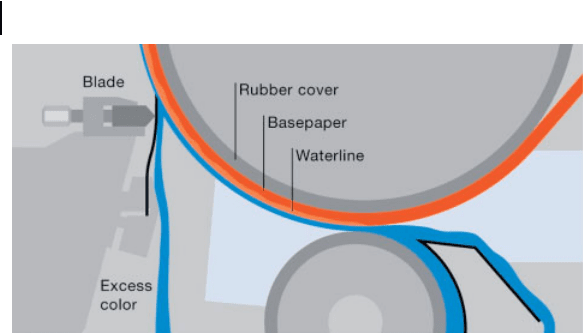
takes place in the blade coater, in the rod coater, and in the air knife coater. Figure
7.9 depicts a schematic arrangement of backing roll, roll applicator and doctor
together with the coating base. The applicator roll runs at a slower rate than the
paper sheet and applies a generous amount of color (20–30 times in excess) to the
base paper. After wetting the base paper, the waterline migrates into the coating
base. This penetration is assisted by hydrodynamic pressure building up in the nip
as a result of the web speed. Consequently, the kinds of application and metering
characterize the various coating methods. In both the metered size press (MSP)
and in the gate roll press, metering takes place on the surface of a roll, and the
coating film is then transferred onto the paper in the nip between two rolls.
Coating can be done double-sided, i.e., both sides of the paper are coated simul-
taneously (e.g., MSP), or on only one side at a time. Printing papers are usually
coated similarly on both sides, and boards often on one side only.
Single coating means that only one coating layer is applied per paper side, in
multiple coating several coating layers are applied per paper side. The most com-
mon multiple coating is double coating. So-called art papers may be triple-coated,
i.e., three coating layers per paper side.
7.4 Principles of Coating Techniques for Paper and Board 343
If coating is done on-machine, then the coating will immediately follow the
manufacturing of the base paper without intermediate reeling. Off-machine coat-
ing means that the paper is reeled after the paper machine and coating is done in a
separate machine. Web defects may be removed during re-reeling.
During coating the following effects occur:
Liquid is removed from the color, which then adheres to the base paper. As the
liquid phase strikes into the base paper, water containing dissolved substances and
other color components (mainly binders, cobinders and additives) migrates into
the base paper. Actually, filtration of the coating components takes place in the z-
direction, i.e. perpendicular to the sheet plane. This anchors the color to the paper
surface. If color strike-in is too intense the coating layer may become depleted of
binder. This may in turn give rise to undesirable phenomena like dusting or pick-
ing. If the color is dewatered extremely quickly, solids content and hence viscosity
will increase. This increases e.g. the blade pressure in blade coating, so the coating
color needs dilution – a measure that may result in poorer surface quality. Another
key phenomenon is the mechanical shear stress experienced by the color in the
clearance between the stationary doctor and the paper sheet as it passes by. The
shear rate D (rate of application of strain) on the color may be calculated from the
velocity v of the paper and the clearance d between paper and doctor as follows:
D = v/d [s
–1
]
The clearance d is difficult to measure due to the flexible cover of the backing roll
and the compressibility of the base paper. The shear rate D may attain a multiple of
10
6
s
–1
. This value plays a crucial role in coating color rheology and runnability.
More recent analysis shows that at high speed, the above simple shear generation
model may no longer be applicable. Boundary slip conditions can occur, leading to
a pseudo-plug flow under the doctor nip initiated by the rapid change in shear rate
upstream from the nip. Under these circumstances, the coating color behaves
partially elastically, in contrast to the classical viscous flow described here.
Fig. 7.9 Principle of coating color application (source: Omya).
7 Coating of Paper and Board
344

Appropriate absorbency of the coating base paper, water retention (WR) of the
coating color as well as its rheology or viscosity ensure good coating quality and
runnability. These mechanisms take place within fractions of a second: at a coater
speed of 1500 m min
–1
, e.g. the paper web reaches the doctor just 0.04 s after the
moment of color contact. Under adverse drying conditions, binder may distribute
nonuniformly into the coating surface. Along with local variations in surface po-
rosity caused by nonuniform coating consolidation during drying, this is a typical
cause of print mottle as a result of irregular ink absorption.
7.5
Components and Properties of Coating Colors [1, 3–6]
Coating colors have a very simple composition, although the interactions between
ingredients are far from simple. A coating color consists primarily of pigments
dispersed in water, plus binders, cobinders and additives (see also Section 3.6.9.).
Calculations are, as a rule, based on the dry product, even if the actual ingredients
deployed are mainly liquid commercial products with differing dry contents (pro-
portion of active substances). The basis of calculation is 100 parts of pigment, to
which all additions are referred (Table 7.2). As an example 24 kg of commercial
product binder must be added to 100 kg of dry pigment to obtain 12 parts of dry
binder in the formulation if the synthetic binder has 50% dry content.
7.5.1
Pigments
Pigment is the most abundant component in the coating, so pigment is naturally
the most important factor affecting the properties of the coating (see also Section
2.2.2). An ideal pigment would have the following properties:
• appropriate particle size and narrow particle size distribution
• free from impurities
Table 7.2 Example of an offset coating formulation.
Parts
1
Substance
100.0 Coating pigment
12.0 Binder
0.5 Cobinder
0.5 Additives (e.g. calcium stearate, wax, optical brightener)
pH is set to 8.5 by adding sodium hydroxide solution (NaOH),
and the solid content to 65%–70% by adding water.
1
The term parts refers to the parts by weight addition of a component
based on 100 parts by weight of pigment
7.5 Components and Properties of Coating Colors 345

• good dispersibility for easy mixing with water and low water absorption
• high chemical stability and low solubility in water
• good compatibility with other coating components
• good light reflectivity at all wavelengths for high brightness
• high refractive index for good opacity
• good glossing properties for eye-pleasing coating gloss and high print gloss
• low binder demand
• lood flow properties in an aqueous suspension and low abrasiveness
• cheapness.
There is of course no pigment that could meet all these requirements, however,
different pigments meet different combinations of them. The main coating pig-
ments are clay (kaolin), ground calcium carbonate (GCC), precipitated calcium
carbonate (PCC) and talc.
7.5.2
Binders
Binders serve as pigment-pigment bonders, and to anchor the pigments to the
base paper surface. They are also expected to control the coating color viscosity and
water retention, and to prepare the coated papers for printing and converting
stages. Today, synthetic binders are preferred in coating kitchens. They are polym-
erized petroleum products that are available in the form of dispersions in very fine
distributions, often with 50% solids. Some typical starting materials are mono-
meric styrene, butadiene, acrylic acid, and their derivatives from which products
such as styrene butadiene latexes, acrylic acid esters and polyvinyl acetate are ob-
tained. Besides synthetic binders, natural binders are also used. They are often
multifunctional in that they contribute to bond strength, water retention and im-
proved runnability. Natural binders include starch and derivatives, and with some
restriction carboxy methyl cellulose (CMC, see Section 7.5.3.1). These products are
normally supplied dry and need to be dissolved during color preparation (see Sec-
tion 3.6.9.3.3).
Among binders, styrene-butadiene latexes dominate beside modified starches.
Styrene-acrylate dispersions are specialties and of high importance for impressive
prints. Additionally acrylate dispersions have an excellent brightness and ageing
resistance and are less odorous. Future requirements of coating process condi-
tions, on paper characteristics and printing technologies forced the production of
tailor-made binders with very specific property profiles.
7.5.3
Other Coating Additives
Coating additives are either production additives required for the coating process
(see also Section 7.7), or product additives that contribute towards specific paper
properties (see also Section 7.8).
7 Coating of Paper and Board346
7.5.3.1 Production Additives
Coating additives which primarily influence the production process are
• dispersants for pigments, alkalis for pH control, such as sodium hydroxide solu-
tion (NaOH) or ammonia solution (ammonium hydroxide, NH
4
OH)
• products for controlling viscosity and water retention, and for optimizing runn-
ability, (co-binders, thickeners)
• products that aid lubrication/smoothing of coated paper surfaces, such as cal-
cium stearate or waxes
• defoamers, deaerators and preservatives (biocides).
The purpose of using dispersants is to prepare a pigment dispersion where neither
agglomerates nor aggregates exist and only primary particles are present. Primary
particles are to be evenly distributed in water, and the system is to stay stable for a
certain period of time (see also Section 3.6.9.3.2).
Synthetic co-binders and thickeners are both used for the same purpose in coat-
ing colors, i.e., adjusting rheological properties (shear viscosity), and water reten-
tion. Most of these products have additional binding power and also act as acceptor
chemicals for optical brightening agents (OBA) (see following sections). Products
belonging to this group are carboxy methyl cellulose (CMC), polyvinyl alcohol
(PVOH, or PVA), acrylic copolymers, and associative thickeners (see Section
3.6.9.3.4). Thickeners need to be able to interact strongly with water molecules
when they are to increase the water retention of coating colors. They also need to
interact with other ingredients of coating formulations, especially pigments, in
order to display a thickening effect. The nature and strength of these interactions
depend on the chemical composition of the polymer.
Coating consolidation is the process during which the liquid coating color on the
base paper is transformed into an immobilized coating layer. The runnability of a
coating color is determined by the properties of the liquid color, i. e., wet coating
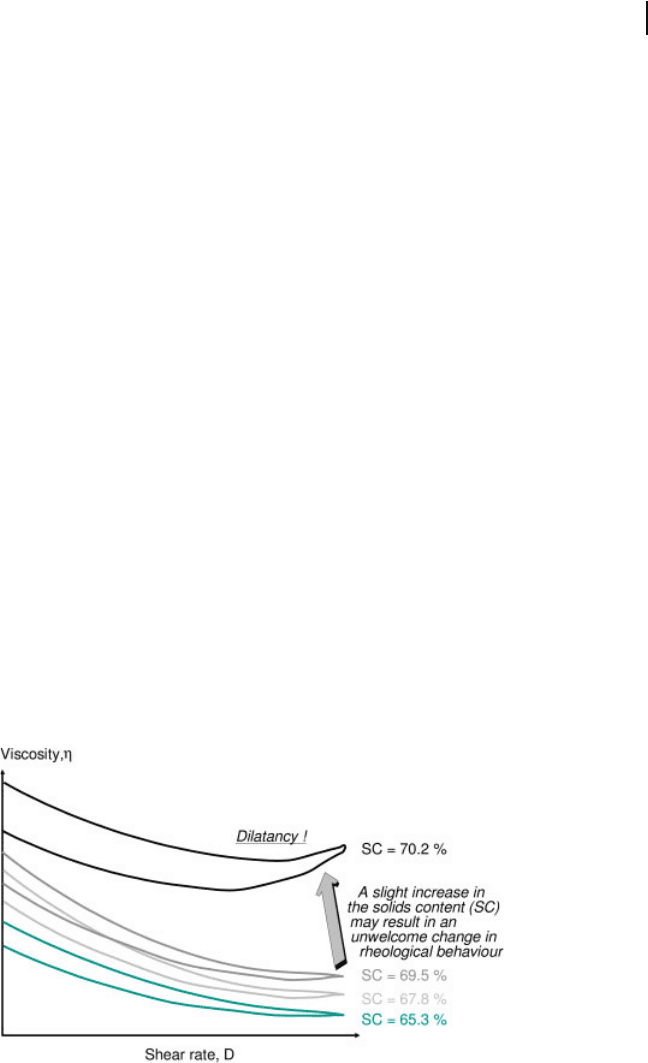
Fig. 7.10 Influence of dewatering on the rheology of coating
colors (source: BASF).
7.5 Components and Properties of Coating Colors
347
structure. Modern coating processes with high solids contents and high coating
speeds demand coating colors with pronounced pseudoplasticity, i. e., low viscosity
under high shear. The increase in the color viscosity by an increase in the shear
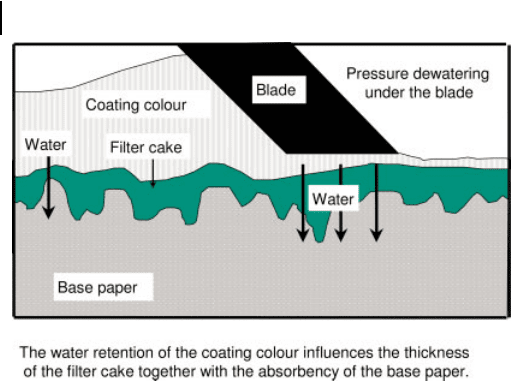
rate is called dilatancy or shear thickening (Fig. 7.10). The final quality of the
coated paper depends on the dry coating structure. The transfer from wet to dry
coating structure is a result of the aqueous phase penetration from the coating
color into the base paper (influence of water retention; Fig. 7.11) and, later, due to
evaporation during drying.
Air/gas has a negative effect on the rheology of coating colors. If the coating
color contains large amounts of air/gas bubbles, the extreme consequence can be
skip coating, i.e. occurrence of uncoated spots, so physical and chemical aids have
to be applied to reduce the air content (see Section 3.6.9.3.4.5). Preservatives, re-
spectively biocides or microbiocides, are chemicals used in the pigment slurry
and/or in the finished coating color to prevent the growth of microbes (see Section
3.7.4).
7.5.3.2 Product Additives
Shading dyes, optical brightening agents (OBA) and their carriers, cross-linking
agents for natural binders and wet strength agents for offset papers, belong to the
group of product additives which influence primarily the properties of the coated
paper surface. The last two product classes are also called insolubilizers (see Sec-
tion 3.6.9.3.5).
The brightness of pulp, fillers and coating pigments is often not high enough to
reach today’s brightness targets. Therefore there is a need to use blue/violet shad-
ing dyes and especially so-called optical brightening agents (OBA) as coating additives
(see Sections 3.6.9.3.5 and 3.6.2). Optical brighteners work only when they are
Fig. 7.11 Influence of water retention on coating color
application (source: BASF).
7 Coating of Paper and Board
348

fixed to a carrier. A good carrier is linear and contains OH- or other hydrophilic
groups. Linearity increases the contact between the carrier and OBA so physical
bonds (such as hydrogen bonds and van der Waals forces) can be formed between
the OBA and the hydrophilic groups of the carrier. Carriers in a coating color are,
among others, starch, CMC (carboxy methyl cellulose), PVA (polyvinyl alcohol), or
PVFA (polyvinyl formamide) derivatives.
There are many chemically different types of insolubilizers or crosslinkers. They all
have the same function – to increase water resistance (see also Section 3.6.9.3.5.2).
Water resistance is particularly important in offset printing, but also for wallpaper
and in the storage of board packages. In double-coated boards, crosslinkers are
used in the precoating to impart water resistance against the topcoat. The water
resistance can be measured as wet rub and wet pick or is seen as less pick, print
mottle, or binder migration. The water sensitivity of paper and board coating origi-
nates from the fact that water-soluble binders tend to lose their binding power in
contact with water and dissolve. This water sensitivity of binders can be described
as the amount of O-atoms in the molecule (in hydroxy and carboxy groups). The
water sensitivity can be decreased by crosslinking the soluble binders together
with insolubilizers or by building an insoluble net around the binders. Traditional
insolubilizers in paper and board coating are based on formaldehyde and its amino
compounds (melamine, urea) or on glyoxal. Imidazoline derivatives are also used
as crosslinkers. Another class of insolubilizers are based on zirconium; the prod-
uct most widely used is ammonium zirconium carbonate (AZC).
Lubricants improve the runnability of the coating color by reducing the friction
between the machine part and the coating color. This can be seen for example as
fewer scratches in the coating and longer lifetime of coater blades. Lubricants
enhance the plastic deformation of the dry coating in the supercalender by pre-
venting the cracking of the soluble binder film that would lead to dusting. It also
improves gloss. During calendering, lubricants migrate from the coating onto the
hot calender rolls and form a monolayer on the rolls, thus preventing sticking of
the coating to the rolls. Dusting at printing machines has been a problem in LWC,
especially when delaminated kaolins are used. Different kaolins have different
dusting tendencies, dusting can often be reduced or eliminated by using a lu-
bricant. The most commonly used lubricant is calcium stearate. Wax emulsions
(mostly emulsions of paraffin waxes, microcrystalline waxes, or polyethylene
waxes) are the oldest group of lubricants in paper and board coating. These emul-
sions give good runnability but have less effect as antidusting agents than has
stearate. A new group of substances used as lubricants are soy lecithin/oleic acid
blends. Polyethylene and polypropylene glycols are used in blends with calcium
stearate or alone as a lubricant with additional influence on rheology and flow
properties of the coating color (see also Section 3.6.9.3.4.4).
7.5 Components and Properties of Coating Colors 349

7.6
Coating Color Formulations [1, 4, 8]
The main driving forces to develop new or improved coating color formulations
are:
• customer needs for improved coated paper quality such as higher brightness,
print gloss and bulk, better coating coverage
• requirement of high uniformity of paper quality which calls for accurate process
control during coating color formation, color application, and drying
• trends in printing technology such as higher printing speeds or digital color
printing
• new developments in coating technology such as new coating methods or higher
coating speeds requiring good coating color runnability and uniform coating
color quality at the same time
• need for less energy consumption in drying which means higher solids content
of coating colors
• environmental requirements including recirculation and reuse of coating col-
ors.
However, coating color formulations, in any case, must be cost competitive.
Coating color application requires its special formulation:
1. The solids content greatly influences the runnability of the coating color in the
coating machine. The solids content basically influences the viscosity of the
color and its flow behavior at varying shear stresses in the coating machine.
2. The various components of the coating color determine the highest possible
solids content attainable for the target viscosity. The highest possible solids
content is aimed for to save energy for drying of the coating color.
3. Most coatings are processed in the pH range 7.5–11.5. The alkaline range is
preferred because most of the color components are anionic in character and,
from a colloidal chemical viewpoint, form considerably more stable systems at
higher pH values than at low pH values. In addition, the drying time in offset
printing is greatly reduced with increasing pH, because of the oxidative drying
system mostly used.
4. For nearly all coating processes, the water retention capacity of the coating color
is most important; i.e., the ability of the coating color to retain water in spite of
the sucking action of the coating base paper. If the water retention capacity is
too low, the coating color may be too strongly dewatered between application
and levelling. This leads to an increased solid content of the coating color before
it comes into contact with the levelling blade which causes streaking and an
uneven coat surface.
Coating color formulations and their solid content and properties differ according
to the kind of application and coating process. Typical ranges of coating weight
applied to the paper as well as solids content of the coating color for the various
principles of pigmenting and coating are shown in Table 7.3.
7 Coating of Paper and Board350

Another crucial factor in coating color formula design is the intended use, i. e.,
the envisaged paper type and printing process. Formulations differ between matt
and glossy grades, as well as for single or double coats with pre- and top coats, and
triple coats with precoat, intermediate and topcoat. All coating color formulations
aim for maximum solids content for quality and economic reasons. The coating
color formulations presented in Tables 7.4 to 7.12. are examples commonly used in
Europe at present. However, they must usually be adapted to suit the particular
conditions in the individual paper and board mills. All formulations are in dry
parts of the individual substances. In many cases coated web offset paper has to
have high stiffness of paper and freedom from blistering and creasing, the latter
especially for heat-set web offset. Manufacture of higher-weight papers like MWC
and HWC involves formulations similar to those used for woodfree grades.
Table 7.3 Coat weights and solid contents of coating colors for
different coating methods.
Coating Method Coating Color
solid content (%)
Coating Speed
(m/min)
Coat Weight Remarks
Size Press 20–30 100–1000 2–5 Pigmented
surface sizing
Film-Press 35–68 100–2000 6–12
Blade Coater 45–72 100–3000 7–20
Metering Bar Coater 40–65 100–800 3–12 Pigmented surface
Sizing or coating
Air Knife 30–50 100–500 8–12 Mainly
Board coating
Spray Coating 45–55 100–2000 5–12
Curtain Coating 45–68 100–2000 8–12
Table 7.4 Woodfree offset printing paper – single-coat, matt
quality.
Amount (parts) Component
80 natural ground calcium carbonate (GCC, 60–90% < 2 mm)
20 kaolin
10–12 synthetic binder
0.5–1.0 co-binder, thickener
0.5–0.8 optical brightener (as received)
65–68% solids content
7.6 Coating Color Formulations 351