
Holik H. (ed.) Handbook of Paper and Board
Подождите немного. Документ загружается.

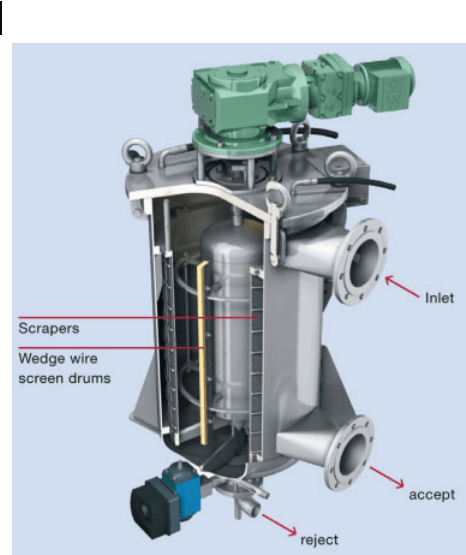
Whichever system is chosen, the mesh of screens or filters has to be small enough
to retain all particles > 50 mm.
In modern coating kitchens the various starting materials are usually pre-
screened over mesh widths around 50–60 mm before the finished coating color is
passed through 100–150 mm screens or filters in the circulation system. Smaller
mesh sizes are inadvisable, because they would largely restrict the passage of the
highly viscous color. Coarser screens are frequently installed in the coater recircu-
lation system to retain scraps of paper that may have been introduced into the
coating circuit after web breaks.
7.7.6
Degassing of Coating Colors
Coating colors contain air and gas bubbles of various sizes that originate from the
raw materials and turbulence during color preparation. Gas content can vary
greatly: 10–15% by volume is typical, although it may exceed 35 % in extreme
cases. Gas levels in coatings have become a major quality issue since the introduc-
tion of new jet applicators because every air or gas bubble leaves a crater in the
coating surface. This compelled papermakers to install online degassing equip-
ment in coaters with jet applicators. Most of the degassing systems are based on
Fig. 7.19 Closed filter system (source: Metso).
7 Coating of Paper and Board
362
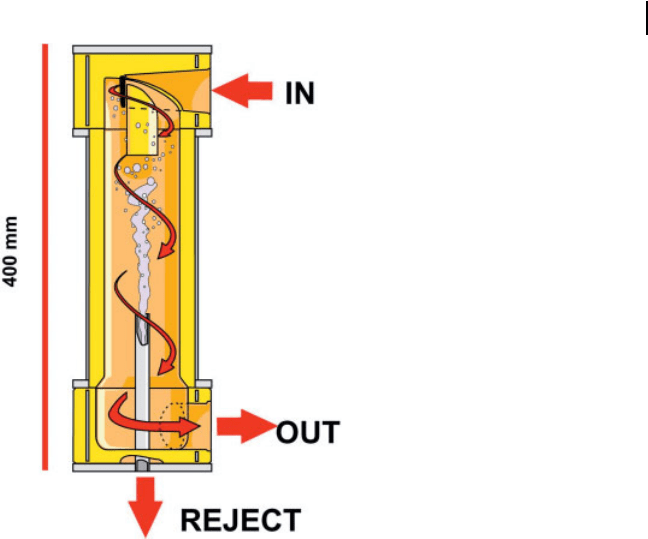
the density differences in a centrifugal field of a cyclone (Fig. 7.20). Modern sys-
tems are capable of reducing gas levels to 4%. The effiency of such physical de-
gassing apparatuses will be further improved by the additional use of chemical
deaerators (see 3.6.9.3.4.5).
7.7.7
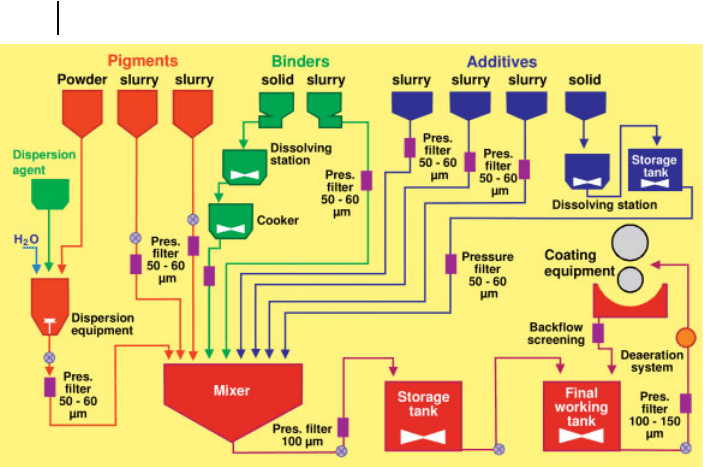
Batch Preparation of Coating Colors (Fig. 7.21)
All components of the coating color formula are pumped from their storage tanks
into a mixer and hereby screened once again. A recirculation pipe installed be-
tween the component storage tank and the mixer is used for those chemicals that
have a settling tendency, like pigment slurries, or to keep certain products homo-
geneous in their temperatures and concentrations, like starch, CMC, or proteins.
The mixer is placed on load cells to measure accurately the batch sizes and weights
of the major components. Other precise ways to dose the additives are mass flow-
meters and metering pumps. In batch processes, these metering devices can be
optimally calibrated and dimensioned because the flow rates are normally kept
constant and the dosing time is varied depending on the amount of each additive
used in a coating color formula. Batch processes are also very flexible for a wide
dosing range of each component. The difference between the maximum and mini-
mum rates does not negatively influence their accuracy or the flexibility. One set of
metering instruments and valves can easily be used to serve two mixers optimizing
Fig. 7.20 Degassing cyclone.
7.7 Coating Color Preparation
363
investment costs and space in the coating color kitchen. The flexibility of a batch
process is obvious in cases where the rheological or other properties of coating
colors have to be changed by altering the order of addition of the same chemicals.
The mixing time and mixing energy can also be easily changed.
7.7.8
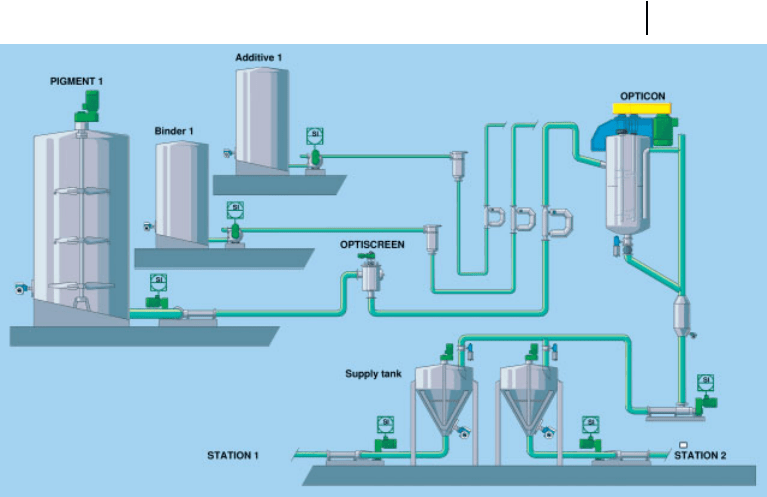
Continuous Coating Color Preparation (Fig. 7.22)
The major advantage of a continuous process is the smaller size and thus lower
cost of pumps, valves, flow meters and pipings. So-called “calibration systems” for
each line ensure the metering accuracy and are fully automated. These continuous
systems are most effective in high-capacity coating with large volumes of coating
colors with the same color quality, such as in a one-grade paper mill. Here the
number of different coating colors is low and, if there is a grade change, different
coatings are usually allowed to be mixed with each other. This continuous system
differs from a batch process in many aspects: The components of coating colors
are continuously pumped, screened, and metered into a continuous mixer. Besides
the size difference of the piping equipment the mixers are completely different
because mixing must be completed during the short time when the components
are passing through the mixer. It is equipped with high-shear, high-energy mixing
zones, usually two, or two separate mixers in series are operated. Dosing of all
additives is crucial for constant coating color quality, they are metered with mass
flow meters, magnetic flow meters, or metering pumps. The mixer feeds its ready-
made coating color directly to the coater supply tanks which results in a low stor-
Fig. 7.21 Batch preparation of coating colors (source: Metso).
7 Coating of Paper and Board
364
age volume of processed coating color. The advantages are fast control measure-
ments of the coating color properties and the possibility of quick changes in the
color composition. On the other hand the range of volumetric capacity of each
chemical line is strongly limited for a given installation.
7.7.9
Coating Color Supply Systems for Coaters
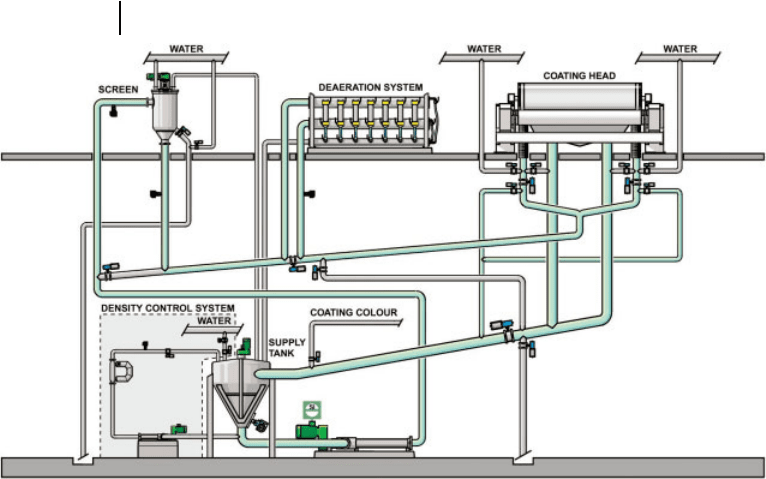
The basic function of the coater supply system is to supply coating color to the
coating heads to be evenly spread on the paper or board web. In most cases only
about 10% of the pumped coating color will be applied onto the running fiber web.
About 90% of the coating color flows back to the supply tank. This high internal
coating color recirculation is required to ensure homogenous and constant color
properties for trouble-free coater operation. The feed of the fresh color into the
supply tank is controlled by its level. From the supply tank, the coating color will be
pumped first to the screens, which eliminate all impurities larger than 50 mm,
depending on the geometry of the screening elements. The second key process is
degassing of the coating color. Depending on the design of the coating heads, the
coating color flow is led to the ponds or chambers through one or two inlet pipes
(Fig. 7.23) controlled by a throttling valve for accurate flow. The overflow goes back
freely to the supply tank. The contents of solids and gas as well as temperature and
pH and their variations are monitored continuously.
Fig. 7.22 Continuous preparation of coating colors
(source: Metso).
7.7 Coating Color Preparation
365
7.8
Measurements of Coating Colors [3–4, 8]
The shear-viscosity and viscoelastic properties of paper coatings and their time-
dependent behavior are important attributes that need to be measured for better
understanding and optimization of the process.
7.8.1
Viscosity
Viscosity is measured with rheometers or viscometers. The methods used include
rotational deformation, squeezing deformation, extrusion (capillary) flows, and
free surface stretching. For rotational instruments, there are two modes of opera-
tion: controlled strain and controlled stress. Rotational measurements can be fur-
ther subdivided into different measuring methods (flow, oscillatory, stress relaxa-
tion, and creep) and different measurement devices (spindle, cone-and-plate, par-
allel plate, concentric cylinder). As for a capillary rheometer, there are two modes
of operation: controlled flow (strain) and controlled pressure (stress).
Fig. 7.23 Coating color supply system (source: Metso).
7 Coating of Paper and Board
366

7.8.2
Viscoelasticity
Viscoelasticity refers to rheological behavior that is a combination of viscous (liq-
uid-like) and elastic (solid-like) behavior. Ideal elastic behavior is called Hookean,
where the stress is directly proportional to the strain. A Hookean solid deforms as
long as stress is applied. Once stress is removed, it fully recovers its original shape.
This behavior can be modeled by a spring that stores energy under deformation
and then releases it. Ideal viscous behavior is called “Newtonian”, where the stress
is directly proportional to the rate of strain.
A Newtonian fluid flows as long as a stress is applied and retains its final shape
once the stress is removed. This behavior is modeled by a dashpot that consists of
a piston moving in a viscous liquid.
Paper coatings can be generally considered as viscoelastic fluids. The viscoelas-
ticity of a material is most often measured by applying oscillatory shear instead of
steady shear. There are two common types of oscillatory tests. A strain sweep test is
carried out at a fixed frequency while the amplitude of the oscillation is varied. As
the amplitude is increased, more energy (or shear) is applied to the sample. This
energy may begin to break down the internal structure of the material. This is
analogous to stretching a spring too far. The strain at which the coating structure
begins to break down is called the critical strain, which gives some information on
the nature of the internal structure of the material. For example, flocculated disper-
sions have critical strains of about 1%, polymer solutions have critical strains of
about 10%, and polymer melts have critical strains of about 100 %. Most paper
coatings have critical strains of about 0.5–5%, indicating that their elastic behavior
is a result of a weak network structure between pigment particles and/or thickener.
The second common type of oscillatory test is a frequency sweep where the ampli-
tude of oscillation is fixed while the frequency of oscillation is varied. The ampli-
tude for the frequency sweep is chosen to be within the linear viscoelastic region,
as determined by the amplitude sweep measurement.
An alternative way to measure the viscoelastic properties of a material is to apply
a step change in stress or strain and then measure the response of the material
over time. This is the basis for stress relaxation and creep testing of materials. In a
stress-relaxation test a constant strain (or shear) is applied for a period of time and
then removed. Upon removal of the strain, the stress begins to relax. Typically, one
measures the relaxation time needed for the stress to relax to half of its equilib-
rium value at long times. Closely related to stress relaxation is a stress-growth test.
Here a sudden increase in strain is applied to the sample, and the growth in stress
is monitored over time. Both stress-relaxation and stress-growth measurements
are used to characterize paper coatings. A correlation between the stress-relaxation
time and the healing of coating defects can be observed in practice: Coatings with
a shorter relaxation time (more fluid-like) show narrower residual widths of an
induced blade streak. Stress-relaxation properties of a coating also correlate with
improved leveling of orange peel patterns for high-speed metered film coatings.
7.8 Measurements of Coating Colors 367

7.8.3
Water Retention
During coating consolidation the liquid coating color on the base paper transforms
into an immobilized (stiff) coating layer. The runnability of a coating color in
coating is determined by the properties of the liquid color, i. e., wet coating struc-
ture, whereas the final quality of the coated paper depends on the dry coating
structure. The transfer from wet to dry coating structure is a result of the aqueous
phase penetrating from the coating color into the base paper and, later, due to
evaporation on drying. A prerequisite for liquid transport in porous material is the
presence of a driving force. Some common examples for water transport in paper
are capillary pressure, external pressure, vapor pressure, concentration gradient,
and temperature gradient. Several driving forces may be present at the same time,
which makes the transport mechanism complex.
The various water retention measurement techniques can be divided into static
(direct and indirect) as well as dynamic methods. The first provides a quantifica-
tion of the amount of aqueous phase leaving the coating color and penetrating into
the base paper. The measurement principle is based on filtration of coating color
under the influence of external pressure. The indirect methods measure other
parameters reflecting the penetration of aqueous phase into the base paper, such
as electric conductivity, ultrasonic transmittance surface gloss, and coating vis-
cosity. The dynamic techniques are usually based on measurement of solids in-
crease in the coating pan or various scrape-off experiments during laboratory and
pilot coater trials.
7.8.4
Solids Content
The right solids content of pigments is important as pigments are the biggest
portion in the coating color recipe. The solids content of the coating color being too
high or too low, directly affects the coat weight, the runnability of the coating unit
and the necessary drying energy. The solids content is measured by drying a sam-
ple in an oven and calculating the amount of dry components as a percentage.
Because the traditional oven method takes several hours to measure solid content,
quicker methods have been developed for “just-in-time quality control”. In these
quick methods, infrared and microwave drying are used.
7.8.5
pH
In practice it is easy and quick to ascertain pH from aqueous suspensions and
chemicals. However pH is sensitive to temperature variations; therefore pH meas-
urements should be performed under constant conditions and the calibration
rules of each individual pH gauge have to be followed carefully. The normal coat-
ing color pH is between 8 and 8.5, but higher levels are needed when using some
7 Coating of Paper and Board368

synthetic thickeners or pH-dependent latexes. The ISO 787–9 method should be
followed for pH value measurements.
7.8.6
Screening Residue
This is defined as the percentage of coarse particles in the measured material after
screening through a given Mesh-number screen (e.g. for pigment slurries and
finished coating colors a Mesh number of 300 is used, and for latex Mesh numbers
150 and 80 are used). If blade stripes or other similar coating problems occur, it is
worth measuring the screening residue and determining whether any larger parti-
cles are mixed in the coating color.
7.8.7
Bacteria Level
A high bacteria level of coating color chemicals may influence the machine runn-
ability. Furthermore, for coated paper that comes into contact with food the bacte-
ria level has to be low. The bacteria level of a material can be counted by the so-
called Easicult Combi test. This method of control is easier than doing a plate
cultivation (see also section 3.7.4).
7.9
Measurements of Coated Surface (see also Chapter 12), [4, 5, 10, 11]
Different printing methods have their own requirements for coated paper and
paperboard. The coating amount has a big influence on the physical and optical
surface properties. Physical properties are smoothness, gloss, surface strength,
ink absorption, dusting/linting, piling and visual defects. Optical properties are
brightness, whiteness, color shade, opacity, mottling and print unevenness. Taste
and odor are important properties, especially for paper and paperboard grades
used for food packages.
7.9.1
Coat Weight
Coat weight measurement in the laboratory is based on the ash content (925 °C) of
base paper and the ash content of coated paper. Several different technologies have
been used to measure on-line coat weight. The Beta or dry weight technique meas-
ures dry weight before and after the coating operation and the coat weight is
calculated by difference. Weight and moisture sensors are required at both loca-
tions. The ash or X-ray absorption method is similar except that ash sensors are
used instead of basis weight measurement. IR absorption is the newest technique
to be used, as with X-ray fluorescence, latex and/or carbonate in the coating color
7.9 Measurements of Coated Surface 369

are measured. The methods are used in differential mode, i.e., two scanners are
applied.
7.9.2
Smoothness
The same basic smoothness measurements are applicable for coated paper as for
base paper. As rotogravure printing is the most demanding printing method for
paper surface, a special test method is used only for that purpose. The so-called
“Helio-test” is performed with an IGT-tester (see Section 7.9.5). In this simulated
printing test, the number of missing dots, counted visually, provides information
on the printability.
7.9.3
Gloss
Gloss describes the mirror-like property of a coated surface and is defined as the
percentage of the light that is reflected from the surface at an angle equal to the
angle of incidence, in comparison with a standard surface.
7.9.4
Ink Absorption
This is the ability of a (coated) paper surface to absorb ink during printing. If ink
absorption is too slow, there may be a risk of set-off. Generally used tests are the
K&N test (TAPPI Method 553), the Lorilleux Porometrique test, the Microcontour
test, or the Croda test, depending on the test ink used. All the above-mentioned
tests follow similar test procedures: The ink used is applied to a paper surface in a
thickness of 0.1 mm; after 2 min nonabsorbed ink is wiped off. The brightness of
the colored area is measured and subtracted from the original brightness of the
paper to give the ink absorption value as a percentage. The test area can also be
used for visual evaluation of the evenness of absorption. If the area is mottled,
there is a risk of mottle during printing.
7.9.5
Surface Strength
This is the internal and surface bond strengths of paper which are necessary to
prevent fibers, fines, filler, or coating from being removed in printing or convert-
ing operations that involve ink and/or aqueous liquids such as in offset printing.
Generally, for coated paper, the picking test and rub resistance are used. The pick-
ing test is done either by using a wax pick test (Dennison Wax/TAPPI Method UM
463) or a simulated printing by using a device from the Institute for Graphische
Technik (IGT tester/TAPPI UM 591). Rub resistance describes the ability of
printed paper to withstand marking, scuffing, or smudging during handling
7 Coating of Paper and Board370

coated material. Laboratory rub testing of dry print can be carried out with an
optional number of rubs and pressure. The results are assessed visually against set
standards. The rub resistance method follows TAPPI 592.
7.9.6
Dusting or Linting
This is an accumulation of cutter or slitter dust on the blanket around edges of the
web and an accumulation of fibrous materials or/and pigment on the blanket of
the print press. These phenomena influence both print quality and production
efficiency. Dusting and linting are tested on a full-scale heatset press at a printing
speed of 50 000 sheets h
–1
(6.2 m s
–1
) under normal press conditions. Usually 30
000 copies of each paper have to be printed. The accumulated lint on the printing
blanket from 50% halftone and the nonprinting area is collected with a tape and
weighed. The lint can be analysed with a microscope to determine the origin of the
lint (small shives, fibers, ray cells fines, etc.).
7.9.7
Piling
This results in the accumulation of coating particles and ink on the tail-edge of the
solid printing area or/and the halftone area on the blanket. The accumulation is
tacky material of the same color as the ink. Piling is also tested on a full-scale
heatset press at a speed of 60000 sheets h
–1
(7.4 m s
–1
), with a special tacky ink on
the first and second units, a high water feed on the first unit to lower the surface
strength and a low water feed on the fourth unit (adjusted with graphometronic;
the goal is between the normal water feed and the toning level). Further print
conditions are a special layout, papers are printed to a constant density and 30 000
to 40000 copies of each paper are printed. The degree of piling will be classified as
“extreme piling” (printed amount less than 20 000 copies at good printing quality,
danger of web break), “major piling” (printing amount 20000–40 000 good copies,
danger of web break), “minor piling” (printing amount up to 40000 good copies)
and “no piling” (printing amount significantly above 40000 good copies).
7.9.8
Visual Defects
As the primary objective in pigment coating is to improve the printability and
appearance of the material, no visual defects should appear. Typical defects are
holes, spots, blade scratches and streaks and creases. Visual defects are controlled
using on-line detectors and visual checking. Visual checking is done in two places:
The machine crew take a cross sample from the web at the top of each machine
reel and examine it under strong light sources with different light angles to mark
the defects. In laboratories, sheets are checked visually under a light source, and
defects are counted and recorded. The on-line devices measure faults like slime
7.9 Measurements of Coated Surface 371