
Holik H. (ed.) Handbook of Paper and Board
Подождите немного. Документ загружается.

References
1 Omya Paper Handbook, Klauser Weibel
Design, Zürich 2005.
2 P. Oittinen, H. Saarelma, Papermaking
Science and Technology, Book 13, Printing
Fapet Oy, Helsinki 1999.
3 E. Lehtinen, Papermaking Science and Tech-
nology, Book 11, Pigment Coating and Sur-
face Sizing of Paper, ISBN 952-5216-00-4
Fapet Oy, Helsinki 1999.
4 BASF Brochure of International Coating
Seminar, Ludwigshafen 05.2001.
5 N. Willenbacher, H. Hanciogullari, TAPPI
1997 Advanced Coating Fundamentals Sym-
posium Notes, TAPPI Press, Atlanta.
6 R. L. Kearney, H. W. Maurer, Starch and
Starch Products in Paper Coating, TAPPI
Press, Atlanta 1990.
7 H. Paulapuru, Papermaking and Technology,
Book 18, Paper and Board Grades, ISBN
952-5216-00-4 Fapet Oy, Helsinki 1999.
8 Preprints of 21
st
PTS Coating Symposium,
Sept. 16
th
-19
th
, 2003 at Baden-Baden.
9 R. Etzel, L.-H. Olsson, V. Elovaara, OptiS-
pray – the new improved coating technol-
ogy and the first production results, Das
Papier, 2004-T53pp
10 J. Schölkopf, P. A. C. Gane, The moment
ink contacts the surface: a fresh look at the
absorption dynamic into coated paper, Das
Papier, 2004-T26pp.
11 J. E. Levlin, L. Söderhjelm, Papermaking
Science and Technology, Book 17, Pulp
and Paper Testing, Fapet Qy, Helsinki
1999.
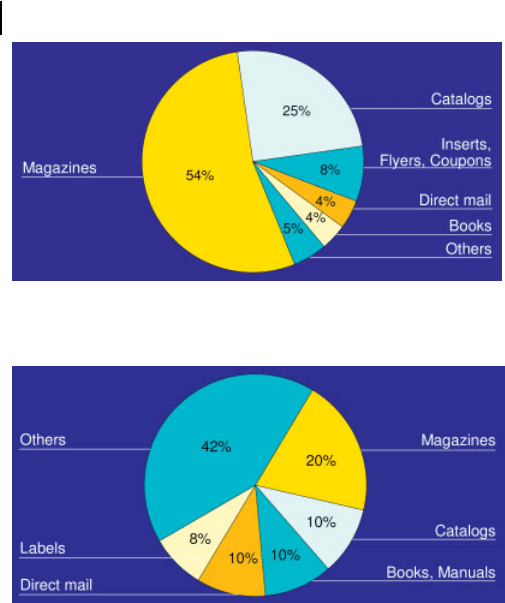
Fig. 7.30 Worldwide usage of all coated mechanical paper
grades for printing.
Fig. 7.31 Worldwide usage of coated fine paper grades for
printing.
References
382

8
Finishing
Herbert Holik
In a paper mill the process steps after the paper machine, i.e. reel slitting and roll
packaging, format cutting and packaging of the formatted sheets, in a wider sense
also offline calendering, and sometimes offline coating, can be summarized under
the term finishing. Reel-slitting converts the large parent reels from the paper
machine into suitable size rolls, to be delivered to the (external) customer after
being adequately packed, or for further in-house processes such as sheet cutting.
The input into the sheet cutter is pre-cut reels of up to 2.5 m. The sheet cutter cuts
the web into individual sheets, i.e. cuts the web first in MD and then in CD. The
individual sheets are piled automatically and packed. Reel slitting as well as roll
wrapping and handling will be described in the next two sections.
8.1
Reel-Slitting
Rüdiger Feldmann
8.1.1
Objective and General Description of Reel-slitting
The objective of reel-slitting is to convert the large parent reels (machine reels,
jumbo reels) from the paper machine into suitable size rolls which can be either
sent directly to the end-user, e. g. a printer, or receive further mill-internal treat-
ment such as sheeting.
The machine on which reel slitting is done is commonly called a winder. Basi-
cally, winders consist of equipment for parent roll change, an unwind station for
the parent rolls, a slitting station and a rewind station.
The rolls have to be free from defects (Fig. 8.1) such as:
• soft centers
• bursts
• corrugations/rope marks
• crepe wrinkles
• dishing
Handbook of Paper and Board. H. Holik (Ed.)
Copyright © 2006 WILEY-VCH Verlag GmbH & Co. KGaA, Weinheim
ISBN: 3-527-30997-7
383
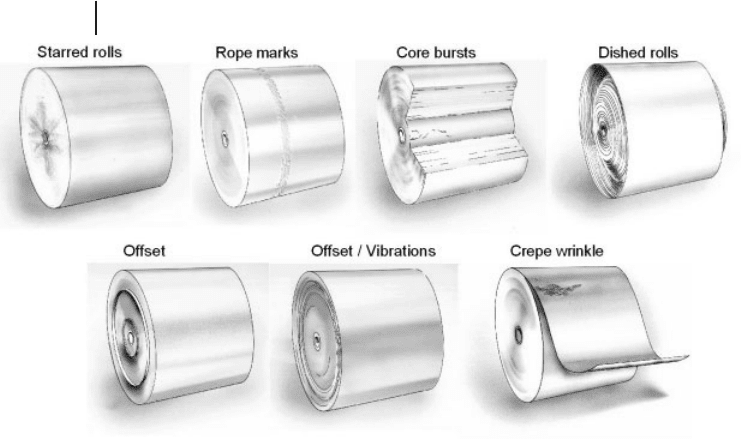
• dust
• concave or convex faces.
These kinds of defects may disturb the subsequent working steps in or outside the
mill and may reduce the quality e.g. in printing or the productivity. The roll quality
ultimately determines the mill’s reputation with its customers and so the winding
process is very important.
Winders have a series of basic operations in common, e.g. unwinding, slitting,
reel and set change etc. These operations will be reviewed in the following. Later,
special attention will be paid to the various winder types and their suitability for
obtaining optimum winding results for the main paper grades.
Though various slitting techniques are available, e.g. water jet slitting and laser
slitting, most of the winders make use of the tangential shear slitting technique.
With this method, the web is cut between two edge-contacting circular knives, the
top slitter blade and the bottom slitter blade. In order to achieve optimum slitting
results, the cut point should be located at the beginning of the wrap, i.e. the area
where the web contacts the bottom band. The depth with which the blade should
incise into the web depends on the paper grade and ranges between 0.5 and
2.5 mm with 1.5 mm being a normal depth. The overlap of the top blade and the
bottom blade should be between 0.5 and 2.5 mm, the exact amount depending
again on the grade of the paper to be slit. Furthermore it is recommended that the
top blade exerts a light side load in the range of 20 to 45 N on the bottom blade.
Since the bottom bands wear, counter measures have to be taken in order to avoid
the cutting nip opening up, resulting in band wobble, so called slitter run out. The
speed with which the bottom blade is driven is yet another decisive factor. As a
Fig. 8.1 Various roll defects (source: Voith).
8 Finishing
384
rule, this blade is driven at a speed that is somewhat higher (2 to 3%) than the
running speed of the web.
With an improper setting of the blades, the slitter often generates dust but even
under optimum conditions, slitter dust cannot always be avoided and hence suc-
tion devices are installed to remove the dust.
The pair of knives must be accurately positioned so as to obtain precisely the
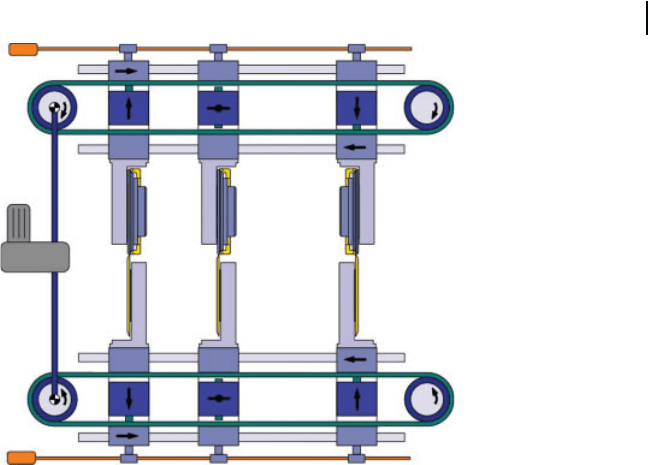
desired format for the sheets. Various solutions exist in this respect. Figure 8.2
shows one example: The apparatus for positioning has slides displaceable along
guides and a belt with oppositely moving stretches as the belt is moved in a single
direction. A coupling between the belt stretches and the slide can be actuated to
press against one or the other stretch or pass of the belt to couple it with the slide.
The coupling also has a cylinder-and-piston to lock the slide by clamping it against
its guide when the proper position is reached. Positioning can be carried out man-
ually, semi-automatically or in a fully automated manner.
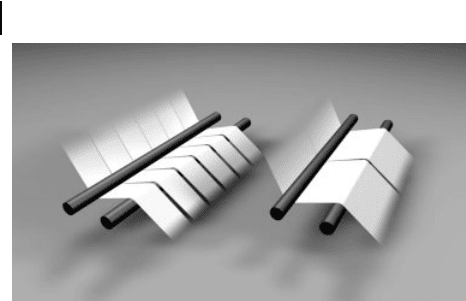
After slitting, the partial webs have to be separated. Any overlap is unacceptable.
The extent of separation is 0.2 to 0.5 mm. In order to achieve proper separation,
winders are featured with a spreader device consisting, as a rule, of two spreader
rolls arranged parallel to each other (Fig. 8.3).
The following provides an overview of the main technical data of current
winders:
• parent rolls:
– max. width 11.000 mm
– max. diameter 4.500 mm
– max. weight 135 t
Fig. 8.2 Positioning system for slitters (source: Voith).
8.1 Reel-Slitting
385
• finished rolls:
– min. width 150 mm
– max. width 5.000 mm
– max. diameter 1.800 mm, paper grades
2.500 mm, board grades
– max. weight 10 t
• max. working speed 3.000 m min
–1
• max. availability 99 %
8.1.2
The Different Winder Types and Their Suitability for the Various Paper Grades
8.1.2.1 Classical Two-drum Winders
The rewind station of a classical two-drum winder consists of a first and a second
steel drum forming a winding bed wherein the set of rolls is wound side-by-side,
and a rider roll. The two-drum winder uses tension, nip load and torque as wind-
ing parameters.
The first parameter “tension” is necessary to get the single web-sheets spread
and to give them a basic strain at the front drum. The amount of tension needs to
be in the range of the elasticity of the web. A programmable tension curve is one
basic instrument to influence the roll quality.
The second parameter, “torque”, is another tool for controlling the “wound-in-
tension” or the density of the rolls. Increasing torque tightens the rolls. The torque
is introduced by the second drum which is not wrapped by the paper. Therefore the
second drum is torque controlled.
The first drum (wrapped drum) is a speed controlled drum.
The third parameter, “nip load in the winding bed”, results from the weight of
the roll set and the rider roll load. At the beginning of the winding process, the
weight of the rolls is not sufficient to produce the required line load for introduc-
ing additional torque by the second drum. Hence it is the rider roll placed on top of
Fig. 8.3 Web separation device (source: Voith).
8 Finishing
386
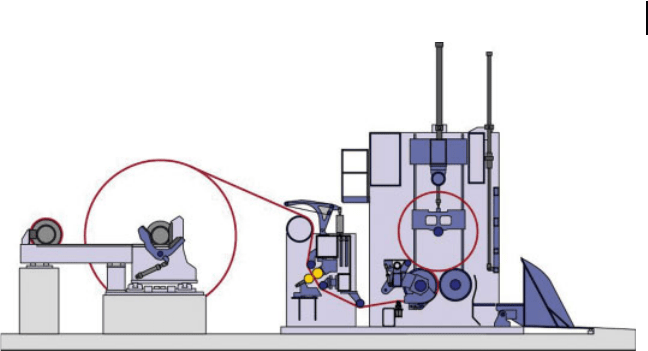
the roll set which provides the required nip load. As the diameter of the rolls
grows, the pressure exerted by the rider roll is decreased. Finally, the rider roll
serves only as means of keeping the set in the winding bed, for instance in the case
of vibrations (Fig. 8.4).
All of these parameters influence each other and have to be carefully adapted to
the different paper grades.
Classical two-drum winders are used for winding
• cigarette paper
• corrugated medium
• decor paper
• filter paper
• kraftliner
• test liner
• uncoated board.
8.1.2.2 Modified Two-drum Winders
The two-drum winder is often called the “work-horse” among the winders on
account of its easy set-up combined with high productivity and efficiency and its
initial investment cost being lower than with the single-drum winder. The classical
two-drum winder is an economic solution but its technological limitation is the
uncontrollable nip loads that necessarily occur when the roll diameters get above
nip-load critical limits, with the consequent risk of roll defects. To overcome this
drawback and to achieve low-intensity controlled nip pressures various modifica-
tions have been developed.
Modified two-drum winders are in use for the following grades:
• coated board
• directory paper
• envelope paper
Fig. 8.4 Two-drum winder with steel drums (source: Voith).
8.1 Reel-Slitting
387
• LWC paper
• newsprint paper (standard and improved grades)
• SC offset paper
• silicone base paper
• woodfree coated and uncoated paper.
8.1.2.2.1 Two-drum Winders with Air Relief
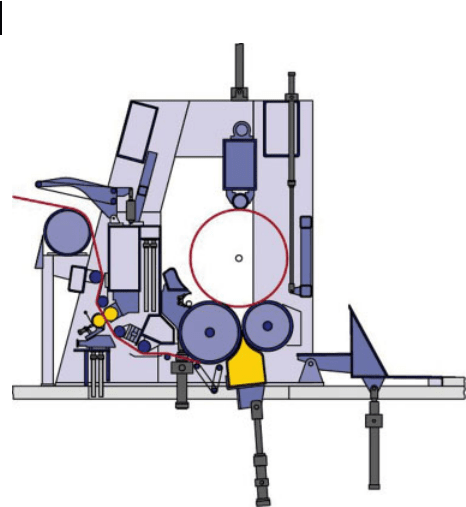
The two-drum winder with air relief is equipped with a pressure box arranged
underneath the winding bed and extending over its entire length. Compressed air
fed through this box defines a compressed air cushion in the roller bed and coun-
teracts the weight of the rolls. Since the supporting area increases with increasing
roll diameters (the supported roll surface gets bigger with growing roll diameter), a
rather low pressure (< 10 kPa) is sufficient to effectively relieve the set of rolls
(Fig. 8.5).
8.1.2.2.2 Two-drum Winders with Belt Support
This variant of the two-drum winder family consists of a drum and a belt bed to
support the roll set. As the roll diameter exceeds a certain diameter, the weight of
the roll set is partially transferred to the belt bed whereby the specific pressure in
the nip is reduced (Fig. 8.6).
Fig. 8.5 Two-drum winder with air relief (source: Voith).
8 Finishing
388
8.1.2.2.3 Two-drum Winders with Soft Covered Drums
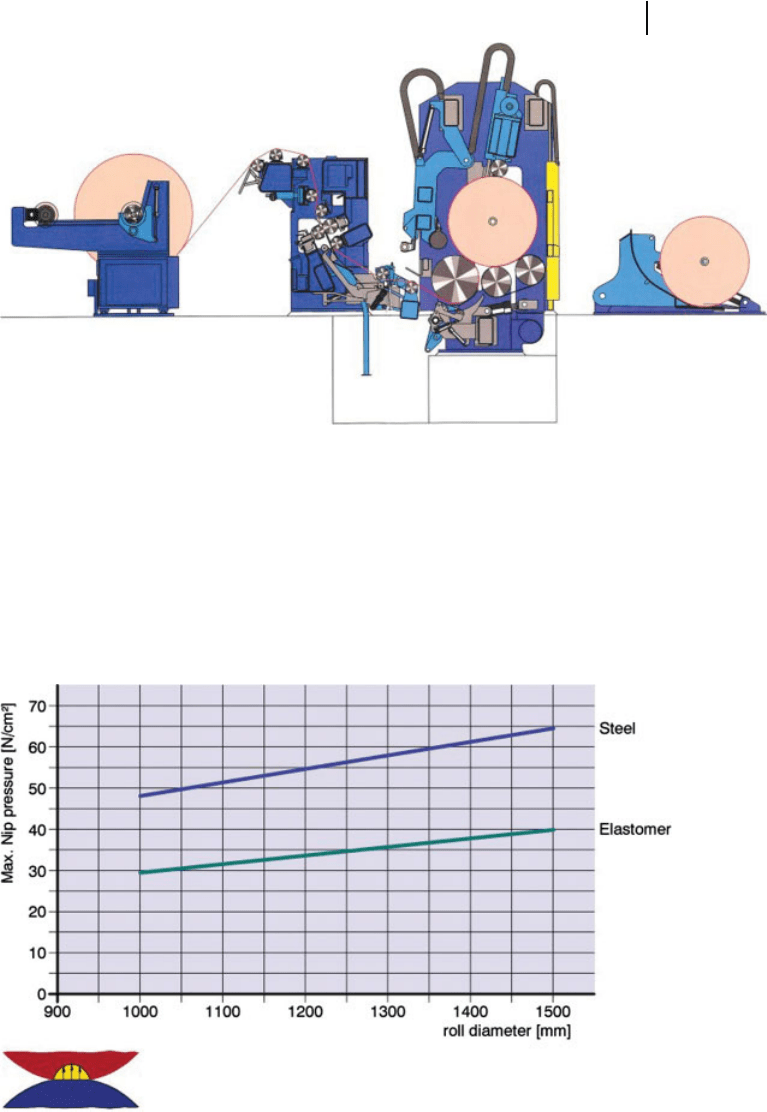
The purpose of covering the drums with a soft material is to make the nips wider,
thus reducing the radial stress between the rolls and the drums to a level where
even with heavy rolls no nip load-induced defects can occur.
The deformation of the covers in the nip especially at the first, i.e. “wrapped
drum”, avoids roll defects such as corrugations and rope marks and allows wind-
ing of defect-free rolls with a larger diameter (Fig. 8.7).
Fig. 8.6 Two-drum winder with belt support (source: Metso).
Fig. 8.7 Comparison of a two-drum winder with soft covered drums
with a two-drum winder with steel drums (source: Voith).
8.1 Reel-Slitting
389
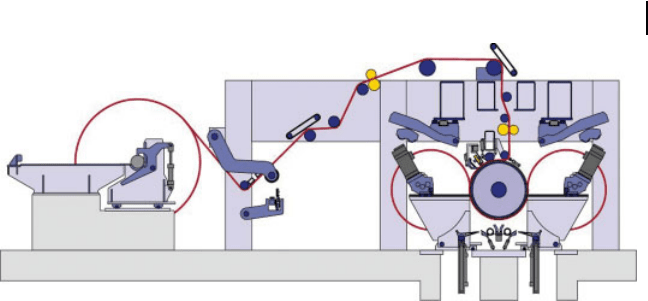
8.1.2.3 Single-drum Winders
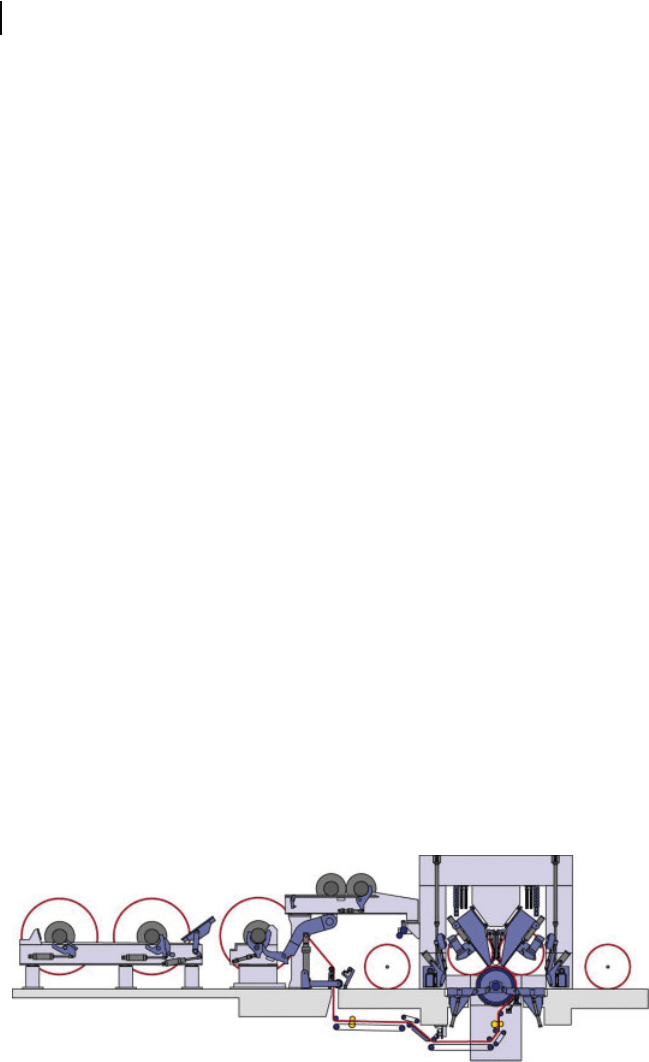
The characteristic of single-drum winders – also called multi-station winders – is
that each paper roll is supported on a common center drum, yet is wound in a
separate station. Since the rolls are held by core chucks on both sides, they have to
be arranged alternately on either side of the single-drum at approximately 11 and 1
o’clock positions (Fig. 8.8). As a consequence, the weight of the rolls is partly
supported by the center drum and partly by the core chucks – the proportion can
be freely selected. The 11 and 1 o’clock arrangement is used for winding wide rolls
(normally of width 4.320 mm) of high density paper with a need for a very tight
core winding to get the roll stiff enough for the further production process, e.g.
printing. A tight core winding is achieved by connecting the core chucks to an
electrical motor which leads its torque via core-chucks directly to the core of the
wound roll.
In special cases, 9 and 3 o’clock positions are also used (Fig. 8.9). This arrange-
ment is used for paper grades with surfaces that are very sensitive to high nip
loads. Due to the position of the rolls during the winding process the nip load can,
theoretically, be reduced to zero. The necessary torque for tight core-winding is
created by the center torque motor.
Modern single-drum winders are core-, periphery- and rider-roll supported
winders. The main parameters influencing winding are web tension, nip load (by
rider roll load or core-chuck carriage load) and torque. At the beginning of the
winding process, rider rolls are placed against the cores so as to produce the re-
quired nip load or to avoid bending of wide cores due to web tension. When the
diameter of the rolls has reached a certain value, the rider rolls are no longer
necessary. The desired nip load is then obtained by the roll weight alone or by the
relief pressure of the core-chuck carriages. Therefore, the rider rolls are disabled or
pivoted downwards in order to support the wound rolls from below.
The grades to be wound on single-drum winders are:
• carbon copy paper – winder as in Fig. 8.9
• cast coated paper – winder as in Fig. 8.9
• LWC paper – winder as in Fig. 8.8
• SC rotogravure paper – winder as in Fig. 8.8
Fig. 8.8 Single-drum winder – finished rolls at 11 and 1
o’clock positions (source: Voith).
8 Finishing
390
• silicone treated paper – winder as in Fig. 8.9
• thermal paper – winder as in Fig. 8.9.
8.1.3
Automatic Functions
The productivity of a winder is a function of its speed, its acceleration rate and its
necessary stop times for set-change or reel-spool change. The stop times can be
reduced by using automatic functions. To that end, equipment and controls have
been developed which abridge the following functions:
• reel changing
• reel splicing
• web threading
• slitter positioning
• core inserting
• core gluing
• automatic set-change
• web cutting
• tail gluing
• roll ejecting
• automatic stop at wind-up and unwind-diameter.
Furthermore, diagnostic functions are available that help the operator to quickly
detect the cause of problems on the winder and in the paper:
• automatic stop at detected paper faults (holes, edge-cracks etc.)
• extended help messages if winding process discontinues
• run-time messages for preventive maintenance.
Fig. 8.9 Single-drum winder – finished rolls at 9 and 3 o’clock
positions (source: Voith).
8.1 Reel-Slitting
391