
Holik H. (ed.) Handbook of Paper and Board
Подождите немного. Документ загружается.


3
Chemical Additives
Werner J. Auhorn
3.1
Introduction
Natural chemical additives have played an important role in the raw material prep-
aration stage since the earliest beginnings of handmade papermaking more than
two thousand years ago. Up to the end of the eighteenth century, chemical ad-
ditives from natural resources were used to increase paper strength, to generate
better writing and printing characteristics, to enhance paper brightness, and to
color it. With the invention of the papermaking machine, chemicals began to con-
tribute to industrial papermaking processes. It was only when newly developed
bleaching chemicals came into use that wood pulp as a new source of raw material
could be exploited to the full. The chemical additives assisted the automation and
productivity of the papermaking process as well as the enhancement of paper
quality and thus contributed to a large degree to the growth of the paper industry
in the first half of the twentieth century. The past 50 years have been characterized
by the increased use of recovered paper and white natural pigments as fillers and
for paper coating, as raw materials, by an ongoing improvement of the paper
machine productivity, and an emphasis on economics, ecology and quality. All this
has been, and still is, supported by chemical additives and their creative applica-
tion.
On a global view, paper and board today consist of nearly 99 % natural materials:
Virgin fibers from chemical and mechanical pulps contribute 48% of the total raw
material consumption; recycled fibers 40%; non-fiber material as fillers and coat-
ing pigments 9% with the remaining 3 % being “chemical additives” (solid materi-
als). In addition, 3% of so-called basic and bleaching chemicals are added, mainly in
the production of chemical, mechanical and deinked pulps (Fig. 3.1). These chem-
icals do not remain in the pulp (they are decomposed and are contained in the
cooking liquor and the untreated waste water) and thus do not appear in the paper
but they are a significant factor in production costs (Fig. 3.2). By mass starch ac-
counts for 1.7% of the world paper production, which is more than 50 % of all
chemical additives. Traditional papermaking chemicals such as aluminum sulfate
and nowadays other aluminum compounds are still used at a rate of 0.3% on
Handbook of Paper and Board. H. Holik (Ed.)
Copyright © 2006 WILEY-VCH Verlag GmbH & Co. KGaA, Weinheim
ISBN: 3-527-30997-7
62
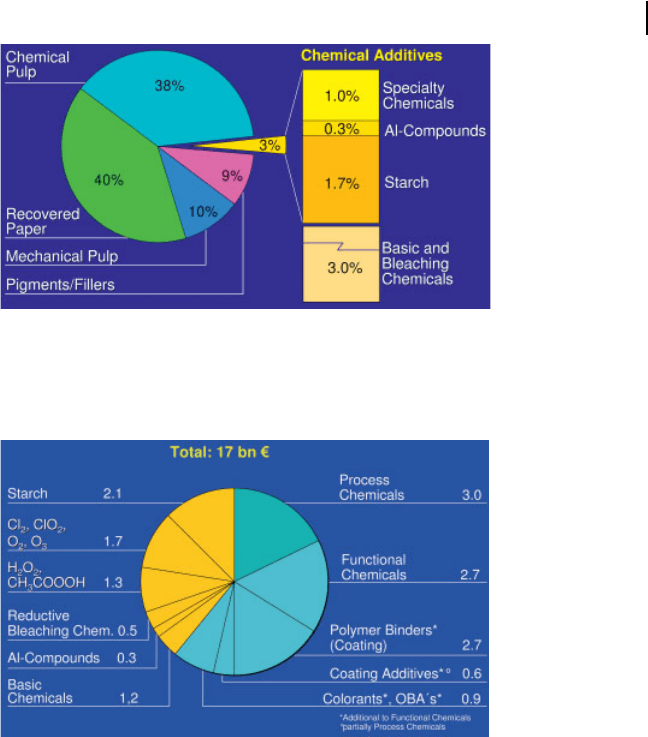
paper, 10 % of the total dry based mass of chemical additives. Pure synthetic chem-
icals – called “specialty chemicals” – account for only 1%, relative to the paper and
board production. The market for chemical additives is currently estimated at
17 billion € worldwide. 28% of this is basic and bleaching chemicals, mainly used
in the production of pulp and 72% is chemical additives used in the production of
paper and board. On average, chemical additives account for approximately 5 % of
the cost of the finished paper and board, varying for the individual paper and board
grades.
The wide variety of specific demands that are placed on the different paper and
board grades cannot be fulfilled with natural raw materials alone. It needs chem-
ical additives with very specific performances, the so-called “specialty chemicals”,
Fig. 3.1 Mass shares of groups of chemical additives and raw
materials for paper production in 2004 (worldwide average
figures based on 350 V 10
6
tons of paper and board
production).
Fig. 3.2 Global consumption of chemical additives (turnover
in billion €) for pulp and paper production in 2004.
(OBA = optical brightening agents.)
3.1 Introduction
63
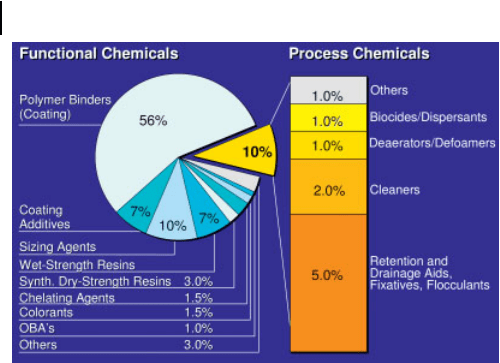
and their intelligent application. Some of these additives are used in order to ob-
tain certain properties of the finished paper e.g. colored sheets, resistance against
ink or water, high gloss, good and appealing printability or high strength for pack-
aging. This group of chemical additives is called “functional chemicals”. Other
chemical additives are used to solve or prevent problems in the paper manufactur-
ing process, to improve the efficiency of the production process and/or to protect
the environment. The latter type of additives for instance helps to reduce the con-
sumption of fresh water and energy, prevent foam and deposits, improve drainage
or reduce fiber loss. This second group of additives is called “process chemicals”
(Fig. 3.3.) [1–3].
3.2
Basic Chemicals [4–7]
Wood is a natural composite material and is far more complex than any man-made
composite. Wood consists of fibers with lignin as a glue in between, and is thus a
“fiber composite material”. The purpose of the pulping process is to separate the
wood into individual fibers and to make the fibers suitable for papermaking. For
that the lignin and, to a large extent also the hemicellulose, must be either dis-
solved and degraded in the chemical pulping process or removed, as is done in
thermochemical pulping, or more or less softened as in thermomechanical pulp-
ing.
For chemical delignification and defibration of wood several basic chemicals are
used, depending on the process (see Volume 1). In kraft pulping, which is the
dominant alkaline process, the main active compounds are sodium hydroxide
(NaOH) and sodium sulfide (Na
2
S). In addition, soda (Na
2
CO
3
), sodium sulfate
Fig. 3.3 Specialty chemicals for paper and board production in
2004 (mass shares of solid substances; total amount 1% on
paper/board production).
3 Chemical Additives
64

(Na
2
SO
4
), sodium chloride (NaCl), sodium chlorate (NaClO
3
) and sulfuric acid
(H
2
SO
4
) necessary for chlorine dioxide manufacture, and calcium carbonate
(CaCO
3
) are used. In a modified kraft process polysulfide is used by adding ele-
mental sulfur to the cooking liquor. Some pulp mills use unmodified anthraqui-
none (AQ) to stabilize carbohydrates against alkaline degradation by slowing down
the peeling reaction and hereby gain a few % higher yield. In industrial sulfite
cooking of the wood chips, calcium, ammonium, sodium and magnesium hydro-
gensulfite – Ca(HSO
3
)
2
, NH
4
(HSO
3
), NaHSO
3
, Mg(HSO
3
)
2
– as well as sulfur
dioxide (SO
2
) are applied. Neutral sulfite semi-chemical (NSSC) pulping uses a
solution of sodium sulfite and carbonate or bicarbonate to impregnate the wood
chips.
Solvent-based pulping (Organosolv) is still in a very early stage of industrial
development. In this chemical pulping method the delignification of the biomass
(usually wood) is done in an organic solvent or solvent plus water system. There
are a variety of processes, which use different solvents e.g. ethanol, methanol,
acetic acid, formic acid, often in combination with sodium hydroxide, alkaline
sulfite, and/or anthraquinone.
In the production of mechanical pulps (stone groundwood, thermomechanical
pulp/TMP) sodiumsulfite or sodium hydrogensulfite is sometimes added to sup-
port softening of lignin and the defibration. These chemicals are generally used to
produce chemimechanical pulp (CMP) or chemithermomechanical pulp (CTMP).
Sodium hydroxide or soda is very often applied to control the pH during or at the
end of the production process.
Recovered paper is disintegrated in water at a consistency of 4–30%, depending
on the machine type. For the production of packaging paper no or only a few
chemicals e.g. dispersant, wetting agent (nonfoaming detergent) are used in the
disintegration. Using recovered paper to produce a white paper stock a relatively
high amount of different chemicals has to be added, to separate the printing ink
and adhesives from the recovered paper. By volume the most important chemicals
in this so-called “deinking process” are sodium hydroxide, hydrogen peroxide, so-
dium silicate (water glass) and fatty acid [5].
3.3
Bleaching Chemicals [4–7]
When chemical pulp, mechanical pulp and deinked recycled fibers are used in the
production of white papers e.g. printing and writing papers, hygiene paper (tissue)
or white top of board, these pulps have to be bleached up to a certain brightness.
The bleaching of chemical pulp (see Volume 1) is carried out in several stages, with
the elimination of residual lignin as far as possible being the primary objective of
the first stage. The subsequent bleaching stages are responsible for brightening
the pulp. Bleaching chemicals can be classified according to the particular groups
they prefer to react with. Cations or radicals in acid medium react primarily with
phenolic structures of lignin, alkaline nucleophiles attack carbonyl groups as fol-
lows:
3.3 Bleaching Chemicals 65

• Group I: Cl
2
, O
3
, peroxyacids react with all aromatic lignin units, with phenolic
groups and their double bonds.
• Group II: O
2
, ClO
2
react primarily with free phenolic hydroxy groups.
• Group III: H
2
O
2
in alkaline conditions react mainly with certain functional
groups in lignin, e.g. carbonyl groups.
Accordingly, bleaching is divided into pre-bleaching and final bleaching. After the
basic chemical pulping process the following bleaching chemicals are added sepa-
rately in several steps, for which certain abbreviations have been introduced
[4, 6].
3.3.1
Bleaching Substances
• Chlorination (C) with chlorine, an effective, selective and inexpensive bleaching
agent that reacts very fast with lignin. For environmental reasons during the last
ten years chlorine is being substituted by chlorine dioxide, ozone and/or oxygen
all over the world. In Europe substitution is already 100%. In this particular case
bleached pulp is called “Elementary Chlorine Free – ECF”.
• Alkaline extraction (E) with sodium hydroxide, both to extract kraft lignin precip-
itated on the fiber surface and remove degraded lignin moieties originating
from the preceding acid bleaching stages (e.g. ozone or chlorine dioxide).
• Sodium or calcium hypochlorite bleaching (H) is mainly applied to eliminate
residual lignin and to control the viscosity in the case of the production of solu-
ble pulp. Today hypochlorite is largely substituted by chlorine dioxide.
• Chlorine dioxide bleaching (D) – The production of chlorine dioxide is carried
out by the reduction of sodium chlorate. The bleaching effect of chlorine dioxide
is based on the oxidation of lignin. It has an exceptionally positive effect on pulp
brightness. Chlorine dioxide can be applied in several bleaching stages of an
ECF-sequence, e.g. as a pre-bleaching stage in connection with alkaline extrac-
tion (DOE), in the first stage in final bleaching to remove the residual lignin and
activate the remaining chromophores to be removed in the final bleaching stage
(DIE, DIEOP), and in a final bleaching stage to achieve the target brightness
(D2, D3).
• Oxygen bleaching (O) – The treatment of pulp with oxygen under alkaline condi-
tions is a chlorine-free alternative to pre-bleaching. Sodium hydroxide and oxi-
dized white liquor are used as the alkali source. Under these conditions, oxygen
also attacks carbohydrates to a considerable extent so appropriate conditions
have to be applied to avoid cellulose degradation. Consequently, oxygen bleach-
ing is less effective than conventional pre-bleaching with chlorine. With se-
quences containing only alkaline bleaching stages, a high final brightness is also
possible, but these stages are most suitable as oxygen chemical sequences in
fiber lines that also bleach pulp with the use of chlorine dioxide.
• Ozone bleaching (Z) – Because oxygen delignification is limited, additional de-
lignifying agents must be used before final bleaching. Ozone is a possibility, but
3 Chemical Additives66

it requires new technology. Like oxygen, ozone is only slightly soluble in water
and is also very unstable.
• Peroxide bleaching (P) – Hydrogen peroxide (H
2
O
2
) in an alkaline medium is
well suited to the final bleaching of chemical pulps and leads to high brightness
stability. Originally sodium peroxide and, since 1950, hydrogen peroxide (as a
50% solution) were used to bleach mechanical pulps, where they destroy the
chromophoric groups present in lignin by cleaving conjugated double bonds by
an oxidation process. Hydrogen peroxide bleaching is carried out in the presence
of NaOH, sodium silicate and also very often chelating agents (see Section 3.6.3).
Depending on the individual process conditions for mechanical pulp and the
initial brightness, 1 to 2% peroxide (100 % active substance) leads to a bright-
ness increase of up to 10 to maximally 18 points, relative to an absolute bright-
ness level of 74 to 80% measured at TAPPI Standard 457 nm wavelength.
In the production of deinked pulp (DIP) from recovered paper hydrogen per-
oxide is the most favorable bleaching chemical. This process requires an alkaline
medium obtained by adding NaOH, and also sodium silicate (water glass) to
stabilize the hydrogen peroxide. Under these conditions the necessary swelling
of the fibers will be achieved, making it easier to detach the printing ink/dye
particles from the fibers. Saponification of rosin and synthetic binders/adhesives
also occurs.
Furthermore peroxide bleaching strongly increases the amount and influences
the composition of dissolved colloidal substances (DCS). A high amount of DCS
results in a high COD (chemical oxygen demand) load in the process water and
in a loss of quality of the mechanical pulp, e.g. strength properties.
• Dithionite (hydrosulfite) bleaching (Y) – In the late 19th century sodium bi-
sulfite (NaHSO
3
) was developed as the first bleaching agent for mechanical pulp.
Because of its very limited brightness increase a few years later sodium dithio-
nite (Na
2
S
2
O
4
) – a further reductive bleaching agent – came to the market.
Sodium dithionite is supplied as a white crystalline powder (88% active sub-
stance) or as a liquid with approximately 13% active substance. It can also be
produced on-site from commercial solutions containing sodium borohydride
and sodium hydroxide. Such solutions typically contain 12 % sodium borohy-
dride, 40% sodium hydroxide and 48 % water (the molar ratio is 3.2 mole NaOH
to 1 mole NaBH
4
). When making dithionite, more sodium hydroxide and sulfur
dioxide or sodium bisulfite is added in a continuous process. Hereby sodium
bisulfite is then reduced by borohydride and one atom of borohydride reduces
eight sulfur atoms.
For optimum bleaching efficiency stock consistency should be 5%, temperature
60 °C and pH 6. At these conditions addition of 1.2 % (100 % active substance) to
dry pulp leads to a brightness increase of 10 to 12 points. This means a bright-
ness of 70 to 76% (at TAPPI Standard 457 nm) can be reached, depending on
the wood quality and on the initial brightness (see also Volume I). There is
nearly no increase in dissolved colloidal substances (DCS) with dithionite
bleaching. Dithionite is also very often used for the final bleaching of deinked
pulp (DIP). For maximum brightness levels of the mechanical or deinked pulp,
3.3 Bleaching Chemicals 67

e.g. above 72 or 74 %, a two-stage bleaching process is applied with hydrogen
peroxide in the first stage and sodium dithionite in the second one. In most
cases this combination is also the most economic one.
• Formamidine sulfinic acid (CH
4
N
2
O
2
S) (FAS) is another strong reductive
bleaching agent, produced from hydrogen peroxide and thiourea. FAS is a white
to slightly yellowish crystalline powder with a purity of 99%. The reaction condi-
tions are in a wide range of pulp temperature (60 to 120 °C), pulp pH (6.5 to
10.0) and pulp consistency (4 to 30%), therefore FAS is more often commer-
cially applied in pulp bleaching of recovered papers than in bleaching of me-
chanical pulps.
3.3.2
Bleaching Auxiliaries
These products enable a more efficient bleaching of the chemical, mechanical and
deinked pulps and lead to increased whiteness. They are generally based on sur-
face active agents, i. e. wetting agents (see Section 3.6.7.) which are resistant to
bleaching chemicals as well as chelating (complexing) agents (see Section 3.6.3.).
Some of the transition metals (e.g. Fe, Mn, Cu) in pulp can reduce the bleaching
effect due to catalyzed decomposition reactions of dithionite and the re-oxidation
of reduced chromophore groups. Chelating agents also prevent transition metal
ions from catalyzing peroxide decomposition. Since the beginning of peroxide
bleaching of mechanical and deinked pulps, sodium silicate (Na
2
O 3–4 SiO
2
) has
been used as an additive. Addition of 0.5 to 3% (41 °Be’ solution calculated on dry
pulp) stabilized peroxide, acts as a buffer and has the ability to form metal com-
plexes. Small amounts (0.05–0.1%) of magnesium sulfate (usually in the form of
Epsom salts, MgSO
4
7H
2
O) are commonly included in the peroxide bleach liquor
or added separately. Magnesium acts as a stabilizer of peroxide, probably together
with sodium silicate.
3.4
Starch [3, 8]
3.4.1
Products and Market Figures
Starch plays a dominant role amongst chemical additives that are used for the
manufacturing and upgrading of paper and board (see Fig. 3.1 and 3.2). It was
used in papermaking even before the invention of handmade papers, being de-
tected in sheets of papyrus. Starch derivatives are mainly used for dry strength
improvement of paper and board and as a binder for pigment coating. As a bio-
polymer, starch can be provided in sufficient quantities. The total world production
of all kinds of starch at present is 48.5 V 10
6
tonne p.a., 52 % of which is produced
in the USA, 17% in Europe and the remaining 31 % in the rest of the world. The
3 Chemical Additives68
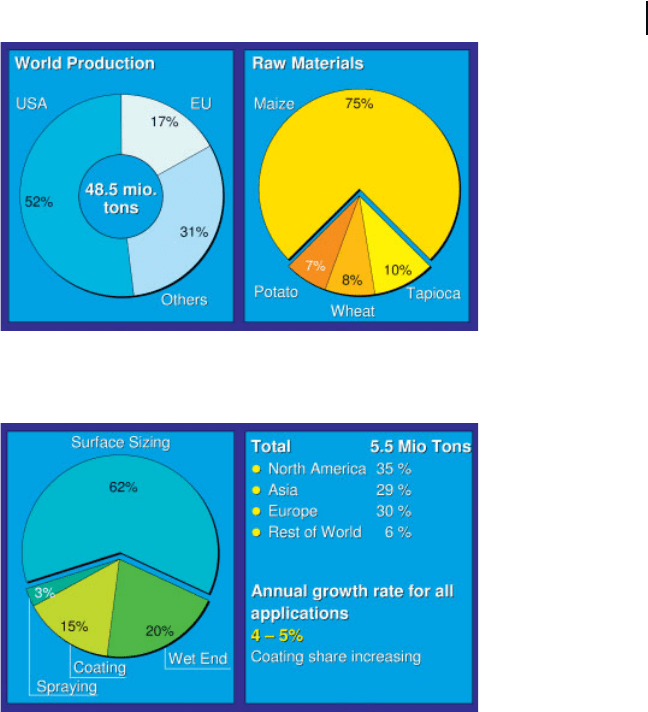
dominant raw material for starch production is corn (maize) with a share of 75%,
followed by 10% tapioca, 8 % wheat and 7 % potato (Fig. 3.4). In the paper industry
about 5.5 V 10
6
tons p.a. of starch were used worldwide in 2004, with nearly equal
amounts in North America, Asia and Europe. The total spectrum of starch applica-
tions in the paper industry now includes wet-end addition for dry strength im-
provement as well as improvement of filler and fines retention, and application in
the surface sizing, pigment coating, and converting adhesive functions (Fig. 3.5)
[3].
Fig. 3.4 Starch production and raw materials worldwide in
2002 (in million tons p.a. and % shares).
Fig. 3.5 Starch usage in paper and board production in 2004
(consumption in different applications and local areas).
3.4 Starch
69

3.4.2
Chemistry, Modification and Conversion Technologies, Properties
Starch is chemically similar to cellulose. It is a polymer composed of glucopyr-
anose units linked through carbons. The vast majority of starches occur as a mix-
ture of linear and branched molecules. The linear fraction is called amylose and
the branched one amylopectin. For efficient usage of starch in papermaking the
native starch has to be modified. Unmodified starches are available that differ in
properties such as amylopectin to amylose ratio, granule dimensions, gelatinisa-
tion temperature, and the molecular weights of the component fractions. In addi-
tion to these variables, modified starches greatly extend the number of potential
wet-end starch additives available for a given application. Much research has been
carried out that has resulted in the development of new applications for starch in
papermaking. Physical, chemical, and genetic modifications and combinations
have further improved starch application potential. The following modification
methods are practised:
• Physical modification
• Fractionation into amylose and amylopectin components
• Thermomechanical conversion
• Acid hydrolysis
• Chemical modification
• Oxidation
• Derivatization
• Enzyme conversion
Thermomechanical conversion, acid hydrolysis, and enzyme conversion all lead to
a decrease in the molecular weight of the starch and a corresponding decrease in
the solution viscosity. This makes the starch more manageable, for instance for its
application onto the paper surface in a size-press or film-press. For that a certain
low viscosity of the starch solution is necessary. On the other hand a reduction in
the molecular weight of the starch means a loss in its potential for improvement of
paper strength. This means that maximum strength improvement by surface ap-
plication requires the optimal ratio between the viscosity and the pick-up of the
starch solution in sizing. Improvement of up to 30–60% in paper strength proper-
ties is reached by surface treatment of paper. This explains why today 62 % of all
starches used in the paper industry are for surface sizing (Fig. 3.5).
Native starch as such is not suitable for wet-end usage because of its very low
retention in the paper sheet () 40%), which is undesirable from both the economic
and environmental standpoints. To obtain good starch retention on papermaking
stock, it is necessary to attach cationic substituents to the starch molecule. Starches
are cationized with either tertiary (diethylamine ethyl chloride hypochloride) or
quaternary (epoxy propyl trimethyl ammonium chloride) amine groups. The cati-
onic charge of the tertiary group depends on pH, with decreasing charge at higher
pH values above 6. Quaternary cationic groups retain their complete charge at all
pH levels. Typical commercial wet-end cationic starches have a degree of substitu-
3 Chemical Additives70
tion (d.s.) of cationic groups ranging from 0.01 to 0.05. In other words, 1–5 of 100
anhydroglucose units contain a cationic group. For example, a starch of molecular
weight 4 V 10
6
and a d.s. of 0.01 will have approximately 250 cationic charges per
molecule. These cationic starches are produced by the starch manufacturers. Due
to the ionic reaction with the paper stock, addition rates above 1.5% lead to an
undesirable change in the charge in the stock suspension, causing problems dur-
ing paper production and leading to a high COD load in the circuit water system
and in the untreated waste water.
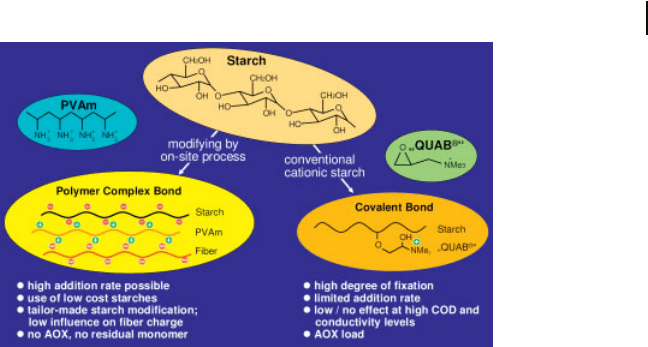
Alternatives to these covalently bonded cationic charges are cationic polymers,
which react with native or slightly anionic starches by fixation and/or precipitation.
Such polymers can be used in the paper mill during or just after the cooking
process of starch. A very effective polymer is polyvinylamine [23]. It forms, e.g.
with native potato starch or mildly anionic corn starches and the paper fibers, a
very stable complex, which results in very good retention up to an addition level of
5% starch. Figure 3.6 shows a model of such an on-site process. This wet-end
application allows much greater improvements in paper strength than with cati-
onic starches and gives results very close to those obtained with surface application
of starch [24]. The mechanism of dry strength improvement by wet-end starch is
based on interfiber bonding. Here its free glucose hydroxy groups participate in
hydrogen bonding with fiber surface cellulose molecules, which means a “chem-
ical hydration” of the fiber compound system. Additionally wet-end starch im-
proves the sheet formation by improved retention of fines and fillers and also
provides more uniformly distributed fiber-fiber bonds by hydrogen bonding.
Fig. 3.6 Starch modifications for wet-end application
(PVAm = polyvinylamine), (QUAB = quaternary ammonium
compound).
3.4 Starch
71