
Kallen A. Understanding Biostatistics
Подождите немного. Документ загружается.

120 LEARNING ABOUT PARAMETERS, AND SOME NOTES ON PLANNING
5.2 Test statistics described by parameters
The principal task of statistics is to reduce data to something that is interpretable. We see
our data, which are observations of an outcome variable, as a representative sample from a
hypothetical infinite population in which the corresponding data are described by a distribu-
tion function. This distribution is specified up to a few unknown parameters. For example,
the ubiquitous Gaussian distribution depends on the parameter vector θ = (m, σ
2
), where m
is the mean and σ
2
the variance. For the purpose of this discussion we will denote a general
distribution function by F (x, θ), where θ may be a parameter vector, but will still be called
a parameter. The aim of the statistical analysis is to estimate this parameter using an esti-
mator, which itself has a distribution because its value varies with the sample we draw from
the population.
Since this will be a discussion about tests, our primary interest is not in the CDFs that
describe the population data, but in the CDFs of test statistics (which are summaries of the
sample data). In such a case the parameter θ may be multidimensional and contain one part
that is of interest (such as the odds ratio) but also some nuisance parameters. For example, if
we want to test for a mean difference (our parameter of interest) in Gaussian data, the original
model also contains a nuisance parameter, the variance. Such nuisance parameters cannot be
ignored; a way to handle them must be found (this is how the t distribution emerges: we use
a particular estimate for the variance, which replaces the original Gaussian distribution by a
t distribution). To simplify the present discussion we suppress any nuisance parameters from
the notation, so that the CDF F (x, θ) of the test statistic contains only one parameter. The
null hypothesis of the test we are interested is written θ = θ
0
, where θ
0
is a specified value
of the parameter, usually zero or one. This means that the distribution F(x) under the null
hypothesis is the same as F(x, θ
0
).
When it comes to the parameter θ, statistics addresses two different problems. The first is
what we actually know about θ, and the second is what is the best estimate of θ. These two
problems must not be confused: a small sample may produce an accurate estimate, but our
confidence in it may still be rather low. The two problems can be described as follows.
Hypothesis testing. We want a test of the hypothesis that θ = θ
0
. The confidence in the
rejection of this hypothesis is inferred from the p-values which we compute from the
distribution F (x, θ
0
). For our discussion we mostly assume that this test is one-sided
and that the p-value is computed from the value x
∗
of the test statistic X obtained in
the experiment as the probability P(X ≥ x
∗
|θ
0
), that is,
p = 1 − F (x
∗
−,θ
0
).
The different p-values based on this observation, as a function of θ
0
, are what constitute
the confidence function.
Parameter estimation. This is about finding the ‘best’ value for θ, based on the informa-
tion the data give us. One estimation method is the likelihood method, which addresses
the problem by asking, given the data we have, what is the most likely value of θ.
Mathematically this means that we want to find the θ that maximizes the probability
L(θ) for what we have observed. We do not use L(θ) as a true probability, and it is
therefore referred to as the likelihood function of θ. The estimation method is called the
maximum likelihood method. Though probably the most important estimation method,

TEST STATISTICS DESCRIBED BY PARAMETERS 121
Box 5.1 On Bayes, Fisher and the maximum likelihood concept
The maximum likelihood theory was created single-handedly by R. A. Fisher between
1912 and 1922, culminating in his fundamental paper ‘On the mathematical foundations
of theoretical statistics’. Prior to this time most statistical reasoning had been based on
Bayes’ theorem which gives the posterior CDF P(θ|x) for θ from the CDF F (x, θ)of
the test statistics and a prior distribution Q(θ) for the parameter as
dP(θ|x) ∝ dF (x, θ)dQ(θ).
Here x is the observed data, and the proportionality constant makes the integral one. In
the nineteenth century the terminology was that dF(x, θ) was a direct probability (for
the outcome x,givenθ) and dP(θ|x) an ‘inverse probability’ (for θ, given the observation
x). Laplace, at least, used the terminology that θ was the cause and x the effect, and
looked for the most probable cause based on the observed effect. Most statistics was
done under the assumption that dP (θ|x) ∝ dF (x, θ), which means that a uniform prior
(dQ(θ) = dθ) was used. The major argument against such a choice of prior in the
physical sciences is that nature does not randomly select parameter values, but even if
you accept the argument about the prior (which Fisher did not) the integrals involved
in probability statements about θ are still complicated to compute in many cases, and
Fisher therefore maximized the direct probability instead. With this he eliminated all
reference to a subjective prior distribution, an idea Fisher hated. This led to a confusion
of terminology which was not cleared up until 1921 when Fisher introduced the term
‘likelihood’ for the density/probability function dF (x, θ) when considered as a function
of θ, given data. A year later he also introduced the term ‘maximum likelihood estimate’.
This constitutes the birth of the frequentist school of statistics.
On many occasions frequentists need to replace the log-likelihood with what is
called a penalized log-likelihood in order to get sensible parameter estimates. Such
a likelihood is obtained by subtracting from the log-likelihood a penalty function
φ(θ
). Put in the context above, this corresponds to having a prior density of the form
dQ(θ) = e
−φ(θ)
dθ.
it is not the only one. For a short discussion on how this concept is connected with the
Bayesian approach to statistics, see Box 5.1.
Knowledge about a parameter θ is derived from the distribution F(x, θ) of the test statistic
with the observed value of the test statistic inserted, and not directly from the likelihood
function. However, in many cases there is a close connection between these, because we use
the likelihood method to derive the test statistic, and then the approximation of the distribution
for this is derived from the likelihood function.
To pursue the question of what we know about the parameter, if we want to test if
θ = θ
0
at a particular significance level α, we first compute the (one-sided) p-value and then
compare it to our chosen α. Alternatively, we can first determine the critical value x
crit
defined
by the relation
1 − F (x
crit
−,θ
0
) = α,

122 LEARNING ABOUT PARAMETERS, AND SOME NOTES ON PLANNING
and then reject the hypothesis when the observed value x
∗
of the test statistic is such that
x
∗
≥ x
crit
. The set of outcomes {x ≥ x
crit
}defines a region in the space of test outcomes, which
is referred to as the critical region for the test. How to modify this for one-sided tests in the
other tail and for two-sided tests is left to the reader. The implicit assumption is that there is one
particular value, θ
true
, which is such that the true distribution of the test statistic is F(x, θ
true
).
(This distribution was denoted G(x) in Section 4.5.2.) Once we have obtained the data from
the experiment we can estimate θ
true
and also describe what we actually know about it.
5.3 How we describe our knowledge about a parameter from
an experiment
Suppose that we have performed an experiment and have obtained the value x
∗
for the test
statistic. The distribution of the test statistic is assumed to depend on a parameter θ such that
large values of θ correspond to large values of the test statistic. Traditionally the knowledge this
observation provides us with about θ is summarized in a confidence interval with a specified
confidence level 1 − α. As mentioned in Section 4.6.1, when we discussed a single binomial
parameter, such an interval has the interpretation that in the long run a fraction 1 − α of them
will contain the true parameter θ
true
. Not all, only the fraction 1 − α. They have an intimate
relationship with p-values, and, in fact, it is all better explained by introducing the confidence
function, from which both pieces of information can be deduced.
We define the (one-sided) confidence function for θ by inserting the observed value x
∗
in
the distribution function for the test statistic
C(θ) = 1 − F (x
∗
−,θ).
The proper interpretation of this is as the proportion of experiments that will produce an
observation that is at least x
∗
when θ is the true value, which means it is the (one-sided)
p-value for that hypothesis. This function summarizes the knowledge we obtain about the
true parameter value from the observation x
∗
.
One important special case is when we have a location model, which means that we have
that F (x, θ) = F(x − θ) for a CDF F (x) of one variable. If we introduce the notation θ
∗
= x
∗
,
we can in this case
1
write
C(θ) = 1 − F (θ
∗
− θ) = F (θ − θ
∗
),
so the confidence function is obtained from the CDF under the null hypothesis (which is
F (x)) by a horizontal shift of magnitude θ
∗
. Such a function may look like the solid curve in
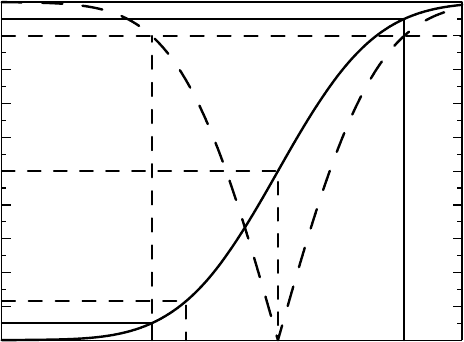
Figure 5.1. This plot shows how we derive p-values and confidence intervals from C(θ):
•
The value C(θ
0
) gives the p-value for the null hypothesis θ ≤ θ
0
.
2
(In Figure 5.1 this
takes the value 0.12.)
•
1 − C(θ
0
) defines the p-value for the hypothesis θ ≥ θ
0
.
1
As long as the distribution is continuous, otherwise we replace θ
∗
in the middle by its left-hand limit.
2
We use the notation θ ≤ θ
0
to denote the situation where the null hypothesis is θ = θ
0
and the alternative is
θ>θ
0
, with a similar convention for the opposite one-sided hypothesis.
OUR KNOWLEDGE ABOUT A PARAMETER FROM AN EXPERIMENT 123
0
0.1
0.2
0.3
0.4
0.5
0.6
0.7
0.8
0.9
1
Confidence function C (θ)
θ
1
θ
2
θ
*
θ
0
Population parameter θ
Figure 5.1 The confidence function based on the observed statistical result θ
∗
. The solid
curve shows the one-sided confidence function, whereas the dashed curve corresponds to the
two-sided one. See text for details.
•
Taking the inverse image of an interval of length d on the y-axis, we obtain a confidence
interval for the parameter θ with confidence level d. In the graph there is a symmet-
ric 90% confidence interval (θ
1
,θ
2
) around θ
∗
, obtained by finding the points on the
θ-axis with confidence function values equal to 0.05 and 0.95 (i.e., C(θ
1
) = 0.05 and
C(θ
2
) = 0.95, respectively).
We noted in Section 4.5.2 that for symmetric two-sided confidence statements (which
confidence intervals typically are) we can use the distribution function of the square of
the test statistic. Since many one-sided tests are based on the Gaussian distribution, this
means using the χ
2
distribution (see Appendix 5.A.2). We will use the notation χ
n
(x) for
the CDF of the χ
2
(n) distribution. This is illustrated in Figure 5.1, where the dashed curve
shows the confidence function for two-sided alternatives. Inspecting it, we find that (1) the
estimate θ
∗
corresponds to the minimum, and (2) the 90% confidence interval for θ is
obtained by reading off where the dashed curve intersects the line y = 0.9 (the horizon-
tal dashed line). The one-sided confidence function is the one with most information,
because when we square, we lose track of the sign, but the two-sided version is required in
many problems.
A first illustration of this was given in Section 4.6.1, to which we want to add two further
examples, both of which are concerned with one-parameter problems. In the next section we
will address the more complicated problem with two parameters when we are only interested
in some particular combination of these, which will leave us with one nuisance parameter.
Example 5.1 This is a continuation of the Fisher’s exact test discussed in Section 4.5.1
and uses the data of the first study there. Fisher’s test can be expressed as a test of the
null hypothesis that the odds ratio is one, and we now want to exploit this test further in
124 LEARNING ABOUT PARAMETERS, AND SOME NOTES ON PLANNING
0
0.1
0.2
0.3
0.4
0.5
0.6
0.7
0.8
0.9
1
Confidence Function
54321
Odds Ratio
0
0.04
0.08
0.12
P(x
11
= 67)
5432
Odds Ratio
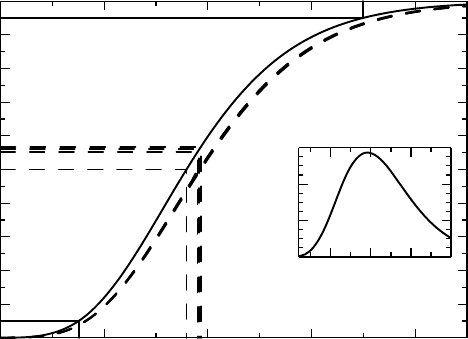
Figure 5.2 The exact confidence function for the odds ratio for the first Hodgkin’s lymphoma
table is shown as the solid curve, whereas some approximations based on natural estimates of
the odds ratio are shown as the almost overlapping dashed curves – see text. The inset graph
shows the likelihood function that determines the maximum likelihood estimate.
order to obtain knowledge about the true odds ratio from available data. What we do is
essentially to repeat Fisher’s test for arbitrary values θ of the odds ratio. For each θ we compute
the probability that the observation is 67 or larger, which gives us the confidence function
C(θ) that is plotted as the solid curve in Figure 5.2. Also illustrated is the symmetric 95%
confidence interval for the odds ratio, which is (1.75, 4.49), and is indicated by the solid lines in
Figure 5.2.
There is more to be said about this example, also illustrated in Figure 5.2. The computation
of the confidence interval for the odds ratio was done without reference to a point estimate.
How we obtain a point estimate of the odds ratio is a separate question. There are quite a few
options available.
•
One estimate would be the point that gives 50% confidence, that is, the solution of the
equation C(θ) = 0.5. In our case this point estimate is 2.79.
•
Intuitively the most obvious choice is probably the empirical odds ratio which was
discussed at the end of Section 4.5.1, which we know is 2.93.
•
A further choice is to use the θ for which the observed count equals the expected count.
This is the θ which solves the equation x
∗
11
= E
θ
(x
11
) and gives us the estimate 2.92.
•
A final choice is to use the maximum likelihood estimate, which in this case is 2.90.
All these estimates are shown in Figure 5.2, where we see that all but the first of these estimates
correspond to more than 50% confidence on the solid curve. We also see that the variability
for the other three estimates is very small. Each of these suggested point estimates for the

OUR KNOWLEDGE ABOUT A PARAMETER FROM AN EXPERIMENT 125
odds ratio has its own rationale and to each of them there is associated a confidence function,
also indicated in Figure 5.2 as the dashed curves. These confidence curves agree well with
each other, but not with the original, solid, one. Why this is will be explained after we have
discussed how the alternative confidence functions are obtained.
As can be seen from the discussion in Appendix 5.A.1, and will be further detailed in
Example 13.3, under the assumption of a (non-central) hypergeometric distribution for x
11
we have that if
ˆ
θ is the empirical odds ratio, then
ln(
ˆ
θ) ∈ AsN
ln(θ),
1
μ
+
1
n
1+
− μ
+
1
n
2+
− μ
+
1
n
2+
− r + μ
,
where μ = E
θ
(x
11
) and r is the column sum we condition on. Inserting the observation x
∗
11
for μ provides us with an approximative confidence function for the odds ratio, based on the
empirical odds ratio. With our data we have that the estimated log-odds ratio is 1.076, and its
variance is estimated as 1/67 + 1/34 + 1/43 + 1/64 = 0.083. This gives a 90% confidence
interval of (0.602, 1.551) for the logarithm of the odds ratio, which upon exponentiation gives
the corresponding interval for the odds ratio as (1.82, 4.71).
The next choice for an estimate of the odds ratio in the list above is the solution θ of
the equation x
∗
11
= E
θ
(x
11
). For this estimator we can obtain an approximative confidence
function (by appealing to large-sample theory) as
C(θ) =
E
θ
(x
11
) − x
∗
11
√
V
θ
(x
11
)
.
How to compute the mean and variance is discussed in Appendix 5.A.1.
Finally, we have the maximum likelihood approach, in which we compute, for different
values of the odds ratio θ, the probability of obtaining exactly the observed value 67. This
gives us a function of θ which is illustrated in the inset graph in Figure 5.2, a function which
has its maximum at the point 2.90, which therefore is the maximum likelihood estimate. (The
general method of obtaining the confidence function for a maximum likelihood estimator is
the subject of Section 13.3.)
It remains to explain why the dashed curves differ from the solid one in Figure 5.2. This
explanation has less to do with the fact that the three alternatives build on approximations,
appealing as they do to large-sample theory. The root cause of the difference is the discrete
nature of the hypergeometric distribution. In this case we have not used the mid-P adjustment
in equation (4.2), which we did for the binomial parameter in the previous chapter. With
the mid-P adjustment the solid curve moves to the dashed ones, and the confidence interval
with it.
The next example describes another one-parameter problem.
Example 5.2 We wish to study a certain adverse event, which is likely to occur with long-
term treatment using a particular drug. In order to estimate the risk for this adverse event,
we planned to follow 20 subjects for 5 years. The actual observation times for the patients
varied between 4.4 and 6.9 years and the event occurred during this observation period in
12 out of the 20 subjects. This particular adverse event can appear anywhere during treat-
ment, so we assume there is a constant hazard λ for it. If subject i is observed for time
T
i
, the probability that he experiences the event while being observed is p
i
(λ) = 1 − e
−λT
i
.
Denote by x
i
the outcome for subject i: it is one if the event has occurred, otherwise zero.
126 LEARNING ABOUT PARAMETERS, AND SOME NOTES ON PLANNING
0
0.2
0.4
0.6
0.8
1
Confidence function C (λ)
0.10 0.2 0.3
Hazard rate λ
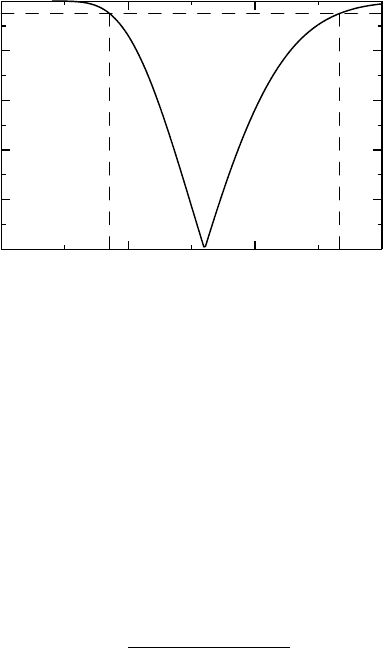
Figure 5.3 Two-sided confidence function for a hazard rate.
The total number of events, x = x
1
+ ...+ x
n
, is not an observation of a binomial distribu-
tion, even though each x
i
is an observation of a Bin(1,p
i
(λ)) distribution. We can, however,
still appeal to the CLT to find that the total number of events is asymptotically Gaussian in
distribution:
x =
n
i=1
x
i
∈ AsN
i
p
i
(λ),
i
p
i
(λ)(1 − p
i
(λ))
.
From this we derive the two-sided (approximate) confidence function
C(λ) = χ
1
(x −
i
p
i
(λ))
2
i
p
i
(λ)(1 − p
i
(λ))
.
We estimate λ as the value λ
∗
for which C(λ) = 0 (i.e., solve
i
p
i
(λ) = x) and obtain
confidence limits for λ as shown in Figure 5.3. We see that the hazard is estimated as 0.16
with 95% confidence interval (0.09, 0.27). We can also compute the predicted probability
that an individual experiences an adverse event within 5 years as 1 − e
−5·0.16
= 0.55, with
corresponding 95% confidence interval (0.35, 0.74).
We have used the confidence function in a way that makes it only a graphical tool for
obtaining confidence intervals and p-values. We have tacitly assumed that we are only dealing
with situations in which such things can be computed. However, looking at the one-sided
confidence curve in Figure 5.1 it is tempting to see it as a CDF for the parameter θ and,
subsequently, make probabilistic statements about θ. There are two problems with this:
1. There is in general no guarantee that the one-sided confidence function is monotonically
covering the entire interval (0, 1), which is a necessary condition for it to be a CDF.
2. There is a considerable conceptual leap involved in assigning a probability to θ. What
the confidence function does is to assign probabilities to where we find θ, which is
fundamentally different.

STATISTICAL ANALYSIS OF TWO PROPORTIONS 127
We will encounter a famous example of the first problem later, in Example 7.7. When it
comes to the second problem, we may note that Fisher himself argued for such a probabilistic
viewpoint. He did this in 1930, three years before Kolmogorov formulated his axioms for
probabilities and four years before Neyman introduced the concept of the confidence interval.
Fisher also assigned a special name to this probability, fiducial. He set about introducing it
by finding a substitute for the subjective priors used in Bayesian theory. Fisher had a distaste
for subjectivity and wanted probabilistic statements derived from objective data only. The
concept led to a lot of controversy and more or less died with Fisher himself. As already
indicated, there are situations where very specific assumptions on the prior in the Bayesian
approach are equivalent to this fiducial probability, the prime example being the t-test (and
shift models in general).
The controversy around fiducial probabilities is better left to the theoretical statisticians;
we only use the confidence function as a convenient tool to summarize the knowledge obtained
from an experiment. It is, however, interesting to note that the difference between using the
confidence function and using confidence intervals is essentially a continuation of the debate
about the nature of the p-value outlined in Box 1.3; the confidence function is much closer
to the view advocated by Fisher, whereas a single confidence interval, with its prespecified
confidence level, is more of a Neyman–Pearson tool for decision making.
5.4 Statistical analysis of two proportions
5.4.1 Some ways to compare two proportions
For a more complicated situation where we want to derive confidence about a parameter,
we next discuss ways to compare two proportions. We assume we have observations x
i
,
i = 1, 2, of two independent binomial distributions Bin(n
i
,p
i
), respectively, and we want to
compare p
1
and p
2
. For the purposes of the discussion we assume that the first group consists
of individuals exposed to something, and the second group is a control group. We want to
summarize the group comparison in a single parameter, which we denote θ in general. The
most important choices for θ are:
1. the difference = p
1
− p
2
, which measures the additive contribution of the exposure;
2. the relative ratio RR = p
1
/p
2
, closely related to the relative contribution of the expo-
sure (p
1
− p
2
)/p
2
= RR − 1;
3. the odds ratio OR = p
1
(1 − p
2
)/[p
2
(1 − p
1
)], which is the ratio of the odds for the
two groups.
(We may note in passing that the odds ratio can be written as a relative risk, because (by
independence)
OR =
P(X
1
= 1 and X
2
= 0)
P(X
1
= 0 and X
2
= 1)
=
P(X
1
>X
2
)
P(X
1
<X
2
)
.
It is therefore the relative probability of obtaining a larger value on the first variable, to that of
a smaller. This is a formulation that can be extended to more general data.) The three measures
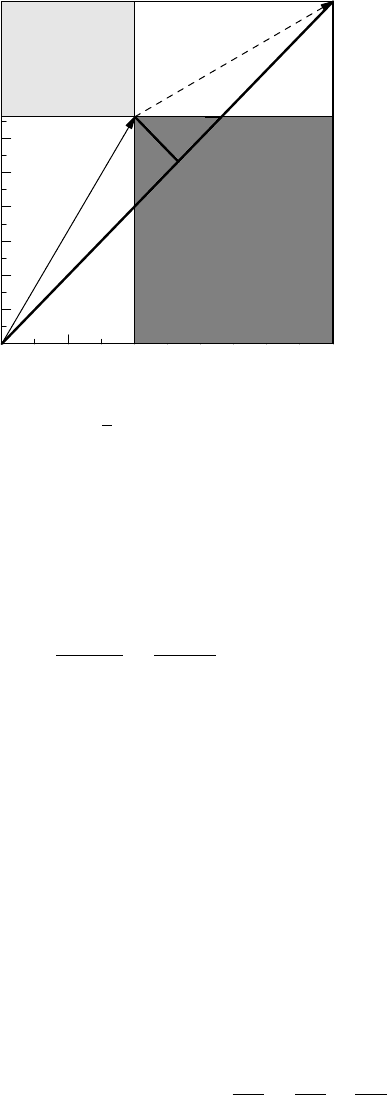
discussed above are geometrically described in Figure 5.4, and are the ones we will focus on.
There are, however, other useful combinations of p
1
and p
2
.
128 LEARNING ABOUT PARAMETERS, AND SOME NOTES ON PLANNING
0
0.1
0.2
0.3
0.4
0.5
0.6
0.7
0.8
0.9
1
0.20 0.4 0.6 0.8 1
p
2
(p
1
, p
2
)
p
1
RR
RR
c
|Δ |/
√
2
Figure 5.4 Geometrical illustration of parameters comparing two binomial probabilities.
RR is the slope of the solid arrow, ||/
√
2 the distance to the identity line, and OR the ratio
of the dark gray to the light gray rectangle (we can also see it as the ratio of the slopes RR
and RR
c
= (1 − p
1
)/(1 − p
2
)).
Example 5.3 If we measure the frequency of a particular outcome in an exposed and an
unexposed group, respectively, we get the attributable fraction among those exposed as
p
1
− p
2
p
1
=
RR − 1
RR
.
This measures the proportion of cases that would be eliminated if we eliminated the exposure,
should those in the exposed group have the same risk for being a case as those in the unexposed
group (see Box 5.2). Related to the attributable fraction is the excess risk q, which is the
probability that an exposed individual becomes a case, had he not been one when unexposed,
which means that it is derived from the equation p
1
= p
2
+ q(1 − p
2
)orq = (p
1
− p
2
)/
(1 − p
2
).
Another alternative transformation of p
1
and p
2
is the number needed to harm, which
refers to how many individuals we need to expose in order to get one extra case. It is defined by
the relation N · = 1 and is therefore given by the inverse of . It is often used by clinicians
as a way to quantify risks. However, it is a measure with drawbacks. Suppose we have two
different exposures with probabilities p
1
and p
2
and let p
0
denote the risk for an unexposed
individual. Then the extra risk of the first exposure over the second exposure is the difference
of the risk differences to the unexposed, but the relation for the numbers needed to harm is
more complicated:
p
1
− p
2
= (p
1
− p
0
) − (p
2
− p
0
) ⇔
1
N
12
=
1
N
10
−
1
N
20
,

STATISTICAL ANALYSIS OF TWO PROPORTIONS 129
Box 5.2 The attributable risk in the population
The attributable risk, also known as the etiologic factor (or fraction) is a widely
used measure for assessing the public health consequences of an association between
an exposure (E) and a disease (C). It was first introduced by Morton B. Levin in
1953 as a way to quantify the impact of smoking on lung cancer occurrence, and is
defined as
AR =
P(C) − P(C|E
c
)
P(C)
.
It measures the proportion of disease cases that can be related to the exposure, and
can therefore be used to assess the potential impact of a prevention program. It takes
into account both the strength of the association between exposure and disease, and the
prevalence of the exposure. It should be recognized that it assumes that the probability
of the disease in an exposed subject when the exposure is removed is the same as that
for an unexposed subject, an assumption we can seldom prove.
If we replace P (C) with P(C|E) we get the attributable risk AR(E) among those
exposed. Its relation to the attributable risk is that the latter is obtained by multiplying
by the proportion of those with the disease that has been exposed:
AR = AR(E)P(E|C).
This is derived using Bayes’ theorem. For rare diseases we can estimate AR from a
case–control study, if we approximate the relative risk with the odds ratio.
where N
ab
denotes the numbers needed to harm comparing groups a and b. This property
makes it doubtful that this parameter really is easily interpretable. When the event is positive
we talk about the number needed to treat (NNT).
In order to build the statistical machinery for the analysis of any of the parameters discussed
above, we start from the large-sample N(p, p(1 − p)/n) approximation for the distribution
of the estimator ˆp = x/n of p. This information can be used in two different ways. First, we
may note that
n(ˆp − p)
2
p(1 − p)
=
(x − np)
2
np(1 − p)
∈ χ
2
(1),
and since our two groups are independent, the sum of these expressions for the two groups
will have a χ
2
(2) distribution:
(x
1
− n
1
p
1
)
2
n
1
p
1
(1 − p
1
)
+
(x
2
− n
2
p
2
)
2
n
2
p
2
(1 − p
2
)
∈ χ
2
(2).
How to use this observation in order to derive confidence statements about different functions
of p
1
and p
2
will be discussed in Section 7.7. That discussion will allow us to simultaneously
obtain confidence information for any number of derived parameters we want. It is, however,
more involved mathematically than the approach we will discuss here.