
Kallen A. Understanding Biostatistics
Подождите немного. Документ загружается.

100 THE ANATOMY OF A STATISTICAL TEST
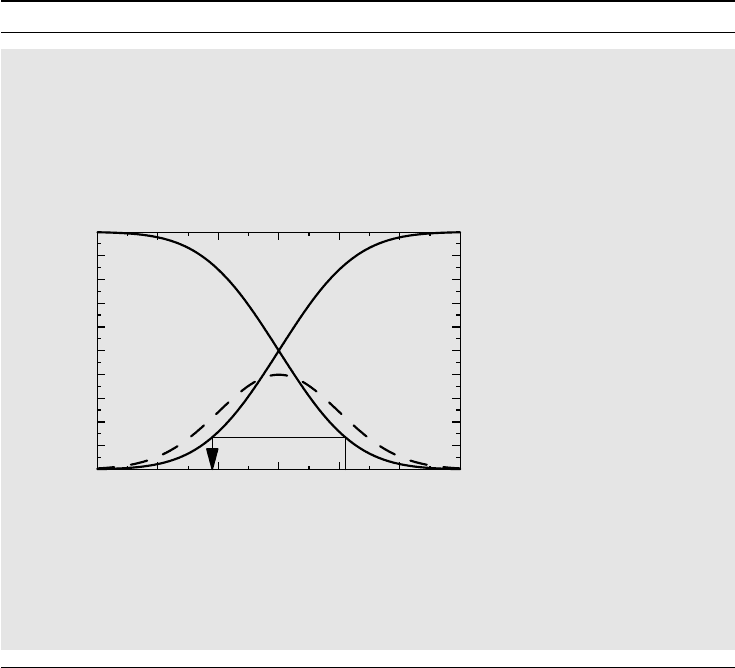
Box 4.6 Distributions symmetric around zero
One of the key properties of the standard normal distribution is that it is symmetric
around x = 0, which means that its probability density has the same value at the two
points ±x for all x. Expressed in terms of the CDF this means that
F (−x) = 1 − F(x−), (4.1)
which is equivalent to the probabilistic statement that it is as probable to get an obser-
vation to the left of −x as it is to get one to the right of x: P(X ≤−x) = P (X ≥ x).
0
0.1
0.2
0.3
0.4
0.5
0.6
0.7
0.8
0.9
y
−3 −2 −1 3210
x
y = 1 − F(x)
y = F(x)
y = f(x)
The figure above explains why equation (4.1) expresses symmetry around zero
for a continuous distribution (in fact, for a Gaussian distribution). The dashed func-
tion is the density function and we see that F (x) is the same as the reflection in the
y-axis of 1 − F (x). The rectangle at the bottom illustrates that the symmetry relation in
equation (4.1) at the point x = 1.1.
using the square X
2
as the test statistic instead, because the two-sided test for X becomes a
one-sided test for X
2
. For the normal distribution this turns the problem into one involving a
chi-square distribution (see Appendix 5.A.2).
Just as there may be more than one way to detect a specific chemical in a fluid, so the
same data can often be approached by different statistical tests. First of all, we can define
different test statistics. If we choose to do a t-test, our test statistic is based on a mean
difference, whereas the corresponding non-parametric test, the Wilcoxon test, is based on
a rank sum. But also when we have decided on the test statistic there are sometimes a few
options in the details of the computation of the p-value. A further aspect of statistical testing
is concerned with choosing between an unconditional and a conditional tests. An example is
Fisher’s exact test for a 2 × 2 table, discussed above. It starts with two binomial distributions
(the two rows) and we consider the result conditional on the outcome of the first column total.
This way we reduce two parameters, the two binomial proportions, to one, the odds ratio.
The general situation is that we are interested in a parameter (say, the odds ratio) and there
are other so-called nuisance parameters in the distributions (the first binomial proportion,
for example). It is then sometimes possible to derive a conditional distribution which defines
a distribution (under the null hypothesis) without the nuisance parameters. The down-side
MAKING STATEMENTS ABOUT A BINOMIAL PARAMETER 101
of this is that such a test is a conditional test, conditional on the value of this other test
statistic. Even though the other test statistic has nothing to do with our primary problem, it
is still the case that any p-value will be computed under the assumption that this other test
statistic takes on a particular value. Statisticians are divided as to how much this allows us
to generalize (most medics probably do not care). For Fisher’s exact test, can you generalize
to all 2 × 2 tables that can be derived from this experiment, or only to those that have the
same margins?
4.6 Making statements about a binomial parameter
4.6.1 The frequentist approach
We now wish to address what appears at first to be a very simple problem. Suppose that we
have studied n = 101 individuals and found that x = 67 of these have a particular property;
what we can say about the binomial parameter p which is the fraction of individuals in
the population with this property? That we have the point estimate p
∗
= 67/101 = 0.66
of p is obvious, but what can we say about how accurate this estimate is? A discussion
about this simple problem will allow us to compare the frequentist and Bayesian approaches
to statistics.
Here is how the frequentist approaches the problem. He bases his analysis exclusively on
what he knows. If p is the true parameter value, the number of individuals in the sample with
the property has the Bin(n, p) distribution. The CDF for this distribution is given by
F (x, p) =
k≤x
n
k
p
k
(1 − p)
n−k
,
which, like the hypergeometric distribution in the previous section, is a step function. We can
then define the function (where x is the observed outcome)
C(p) = 1 − F(x−,p),
which is the probability P(X ≥ x|p) that we get an observation at least as large as the observed
value x, when the true parameter value is p. This function C(p) is an increasing function, start-
ing at zero when p = 0 and ending at one when p = 1. It is called the confidence function for
the binomial parameter p based on the outcome of this experiment. From the frequentist’s point
of view this function contains all the information about p that is provided by the experiment.
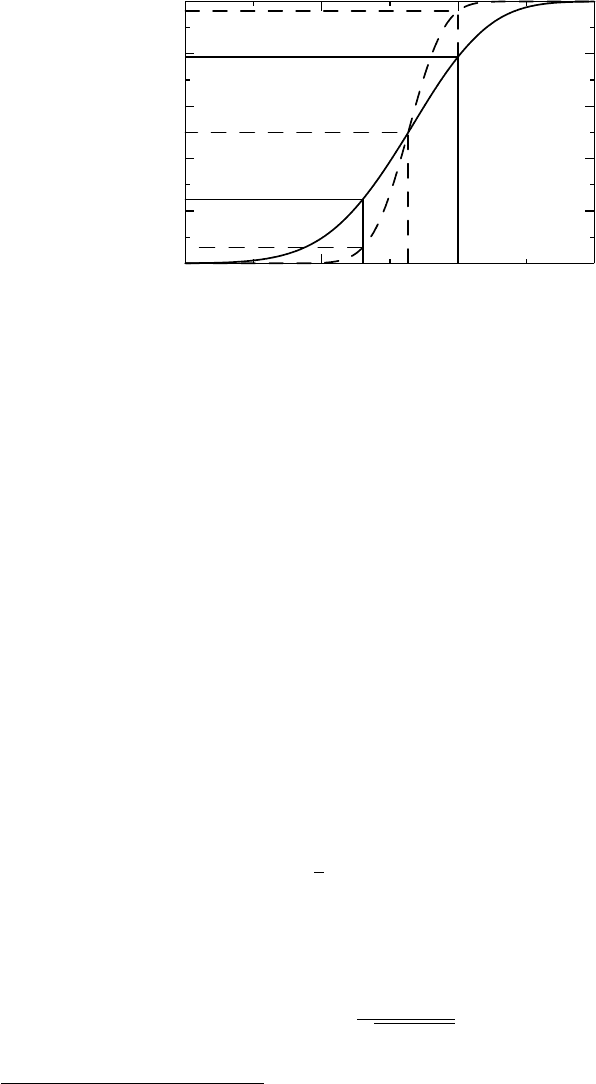
For the data above, the confidence function C(p) is illustrated as the solid curve in Figure 4.3.
The graph also contains a dashed curve, which shows what the confidence function would
look like if we had five times as many observations but with the same observed proportion
(i.e., 335/505). We have added this curve to illustrate how a larger sample size increases the
knowledge about p, by making the confidence curve steeper.
What can the confidence function tell us about the binomial parameter p? First, we note
that the point estimate 0.66 corresponds to the confidence value 0.5 for both confidence
curves (because we assumed that we had the same point estimate in the two cases). Next we
consider the solid confidence function. For this we have that C(0 .63) = 0.24, which means
102 THE ANATOMY OF A STATISTICAL TEST
0
0.2
0.4
0.6
0.8
1
Confidence in p
0.5 0.6 0.7 0.8
Binomial parameter p
Figure 4.3 Two confidence functions for a binomial parameter, where the dashed one has
five times as many observations as the solid one.
that this is the one-sided p-value if we test the hypothesis that p ≤ 0.63.
2
Similarly, we have
C(0.70) = 0.79, so the one-sided p-value for the test of the hypothesis p = 0.70, or larger, is
0.21. In this way we can compute the p-values, for all kinds of one-sided hypotheses regarding
the parameter p.
The numerical observations above also mean that the interval (0.63, 0.70) is a confidence
interval with confidence level 0.55 (= 1 − (0.24 + 0.21)). A confidence interval has con-
fidence degree 1 − α, if the method we use to compute it guarantees that it contains the true
value p in the fraction 1 − α of experiments. We will discuss such intervals in more detail in the
next chapter. The corresponding p-values for confidence functions based on the larger sample
size can be read off from the dashed curve as C(0 .63) = 0.060 and 1 − C(0.70) = 0.036, so
in this case the same interval has confidence level 0.904.
Actually, we have cheated a little here. There is a minor complication due to the discrete
nature of the binomial CDF F (x, p) as a function of x for fixed p. The complication is that
P(X ≤ x) = F (x, p) but that P(X ≥ x) = 1
− F (x − 1,p),
which represents an asymmetry between the two tails, and justifies why we should redefine
C(p) as the compromise
C(p) = 1 −
1
2
(F (x − 1,p) + F (x, p)). (4.2)
This modification is called the mid-P adjustment, and is actually the confidence function
we have used above. It agrees to a very high precision with what we obtain if we apply a
large-sample approximation, namely
C(p) =
np − x
√
np(1 − p)
. (4.3)
2
More precisely, the null hypothesis is p = 0.63 and the alternate hypothesis is p>0.63.

MAKING STATEMENTS ABOUT A BINOMIAL PARAMETER 103
Box 4.7 Confidence intervals for a binomial parameter
The confidence intervals we derive from the discussion in Section 4.6.1 are not the
ones most often used. The method discussed, for a symmetric confidence interval of
confidence degree 1 − α, is equivalent to finding the two solutions to the equation
(p
∗
− p)
2
p(1 − p)/n
= z
2
α/2
, (4.4)
where z
α
denotes the (1 − α)th percentile for the standard Gaussian distribution. The
solution to this is given by
p
∗
+
z
2
α/2
2n
1 +
z
2
α/2
n
±
z
α/2
√
n +
z
2
α/2
√
n
p
∗
(1 − p
∗
) +
z
2
α/2
4n
.
These intervals were introduced in the late 1920s by Wilson, and differ from the standard
confidence intervals, which are obtained by using the estimate p
∗
(1 − p
∗
)/n for the
variance and solving equation (4.4):
p
∗
± z
α/2
p
∗
(1 − p
∗
)
n
.
An important difference between the Wilson intervals and the conventional ones is that
the former are always restricted to [0 , 1]. In fact, it can be seen from the quadratic
equation that its limits are such that the interval for the odds p/(1 − p) is symmetrical
around the estimate on a multiplicative scale.
These are, however, only two of a number of different suggestions for how to
compute confidence intervals for a binomial proportion. The exact version, called the
Clopper–Pearson intervals, is derived directly from the binomial distribution (without
the mid-P adjustment). It is conservative in terms of actual coverage level, a fact derived
from its discreteness. That reason, and the complexity of computing the exact interval
(prior to the computer age), has led to the emergence of a number of approximative
intervals, of which the standard one and the Wilson interval are only two.
This approximation is called de Moivre’s theorem and is justified in Section 4.7. (It is common
to use a mid-x adjustment instead of a mid-P adjustment to correct for the discreteness of the
binomial distribution, which means that the Gaussian approximation is computed not at the
point x but at the point x + 1/2. This is called a continuity correction or half-correction. We
will later see other arguments for why the mid-P adjustment might be the right thing to do.)
We have used a geometric approach to the description of how to derive knowledge about a
binomial proportion, but the algebra involved is discussed in Box 4.7 (using the large-sample
approximation).
At this point it is worth commenting on how to produce confidence intervals for a
function of a parameter. Suppose we want to make statements about the odds p/(1 − p)
instead of about p itself. This is simple: all we need to do is to compute the confidence
function as before and plot it, not versus p, but versus θ = p/(1 − p). Confidence intervals
104 THE ANATOMY OF A STATISTICAL TEST
for the odds are derived in the same way as described above, which is equivalent to
applying the odds function f (p) = p/(1 − p) to the limits of the confidence intervals
in Figure 4.3.
There are some interesting observations to make about this. To estimate θ from the ob-
servation x, the natural estimate is probably θ
∗
= x/(n − x), the empirical odds. But the
corresponding test statistic is not unbiased; its expected value is not θ. In fact, its mean value
does not even exist, because there is a positive probability of x/(n − x) becoming infinite,
which occurs when x = n. However, for large n this is unlikely, unless p is very close to one,
and there is a useful approximation to the confidence function, namely
C(θ) =
ln(θ) − ln(θ
∗
)
√
1/x + 1/(n − x)
. (4.5)
In order to justify this, recall from basic calculus that ln(1 + x) ≈ x for small x, from which
we deduce that
ln
x
n − x
≈ ln θ +
x − np
np(1 − p)
.
De Moivre’s theorem then implies that the right-hand side has (asymptotically) a Gaussian
distribution with mean zero and a variance given by
1
np(1 − p)
=
1
np
+
1
n(1 − p)
.
Finally, we replace np with the observation x and n(1 − p) with the observation n − x.
4.6.2 The Bayesian approach
We saw in Section 1.10 that the concept of probability is not restricted to probabilities
which can be interpreted as frequencies, and that there is a whole school of statisticians
who think of probabilities more in terms of an subjective assessment – the Bayesians. So
how would a Bayesian statistician approach the problem of obtaining knowledge about a
binomial parameter?
Before we discuss this, let us stress one particular aspect of the foregoing frequentist
analysis. The data from the experiment define a confidence function, from which p-values and
confidence intervals are derived. This type of confidence is something that is very reminiscent
of a probability; it is always between 0 and 1, for a start. But its interpretation as a probability
is more involved. For example, for something to be a 90% confidence interval means that if
we repeat the experiment very many times, we expect the true parameter to be somewhere
within these intervals in 90% of runs. It is not a probability statement about the parameter
but about the computational method for the interval. However, to make probability statements
about the parameter is precisely what Bayesian statisticians do. They do this following a
well-defined process that captures the inductive aspect of science: we learn more as we do
more experiments.
Another point before we start the discussion is the need for a convenient notation that
conveys the important mathematical aspects of the discussion, which is about sums. To avoid
the conventional distinction between discrete and continuous stochastic variables we will use
the integral notation outlined in Box 4.8, which was also mentioned in Section 2.5. Now to
the Bayesian analysis.

MAKING STATEMENTS ABOUT A BINOMIAL PARAMETER 105
Box 4.8 Notation: Differentials and the Stieltjes integral
Statistics is often divided into a discrete and continuous version, with the former ex-
pressed in probability functions and sums and the latter having probability densities
and integrals (and therefore being more involved mathematically). In order to avoid this
distinction we will use a uniform notation based on the mathematical concept of the
Stieltjes integral.
If F (x) is a right-continuous function (in our case almost always a CDF), we denote
by dF (x) either the jump F(x) = F (x) − F (x−) at that point, if there is one, or the
differential at that point (we assume that a function that does not have a jump at a
point is differentiable there). The latter means that dF (x) = f (x)dx, where f (x)isthe
probability density at that point. At a jump point, the probability function is F (x). On
occasion we even let dF (x) denote the density f (x) at continuity points x.
Sums and conventional integrals are now replaced by the Stieltjes integral
b
a
g(x)dF (x).
This represents a sum – the notation
for an integral is actually only a slanted S for the
first letter in sum – and the notation means that we sum the g(x) using weights dF (x).
It is defined, by first defining it for a step function g(x) corresponding to the partition
a = x
0
<x
1
<...<x
n
= b with values g
i
in the intervals (x
i−1
,x
i
], as
b
a
g(x)dF (x) =
n
i=1
g
i
(F (x
i
) − F (x
i−1
)).
Repeating the standard definition of the Riemann integral (sandwich a general function
between two step functions with the same partition), we obtain, by making the parti-
tion finer and finer, a limit that defines the integral. For a continuous distribution with
dF (x) = f (x)dx, this is the conventional integral
g(x)f (x)dx, and if the distribution
is discrete, it is the sum
k
g(x
k
)F (x
k
).
Before he starts the experiment, the Bayesian statistician must have a prior opinion
about the value of the parameter p. In order to describe his prior belief he defines a CDF
Q(p), called the a priori distribution. If he is certain of the value of the parameter, he
should assign all probability to one point. The opposite extreme is complete ignorance, in
which case he might assign equal probability to everything between 0 and 1. We should
not confuse Q(p) with the heterogeneity distribution which was discussed in Section 2.5;
they are not related. The heterogeneity means that there are different probabilities for
different individuals, whereas the Bayesian assumes a common p for all, but is uncertain
about its value and wants that uncertainty to be propagated through the calculations.
Given the prior, the probability for obtaining a particular outcome is computed by
the formula
P(X = x) =
1
0
P(X = x|p)dQ(p),

106 THE ANATOMY OF A STATISTICAL TEST
where P(X = x|p) is the binomial probability function. The probability P(X = x) is called
the predictive probability for the different outcomes of the experiment.
Having decided on his prior opinion, the Bayesian statistician performs the experiment.
We assume he gets the same data as in the previous section (n = 101,x= 67 for a binomial
distribution). Using this information, he updates his belief about what p is. The updated
distribution F (p|x) is called the a posteriori distribution of p (based on the observation x)
and is obtained from Bayes’ theorem as
dF (p|x) =
P(X = x|p)dQ(p)
P(X = x)
= C(x)p
x
(1 − p)
n−x
dQ(p).
Here C(x) = 1/P (X = x) is independent of p and makes F (p|x) a CDF for p.
In case of complete certainty, when Q(p) has probability one at a single point, the a
posteriori distribution will also have probability one at that point; there is nothing in the
outcome of the experiment that will change your view.
There is a particular prior of special interest, called the uninformed prior (flat or uniform
prior would probably be a better description). This is the prior distribution for which every
value of p in (0 , 1) is equally probable, and therefore means that dQ(p) = dp . Not surprisingly,
the uninformed prior implies that the predictive probability for all possible values is the same:
P(X = x) =
1
0
n
x
p
x
(1 − p)
n−x
dp =
1
n + 1
,x= 0,...,n.
Furthermore, the assumption implies that the a posteriori distribution becomes
dF (p|x) = (n + 1)p
x
(1 − p)
n−x
dp.
Such a distribution, for which the probability density f (p) is proportional to p
a−1
(1 − p)
b−1
,
is called the beta distribution with parameters a and b; we denote its CDF by β(p; a, b). We
therefore have that
F (p|x) = β(p; x + 1,n− x + 1).
The expected value for p based on this a posteriori distribution can be calculated as
1
0
pdF(p|x) =
x + 1
n + 2
, (4.6)
a result known as ‘Laplace’s rule of succession’ (see Box 4.9). As an application of this, if you
have no prior idea of what percentage of swans are white, you may assign the uninformative
prior to this. After having observed n swans, all white, your prediction is that the fraction
n/(n + 1) of all swans are white. (The frequentist would obtain this estimate had he seen n
white and one colored swans.) This is your inductive conclusion, and essentially means that
since you have only seen white swans, you believe most (or almost all, depending on n) swans
are white.
However, the point about Bayesian statistics is not really to use the uninformed prior.
The point is to synthesize prior knowledge into a more structured, but still subjective, prior
distribution Q(p). Assume that we believe that the true probability is somewhere in the vicinity
of 0 .4. To make it precise we assume that our subjective prior information can be summarized

MAKING STATEMENTS ABOUT A BINOMIAL PARAMETER 107
Box 4.9 Laplace rule of succession and the sunrise problem
If we have n independent observations of a Bernoulli experiment in which the event
has occurred k times, what is the probability that it will occur in the next, independent,
experiment? Conventional reasoning would estimate the unknown probability as k/n,
which therefore is the predicted probability that it will occur in the next test.
However, if we have had success on all occasions, so that k = n, is it obvious that this
is the proper estimate? The prediction would be that we are certain the event will occur
next time. But if we toss a possibly biased coin 10 times getting a head each time, is the
best predictive probability estimate really that we are certain to get a head next time?
Laplace addressed this as the sunrise problem: ‘what is the probability that the sun
will rise tomorrow?’ He argued as follows. Prior to knowing of any sunrises, one is
completely ignorant of the probability p of a sunrise. Laplace takes this ignorance to
mean that at that stage of our knowledge about p, it can be described by the uniform
distribution on the interval (0, 1). He then derived equation (4.6) and concluded that
after the sun has risen on n consecutive days, the updated probability of a sunrise is
p = (n + 1)/(n + 2). The larger the number of days that have begun with a sunrise, the
higher the plausibility of a sunrise tomorrow. His numerical estimate of this was based
on the assumption that Earth was created on October 23, 4004 bc, as the Bible had been
thought to imply.
However, we must not think that Laplace seriously believed in this. Laplace was
the author of the masterpiece Trait´edeM´echanique C´eleste in five volumes, which
described the solar system in deterministic mathematical equations. Concerning the
sunrise problem he reflected: ‘But this number is far greater for him who, seeing in
the totality of phenomena the principle regulating the days and seasons, realizes that
nothing at present moment can arrest the course of it.’ Or, in other words, the plausibility
of a sunrise depends on how much you know, and this varies from person to person.
This is at the heart of Bayesian statistics: the only good probability is a conditional
probability taking into account what one knows.
by the β(p;4, 6) distribution (which has mean 0.4). In such a case the a posteriori distribution
is proportional to
p
x
(1 − x)
n−x
dβ(p;4, 6) = p
x+4−1
(1 − p)
n−x+6−1
dp,
which is the β(p; x + 4,n− x + 6) distribution. (Bayesian statistics is often numerically hard
and often requires computer simulations, but for this particular case the beta distribution makes
it simple.)
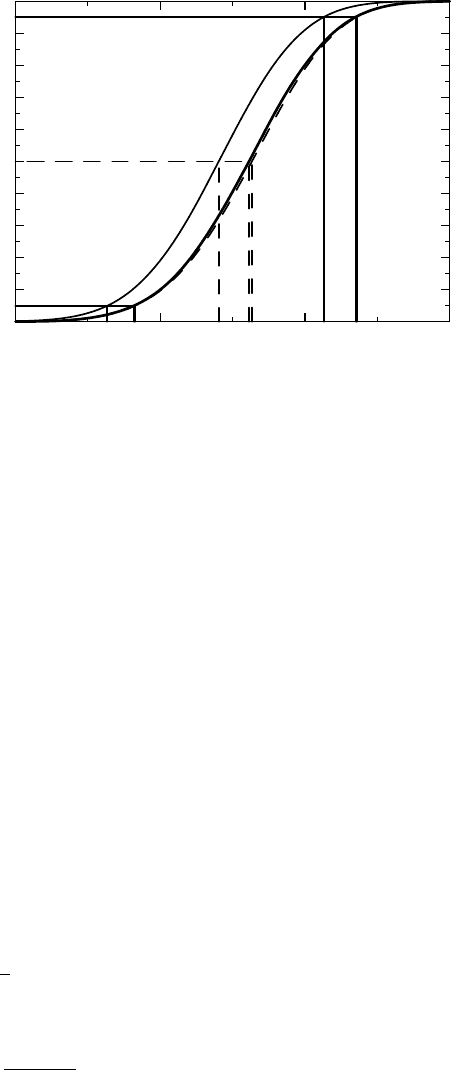
All this is illustrated in Figure 4.4, using the data above. In this graph we have also
reproduced, as the dashed curve, the confidence function in Figure 4.3. Indicated is its median
value, which is the old estimate 0.66, together with the 90% confidence interval (0.58, 0.74).
In addition there are two CDFs, both drawn as solid curves. The rightmost of these, which
is very close to the graph of the confidence function, shows the a posteriori distribution for
p when we use the uninformative prior. We have also indicated its median value, together
with what would correspond to a 90% confidence interval. However, in this setting, this
corresponds to a true probability statement – the probability that the value of p lies in this
108 THE ANATOMY OF A STATISTICAL TEST
0
0.1
0.2
0.3
0.4
0.5
0.6
0.7
0.8
0.9
1
Posterior probability CDF for p
0.5 0.6 0.7 0.8
Binomial proportion p
Figure 4.4 Bayesian analysis of a single binomial proportion. The solid curves are Bayesian
a posteriori distributions, the dashed curve is the frequentist’s confidence function. The right
solid curve corresponds to the uninformed prior, the left one to an informed prior centered
on p = 0.4.
interval is 90%. The interval is therefore not called a confidence interval, but a credibility
interval (both are conveniently abbreviated CI). Numerically we obtain the estimate 0.66
with 90% credibility interval (0.58, 0.74) – the same to two decimal places as found by
the frequentist.
The left solid curve in Figure 4.4 describes the a posteriori distribution when we use
the informed prior distribution above. Recall that the a priori distribution was centered
on p = 0.4, which is far to the left in this graph, so we see how the data have moved our
subjective assessment considerably toward larger values of p, and into a distribution for which
we have the median value 0.64 with 90% credibility interval (0.56, 0.71). This illustrates how
the Bayesian view of the world works: you update your collected knowledge when you get
new information.
Note the close agreement between the a posteriori distribution of p when using the un-
informed prior and the confidence function. This is sometimes interpreted as implying that if
we have no prior opinion on p, we are almost in the frequentist situation. This is, however,
debatable. What is true is that in many situations you can find a prior that is such that the
corresponding a posteriori distribution closely resembles the confidence function. What is
debatable is whether it reflects ignorance: if we are ignorant about the value of p we are also
ignorant about the value of p
2
, but if p is uniformly distributed on (0, 1), then the CDF for p
2
would be F (x) =
√
x, which is not uninformative. However, things gets more bizarre, because
the CDF for the β(p; x + 1/2,n− x + 1/2) distribution actually improves the approximation
to the confidence function. This case corresponds to taking as the a priori distribution the
β(1/2, 1/2) distribution, which (in this case) is called Jeffrey’s prior. Its probability den-
sity function is 1/
√
p(1 − p), which means that it puts very large weight on very small and
large values of p, and much less on intermediate values. So the best approximation to the

THE BELL-SHAPED ERROR DISTRIBUTION 109
confidence function is not obtained by ignorance, but by putting weights on the boundaries.
In passing, we may note that this observation gives us what is actually a rather robust way to
obtain traditional confidence intervals for p, by approximating the confidence function with
this beta distribution. (We may also note that if Laplace had used this prior for his law of
succession, he would have found the odds to be 2n + 1 to 1 instead of n + 1to1asinthe
discussion above.)
4.7 The bell-shaped error distribution
The Italian priest and astronomer Guiseppe Piazzi discovered early in 1801 what he thought
was a new planet. He gave it the name Ceres, but after a while he lost sight of it when it
went behind the sun. There were so few observations made that astronomers were not able to
work out its orbit and therefore worried that they would not be able to locate it again, once
it emerged from behind the sun. Karl Friedrich Gauss, arguably the greatest mathematician
of all time, decided to give this problem his attention. After some lengthy calculations, he
predicted where Ceres would reappear. When it duly did so, Gauss’s fame spread far and
wide. At the time, Gauss did not communicate how he had arrived at his prediction, but it
later turned out that the method he used was what we today call the method of least squares.
Gauss had invented and used this method years earlier before he applied it to this particular
astronomical problem. He subsequently produced two proofs for the method. It is his first
version that is of interest to us here, because it justifies the choice of the Gaussian distribution
as a distribution for errors.
At the time it was customary in the natural sciences to use the arithmetic mean of repeated
observations, taken under essentially the same circumstances, as the estimate of the true value
of the phenomenon in questions. However, this method seemed not justified by the probability
distributions used at the time. Gauss filled this gap between statistical practice and statistical
theory by changing both the probability density and the method of estimation. With respect
to the former, the question was this: what does the error distribution look like, if the best way
to estimate the location is by taking the average? Using an argument, a modern short version
of which is given in Box 4.10, Gauss deduced that the distribution of the errors should have
a density which takes the form
ϕ(x) =
k
2π
e
−kx
2
/2
for some constant k>0. Gauss pointed out that ‘the constant k can be considered as
the measure of precision of the observations’. He also made the comment that the dis-
tribution cannot truly represent a law of error, since it also assigns positive probabilities
to errors outside the range of possible errors; negative errors are often not possible and
there may be practical constraints on how large errors can be. Gauss considers this
feature unavoidable but of no importance because of the rapid vanishing of ϕ(x) for large
values of |x|.
This was, however, not the first time the Gaussian distribution had appeared. In 1733
Abraham de Moivre derived it as an approximation to the probability that a binomial
variable is observed in a specified interval. His investigation was prompted by a need to
compute probabilities of winning in various games of chance, and what he demonstrated