
Kallen A. Understanding Biostatistics
Подождите немного. Документ загружается.

150 EMPIRICAL DISTRIBUTION FUNCTIONS
0
0.1
0.2
0.3
0.4
0.5
0.6
0.7
0.8
0.9
1
Fraction of patients
6000500040003000200010000
sputumcount/gNeutrophil
0
0.2
0.4
0.6
0.8
6004002000
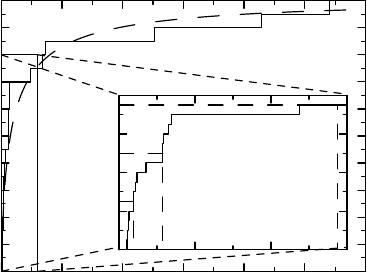
Figure 6.1 Illustration of data as an empirical distribution function. In the main graph,
the solid step function is the e-CDF and the dashed curve the population CDF. The inset
graph shows a blow-up of the initial part of the e-CDF, illustrating how some percentiles
are estimated.
all these x
i
. We now wish to look at the more general situation in which the outcome variable
can take on a multitude of different values, including the case where (in theory) it can take
on all possible values, at least in some interval. Well-known examples are blood pressure and
objective lung function measurements such as FEV
1
.
Consider the following 20 numbers: 37, 71, 24, 38, 44, 4286, 728, 26, 22, 138, 475, 47,
5408, 115, 131, 2520, 676, 21, 117, 115. They represent the neutrophil cell counts found in
sputum samples from 20 COPD patients. The medical meaning of this is not important, only the
assumption that these observations constitute a representative sample from some population.
We are going to use these data for illustrative purposes extensively in the upcoming discussion.
(The numbers are actually simulated, which explains why we can draw certain dashed curves
in some graphs below.)
One way to illustrate these 20 numbers graphically is the staircase function shown in
Figure 6.1. The data values are on the x-axis, at each of which there is a vertical step of
1/20, leading up to a monotonically increasing function starting at zero and finishing at one.
This function is called the empirical cumulative distribution function (e-CDF) of the data. We
usually denote it by F
n
(x), with n being the number of observations it is based on.
In the graph there is also a dashed curve. This represents another function, namely the
population CDF F (x), the distribution in the population of such data. This is what the e-CDF
F
n
(x) tries to estimate. The difference between the e-CDF and the CDF is that if we repeat
the experiment there will be a new e-CDF each time, although the CDF stays the same. This
means that F (x) is a characteristic of the outcome variable in the population (when measured
in the particular way of the specific protocol), whereas F
n
(x) is an estimate of F(x) from a
particular sample from that population. In general, statistics is divided into two main parts:
descriptive statistics which describes F
n
(x), and
inferential statistics which uses F
n
(x) to understand F (x).

HOW TO DESCRIBE THE DISTRIBUTION OF A SAMPLE 151
We have already noted that there are continuous and discrete stochastic variables. For
the former the CDF is a continuous function, whereas for the latter it is a step function.
Some data are hybrids of discrete and continuous data. For example, in order to assess a
person’s disability we may use a Visual Analogue Scale (VAS) which means that the disability
is described by a mark on a line going from 0 to 1, where 0 means no disability and 1 complete
disability. The corresponding CDF may have jumps at both the end points, but be a continuous
and increasing function in between.
The value of the e-CDF at the point x is the proportion of elements in the sample
{x
1
,...,x
n
} that are at most x in magnitude. It therefore has the analytical expression
F
n
(x) =
1
n
n
i=1
I(x
i
≤ x), (6.1)
where I(C) denotes the indicator function which is 1 if the condition C is true and 0 if it is false.
If precisely k of these x
i
are less than or equal to a particular value x, then F
n
(x) = k/n.Ifso,
and x is one of the observations, we call k the rank of x and denote it by R
n
(x) (which therefore
is equal to nF
n
(x)). (If there are ties, a modification is needed.) There is a fundamental theorem
in probability theory, called the Glivenko–Cantelli theorem, which says that the e-CDF F
n
(x)
converges to F (x) (in a uniform way in x), as the sample size n increases.
The e-CDF is defined as a (right-continuous) step function. For many purposes it would
have been more convenient, at least for a continuous CDF, to define it as a piecewise linear
function such that the point (x
k
,F(x
k
)) is connected to (x
k+1
,F(x
k+1
)) by a straight line,
instead of via the point (x
k+1
,F(x
k
)) (the staircase). We will, however, mostly stick with
the convention, except for a few occasions when we point out some benefits of the linearly
interpolated version, when this clarifies a particular statistical method.
There is an alternative formula for the e-CDF. Its derivation is based on the observation that
for any monotone function we have that F (x) = F (x−) + F (x), where F(x) is the jump at
the point x and F (x−) is the left-hand limit of F (x). If we rewrite this for the complementary
function F
c
(x) = 1 − F (x), we get
F
c
(x) = F
c
(x−) − F (x) = F
c
(x−)
1 −
F (x)
F
c
(x−)
.
This is an observation which only is of interest at jump points, and since the e-CDF consists
exclusively of jump points, it is particularly useful for that function. In fact, if we apply the
observation repeatedly to the e-CDF, we get the alternative formula for F
n
(x), referred to
above. The way it is computed is as follows. Order the different values in the sample into a
strictly increasing sequence x
1
<x
2
<...and let d
j
denote the number of observations with
value x
j
. Let r
j
= nF
c
n
(x
j
−) be the number of observations that are at least x
j
in size. The
formula then reads
F
c
n
(x) =
j;x
j
≤x
1 −
d
j
r
j
,
where
C
a
j
means that we should multiply all the a
j
that fulfill the criterion defined in C.
This way of writing the e-CDF is called the Kaplan–Meier form of the e-CDF, or the Kaplan–
Meier estimate of the CDF. It has the important property that it can be generalized to some
situations where there is incomplete knowledge in the data. If we study the time until some
152 EMPIRICAL DISTRIBUTION FUNCTIONS
particular event occurs, this event may not occur for some patients during the observation
period, in which case we only know that the true observation is larger than the observation
time. In such a case we can use the Kaplan–Meier form of the e-CDF to estimate F (x), which
is useful in the analysis of survival data.
The discussion above applies equally well to continuous and discrete CDFs, but there
are some aspects of the latter that should be emphasized. To be able to plot the e-CDF for a
discrete distribution, we need the observations to be ordered. For a binomial, for example, we
can code no event as x = 0, and event as x = 1. An observation k from a Bin(n, p) distribution
is then the sum of n independent observations of a Bin(1,p) distribution, which is such that
the CDF has jump 1 − p at x = 0, followed by another jump of size p in the point x = 1.
The e-CDF is the corresponding jump function, for which the jump at x = 0is1−k/n and
at x = 1isk/n. This can be generalized to data that fall into more than two categories, as
long as these are ordered so that we actually can draw the graph of the CDF F (x). If so, it is
no restriction to code the categories as k = 1,...,c. We may, for example, assign a disability
index in c categories to patients who have had a stroke, which represents a judgement of how
disabled they are, in such a way that a larger score means that the patient is more disabled.
Such data are simply described by the probabilities p
j
of falling into each category j, and
we have that the CDF is a cumulative sum of these p
j
, that is, F (k) = p
1
+ ...+ p
k
. This
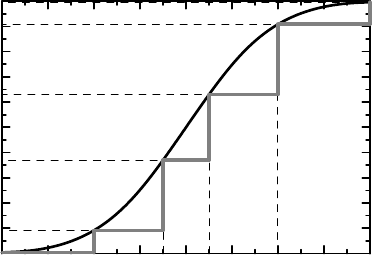
defines a step function, an example of which is shown in gray in Figure 6.2. In this case the
jump points of the CDF and the e-CDF of a particular experiment will coincide, though the
actual jump sizes may differ.
Ordered categorical data can often be perceived to be a discrete approximation of some
underlying continuous variable. For the disability score above we may assume the existence of
a continuous (and probably unmeasurable) disability variable X with a continuous CDF F (x),
together with a series of cut-off points a
0
=−∞<a
1
<...<a
c−1
<a
c
=+∞, such that
our ordered categorical variable takes the value k precisely if a
k−1
<X≤ a
k
. The probability
of falling into category k is then given by p
k
= F(a
k
) − F (a
k−1
).
We have pointed out that some aspects of statistics would have been conceptually simpler
with the e-CDF defined by linear interpolation. This applies to the CDF of a discrete distri-
bution as well, in that it is not clear why the CDF should be right- and not left-continuous
0
0.1
0.2
0.3
0.4
0.5
0.6
0.7
0.8
0.9
1
876543210
disabilityofDegree
Figure 6.2 Illustration of how we can consider ordinal data derived from an underlying
continuous distribution, with cut-off points 2 < 3.5 < 4.5 < 6.
DESCRIBING THE SAMPLE: DESCRIPTIVE STATISTICS 153
0
0.1
0.2
0.3
0.4
0.5
0.6
0.7
0.8
0.9
1
0.5
0
1
1=
− p
=
Δ F(1)
Δ F(0)
p
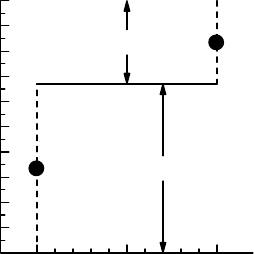
Figure 6.3 The mid-point CDF for a two-point distribution.
at jump points. What corresponds to linear interpolation in such a case would be to take the
mid-value of the jump as the definition of the CDF at that point. This provides the same
staircase function as the traditional one, except for the values at the actual jumps. If F (x)is
the traditional, right-continuous, distribution, then we redefine the CDF to take the average
value (F(x−) + F(x))/2 at the point x. This is illustrated for a two-point Bin(1,p) distribution
in Figure 6.3. We will later see the usefulness of this modified CDF in connection with the
Wilcoxon test for discrete data. We should also note that this is precisely the mid-P adjustment
mentioned in equation (4.2), where we constructed the confidence function for a parameter
in a discrete distribution.
If we have c ordered categories, labeled 1,...,c, then the jumps p
k
= F(k) are prob-
abilities, and the CDF is that of the multinomial, Mult
c
(1,p
1
,...,p
c
), distribution. If we
perform n experiments resulting in observed frequencies x
1
,...,x
c
, the e-CDF is the step
function with jump x
k
/n at the point k. Moreover, there are only finitely many possible out-
comes of a multinomial distribution, so there are a finite number of possible e-CDFs, namely
n+c−1
n
. This has implications for how p-values can be computed.
6.3 Describing the sample: descriptive statistics
We will now see how we can describe the e-CDF of a sample {x
1
,...,x
n
} using various
summary statistics. Though the most complete way to describe the sample is to list it (not
practical unless the sample is small) or plot it, there is often a need to summarize its key
aspects in some convenient and easily communicable way.
One way to do this is to choose some value between 0 and 1 and describe where the
e-CDF is equal to this particular value. In other words, choose 0 <p<1 and solve the
equation F
n
(x) = p for x = x
p
. Because F
n
(x) is a step function this cannot always be done
exactly, and we may need to average two numbers. As an example, take p = 0.5. This means
that we want the value x
0.5
for which half of the observations are less than or equal to it. If n
is odd, x
0.5
is obtained by ordering the sample and take the middle number. If n is even, we
need to take a number between the two values that are in the middle of the sample, and by
convention we take the arithmetic mean of these. We call x
0.5
the median of the sample. (This
is one instance when using linear interpolation to define the e-CDF would help: it would define
154 EMPIRICAL DISTRIBUTION FUNCTIONS
0
0.1
0.2
0.3
0.4
0.5
0.6
0.7
0.8
0.9
1
Fraction of patients
9876543210
Value of outcome
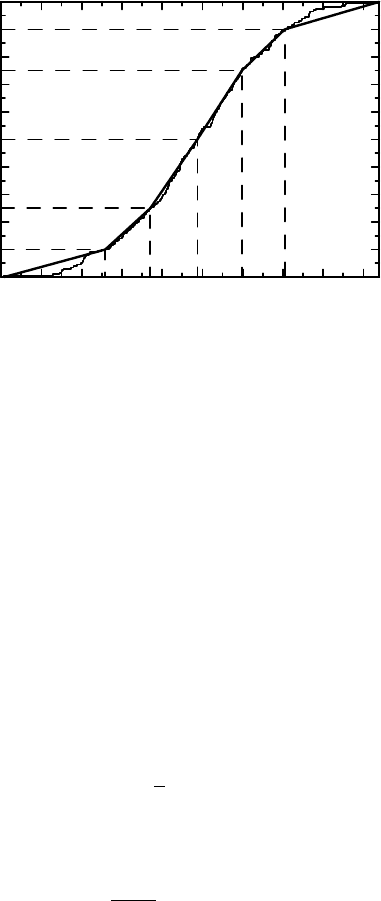
Figure 6.4 Approximating an empirical distribution function, which describes a large data
set, by a piecewise linear function defined by percentiles.
a unique sample median, providing a better estimate of the median of the true distribution.)
The general x
p
is called a percentile, and as for x
0.5
we have special names for x
0.25
and x
0.75
:
the lower and upper quartiles. By describing a set of percentiles and adding the smallest and
largest observations, we get a smaller set of data, which can be used to obtain an approximation
of the e-CDF. This is illustrated in Figure 6.4, where the e-CDF of a sample of 200 points from
a continuous distribution is approximated by the 10th and 90th percentiles, the quartiles and
the median: a stepwise linear function connecting the smallest and the largest observations
with break points at these percentiles may be a fairly good approximation to the CDF.
It should be noted that what value a percentile assumes does not depend on all the individual
observations in the sample. Take the median as an example. Its value is the value in the middle
of the sorted sample, but does not depend on the exact values of those data points that are less
than (or larger than) this value, except that they are smaller (or larger).
The most popular way of summarizing a data set is through the (arithmetic) mean
¯x =
1
n
n
i=1
x
i
together with the standard deviation s, which is the square root of the sample variance
s
2
=
1
n − 1
n
i=1
(x
i
− ¯x)
2
.
The mean is a measure of the location of data and the standard deviation is a measure of the
dispersion around the mean. These sample parameters estimate the corresponding population
parameters (which were defined in Box 4.5 and will be revisited in the next section).
However, ¯x and s are not always good measures for describing the CDF. For the sputum
data shown in Figure 6.1 the mean is 752.0 and the standard deviation is 1521.1. Compare
this with the three quartiles 37.5, 115.0, 575.5, shown in the small subplot in Figure 6.1. We
see that the upper quartile, below which 75% of the data lie, is much smaller than the mean.

DESCRIBING THE SAMPLE: DESCRIPTIVE STATISTICS 155
Box 6.1 The lognormal distributions
If the logarithm of a stochastic variable X has a Gaussian distribution, ln X ∈ N(m, σ
2
),
we say that X has a lognormal distribution. Its CDF is given by F (x) = ((ln x − m)/σ),
from which some calculus shows that its mean and variance are given by
E(X) = e
m+σ
2
/2
and V(X) = e
2m+σ
2
(e
σ
2
− 1),
respectively. The median is e
m
, which we can derive from the general observation that
for a monotonic transformation h(x) we have that
median(h(X)) = h(median(X)),
here applied to h(x) = e
x
. The same applies to any other percentile. The coefficient of
variation is by definition CV =
√
V (X)/E(X), and is a dimensionless expression of
variability. For the particular case of the lognormal distribution we find that
CV =
e
σ
2
− 1.
Note that for σ
2
small we have that CV ≈ σ =
√
V (ln X).
The reason for this is obvious from the formulas above in combination with Figure 6.1; the
distribution is skewed to the right in the sense that most of the data is concentrated in the left
portion of the graph, but with a long tail of large values to the right. In such a case the choice
of mean and standard deviation as descriptors of the e-CDF, and ultimately the CDF, may be
rather poor and misleading. Implicit in the choice of these sample statistics as descriptors of
the e-CDF lies an assumption that the distribution is reasonably symmetric around its mean.
When the distribution is symmetric around its mean, the median should be equal to it, so
if the difference between these two parameters is large, the distribution is skewed. (This is
not to say that you do not want to estimate the mean for a skew distribution, only that more
information is needed to understand the CDF.)
When a distribution is skewed to the right, and the data are positive, we may try to
symmetrize it by taking the logarithms of the data. This means that we replot the e-CDF
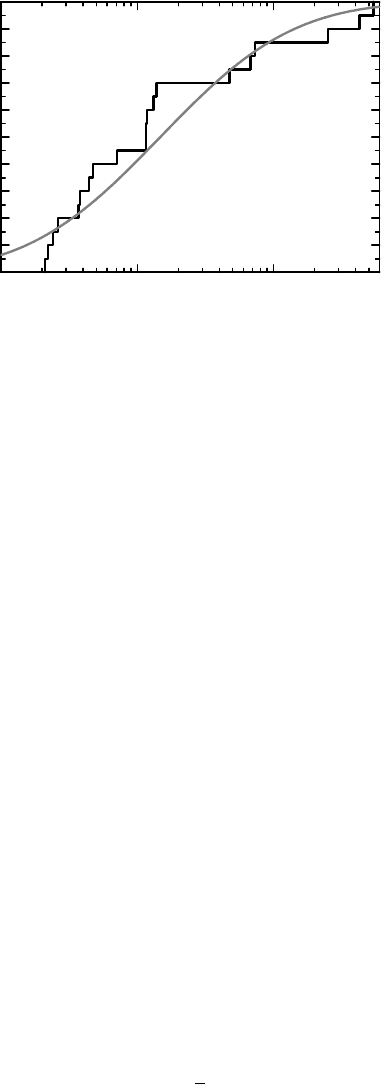
on a logarithmic scale, as we have done in Figure 6.5 for the sputum data. The mean
in this graph corresponds to the geometric mean 147.2 of the original data. More pre-
cisely, this is the arithmetic mean of the logarithmic data, rescaled to the original scale
by exponentiation:
e
ln x
=
n
i=1
x
i
1/n
.
This number is much closer to the sample median, which we saw above was 115, and is in
this case a meaningful description of the center of the distribution. To describe the variability
for a lognormal distribution we can use the coefficient of variation for that distribution,
CV =
e
s
2
− 1 (see Box 6.1), where s
2
is the sample variance of ln x
i
. Multiply it by 100,
and we express the coefficient of variation as a percentage. For our sputum data it is 469%.
156 EMPIRICAL DISTRIBUTION FUNCTIONS
0
0.1
0.2
0.3
0.4
0.5
0.6
0.7
0.8
0.9
1
Fraction of patients
10
1
10
2
10
3
Neutrophil count/
g
sputum
Figure 6.5 Illustrating sputum data as an empirical distribution function with a logarithmic
scale. The gray curve is the reconstructed CDF from the observed mean and standard deviation
of the logged data.
When we discussed percentiles, we emphasized their ability to reconstruct the e-CDF.
How can we reconstruct the e-CDF from the mean and standard deviation? This is done based
on the Gaussian distribution in such a way that we reconstruct F (x)as((x − ¯x)/s). The
dashed curve in Figure 6.5 shows this for the sputum data, albeit on a logarithmic scale.
We see that the mean and standard deviation of the logged data (or the geometric mean and
coefficient of variation on the original scale) represent a reasonable summary of these data.
6.4 Population distribution parameters
Descriptive statistics have their counterpart for the population CDF F (x). To describe this
we use the notation that was introduced in Box 4.8, but we repeat it here because of the
fundamental role it will play in our discussion from now onwards. The notation is that we
write dF (x) = f (x)dx for a point x where a particular distribution is (absolutely) continuous,
and dF (x) = F(x) for a point x where there is a jump of size F (x). Based on this, we
denote sums and integrals by use of the common notation
b
a
g(x)dF (x).
If F (x) is piecewise differentiable with derivative f (x), this is
b
a
g(x)dF (x) =
b
a
g(x)f (x)dx,
whereas for a e-CDF F
n
(x), computed from the data {x
1
,...,x
n
}, it becomes
b
a
g(x)dF
n
(x) =
1
n
n
i=1
g(x
i
),

POPULATION DISTRIBUTION PARAMETERS 157
since dF
n
(x
i
) = 1/n in this case. When F(x) is a population CDF the integral represents the
average of the values g(x) in the whole population and is therefore a population parameter.
It is estimated by replacing F (x) with the e-CDF F
n
(x) in the computation, defining the
sample parameter.
As a first example, recall that the mean of F (x) is defined as
m =
∞
−∞
xdF(x).
To estimate it, we replace F (x) with F
n
(x) and get the sample mean:
¯x =
∞
−∞
xdF
n
(x) =
1
n
i
x
i
.
The mean is obviously a location measure, being the average of all values. To describe it
geometrically, we can rewrite it as
m =
∞
0
(1 − F (x))dx −
0
−∞
F (x)dx.
This means that we can interpret the mean as the area between the curve y = F (x) and the line
y = 1 for positive x, minus the area under the curve y = F (x) above the x-axis for negative x.
More importantly, the formula gives us a way to visualize the difference in the mean values
for two distributions. In such a case, if m
F
is the mean for the CDF F (x) and m
G
that for
G(x), then
m
F
− m
G
=
∞
−∞
(G(x) − F (x))dx,
which is the area enclosed by the CDFs.
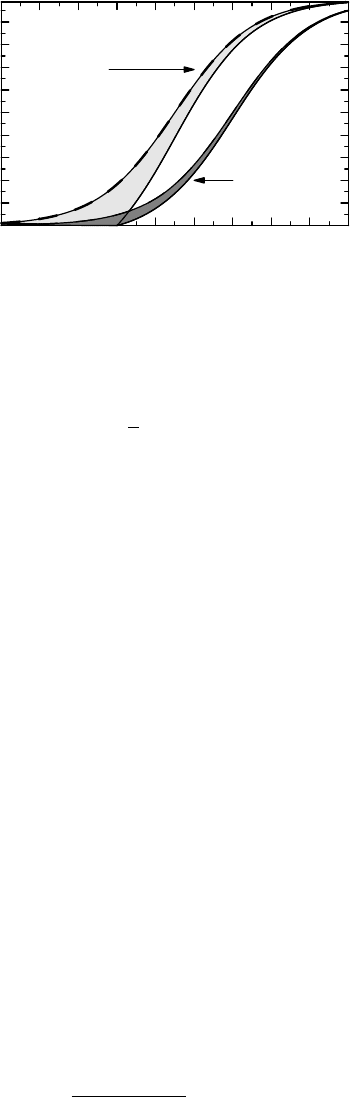
Example 6.1 As an example, consider Figure 6.6, which is a reproduction of the graph that
illustrated the effect of differential drop-out in Section 3.7. The area between the dashed and
solid curves for a group shows the effect that missing data have on the mean value in that
group. Inspecting the graph, we see that the area between the two solid curves is smaller than
the area between the two dashed curves, showing that, if we analyze completers only, we get
a bias toward no effect in the mean.
We can also visually estimate the bias with the LOCF approach. This would mean that we
impute the value −1 for missing data, which means that the distribution for LOCF imputed
data is zero up to the point x =−1, where there is a jump up to the dashed curve. The area
between these two CDFs is the area between the dashed curves over the region x>1. The area
between the curves to the left of x =−1 is therefore the bias we get by the LOCF approach.
Comparing areas, we see that in this case LOCF is less biased than analyzing completers only.
To measure the spread, or dispersion, of the distribution, a common measure is the popu-
lation variance defined by
σ
2
=
∞
−∞
(x − m)
2
dF (x). (6.2)
158 EMPIRICAL DISTRIBUTION FUNCTIONS
0
0.1
0.2
0.3
0.4
0.5
0.6
0.7
0.8
0.9
Proportion of patients
−4 −3 −2 −1 543210
Chan
g
e from baseline
Placebo
Active drug
Figure 6.6 Reproduction of Figure 3.1, illustrating how we can assess the effect on the mean
by comparing areas.
If we replace F (x) with F
n
(x), we see that this should be estimated by
ˆ
σ
2
n
(m) =
1
n
(x
i
− m)
2
.
However, this only works if we know the mean m. If we do not, we need to estimate it with the
sample mean and use
ˆ
σ
2
n
(¯x) as the estimate of σ
2
. For this to be an unbiased estimator we need
to replace the denominator n with n − 1, which gives us the sample variance s
2
. Intuitively the
reason is that though we have n terms, there are only n − 1 independent ones, since subtracting
¯x means that the sum of the terms x
i
− ¯x is constrained to be zero. By analogy, with more
parameters, say p, to estimate, we would in general have to divide by n − p. There are ways
to derive the correct denominator directly by eliminating the mean from the problem. One
way uses the differences x
i
− x
j
and is outlined in Box 8.6, another is based on the residuals
x
i
− ¯x and the likelihood theory for Gaussian data and is discussed in Box 13.1. For both of
these derivations the situation is complicated by the fact that the data analyzed are dependent.
It is interesting to note that the bias adjustment of the variance made by dividing by n − 1
instead of by n is not usually done when we estimate proportions in a binomial distribution.
The variance estimator for the frequency ˆp is usually taken to be ˆp(1 − ˆp)/n, which is biased
for the reason above; the unbiased estimator is ˆp(1 − ˆp)/(n − 1).
The mean is a measure of location, and so are the percentiles, which are defined for the
population CDF in the same way as the sample percentiles were defined for the e-CDF – as the
solution of the equation F(x) = p. This defines the population percentiles which we estimate
by the sample percentiles, as discussed in the previous section.
6.5 Confidence in the CDF and its parameters
Foragivenx, the value F (x) of the CDF is a probability and the value of the e-CDF F
n
(x)
is an observed relative frequency, such that nF
n
(x) follows a Bin(n, F(x)) distribution. Since
V (F
n
(x)) = p(1 − p)/n, this means that the set of ps that satisfy
χ
1
n(F
n
(x) − p)
2
p(1 − p)
≤ 1 − α
CONFIDENCE IN THE CDF AND ITS PARAMETERS 159
0
0.1
0.2
0.3
0.4
0.5
0.6
0.7
0.8
0.9
1
Fraction of patients
10
2
10
3
Neutrophil count/
g
sputum
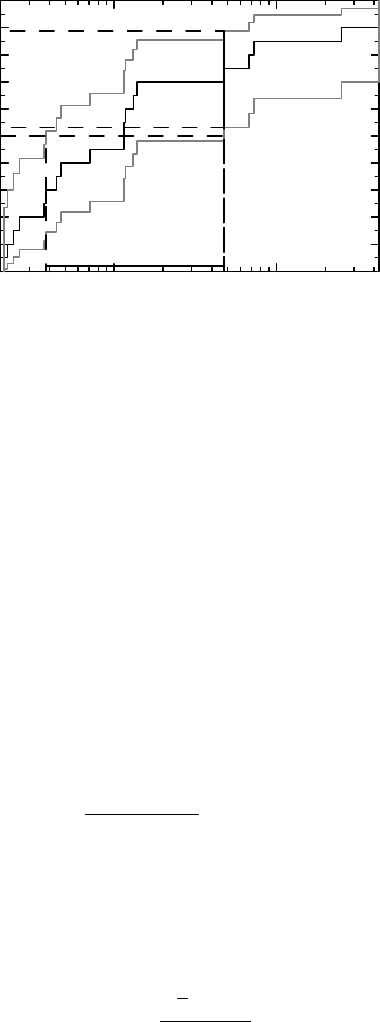
Figure 6.7 Illustration of how to obtain confidence limits for percentiles, using pointwise
confidence limits for the CDF.
constitute a confidence interval for F (x) of degree 1 − α. Figure 6.7 illustrates this for the
sputum data. The black step function is the original e-CDF, and the two solid gray step
functions above and below it define (the end points of) the 95% confidence limits. One such
confidence interval is also illustrated as the thick vertical line above the point x = 475. It
is important to point out that these intervals are pointwise confidence intervals: to get the
correct confidence degree we first need to fix the point x. If we do not prespecify the point
x, we have a multiplicity problem. The natural follow-up question is then to ask for limits
that by construction contain the complete CDF F (x) with 95% probability. Such a region
is made up of simultaneous confidence intervals, and its construction is briefly addressed in
Appendix 6.A.2.
In Figure 6.7 we also have a horizontal line which is defined from the gray confidence limit
curves at level 0.5. The interval it defines has limits 38 and 475. These are (approximate) 95%
confidence limits for the median of F (x). Confidence limits for other percentiles are obtained
in the same way. The argument is the following simple observation: finding the confidence
interval for a parameter θ such that F (θ) = p is the same as finding all θ such that
χ
1
n(F
n
(θ) − p)
2
p(1 − p)
≤ 1 − α
(the same as above, except that now p is held fixed).
To obtain confidence intervals for the mean is done in an altogether different way, which is
not easily described in geometric terms. The computation is based on the fact that ¯x (according
to the CLT) asymptotically has a Gaussian distribution with mean m and variance σ
2
/n, where
σ
2
is the variance of F (x). This suggests the use of the confidence function
C(m) =
√
n(m − ¯x)
σ
,
which should be at least approximately valid for learning about the mean m. The problem
here is that we do not know σ
2
, a problem we solve by estimating it by the sample variance s
2
.