
Kallen A. Understanding Biostatistics
Подождите немного. Документ загружается.

130 LEARNING ABOUT PARAMETERS, AND SOME NOTES ON PLANNING
Instead we will build on the observation that the difference of two Gaussian stochastic
variables also has a Gaussian distribution and therefore that
ˆp
1
− ˆp
2
∈ N
p
1
− p
2
,
p
1
(1 − p
1
)
n
1
+
p
2
(1 − p
2
)
n
2
, (5.1)
at least approximately for large n
1
and n
2
. In order to make inference about the risk differ-
ence = p
1
− p
2
, we rewrite equation (5.1) in and one further parameter, for which we
choose p
2
:
ˆ
= ˆp
1
− ˆp
2
∈ N
, p
2
(1 − p
2
)
1
n
1
+
1
n
2
+
(1 − 2p
2
− )
n
1
.
The problem when we use this to derive a confidence function for is that we need to do
something about the nuisance parameter p
2
. One suggestion is to estimate it from data. This
is an approximation, but it is only the variance that depends on p
2
, and only mildly so, so we
do not really need a high-precision estimate of it. We will illustrate this in the next section.
5.4.2 Analysis of the group difference
To see how we can do the statistical analysis of the difference we use the data of
the first Hodgkin’s lymphoma example in Section 4.5.1, with p
∗
1
= 67/101 = 0.66 and
p
∗
2
= 43/107 = 0.40. The difference is therefore estimated to be
∗
= 0.26. Based on the
discussion in the previous section, we can derive knowledge about the true difference from
the confidence function
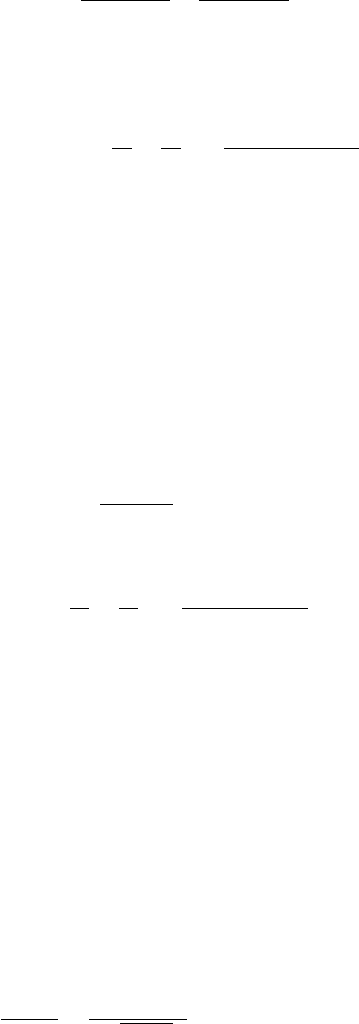
C() =
−
∗
σ(, p
∗
2
)
,
where we have inserted the estimate p
∗
2
for p
2
in the variance expression
σ
2
(, p) = p(1 − p)
1
n
1
+
1
n
2
+
(1 − 2p − )
n
1
. (5.2)
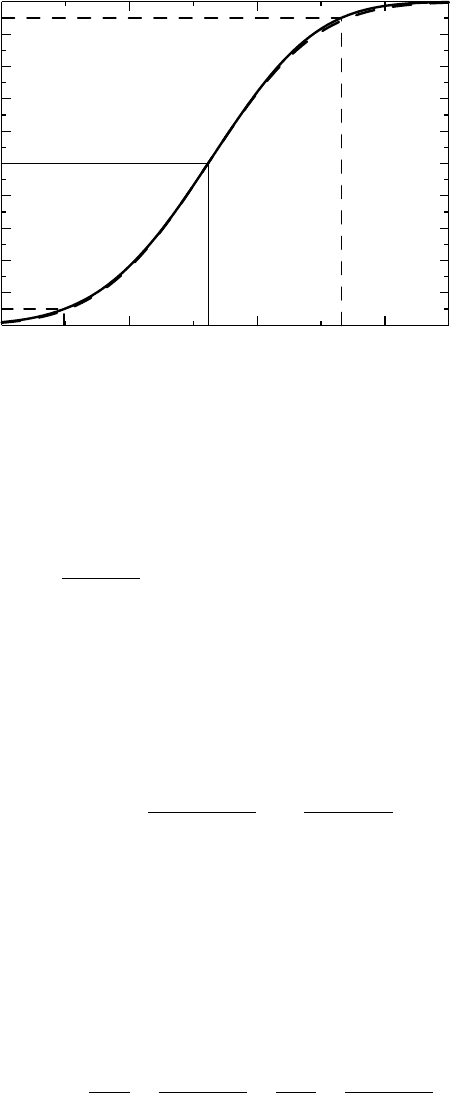
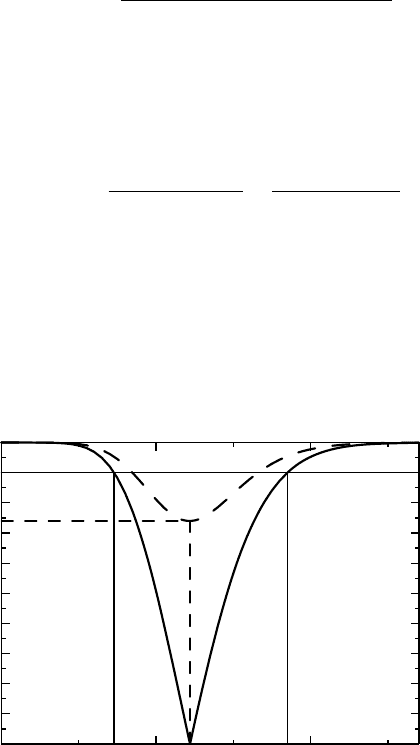
The function C() is graphed as the solid curve in Figure 5.5, from which we can deduce,
for example, that the symmetric 90% confidence interval around
∗
is (0.15, 0.37). What
is not shown is the one-sided p-value for the null hypothesis of ≤ 0. This is given by
C(0) = (−
∗
/σ(0,p
∗
2
)) = 0.00008 and is too small to show up in the graph. We note
instead that if we test the hypothesis ≤ 0.15 we get a p-value of 0.05; this is part of the
information found in the (symmetric) 90% confidence interval above.
This is actually not the standard p-value computed for the null hypothesis ≤ 0. What is
usually done is to compute the standard deviation using ¯p = (67 + 43)/(101 + 107) = 0.53
instead of p
∗
2
. This is because when = 0, this should be a better estimate of the parameter
p
2
than p
∗
2
. Similarly, it is common practice to replace in the expression for the variance
with its estimate
∗
(cf. Box 4.7). The confidence function obtained with these substitutions
is shown as the dashed curve in Figure 5.5. We see that there is a difference, but it is very
small and of no consequence in this particular case.
We may also note the following. A short calculation shows that
∗
σ(0, ¯p)
=
x
1
− E
1
(x
1
)
√
V
1
(x
1
)
,
STATISTICAL ANALYSIS OF TWO PROPORTIONS 131
0
0.1
0.2
0.3
0.4
0.5
0.6
0.7
0.8
0.9
1
Confidence function C (Δ)
0.1 0.2 0.3 0.4
Risk difference Δ = p
1
– p
2
Figure 5.5 Confidence functions for the two-group binomial test. The two functions differ
in how the variance is estimated. For the solid curve we vary and use the frequency in the
second group to estimate p
2
, whereas the dashed curve uses the probability estimates in the
variance estimate.
where the mean and variance on the right are computed under the assumption of a hyperge-
ometric distribution for x
1
(as part of a 2 × 2 table with fixed margins). Actually this is not
quite true, there is a factor
√
n/(n − 1) in front of the right-hand side, but we can eliminate
it if we bias-correct the estimator σ
2
(0, ¯p) (see page 158). This means that, when we use the
large-sample approximations, the binomial test and Fisher’s exact test give identical p-values
for the hypothesis of no difference. The difference between the tests is in their small-sample
properties, which is when the different assumptions play a role.
We next turn our attention to the relative risk θ = p
1
/p
2
. We can obtain a confidence
function for this ratio in a way very similar to what we did for the difference by using a trick
due to Fieller (see Box 7.7), which uses the observation that
ˆp
1
− θ ˆp
2
∈ AsN
0,
p
2
θ(1 − p
2
θ)
n
1
+ θ
2
p
2
(1 − p
2
)
n
2
.
As was the case when we analyzed above, it is only the variance that depends on p
2
, and
it does so only mildly. Carrying through the analysis as we did for above, we can deduce
that the estimated relative risk is 1.65 with 90% confidence interval (1.32, 2.08).
In order to get a reasonable estimate of the odds ratio θ we proceed along a different
route, building on the observation made at the end of Section 4.6.1 about the large-sample
approximation to the logarithm of the odds x/(n − x). Since the logarithm of the odds ratio
is the difference of two independent log-odds, we see that, for the empirical odds ratio
ˆ
θ = x
1
(n
2
− x
2
)/x
2
(n
1
− x
1
),
ln
ˆ
θ ∈ AsN
ln(θ),
1
n
1
p
1
+
1
n
1
(1 − p
1
)
+
1
n
2
p
2
+
1
n
2
(1 − p
2
)
.
132 LEARNING ABOUT PARAMETERS, AND SOME NOTES ON PLANNING
If we insert estimates into this variance expression, this becomes the same analysis as we did
in the previous section, though at that time we assumed a hypergeometric distribution, and
we found there that the estimate and 90% confidence interval for the odds ratio are 2.93 and
(1.82, 4.71), respectively.
We conclude this section with a comment about how a Bayesian statistician might approach
this problem. Theoretically he would do the obvious follow-up on what he did for a single
proportion, possibly using different priors for the two proportions. Once the priors are decided,
the data will give him a two-dimensional distribution for the two probabilities, and with some
mathematical tricks he can use standard probability theory to make any kind of probability
statements he wants for any particular function of these parameters (with no adjustments made
for multiplicity issues).
To be more specific, let us use the same data as above and assume that we believe, a priori,
that there is no difference between the two groups and that the two proportions have indepen-
dent and identical a priori distributions. If the common prior has a β(x; a, b) distribution, we
get an a posteriori distribution for the pair (p
1
,p
2
) as the product of two beta distributions:
β(x; x
1
+ a, n
1
− x
1
+ b) and β(x; x
2
+ a, n
2
− x
2
+ b). From this we can compute the dis-
tribution of any function of (p
1
,p
2
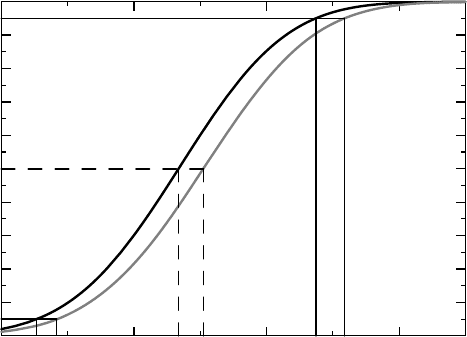
) we want to, which is illustrated in Figure 5.6 for the
difference = p
1
− p
2
. There are two curves. The black one to the left uses independent
informed priors β(x;4, 6) for the two parameters, whereas the gray one to the right uses unin-
formed priors. The median for the distribution of with uninformed priors is 0.25 with 90%
credibility interval (0.14, 0.36), which is similar to what the confidence function produced
in terms of point estimate and 90% confidence interval. The corresponding estimate with
informed priors is smaller, 0.23 with 90% credibility interval (0.13, 0.34). The reason why
it is smaller is that our prior belief was that there was no difference between p
1
and p
2
,so
that was symmetrically distributed around zero, and old beliefs are hard to change. But the
evidence was somewhat overwhelming, and we therefore ended up relatively close to what
the uninformed priors provide.
0
0.1
0.2
0.3
0.4
0.5
0.6
0.7
0.8
0.9
1
Posterior probability CDF
0.1 0.2 0.3 0.4
Risk difference Δ = p
1
– p
2
Informed prior
Uninformed prior
Figure 5.6 Bayesian analysis of the difference of two binomial proportions.
ADJUSTING FOR CONFOUNDERS IN THE ANALYSIS 133
5.5 Adjusting for confounders in the analysis
If we want to investigate an exposure–response relationship defining a 2 × 2 table and we have
known and measurable confounders, one way to adjust for them in the analysis is to divide the
population into smaller groups for which we have similar values for these confounders. This
gives us a number N of 2 × 2 tables within each of which we can apply Fisher’s exact test,
as outlined in Section 4.5.1. The assumption is that within each table there is homogeneity to
such an extent that a common odds ratio within that group is a reasonable description. The
problem is to summarize this information into a common odds ratio applicable to all groups
or, if that is not possible, a simple description of the variability of the odds ratios between
groups. As already mentioned, these groups are called strata, and the process of dividing the
population up into strata is called stratification.
For example, if we want to see whether there is an effect of a particular exposure on the
occurrence of Down’s syndrome, we know from previous examples that we should stratify
with respect to the age of the mother. This means that we define a sequence of age classes,
and do the comparison between exposed and non-exposed pregnancies within each age class.
In order to define the age spans of the different strata, it may be helpful to look at the risk
function for the event as a function of age, as shown in Figure 2.2(a). We can also define strata
by combining a set of different confounders, such as age, smoking habit and social class.
A particular example is when we want to do a meta-analysis and try to combine the
information from a number of different studies, possibly of different designs, each provid-
inga2× 2 table from which we want a collated summary. The strata in this case are the
individual studies.
Example 5.4 In Section 4.5.1 we discussed two studies investigating tonsillectomy as a risk
factor for Hodgkin’s lymphoma. The second of these had much more data than was used in the
analysis, because the investigators first ascertained the tonsillectomy history of 174 patients
with Hodgkin’s lymphoma and all of their 472 siblings. They then matched the data in a way
that actually ignored more than 70% of these data. We want to use all 646 patients in this
study and combine them with those of the first study in a meta-analysis. The data are given
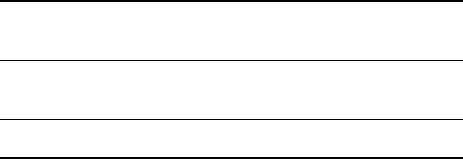
in the following table:
Patients Controls
+−+− OR
Study 1 67 34 43 64 2.93
Study 2 90 84 165 307 1.99
Sum 157 118 208 371 2.37 (1.83, 3.00)
The last row contains the marginal table, in which we have ignored which study the data
come from. It also contains the corresponding empirical odds ratio and its 90% confidence
interval. In this table we ignore the familial relations in the second study. To do a traditional
meta-analysis we need a way to combine the information about a common odds ratio from
those of the individual tables. Some ideas about how to obtain knowledge about the odds ratio
within a single table were addressed in Section 5.3, and our objective is to extend one of these
ideas to a series of tables.
134 LEARNING ABOUT PARAMETERS, AND SOME NOTES ON PLANNING
The method to generalize in Section 4.5.1 is the one that equated the observation of x
11
with its mean. There are two ways to extend this to two tables. Both methods are based on
the idea of looking at the squared difference between what we observe and what a model
predicts, normalized to what we expect this squared difference to be. The difference between
the methods is whether you sum the observations first, or sum the normalized squares:
1. If we first sum the observations from the two tables, and then normalize with the
variance for the sum, we get the function
Q
MH
(θ) =
(x
11
+ y
11
− E
θ
(x
11
) − E
θ
(y
11
))
2
V
θ
(x
11
) + V
θ
(y
11
)
.
We will call this the Mantel–Haenszel quadratic form (it is a quadratic form in the
observations, not the parameter, but we study it as a function of the parameter).
2. If we first normalize each squared difference with its variance and then compute the
sum, we get the function
Q
BD
(θ) =
(x
11
− E
θ
(x
11
))
2
V
θ
(x
11
)
+
(y
11
− E
θ
(y
11
)
2
V
θ
(y
11
)
,
which we call the Breslow–Day quadratic form.
With large numbers, x
11
+ y
11
is approximately Gaussian in distribution, and we should have
that Q
MH
(θ) is distributed approximately as χ
2
(1). We can use this to define a pooled odds
ratio for the two tables by finding the θ for which the quadratic form is zero, and we can
also derive a two-sided confidence function for θ, which is shown as the solid function in
Figure 5.7 for our data. From this we get the estimate of the pooled odds ratio as 2.22, and
the symmetric 90% confidence interval is given by (1.73, 2.85).
0
0.1
0.2
0.3
0.4
0.5
0.6
0.7
0.8
0.9
1
Two-sided confidence function
321
Odds Ratio
Figure 5.7 The two curves in this graph are the χ
2
(1) maps of the quadratic forms Q
MH
(θ)
and Q
BD
(θ) discussed in the text. The solid curve is the one for the Mantel–Haenszel form,
and defines a two-sided confidence function for θ. The dashed one is for the Breslow–Day
form, and is used to test for homogeneity as indicated by the dashed lines.
ADJUSTING FOR CONFOUNDERS IN THE ANALYSIS 135
The Breslow–Day quadratic form Q
BD
(θ) is used differently, namely to assess how
reasonable it is that a particular pooled odds ratio θ is a good description of the data. If a
particular value θ applies to both tables, this quadratic form should also be zero. The amount
it differs from zero is therefore a measure of the heterogeneity of the two tables. To translate
this to a probability we need to compare its value to the χ
2
(1) distribution. The corresponding
function is shown in Figure 5.7 as the dashed curve and by taking one minus the confidence
in the estimate for the pooled odds ratio, we get a p-value for the hypothesis of homogeneity
of the odds ratios in the two studies. In this case it turns out to be 0.26.
EE
c
Ca
k
b
k
C
c
c
k
d
k
However, this example does not really describe how most
epidemiologists work with pooled odds ratios. In order to un-
derstand their preferred method we first generalize the present
discussion to a general series of 2 × 2 tables. In doing this we
change the notation so that we have N different strata, and in
each a 2 × 2 table with data as shown in the table shown on the right. We can then define the
following two quadratic forms:
1. The Mantel–Haenszel quadratic form is defined as the function
Q
MH
(θ) =
(
N
k=1
a
k
− E
θ
(a
k
))
2
N
k=1
V
θ
(a
k
)
.
A pooled estimate θ
∗
is obtained as the point where this is zero, and a confidence
function for θ is obtained as C(θ) = χ
1
(Q
MH
(θ)).
2. The Breslow–Day quadratic form is defined as the function
Q
BD
(θ) =
N
k=1
(a
k
− E
θ
(a
k
))
2
V
θ
(a
k
)
.
It is used to test for homogeneity among strata of the individual odds ratios by com-
paring Q
BD
(θ
∗
)toaχ
2
(N − 1) distribution.
Example 5.5 Before we continue, let us see what the quadratic form Q
MH
(θ) means in the
case where we have a one-to-one matched case–control study. In such a study, the investigator
selects for each case a control with a specified set of characteristics that are the same as those
of the case, and then determines, for both case and control, whether there has been an exposure
or not. Each such pair produces a small 2 × 2 table, in which the total number in each row is
one. In this case, what is the quadratic form Q
MH
(θ)?
Each table has row sums n
1
= n
2
= 1, and for the sum of the elements in the first column,
r, we can have only three possible values, r = 0, 1, 2. However, when r = 0 neither case nor
control was exposed, and the expected value of a
k
must be zero, and when r = 2 both case
and control were exposed, so the expected value of a
k
is necessarily one. In both cases we
have a
k
− E
θ
(a
k
) = 0, so the terms involved in Q
MH
(θ) are only non-zero if r = 1; only those
pairs contribute to the analysis for which either the case or the control is exposed, but not
both. Let the number of such tables be n.
For a table with r = 1 we have (see Appendix 5.A.1) that E
θ
(a
k
) = p = θ/(1 + θ)
and that V
θ
(a
k
) = θ/(1 + θ)
2
= p(1 − p). It follows that if z =
k
a
k
is the total
136 LEARNING ABOUT PARAMETERS, AND SOME NOTES ON PLANNING
number of cases that were exposed, and if we express Q
MH
as a function of p,
Q
MH
(p) = (z − np)
2
/np(1 − p). This is the same test as the large-sample approximation
for a Bin(n, p) distribution, and the test for the null hypothesis θ = 1 is therefore McNemar’s
test mentioned in Section 4.5.1.
Using Q
MH
(θ) for the estimation of θ is, however, somewhat complex and it is not clear
how the pooled estimate relates to the empirical odds ratio of the individual tables, given by
θ
∗
k
= a
k
d
k
/b
k
c
k
. Epidemiologists have therefore largely chosen to use a different pooled esti-
mate, one that is explicitly derived from the individual θ
∗
k
s. When a
k
follows a hypergeometric
distribution we have that E
θ
(a
k
d
k
− θb
k
c
k
) = 0 and if we specify stratum weights w
k
,wecan
therefore define a pooled odds ratio from the equation
E
θ
k
w
k
(a
k
d
k
− θb
k
c
k
)
= 0.
The corresponding pooled odds ratio estimate is obtained by inserting observed table data,
from which we derive the pooled estimate
ˆ
θ
pool
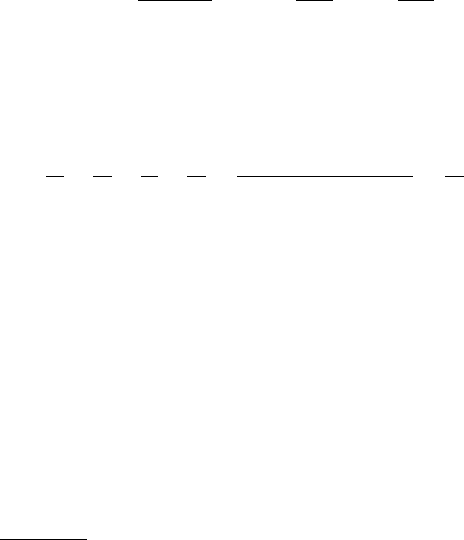
= (
N
k=1
w
k
a
k
d
k
)/(
N
k=1
w
k
b
k
c
k
). Each
choice of weights gives its own pooled odds ratio. The particular choice w
k
= 1/N
k
, where
N
k
= a
k
+ b
k
+ c
k
+ d
k
is the total number of observations in stratum k, provides the Mantel–
Haenszel pooled odds ratio
ˆ
θ
MH
=
N
k=1
R
k
N
k=1
S
k
,R
k
=
a
k
d
k
N
k
,S
k
=
b
k
c
k
N
k
.
This is a weighted sum of the individual empirical odds ratios,
ˆ
θ
MH
=
N
k=1
w
k
θ
∗
k
, where
w
k
= S
k
/
N
k=1
S
k
. We know that the variances of the individual empirical odds ratios are
approximately given by
1
a
k
+
1
b
k
+
1
c
k
+
1
d
k
=
(a
k
+ d
k
)θ
k
+ b
k
+ c
k
b
k
c
k
≈
1
S
k
,
where the last approximation is valid when θ
k
≈ 1, which means that the Mantel–Haenszel
pooled odds ratio is close to being the most efficient weighting of the individual table odds
ratios. It is so if the individual odds ratios are one.
As an example, consider the one-to-one matched case–control study. In each cell we have
that a
k
d
k
= 1 if and only if case is exposed and control is not, whereas b
k
c
k
= 1 if the reverse
is true. In all other cases these products are zero, so the Mantel–Haenszel odds ratio becomes
the ratio (
N
k=1
b
k
)/(
N
k=1
c
k
) of the off-diagonal elements in the overall summary table
(cf. page 98).
In order to obtain a confidence function for the Mantel–Haenszel estimator we need its
variance. As we will see in Example 13.3, we should do the analysis on the log scale, with
the variance of ln
ˆ
θ
MH
well approximated by
1
2(
k
R
k
)
2
N
k=1
N
−2
k
(a
k
d
k
+ b
k
c
k
θ
MH
)(a
k
+ d
k
+ (b
k
+ c
k
)θ
MH
). (5.3)
ADJUSTING FOR CONFOUNDERS IN THE ANALYSIS 137
(There are other approximations for the variance of
ˆ
θ
MH
, on the original scale and on the log
scale, but experience and simulation studies indicate that the variance given by equation (5.3)
is to be preferred over others.) If we apply these results to the data in Example 5.4, we find the
pooled odds ratio to be 2.23 with 90% confidence interval given by (1.73, 2.86), very close
(but not identical) to what was obtained with the first method.
We noted above, and it is worth repeating, that the Mantel–Haenszel pooled estimate of
the odds ratio is obtained as a weighted average of the individual empirical odds ratios. The
weights were so determined that they were essentially optimal from a statistical perspective.
They had no other, independent, meaning. From a practical point of view this means that the
estimate obtained is really only meaningful if all individual odds ratios (the true ones, not the
empirical ones) are equal. In such a case the pooled estimate will estimate this number in an
efficient way.
There are alternative ways to estimate a pooled odds ratio from a stratified analysis.
A common alternative to the Mantel–Haenszel method is derived from the problem
of estimating a pooled odds ratio from the equation Q
MH
(θ) = 0, which was men-
tioned in Example 5.4. The equation to solve is G(θ) =
k
(a
k
− E
θ
(a
k
)) = 0, which
is a nonlinear equation, so a solution must be obtained by iterative methods. If we
write θ = e
β
and consider only one iteration (starting with β = 0), we get the equation
k
(a
k
− E
1
(a
k
) − βV
1
(a
k
)) = 0, and if we solve this we arrive at Peto’s suggestion for a
pooled odds ratio,
ˆ
θ
Peto
= exp
k
(a
k
− E
1
(a
k
))/V
1
(a
k
)
.
How to obtain confidence intervals, etc., is left to the reader. Even though the Peto estimate
is expected to behave well when the true odds ratio is close to one, it is not known for good
properties when this is not the case.
Pooling the odds ratios is the only option for case–control studies, but in a cohort study
we might prefer to estimate pooled proportions for exposed and non-exposed groups, re-
spectively, and derive a pooled relative risk instead. Alternatively, we might consider rates.
The corresponding Mantel–Haenszel methodology is outlined in Box 5.3. Again the weights
are obtained for optimal statistical efficiency, and the value of the pooled group estimates
depends on the relative contribution of the individual strata. If the stratum-specific probabil-
ities/rates differ, the pooled ones may be a rather meaningless estimate of some population
probability/rate.
To be more specific, consider rates and assume that we have stratified on age, so that we
have a rate λ =
a
w
a
λ
a
, where λ
a
denotes the rate in age stratum a.Ifwewanttheλ to
represent the overall risk in the population, we should take weights w
a
corresponding to the
size of the age class a in the population. However, that may not be the age distribution in
the study, unless we have representative sampling. The weights of the pooled analysis may
therefore provide an estimate for a population with a different age structure than the one we
want to relate to. In order to give meaning to pooled measures, we therefore need to define
the weights properly, a process called standardization. Note that the standardized rate will
typically be estimated to a lower precision than the pooled one. Epidemiologists often talk
about the standardized mortality ratio, which is the rate ratio obtained when both nominator
and denominator use the weights of the exposed group. It represents the ratio of the number
of observed cases, divided by the number of expected cases.

138 LEARNING ABOUT PARAMETERS, AND SOME NOTES ON PLANNING
Box 5.3 Mantel–Haenszel type estimate of a pooled relative risk
For a cohort study we can adjust the Mantel–Haenszel method of obtaining a pooled
estimate to obtain one for a relative risk. This can be applied equally well to proportions
and rates. Suppose that we have observed x
ij
events in group j in stratum i and assume
that one of the following two cases applies:
1. x
ij
∈ Bin(T
ij
,p
ij
), where T
ij
is total number of observations;
2. x
ij
∈ Po(λ
ij
T
ij
), where T
ij
is observation time.
Let the relative risk in stratum i be denoted θ
i
, so that θ
i
= p
i1
/p
i2
in the first case
and θ
i
= λ
i1
/λ
i2
in the second case. We wish to define a pooled relative risk θ
MH
from
these these.
The relative risk in stratum i satisfies the equation E
θ
i
(x
i1
/T
i1
− θ
i
x
i2
/T
i2
) = 0soa
pooled relative risk could be defined from an equation of the form
E
θ
i
w
i
(x
i1
/T
i1
− θx
i2
/T
i2
)
= 0.
If, for each i, we take as weights the harmonic mean of the T
ij
, that is, w
i
= 2T
i1
T
i2
/T
i+
,
where T
i+
= T
i1
+ T
i2
, we arrive at the Mantel–Haenszel relative risk estimate
ˆ
θ
MH
=
i
(x
i1
T
i2
/T
i+
)
i
(x
i2
T
i1
/T
i+
)
.
This corresponds to the pooled probability estimates p
∗
j
=
i
w
i
p
∗
ij
for group j, where
w
i
= w
i
/
i
w
i
, and similarly for rates. Much as in Example 13.3 the variance of ln
ˆ
θ
MH
is approximately given by
i
(T
i1
T
i2
x
i+
/T
2
i+
)
θ
MH
(
T
i1
T
i2
x
i+
/T
i+
(T
i1
+ T
i2
θ
MH
)
)
2
We are appealing to Gaussian approximations here, so we can alternatively use the
Fieller approach (see Box 7.7) to obtain a confidence function for θ
MH
.
5.6 The power curve of an experiment
In the planning phase for an experiment it is important to figure out how large it should
be – how many patients to include in a clinical study. If the experiment is too small, so
that the statistical analysis has no realistic chance of detecting a difference, it may be a
waste of money to make the experiment at all (or unethical, when it comes to clinical
trials). On the other hand, if it is too large, providing more evidence than necessary,
there is also some concern about money spent unnecessarily (and possibly patients put
at risk). To find the right size of an experiment we need to investigate the statistical
properties of a proposed size. To do that, we first need to be explicit about the objective of
the experiment.
THE POWER CURVE OF AN EXPERIMENT 139
The standard protocol for this is as follows. We want to reject the null hypothesis θ = 0at
a specified significance level α. That means that we consider the experiment a success if we
get a p-value which is less than α. That part is the actual statistical test, and controls the Type
I error. As noted at the end of Section 5.2, this defines a particular value, x
crit
, such that if the
value of the test statistic is equal to this, the p-value is α. (We continue to consider one-sided
tests where a large value of the test statistic is evidence against the null hypothesis.)
We also want to understand the Type II error. This involves the true distribution
G(x) = F (x, θ
true
) for the test statistic. We want to know what our chances are of a suc-
cessful outcome of the experiment. However, we do not know θ
true
, so we investigate
the probability
β(θ) = 1 − F(x
crit
,θ)
for a range of θ where we expect θ
true
to be. This function is called the power function of the
experiment and is such that β(0) = α by construction. Actually the notation is unconventional
here; usually β(θ) is used to denote the Type II error, so the power function should be β
c
(θ).
If we vary x
crit
we get a family of different power curves. Each such curve corresponds to
a particular choice of significance level, which can be read off from its value at θ = 0. Some
further insight into the nature of power curves is obtained in the following example. (This
is the slightly confusing case when we estimate a location parameter, so that the experiment
outcome x works on the same scale as the parameter θ, and we therefore label values on the
x-axis in two different ways.)
Example 5.6 Assume that the parameter θ is a location parameter (such as a mean) and that the
statistical model is a shift model, which means that F(x, θ) takes on the form F (x − θ) for some
CDF F (x), assumed to be symmetric around x = 0. This special case has some geometrical
properties which are illustrated in Figure 5.8. For a symmetric and continuous distribution we
have that F (−x) = 1 − F (x), which implies not only that F (0) = 0.5, but also that
β(θ) = 1 − F(x
crit
− θ) = F (θ − x
crit
),
so the power function is obtained from a horizontal shift of magnitude x
crit
of the null
distribution F(x). If we introduce the alternative notation θ
c
for the critical value x
crit
we can
write β(θ) = F (θ − θ
c
), and we have that β(θ
c
) = 0.5. In other words, the value of θ which
gives 50% power defines the critical value x
crit
for the test statistic.
The dashed curve on the left in Figure 5.8 is a part of the graph of F (θ). The solid curve
is this function shifted by the amount θ
c
. This is an increasing function which starts with the
value α at θ =0, passes through the value 0.5 at θ = θ
c
(= x
crit
), and reaches the level 1 − α
for θ = 2θ
c
, after which it increases asymptotically to one. To be successful, the experiment
must produce an observation of the test statistic which is larger than x
crit
= θ
c
. When θ is less
than θ
c
, this probability is less than 50%, and when it is greater than θ
c
, the probability is
greater than 50%.
So far we have discussed the power curve for a particular experiment. Most often we
want to use power considerations to find the appropriate size of the experiment. We therefore
introduce the study size n into the notation, so that the CDF for the test statistic becomes
F
n
(x, θ). To determine n we must hold something fixed, and this can be done in different
ways. We can, for example, decide that we want the test on significance level α and specify