
Kallen A. Understanding Biostatistics
Подождите немного. Документ загружается.


160 EMPIRICAL DISTRIBUTION FUNCTIONS
This means that the (approximate) symmetric confidence interval, of confidence degree 1 − α,
for the mean is computed from the well-known formula
¯x − z
α/2
s
√
n
, ¯x + z
α/2
s
√
n
.
However, whether this approximation is good or not depends on how skewed (i.e., non-
symmetrical) the distribution F(x) is (and how heavy the tails are). If n is taken sufficiently
large, it can be made as good as we want, but it may require very large values of n.Onthe
other hand, when F (x) is very symmetric around the mean, a relatively small n might suffice.
The extreme case here is when F (x) is in fact Gaussian in itself, in which case the confidence
function C(m) is exact if σ
2
is known. If σ
2
is not known, but needs to be estimated by s
2
,
the mathematical analysis has been taken one step further, to obtain an explicit, analytical,
description of the true distribution of
√
n(¯x − m)/s. This is the t distribution with n − 1 degrees
of freedom, which we denote t(n − 1) (a derivation of this is outlined in Appendix 6.A.1).
So, if we let T
n
(x) denote the CDF of the t(n) distribution, we have in this case the exact
confidence function
C(m) = T
n−1
√
n(m − ¯x)
s
.
The corresponding confidence interval is wider than that for the normal approximation; how
much wider depends on the size of n. The following example illustrates this.
Example 6.2 To illustrate the confidence functions for the mean we use the data that Student,
the inventor of the t distribution, used for illustration. These data are often referred to as the
Cushny and Peebles data and consist of the following list of paired observations from 10 sub-
jects: (0.7, 1.9), (−1.6, 0.8), (−0.2, 1.1), (−1.2, 0 .1), (−0.1, −0.1), (3.4, 4.4), (3.7, 5.5),
(0.8, 1.6), (0.0, 4.6), (2.0, 3.4). In this example we analyze the data obtained by computing
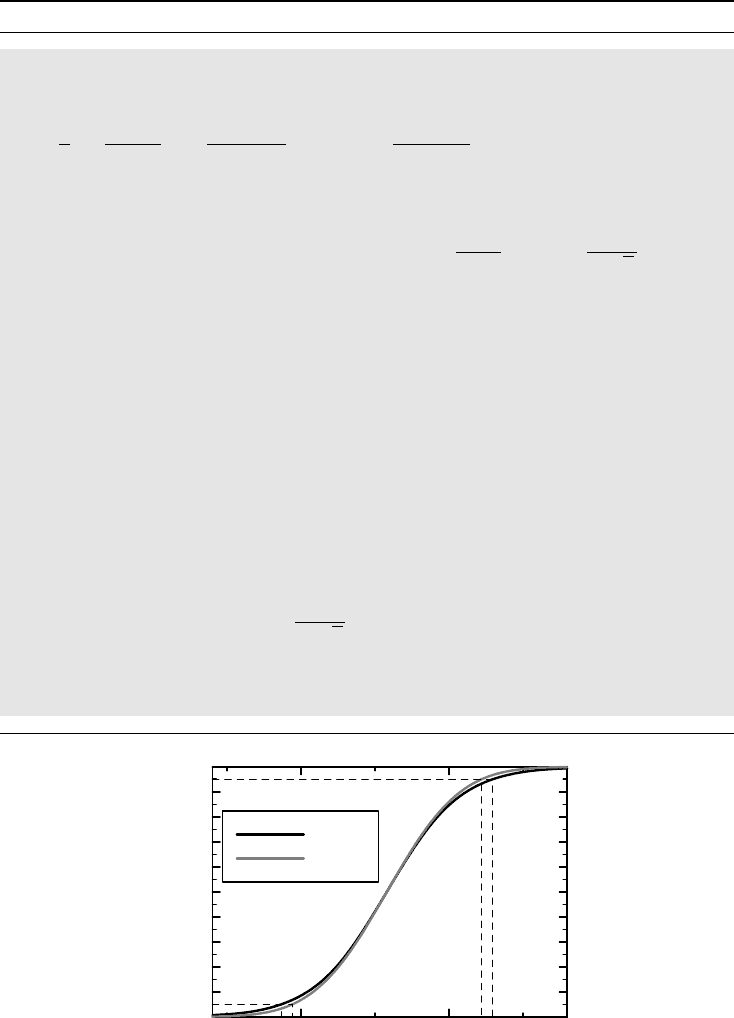
the difference for each pair. Figure 6.8 contains two confidence functions for this data set,
the conventional t-test and the large-sample approximation which uses the Gaussian CDF
(x). We see that ignoring the extra variability that led to the definition of the t distribution
will produce shorter confidence intervals than the correct one, as expected.
Recalling how we obtained confidence intervals for a binomial proportion in Section 4.6.1,
it may be natural to ask if we should not use the ratio
√
n(m − ¯x)/
ˆ
σ
n
(m) as a test statistic
instead. At first glance it may appear that this should have a t(n) distribution, but it does
not, because the numerator and denominator are now dependent. Its distribution is given in
Appendix 6.A.1, where it is shown that the confidence function for m it defines is equivalent
to the t(n − 1)-based confidence function above.
As outlined in Box 6.2, the t-based confidence function also has a Bayesian interpretation:
if we assume very special prior distributions for m and σ, the function C(m)isthea posteriori
distribution for m. However, for this we need to use rather peculiar prior distributions for m
and σ, at least from a probabilistic point of view.
CONFIDENCE IN THE CDF AND ITS PARAMETERS 161
Box 6.2 Bayesian approach to a Gaussian distribution
Given independent observations x
1
,...,x
n
from a N(m, σ
2
) distribution, the sample is
an observation of a distribution with probability density
n
i=1
1
σ
φ
x
i
− m
σ
=
1
(2πσ
2
)
n/2
exp
−
i
(x
i
− m)
2
2σ
2
= (2πσ)
−n
exp(−Q/2σ
2
),
where
Q = (n − 1)s
2
+ n(¯x − m)
2
= (n − 1)
1 +
t
2
n − 1
,t=
m − ¯x
s/
√
n
.
If we assume that the prior distributions for m and σ
2
are independent, and that the
prior for σ
2
corresponds to the measure dσ
2
/σ
2
(which is not a probability measure,
but means that the precision variable σ
−2
has a uniform distribution), we can obtain the
marginal distribution for m by first integrating σ
2
out, and then multiply by the prior
for m. To integrate, we introduce the new variable y = 1/σ
2
, and get the integral
(2π)
−n/2
∞
0
y
n/2−1
exp(−Qy/2)dy ∝ Q
−n/2
.
This means that the density for m is proportional to (1 + t
2
/(n − 1))
−n/2
, which de-
fines the t(n − 1) distribution. If we therefore take the uninformative prior dm for m,
we see that the posterior density for m, given the observed data, is derived from the
observation that
m − ¯x
s/
√
n
∈ t(n − 1).
If we have some prior information on m (but none on σ
2
) we simply multiply the t(n − 1)
density with this a priori density and normalize, to obtain the a posteriori distribution.
0
0.1
0.2
0.3
0.4
0.5
0.6
0.7
0.8
0.9
1
Confidence in m
21
Mean m
t(n − 1)
N (0, 1)
Figure 6.8 Confidence functions describing our information about the mean. The solid black
curve corresponds to Student’s t-test, the gray curve to the Gaussian approximation.
162 EMPIRICAL DISTRIBUTION FUNCTIONS
6.6 Analysis of paired data
We next return to the COPD patients and their sputum data, but now we assume we have
two observations on each of the 20 subjects. The second set of data consists of the following
numbers (paired with the previous sequence): 18, 19, 2, 2, 5, 515, 30, 10, 3, 55, 127, 2, 260,
16, 8, 301, 443, 1, 26, 24. The original observations (X) were taken after some drug was
given, whereas the new data (Y ) were obtained under the same conditions, but without this
drug. Precisely as with Cushny and Peebles data in the previous section, we wish to analyze
the difference Z = Y − X. Our intention here is to have a more general discussion about what
we can do by exploring the CDF for Z, noting that if X and Y have the same distribution,
the distribution for Z would be symmetric around zero (see equation (4.1)). We wish to find
ways to explore this symmetry in order to obtain a test for the null hypothesis that there is no
effect of the drug.
The immediate consequence of the symmetry is that both the median and the mean of Z are
zero. One way to test the null hypothesis is therefore to test if either of these two parameters
are zero. For the mean we get the estimate −659 with 95% confidence limits (−1318, 1), and
for the median we get the estimate −87 with 95% confidence limits (−235, −39). For the
mean there is not sufficient evidence to reject the null hypothesis at the conventional two-sided
5% level, since the interval contains zero, whereas based on the median we have sufficient
evidence. However, because of the skewness of the data, the proposed confidence interval for
the mean may be quite inaccurate (have the wrong error control). We will see that this is the
case in the next section.
The mean and median estimates are quite different, and from our previous discussion we
have a fairly good idea of why this is: we should probably log our data before we analyze. The
analysis should therefore be on the stochastic variable Z = ln Y − ln X = ln(Y/X) instead.
The mean and median of this distribution should then be back-transformed to the original
measurement scale by exponentiation. As discussed earlier, when we exponentiate the (arith-
metic) mean of the logged data, we get the geometric mean of the original data, whereas when
we exponentiate the median of the logged data, we get the median of the original data. For
our data the geometric mean estimate is 0.14 with 95% confidence limits (0.09, 0.21), and
for the median the estimate is 0.13 with 95% confidence limits (0.06, 0.22). We see that we
get more consistent results by analyzing logged data instead of the original data, but the final
claim is different: the first is the ratio of the geometric means obtained with and without drug
treatment, and the second is the median of the individual ratios.
What if we analyze the ratio Y/X directly? The median is the same, but now the mean is
the arithmetic mean of the ratio, estimated as 0.19 with 95% confidence limits (0.12, 0.27).
This is not the ratio of the individual means (as is true for the geometric mean) and may
therefore not be a natural measure of the location of the data. If we want to discuss a mean
ratio we should analyze differences of logged data instead (see Box 6.3).
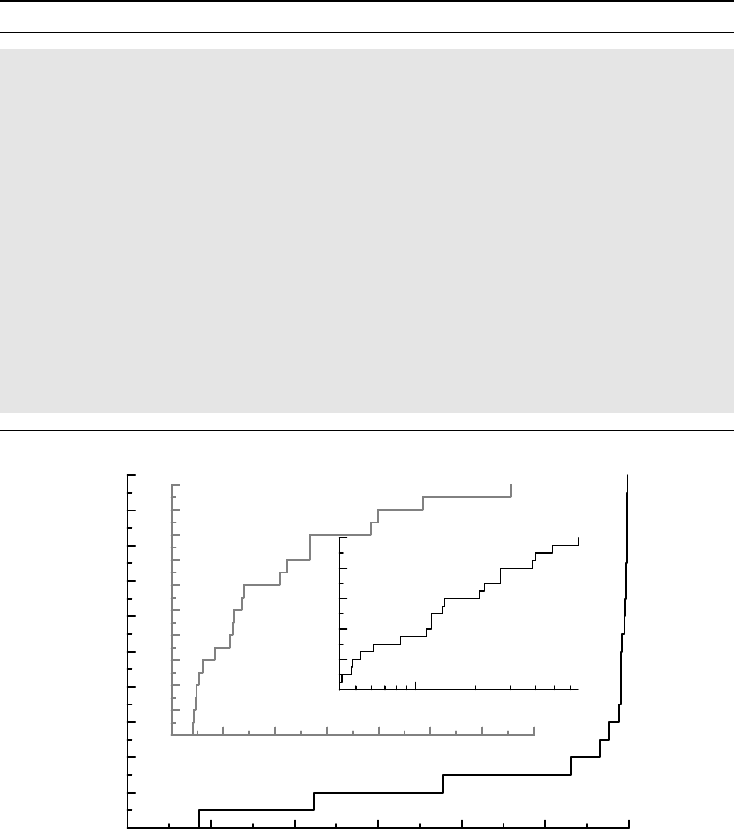
In Figure 6.9 we have plotted the various e-CDFs discussed above. The largest, outer, graph
shows the e-CDF for the difference, which is highly skewed to the left, making measures like
the mean more or less meaningless. The middle graph shows the e-CDF for the ratios on the
original (linear) scale. This is also slightly skewed, but now to the right. Finally, the innermost
graph shows the same e-CDF but now on a logarithmic scale. This is the most symmetric of
the e-CDFs, and the scale we should work on for these data (supported by the fact that when
we consider cell counts in sputum, it is the relative effect that has clinical meaning).
BOOTSTRAPPING 163
Box 6.3 When should we log the data in the analysis?
This question is an important one that does not have a simple, definite answer. But there
are a few points to be considered.
One situation in which to consider log-transformation is when we have a skewed distri-
bution with a long tail to the right. Log-transformation may or may not symmetrize the
distribution in this case; if it does there is still the problem of justifying why we should
describe this variable in this way.
To me the main driver behind the choice to log-transform the data is how the experienced
clinician, or scientist, sees the variable in question. Does he think of effects as absolute
changes, or as relative changes? If the answer is absolute changes, the choice should
be to analyze the data on the original scale. If, on the other hand, the answer is relative
changes, that means interpreting effects in a relative sense, so that the expression dE/E
represents the true effect. In such a case the analysis should be done on ln E. There
are no other changes to how we set up the model, but care must be taken with the
description of the end result. Usually a mean difference on the logarithmic scale should
be back-transformed to a ratio of (geometric) means.
0
0.1
0.2
0.3
0.4
0.5
0.6
0.7
0.8
0.9
1
−6000 −5000 −4000 −3000 −2000 −1000 0
Y − X
0
0.1
0.2
0.3
0.4
0.5
0.6
0.7
0.8
0.9
1
0.10 0.2 0.3 0.4 0.5 0.6 0.7
Y/X
0
0.2
0.4
0.6
0.8
1
10
−1
Y/X
Figure 6.9 The e-CDFs for Y − X and Y/X, the latter on both a linear and a
logarithmic scale.
6.7 Bootstrapping
We have discussed how we can describe a population CDF F (x) in terms of various (popu-
lation) parameters, and how these can be estimated from a random sample. The tricky part
164 EMPIRICAL DISTRIBUTION FUNCTIONS
is to describe the actual knowledge we obtain about the parameter from our estimate, that is,
how close we believe it is to the true value. We have outlined how we can do this in special
situations, such as for percentiles and the mean. However, there may be other parameters we
wish to estimate, and it may not be trivial to derive confidence statements for these. In such
situations a method of considerable conceptual simplicity comes to the rescue, but it is rather
computer-intensive (though this is less of a problem now than it used to be).
To specify the problem, from a particular random sample {x
1
,...,x
n
}we wish to compute
a particular function
ˆ
θ(x
1
,...,x
n
), often an estimator of a parameter θ. We can compute the
estimate, but how do we get confidence statements about θ? We have seen how such statements
can be obtained for percentiles by using the e-CDF F
n
(x) together with knowledge about the
binomial distribution. The mean, in turn, used a different method which did not work well for
the sputum data on the original scale, because the distribution was so skew. How can we get
more reliable confidence statements for the mean on the original scale?
To understand the method to be described, we first note that if we knew the true CDF F (x),
we could obtain such information with any prespecified precision by employing an in silico
experiment. We do this by obtaining the distribution of
ˆ
θ (which is a function of a sample) by
constructing a very large number of independent samples from the distribution, computing the
test statistic for each of these and investigating the distribution of these computed numbers.
A single such simulation is how the collection of data from one experiment works, and we
can do this on the computer as many times as we wish. The fact that we do not know F (x)
poses a problem, but we have data from an experiment, and with it an approximation of F (x)
as the linearly interpolated version of the e-CDFs (instead of the step function version; see
page 151). We therefore start this discussion by assuming that F
n
(x) is a linearly interpolated
e-CDF, and that this function is a good description of the true (but unknown) CDF F (x). We
then generate new random samples using the following process:
1. Choose n random numbers p
k
from the uniform distribution on the unit interval.
2. For each of these, compute the percentiles x
k
= F
−1
n
(p
k
).
3. Compute the function
ˆ
θ(x
1
,...,x
n
).
On the computer we can do this as many times as we wish. This will produce a random
sample {θ
1
,...,θ
N
} of function values, which can be used to describe the distribution of
ˆ
θ.
The process therefore defines an approximation to the confidence function for θ, from which
we can compute any (approximate) confidence interval or p-value we wish. How well this
works obviously depends on how well F
n
(x) approximates F (x), but it is expected to improve
as we increase the sample.
As already hinted, this is not the method we actually use, because the e-CDF is not defined
by linear interpolation, but as a staircase function. If we repeat the procedure described above,
we now get our simulated data values only among the original observations. If these are all
different, we can get for each random number any of these with equal probability; if there are
ties such numbers will turn up proportionally more often. But this means that the procedure
above is the same as taking a random sample from the original data set by sampling with
replacement. This defines the bootstrap method and for clarity we repeat how it works.
1. Generate a large number N of samples by sampling with replacement from the data
x
1
,...,x
n
.
BOOTSTRAPPING 165
2. For each sample i, compute the function value as θ
i
.
3. Use the (linearly interpolated) e-CDF for the data {θ
1
,...,θ
N
} as a confidence function
for θ.
The term ‘bootstrapping’ was introduced by Bradley Efron and is taken from the phrase ‘to
pull oneself up one’s bootstrap’, from the famous Adventures of Baron Munchausen, where
in one story the baron used this method to escape from the bottom of a deep lake.
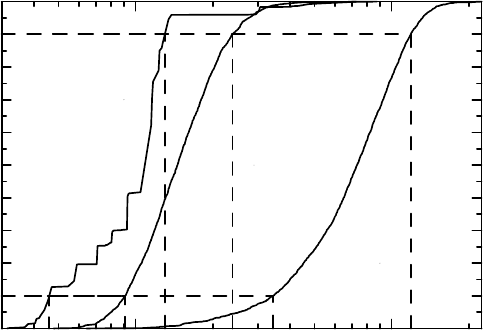
Example 6.3 To illustrate bootstrapping, consider our original sputum cell count data. Using
2000 samples, the process mentioned above gives us the confidence curves in Figure 6.10 for
the median, the geometric mean and the arithmetic mean. Note that the data have been analyzed
on the original scale, but we display them on a logarithmic scale for presentational clarity.
The graph also illustrates the corresponding symmetric 80% confidence intervals for each of
these parameters.
We can use this approach for any parameter we wish, including the value of the CDF
F (x) itself at a given point x. We can also provide estimates with confidence intervals
for some more unconventional parameters in the same way. We can look at the difference
of the mean and the median to demonstrate that the distribution is not symmetric, or we
may use the difference between the median and the average of the two quartiles for the
same purpose.
If we apply this to the comparison of the two stochastic variables Y and X we dis-
cussed in the previous section, we can compare those results with the results obtained
using bootstrapping.
0
0.1
0.2
0.3
0.4
0.5
0.6
0.7
0.8
0.9
1
10
2
10
3
valueparameter
median
meangeometric
meanarithmetic
Figure 6.10 Bootstrapped confidence curves for statistics of the sputum count data
(obtained on the original scale, but shown on the log scale), demonstrating how we obtain
their confidence limits.
166 EMPIRICAL DISTRIBUTION FUNCTIONS
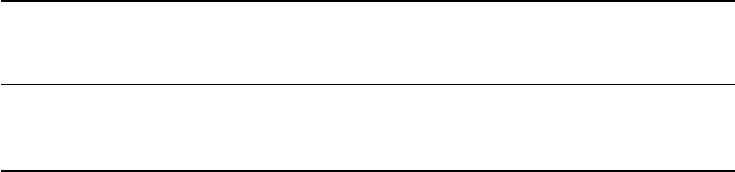
Example 6.4 The table below compares what we get using the bootstrap method (Boot), in a
run with 2000 samples, with the results we derived in the previous section (NP), for the median
and the mean. We make the comparison both for the difference, labeled Y −X, and for the
difference of the logged data, labeled Y/X. What is shown are estimates and 95% confidence
limits. For the bootstrap samples the point estimate is the median of the confidence curve.
Analysis of Y − X Analysis of Y/X
Median Mean Median Mean
NP Boot NP Boot NP Boot NP Boot
Lower CL −235 −208 −1318 −1360 0.09 0.09 0.06 0.07
Estimate −87 −87 −659 −650 0.14 0.14 0.13 0.13
Upper CL −39 −38 1 −126 0.21 0.20 0.22 0.24
We find consistency in the results for the two methods when it comes to the analysis of the
ratio, and also when it comes to the analysis of the median for the difference. However,
the upper limit for the mean has been lowered considerably now, which justifies our earlier
cautionary remark about the NP confidence interval for the mean with skewed data.
6.8 Meta-analysis and heterogeneity
It may be tempting to view meta-analysis in roughly the same way as we view the bootstrap
method: you have a number of different estimates of a parameter in a series of studies, so why
not apply the bootstrap idea to obtain the pooled information by looking at the CDF generated
from the individual study results? As an example, consider a meta-analysis carried out in the
mid 1980s on 22 clinical trials, each of which investigated whether the use of beta-blockers re-
duces mortality after a heart attack. The 22 odds ratios (treated versus control) for the individual
trials are shown in Figure 6.11 as an e-CDF versus logged odds ratio (the staircase curve).
Before we discuss the graph in detail, we perform the conventional Mantel–Haenszel
analysis (see Section 5.5) on these data. Such an analysis gives us an estimated pooled odds
ratio of 1.20 with 90% confidence interval (1.10, 1.30). The traditional analysis also includes
a test for homogeneity, the Breslow–Day test, with p-value 0.063, which is close to being
statistically significant at the conventional 5% level. This would be the standard output of a
conventional meta-analysis for these data. On the log scale the odds ratio and 90% confidence
interval are given by 0.18 and (0.10, 0.26), respectively.
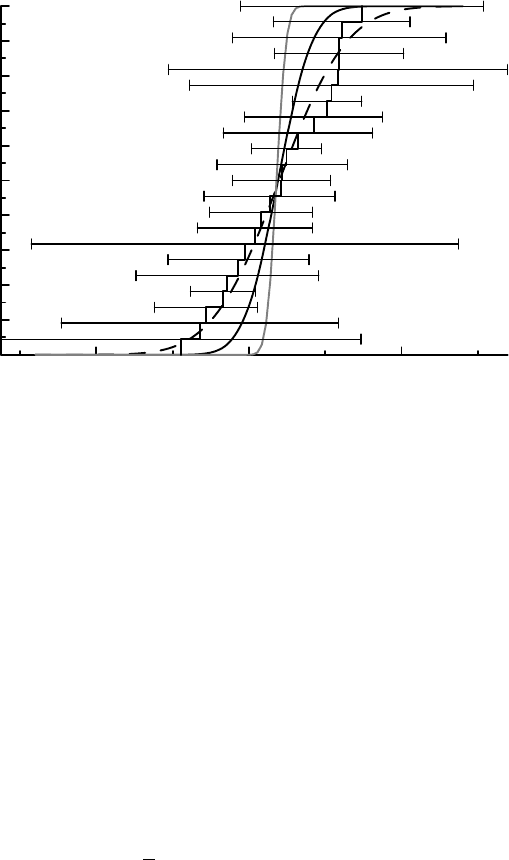
As already mentioned, the e-CDF of the logged odd ratios is shown in Figure 6.11 as the
staircase function. This is approximated by the dashed curve, which shows a Gaussian CDF
with the mean and standard deviation of the 22 logged odds ratios. Given the rationale for the
bootstrap method, we might think that the dashed curve provides us with a confidence function
for a common odds ratio on the log scale. However, a quick inspection of the symmetric 90%
confidence interval derived from it tells us that it cannot be so. The interval is far too wide,
compared to what we found above.
In bootstrapping we reconstruct the confidence function from estimates of a parameter
which are given with the same precision, a precision that is defined by the size n of the
data sample. The larger the value of n, the steeper the confidence curve will be, because
when n is small, some estimates are way off in either direction, giving heavy tails in the
META-ANALYSIS AND HETEROGENEITY 167
0
0.1
0.2
0.3
0.4
0.5
0.6
0.7
0.8
0.9
1
−1 10
ln(OR)
Figure 6.11 A meta-analysis provides both information on a common odds ratio and a
description of heterogeneity.
confidence function. In the situation now at hand the individual estimates are computed to
different precision, and then the method does not work. This is illustrated in Figure 6.11 by
the 90% confidence intervals around the log-odds ratio estimate for each individual study.
The appropriate confidence function must be computed by factoring this in, which is what the
Mantel–Haenszel methodology does, weighting individual odds ratios according to precision.
For reference the confidence curve for the Mantel–Haenszel pooled odds ratio is shown as
the gray solid curve in the graph.
To better understand this, we need to be explicit about the assumptions. Let θ
∗
i
denote
the estimate of the odds ratio in study i. Since studies are different in size, the appropriate
probability model is that x
i
= ln(θ
∗
i
) is an observation of a N(ln(θ),σ
2
i
) distribution, where
we have an estimate s
2
i
of σ
2
i
. If we substitute s
2
i
for σ
2
i
, how would we estimate ln(θ)?
We can use the least squares idea, which means minimizing Q(θ) =
i
(x
i
− ln(θ))
2
/s
2
i
(see
Section 9.3), which would give ln(θ) as a weighted average of the individual log-odds ratios,
weighted according to precision: ln(θ) = (
i
x
i
s
−2
i
)/(
i
s
−2
i
) = W/S. This is an alternative
estimator to the Mantel–Haenszel pooled odds ratio, for which the corresponding confidence
curve θ is given by C(θ) = (
√
S(ln(θ) − W/S)). It is very close to the one derived from
the Mantel–Haenszel method in our case (and in general). In summary, the dashed curve in
Figure 6.11 would be our choice of confidence function if we only knew the estimates, and
not the precision. Since we know the precision, we can improve considerably on this, which
is what we have done with either the Mantel–Haenszel method or the method above.
As we saw above, the Breslow–Day test produced a relatively small p-value, so there
is some evidence that the true odds ratio actually varies between different studies. We can
modify the model to account for this – in other words, to allow for heterogeneity in the studies.
For this we assume that for the true odds ratio θ
i
of study i we have that
ln(θ
i
) ∈ N(ln(θ),σ
2
),

168 EMPIRICAL DISTRIBUTION FUNCTIONS
Box 6.4 Bayes on Gauss
Assume that a characteristic x ∈ N(θ, σ
2
), with σ known, and make the Bayesian as-
sumption that we have the a priori distribution θ ∈ N(μ, τ
2
), where μ and τ both are
known. What can we then say about θ after we have made the observation x? The den-
sity for the a posteriori distribution is proportional to ϕ((x − θ)/σ)ϕ((θ − μ)/τ), which
means that the distribution is
N
xτ
2
+ μσ
2
σ
2
+ τ
2
,
σ
2
τ
2
σ
2
+ τ
2
.
The best estimate of θ is the mean in this distribution, which we can write
μ +
1 −
σ
2
σ
2
+ τ
2
(x − μ).
This is an average of the global mean μ and the observation x. It is closer to x the larger
the ratio τ/σ is. It is the Bayesian update of θ from the observation x.
The calculation is also relevant for the frequentist, but now θ has a distribution in
the population instead. We do not have a single observation, but a sample x
1
,...,x
n
,
and we know that the expected value of the average of these observations is μ and that
s
2
is an estimate of σ
2
+ τ
2
. The properties of the χ
2
(n − 1) distribution show that the
expected value of s
−2
is (n − 1)/(n − 3)(σ
2
+ τ
2
), so the frequentist can substitute the
Bayesian update above with the corresponding empirical Bayesian update
¯x −
1 −
n − 3
n − 1
σ
2
s
2
(x − ¯x).
This is actually a better estimate of the value of θ based on an observation x, than the
observation itself. Put in the context of point estimation, this result is known as the Stein
effect; it is discussed further in Box 7.5.
where the variance σ
2
is a measure of the heterogeneity. It then follows that ln(θ
∗
i
)is
(asymptotically) an observation of a N(ln(θ),σ
2
+ s
2
i
) distribution. If we have an estimate
of σ
2
, we can, on the one hand, derive a new confidence function for θ and, on the other
hand, graphically illustrate the heterogeneity. With respect to the first, the estimate for ln( θ)
now becomes 0.19, and if we transform this to the odds ratio scale we get 1.21 with 90%
confidence interval (1.08, 1.36), which is very similar to the Mantel–Haenszel estimate. The
standard deviation σ is estimated at 0.18, and if we draw the CDF for the distribution of the θ
i
from this, we get the solid, smooth, curve in Figure 6.11. This curve therefore is a description
of how the true odds ratios vary in these types of studies. The range of odds ratios can be de-
scribed by saying that 90% of the odds ratios from different studies can be found in the interval
(0.90, 1.62).
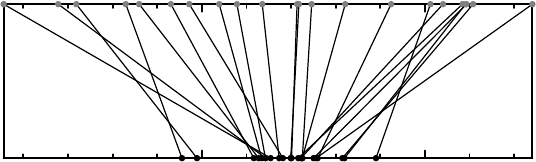
The model we have used also gives us updated estimates of the odds ratios of individual
studies, using the information that they all follow a Gaussian distribution. The idea, which is
Bayesian except that we replace the parameters ln(θ) and σ
2
with estimates from the data, is
outlined in Box 6.4. The result is shown in Figure 6.12. These updated estimates are called
COMMENTS AND FURTHER READING 169
0.50
ln(OR)
Figure 6.12 The estimated log-odds (upper row) and how they are shrunk (lower row) if we
assume the true log-odds come from a Gaussian distribution.
empirical Bayes estimates for the individual odds ratios, and the fact that we can strip the
estimates of some uncertainty this way is an example of a famous paradox pointed out by
Charles Stein (see Box 7.5). The paradox is that you can improve the estimate in one study
by using the estimates of other studies, which in this case is because we make the assumption
that the true log-odds follow a Gaussian distribution. This assumption provides a mechanism
for other studies to provide information on a single one.
One loose end remains: how do we get an estimate of σ
2
? Simple least squares does not
suffice because of the way this parameter appears in the statistical model. The are different
ways we can estimate it, the simplest of which is to refer to the general maximum likelihood
theory. If we write down the log-likelihood of the problem above, we get a function of the
parameters θ and σ
2
, which we can maximize. This provides us with point estimates, and what
we have done above is use the point estimate of σ
2
from this as a true value in the description.
6.9 Comments and further reading
Most of the material here is very basic statistics, though the format is slightly unconventional.
Our main ambition has been to clarify the connection between the true CDF (the Platonic
world), and the world we observe, which consists of a limited amount of finite observed data,
summarized in the e-CDF. The e-CDF is my preferred substitute for histograms, which is
the way distributions usually are displayed. For discrete data histograms are not problematic,
describing frequencies as they do, but for continuous data one first has to discretize the
data, and there is no unique way to do this. The precise way this is done may have a strong
influence on what the distribution looks like in a histogram. The main virtue of the e-CDF
is that it works for all kinds of distributions – continuous, discrete and mixed – which also
explains why the CDF is preferred over probability functions and probability densities in
this book. For an overview of the mathematical properties of the e-CDF, both exact and
large-sample theory, see Cs
´
aki (1984). Some key large-sample results are summarized
in Appendix 6.A.3.
When we introduced the t-test, we used the original data that William Gosset, publishing
under the pseudonym ‘Student’, used for illustration of his method. His test, now known as
Student’s (one-sample) t-test, was developed from a need to analyze small data sets accurately.
He could not use any of his own data for illustration (his employer, the beer company Guinness,
was afraid of disclosing company secrets), so he borrowed some medical data from Cushny
and Peebles, describing a crossover study on additional hours of sleep obtained when subjects