
Kallen A. Understanding Biostatistics
Подождите немного. Документ загружается.


180 CORRELATION AND REGRESSION IN BIVARIATE DISTRIBUTIONS
The covariance is important for much the same reason the mean and variance are important;
it will be the key additional descriptor that defines the bivariate Gaussian distribution. The
factor that we integrate in the definition is positive when x and y are on the same side of
m
1
and m
2
, respectively, so the covariance will be positive if F (x, y) puts more weight in
those areas than in other areas. A positive covariance therefore implies that there is a net
covariation of X and Y , whereas a negative value implies that, on average, whenever one is
high, the other is low. It is a mathematical fact that C(X, Y )
2
≤ V (X)V (Y), and therefore
it is natural to describe the covariation of two stochastic variables in terms of the unit-free
correlation coefficient
ρ(X, Y ) =
C(X, Y )
√
V (X)V (Y)
.
This correlation coefficient ρ is by necessity a number between −1 and 1, and two
variables are said to be uncorrelated if ρ = 0. It is easy to show that two independent
variables are uncorrelated, but it is possible for dependent variables to be uncorrelated
(though not for Gaussian variables). As already mentioned, the correlation coefficient is
a parameter that is heavily related to a bivariate Gaussian distribution, but it is not the
only way to describe correlation. Some alternative measures of correlation are outlined in
Box 7.1. To distinguish ρ from other correlation coefficients, it is referred to as the Pearson
correlation coefficient.
In passing we may note that if Z = (X, Y ) and m = (m
1
,m
2
) we can define the matrix
V (Z) =
∞
−∞
∞
−∞
(z − m)(z − m)
t
dF (z), (7.1)
which will be a 2 ×2 matrix (z − m is a column vector in the integral) such that the diagonal
elements are the variances of the two components and the off-diagonal elements are the
covariance. We call this matrix the variance matrix of the bivariate stochastic variable. To
estimate it we use the corresponding discrete entity in which we replace the vector m with
the vector of arithmetic means ¯z, and the CDF with the corresponding e-CDF. The result is
the sample variance matrix
S =
1
n − 1
i
(z
i
− ¯z)(z
i
− ¯z)
t
,
where the denominator is adjusted to make the corresponding variable unbiased. This has an
immediate generalization to higher-dimensional stochastic variables.
Example 7.1 Pearson’s correlation coefficient is often used in medical statistics to describe
association, but when it comes to interpreting it, there is one salient point that is often missed.
Suppose that we have two outcomes (X, Y ) and we wish to understand the association between
them. Assume that their correlation coefficient is ρ and let σ
2
1
and σ
2
2
denote their variances.
Each of the variables (X could be a biomarker, and Y a manifestation of a disease) is measured
with a measurement error. Assume that the measurement error for X has variance η
2
1
and that
for Y has variance η
2
2
. Let X
and Y
be the observed data. If measurement error is independent
of actual values, we have that C(X
,Y
) = C(X, Y ) = ρσ
1
σ
2
, and therefore that the observed

BIVARIATE DISTRIBUTIONS AND CORRELATION 181
correlation coefficient is
ρ(X
,Y
) =
ρσ
1
σ
2
σ
2
1
+ η
2
1
σ
2
2
+ η
2
2
=
ρ
(1 + η
2
1
/σ
2
1
)(1 + η
2
2
/σ
2
2
)
.
If the measurement error is large relative to the variable variability, this means that the corre-
lation we observe gets attenuated. If we do not have precision in our measurements of X and
Y, the association may drown in the measurement noise.
We next wish to see how the Pearson correlation coefficient relates to the odds ratio in the
simple case of a 2 ×2 table.
Example 7.2 Fora2× 2 table with cell probabilities p
ij
, i, j = 1, 2, the covariance is easily
computed as p
11
− p
1+
p
+1
= p
11
p
22
− p
12
p
21
, so that Pearson’s correlation coefficient is
given by
ρ =
p
11
p
22
− p
12
p
21
√
p
1+
p
+1
p
2+
p
+2
.
An estimate of this is called the phi coefficient, and is obtained from cell counts as follows:
φ =
x
11
x
22
− x
12
x
21
√
x
1+
x
+1
x
2+
x
+2
.
To interpret ρ here, introduce δ by the relation p
11
= p
1+
p
+1
+ δ. Then we must also
have that p
21
= p
2+
p
+1
− δ, p
12
= p
1+
p
+2
− δ, and p
22
= p
2+
p
+2
+ δ, from which it
follows that δ = p
11
p
22
− p
12
p
21
. We obtain a relationship between δ and the odds ratio
θ = p
11
p
22
/p
12
p
21
by inserting the expressions above to get
δ
2
+ δ
p
1+
p
+1
+ p
2+
p
+2
+
θ
1 − θ
+ p
1+
p
+1
p
2+
p
+2
= 0.
Solving this equation, we can express ρ = δ/
√
p
1+
p
+1
p
2+
p
+2
in the odds ratio θ and con-
stants that only depend on margins. This means that we can obtain a confidence interval for ρ
conditional on the margins from a corresponding interval for the odds ratio. As example we
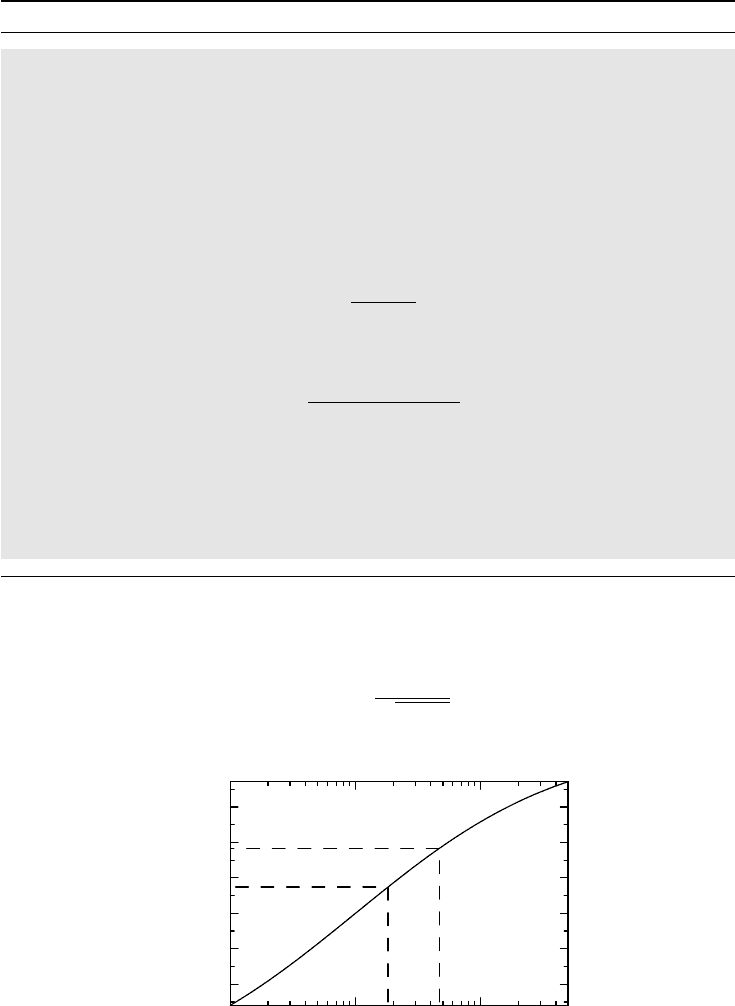
take the first Hodgkin’s lymphoma example, for which the relation is illustrated in Figure 7.1.
The 90% confidence interval (1.82, 4.71) for the odds ratio translates into the 90% confidence
interval (0.15, 0.37) for ρ.
A related measure of association is Cohen’s κ, which is discussed in Box 7.2.
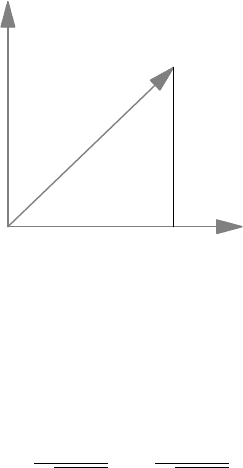
Figure 7.2 describes a geometric interpretation of the Pearson correlation coefficient.
It shows how, given two independent and standardized stochastic variables, we can find a
linear transformation of these which has correlation ρ to one of them. For future reference,
we note that the bivariate distribution F(y, z) = P(Y ≤ y, Z ≤ z)of(Y, Z ) in Figure 7.2 is
computed from
z
−∞
P(Y ≤ y|Z = ζ)dF
Z
(ζ) =
z
−∞
P
X ≤
y − (sin θ)ζ
cos θ
|Z = ζ
dF
Z
(ζ),
182 CORRELATION AND REGRESSION IN BIVARIATE DISTRIBUTIONS
Box 7.2 Rater agreement and Cohen’s κ
Suppose that two pathologists independently examine a set of n slides for the pres-
ence or absence of a cell abnormality. One way to express the agreement between the
two (as an indicator of the reproducibility or interchangeability of their classifications)
is in terms of Cohen’s κ (kappa). To define this, arrange the possible outcomes in a
2 ×2 table so that the rows and columns are the classifications of the two patholo-
gists. If p
ij
is the probability of a slide falling into cell (i, j ), the actual probability
of agreement is p
a
= p
11
+ p
22
and the probability of agreement by chance alone is
p
c
= p
1+
p
+1
+ p
2+
p
+2
. Cohen’s measure of agreement is now the excess probability
of agreement beyond chance,
κ =
p
a
− p
c
1 − p
c
.
To estimate this, we insert the observed cell counts into the expression for κ to get
ˆκ =
2(x
11
x
22
− x
12
x
21
)
x
1+
x
+2
+ x
2+
x
+1
.
We see that κ is proportional to the Pearson correlation coefficient discussed in
Example 7.2 with a proportionality constant that only depends on margins. This means
that we can use the discussion in that example to transform a confidence interval for
the odds ratio to one for κ. The result will be conditional upon margins, as for Fisher’s
exact test.
which means that
F (y, z) =
z
−∞
F
X
y − ρζ
1 − ρ
2
dF
Z
(ζ). (7.2)
−0.4
−0.2
0
0.2
0.4
0.6
Pearson correlation (ρ)
10
−1
10
0
10
1
Odds ratio (θ )
Figure 7.1 The connection between the odds ratio and the Pearson correlation coefficient
in a (particular) 2 ×2 table with given margins.
ON BASELINE CORRECTIONS AND OTHER COVARIATES 183
X
Z
Y
ρ
θ
Figure 7.2 From two independent stochastic standardized (mean zero and variance one)
variables X and Z we can construct a new standardized variable Y which has correlation ρ
with Z by rotation an angle θ such that ρ = sin θ. This is easily checked from the fact that
Y = (cos θ)X + (sin θ)Z. The correlation with X is cos θ.
For a continuous distribution this means that the bivariate density is given by
f (y, z) =
1
1 − ρ
2
f
X
y − ρz
1 − ρ
2
f
Z
(z)
This formula will be used to derive the bivariate Gaussian distribution below.
The description of a general bivariate distribution in terms of parameters is more compli-
cated than in the univariate case. Percentiles, which should be the points defining the same
height for the bivariate CDF, corresponds not to points on a line, but to curves in the plane.
This makes them not only hard to estimate, but also impossible to describe, except in a graph-
ical form. Therefore, to describe the location of a bivariate distribution the mean (vector)
becomes even more important than it was for univariate distributions, and multivariate Gaus-
sian distributions are even more important in multivariate statistics than univariate Gaussian
distributions are in univariate statistics.
7.3 On baseline corrections and other covariates
In this section we address the question how we best can utilize information on one variable in
the analysis of another when they are dependent. The setting will be the analysis of a clinical
trial, for which there is a choice between designing it as a parallel group study and a crossover
study. Sometimes there is no such choice, as when a long treatment period is needed, or the
effect of the drug is long-lasting, but when there is a choice, we need to understand the pros
and cons of the two designs. Some aspects of this are statistical and will now be discussed.
The setting is that we want to compare two treatments, an active drug and a matching
placebo, utilizing a particular outcome variable which we do not need to specify. Define the
following two stochastic variables:
•
X is the value of the outcome variable when the patient is given placebo;
•
Y is the value of the outcome variable when the patient is given the active drug.

184 CORRELATION AND REGRESSION IN BIVARIATE DISTRIBUTIONS
In theory both of these have a value for each individual, though we may only measure one of
them. Assume that (X, Y ) has a bivariate distribution with mean (m
1
,m
2
), variances (σ
2
1
,σ
2
2
)
and (the Pearson) correlation coefficient ρ. If we run a parallel group study, we will observe X
for some patients and Y for others, whereas if we run a crossover study we essentially observe
both, though not necessarily under identical conditions (which has consequences which will
be the subject of Section 8.7).
Our objective is to estimate the treatment difference = m
2
− m
1
, which in the case of
a parallel group study is the mean difference between the groups. We wish to know which
design has the smallest standard error σ (the standard error is the standard deviation of the
estimator of ). Recall that it is /σ that defines the power of the study, so this determines
which design is the most efficient when it comes to demonstrating effects.
If we assume that for the parallel group study each group contains n subjects, we have
that the variance of the observed mean difference is
V (
¯
Y −
¯
X) =
1
n
(σ
2
1
+ σ
2
2
),
whereas for the crossover study with n subjects it is
V (
¯
Y −
¯
X) =
1
n
(σ
2
1
+ σ
2
2
− 2ρσ
1
σ
2
).
If we denote the estimator in the parallel group study by
ˆ
PG
and the estimator in the crossover
study by
ˆ
XO
, this means that we have the following relationship between their variances:
V (
ˆ
XO
) = V (
ˆ
PG
) − 2ρσ
1
σ
2
/n.
If there is a positive correlation between the variables X and Y , which is to be expected in
this context, a two-period crossover study with n subjects is therefore always more efficient
than a parallel group study with 2n subjects in total. These two study types can be considered
equivalent, since they involve the same number of assessments. In the extreme case of ρ = 0
they are equivalent from a statistical (though probably not from a cost) perspective, since this
condition implies that it does not matter if we reuse subjects in the study.
Conceptually things become clearer if we assume that the variance is the same for
X and Y and equal to σ
2
. In such a case we have that V (
ˆ
PG
) = 2σ
2
/n and that
V (
ˆ
XO
) = 2(1 − ρ)σ
2
/n. Split σ
2
into a sum σ
2
= σ
2
b
+ σ
2
w
, with σ
2
b
= ρσ
2
and
σ
2
w
= (1 − ρ)σ
2
.
We can think of X − m
1
and Y − m
2
as constructed from a common stochastic variable Z
which has variance σ
2
b
, to which we have added a measurement error ξ, which has variance σ
2
w
.
The values of ξ are different and independent for the two measurements as well as independent
of Z. Under this assumption X and Y will have the same variance σ
2
b
+ σ
2
w
, whereas the
difference Y − X will have the same variance as the difference of two independent ξs, which
is 2σ
2
w
. We call σ
2
b
the between-subject variance, and σ
2
w
the within-subject variance. In this
notation we have that ρ = σ
2
b
/(σ
2
b
+ σ
2
w
) and the variance of
ˆ
PG
will be proportional to
σ
2
b
+ σ
2
w
, whereas that of
ˆ
XO
will be proportional to σ
2
w
. In both cases the proportionality
factor is 2/n.
A more detailed modeling along these lines would suggest that we should write X as
above but that for Y, which is obtained on drug treatment, we should have the decomposition
Y = m
2
+ Z + τ + ξ, with the same Z as before but now adding not only an observational
error ξ but also a true treatment effect size τ which varies between subjects (and is independent
ON BASELINE CORRECTIONS AND OTHER COVARIATES 185
of the other components) with a variance σ
2
t
. This assumption implies that V (Y ) = V (X) +σ
2
t
,
so we expect the variance in the drug-treated group to be larger than in the placebo group.
In statistical modeling it is common practice to assume σ
2
t
= 0, which corresponds to a fixed
treatment effect for all subjects. If we perform a t-test in such a situation, the estimated
(common) variance will be a compromise between σ
2
and σ
2
+ σ
2
t
. To avoid making this
assumption, and to allow for heterogeneity in the response to treatment, we need to replace
the classical fixed effects models with mixed effects models.
One way to improve the efficiency of a (randomized) parallel group study would be to
measure the outcome variable not only at the end of treatment, but also at randomization,
providing a baseline measurement. We can then study the change from baseline as a new
outcome variable. The question is whether this helps. To see if it does, assume that the pair
(X, Y ) above consist of (baseline, end-of-treatment) measurements. The previous discussion
shows that
V (Y ) = σ
2
2
,V(Y − X) = σ
2
1
+ σ
2
2
− 2ρσ
1
σ
2
,
from which it follows that V (Y − X) <V(Y ) precisely when ρ>σ
2
/2σ
1
. It is therefore
the correlation that determines whether we gain anything from looking at the change from
baseline or not. The cut-off point for this is a correlation of 0.5 when σ
1
= σ
2
, in which
case we can write the variances as V (Y ) = σ
2
b
+ σ
2
w
and V (Y − X) = 2σ
2
w
. Another way to
express the criterion that V (Y ) >V(Y − X) is therefore that the within-subject variability is
smaller than the between-subject variability. There is, however, a better way to approach the
problem, but before we discuss this, we need to understand why, and when, we can replace
the end-of-treatment value with the change from baseline and still get a valid estimate of .
Call the two groups A and B, and let superscript denote group membership, while
subscripts denote which variable we compute the mean of. It is a basic property of the
mean that
= m
B
Y
− m
A
X
= (m
B
Y−X
− m
A
Y−X
) + (m
B
X
− m
A
X
),
because the mean of a difference is the difference of the means. The first parenthesis on the
right is what we measure when we analyze the change from baseline. This will estimate
if and only if the second parenthesis is zero. If this is not the case, the two analyses estimate
different things. One way to guarantee equality at baseline is to randomize the study.
The answer to the question whether to choose Y or Y − X as outcome variable is that
we should choose neither. To see why, first replace the change from baseline with the more
general variable Y − bX for some arbitrary constant b. If the groups have equal distribu-
tions at baseline, this variable also estimates , irrespective of our choice of b. To get the
most efficient outcome variable we should therefore use Y − bX instead, where b is chosen
to minimize
V (Y − bX) = σ
2
2
+ b
2
σ
2
1
− 2bρσ
1
σ
2
.
This is a quadratic function in b, which has its minimum when b = ρσ
2
/σ
1
. This may appear
difficult to apply in practice, since it looks like we need to have a good knowledge of the
distributional parameters in order to be able to compute b, but we will see that this is what is
done in an analysis of covariance.
The obvious next question is why we should content ourselves with taking a linear pre-
dictor for Y of the form bX – why not use some more general function of X?Ifwewant

186 CORRELATION AND REGRESSION IN BIVARIATE DISTRIBUTIONS
to predict Y from an observation x of X using a function g(x), how should we choose g(x)?
Suppose that we assess how good a particular prediction is by measuring the mean squared
error of the prediction E((Y − g(X))
2
); then the function g(x) that minimizes this is the
conditional expectation
g(x) = E(Y |X = x).
The importance of this function is obvious; by viewing X as an explanatory variable for Y ,
we can reduce the uncertainty about Y by observing X. The increase in precision is expressed
in the mathematical observation that
V (Y ) = E(V (Y|X)) + V (E(Y|X)).
In words: the total variance is the average of the conditional variances (essentially the unex-
plained variance) plus how much the predictor varies. We may also note that the overall mean
is the mean of all conditional means:
E(Y ) = E(E(Y |X)).
(This formula is sometimes called the tower formula for the mean.) The problem here is that we
may not know the exact bivariate distribution of (X, Y ), and therefore not be able to compute
the true predictor g(x). We may, however, know it up to some unknown parameters, so that we
have a family of functions g(θ, x) from which we want to pick one by obtaining an estimate
of θ from data. Alternatively, we can simply assume such a functional form, without having
any distributional knowledge to justify it. We then try to estimate θ from data by minimizing
the function Q(θ) = E((Y − g
(θ, X))
2
). This is the least squares method for the estimation of
parameters, the method Gauss used to find Ceres. It will be the subject of Chapter 9.
The simplest choice for a function here, seen below to be appropriate for the bivariate
Gaussian distribution, is to use a linear function g(x) = a + b(x − m
1
), which is the best linear
predictor. As before m
1
is the mean of X. This case is what we considered above, and what
we have seen is that a = m
2
, the mean of Y, that b = C(X, Y )/V(X) = ρσ
2
/σ
1
, and that the
variance of the residuals is
V (Y − g(X)) = V (Y) − V (g(X)) = σ
2
2
(1 − ρ
2
).
This is what still remains to be explained in terms of other covariates.
7.4 Bivariate Gaussian distributions
The bivariate counterpart to a standardized Gaussian distribution N(0, 1) should have
m
1
= m
2
= 0 and σ
1
= σ
2
= 1, but there still are many of them, each corresponding to a
different degree of correlation between the components. One way to derive these distributions
uses equation (7.2) in its differentiated form, which shows that the density should be given by
ϕ
2
(x, y; ρ) =
1
1 − ρ
2
ϕ
y − ρx
1 − ρ
2
ϕ(x). (7.3)
BIVARIATE GAUSSIAN DISTRIBUTIONS 187
−3
−2
−1
0
1
2
3
y
−3 −2 −1 0 1 2 3
x
ρ =0
.
5
ρ =0.75
ρ =0 ρ =0.5 ρ =0.75
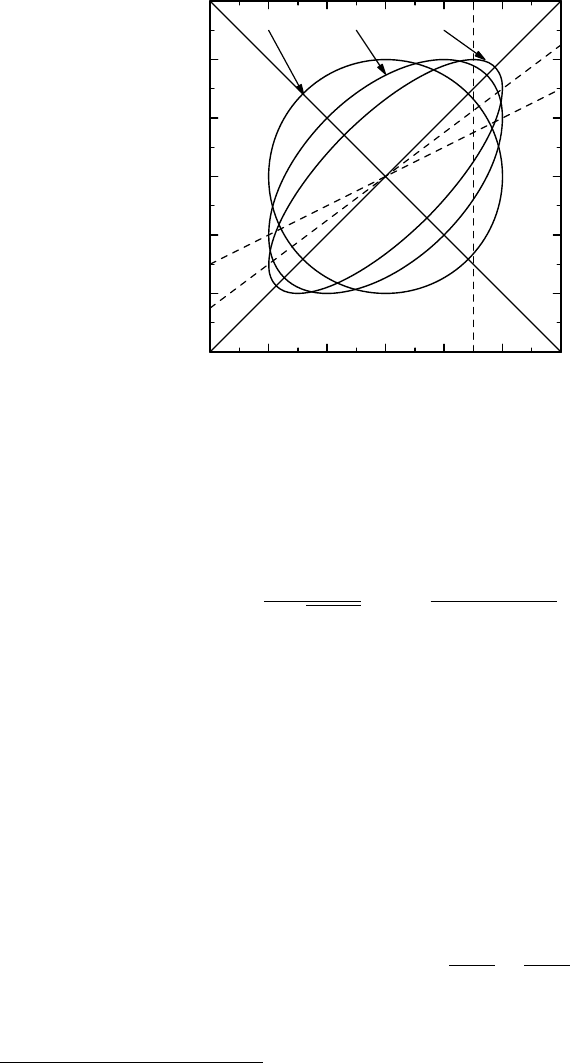
Figure 7.3 The shape of the height contours for standardized bivariate Gaussian distributions
for different correlation coefficients.
Here ρ is the Pearson correlation coefficient between the components. Writing out the expres-
sion and completing squares, we find that this is
ϕ
2
(x, y; ρ) =
1
2π
1 − ρ
2
exp
−
x
2
− 2ρxy + y
2
2(1 − ρ
2
)
. (7.4)
We denote this distribution by N
2
(0, 1,ρ) and its CDF by
2
(x, y; ρ).
To describe the effect of ρ on the shape of the bivariate Gaussian distribution ge-
ometrically, look at Figure 7.3. It shows a contour
1
for the density function for three
different choices of the correlation coefficient. Specifically, the curves are the ellipses
x
2
− 2ρxy + y
2
= 1 − ρ
2
for the choices ρ = 0, 0.5 and 0.75. (These are on the same
relative level, relative to the height of the density.) Note the oblique cross in the graph, which
corresponds to the two lines x = y and x =−y in the original coordinate system. For all
choices of ρ these lines represent the appropriate coordinate system in which to view data
(when ρ = 0 there is no preferred coordinate system). If we rewrite the equation for the
ellipse in this rotated coordinate system (45
◦
counterclockwise) with coordinates s, t, the
equation becomes
(1 − ρ)s
2
+ (1 +ρ)t
2
= 1 − ρ
2
⇔
s
2
1 + ρ
+
t
2
1 − ρ
= 1.
1
Functions of two variables can be graphically illustrated in the same way as nature topography is illustrated on
maps, by indicating height levels as curves in the plane.
188 CORRELATION AND REGRESSION IN BIVARIATE DISTRIBUTIONS
This expression confirms what we can see in Figure 7.3, namely that if we increase ρ from
0 toward 1, the ellipse becomes more elongated in the x = y direction and narrower in the
x =−y direction. In other words, the closer the correlation is to one, the more concentrated the
distribution is around the line x = y. Similarly, if the correlation is close to −1, the distribution
is concentrated around the line x =−y.
On occasion we may have a 2 × 2 table in which both factors actually have continuous
distributions, but data collection has been dichotomized into yes/no categories only. We can
then analyze the table in such a way that we actually get a correlation measure between the
two factors. This is illustrated in the following example.
Example 7.3 The table below describes a cross-classification according to whether or not a
group of workers were exposed to a particular environmental hazard, and whether or not they
showed symptoms of bronchitis:
Not exposed Exposed
Bronchitis 89 123
No bronchitis 453 318
Each of these two factors can be considered to vary in strength: there may be different degrees
of exposure and the bronchitis symptom may vary in severity. However, based on a cut-off
point for each, as in a medical test, each subject has found his place in this table. In this way
we may have a dichotomization of factors that are really continuous variables, but we have no
further recorded information on these. We therefore assume that the underlying continuous
data have a standardized bivariate Gaussian distribution, and that the table is obtained using
cut-offs a and b for exposure and bronchitis, respectively. As noted earlier, in order to fit the
data to such a distribution we need to invoke the correlation coefficient. In all there are three
parameters to fit, and three conditions:
453/983 =
2
(a, b; ρ), (89 + 453)/983 = (a), (453 + 318)/983 = (b).
The solution to this system is a = 0.129,b = 0.787,ρ = 0.241, where the last parameter is a
description of association. The correlation coefficient in this hypothetical model is called the
tetrachoric correlation coefficient.
The bivariate Gaussian is a distribution for which the best linear predictor is also the
best of all predictors. To see this, note that equation (7.3) implies that the conditional distri-
bution of Y given that X = x (whose density is ϕ
2
(x, y; ρ)/ϕ(x)) is also Gaussian, namely
N(ρx, 1 − ρ
2
). If we base our understanding of the bivariate Gaussian on the geometric de-
scription in Figure 7.3, it may be a little surprising to find that the mean is ρx and not x, since
this graph shows that the distribution of the standardized bivariate normal (when ρ>0) is
concentrated along the line y = x. To see why the mean is ρx, look at the vertical dashed line
over the point x = 1.5 in Figure 7.3. It intersects the axes of the ellipse in an oblique manner
(actually 45
◦
), so more of it is below the line y = x than is above it. The mean is the mid-point
on this line within the ellipse, and the geometrically inclined reader can convince himself that
the line of means is precisely the line y = ρx.
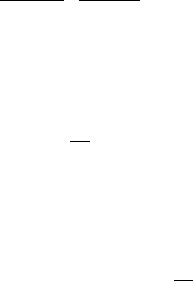
REGRESSION TO THE MEAN 189
The general bivariate Gaussian distribution is defined by the requirement that the mean
should be m = (m
1
,m
2
) and its variance matrix should be =
σ
2
1
σ
12
σ
12
σ
2
2
. This distribution
is denoted by N(m, ) and is defined by the requirement that
X − m
1
σ
1
,
Y − m
2
σ
2
∈ N
2
(0, 1,ρ),
where ρ = σ
12
/σ
1
σ
2
. For this distribution the discussion above shows that the distribution of
Y conditional on X = x is
N
m
2
+ ρ
σ
2
σ
1
(x − m
1
),σ
2
2
(1 − ρ
2
)
.
This implies that for a bivariate Gaussian distribution, the conditional mean of Y, given that
X = x, is the linear predictor
E(Y |X = x) = m
2
+ ρ
σ
2
σ
1
(x − m
1
). (7.5)
This last equation has some interesting consequences, which will be the subject of the
next section.
7.5 Regression to the mean
We will now use the fact that, for the bivariate Gaussian distribution, the best predictor is the
linear predictor, to illustrate an interesting and important point about the world and human
affairs. It is concerned with the situation where we make two consecutive observations of
something, and want to explain the effect we see by a causal relation. There is a specific
pattern to what happens in the long run, which leads to certain biases in causal explanations.
One example is found in sports, where being on the cover of a Sports Illustrated journal, or
being awarded the ‘Ballon d’Or’ in soccer, seems to imply poorer performance in the future.
Other examples include the following:
•
in education, where special treatment of poor performers all but guarantees their im-
provement;
•
in road safety policies, where actions taken at an accident-prone intersection almost
invariably have positive effects;
•
the observation that highly intelligent/successful parents often have less intelli-
gent/successful children.
The common denominator for all these examples is a law of nature called regression to
the mean, which was originally discovered by Francis Galton (see Box 7.3). He studied the
relationship between the height of a child and that of its parents. At his disposal he had human
data on the heights of 930 children and their 205 parents, which he sex-adjusted to ‘male’
heights by multiplying all women’s heights by 1.08. A quick summary of his result is that: