
Kallen A. Understanding Biostatistics
Подождите немного. Документ загружается.


190 CORRELATION AND REGRESSION IN BIVARIATE DISTRIBUTIONS
Box 7.3 On Francis Galton, correlation and regression
The concepts of regression and correlation, as well as the bivariate Gaussian distribution,
were all introduced in the second part of the nineteenth century by an English polymath,
Sir Francis Galton.
Galton was nephew to Charles Darwin and was intrigued by The Origin of Species
and its identification of the survival of the fittest as the evolutionary force. Inspired
by this idea, Galton studied how talent ran in a number of families, including his own
and that of the Bernoulli (see Section 11.5). Based on this study Galton became in the
1860s a fervent advocate of positive eugenics, a term he coined in 1883, defining it as
‘the study of all agencies under human control which can improve or impair the racial
quality of future generations’. (‘Positive’ refers to the fact that his suggested method
was to encourage marriage for the superior, instead of sterilizing the inferior as in the
US and some other countries.)
However, there was a disturbing pattern in the data, which was further clarified in
a series of investigations into different sizes of seeds of the same species of sweet pea.
It had to do with two successive generations. When he finally had sorted it out and
published, he chose a different outcome variable, height in successive human genera-
tions, in order to drive home the message to a wider audience. This publication, which
also introduced the bivariate Gaussian distribution, had as its key message the notion
of regression to the mean: for standardized variables we have E(Y |X = x) = ρx,sowe
should on average expect some regression toward mediocrity. (Galton did not standard-
ize by mean and standard deviation, instead he used the median and half the interquartile
range.) This concept, regression, describes how the outcome of one variable predicts
the value of another.
What he did not note at the time was that the reverse is also true, that
E(X|Y = y) = ρy. The implication of this is that ρ is a more symmetric number related
to the two variables. It was not until later, when Galton worked in anthropology on
relations like that between a particular bone and the overall length of the body, that he
realized this symmetry and invented correlation, both the concept and the word, which
appeared in 1888 in a paper titled ‘Correlations and Their Measurement Chiefly from
Anthropometric Data’. Correlation is a spelling of the word ‘co-relation’ which was in
common use at the time.
•
when mid-parents (Galton’s term for the average parent height for each child) are taller
than mediocrity (Galton’s word for the median, which is the mean for the Gaussian
distribution), their children tend to be shorter than they are; and
•
when mid-parents are shorter than mediocrity, their children tend to be taller than
they are.
This summary is probably as good as any description of this phenomenon, in conjunction
with the tale in Box 7.4.
Galton’s observation is deduced from equation (7.5). To simplify the discussion, assume
that the marginal distribution of each generation is the same (same mean and variance). Then
E(Y |X = x) −m = ρ(x − m),

REGRESSION TO THE MEAN 191
Box 7.4 A tale about regression to the mean
Daniel Kahnemann is a psychologist who in 2002 received the Nobel prize in Economics
(actually, the Bank of Sweden Prize in honor of Alfred Nobel) for his work in behavioral
economics. In his speech of thanks he spoke about the following experience.
‘I had the most satisfying Eureka experience of my career while attempting to
teach flight instructors that praise is more effective than punishment for promoting
skill-learning. When I had finished my enthusiastic speech, one of the most seasoned
instructors in the audience raised his hand and made his own short speech, which began
by conceding that positive reinforcement might be good for the birds, but went on to
deny that it was optimal for flight cadets. He said,
“On many occasions I have praised flight cadets for clean execution of some
aerobatic maneuver, and in general when they try it again, they do worse. On
the other hand, I have often screamed at cadets for bad execution, and in general
they do better the next time. So please don’t tell us that reinforcement works and
punishment does not, because the opposite is the case.”
This was a joyous moment, in which I understood an important truth about the world:
because we tend to reward others when they do well and punish them when they do
badly, and because there is regression to the mean, it is part of the human condition that
we are statistically punished for rewarding others and rewarded for punishing them. I
immediately arranged a demonstration in which each participant tossed two coins at
a target behind his back, without any feedback. We measured the distances from the
target and could see that those who had done best the first time had mostly deteriorated
on their second try, and vice versa. But I knew that this demonstration would not undo
the effects of lifelong exposure to a perverse contingency.’
and, since −1 <ρ<1, this means that the expected difference from the mean for the son
(i.e., E(Y |X = x) −m) is smaller (closer to zero) than that for the mid-parent (i.e., x − m).
This is what Galton’s summary amounts to. The immediate consequence is that if we select
only parents with an above average mid-parent height, and look at their children, we will find
that these are on average shorter than their parents. Still tall, but shorter. It works the other
way around also, in that if we look at tall children, their parents are expected to be, on average,
shorter than them, though still tall:
E(X|Y = y) −m = ρ(y − m).
Actually the son/father example is a better illustration of the special case than the mid-
parent/son example of Galton. This is because in Galton’s case the variances for X and Y are
not equal, and we therefore need to use the more general equation (7.5). Instead the mid-parent
height is an average of two heights, so we are probably closer to having σ
1
= σ
2
/
√
2 than
to having σ
1
= σ
2
. This means that the regression curve in this case is E(Y |X = x) −m =
√
2ρ(x − m), and it is only when ρ<1/
√
2 = 0.71 that we have regression to the mean (the
estimate for ρ in Galton’s data was 0.497).
Regression to the mean explains why we should avoid drawing conclusions about an
intervention from a change that has been observed over time. To expand on this, note that we

192 CORRELATION AND REGRESSION IN BIVARIATE DISTRIBUTIONS
can rewrite equation (7.5) as
E(Y |X = x) −x = m
2
− m
1
−
1 − ρ
σ
2
σ
1
(x − m
1
).
If we let this represent a situation with a pre-test and a post-test for which we assume a
common variance, and with an intervention in-between, the relation becomes
E(Y |X = x) −x = − (1 − ρ)(x − m),
where m is the pre-test mean and the true mean intervention effect. This expression gives
the apparent intervention effect, which is made up of two terms, the true intervention effect
and a term which defines the regression to the mean effect. In a study this becomes a
statement about the bias in the expected value of the mean increase due to a difference to the
mean at baseline:
E(
¯
Y −
¯
X|
¯
X = ¯x) = − (1 − ρ)(¯x − m). (7.6)
We see that if we for some reason have ¯x<m, we will overestimate the effect, whereas the
reverse is true if ¯x>m. This observation becomes important when we compare two groups
and build our analysis on the change from baseline. In studies numerical differences at baseline
will lead to numerical differences at the end. We therefore need to build an analytic model
which adjusts for this, which is what is done in the analysis of covariance methodology (which
is actually an analysis of means) to be discussed in Section 8.8.
So far the discussion has been based on the assumption that the underlying distribution
is a bivariate Gaussian distribution. A natural question is to ask to what extent these obser-
vations hold true for other distributions. To investigate one particular extension, we build on
the decomposition
X = Z + ξ, Y = Z + η,
which is one way we can derive the bivariate Gaussian distribution from independent Gaus-
sian components, following the discussion on page 184. This assumption means that each
individual has a true value of the response variable, given by Z, but that value is measured
with (independent) errors on two occasions. Now drop the condition that Z has a Gaussian
distribution, but keep this assumption on ξ and η. Let g(x) denote the probability density for
the common marginal distribution of
X and Y. We can then compute the following expression
for the conditional mean (the derivation of which is outlined in Appendix 7.A.1):
E(Y |X = x) = x + σ
2
(ln g(x))
. (7.7)
This equation is also applicable in the related situation where we have a stochastic variable
(X = Z) distributed in a population, which we measure with an error (Y = Z + η), and we
wish to understand what we can say about the true value based on the observation. This is
related to an (in)famous observation in statistics, the Stein effect (see Box 7.5).

REGRESSION TO THE MEAN 193
Box 7.5 The Stein effect
Assume that there is a characteristic Z in a population which has a N(m, η
2
) distribu-
tion. When we measure Z, we do it with an error ξ which we assume has a N(0,σ
2
)
distribution, so that what we measure, X = Z + ξ, has a N(m, η
2
+ σ
2
) distribution.
Given that we have observed the measurement x in an individual, what can we say about
the true value for this individual? The regression to the mean equation shows that
E(Z|X = x) = m +
1 −
σ
2
η
2
+ σ
2
(x − m),
which means that there is a shrinkage toward the mean, which is greater the larger σ
2
is relative to η
2
.
This observation is related to a famous result by Charles Stein from 1955. We do
not know m, but instead have a single observation x
i
(measured with error) on each
of n individuals. The intuitive answer to the question how we should estimate the true
value Z
i
for subject i, is that we should take Z
i
= x
i
. What Stein was able to prove, in
a more general context, was that we should really use an estimate
ˆ
Z
i
= ¯x + c(x
i
− ¯x)
for a constant c<1.
Comparing this with the observation in the first paragraph, we see that we have re-
placed m with ¯x and that we should have something like c = 1 −σ
2
/s
2
for the constant,
where s
2
is the sample variance of the observations. This is not quite true, but if we
redefine s
2
by dividing by n − 3, instead of n − 1, it becomes so. This is done to ensure
unbiasedness, and was discussed in Box 6.4.
For the special case with the bivariate normal distribution, the σ
2
in equation (7.7)
is the within-subject σ
2
w
and g(x) = σ
−1
ϕ((x − m)/σ), where the new σ
2
is the total
variance, σ
2
= σ
2
b
+ σ
2
w
. In this case it follows that (ln g(x))
=−(x − m)/σ
2
,so
equation (7.7) becomes
E(Y |X = x) = x −
σ
2
w
σ
2
b
+ σ
2
w
(x − m) = x − (1 − ρ)(x − m).
We then rederive our regression to the mean equation.
What equation (7.7) tells us is that the correction term is increasing as long as g(x)is
increasing, and decreasing when g(x) is decreasing, which means regression toward the mode
of the density g(x), that is, the value x that defines the maximum of the function g(x) (a point
given by the solution to the equation g
(x) = 0). The mean, median and mode just happen to
be the same for the Gaussian distribution. However, this is only one particular model extension
of the bivariate Gaussian distribution.
Making statements about one outcome variable conditional on the observed values of
other variables is what we do when we consider the so-called linear models, which will be
the subject of Chapter 9. From a clinical trial perspective it is also important to understand
what it means to do something conditional on a condition of the type a<X<b. If we, as
before, consider X to be the baseline measurement of a clinical variable, a clinical protocol
in general defines a particular subpopulation of patients to study, which we hope will make

194 CORRELATION AND REGRESSION IN BIVARIATE DISTRIBUTIONS
Box 7.6 Conditioning in the bivariate Gaussian distribution
For a general (continuous) bivariate distribution, the conditional density of Y given a
condition such s a<X<b(a =−∞and b =∞are allowed), is given by
f
Y| a<X<b
(y) =
b
a
f
X,Y
(x, y)dx
P(a<X<b)
.
It follows that the expected value E(Y|a<X<b)isgivenby
∞
−∞
y
b
a
f
X,Y
(x, y)dxdy =
b
a
E(Y |X = x)dF
X
(x),
divided by F
X
(b) −F
X
(a). Note that
E(X|a<X<b) =
b
a
xdF
X
(x)/(F
X
(b) −F
X
(a)) = μ(a, b).
In the situation, discussed in the main text, where we observe a stochastic variable Z
twice with independent errors, equation (7.7) (what we denoted g(x) there is f
X
(x) here)
shows that
E(Y − X|a<X<b) =
σ
2
b
a
(ln f
X
(x))
f
X
(x)dx
F
X
(b) −F
X
(a)
= σ
2
η(a, b), (7.8)
where η(a, b) = (f
X
(b) −f
X
(a))/(F
X
(b) −F
X
(a)), and also that
V (Y | a<X<b) = σ
2
(2 +σ
2
(λ(a, b) − η(a, b)
2
)),λ(a, b) =
f
X
(b) −f
X
(a)
F
X
(b) −F
X
(a)
.
it easier to demonstrate an effect. Such inclusion criteria will imply some kind of restriction
on the baseline measurements. For example, in asthma trials we may want to include only
patients who take a certain amount of rescue medication per day, and as outcome measurement
we may have a lung function measurement. We expect a symptomatic patient to have a
more compromised lung function than a non-symptomatic one, so the study population will
essentially be selected on a criterion of the form X ≤ a, though we have not specified a in the
protocol. How does regression to the mean manifest itself in such situations?
We consider again the bivariate Gaussian distribution for the case where the pre-treatment
and the post-treatment measurement have correlation ρ and the same variance σ
2
. We assume
that the population mean values are m and m + , respectively, for the two variables so that
the true treatment effect is . Our interest is in the estimation of this , which refers to the
whole population. Now assume that the net effect of the inclusion criteria is that we only
include subjects that fulfill the criterion a<X<bfor some a and b, possibly infinitely small
or large, respectively. From the discussion in Box 7.6 we have that
E(Y − X | a<X<b) = + (1 − ρ)σ
ϕ(
b−m
σ
) − ϕ(
a−m
σ
)
(
b−m
σ
) − (
a−m
σ
)
.

STATISTICAL ANALYSIS OF BIVARIATE GAUSSIAN DATA 195
The second term on the right shows the bias introduced in the estimate for the treatment effect
by having the inclusion criteria (assuming, of course, that our ultimate objective is to find the
in the whole population). There is no bias if ρ = 1 (which is obvious), and when a and b
are taken symmetrically around the mean m (because of the symmetry of ϕ(x)). Note that the
bias we get in the mean difference
¯
Y −
¯
X is not affected by sample size; it is determined by
the cut-off points alone.
Example 7.4 Assume that we work with an assay which, like all assays, measures with an
error. When measurements are (suspiciously) high, it may be tempting to reanalyze the same
sample and use the new measurement instead. What is the consequence of this? When the
true value in the sample is Z our first measurement will be X = Z + ξ and the second will
be Y = Z + η, where ξ and η are independent measurement errors. Y is only observed when
X>a. The expected value for our measurement will be
E(X) + E(Y − X|X>a)(1 − F(a)) = E(X) − σ
2
g(a),
from which we see that we have a negative bias of size σ
2
g(a).
7.6 Statistical analysis of bivariate Gaussian data
We now wish to find the two-variable analogue of the (univariate) t-test, which is about
obtaining (simultaneous) knowledge about (the components of) the mean vector in a bivariate
Gaussian distribution. The key observation is that for a variable Z with a bivariate Gaussian
distribution with mean m = (m
1
,m
2
) and covariance matrix =
σ
2
1
σ
12
σ
12
σ
2
2
, we have that
(Z − m)
t
−1
(Z − m) ∈ χ
2
(2).
Precisely as in the univariate case we usually do not know the variance matrix , and need
to estimate it with the sample variance matrix S. The theory that works in one dimension,
and was outlined in Appendix 6.A.1, can be generalized at the expense of some slightly more
complicated mathematics (see Appendix 7.A.2). The key information is that, for a sample
of size n,
n(n − 2)
2(n − 1)
(¯z − m)
t
S
−1
(¯z − m) ∈ F (2,n− 2).
This is a generalization of the univariate t-test and is called Hotelling’s T
2
-test. It is used to
obtain confidence statements about the mean vector m by use of the confidence function
C(m) = F
2,n−2
n(n − 2)
2(n − 1)
(¯z − m)
t
S
−1
(¯z − m)
, (7.9)
where F
a,b
(x) denotes the CDF of the F (a, b) distribution. This is a function of two variables,
which means that what was a confidence interval for the univariate test now becomes a
confidence region in the plane. The next example illustrates this.
196 CORRELATION AND REGRESSION IN BIVARIATE DISTRIBUTIONS
0
1
2
3
4
Mean of variable 2
−1 3210
0.8
0.9
0.95
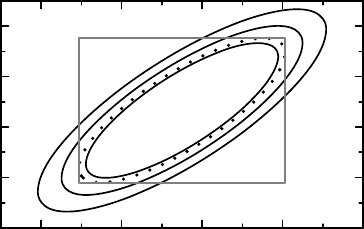
Figure 7.4 The solid contours define simultaneous confidence regions for a Hotelling’s T
2
-
test. Also shown are the univariate confidence intervals and the univariate confidence region
as a dotted contour. See text for details.
Example 7.5 The Cushny and Peebles data mentioned in Example 6.5 consisted of 10 pairs of
data points, data which we assume come from a bivariate Gaussian distribution. Previously we
analyzed the mean difference of the two variables; now we wish to describe our confidence in
the pairs of means. The mean vector is estimated as (0.75, 2.33), and the estimated covariance
matrix is
3.20 2.85
2.85 4.01
. Together these are all we need to calculate the confidence function
in equation (7.9), which is described graphically by a contour plot in Figure 7.4. This graph
shows three contours of equal value for the function C(m), namely those corresponding to
the 0.8, 0.9 and 0.95 confidence levels, respectively. The region enclosed by the last of these
levels corresponds to a confidence region of (simultaneous) confidence level 95% for the pair
of means. The corresponding univariate 95% confidence intervals for the individual means are
indicated by the sides of the rectangle in the graph. This, however, does not enclose a region
with (simultaneous) confidence level 95% for the mean vector, but by using the Bonferroni
correction we can show that the confidence level is at least 90%.
Based on Figure 7.4 we can derive simultaneous confidence limits for different combina-
tions of the two means. This means that we can compute as many functions as we wish without
losing credibility (in other words, no multiplicity correction is needed). Before we proceed,
however, look again at the confidence function defined by equation (7.9). It is computed by a
two-step procedure. First we compute the value of the quadratic form in the argument, from
which we derive the confidence by applying a particular CDF to it. The choice F
2,n−2
(x)
as this CDF gives us simultaneous confidence statements. If we want univariate statements,
that is, the limits of a single confidence interval, we can use the F (1,n− 1) distribution
instead (which is the square of the t(n − 1) distribution). In other words, we use the
confidence function
C(m) = F
1,n−1
((¯u − m)
t
S
−1
(¯u − m)). (7.10)
(Strictly speaking this may only hold true if the statement is based on a linear combination
of the components of m, as is the case below, because a linear combination of Gaussian
variables is a univariate Gaussian variable; see Appendix 7.A.3.) The 95% region obtained
STATISTICAL ANALYSIS OF BIVARIATE GAUSSIAN DATA 197
0
1
2
3
4
5
Mean of variable 2
−2 −1 43210
Mean of variable 1
0.8
0.95
0.995
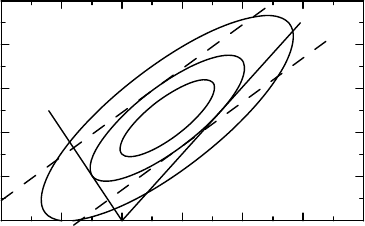
Figure 7.5 How to obtain univariate confidence intervals for a mean difference and a mean
ratio from the bivariate confidence function, defined by the t distribution.
using this function is shown in Figure 7.4 as the dotted contour. It is the largest such contour
that fits into the rectangle defined by univariate confidence intervals; the curve is tangent
to this rectangle at four points. The rectangle is therefore obtained by projecting the dotted
contour on to the respective axis.
Example 7.6 Continuing with the previous example, we now wish to derive univariate confi-
dence intervals for two particular functions of the two means, using the (univariate) confidence
function in equation (7.10). Three contours for this confidence function, corresponding to the
confidence levels 0.8, 0.95 and 0.995, respectively, are shown in Figure 7.5. The reason why
we choose these particular levels will soon become apparent.
We wish to identify the confidence intervals both for the mean difference m
2
− m
1
and
for the mean ratio m
1
/m
2
from this graph. To obtain the 95% confidence interval for the mean
difference we consider the different lines m
2
− m
1
= θ, and identify those θ for which this
line is tangential to the 95% contour of C(m). These are indicated in the graph as the two
parallel dashed lines, corresponding to the two θ-values 0.70 and 2.46, respectively. These
two numbers are therefore the 95% confidence limits for the mean difference, which agrees
with what we found in Example 6.5. Similarly, we obtain the confidence limits for the ratio
m
1
/m
2
by considering where the line m
1
= θm
2
is tangent to the 95% contour of C(m). These
two lines are illustrated in Figure 7.5 as solid straight lines, and the slopes of these provide
us with the limits −0.48 and 0.66, respectively, for the 95% confidence interval.
There is also the contour for the level 0.995 shown in Figure 7.5. This is there to illustrate
a particular problem: the line corresponding to the lower confidence limit for the ratio with
this confidence level is horizontal, which means an infinitely small lower confidence limit. If
we require more confidence than 0.995 we will therefore not get a finite interval. This will be
further explored below.
The intervals for the ratio of two means that we obtained above are called Fieller intervals
and are analytically described in Box 7.7. We see that two conditions need to be fulfilled in
order for this to provide finite intervals, and if we ask for enough confidence, these conditions
will be violated for any data. In the next example we explore this further.

198 CORRELATION AND REGRESSION IN BIVARIATE DISTRIBUTIONS
Box 7.7 Fieller intervals for the ratio of means
Assume that we have a bivariate stochastic variable (X, Y ) with a Gaussian distribution
with mean (m
1
,m
2
) and covariancematrix = (σ
ij
), and consider the ratio θ = m
2
/m
1
.
We then have that
Y − θX ∈ N(0,σ
2
(θ)), where σ
2
(θ) = σ
22
− 2θσ
12
+ θ
2
σ
11
.
If is known, this means that the function
C(θ) =
y − θx
σ(θ)
is a confidence function for the ratio of the means. When we do not know we may
estimate it with something that has a Wishart distribution, such as the sample variance, in
which case the estimate of σ
2
(θ) follows a χ
2
distribution, and we replace the Gaussian
CDF with the appropriate t distribution CDF.
There are conditions when such Fieller intervals (of confidence level 1 − 2α)do
not produce finite intervals for the point estimate m
2
/m
1
, conditions that occur for all
data if we ask for sufficiently high confidence level (small α). The interval is defined as
those θ for which we have that (y − θx)
2
≤ t
2
α
σ
2
(θ), which can be rewritten as
(t
2
α
σ
22
− y
2
) − 2θ(t
2
α
σ
12
− xy) +θ
2
(t
2
α
σ
11
− x
2
) ≥ 0.
The coefficient on θ
2
has to be negative in order for this to define an interval, and the
condition for this is that |x|/
√
σ
11
>t
α
, which means that for the denominator m
1
there
is enough evidence that it is different from zero at the required confidence level. The
other condition is that the discriminant is positive, which can be written
t
2
α
(z
t
−1
z − t
2
α
) det >0,z=
x
y
.
The first of these criteria is violated first, and when it is, the interval will contain infinity
since it allows for division by zero. When both criteria are violated, the inequality holds
true for all θ, because this case allows for the indeterminate number 0/0.
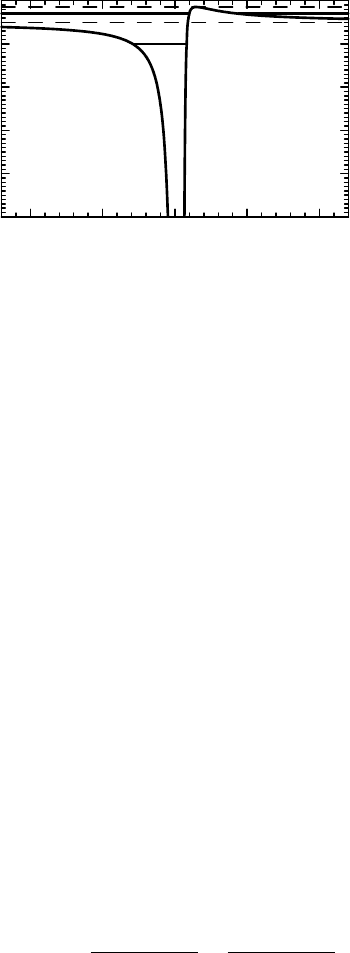
Example 7.7 The top part of the two-sided confidence function for the mean ratio for the
Cushny and Peebles data is shown in Figure 7.6. The graph shows that the confidence intervals
are somewhat ‘fishy’ at very high confidence levels. In fact, in order to have a finite interval
we must have a confidence level less than 0.995. This level is shown as the lower dashed line
in the graph. It is the asymptote of the confidence function in both infinities. For a confidence
level above this, but less than 0.9986, the confidence region excludes a finite interval (and
includes infinity), whereas for even higher confidence levels all possible values constitute the
confidence region; the data are insufficient to provide any information about the parameter
with such high confidence.
SIMULTANEOUS ANALYSIS OF TWO BINOMIAL PROPORTIONS 199
−10 − 10505
Mean ratio m
1
/ m
2
0.95
0.96
0.97
0.98
0.99
1
Confidence in the ratio
Figure 7.6 The upper part of the two-sided confidence function for the ratio of means for
the Cushny–Peebles data.
If instead we had drawn the one-sided confidence function we would not have obtained
an increasing function from zero to one. Such a function cannot therefore work as a CDF,
which means that this is an example where we cannot interpret the confidence function as a
distribution function, and which gave Fisher a headache with his fiducial concept.
7.7 Simultaneous analysis of two binomial proportions
The final section of this chapter is rather mathematical in nature. It is about the general problem
of how we do inference on the parameters of interest in the presence of nuisance parameters.
The discussion to come, in the context of binomial parameters, is mainly explained in terms
of graphics, and it may be worthwhile for the less mathematically interested not to ignore it.
The ideas are the same as in the previous section.
In Chapter 5 we discussed how to compare binomial proportions from two different
groups. The assumption was that we have an observation x
1
from a Bin(n
1
,p
1
) distribution,
and an observation x
2
from a Bin(n
2
,p
2
) distribution which is independent of the first. We
are interested in confidence statements about various combinations of p
1
and p
2
.Inthe
discussion in Section 5.3 we noted that the approach taken there failed to take proper account
of all uncertainty in the data. Building on the ideas presented in the previous section, we will
now remedy this and obtain a simultaneous confidence region for the pair (p
1
,p
2
). Since it is a
simultaneous analysis, we can derive from this as many confidence intervals for combinations
of p
1
and p
2
as we wish, without losing control of the overall significance level. The starting
point for our investigation will be an observation we made in Section 5.4.1, namely that
C(p
1
,p
2
) = χ
2
n
1
(p
∗
1
− p
1
)
2
p
1
(1 − p
1
)
+
n
2
(p
∗
2
− p
2
)
2
p
2
(1 − p
2
)
(7.11)
(where p
∗
i
is the estimate of p
i
) is an approximate confidence function for p = (p
1
,p
2
).
For illustration we again use the first Hodgkin’s lymphoma data set, for which we
have p
∗
1
= 67/101 and p
∗
2
= 43/107. A few contours for the confidence function C(p
1
,p
2
)
are shown in Figure 7.7, the outermost of which is a 95% confidence region for the
pair (p
1
,p
2
). The other contours represent other confidence levels. We will use the 95%