
Kazuaki Taira. Boundary Value Problems and Markov Processes
Подождите немного. Документ загружается.

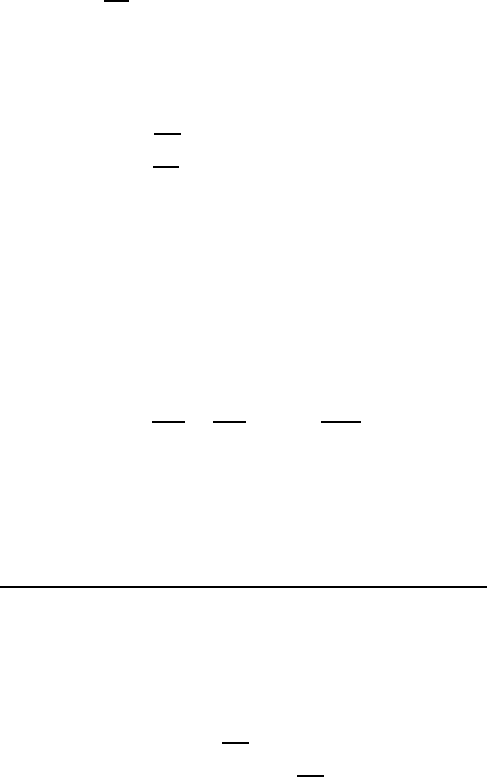
98 6 A Priori Estimates
We let
,
T (θ): C
∞
(∂D × S) −→ C
∞
(∂D × S)
,ϕ −→ L
,
P (θ) ,ϕ.
Then the operator
,
T (θ) can be decomposed as follows:
,
T (θ)=μ(x
)
,
Π(θ)+γ(x
), (6.5)
where
,
Π(θ) ,ϕ =
∂
∂n
,
P (θ) ,ϕ
∂D×S
, ,ϕ ∈ C
∞
(∂D × S).
It is known that the operator
,
Π(θ) is a classical pseudo-differential operator
of first order on the boundary ∂D × S and that its complete symbol is given
by the following formula (cf. [Ta2, Section 10.2]):
,p
1
(x
,ξ
,y,η; θ)+
√
−1 ,q
1
(x
,ξ
,y,η; θ)
+
,p
0
(x
,ξ
,y,η; θ)+
√
−1 ,q
0
(x
,ξ
,y,η; θ)
+ terms of order ≤−1,
where
,p
1
(x
,ξ
,y,η; θ) < 0
on the bundle T
∗
(∂D × S) \{0} of non-zero cotangent vectors,
for −π<θ<π. (6.6)
For example, if A is the usual Laplacian
Δ=
∂
2
∂x
2
1
+
∂
2
∂x
2
2
+ ...+
∂
2
∂x
2
N
,
then we have the formula
,p
1
(x
,ξ
,y,η; θ)
= −
⎡
⎢
⎣
*
|ξ
|
2
+cosθ · η
2
2
+sin
2
θ ·η
4
+
1/2
+
|ξ
|
2
+cosθ · η
2
2
⎤
⎥
⎦
1/2
.
Therefore, we obtain that the operator
,
T (θ)=μ(x
)
,
Π(θ)+γ(x
)isa
classical pseudo-differential operator of first order on the boundary ∂D × S
and that its complete symbol is given by the following formula:
μ(x
)
,p
1
(x
,ξ
,y,η; θ)+
√
−1 ,q
1
(x
,ξ
,y,η; θ)
+
[γ(x
)+μ(x
),p
0
(x
,ξ
,y,η; θ)] +
√
−1 μ(x
),q
0
(x
,ξ
,y,η; θ)
+ terms of order ≤−1. (6.7)

6 A Priori Estimates 99
Then, by virtue of assertions (6.7) and (6.6) we can verify that the operator
,
T (θ) satisfies conditions (3.7a) and (3.7b) of Theorem 3.16 with μ := 0, ρ := 1
and δ := 1/2, just as in the proof of Lemma 5.2. Hence we obtain the following
result, analogous to Lemma 5.1:
Lemma 6.5. Assume that conditions (A) and (B) are satisfied. Then we have,
for all s ∈ R,
,ϕ ∈D
(∂D × S),
,
T (θ) ,ϕ ∈ B
s,p
(∂D × S)=⇒ ,ϕ ∈ B
s,p
(∂D × S).
Furthermore, for any t<s, there exists a positive constant
,
C
s,t
such that
|,ϕ|
s,p
≤
,
C
s,t
|
,
T (θ) ,ϕ|
s,p
+ |,ϕ|
t,p
. (6.8)
The desired estimate (6.4) follows from estimate (6.8) with s := 2 − 1/p
and t := −1/p, just as in the proof of Theorem 4.10.
The proof of Proposition 6.4 is complete.
Step II:Nowletu(x) be an arbitrary function in the domain D(A
p
):
u ∈ W
2,p
(D)andLu =0on∂D.
We choose a function ζ(y)inC
∞
(S) such that
⎧
⎨
⎩
0 ≤ ζ(y) ≤ 1onS,
supp ζ ⊂
3
π
3
,
5π
3
4
,
ζ(y)=1 for
π
2
≤ y ≤
3π
2
,
and let
,v
η
(x, y)=u(x) ⊗ ζ(y)e
iηy
,x∈ D, y ∈ S, η ≥ 0.
Then we have the assertions
,v
η
∈ W
2,p
(D ×S),
,
Λ(θ),v
η
=
A + e
iθ
∂
2
∂y
2
,v
η
=(A − η
2
e
iθ
)u ⊗ ζ(y)e
iηy
+2(iη)e
iθ
u ⊗ ζ
(y)e
iηy
+ e
iθ
u ⊗ ζ
(y)e
iηy
,
and also
L,v
η
(x
,y)=Lu(x
) ⊗ ζ(y)e
iηy
=0 on∂D × S.
Thus, by applying inequality (6.4) to the functions
,v
η
(x, y)=u(x) ⊗ ζ(y)e
iηy
,x∈ D, y ∈ S, η ≥ 0,
we obtain that
u ⊗ ζe
iηy
2,p
≤
,
C(θ)
,
Λ(θ)(u ⊗ζe
iηy
)
p
+
u ⊗ ζe
iηy
p
. (6.9)
100 6 A Priori Estimates
We can estimate each term of inequality (6.9) as follows:
u ⊗ ζe
iηy
p
=
D×S
|u(x)|
p
|ζ(y)|
p
dxdy
1/p
= ζ
p
·u
p
. (6.10)
,
Λ(θ)(u ⊗ζe
iηy
)
p
≤
(A −η
2
e
iθ
)u ⊗ ζe
iηy
p
+2η
u ⊗ ζ
e
iηy
p
+
u ⊗ ζ
e
iηy
p
≤ζ
p
·
(A −η
2
e
iθ
)u
p
+(2ηζ
p
+ ζ
p
) u
p
. (6.11)
u ⊗ ζe
iηy
p
2,p
=
|α|≤2
D×S
D
α
x,y
(u(x) ⊗ ζ(y)e
iηy
)
p
dxdy
≥
|α|≤2
D
3π/2
π/2
D
α
x,y
(u(x) ⊗ e
iηy
)
p
dxdy
=
k+|β|≤2
D
3π/2
π/2
η
k
D
β
u(x)
p
dxdy
≥ π
|β|=2
D
D
β
u(x)
p
dx + η
p
|β|=1
D
D
β
u(x)
p
dx
+η
2p
D
|u(x)|
p
dx
= π
|u|
p
2,p
+ η
p
|u|
p
1,p
+ η
2p
u
p
p
. (6.12)
Therefore, by carrying these three inequalities (6.10), (6.11) and (6.12) into
inequality (6.9) we obtain that, with a positive constant
,
C
(θ) independent
of η,
|u|
2,p
+ η |u|
1,p
+ η
2
u
p
≤
,
C
(θ)
(A −η
2
e
iθ
)u
p
+ η u
p
.
If η is so large that
η ≥ 2
,
C
(θ),
then we can eliminate the last term on the right-hand side to obtain that
|u|
2,p
+ η |u|
1,p
+ η
2
u
p
≤ 2
,
C
(θ)
(A −η
2
e
iθ
)u
p
.
This proves the desired inequality (6.2) if we take
λ := η
2
e
iθ
,
R(θ):=4
,
C
(θ)
2
,
C(θ):=2
,
C
(θ).
The proof of Theorem 6.3 is now complete.

7
ProofofTheorem1.2
In this chapter we prove Theorem 1.2 (Theorems 7.1 and 7.9). Once again we
make use of Agmon’s method in the proof of Theorems 7.1 and 7.9. In partic-
ular, Agmon’s method plays an important role in the proof of the surjectivity
of the operator A
p
− λI (Proposition 7.2).
7.1 Proof of Theorem 1.2, Part (i)
First, we prove part (i) of Theorem 1.2:
Theorem 7.1. Assume that conditions (A) and (B) are satisfied:
(A) μ(x
) ≥ 0 on ∂D.
(B) γ(x
) < 0 on M = {x
∈ ∂D : μ(x
)=0}.
Then, for every 0 <ε<π/2, there exists a positive constant r
p
(ε) such
that the resolvent set of A
p
contains the set
Σ
p
(ε)={λ = r
2
e
iθ
: r ≥ r
p
(ε), −π + ε ≤ θ ≤ π − ε},
and that the resolvent (A
p
− λI)
−1
satisfies the estimate
(A
p
− λI)
−1
≤
c
p
(ε)
|λ|
for all λ ∈ Σ
p
(ε), (1.4)
where c
p
(ε) is a positive constant depending on ε.
Proof. The proof of Theorem 7.1 is divided into three steps.
Step I: By estimate (6.2), it follows that if λ = r
2
e
iθ
, −π<θ<πand if
|λ| = r
2
≥ R(θ), then we have, for all u ∈D(A
p
),
|u|
2,p
+ |λ|
1/2
·|u|
1,p
+ |λ|·u
p
≤ C(θ)(A
p
− λI)u
p
.
However, we find from the proof of Theorem 6.3 that the constants R(θ)
and C(θ) depend continuously on θ ∈ (−π, π), so that they may be chosen
K. Taira, Boundary Value Problems and Markov Processes, 101
Lecture Notes in Mathematics 1499, DOI 10.1007/978-3-642-01677-6
7,
c
Springer-Verlag Berlin Heidelberg 2009

102 7 Proof of Theorem 1.2
uniformly in θ ∈ [−π + ε, π − ε], for every ε>0. This proves the existence
of the constants r
p
(ε)andc
p
(ε), that is, we have, for all λ = r
2
e
iθ
satisfying
r ≥ r
p
(ε)and−π + ε ≤ θ ≤ π − ε,
|u|
2,p
+ |λ|
1/2
·|u|
1,p
+ |λ|·u
p
≤ c
p
(ε)(A
p
− λI)u
p
. (7.1)
By estimate (7.1), it follows that the operator A
p
− λI is injective and its
range R(A
p
− λI)isclosedinL
p
(D), for all λ ∈ Σ
p
(ε).
Step II: We show that the operator A
p
−λI is surjective for all λ ∈ Σ
p
(ε),
that is,
R(A
p
− λI)=L
p
(D) for all λ ∈ Σ
p
(ε). (7.2)
To do this, it suffices to show that the operator A
p
−λI is a Fredholm operator
with
ind (A
p
− λI) = 0 for all λ ∈ Σ
p
(ε), (7.3)
since A
p
− λI is injective for all λ ∈ Σ
p
(ε).
Here we recall that a densely defined, closed linear operator T with domain
D(T )fromaBanachspaceX into itself is called a Fredholm operator if it
satisfies the following three conditions:
(i) The null space N(T )={x ∈D(T ):Tx =0} of T has finite dimension,
that is, dim N(T ) < ∞.
(ii) The range R(T )={Tx: x ∈D(T )} of T is closed in X.
(iii) The range R(T ) has finite codimension in X, that is, codim R(T )=
dim X/R(T ) < ∞.
In this case the index ind T of T is defined by the formula
ind T =dimN(T ) − codim R(T ).
Step II-1: We reduce the study of the operator A
p
− λI (λ ∈ Σ
p
(ε)) to
that of a pseudo-differential operator on the boundary, just as in the proof of
Theorem 1.1.
Let T (λ) be a classical pseudo-differential operator of first order on the
boundary ∂D defined as follows:
T (λ)=LP(λ)=μ(x
)Π(λ)+γ(x
),λ∈ Σ
p
(ε), (7.4)
where
Π(λ): C
∞
(∂D) −→ C
∞
(∂D)
ϕ −→
∂
∂n
(P (λ)ϕ)
∂D
.
Since the operator T (λ):C
∞
(∂D) → C
∞
(∂D) extends to a continuous linear
operator T (λ):B
t,p
(∂D) → B
t−1,p
(∂D) for all t ∈ R,wecanintroducea
densely defined, closed linear operator
T
p
(λ):B
2−1/p,p
(∂D) −→ B
2−1/p,p
(∂D)
as follows.

7.1 Proof of Theorem 1.2, Part (i) 103
(α) The domain D(T
p
(λ)) of T
p
(λ)isthespace
D(T
p
(λ)) =
ϕ ∈ B
2−1/p,p
(∂D):T (λ)ϕ ∈ B
2−1/p,p
(∂D)
.
(β) T
p
(λ)ϕ = T (λ)ϕ, ϕ ∈D(T
p
(λ)).
Then we can obtain the following three results (cf. [Ta2, Section 8.3]):
(I) The null space N(A
p
−λI)ofA
p
−λI has finite dimension if and only if
the null space N (T
p
(λ)) of T
p
(λ) has finite dimension, and we have the
formula
dim N(A
p
− λI)=dimN (T
p
(λ)) .
(II) The range R(A
p
− λI)ofA
p
− λI is closed if and only if the range
R(T
p
(λ)) of T
p
(λ)isclosed;andR(A
p
− λI) has finite codimension if
and only if R(T
p
(λ)) has finite codimension, and we have the formula
codim R(A
p
− λI)=codimR(T
p
(λ)) .
(III) The operator A
p
−λI is a Fredholm operator if and only if the operator
T
p
(λ) is a Fredholm operator, and we have the formula
ind (A
p
− λI)=indT
p
(λ).
Therefore, the desired assertion (7.3) is reduced to the following assertion:
ind T
p
(λ) = 0 for all λ ∈ Σ
p
(ε). (7.5)
Step II-2: To prove assertion (7.5), we shall make use of Agmon’s method
just as in Chapter 6.
Let
,
T (θ) be the classical pseudo-differential operator of first order on the
boundary ∂D × S introduced in Chapter 6 (see formula (6.5)):
,
T (θ)=L
,
P (θ)=μ(x
)
,
Π(θ)+γ(x
), −π<θ<θ,
where
,
Π(θ): C
∞
(∂D × S) −→ C
∞
(∂D × S)
˜ϕ −→
∂
∂n
,
P (θ)˜ϕ
∂D×S
.
We define a densely defined, closed linear operator
,
T
p
(θ):B
2−1/p,p
(∂D × S) −→ B
2−1/p,p
(∂D × S)
as follows.
104 7 Proof of Theorem 1.2
(˜α) The domain D
,
T
p
(θ)
of
,
T
p
(θ)isthespace
D
,
T
p
(θ)
=
˜ϕ ∈ B
2−1/p,p
(∂D × S):
,
T (θ)˜ϕ ∈ B
2−1/p,p
(∂D × S)
.
(
˜
β)
,
T
p
(θ)˜ϕ =
,
T (θ)˜ϕ,˜ϕ ∈D
,
T
p
(θ)
.
Then the most fundamental relationship between the operators
,
T
p
(θ)and
T
p
(λ) is stated as follows:
Proposition 7.2. If ind
,
T
p
(θ) is finite, then there exists a finite subset K of Z
such that the operator T
p
(λ
) is bijective for all λ
=
2
e
iθ
satisfying ∈ Z\K.
Granting Proposition 7.2 for the moment, we shall prove Theorem 7.1.
Step III: End of Proof of Theorem 7.1
Step III-1: We show that if conditions (A) and (B) are satisfied, then we
have the assertion
ind
,
T
p
(θ)=dimN(
,
T
p
(θ)) − codim R(
,
T
p
(θ)) < ∞. (7.6)
To this end, we need a useful criterion for Fredholm operators (cf. [Ta2,
Theorem 3.7.6]):
Lemma 7.3 (Peetre). Let X, Y , Z be Banach spaces such that X ⊂ Z is
a compact injection, and let T be a closed linear operator with D(T ) from X
into Y with domain D(T ). Then the following two conditions are equivalent:
(i) The null space N(T ) of T has finite dimension and the range R(T ) of T
is closed in Y .
(ii) There is a positive constant C such that
x
X
≤ C (Tx
Y
+ x
Z
) for all x ∈D(T ). (7.7)
Proof. (i) =⇒ (ii): Since the null space N(T ) has finite dimension, we can
find a closed topological complement X
0
in X:
X = N(T ) ⊕ X
0
. (7.8)
This gives that
D(T )=N(T ) ⊕ (D(T ) ∩ X
0
) .
Namely, every element x of D(T )canbewrittenintheform
x = x
0
+ x
1
,x
0
∈D(T ) ∩ X
0
,x
1
∈N(T ).
Moreover, since the range R(T )isclosedinY , it follows from an application
of the closed graph theorem [Yo, Chapter II, Section 6, Theorem 1] that there
exists a positive constant C such that
x
0
X
≤ CTx
0
Y
= Tx
Y
. (7.9)

7.1 Proof of Theorem 1.2, Part (i) 105
Here and in the following the letter C denotes a generic positive constant
independent of x.
On the other hand, it should be noticed that all norms on a finite dimen-
sional linear space are equivalent. This gives that
x
1
X
≤ Cx
1
Z
. (7.10)
Moreover, since the injection X → Z is compact and hence is continuous, we
obtain that
x
1
Z
≤x
Z
+ x
0
Z
≤x
Z
+ Cx
0
X
. (7.11)
Thus we have, by inequalities (7.10) and (7.11),
x
1
X
≤ C (x
Z
+ x
0
X
). (7.12)
Therefore, by combining inequalities (7.9) and (7.12) we obtain the desired
inequality
x
X
≤x
0
X
+ x
1
X
≤ C (Tx
Y
+ x
Z
) for all x ∈D(T ), (7.7)
since Tx
0
= Tx.
(ii) =⇒ (i): By inequality (7.7), it follows that
x
X
≤ Cx
Z
for all x ∈N(T ). (7.13)
However, the null space N(T )isclosedinX, and so it is a Banach space.
Since the injection X → Z is compact, we obtain from inequality (7.13) that
the closed unit ball {x ∈N(T ):x
X
≤ 1} of the Banach space N(T )is
compact. Hence it follows from an application of [Yo, Chapter III, Section 2,
Corollary 2] that
dim N(T ) < ∞.
Let X
0
be a closed topological complement of N(T ) as in decomposition (7.8).
To prove the closedness of R(T ), it suffices to show that
x
X
≤ CTx
Y
for all x ∈D(T ) ∩ X
0
.
Assume, to the contrary, that:
For every n ∈ N, there is an element x
n
of D(T ) ∩ X
0
such that
x
n
X
>nTx
n
Y
.
If we let
x
n
=
x
n
x
n
X
,
then we have the assertions
x
n
∈D(T ) ∩ X
0
, x
n
X
=1, (7.14a)
Tx
n
Y
<
1
n
. (7.14b)

106 7 Proof of Theorem 1.2
Since the injection X → Z is compact, by passing to a subsequence we may
assume that the sequence {x
n
} is a Cauchy sequence in Z. Then, by combining
inequalities (7.14b) and (7.7) we find that the sequence {x
n
} is a Cauchy
sequence in X, and hence it converges to some element x
of X
0
⊂ X.Thus,
by assertions (7.14a) and (7.14b) it follows that
x
X
= lim
n
x
n
X
=1,
and further that
x
∈D(T ),Tx
=0,
since the operator T is closed.
Summing up, we have proved that
x
∈N(T ),
x
X
=1.
However, this is a contradiction. Indeed, we then have the assertion
x
∈N(T ) ∩ X
0
= {0}.
The proof of Lemma 7.3 is complete.
By using estimate (6.8) with s := 2 − 1/p, we obtain that
|˜ϕ|
2−1/p,p
≤
,
C
t
|
,
T (θ)˜ϕ|
2−1/p,p
+ |˜ϕ|
t,p
, ˜ϕ ∈D(
,
T
p
(θ)), (7.15)
where t<2 − 1/p. However, it follows from an application of the Rellich–
Kondrachov theorem that the injection B
2−1/p,p
(∂D ×S) → B
t,p
(∂D ×S)is
compact for t<2 −1/p. Thus, by applying Peetre’s lemma (Lemma 7.3) with
X = Y := B
2−1/p,p
(∂D × S),
Z := B
t,p
(∂D × S),
T :=
,
T
p
(θ),
we obtain that the range R
,
T
p
(θ)
is closed in B
2−1/p,p
(∂D × S)andthat
dim N
,
T
p
(θ)
< ∞. (7.16)
On the other hand, by formula (6.7) we find that the complete symbol of
the adjoint
,
T (θ)
∗
is given by the following formula (cf. Theorem 3.11):
μ(x
)
˜p
1
(x
,ξ
,y,η; θ) −
√
−1˜q
1
(x
,ξ
,y,η; θ)
+
γ(x
)+μ(x
)˜p
0
(x
,ξ
,y,η; θ) −
n−1
j=1
∂
x
j
μ(x
) · ∂
ξ
j
˜q
1
(x
,ξ
,y,η; θ)
−
√
−1
μ(x
)˜q
0
(x
,ξ
,y,η; θ)+
n−1
j=1
∂
x
j
μ(x
) ·∂
ξ
j
˜p
1
(x
,ξ
,y,η; θ)
+ terms of order ≤−1.
7.1 Proof of Theorem 1.2, Part (i) 107
However, it follows from an application of Lemma 5.3 that
∂
x
j
μ(x
)=0onM = {x
∈ ∂D : μ(x
)=0}.
Thus we can easily verify that the pseudo-differential operator
,
T (θ)
∗
satisfies
conditions (3.7a) and (3.7b) of Theorem 3.16 with μ := 0, ρ := 1 and δ := 1/2.
This implies that estimate (7.15) holds true for the adjoint operator
,
T
p
(θ)
∗
of
,
T
p
(θ):
|
˜
ψ|
−2+1/p,p
≤
,
C
τ
|
,
T (θ)
∗
˜
ψ|
−2+1/p,p
+ |
˜
ψ|
τ,p
,
˜
ψ ∈D
,
T
p
(θ)
∗
,
where τ<−2+1/p and p
= p/(p −1) is the exponent conjugate to p. Hence
we have, by the closed range theorem ([Yo, Chapter VII, Section 5, Theorem])
and Peetre’s lemma (Lemma 7.3),
codim R
,
T
p
(θ)
=dimN
,
T
p
(θ)
∗
< ∞, (7.17)
since the injection B
−2+1/p,p
(∂D × S) → B
τ,p
(∂D × S)iscompactforτ<
−2+1/p.
Therefore, the desired assertion (7.6) follows by combining assertions
(7.16) and (7.17).
Step III-2: By assertion (7.6), we can apply Proposition 7.2 to obtain
that the operator T
p
(
2
e
iθ
):B
2−1/p,p
(∂D) → B
2−1/p,p
(∂D) is bijective if
∈ Z \ K for some finite subset K of Z. In particular, we have the assertion
ind T
p
(λ
0
) = 0 for all λ
0
=
2
e
iθ
with ∈ Z \ K. (7.18)
However, in view of formulas (7.4) and (5.3) it follows that, for any given λ,
λ
0
∈ Σ
p
(ε), we can find a classical pseudo-differential operator K(λ, λ
0
)of
order −1 on the boundary ∂D such that
T (λ)=T (λ
0
)+K(λ, λ
0
).
Furthermore, it follows from an application of the Rellich–Kondrachov theo-
rem that the operator
K(λ, λ
0
):B
2−1/p,p
(∂D) −→ B
2−1/p,p
(∂D)
is compact. Hence we have the assertion
ind T
p
(λ)=indT
p
(λ
0
) for all λ, λ
0
∈ Σ
p
(ε). (7.19)
Therefore, the desired assertion (7.5) (and hence assertion (7.3)) follows
by combining assertions (7.18) and (7.19).
Step III-3: Summing up, we have proved that the operator A
p
− λI is
bijective for all λ ∈ Σ
p
(ε)andthatitsinverse(A
p
− λI)
−1
satisfies estimate
(1.4).
Theorem 7.1 is proved, apart from the proof of Proposition 7.2. The proof
of Proposition 7.2 will be given in the next subsection, due to its length.