
Kazuaki Taira. Boundary Value Problems and Markov Processes
Подождите немного. Документ загружается.

3.3 Pseudo-Differential Operators 75
A classical pseudo-differential operator A ∈ L
m
cl
(M)issaidtobeelliptic
of order m if its homogeneous principal symbol σ
A
(x, ξ) does not vanish on
the bundle T
∗
(M) \{0} of non-zero cotangent vectors.
Then we have the following assertion:
(6) An operator A ∈ L
m
cl
(M) is elliptic if and only if there exists a parametrix
B ∈ L
−m
cl
(M)forA:
AB ≡ I mod L
−∞
(M),
BA ≡ I mod L
−∞
(M).
Let Ω be an open subset of R
n
. A properly supported pseudo-differential
operator A on Ω is said to be hypoelliptic if it satisfies the condition
sing supp u = sing supp Au, u ∈D
(Ω).
For example, Theorem 3.13 asserts that elliptic operators are hypoelliptic. We
remark that this notion may be transferred to manifolds.
The following criterion for hypoellipticity is due to H¨ormander (cf. [Ho2,
Theorem 4.2]):
Theorem 3.16. Let A = p(x, D) ∈ L
m
ρ,δ
(Ω) be properly supported. Assume
that, for any compact K ⊂ Ω and any multi-indices α, β, there exist positive
constants C
K,α,β
, C
K
and a real number μ such that we have, for all x ∈ K
and |ξ|≥C
K
,
D
α
ξ
D
β
x
p(x, ξ)
≤ C
K,α,β
|p(x, ξ)|(1 + |ξ|)
−ρ|α|+δ|β|
, (3.7a)
|p(x, ξ)|
−1
≤ C
K
(1 + |ξ|)
μ
. (3.7b)
Then there exists a parametrix B ∈ L
μ
ρ,δ
(Ω) for A.

4
L
p
Approach to Elliptic Boundary
Value Problems
In this chapter we study elliptic boundary value problems in the framework of
L
p
-spaces, by using the L
p
theory of pseudo-differential operators. For more
thorough treatments of this subject, the reader might refer to H¨ormander
[Ho1], Seeley [Se2], Taylor [Ty, Chapter XI] and also Taira [Ta2, Chapter 8]
(L
2
-version).
4.1 The Dirichlet Problem
In this section we shall consider the Dirichlet problem in the framework of
Sobolev spaces of L
p
type. This is a generalization of the classical potential
approach to the Dirichlet problem.
Let Ω be a bounded domain of Euclidean space R
n
with smooth boundary
Γ = ∂Ω.Itsclosure
Ω = Ω ∪Γ is an n-dimensional, compact smooth manifold
with boundary. We may assume that
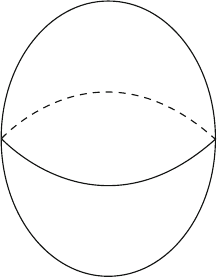
Ω is the closure of a relatively compact
open subset Ω of an n-dimensional, compact smooth manifold M without
boundary in which Ω has a smooth boundary Γ . This manifold M is the
double of Ω (see Figure 4.1).
We let
A =
n
i,j=1
a
ij
(x)
∂
2
∂x
i
∂x
j
+
n
i=1
b
i
(x)
∂
∂x
i
+ c(x)
be a second-order, elliptic differential operator with real coefficients such that:
(1) a
ij
∈ C
∞
(M)anda
ij
(x)=a
ji
(x) for all x ∈ M ,1≤ i, j ≤ n,andthere
exists a positive constant a
0
such that
n
i,j=1
a
ij
(x)ξ
i
ξ
j
≥ a
0
|ξ|
2
on T
∗
(M).
Here T
∗
(M) is the cotangent bundle of the double M.
K. Taira, Boundary Value Problems and Markov Processes,77
Lecture Notes in Mathematics 1499, DOI 10.1007/978-3-642-01677-6
4,
c
Springer-Verlag Berlin Heidelberg 2009
78 4 L
p
Approach to Elliptic Boundary Value Problems
Ω
Γ=∂ Ω
M
Fig. 4.1.
(2) b
i
∈ C
∞
(M) for all 1 ≤ i ≤ n.
(3) c ∈ C
∞
(M)andc(x) ≤ 0inM .
Furthermore, for simplicity, we assume that:
The function c(x)doesnotvanishidentically on the double M. (4.1)
The next theorem states the existence of a volume potential for A,which
plays the same role for A as the Newtonian potential plays for the Laplacian
(cf. [Se1, Theorem 1] and [Ta2, Theorem 8.2.1]):
Theorem 4.1. (i) The operator A : C
∞
(M) → C
∞
(M) is bijective, and its
inverse Q is a classical elliptic pseudo-differential operator of order −2 on M.
(ii) The operators A and Q extend respectively to isomorphisms
A : H
s,p
(M) −→ H
s−2,p
(M),
Q : H
s−2,p
(M) −→ H
s,p
(M)
for all s ∈ R, which are still inverses of each other.
Next we construct a surface potential for A, which is a generalization of
the classical Poisson kernel for the Laplacian.
We let
Kv = Q(v ⊗ δ)|
Γ
,v∈ C
∞
(Γ ).
Here v(x
) ⊗ δ(t) is a distribution on M defined by the formula
v ⊗ δ, ϕ · μ = v, ϕ(·, 0) · ω,ϕ(x
,t) ∈ C
∞
(M),
where μ is a strictly positive density on M and ω is a strictly positive density
on Γ = {t =0}, respectively.
Then we have the following (cf. [Ta2, Theorem 8.2.2]):

4.1 The Dirichlet Problem 79
Theorem 4.2. (i) The operator K is a classical elliptic pseudo-differential
operator of order −1 on Γ .
(ii) The operator K : C
∞
(Γ ) → C
∞
(Γ ) is bijective, and its inverse L is a
classical elliptic pseudo-differential operator of first order on Γ .Furthermore,
the operators K and L extend respectively to isomorphisms
K : B
σ,p
(Γ ) −→ B
σ+1,p
(Γ ),
L : B
σ+1,p
(Γ ) −→ B
σ,p
(Γ )
for all σ ∈ R, which are still inverses of each other.
Now we let
Pϕ = Q(Lϕ ⊗ δ)|
Ω
,ϕ∈ C
∞
(Γ ).
Then the operator P maps C
∞
(Γ ) continuously into C
∞
(Ω), and extends to
a continuous linear operator
P : B
s−1/p,p
(Γ ) −→ H
s,p
(Ω)
for all s ∈ R.Furthermore,wehave,forallϕ ∈ B
s−1/p,p
(Γ ),
AP ϕ = AQ(Lϕ ⊗ δ)|
Ω
=(Lϕ ⊗ δ)|
Ω
=0 inΩ,
Pϕ|
Γ
= KLϕ = ϕ on Γ.
The operator P is called the Poisson operator.
We let
N(A, s, p)={u ∈ H
s,p
(Ω):Au =0inΩ},s∈ R.
Since the injection H
s,p
(Ω) →D
(Ω) is continuous, it follows that the null
space N(A, s, p) is a closed subspace of H
s,p
(Ω); hence it is a Banach space.
Then we have the following fundamental result (cf. [Se2, Theorems 5
and 6]):
Theorem 4.3. The Poisson operator P maps the Besov space B
s−1/p,p
(Γ )
isomorphically onto the null space N (A, s, p) for all s ∈ R.
By combining Theorems 4.1 and 4.3, we can obtain the following existence
and uniqueness theorem for the Dirichlet problem (cf. [ADN]):
Theorem 4.4. Let s ≥ 2. The Dirichlet problem
Au = f in Ω,
u = ϕ on Γ
(4.2)
has a unique solution u(x) in H
s,p
(Ω) for any f ∈ H
s−2,p
(Ω) and any ϕ ∈
B
s−1/p,p
(Γ ).
Furthermore, we can prove the following existence and uniqueness theorem
for the Neumann problem (cf. [ADN]):

80 4 L
p
Approach to Elliptic Boundary Value Problems
Theorem 4.5. Let s ≥ 2. The Neumann problem
Au = f in Ω,
∂u
∂n
= ϕ on Γ
(4.3)
has a unique solution u(x) in H
s,p
(Ω) for any f ∈ H
s−2,p
(Ω) and any ϕ ∈
B
s−1−1/p,p
(Γ ).Heren is the unit interior normal to the boundary Γ .
By Theorem 4.5, we can introduce a linear operator
G
N
: H
s−2,p
(Ω) −→ H
s,p
(Ω)
as follows: For any f ∈ H
s−2,p
(Ω), the function G
N
f ∈ H
s,p
(Ω) is the unique
solution of the problem
Au = f in Ω,
∂u
∂n
=0 onΓ.
The operator G
N
is called the Green operator for the Neumann problem.
4.2 Formulation of a Boundary Value Problem
If u ∈ H
2,p
(Ω)=W
2,p
(Ω), we can define its traces γ
0
u and γ
1
u respectively
by the formulas
γ
0
u = u|
Γ
,
γ
1
u =
∂u
∂n
Γ
,
and let
γu = {γ
0
u, γ
1
u}.
Then we have the following (cf. [St1]):
Theorem 4.6 (the trace theorem). The trace map
γ : H
2,p
(Ω) −→ B
2−1/p,p
(Γ ) ⊕ B
1−1/p,p
(Γ )
is continuous and surjective for all 1 <p<∞.
We define a boundary condition
Bu := a(x
)
∂u
∂n
+ b(x
)u
Γ
= a(x
)γ
1
u + b(x
)γ
0
u, u ∈ H
2,p
(Ω),
where a(x
)andb(x
) are real-valued, smooth functions on Γ .
Then we have the following:
Proposition 4.7. The mapping
B : H
2,p
(Ω) −→ B
1−1/p,p
(Γ )
is continuous for all 1 <p<∞.
Now we can formulate our boundary value problem for (A, B) as follows:
Given functions f ∈ L
p
(Ω)andϕ ∈ B
2−1/p,p
(Γ ), find a function u ∈ H
2,p
(Ω)
such that
Au = f in Ω,
Bu = ϕ on Γ.
(4.4)
4.3 Reduction to the Boundary 81
4.3 Reduction to the Boundary
In this section, by using the operators P and G
N
we shall show that problem
(4.4) can be reduced to the study of a pseudo-differential operator on the
boundary.
First, we remark that every function u(x)inH
2,p
(Ω) can be written in
the following form:
u(x)=v(x)+w(x), (4.5)
where
v = G
N
(Au) ∈ H
2,p
(Ω),
w = u − v ∈ N (A, 2,p)=
z ∈ H
2,p
(Ω):Az =0inΩ
.
Since the operator G
N
: L
p
(Ω) → H
2,p
(Ω) is continuous, it follows that the
decomposition (4.5) is continuous; more precisely, we have the inequalities
v
2,p
≤ CAu
p
≤ Cu
2,p
;
w
2,p
≤u
2,p
+ v
2,p
≤ Cu
2,p
.
Here the letter C denotes a generic positive constant.
Now we assume that u ∈ H
2,p
(Ω) is a solution of the boundary value
problem (4.4)
Au = f in Ω,
Bu = ϕ on Γ.
Then, by virtue of the decomposition (4.5) of u(x)thisisequivalenttosaying
that w ∈ H
2,p
(Ω) is a solution of the boundary value problem
Aw =0 inΩ,
Bw = ϕ − Bv on Γ.
(4.6)
Here v(x)=G
N
f ∈ H
2,p
(Ω)andw(x)=u(x) − v(x). However, Theorem 4.3
asserts that the spaces N (A, 2,p)andB
2−1/p,p
(Γ ) are isomorphic in such a
way that:
N(A, 2,p)
γ
0
−→ B
2−1/p,p
(Γ ).
N(A, 2,p) ←−
P
B
2−1/p,p
(Γ ).
Therefore, we find that w ∈ H
2,p
(Ω) is a solution of problem (4.6) if and only
if ψ(x
) ∈ B
2−1/p,p
(Γ ) is a solution of the equation
BPψ = ϕ − Bv on Γ. (4.7)
Here ψ = γ
0
w,orequivalently,w = Pψ.
Summing up, we obtain the following:

82 4 L
p
Approach to Elliptic Boundary Value Problems
Proposition 4.8. For functions f ∈ L
p
(Ω) and ϕ ∈ B
2−1/p,p
(Γ ),thereexists
asolutionu ∈ H
2,p
(Ω) of problem (4.4) if and only if there exists a solution
ψ ∈ B
2−1/p,p
(Γ ) of equation (4.7). Furthermore, the solutions u(x) and ψ(x
)
are related as follows:
u = G
N
f + Pψ.
We remark that equation (4.7) is a generalization of the classical Fredholm
integral equation.
We let
T : C
∞
(Γ ) −→ C
∞
(Γ )
ϕ −→ BPϕ.
Then we have, by condition (4.2),
T = a(x
)Π + b(x
),
where
Πϕ = γ
1
Pϕ =
∂
∂n
(Pϕ)
Γ
,ϕ∈ C
∞
(Γ ).
It is known (cf. [Ho1], [Se2]) that the operator Π is a classical pseudo-
differential operator of first order on Γ ; hence the operator T is a classical
pseudo-differential operator of first order on the boundary Γ .
Consequently, Proposition 4.8 asserts that problem (4.4) can be reduced to
the study of the first-order pseudo-differential operator T on the boundary Γ .
We shall formulate this fact more precisely in terms of functional analysis.
First, we remark that the operator T : C
∞
(Γ ) → C
∞
(Γ ) extends to a
continuous linear operator
T : B
s,p
(Γ ) −→ B
s−1,p
(Γ ),s∈ R.
Then we have the formula
Tϕ= BPϕ, ϕ ∈ B
2−1/p,p
(Γ ),
since the Poisson operator
P : B
2−1/p,p
(Γ ) −→ N(A, 2,p)
and the boundary operator
B : H
2,p
(Ω) −→ B
1−1/p,p
(Γ )
are both continuous.
We associate with problem (4.4) a linear operator
A : H
2,p
(Ω) −→ L
p
(Ω) ⊕ B
2−1/p,p
(Γ )
as follows.

4.3 Reduction to the Boundary 83
(a) The domain D(A)ofA is the space
D(A)=
u ∈ H
2,p
(Ω)=W
2,p
(Ω):Bu ∈ B
2−1/p,p
(Γ )
.
(b) Au = {Au, Bu}, u ∈D(A).
Note that the space B
2−1/p,p
(Γ ) is a right boundary space associated with
the Dirichlet condition: a(x
) ≡ 0andb(x
) ≡ 1onΓ .
Since the operators A : H
2,p
(Ω) → L
p
(Ω)andB : H
2,p
(Ω) → B
1−1/p,p
(Γ )
are both continuous, it follows that A is a closed operator. Furthermore, the
operator A is densely defined, since the domain D(A) contains the space
C
∞
(Ω).
Similarly, we associate with equation (4.7) a linear operator
T : B
2−1/p,p
(Γ ) −→ B
2−1/p,p
(Γ )
as follows.
(α) The domain D(T )ofT is the space
D(T )=
ϕ ∈ B
2−1/p,p
(Γ ):Tϕ ∈ B
2−1/p,p
(Γ )
.
(β) T ϕ = Tϕ, ϕ ∈D(T ).
Then the operator T is a densely defined, closed operator, since the opera-
tor T : B
2−1/p,p
(Γ ) → B
1−1/p,p
(Γ ) is continuous and since the domain D(T )
contains the space C
∞
(Γ ).
The next theorem states that A has regularity property if and only if T
has.
Theorem 4.9. The following two conditions are equivalent:
u ∈ L
p
(Ω),Au∈ L
p
(Ω) and Bu ∈ B
2−1/p,p
(Γ )=⇒ u ∈ H
2,p
(Ω). (4.8)
ϕ ∈ B
−1/p,p
(Γ ) and Tϕ∈ B
2−1/p,p
(Γ )=⇒ ϕ ∈ B
2−1/p,p
(Γ ). (4.9)
Proof. (i) First, we show that assertion (4.8) implies assertion (4.9). To do
this, assume that
ϕ ∈ B
−1/p,p
(Γ )andTϕ∈ B
2−1/p,p
(Γ ).
Then, by letting u = Pϕ we obtain that
u ∈ L
p
(Ω),Au=0 and Bu = Tϕ∈ B
2−1/p,p
(Γ ).
Hence it follows from condition (4.8) that
u ∈ H
2,p
(Ω),
84 4 L
p
Approach to Elliptic Boundary Value Problems
so that, by Theorem 4.6,
ϕ = γ
0
u ∈ B
2−1/p,p
(Γ ).
(ii) Conversely, we show that assertion (4.9) implies estimate (4.8). To do
this, assume that
u ∈ L
p
(Ω),Au∈ L
p
(Ω)andBu ∈ B
2−1/p,p
(Γ ).
Then the distribution u(x) can be decomposed as follows:
u(x)=v(x)+w(x),
where
v = G
N
(Au) ∈ H
2,p
(Ω),
w = u − v ∈ N (A, 0,p)={z ∈ L
p
(Ω):Az =0inΩ}.
Moreover, Theorem 4.3 asserts that the distribution w(x) can be written in
the form
w = Pϕ, ϕ = γ
0
w ∈ B
−1/p,p
(Γ ).
Hence we have, by Theorem 4.6,
Tϕ= BPϕ = Bw = Bu − Bv = Bu − b(x
)γ
0
v ∈ B
2−1/p,p
(Γ ),
since γ
1
v = 0. Thus it follows from condition (4.9) that
ϕ ∈ B
2−1/p,p
(Γ ),
so that again, by Theorem 4.3,
w = Pϕ ∈ H
2,p
(Ω).
This proves that
u = v + w ∈ H
2,p
(Ω).
The proof of Theorem 4.9 is complete.
The next theorem states that aprioriestimates for A are entirely equiv-
alent to corresponding aprioriestimates for T .
Theorem 4.10. The following two estimates are equivalent:
u
2,p
≤ C
Au
p
+ |Bu|
2−1/p,p
+ u
p
,u∈D(A). (4.10)
|ϕ|
2−1/p,p
≤ C
|T ϕ|
2−1/p,p
+ |ϕ|
−1/p,p
,ϕ∈D(T ). (4.11)
Here and in the following the letter C denotes a generic positive constant.
4.3 Reduction to the Boundary 85
Proof. (i) First, we show that estimate (4.10) implies estimate (4.11).
By taking u = Pϕ with ϕ ∈D(T ) in estimate (4.10), we obtain that
Pϕ
2,p
≤ C
|T ϕ|
2−1/p,p
+ Pϕ
p
. (4.12)
However, Theorem 4.3 asserts that the Poisson operator P maps the Besov
space B
s−1/p,p
(Γ ) isomorphically onto the null space N(A, s, p) for all s ∈ R.
Thus the desired estimate (4.11) follows from estimate (4.12).
(ii) Conversely, we show that estimate (4.11) implies estimate (4.10).
To do this, we express a function u ∈D(A)intheform
u(x)=v(x)+w(x),
where
v = G
N
(Au) ∈ H
2,p
(Ω),
w = u − v ∈ N (A, 2,p)=
z ∈ H
2,p
(Ω):Az =0inΩ
.
Then we have, by Theorem 4.5 with s := 2,
v
2,p
= G
N
(Au)
2,p
≤ CAu
p
. (4.13)
Furthermore, by applying estimate (4.11) to the distribution γ
0
w we obtain
that
|γ
0
w|
2−1/p,p
≤ C
|T (γ
0
w)|
2−1/p,p
+ |γ
0
w|
−1/p,p
= C
|Bw|
2−1/p,p
+ |γ
0
w|
−1/p,p
≤ C
|Bu|
2−1/p,p
+ |Bv|
2−1/p,p
+ |γ
0
w|
−1/p,p
.
In view of Theorem 4.3, this proves that
w
2,p
≤ C
|Bu|
2−1/p,p
+ |Bv|
2−1/p,p
+ w
p
≤ C
|Bu|
2−1/p,p
+ |Bv|
2−1/p,p
+ u
p
+ v
p
≤ C
|Bu|
2−1/p,p
+ |Bv|
2−1/p,p
+ u
p
+ v
2,p
. (4.14)
However, since γ
1
v = 0, it follows from an application of Theorem 4.6 that
|Bv|
2−1/p,p
= |b(x
)γ
0
v|
2−1/p,p
≤ Cv
2,p
. (4.15)
Thus, by carrying estimates (4.13) and (4.15) into estimate (4.14) we obtain
that
w
2,p
≤ C
Au
p
+ |Bu|
2−1/p,p
+ u
p
. (4.16)
Therefore, the desired estimate (4.10) follows from estimates (4.13) and
(4.16), since u(x)=v(x)+w(x).
The proof of Theorem 4.10 is complete.