
Kazuaki Taira. Boundary Value Problems and Markov Processes
Подождите немного. Документ загружается.



Preface to the Second Edition
This monograph is an expanded and revised version of a set of lecture notes for
the graduate courses given by the author both at Hiroshima University (1995–
1997) and at the University of Tsukuba (1998–2000) which were addressed to
the advanced undergraduates and beginning-graduate students with interest
in functional analysis, partial differential equations and probability.
The first edition of this monograph, which was based on the lecture notes
given at the University of Tsukuba (1988–1990), was published in 1991. This
edition was found useful by a number of people, but it went out of print after
afewyears.
This second edition has been revised to streamline some of the analysis and
to give better coverage of important examples and applications. The errors
in the first printing are corrected thanks to kind remarks of many friends.
In order to make the monograph more up-to-date, additional references have
been included in the bibliography.
This second edition may be considered as a short introduction to the more
advanced book “Semigroups, boundary value problems and Markov processes”
which was published in the Springer Monographs in Mathematics series in
2004. For graduate students working in functional analysis, partial differential
equations and probability, it may serve as an effective introduction to these
three interrelated fields of analysis. For graduate students about to major in
the subject and mathematicians in the field looking for a coherent overview,
it will provide a method for the analysis of elliptic boundary value problems
in the framework of L
p
spaces.
My special thanks go to the editorial staffs of Springer-Verlag for their
unfailing helpfulness and cooperation during the production of this second
edition.
This research was partially supported by Grant-in-Aid for General Scien-
tific Research (No. 19540162), Ministry of Education, Culture, Sports, Science
and Technology, Japan.
VII
VIII Preface to the Second Edition
Last but not least, I owe a great debt of gratitude to my family who gave
me moral support during the preparation of this book.
Tsukuba, Kazuaki Taira
March 2009

Preface to the First Edition
This monograph is devoted to the functional analytic approach to a class of
degenerate boundary value problems for second-order elliptic differential oper-
ators which includes as particular cases the Dirichlet and Neumann problems.
We prove that this class of boundary value problems provides a new example
of analytic semigroups both in the L
p
topology and in the topology of uniform
convergence. As an application, we show that there exists a strong Markov
process corresponding to such a diffusion phenomenon that either absorption
or reflection phenomenon occurs at each point of the boundary. Furthermore,
we study a class of initial-boundary value problems for semilinear parabolic
differential equations.
This monograph is an expanded version of a set of lecture notes for the
graduate courses given by the author at the University of Tsukuba between
1988 and 1990. We confined ourselves to the simple boundary condition. This
makes it possible to develop our basic machinery with a minimum of bother
and the principal ideas can be presented concretely and explicitly. I hope that
this monograph will lead to a better insight into the study of three interrelated
subjects: elliptic boundary value problems, analytic semigroups and Markov
processes. For additional information on many of the topics discussed here,
I would like to call attention to my previous book Diffusion Processes and
Partial Differential Equations, Academic Press, 1988.
I would like to express my hearty thanks to many colleagues and graduate
students in my courses, whose helpful criticisms of my lectures resulted in a
number of improvements. The manuscript is typeset in a camera-ready form
using A
M
S-T
E
X.
Tsukuba, Kazuaki Taira
April 1991
IX

Contents
1 Introduction and Main Results ............................ 1
2 Semigroup Theory ......................................... 13
2.1 AnalyticSemigroups..................................... 13
2.1.1 GenerationofAnalyticSemigroups .................. 13
2.1.2 FractionalPowers ................................. 24
2.1.3 The Semilinear Cauchy Problem . . . . . . . . . . . . . . . . . . . . 26
2.2 MarkovProcessesand FellerSemigroups ................... 27
2.2.1 MarkovProcesses ................................. 28
2.2.2 MarkovTransition Functions........................ 31
2.2.3 PathFunctionsofMarkovProcesses ................. 35
2.2.4 Strong Markov Processes and Transition Functions . . . . 36
2.2.5 Markov Transition Functions and Feller Semigroups . . . 39
2.2.6 Generation TheoremsofFeller Semigroups............ 44
3 L
p
Theory of Pseudo-Differential Operators ............... 55
3.1 Function Spaces......................................... 55
3.2 FourierIntegral Operators................................ 62
3.2.1 SymbolClasses ................................... 62
3.2.2 PhaseFunctions................................... 64
3.2.3 Oscillatory Integrals . . . . . . . . . . . . . . . . . . . . . . . . . . . . . . . 65
3.2.4 FourierIntegralOperators.......................... 67
3.3 Pseudo-DifferentialOperators............................. 67
4 L
p
Approach to Elliptic Boundary Value Problems ........ 77
4.1 The Dirichlet Problem ................................... 77
4.2 Formulation of a Boundary Value Problem . . . . . . . . . . . . . . . . . . 80
4.3 Reduction to the Boundary . . . . . . . . . . . . . . . . . . . . . . . . . . . . . . . 81
5 Proof of Theorem 1.1 ...................................... 87
5.1 Boundary Value Problem with Spectral Parameter . . . . . . . . . . . 87
5.2 ProofofEstimate(1.2)................................... 89
XI

XII Contents
6 A Priori Estimates ........................................ 95
7 Proof of Theorem 1.2 ......................................101
7.1 ProofofTheorem1.2,Part(i) ............................101
7.1.1 Proofof Proposition7.2............................108
7.2 ProofofTheorem1.2,Part(ii)............................110
8 Proof of Theorem 1.3, Part (i) .............................113
8.1 The Space C
0
(D \ M )....................................113
8.2 Sobolev’sImbeddingTheorems............................114
8.3 ProofofPart(i)ofTheorem1.3...........................115
9 Proof of Theorem 1.3, Part (ii) ............................125
9.1 GeneralExistenceTheoremforFeller Semigroups............125
9.2 FellerSemigroups with Reflecting Barrier...................140
9.3 ProofofTheorem1.4 ....................................149
9.4 ProofofPart(ii) ofTheorem1.3 ..........................159
10 Application to Semilinear Initial-Boundary
Val ue Problem s ............................................161
10.1 LocalExistenceand UniquenessTheorems..................161
10.2 FractionalPowersandImbeddingTheorems ................163
10.3 Proofof Theorems10.1and 10.2 ..........................165
10.3.1 ProofofTheorem10.1 .............................165
10.3.2 ProofofTheorem10.2 .............................166
11 Concluding Remarks ......................................169
A The Maximum Principle ...................................175
References .....................................................179
Index ..........................................................183

1
Introduction and Main Results
In this introductory chapter, our problems and results are stated in such
a fashion that a broad spectrum of readers could understand, and also de-
scribed how these problems can be solved, using the mathematics presented
in Chapters 2 through 4.
In 1828, the English botanist R. Brown observed that pollen grains sus-
pended in water move chaotically, incessantly changing their direction of mo-
tion. The physical explanation of this phenomenon is that a single grain suffers
innumerable collisions with the randomly moving molecules of the surround-
ing water. A mathematical theory for Brownian motion was put forward by
A. Einstein in 1905 ([Ei]). Einstein derived an accurate method of measur-
ing Avogadro’s number by observing particles undergoing Brownian motion.
Einstein’s theory was experimentally tested by J. Perrin between 1906 and
1909.
Brownian motion was put on a firm mathematical foundation for the first
time by N. Wiener in 1923 ([Wi]). Wiener characterized the “starting afresh”
property of Brownian motion that if a Brownian particle reaches a position,
then it behaves subsequently as though that position had been its initial
position.
Markov processes are an abstraction of the idea of Brownian motion.
In the first works devoted to Markov processes, the most fundamental was
A. N. Kolmogorov’s work in 1931 ([Ko]) where the general concept of a
Markov transition function was introduced for the first time and an analytic
method of describing Markov transition functions was proposed. From the
viewpoint of analysis, the transition function is something more convenient
than the Markov process itself. In fact, it can be shown that the transition
functions of Markov processes generate solutions of certain parabolic partial
differential equations such as the classical diffusion equation; and, conversely,
these differential equations can be used to construct and study the transition
functions and the Markov processes themselves.
In the 1950s, the theory of Markov processes entered a new period of inten-
sive development. We can associate with each transition function in a natural
K. Taira, Boundary Value Problems and Markov Processes,1
Lecture Notes in Mathematics 1499, DOI 10.1007/978-3-642-01677-6
1,
c
Springer-Verlag Berlin Heidelberg 2009

2 1 Introduction and Main Results
way a family of bounded linear operators acting on the space of continuous
functions on the state space, and the Markov property implies that this fam-
ily forms a semigroup. The Hille–Yosida theory of semigroups in functional
analysis made possible further progress in the study of Markov processes. The
semigroup approach to Markov processes can be traced back to the pioneering
work of Feller in early 1950s ([Fe1], [Fe2]).
Now let D be a bounded domain of Euclidean space R
N
,withsmooth
boundary ∂D;itsclosure
D = D ∪∂D is an N-dimensional, compact smooth
manifold with boundary. We let
A =
N
i,j=1
a
ij
(x)
∂
2
∂x
i
∂x
j
+
N
i=1
b
i
(x)
∂
∂x
i
+ c(x)
be a second-order, elliptic differential operator with real smooth coefficients
on
D such that:
(1) a
ij
(x)=a
ji
(x) for all x ∈ D and 1 ≤ i, j ≤ N.
(2) There exists a positive constant a
0
such that
N
i,j=1
a
ij
(x)ξ
i
ξ
j
≥ a
0
|ξ|
2
for all (x, ξ) ∈ D × R
N
.
(3) c(x) ≤ 0on
D.
We consider the following boundary value problem with spectral param-
eter: Given functions f (x)andϕ(x
) defined in D and on ∂D, respectively,
find a function u(x)inD such that
(A −λ)u = f in D,
Lu = μ(x
)
∂u
∂n
+ γ(x
)u = ϕ on ∂D.
(1.1)
Here:
(4) λ is a complex parameter.
(5) μ(x
)andγ(x
) are real-valued, smooth functions on the boundary ∂D.
(6) n =(n
1
,n
2
,...,n
N
) is the unit interior normal to the boundary ∂D (see
Figure 1.1).
We remark that if μ(x
) =0andγ(x
) ≡ 0on∂D (resp. μ(x
) ≡ 0and
γ(x
) =0on∂D), then the boundary condition L is essentially the so-called
Neumann (resp. Dirichlet) condition.
It is easy to see that problem (1.1) is non-degenerate (or coercive) if and
only if either μ(x
) =0on∂D or μ(x
) ≡ 0andγ(x
) =0on∂D. The genera-
tion theorem of analytic semigroups is well established in the non-degenerate
case both in the L
p
topology and in the topology of uniform convergence (cf.
Friedman [Fr1], Tanabe [Tn], Masuda [Ma], Stewart [Sw]).
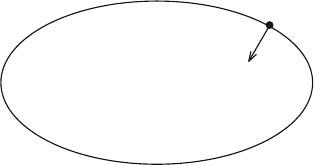
1 Introduction and Main Results 3
∂D
D
n
Fig. 1.1.
In this book, under the condition that μ(x
) ≥ 0on∂D we shall consider
the problem of existence and uniqueness of solutions of problem (1.1) in the
framework of Sobolev spaces of L
p
type, and generalize the generation theorem
of analytic semigroups to the degenerate case.
First, we give a fundamental aprioriestimate for problem (1.1).
If 1 ≤ p<∞,welet
L
p
(D) = the space of (equivalence classes of) Lebesgue
measurable functions u(x)onD such that |u(x)|
p
is integrable on D.
The space L
p
(D) is a Banach space with the norm
u
p
=
D
|u(x)|
p
dx
1/p
.
If m is a non-negative integer, we define the usual Sobolev space
W
m,p
(D) = the space of (equivalence classes of) functions
u ∈ L
p
(D) whose derivatives D
α
u(x), |α|≤m,
in the sense of distributions are in L
p
(D).
The space W
m,p
(D) is a Banach space with the norm
u
m,p
=
⎛
⎝
|α|≤m
D
|D
α
u(x)|
p
dx
⎞
⎠
1/p
.
We remark that
W
0,p
(D)=L
p
(D); ·
0,p
= ·
p
.
Furthermore, we let
B
m−1/p,p
(∂D) = the space of the boundary values ϕ(x
) of functions
u ∈ W
m,p
(D).

4 1 Introduction and Main Results
In the space B
m−1/p,p
(∂D), we introduce a norm
|ϕ|
m−1/p,p
=infu
m,p
,
where the infimum is taken over all functions u ∈ W
m,p
(D) which equal ϕ(x
)
on the boundary ∂D.ThespaceB
m−1/p,p
(∂D) is a Banach space with respect
to this norm |·|
m−1/p,p
;moreprecisely,itisaBesovspace(cf.[BL],[Tb],
[Tr]).
Then we have the following result:
Theorem 1.1. Let 1 <p<∞. Assume that the following two conditions (A)
and (B) are satisfied:
(A) μ(x
) ≥ 0 on ∂D.
(B) γ(x
) < 0 on M = {x
∈ ∂D : μ(x
)=0}.
Then, for any solution u ∈ W
2,p
(D) of problem (1.1) with f ∈ L
p
(D) and
ϕ ∈ B
2−1/p,p
(∂D) we have the aprioriestimate
u
2,p
≤ C(λ)
f
p
+ |ϕ|
2−1/p,p
+ u
p
, (1.2)
with a positive constant C(λ) depending on λ.
It should be emphasized that problem (1.1) is a degenerate elliptic bound-
ary value problem from an analytical point of view. This is due to the fact that
the so-called Lopatinskii–Shapiro complementary condition is violated at each
point x
of the set M. Amann [Am] studied the non-degenerate case; more pre-
cisely, he assumes that the boundary ∂D is the disjoint union of the two closed
subsets M = {x
∈ ∂D : μ(x
)=0} and ∂D \ M = {x
∈ ∂D : μ(x
) > 0},
eachofwhichisan(N − 1) dimensional compact smooth manifold.
Here it is worth while pointing out that the aprioriestimate (1.2) is the
same one for the Dirichlet condition: μ(x
) ≡ 0andγ(x
) =0on∂D (cf.
[ADN], [LM]).
Now we state a generation theorem of analytic semigroups in the L
p
topol-
ogy.
We associate with problem (1.1) a unbounded linear operator A
p
from
L
p
(D) into itself as follows:
(a) The domain of definition D(A
p
)ofA
p
is the set
D(A
p
)=
u ∈ W
2,p
(D):Lu = μ(x
)
∂u
∂n
+ γ(x
)u =0
. (1.3)
(b) A
p
u = Au, u ∈D(A
p
).
The next theorem is an L
p
version of Taira [Ta1, Theorem 1]:
Theorem 1.2. Let 1 <p<∞. Assume that conditions (A) and (B) are
satisfied. Then we have the following two assertions: