
Kazuaki Taira. Boundary Value Problems and Markov Processes
Подождите немного. Документ загружается.

170 11 Concluding Remarks
D
∂D
M
= {¹ =0}
Fig. 11.1.
(2) b
i
∈ C
∞
(D) for all 1 ≤ i ≤ N .
(3) c ∈ C
∞
(D)andc(x) ≤ 0inD.
(4) The integral kernel s(x, y) is the distribution kernel of a properly sup-
ported, pseudo-differential operator S ∈ L
2−κ
1,0
(R
N
), κ>0, which has the
transmission property with respect to ∂D (see [Bt]), and s(x, y) ≥ 0offthe
diagonal {(x, x):x ∈ R
N
} in R
N
×R
N
. The measure dy is the Lebesgue
measure on R
N
.
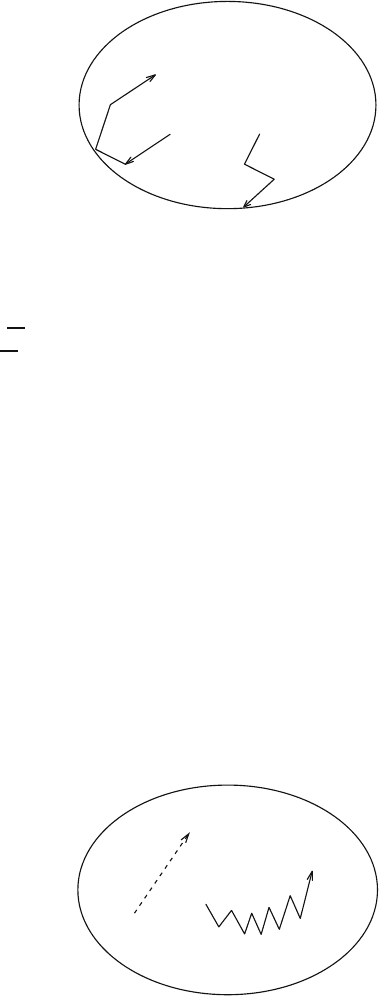
The operator W is called a second-order, Waldenfels operator (cf. [Wa]).
The differential operator A is called a diffusion operator which describes an-
alytically a strong Markov process with continuous paths (diffusion process)
in the interior D. The operator S
r
is called a second-order L´evy operator
which is supposed to correspond to the jump phenomenon in the interior D.
More precisely, a Markovian particle moves by jumps to a random point, cho-
sen with kernel s(x, y), in the interior D. Therefore, the Waldenfels operator
W = A+ S
r
is supposed to correspond to such a diffusion phenomenon that a
Markovian particle moves both by jumps and continuously in the state space
D (see Figure 11.2).
D
Fig. 11.2.

11 Concluding Remarks 171
Let L be a second-order boundary condition such that, in local coordinates
(x
1
,x
2
,...,x
N−1
),
Lu(x
)=Qu(x
)+μ(x
)
∂u
∂n
(x
) − δ(x
)Wu(x
)+Γu(x
)
:=
⎛
⎝
N−1
i,j=1
α
ij
(x
)
∂
2
u
∂x
i
∂x
j
(x
)+
N−1
i=1
β
i
(x
)
∂u
∂x
i
(x
)+γ(x
)u(x
)
⎞
⎠
+ μ(x
)
∂u
∂n
(x
) − δ(x
)Wu(x
)
+
⎛
⎝
∂D
r(x
,y
)
⎡
⎣
u(y
) − u(x
) −
N−1
j=1
(y
j
− x
j
)
∂u
∂x
j
(x
)
⎤
⎦
dy
+
D
t(x
,y)
⎡
⎣
u(y) − u(x
) −
N−1
j=1
(y
j
− x
j
)
∂u
∂x
j
(x
)
⎤
⎦
dy
⎞
⎠
.
Here:
(1) The operator Q is a second-order, degenerate elliptic differential operator
on the boundary ∂D with non-positive principal symbol. In other words,
the α
ij
are the components of a smooth symmetric contravariant tensor
of type
2
0
on ∂D satisfying the condition
N−1
i,j=1
α
ij
(x
)ξ
i
ξ
j
≥ 0 for all x
∈ ∂D and ξ
=
&
N−1
j=1
ξ
j
dx
j
∈ T
∗
x
(∂D).
Here T
∗
x
(∂D) is the cotangent space of ∂D at x
.
(2) Q1=γ ∈ C
∞
(∂D)andγ(x
) ≤ 0on∂D.
(3) μ ∈ C
∞
(∂D)andμ(x
) ≥ 0on∂D.
(4) δ ∈ C
∞
(∂D)andδ(x
) ≥ 0on∂D.
(5) n =(n
1
,n
2
,...,n
N
) is the unit interior normal to the boundary ∂D.
(6) The integral kernel r(x
,y
) is the distribution kernel of a pseudo-differen-
tial operator R ∈ L
2−κ
1
1,0
(∂D), κ
1
> 0, and r(x
,y
) ≥ 0 off the diagonal
Δ
∂D
= {(x
,x
):x
∈ ∂D} in ∂D × ∂D. The density dy
is a strictly
positive density on ∂D.
(7) The integral kernel t(x, y) is the distribution kernel of a properly sup-
ported, pseudo-differential operator T ∈ L
2−κ
2
1,0
(R
N
), κ
2
> 0, which has
the transmission property with respect to the boundary ∂D (see [Bt]), and
t(x, y) ≥ 0 off the diagonal {(x, x):x ∈ R
N
} in R
N
× R
N
.
The boundary condition L is called a second-order Ventcel’ boundary con-
dition (cf. [We]). The six terms of L
N−1
i,j=1
α
ij
(x
)
∂
2
u
∂x
i
∂x
j
(x
)+
N−1
i=1
β
i
(x
)
∂u
∂x
i
(x
),
172 11 Concluding Remarks
γ(x
)u(x
),μ(x
)
∂u
∂n
(x
),δ(x
)Wu(x
),
∂D
r(x
,y
)
⎡
⎣
u(y
) − u(x
) −
N−1
j=1
(y
j
− x
j
)
∂u
∂x
j
(x
)
⎤
⎦
dy
,
D
t(x
,y)
⎡
⎣
u(y) − u(x
) −
N−1
j=1
(y
j
− x
j
)
∂u
∂x
j
(x
)
⎤
⎦
dy
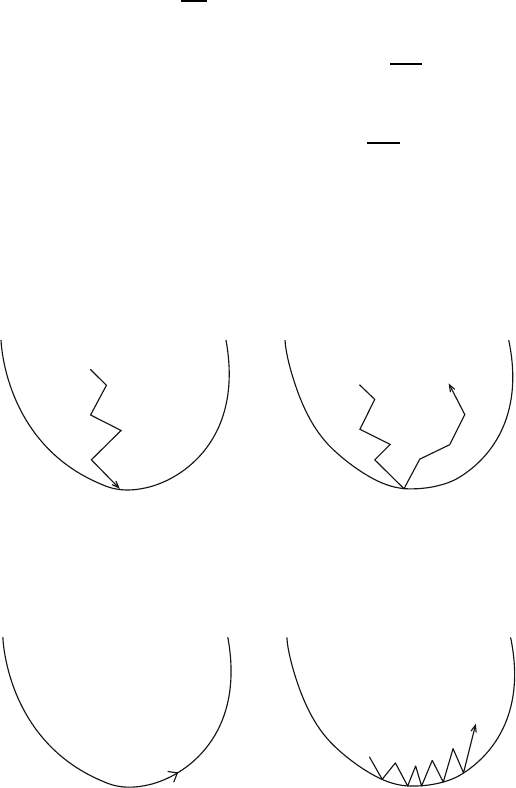
are supposed to correspond to the diffusion along the boundary, the absorption
phenomenon, the reflection phenomenon, the sticking (viscosity) phenomenon
and the jump phenomenon on the boundary and the inward jump phenomenon
from the boundary, respectively (see Figures 11.3 through 11.5).
D
@D
D
@D
absorption reflection
Fig. 11.3.
D
@D
D
@D
diffusion along the boundary sticking (viscosity)
Fig. 11.4.
Finally, we give an overview for general results on generation theorems for
Feller semigroups proved mainly by the author using the theory of pseudo-
differential operators ([Ho1], [Se1], [Se2]) and the theory of singular integral
operators ([CZ]):

11 Concluding Remarks 173
D
∂D
D
∂D
jump into the interior jump on the boundary
Fig. 11.5.
diffusion L´evy Ventcel’ using proved
operator operator condition the theory by
A S
r
L of
smooth null second-order pseudo-
case case differential [Ta2]
operators
smooth general general pseudo-
case case case differential [Ta3]
operators
smooth H¨older degenerate pseudo-
case continuous case differential [Ta5]
case operators
discon- general Dirichlet singular
tinuous case case integral [Ta6]
case operators
discon- null first-order singular
tinuous case integral [Ta7]
case operators
174 11 Concluding Remarks
It should be emphasized that the Calder´on–Zygmund theory of singular in-
tegral operators with non-smooth kernels provides a powerful tool to deal with
smoothness of solutions of elliptic boundary value problems, with minimal as-
sumptions of regularity on the coefficients. The theory of singular integrals
continues to be one of the most influential works in modern history of analysis,
and is a very refined mathematical tool whose full power is yet to be exploited
(see [St2]).