
Kazuaki Taira. Boundary Value Problems and Markov Processes
Подождите немного. Документ загружается.

1 Introduction and Main Results 5
(i) For every positive number ε, there exists a positive constant r
p
(ε) such
that the resolvent set of A
p
contains the set
Σ
p
(ε)=
λ = r
2
e
iθ
: r ≥ r
p
(ε), −π + ε ≤ θ ≤ π − ε
,
and that the resolvent (A
p
− λI)
−1
satisfies the estimate
(A
p
− λI)
−1
≤
c
p
(ε)
|λ|
for all λ ∈ Σ
p
(ε), (1.4)
where c
p
(ε) is a positive constant depending on ε.
(ii) The operator A
p
generates a semigroup U
z
on the space L
p
(D) which is
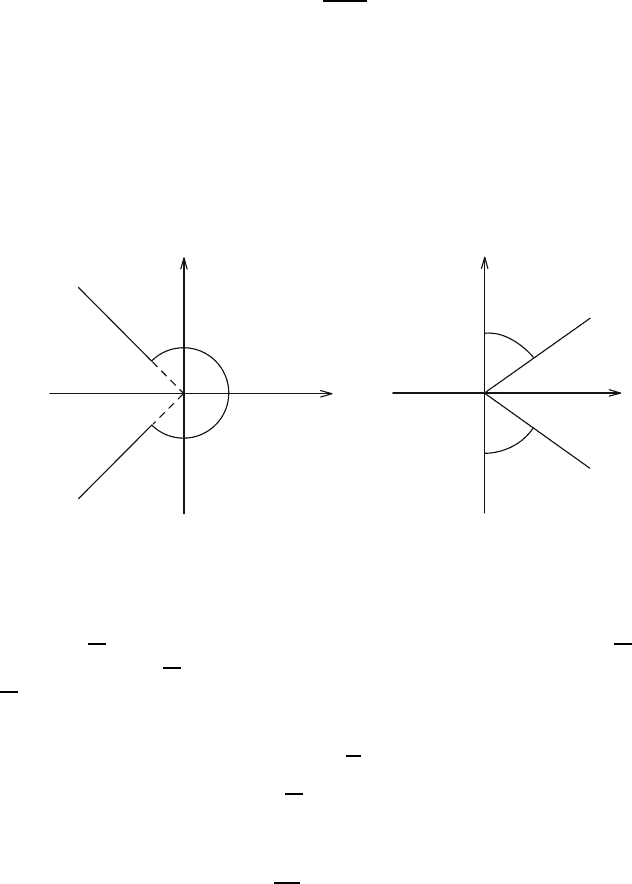
analytic in the sector
Δ
ε
= {z = t + is : z =0, |arg z| <π/2 − ε}
for any 0 <ε<π/2 (see Figure 1.2).
ε
ε
Σ
p
(ε)
ε
ε
⏐λ⏐
=
r
p
(ε)
2
Δ
ε
0
0
Fig. 1.2.
Secondly, we state a generation theorem of analytic semigroups in the
topology of uniform convergence.
Let C(
D) be the space of real-valued, continuous functions f(x)onD.We
equip the space C(
D) with the topology of uniform convergence on the whole
D; hence it is a Banach space with the maximum norm
f
∞
=max
x∈D
|f(x)|.
We introduce a subspace of C(
D) which is associated with the boundary
condition L. We remark that the boundary condition
Lu = μ(x
)
∂u
∂n
+ γ(x
)u =0 on∂D

6 1 Introduction and Main Results
includes the condition
u =0 onM = {x
∈ ∂D : μ(x
)=0},
if γ(x
) =0onM . With this fact in mind, we let
C
0
(D \ M )=
u ∈ C(D):u =0onM
.
The space C
0
(D\M) is a closed subspace of C(D); hence it is a Banach space.
Furthermore, we introduce a unbounded linear operator A from C
0
(D \ M)
into itself as follows:
(a) The domain of definition D(A)ofA is the set
D(A )=
u ∈ C
0
(D \ M ):Au ∈ C
0
(D \ M ),Lu=0
. (1.5)
(b) Au = Au, u ∈D(A).
Here Au and Lu are taken in the sense of distributions (see Chapter 9).
Then Theorem 1.2 remains valid with L
p
(D)andA
p
replaced by C
0
(D\M)
and A, respectively. More precisely, we can prove the following:
Theorem 1.3. Assume that condition (A) and the following condition (B
)
(replacing condition (B)) are satisfied:
(B
) γ(x
) ≤ 0 on ∂D and γ(x
) < 0 on M = {x
∈ ∂D : μ(x
)=0}.
Then we have the following two assertions:
(i) For every positive number ε, there exists a positive constant r(ε) such that
the resolvent set of A contains the set
Σ(ε)=
λ = r
2
e
iθ
: r ≥ r(ε), −π + ε ≤ θ ≤ π − ε
,
and that the resolvent (A − λI)
−1
satisfies the estimate
(A − λI)
−1
≤
c(ε)
|λ|
for all λ ∈ Σ(ε), (1.6)
where c(ε) is a positive constant depending on ε.
(ii) The operator A generates a semigroup T
z
on the space C
0
(D \ M) which
is analytic in the sector
Δ
ε
= {z = t + is : z =0, |arg z| <π/2 − ε}
for any 0 <ε<π/2 (see Figure 1.3).
Moreover, the operators T
t
(t ≥ 0) are non-negative and contractive on
the space C
0
(D \M):
f ∈ C
0
(D \ M), 0 ≤ f(x) ≤ 1 on D \ M =⇒ 0 ≤ T
t
f(x) ≤ 1 on D \ M.

1 Introduction and Main Results 7
Σ (ε )
ε
ε
⏐λ⏐
= r(ε)
2
0
ε
ε
Δ
ε
0
Fig. 1.3.
The main purpose of this book is devoted to the functional analytic ap-
proach to the problem of existence of Markov processes in probability theory.
A strongly continuous, non-negative and contraction semigroup {T
t
}
t≥0
on the space C
0
(D \ M) is called a Feller semigroup on D \ M.
Therefore, we can reformulate part (ii) of Theorem 1.3 as follows:
Theorem 1.4. Assume that conditions (A) and (B
) are satisfied. Then the
operator A generates a Feller semigroup {T
t
}
t≥0
on the space D \ M .
Theorem 1.4 generalizes Bony–Courr`ege–Priouret [BCP, Th´eor`eme XIX]
to the case where μ(x
) ≥ 0 on the boundary ∂D (cf. [Ta2, Theorem 10.1.3]).
It is known (cf. [Dy2], [Ta2, Chapter 9]) that if {T
t
}
t≥0
is a Feller semigroup
on
D \ M , then there exists a unique Markov transition function p
t
(x, ·)on
the space
D \ M such that
T
t
f(x)=
D\M
p
t
(x, dy)f(y),f∈ C
0
(D \ M ).
Furthermore, it can be shown that the function p
t
(x, ·) is the transition func-
tion of some strong Markov process X; hence the value p
t
(x, E) expresses the
transition probability that a Markovian particle starting at position x will be
found in the set E at time t.
The differential operator A describes analytically a strong Markov pro-
cess with continuous paths in the interior D such as Brownian motion (see
Figure 1.4).
The terms μ(x
)∂u/∂n and γ(x
)u of the boundary condition L are sup-
posed to correspond to reflection and absorption phenomena, respectively.
The situation may be represented schematically by Figure 1.5.
Hence the intuitive meaning of condition (B
) is that absorption phe-
nomenon occurs at each point of the set M = {x
∈ ∂D : μ(x
)=0}, while
reflection phenomenon occurs at each point of the set ∂D \ M = {x
∈ ∂D :
μ(x
) > 0}. In other words, a Markovian particle moves in the space D \ M

8 1 Introduction and Main Results
∂D
D
Fig. 1.4.
D
∂D
D
∂D
absorption reflection
Fig. 1.5.
until it “dies” at the time when it reaches the set M where the particle is
definitely absorbed (see Figure1.6). Therefore, Theorem 1.4 asserts that there
exists a Feller semigroup corresponding to such a diffusion phenomenon.
M = {¹ =0}
D
∂D
Fig. 1.6.
It is worth while pointing out here that the condition
μ(x
) ≥ 0andγ(x
) ≤ 0on∂D
is necessary in order that the operator A is the infinitesimal generator of a
Feller semigroup {T
t
}
t≥0
on D \ M (cf. [Ta2, Section 9.5]).

1 Introduction and Main Results 9
As an application of Theorem 1.2, we consider the following semilinear
initial-boundary value problem: Given functions f (x, t, u, ξ)andu
0
(x) defined
in D×[0,T)×R×R
N
and in D, respectively, find a function u(x, t)inD×[0,T)
such that
⎧
⎨
⎩
∂
∂t
− A
u(x, t)=f (x, t, u, grad u)inD × (0,T),
Lu(x
,t)=μ(x
)
∂u
∂n
+ γ(x
)u =0 on∂D × [0,T),
u(x, 0) = u
0
(x)inD.
(1.7)
By making use of the operator A
p
, we can formulate problem (1.7) in terms
of the abstract Cauchy problem in the Banach space L
p
(D) as follows:
du
dt
= A
p
u(t)+F (t, u(t)) , 0 <t<T,
u|
t=0
= u
0
.
(1.8)
Here u(t)=u(·,t)andF (t, u(t)) = f (·,t,u(t), grad u(t)) are functions defined
on the interval [0,T), taking values in the space L
p
(D).
We can prove local existence and uniqueness theorems for problem (1.8)
(Theorems 10.1 and 10.2), by using the theory of fractional powers of analytic
semigroups. Our semigroup approach here can be traced back to the pioneering
work of Fujita–Kato [FK] on the Navier–Stokes equation in fluid dynamics.
Theorem 1.5. Assume that conditions (A) and (B) are satisfied. If the non-
linear term f(x, t, u, ξ) is a locally Lipschitz continuous function with respect
to all its variables (x, t, u, ξ) ∈ D ×[0,T)×R ×R
N
with the possible exception
of the x variables, then we have the following two assertions:
(i) If N<p<∞, then, for every function u
0
(x) of D(A
p
), problem (1.8) has
a unique local solution u(x, t) ∈ C ([0,T
1
]; L
p
(D)) ∩ C
1
((0,T
1
); L
p
(D))
where T
1
= T
1
(p, u
0
) is a positive constant.
(ii) If N/2 <p<N, we assume that there exist a non-negative continuous
function ρ(t, r) on R × R and a constant 1 ≤ γ<N/(N − p) such that
the following four conditions are satisfied:
(a) |f(x, t, u, ξ)|≤ρ(t, |u|)(1 + |ξ|
γ
).
(b) |f(x, t, u, ξ) − f (x, s, u, ξ)|≤ρ(t, |u|)(1+|ξ|
γ
) |t − s|.
(c) |f(x, t, u, ξ) − f (x, t, u, η)|≤ρ(t, |u|)
1+|ξ|
γ−1
+ |η|
γ−1
|ξ − η|.
(d) |f(x, t, u, ξ) − f (x, t, v, ξ)|≤ρ(t, |u| + |v|)(1+|ξ|
γ
) |u − v|.
Then, for every function u
0
(x) of D(A
p
), problem (1.8) has a unique
local solution u(x, t) ∈ C ([0,T
2
]; L
p
(D)) ∩C
1
((0,T
2
); L
p
(D)) where T
2
=
T
2
(p, u
0
) is a positive constant.
Here C ([0,T]; L
p
(D)) denotes the space of continuous functions on the closed
interval [0,T] taking values in L
p
(D), and C
1
((0,T); L
p
(D)) denotes the
space of continuously differentiable functions on the open interval (0,T)taking
values in L
p
(D), respectively.
The rest of this monograph is organized as follows.

10 1 Introduction and Main Results
Chapter 2 is devoted to a review of standard topics from the theory of semi-
groups. Section 2.1 provides a brief description of the basic results about ana-
lytic semigroups (Theorem 2.2) which forms a functional analytic background
for the proof of Theorems 1.2 and 1.3. Moreover, Subsection 2.1.3 is devoted
to the semigroup approach to a class of initial-boundary value problems for
semilinear parabolic differential equations. By making use of fractional powers
of analytic semigroups, we formulate a local existence and uniqueness theorem
for semilinear initial-boundary value problems (Theorem 2.8).
On the other hand, Section 2.2 provides a brief description of basic defi-
nitions and results about Markov processes and Feller semigroups. In Subsec-
tion 2.2.6 we prove various generation theorems of Feller semigroups by using
the Hille–Yosida theory of semigroups (Theorems 2.16 and 2.18) which form
a functional analytic background for the proof of Theorem 1.4.
In Chapter 3 we present a brief description of the basic concepts and results
of the L
p
theory of pseudo-differential operators which may be considered as a
modern theory of the classical potential theory. In particular, we formulate the
Besov space boundedness theorem due to Bourdaud [Bo] (Theorem 3.15) and
a useful criterion for hypoellipticity due to H¨ormander [Ho2] (Theorem 3.16)
which play an essential role in the proof of our main results.
In Chapter 4 we study the boundary value problem (1.1) in the framework
of Sobolev spaces of L
p
type, by using the L
p
theory of pseudo-differential
operators. The idea of our approach is stated as follows:
First, we consider the following Neumann problem:
(A −λ)v = f in D,
∂v
∂n
=0 on∂D.
(1.9)
The existence and uniqueness theorem for problem (1.9) is well established in
the framework of Sobolev spaces of L
p
type (cf. Agmon–Douglis–Nirenberg
[ADN]). We let
v = G
N
(λ)f.
The operator G
N
(λ) is the Green operator for the Neumann problem. Then
it follows that a function u(x) is a solution of problem (1.1) if and only if the
function w(x)=u(x) − v(x) is a solution of the problem
(A −λ)w =0 inD,
Lw = −Lv = −μ(x
)
∂v
∂n
− γ(x
)v = −γ(x
)v on ∂D.
However, we know that every solution w of the homogeneous equation
(A −λ)w =0 inD
can be expressed by means of a single layer potential as follows:
w = P (λ)ψ.
1 Introduction and Main Results 11
The operator P (λ) is the Poisson operator for the Dirichlet problem. Thus,
by using the operators G
N
(λ)andP (λ) we can reduce the study of problem
(1.1) to that of the equation
T (λ)ψ = LP (λ)ψ = −γ(x
)v, v = G
N
(λ)f.
This is a generalization of the classical Fredholm integral equation.
Itiswellknown(cf.[Ho1],[Ho3],[Se2],[Ty])thattheoperatorT (λ)=
LP (λ) is a pseudo-differential operator of first order on the boundary ∂D.We
can prove that the aprioriestimate (1.2) of Theorem 1.1 is entirely equivalent
to the corresponding aprioriestimate for the operator T (λ) (Theorem 4.10).
Chapter 5 is devoted to the proof of Theorem 1.1. We study the pseudo-
differential operator T (λ) in question, and prove that conditions (A) and (B)
are sufficient for the validity of the aprioriestimate (1.2) (Lemma 5.1). More
precisely, we construct a parametrix S(λ)forT (λ)intheH¨ormander class
L
0
1,1/2
(∂D) (Lemma 5.2), and then apply a Besov space boundedness theorem
(Theorem 3.15) to the parametrix S(λ) to obtain the aprioriestimate (1.2)
for problem (1.1).
Here it should be emphasized that if we use instead of the Neumann prob-
lem (1.9) the Dirichlet problem as usual, then we have the following apriori
estimate for problem (1.1):
u
1,p
≤ C(λ)
f
p
+ |ϕ|
1−1/p,p
+ u
p
.
In other words, we can not usethisestimatetoprovethegenerationtheorem
of analytic semigroups in the L
p
topology.
In Chapter 6 we study the operator A
p
, and prove fundamental apriori
estimates for A
p
−λI (Theorem 6.3) which is an essential step in the proof of
Theorem 1.2. We make good use of Agmon’s method (Proposition 6.4). This
is a technique of treating a spectral parameter λ as a second-order, elliptic
differential operator of an extra variable and relating the old problem to a
new one with the additional variable.
Chapter 7 is devoted to the proof of Theorem 1.2 (Theorems 7.1 and 7.9).
Once again we make use of Agmon’s method in the proof of Theorems 7.1 and
7.9. In particular, Agmon’s method plays a fundamental role in the proof of
the surjectivity of the operator A
p
− λI (Proposition 7.2).
Chapter 8 and Chapter 9 are devoted to the proof of Theorem 1.3 and
Theorem 1.4. In Chapter 8 we prove part (i) of Theorem 1.3. Part (i) of
Theorem 1.3 follows from Theorem 1.2 by using Sobolev’s imbedding theorems
(Theorems 8.1 and 8.2) and a λ-dependent localization argument essentially
due to Masuda [Ma] (Lemma 8.4).
In Chapter 9 we prove Theorem 1.4 and part (ii) of Theorem 1.3. This
chapter is the heart of the subject. General existence theorems for Feller
semigroups are formulated in terms of elliptic boundary value problems with
spectral parameter (Theorem 9.12). First, we study Feller semigroups with
reflecting barrier (Theorem 9.14) and then, by using these Feller semigroups

12 1 Introduction and Main Results
we construct Feller semigroups corresponding to such a diffusion phenomenon
that either absorption or reflection phenomenon occurs at each point of the
boundary (Theorem 9.18). Our proof is based on the generation theorems of
Feller semigroups discussed in Section 2.2.
In Chapter 10 we study problem (1.8), and prove Theorem 1.5 by using the
theory of fractional powers of analytic semigroups (Theorems 10.1 and 10.2).
To do this, we verify that all the conditions of Theorem 2.8 are satisfied.
We remark that Theorem 1.5 is a generalization of Pazy [Pa, Section 8.4,
Theorems 4.4 and 4.5] to the degenerate case.
In the final Chapter 11, as concluding remarks, we give an overview for
general results on generation theorems for Feller semigroups proved mainly
by the author using the theory of pseudo-differential operators ([Ho1], [Se1],
[Se2]) and the Calder´on–Zygmund theory of singular integral operators ([CZ]).
In Appendix A, we formulate various maximum principles for second-
order elliptic differential operators such as the weak maximum principle
(Theorem A.1) and the Hopf boundary point lemma (Lemma A.3) which
play an important role in Chapter 9.
The following diagram gives a bird’s eye view of Markov processes, Feller
semigroups and boundary value problems and how these relate to each other:
Probability Functional Partial Differen-
Analysis tial Equations
Markov process Feller semigroup infinitesimal
X {T
t
} generator A
Markov transition T
t
f =
D
p
t
(·,dy)f(y) T
t
=exp[tA]
function p
t
(·,dy)
Chapman and semigroup property differential
Kolmogorov T
t+s
= T
t
· T
s
operator A
equation
absorption function space boundary
and reflection C
0
(D \ M ) condition L
phenomena

2
Semigroup Theory
This chapter is devoted to a review of standard topics from the theory of
semigroups which forms a functional analytic background for the proof of
Theorems 1.2, 1.3, 1.4 and 1.5.
2.1 Analytic Semigroups
This section provides a brief description of the basic results of the theory
of analytic semigroups which forms a functional analytic background for the
proof of Theorems 1.2 and 1.3. Moreover, Subsection 2.1.3 is devoted to the
semigroup approach to a class of initial-boundary value problems for semi-
linear parabolic differential equations (Theorem 2.8). Theorem 1.5 follows by
verifying all the conditions of Theorem 2.8. For more leisurely treatments
of analytic semigroups, the reader is referred to Friedman [Fr1], Pazy [Pa],
Tanabe [Tn], Yosida [Yo] and also Taira [Ta4].
2.1.1 Generation of Analytic Semigroups
Let E be a Banach space over the real or complex number field, and let
A : E → E be a densely defined, closed linear operator with domain D(A).
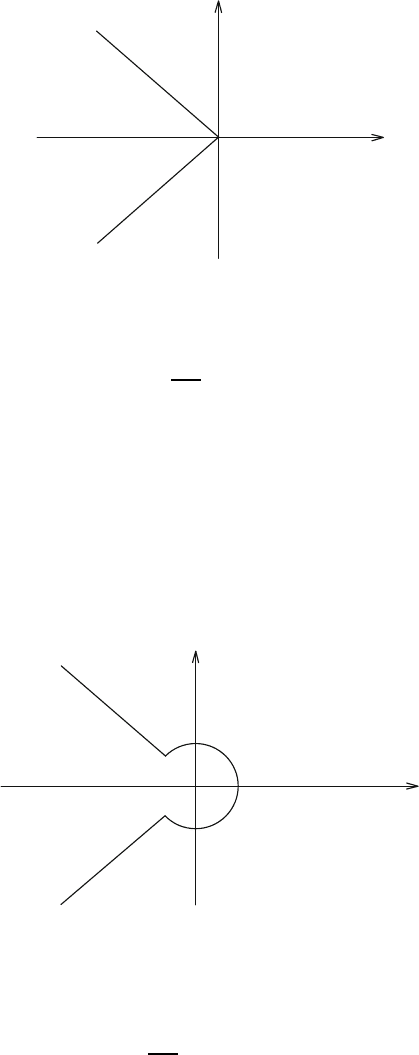
Assume that the operator A satisfies the following two conditions (see
Figure 2.1 below):
(1) The resolvent set of A contains the region
Σ
ω
= {λ ∈ C : λ =0, |arg λ| <π/2+ω}, 0 <ω<π/2.
(2) For each ε>0, there exists a positive constant M
ε
such that the resolvent
R(λ)=(A − λI)
−1
satisfies the estimate
R(λ)≤
M
ε
|λ|
for all λ ∈ Σ
ε
ω
= {λ ∈ C : λ =0, |arg λ|≤π/2+ω − ε}.
(2.1)
K. Taira, Boundary Value Problems and Markov Processes,13
Lecture Notes in Mathematics 1499, DOI 10.1007/978-3-642-01677-6
2,
c
Springer-Verlag Berlin Heidelberg 2009
14 2 Semigroup Theory
0
Σ
ω
Fig. 2.1.
Then we let
U(t)=−
1
2πi
Γ
e
λt
R(λ) dλ. (2.2)
Here Γ is a path in the set Σ
ε
ω
consisting of the following three curves (see
Figure 2.2):
Γ
(1)
=
re
−i(π/2+ω−ε)
:1≤ r<∞
,
Γ
(2)
=
e
iθ
: −(π/2+ω − ε) ≤ θ ≤ π/2+ω − ε
,
Γ
(3)
=
re
i(π/2+ω−ε)
:1≤ r<∞
.
0
Γ
(1)
Γ
(2)
Γ
(3)
Fig. 2.2.
It is easy to see that the integral
U(t)=−
1
2πi
3
k=1
Γ
(k)
e
λt
R(λ) dλ