
Kazuaki Taira. Boundary Value Problems and Markov Processes
Подождите немного. Документ загружается.

108 7 Proof of Theorem 1.2
7.1.1 Proof of Proposition 7.2
The proof of Proposition 7.2 is divided into three steps.
Step 1: First, we study the null spaces N
,
T
p
(θ)
and N (T
p
(λ
)) when
λ
=
2
e
iθ
with ∈ Z:
N
,
T
p
(θ)
=
˜ϕ ∈ B
2−1/p,p
(∂D × S):
,
T (θ)˜ϕ =0
,
N (T
p
(λ
)) =
ϕ ∈ B
2−1/p,p
(∂D):T (λ
)ϕ =0
.
Since the pseudo-differential operators
,
T (θ)andT (λ
)arebothhypoelliptic,
it follows that
N
,
T
p
(θ)
=
˜ϕ ∈ C
∞
(∂D × S):
,
T (θ)˜ϕ =0
,
N (T
p
(λ
)) = {ϕ ∈ C
∞
(∂D):T (λ
)ϕ =0}.
Therefore, we can apply [Ta2, Proposition 8.4.6] to obtain the following most
important relationship between the null spaces N
,
T
p
(θ)
and N (T
p
(λ
))
when λ
=
2
e
iθ
with ∈ Z:
Lemma 7.4. The following two conditions are equivalent:
(1) dim N
,
T
p
(θ)
< ∞.
(2) There exists a finite subset I of Z such that
dim N
T
p
(
2
e
iθ
)
< ∞ if ∈ I,
dim N
T
p
(
2
e
iθ
)
=0 if ∈ I.
Moreover, in this case we have the formulas
N
,
T
p
(θ)
=
5
∈I
N
T
p
(
2
e
iθ
)
⊗ e
iy
,
dim N
,
T
p
(θ)
=
∈I
dim N
T
p
(
2
e
iθ
)
.
Step 2: Secondly, we study the ranges R
,
T
p
(θ)
and R(T
p
(λ
)) when
λ
=
2
e
iθ
with ∈ Z. To do this, we consider the adjoint operators
,
T
p
(θ)
∗
and T
p
(λ
)
∗
of
,
T
p
(θ)andT
p
(λ
), respectively.
The next lemma allows us to give a characterization of the adjoint oper-
ators
,
T
p
(θ)
∗
and T
p
(λ
)
∗
in terms of pseudo-differential operators (cf. [Ta2,
Lemma 8.4.8]):
Lemma 7.5. Let M be a compact smooth manifold without boundary. If T is
a classical pseudo-differential operator of order m on M , we define a densely
defined, closed linear operator
7.1 Proof of Theorem 1.2, Part (i) 109
T : B
s,p
(M) −→ B
s−m+1,p
(M)(s ∈ R)
as follows.
(a) The domain D(T ) of T is the space
D(T )=
ϕ ∈ B
s,p
(M):Tϕ∈ B
s−m+1,p
(M)
.
(b) T ϕ = Tϕ, ϕ ∈D(T ).
Then the adjoint operator T
∗
of T is characterized as follows:
(c) The domain D(T
∗
) of T
∗
is contained in the space
ψ ∈ B
−s+m−1,p
(M):T
∗
ψ ∈ B
−s,p
(M)
,
where p
= p/(p − 1) and T
∗
∈ L
m
cl
(M) is the adjoint of T .
(d) T
∗
ψ = T
∗
ψ, ψ ∈D(T
∗
).
Proof. Let ψ be an arbitrary element of D(T
∗
) ⊂ B
−s+m−1,p
(M), and let
{ψ
j
} be a sequence in C
∞
(M) such that ψ
j
→ ψ in B
−s+m−1,p
(M). Then
we have, for all ϕ ∈ C
∞
(M) ⊂D(T ),
(T
∗
ψ, ϕ)=(ψ, T ϕ)
=(ψ, Tϕ)
= lim
j→∞
(ψ
j
,Tϕ)
= lim
j→∞
(T
∗
ψ
j
,ϕ)
=(T
∗
ψ, ϕ) .
This proves that
T
∗
ψ = T
∗
ψ ∈ B
−s,p
(M).
The proof of Lemma 7.5 is complete.
We remark that the pseudo-differential operators T (λ)
∗
and
,
T (θ)
∗
also
satisfy conditions (3.7a) and (3.7b) of Theorem 3.16 with μ := 0, ρ := 1 and
δ := 1/2; hence they are hypoelliptic.
Therefore, by applying Lemma 7.5 to the operators
,
T (θ)andT (λ
)we
obtain the following:
Lemma 7.6. The null spaces N
,
T
p
(θ)
∗
and N (T
p
(λ
)
∗
) are characterized
respectively as follows:
N
,
T
p
(θ)
∗
=
˜
ψ ∈ C
∞
(∂D × S):
,
T (θ)
∗
˜
ψ =0
.
N (T
p
(λ
)
∗
)={ψ ∈ C
∞
(∂D):T (λ
)
∗
ψ =0}.
110 7 Proof of Theorem 1.2
By using Lemma 7.6, we find that Lemma 7.4 remains valid for the adjoint
operators
,
T
p
(θ)
∗
and T
p
(λ
)
∗
(cf. [Ta2, Lemma 8.4.10]):
Lemma 7.7. The following two conditions are equivalent:
(1) dim N
,
T
p
(θ)
∗
< ∞.
(2) There exists a finite subset J of Z such that
'
dim N
T
p
(
2
e
iθ
)
∗
< ∞ if ∈ J,
dim N
T
p
(
2
e
iθ
)
∗
=0 if ∈ J.
Moreover, in this case we have the formula
dim N
,
T
p
(θ)
∗
=
∈J
dim N
T
p
(
2
e
iθ
)
∗
.
Hence, by combining Lemma 7.7 and the closed range theorem ([Yo,
Chapter VII, Section 5, Theorem]) we obtain the most important relation-
ship between codim R
,
T
p
(θ)
and codim R(T
p
(λ
)) when λ
=
2
e
iθ
, ∈ Z
(cf. [Ta2, Proposition 8.4.11]):
Lemma 7.8. The following two conditions are equivalent:
(1) codim R
,
T
p
(θ)
< ∞.
(2) There exists a finite subset J of Z such that
codim R
T
p
(
2
e
iθ
)
< ∞ if ∈ J,
codim N
T
p
(
2
e
iθ
)
=0 if ∈ J.
Moreover, in this case we have the formula
codim R
,
T
p
(θ)
=
∈J
codim R
T
p
(
2
e
iθ
)
∗
.
Step 3: Proposition 7.2 is an immediate consequence of Lemmas 7.4 and
7.8, with K := I ∪J.
The proof of Proposition 7.2 is now complete.
Summing up, we have proved Theorem 7.1 and hence part (i) of
Theorem 1.2.
7.2 Proof of Theorem 1.2, Part (ii)
Part (ii) of Theorem 1.2 may be proved as follows. Theorem 7.1 asserts that,
for sufficiently large μ
ε
> 0, the operator A
p
− μ
ε
I satisfies condition (2.1)
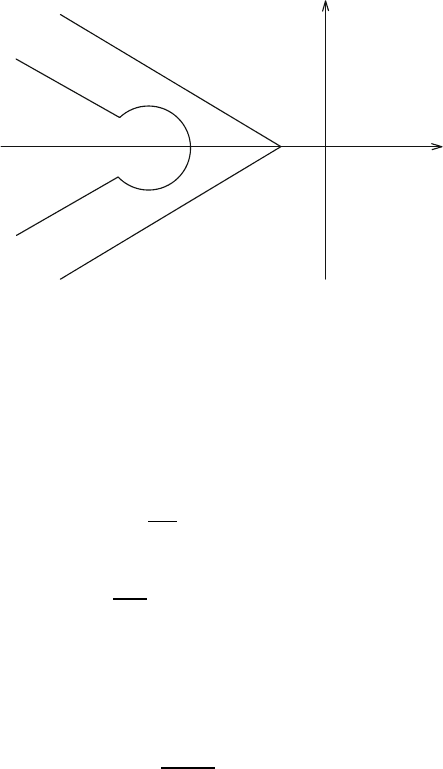
(see Figure 7.1). Thus, by applying Theorem 2.2 (and Remark 2.1) to the
operator A
p
− μ
ε
I we obtain part (ii) of Theorem 1.2:
7.2 Proof of Theorem 1.2, Part (ii) 111
Σ
ω
Fig. 7.1.
Theorem 7.9. Assume that conditions (A) and (B) are satisfied. Then the
operator A
p
generates a semigroup U
z
on L
p
(D) which is analytic in the sector
Δ
ε
= {z = t + is : z =0, |arg z| <π/2 − ε}
for any 0 <ε<π/2, and enjoys the following three properties:
(a) The operators A
p
U
z
and
dU
z
dz
are bounded operators on L
p
(D) for each
z ∈ Δ
ε
, and satisfy the relation
dU
z
dz
= A
p
U
z
for all z ∈ Δ
ε
.
(b) For each 0 <ε<π/2, there exist positive constants
M
0
(ε),
M
1
(ε) and μ
ε
such that
U
z
≤
M
0
(ε)e
μ
ε
·Re z
for all z ∈ Δ
ε
,
A
p
U
z
≤
M
1
(ε)
|z|
e
μ
ε
·Re z
for all z ∈ Δ
ε
.
(c) For each u
0
∈ L
p
(D), we have, as z → 0,z ∈ Δ
ε
,
U
z
u
0
−→ u
0
in L
p
(D).
The proof of Theorem 1.2 is now complete.

8
Proof of Theorem 1.3, Part (i)
This Chapter 8 and the next Chapter 9 are devoted to the proof of Theorem 1.3
and Theorem 1.4. In this chapter we prove part (i) of Theorem 1.3. In the
proof we make use of Sobolev’s imbedding theorems (Theorems 8.1 and 8.2)
and a λ-dependent localization argument due to Masuda [Ma] (cf. Lemma 8.4)
in order to adjust estimate
(A
p
− λI)
−1
≤
c
p
(ε)
|λ|
for all λ ∈ Σ
p
(ε)(1.4)
to obtain the desired estimate
(A − λI)
−1
≤
c(ε)
|λ|
for all λ ∈ Σ(ε). (1.6)
Here we recall that
D(A
p
)=
u ∈ H
2,p
(D)=W
2,p
(D):Lu = μ(x
)
∂u
∂n
+ γ(x
)u =0
. (1.3)
D(A )=
u ∈ C
0
(D \ M ):Au ∈ C
0
(D \ M),Lu=0
. (1.5)
8.1 The Space C
0
(D \ M)
First, we consider a one-point compactification K
∂
= K ∪{∂} of the space
K =
D \ M .
We say that two points x and y of
D are equivalent modulo M if x = y or
x, y ∈ M ;wethenwritex ∼ y.Itiseasytoverifythatthisrelation∼ enjoys
the so-called equivalence laws. We denote by
D/M the totality of equivalence
classes modulo M.Ontheset
D/M we define the quotient topology induced
by the projection
K. Taira, Boundary Value Problems and Markov Processes, 113
Lecture Notes in Mathematics 1499, DOI 10.1007/978-3-642-01677-6
8,
c
Springer-Verlag Berlin Heidelberg 2009
114 8 Proof of Theorem 1.3, Part (i)
q : D −→ D/M.
Namely, a subset O of
D/M is defined to be open if and only if the inverse
image q
−1
(O)ofO is open in D. It is easy to see that the topological space
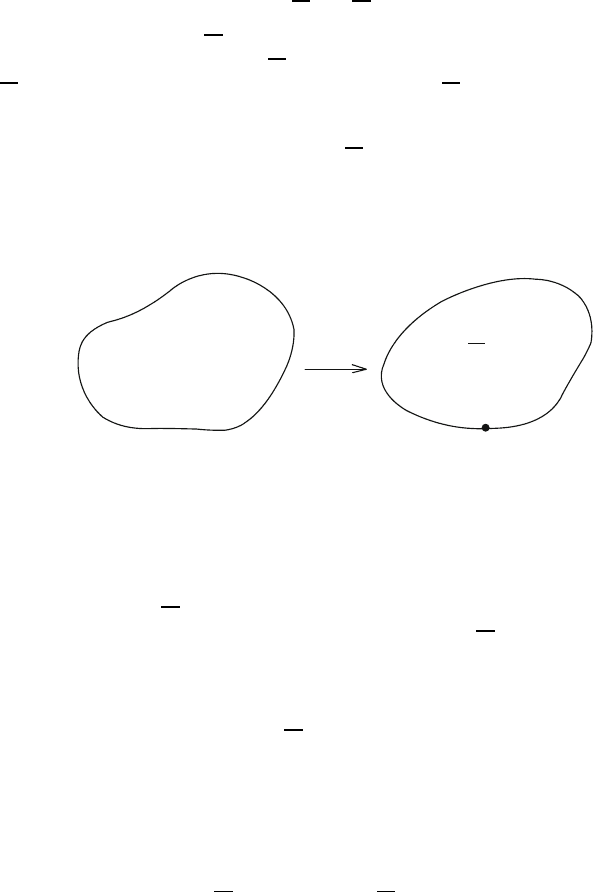
D/M is a one-point compactification of the space D \ M and that the point
at infinity ∂ corresponds to the set M (see Figure 8.1):
K
∂
:= D/M,
∂ := M.
∂
D
D/M
∂D
M
q
Fig. 8.1.
Furthermore, we obtain the following two assertions:
(i) If ˜u is a continuous function defined on K
∂
, then the function ˜u ◦ q is
continuous on
D and constant on M.
(ii) Conversely, if u is a continuous function defined on
D and constant on M,
then it defines a continuous function ˜u on K
∂
.
In other words, we have the following isomorphism:
C(K
∂
)
∼
=
u ∈ C(D):u(x) is constant on M
. (8.1)
Now we introduce a closed subspace of C(K
∂
) as in Subsection 2.2.1:
C
0
(K)={u ∈ C(K
∂
):u(∂)=0}.
Then we have, by assertion (8.1),
C
0
(K)
∼
=
C
0
(D \ M )=
u ∈ C(D):u(x)=0onM
. (8.2)
8.2 Sobolev’s Imbedding Theorems
It is the imbedding characteristics of Sobolev spaces of L
p
type that render
these spaces so useful in the study of partial differential equations. We need
the following imbedding properties of Sobolev spaces:

8.3 Proof of Part (i) of Theorem 1.3 115
Theorem 8.1 (Sobolev). Let D be a bounded domain in the Euclidean space
R
N
with boundary ∂D of class C
2
. Then we have the following two assertions:
(i) If 1 ≤ p<N, we have the continuous injection
W
2,p
(D) ⊂ W
1,q
(D) for
1
p
−
1
N
≤
1
q
≤
1
p
.
(ii) If N/2 <p<∞, p = N, we have the continuous injection
W
2,p
(D) ⊂ C
ν
(D) for 0 <ν≤ 2 −
N
p
.
Theorem 8.2 (Gagliardo–Nirenberg). Let D be a bounded domain in R
N
with boundary of class C
2
,and1 ≤ p, r ≤∞. Then we have the following
assertions:
(i) If p = N and if
1
q
=
1
N
+ θ
1
p
−
2
N
+(1− θ)
1
r
for
1
2
≤ θ ≤ 1,
then we have, for all u ∈ W
2,p
(D) ∩ L
r
(D),
u
1,q
≤ C
1
u
θ
2,p
u
1−θ
r
,
with a positive constant C
1
= C
1
(D, p, r, θ).
(ii) If N/2 <p<∞, p = N and if
0 ≤ ν<θ
2 −
N
p
− (1 − θ)
N
r
,
then we have, for all u ∈ W
2,p
(D) ∩ L
r
(D),
u
C
ν
(D)
≤ C
2
u
θ
2,p
u
1−θ
r
, (8.3)
with a positive constant C
2
= C
2
(D, p, r, θ).
For a proof of Theorem 8.1, see Adams–Fournier [AF, Theorem 5.4] and
for a proof of Theorem 8.2, see Friedman [Fr1, Part I, Theorem 10.1], and also
Taira [Ta4].
8.3 Proof of Part (i) of Theorem 1.3
The proof is carried out in a chain of auxiliary lemmas.
Step (I): We begin with a version of estimate (7.1):
Lemma 8.3. Let N<p<∞. Assume that the following conditions (A) and
(B) are satisfied:

116 8 Proof of Theorem 1.3, Part (i)
(A) μ(x
) ≥ 0 on ∂D.
(B) γ(x
) < 0 on M = {x
∈ ∂D : μ(x
)=0}.
Then, for every ε>0, there exists a positive constant r
p
(ε) such that if
λ = r
2
e
iθ
with r ≥ r
p
(ε) and −π + ε ≤ θ ≤ π −ε, we have, for all u ∈D(A
p
),
|λ|
1/2
|u|
C
1
(D)
+ |λ|·|u|
C( D)
≤ C
p
(ε)|λ|
N/2p
(A − λ)u
p
, (8.4)
with a positive constant C
p
(ε).Here
D(A
p
)=
u ∈ H
2,p
(D)=W
2,p
(D):Lu = μ(x
)
∂u
∂n
+ γ(x
)u =0
.
Proof. First, by applying Theorem 8.2 with p := r>N, θ := N/p and ν := 0
we obtain from the Gagliardo–Nirenberg inequality (8.3) that
|u|
C( D)
≤ C|u|
N/p
1,p
u
1−N/p
p
. (8.5)
Here and in the following the letter C denotes a generic positive constant
depending on p and ε, but independent of u and λ.
Combining inequality (7.1) with inequality (8.5), we find that
|u|
C( D)
≤ C
|λ|
−1/2
(A − λ)u
p
N/p
|λ|
−1
(A − λ)u
p
1−N/p
= C|λ|
−1+N/2p
(A − λ)u
p
,
so that
|λ|·|u|
C( D)
≤ C|λ|
N/2p
(A − λ)u
p
for all u ∈D(A
p
). (8.6)
Similarly, by applying inequality (8.5) to the functions D
i
u ∈ W
1,p
(D),
1 ≤ i ≤ n, we obtain that
|D
i
u|
C( D)
≤ C|D
i
u|
N/p
1,p
D
i
u
1−N/p
p
≤ C|u|
N/p
2,p
|u|
1−N/p
1,p
≤ C ((A − λ)u
p
)
N/p
|λ|
−1/2
(A − λ)u
p
1−N/p
= C|λ|
−1/2+N/2p
(A − λ)u
p
.
This proves that
|λ|
1/2
|u|
C
1
(D)
≤ C|λ|
N/2p
(A − λ)u
p
for all u ∈D(A
p
). (8.7)
Therefore, the desired inequality (8.4) follows by combining inequalities
(8.6) and (8.7).

8.3 Proof of Part (i) of Theorem 1.3 117
The next lemma proves estimate (1.6):
Lemma 8.4. Assume that conditions (A) and (B) are satisfied. Then, for
every ε>0, there exists a positive constant r(ε) such that if λ = r
2
e
iθ
with
r ≥ r(ε) and −π + ε ≤ θ ≤ π − ε, we have, for all u ∈D(A),
|λ|
1/2
|u|
C
1
(D)
+ |λ|·|u|
C( D)
≤ c(ε)|(A − λ)u|
C( D)
, (8.8)
with a positive constant c(ε).Here
D(A )=
u ∈ C
0
(D \ M ):Au ∈ C
0
(D \ M),Lu=0
.
Proof. We shall make use of a λ-dependent localization argument due to
Masuda [Ma] in order to adjust the term (A − λ)u
p
in inequality (8.4)
to obtain inequality (8.8).
First, we remark that
A ⊂ A
p
for all 1 <p<∞.
Indeed, since we have, for any u ∈D(A),
u ∈ C(
D) ⊂ L
p
(D),Au∈ C(D) ⊂ L
p
(D)andLu =0,
it follows from an application of Theorem 4.9 and Lemma 5.1 that
u ∈ W
2,p
(D).
(1) Let x
0
be an arbitrary point of the closure D = D ∪ ∂D.
If x
0
is a boundary point and if χ is a smooth coordinate transformation
such that χ maps B(x
0
,η
0
) ∩ D into B(0,δ) ∩ R
N
+
and flattens a part of the
boundary ∂D into the plane x
N
= 0 (see Figure 8.2), then we let
G
0
= B(x
0
,η
0
) ∩ D,
G
= B(x
0
,η) ∩ D, 0 <η<η
0
,
G
= B(x
0
,η/2) ∩ D, 0 <η<η
0
.
Here B(x, η) denotes the open ball of radius η about x.
Similarly, if x
0
is an interior point and if χ is a smooth coordinate trans-
formation such that χ maps B(x
0
,η
0
)intoB(0,δ), then we let (see Figure 8.3)
G
0
= B(x
0
,η
0
),
G
= B(x
0
,η), 0 <η<η
0
,
G
= B(x
0
,η/2), 0 <η<η
0
.
(2) Now we take a function θ(t)inC
∞
0
(R) such that θ(t) equals one near
the origin, and define
ϕ(x)=θ(|x
|
2
) θ(x
N
),x=(x
,x
N
).
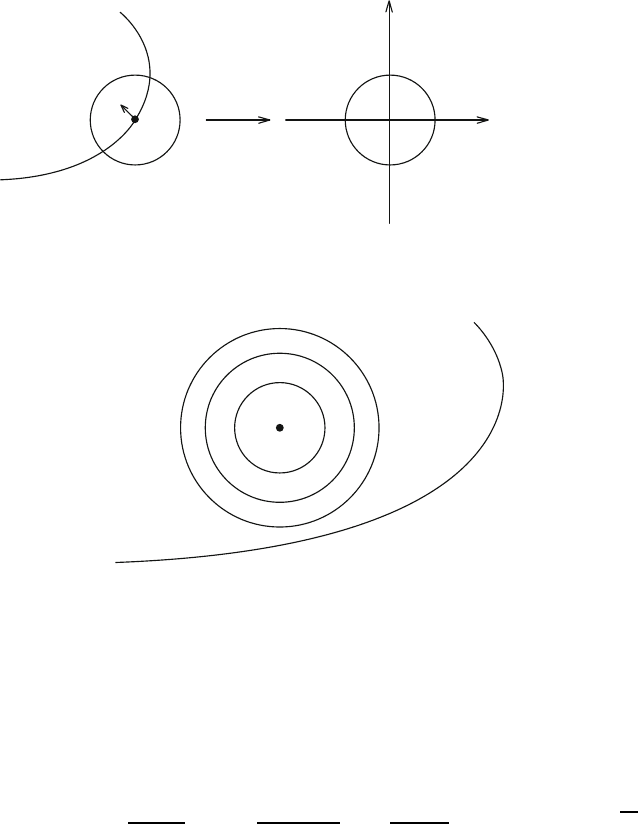
118 8 Proof of Theorem 1.3, Part (i)
n
x
N
x
=(x
1
;:::;x
N−1
)
D
∂D
B(x
0
, η
0
)
B (0;±)
χ
Fig. 8.2.
D
∂D
G
0
= B(x
0
;´
0
)
x
0
G
G
Fig. 8.3.
Here we may assume that the function ϕ(x) is chosen so that
supp ϕ ⊂ B(0, 1),
ϕ(x)=1onB(0, 1/2).
We introduce a localizing function
ϕ
0
(x, η) ≡ ϕ
x − x
0
η
= θ
|x
− x
0
|
2
η
2
θ
x
N
− t
η
,x
0
=(x
0
,t) ∈ D.
We remark that
supp ϕ
0
⊂ B(x
0
,η),
ϕ
0
(x, η)=1onB(x
0
,η/2).
Then we have the following:
Claim 8.5. If u ∈D(A), then it follows that ϕ
0
(x, η)u ∈D(A
p
) for all 1 <
p<∞.