
Kelly J.J. Graduate Mathematical Physics, With MATHEMATICA Supplements
Подождите немного. Документ загружается.


126 5 Integral Transforms
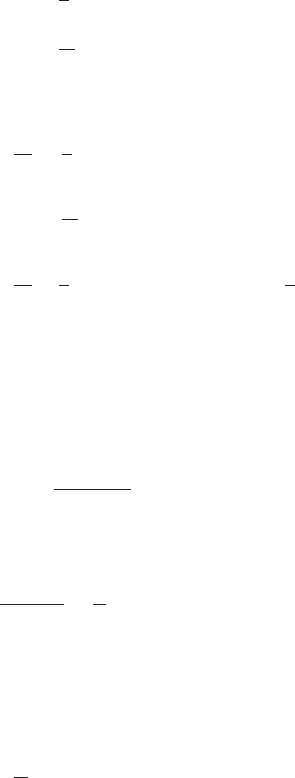
An infinite variety of integral transforms is possible, but the most useful are listed
in Table 5.1. Note that we use the same tilde notation for the transformed function and
trust that the intended operator will be clear from the context. The following sections dis-
cuss the most important properties of these transformations and present examples of their
application to problem solving. One often finds that application of an integral transform
to a linear differential, integral, or integro-differential equation produces a much simpler,
often purely algebraic, equation. Therefore, this technique finds widespread application to
problems involving the response of a linear system to some external influence.
Table 5.1. Common integral transforms.
Type Forward transform Inverse transform
Fourier
˜
f Ω
t
Ωt
f t f t
1
2Π
Ω
Ωt
˜
f Ω
Bessel
˜
f
n
k
0
xxJ
n
kxfx f x
0
kkJ
n
kx
˜
f
n
k
Laplace
˜
f s
0
t
st
f t f t
1
2Π
Γ
Γ
s
st
˜
f s
Mellin
˜
f z
0
tt
z1
f t f t
1
2Π
zt
z
˜
f z
Hilbert
˜
f z
Π
t
f t
tz
f t
Π
z
˜
f z
zt
5.2 Fourier Transform
5.2.1 Motivation
We assume that you are already familiar with Fourier sine and cosine series and their value
in the analysis of periodic phenomena. Suppose that f t is a piecewise smooth function
for
T
2
t
T
2
. By piecewise smooth we mean that there are, at most, a finite number
of distinct discontinuities within tT/2 and that f t has continuous first and second
derivatives in each interval between discontinuities. The Fourier theorem then tells us that
at any point where f t is continuous, the series
f t
a
0
2
n1
a
n
CosΩ
n
t
n1
b
n
SinΩ
n
t , Ω
n
2Πn
T
(5.6)
a
n
2
T
T/2
T/2
t CosΩ
n
t f t (5.7)
b
n
2
T
T/2
T/2
t SinΩ
n
t f t (5.8)
converges to the original function. We will not repeat the proof of this theorem here, but
instead will use Euler’s formula to combine these series using exponentials with complex
arguments, which often simplifies their manipulation and facilitates generalization to the
5.2 Fourier Transform 127
Fourier transform in the limit T !. Thus,
CosΩ
n
t!
1
2
ExpΩ
n
tExpΩ
n
t
(5.9)
SinΩ
n
t!
1
2
ExpΩ
n
tExpΩ
n
t
(5.10)
gives
f t
a
0
2
1
2
n1
a
n
ExpΩ
n
tExpΩ
n
t
1
2
n1
b
n
ExpΩ
n
tExpΩ
n
t
a
0
2
1
2
n1
a
n
b
n
ExpΩ
n
t
1
2
n1
a
n
b
n
ExpΩ
n
t
(5.11)
Recognizing that
Ω
n
Ω
n
b
n
b
n
,b
0
0 (5.12)
we can combine these series by extending n to the negative integers, such that
f t
n
a
n
b
n
2
ExpΩ
n
t (5.13)
Finally, we define
c
n
a
n
b
n
2
1
T
T/2
T/2
t ExpΩ
n
t f t (5.14)
to obtain the complex Fourier series
f t
n
c
n
ExpΩ
n
t (5.15)
c
n
1
T
T/2
T/2
t ExpΩ
n
t f t (5.16)
subject to the same conditions as the sine and cosine series.
Note that if f t is real, then
f
f c
n
c
n
(5.17)
Similarly, for even or odd functions one obtains the symmetry conditions
f tf tc
n
c
n
(5.18)
f tf tc
n
c
n
(5.19)

128 5 Integral Transforms
such that the combined reality and reflection symmetries become
real, even c
n
c
n
(5.20)
real, odd c
n
c
n
(5.21)
Therefore, the complex Fourier series contains the cosine series for even or sine series for
odd functions as special cases. For more general functions, the coefficients are complex
because both sine and cosine terms contribute in unequal proportions. The complex series
is completely equivalent to the original Fourier series, but it is often easier to sum the
exponential form than the trigonometric form.
It is important to recognize that the Fourier series is periodic by construction. Hence,
if f t is not actually periodic, the Fourier series constructed for the interval tT/2
does not represent the original function outside that interval. To produce a good approx-
imation to a nonperiodic function over a wider interval, one must increase T . Thus, a
faithful representation of a nonperiodic function requires the limit T !where the spac-
ing between frequencies becomes infinitesimal and the summation over Ω
n
becomes an
integration over the continuous variable Ω. The Fourier series then becomes the Fourier
transform described in the next section.
5.2.2 Definition and Inversion
A pair of functions related by
f t
Ω
2Π
Ωt
˜
f Ω (5.22)
˜
f Ω
t
Ωt
f t (5.23)
are described as Fourier transforms of each other. The apportionment of two factors of
2Π
1/ 2
between these definitions is purely a matter of convention – some authors multiply
both integrals by 2Π
1/ 2
, but I prefer to apply both factors to one of the integrals. It is
often convenient to employ the operator notation
˜
f f
f t
Ω
t
Ωt
f t (5.24)
f
1
˜
f
1
˜
f Ω
t
Ω
2Π
Ωt
˜
f Ω (5.25)
where the more detailed version includes the input function as an argument and indicates
the output variable explicitly.
These forward and inverse Fourier transforms are related by the orthogonality relations
t
ΩΩ
'
t
2Π∆ΩΩ
'
(5.26)
Ω
Ωtt
'
2Π∆t t
'
(5.27)
5.2 Fourier Transform 129
1 0.5 0 0.5 1
k
0
2
4
6
G #k,R'
R 20
R 10
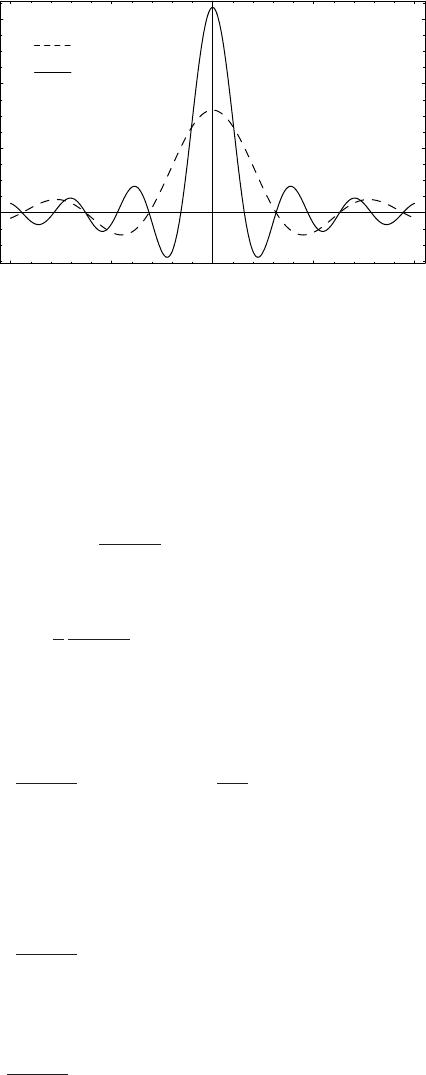
Figure 5.1. Nascent delta functions.
that express the orthogonality of Fourier components with different frequencies. Although
these formulas can be derived by careful analysis of Fourier series when the interval
approaches infinite length, we prefer to employ the method of generalized functions. Con-
sider the integral
R
R
kx
x 2
SinkR
k
(5.28)
whose result is proportional to one of the nascent delta functions
∆k, R
1
Π
SinkR
k
(5.29)
discussed in the previous chapter, except there we used ΣR
1
! 0 and here we use
R !instead. This function is sketched in Fig. 5.1 for two choice of R. The area of this
function is obtained from
SinkR
k
k Im
kR
k
k
(5.30)
where we use the principal value of the exponential form because the singularity in the
original form is removable. Closing with a great semicircle in the upper half-plane, which
does not contribute, the integral reduces to Π times the unit residue of the pole on the real
axis, such that
SinkR
k
k Π (5.31)
Thus, the area is independent of R but becomes increasingly concentrated in a central lobe
around k 0 with height
lim
k!0
SinkR
k
R (5.32)
130 5 Integral Transforms
and width Π/R ! 0asR !; furthermore, the secondary oscillations are much smaller
and their areas cancel almost completely. Therefore, we identify
R
R
kx
x 2Π∆k, Rlim
R!
R
R
kx
x 2Π∆k (5.33)
to obtain the fundamental result
kx
x 2Π∆k (5.34)
that underlies the theory of Fourier transforms.
For the sake of completeness we should mention the conditions required for the exis-
tence of a Fourier transform – the Fourier transform
˜
f Ω exists if f t is piecewise smooth
and is absolutely integrable, meaning that
f t
t< (5.35)
exists and is finite. Then
˜
f Ω
t
Ωt
f t (5.36)
is uniformly convergent by the comparison test and
˜
f Ω satisfies the properties outlined
below. Rigorous proofs of the Fourier theorem can be found in specialized texts, but are
beyond the scope of ours. Furthermore, we sometimes find that it is possible to relax
some of these conditions if we are willing to employ generalized functions. For example,
below we will derive the Fourier transform of the step function even though it violates
the condition on integrability. Thus, these conditions are sufficient, but not always strictly
necessary, for use of the Fourier transform.
5.2.3 Basic Properties
5.2.3.1 Phase
If we require that Ω be real, then inspection of
˜
f Ω
t
Ωt
f t
˜
f
Ω
t
Ωt
f
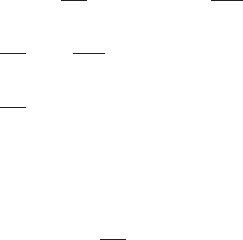
t (5.37)
demonstrates that
f
t f t
˜
f
Ω
˜
f Ω (5.38)
f
tf t
˜
f
Ω
˜
f Ω (5.39)
such that the Fourier transform of a real function is even while the Fourier transform of an
imaginary function is odd.
5.2 Fourier Transform 131
5.2.3.2 Reflection
If f t has a definite reflection symmetry, such that
f tf t
˜
f Ω
˜
f Ω (5.40)
f tf t
˜
f Ω
˜
f Ω (5.41)
then
˜
f Ω shares that symmetry. One can then use either the cosine or sine transforms
for Ω > 0 and t>0, as discussed in a later section.
5.2.3.3 Shifting and Attenuation
Using
f t Τ
t
Ωt
f t Τ
t
'
Ωt
'
Τ
f t
'
(5.42)
one finds that the effect of a time shift on the Fourier transform is an additional phase
factor, such that
f t Τ
ΩΤ
f t
(5.43)
Alternatively, suppose that an exponential damping factor is applied such that
Γt
f t
t
Ωt
Γt
f t
˜
f Ω Γ (5.44)
shifts the frequency into the complex plane.
5.2.4 Parseval’s Theorem
The integrated product of two functions is related to the integrated product of their Fourier
transforms as follows.
tftg
t
t
Ω
2Π
Ωt
˜
f Ω
Ω
'
2Π
Ω
'
t
˜g
Ω
'
Ω
2Π
Ω
'
2Π
∆Ω Ω
'
˜
f Ω˜g
Ω
'
Ω
2Π
˜
f Ω˜g
Ω
(5.45)
If we know that f t and gt are real-valued functions, we can use the phase properties of
Fourier transforms to express Parseval’s theorem in the form
f,greal
tftgt
Ω
2Π
˜
f Ω˜gΩ (5.46)

132 5 Integral Transforms
such that
f real
t
f t
2
Ω
2Π
˜
f Ω
2
Ω
2Π
˜
f Ω
˜
f Ω
2
0
Ω
2Π
˜
f Ω
2
(5.47)
where the squared modulus is often related to the power absorbed or radiated by a system.
Parseval’s theorem then has a simple interpretation – the total energy (power integrated
over time) is the sum of the power found in each interval of frequency. Thus,
˜
f Ω
2
is
proportional to the spectral power density or power radiated per unit interval of frequency.
Naturally, there are variations of the normalization convention.
5.2.5 Convolution Theorem
Suppose that f g P h is defined by the convolution integral
f t
gt t
'
ht
'
t
'
(5.48)
where gt t
'
represents the contribution to f t made by a source ht
'
. Convolution
integrals are found throughout mathematical physics and are often easiest to evaluate using
Fourier transforms. The Fourier transform of f can be related to the Fourier transforms of g
and h, as follows.
˜
f Ω
t
Ωt
t
'
gt t
'
ht
'
t
t
'
Ωt
gt t
'
ht
'
t
t
'
Ωtt
'
gt t
'
Ωt
'
ht
'
s
Ωs
gs
t
'
Ωt
'
ht
'
˜gΩ
˜
hΩ
(5.49)
Notice that we inserted a factor of unity, represented as
Ωt
'
Ωt
'
, into the third line in
order to factor the double integral. This useful trick often simplifies integral transforms.
Thus, we find
g P hgh
˜
f Ω ˜gΩ
˜
hΩ (5.50)
assuming that both ˜g and
˜
h exist. Therefore, the Fourier transform of a convolution of two
functions is the product of the Fourier transforms of the individual functions. Be aware,
though, that other conventions for normalization of the Fourier transform result in different
factors of 2Π in Parseval’s theorem and/or the convolution theorem.
5.2 Fourier Transform 133
Observe that the correlation operator is commutative, associative, and distributive
h P g g P h (5.51)
g Ph P pg P hPp (5.52)
g Ph pg P h g P p (5.53)
if all required integrals exist. These relationships can be demonstrated directly using the
temporal definition, but almost trivial using the convolution theorem because multiplica-
tion shares these properties.
5.2.6 Correlation Theorem
Suppose that the functions gt and ht become similar if their relative time scales are
shifted to match their shapes as closely as possible. We would then describe those functions
as correlated, at least over a finite range of times. A quantitative measure of the degree of
correlation between two functions, gt and ht, is provided by the cross correlation
Cg, ht
gt t
'
ht
'
t
'
(5.54)
where the complex conjugation of one factor ensures that the correlation between complex
exponentials
gt
Ω
1
t
,ht
Ω
2
tΦ
Cg, h2Π∆Ω
1
Ω
2
ExpΩ
1
t Φ (5.55)
reduces to a delta function in frequency with a phase that expresses the time shift. Although
convolution and correlation are different, their similarities suggest that the Fourier trans-
form probably provides a simple theorem for correlation also. Thus, if we let f t
Cg, h, we find
˜
f Ω
t
Ωt
t
'
gt t
'
ht
'
t
t
'
Ωt
g
t t
'
ht
'
t
t
'
Ωtt
'
g
t t
'
Ωt
'
ht
'
s
Ωs
gs
t
'
Ωt
'
ht
'
˜gΩ
˜
hΩ
(5.56)
Therefore, the correlation theorem takes a form
˜
Cg, h˜gΩ
˜
hΩ
(5.57)
that is similar to the convolution theorem, but complex conjugation of one factor does
have important consequences. Although correlation is associative and distributive, it is not
134 5 Integral Transforms
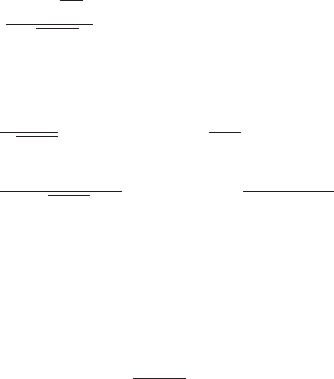
commutative:
Ch, gtC
g, ht
˜
Ch, g
˜
Cg, h
(5.58)
An important special case of correlation is the autocorrelation function, Cg, g, that is
sensitivity of periodic or quasiperiodic behavior. The autocorrelation is obviously strongest
at t 0 and would also exhibit peaks at multiples of the fundamental frequency for a
periodic function, similar to the Fourier series. The closer to true periodicity the narrower
such peaks would be. Thus, the autocorrelation function provides an important empirical
tool for the study of dynamical or statistical systems. Furthermore, the Fourier transform
of the autocorrelation function
˜
Cg, g
˜gΩ
2
(5.59)
is proportional to the power spectrum. This result is known as the Wiener–Khintchine
theorem and is important to the analysis of coherence in optics or the relationship between
fluctuations and dissipation in statistical physics.
5.2.7 Useful Fourier Transforms
5.2.7.1 Gaussian
Suppose that
f t
Exp
t
2
2Σ
2
2ΠΣ
2
(5.60)
is a Gaussian of width Σ and unit area. The Fourier transform
f
1
2ΠΣ
2
t
Ωt
Exp
t
2
2Σ
2
ExpΩ
2
Σ
2
/ 2
2ΠΣ
2
t Exp
t ΩΣ
2
2
2Σ
2
(5.61)
can be evaluated by completing the square; we have already demonstrated that such an
integral can be treated as if the argument of the exponential were real. Thus, we obtain a
Gaussian
f ExpΩ
2
Σ
2
/ 2 (5.62)
with width Σ
1
and area
2Π/ Σ
2
. Notice that
f tt 1
˜
f 01 (5.63)

5.2 Fourier Transform 135
and that the widths of the two Gaussians are reciprocals of each other. For a generic func-
tion gx it is useful to define moments
M
n
gxx
n
x (5.64)
such that
¯x x
M
1
M
0
, Σ
2
x ¯x
2
M
2
M
0
(5.65)
represent the mean and variance of g. Therefore, the variances Σ
t
and Σ
Ω
of a Gaussian and
its Fourier transform are related by
Σ
Ω
Σ
t
1 (5.66)
Similar relationships are observed for other functions that can be described as a localized
peak – the narrower the distribution in one variable (such as time), the broader the distri-
bution in the conjugate variable (such as frequency). The Heisenberg uncertainty principle
in quantum mechanics is closely related to this reciprocal relationship between widths of
a function and its Fourier transform.
5.2.7.2 Chopped Sinusoid
Next, consider the chopped sinusoid
f t
L
M
M
M
M
M
N
M
M
M
M
M
O
0 t<0
ExpΩ
0
t 0 t T
0 T<t
(5.67)
for which
˜
f Ω
T
T
t
ΩΩ
0
t
2T
SinΩ Ω
0
T
ΩΩ
0
T
(5.68)
is the nascent delta function plotted in Fig. 5.2. Although the Fourier transform of a finite
wave train is peaked at its fundamental frequency, Ω
0
, the limitation to a finite time inter-
val T spreads the central peak and produces substantial subsidiary peaks or side-bands.
These characteristics are similar to those of single-slit diffraction: instead of chopping a
wave front in space we are now chopping a wave train in time, but the mathematics is the
same.
An important special case is the rectangular pulse, for which Ω
0
! 0, such that
f t<T t
˜
f Ω
T
T
t
Ωt
2
SinΩT
Ω
(5.69)
clearly exhibits the reciprocal relationship between the widths of a function and its Fourier
transform.