
Kelly J.J. Graduate Mathematical Physics, With MATHEMATICA Supplements
Подождите немного. Документ загружается.

96 3 Asymptotic Series
for any positive n. This relationship requires that the difference between f
n
and f can be
made arbitrarily small if z is sufficiently large for any choice of n. Of course, the smaller n
is, the larger z would have to be to achieve a specified accuracy.
Unlike more familiar convergent series, z
n
g
n
z usually diverges for fixed z as n increas-
es such that
lim
n!
z
n
g
n
z! (3.6)
Thus, the accuracy of f
n
z as an approximation to f z actually deteriorates if too many
terms are included in the series. Given that the error in summing a series is smaller than the
first neglected term, the best approximation to f z for finite z is then obtained by truncat-
ing the series at the smallest term (or, perhaps, the one before). Occasionally f
n
z is actu-
ally convergent with respect to n even though there remains a slight difference from f z for
finite z that decreases as z increases. We consider a series of this type also to be an asymp-
totic approximation to f even though some authors limit that term to divergent series only.
If f
n
z and g
n
z are asymptotic series for f z and gz, one can show that
f
n
zg
n
z f zgz (3.7)
f
n
zg
n
z f zgz (3.8)
Asymptotic series may integrated, but there is no guarantee that f
'
n
z is asymptotically
equal to f
'
z. Finally, the asymptotic series for a given function is unique, but the same
asymptotic series can represent more than one function in an asymptotic sense. For exam-
ple, the asymptotic series for f z
z
for Rez > 0 is the same as that for f z.
In this chapter we explore a few of the methods that can be used to obtain asymp-
totic approximations to some of the functions relevant to theoretical physics. We start
with saddle-point methods because they often provide the simplest methods for obtaining
the leading asymptotic behavior. In particular, we discuss the method of steepest descent
in some detail because it is the most versatile while the closely related but more lim-
ited method of stationary phase is developed in the problems at the end of the chapter.
These methods are often suitable for analyzing integral representations that are obtained
as approximations to the physical behavior of a system under specific conditions, whereas
some of the other methods discussed later in the chapter are more suitable for analysis of
mathematical expressions that are, in principle, exact.
3.2 Method of Steepest Descent
Often one encounters functions of the form
f z
C
Ft,zt (3.9)
where C is a specified contour in the complex t-plane and F is analytic in a domain includ-
ing C. We assume that, for the relevant choices of the parameter z, the contribution made by
the immediate vicinities of the endpoints are negligible and seek an approximation scheme
that takes advantage of the topography of analytic functions.
3.2 Method of Steepest Descent 97
x
y
u
t
0
t
0
v
x
y
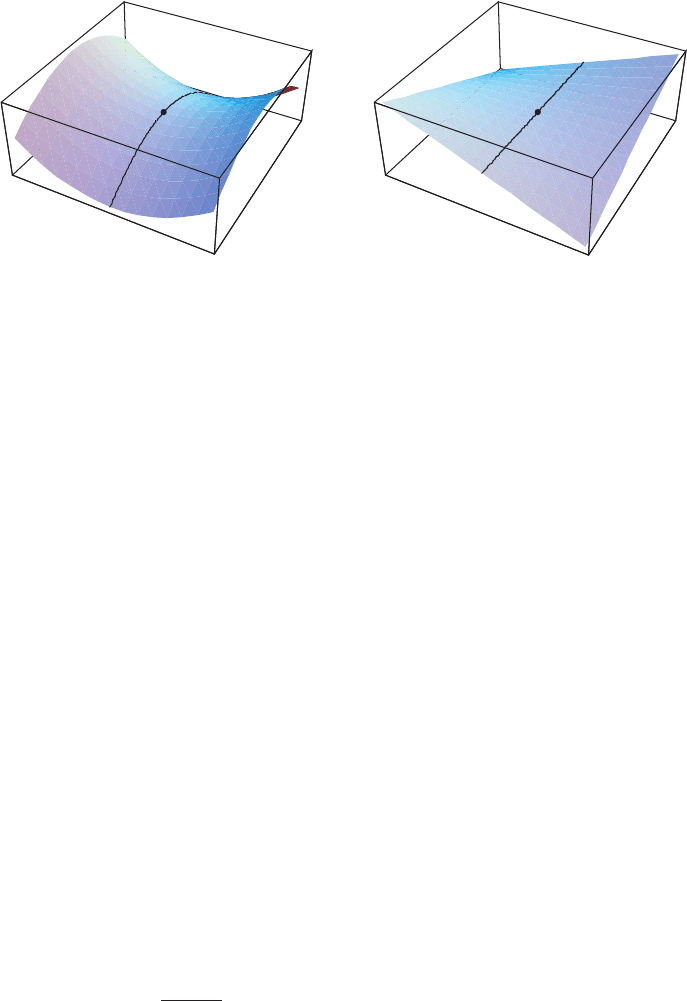
Figure 3.1. Typical saddle with path of steepest descent.
Suppose that the integrand can be represented in the exponential form
Ft,z*Expzgt,z (3.10)
where gt,z is an analytic function of the complex variable t. It is useful to express z r
Θ
in polar form and to absorb the phase into that analytic function by writing
z r
Θ
zgt,zr
utvt
Ft,z*Exprut Exprvt (3.11)
where the real functions ux, y and vx, y are harmonic and t xy. Recall that neither u
nor v can have an extremum, so that any point t
0
where g
'
t
0
0 must represent a simul-
taneous saddle point of both ux, y and vx, y, and that level curves of these two functions
are orthogonal to each other. Therefore, v is constant on the path where u changes most
rapidly. Figure 3.1 illustrates these relationships. The point t
0
is a saddle point for both
u and v. The path of steepest descent for u is a path of constant v. By integrating along
a path of constant v, we avoid the delicate cancellations in the integrand due to the rapid
oscillation of ExprΝ for large r. By selecting the path of steepest descent in u, where
u can be parametrized in the form u * u
0
Αs
2
with positive Α, we ensure rapid con-
vergence of the integral of
rut
t -
Αs
2
s. Thus, the method of steepest descent
can be used whenever it is possible to deform the contour C so that it passes through a
saddle point along this special path. The contribution made by the immediate vicinity of
the saddle point will often provide a very good approximation when r is sufficiently large
and thus represents the lowest term of an asymptotic expansion. The method can also be
generalized for application to more complicated surfaces featuring several saddle points
between the endpoints of the contour. One simply applies this analysis to each saddle point
and adds their contributions.
Near the saddle point we can expand
gtgt
0
g
''
t
0
t t
0
2
2
,,, (3.12)
in parabolic form. It is useful to define
z r
Θ
,t t
0
s
Φ
,g
''
t
0
g
2
Γ
(3.13)
98 3 Asymptotic Series
where r and g
2
are positive real numbers representing the magnitude of z and the curvature
of u at the saddle point, respectively. The angle Γ represents the phase of g
''
t near the
saddle point. A straight path through the saddle point is represented by a constant value
of Φ, describing the orientation of the path, and a real number s varying continuously from
negative to positive values measuring the distance along the path relative to t
0
. Thus, the
argument of the exponential on a path through the saddle point is parametrized by
zgt*zg
0
g
2
rs
2
2
ΘΓ2Φ
(3.14)
We are free to choose Φ in a manner that optimizes our approximation to the contour
integral. The path of steepest descent is selected by choosing Φ according to
ΘΓ2ΦΠΦ
ΠΘΓ
2
, t s
Φ
s (3.15)
such that
zgt*zg
0
Αs
2
(3.16)
where
Α
g
2
r
2
(3.17)
is large and positive for large r, provided that g
2
is not abnormally small (if it is small, we
may need to carry another term). The integrand is then so sharply peaked around s 0
that we can extend the limits of integration to with negligible error and it is easy to
evaluate the resulting Gaussian integral. Hence, we obtain
f z Expzg
0
Φ
ExpΑs
2
s Expzg
0
Φ
Π
Α
Expzg
0
Φ
2Π
g
2
r
(3.18)
Therefore,
f z Expzg
0
Φ
2Π
g
2
z
(3.19)
provides the first term in an asymptotic expansion for f z applicable for large z.
To apply the method we must express the integrand in exponential form and select an
appropriate saddle point of the argument of that exponential through which the contour
can be deformed in a manner that ensures that the integral is dominated by the immediate
vicinity of the saddle point. By identifying the proper contour phase, the leading asymp-
totic behavior can be obtained quite easily. Often one can also develop a systematic series
of corrections, thereby obtaining an asymptotic expansion in negative powers of z.
3.2 Method of Steepest Descent 99
t
h#t',Exp#g#t''
t
h#t',Exp#g#t''
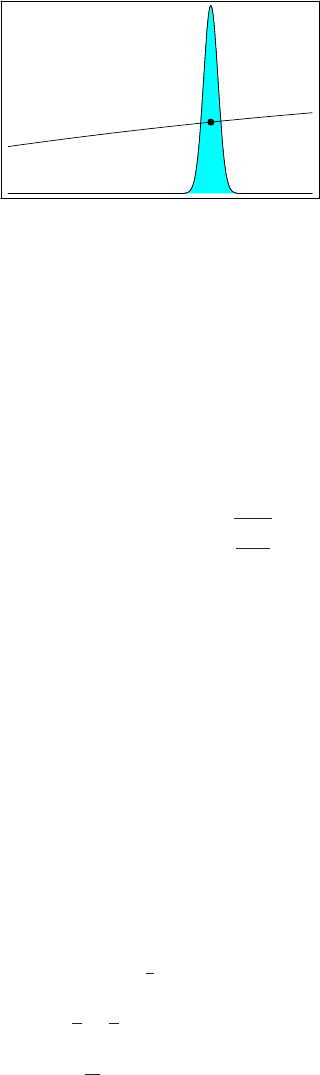
Figure 3.2. Integration of slow fast functions.
The method can be generalized to functions expressible in the form
f z
C
ht Expzgt,z t (3.20)
where ht varies much more slowly on the integration path than does Expzgt,z.Fig-
ure 3.2 illustrates that if ht changes little over the width of the Gaussian approximation
to the exponential factor near the saddle point of gt,z, then ht*ht
0
can be extracted
from the integral such that
f z ht
0
Expzg
0
Φ
2Π
g
2
z
(3.21)
simply has an additional factor.
Approximation is as much art as science. The method of steepest descent provides
one strategy for obtaining a useful approximation to a particular type of function, but
its application depends upon the nature of the particular problem. Rather than memorize
Eq. (3.21), with its definitions of t
0
,g
0
,g
2
, Φ, it is better to understand how the strategy
works and then, if applicable, adapt it to the problem at hand.
3.2.1 Example: Gamma Function
The gamma function for Rez > 0 can be defined in terms of the integral
Az 1
0
t
z
t
t
0
Expz Logttt
0
Expzgt t (3.22)
where z r
Θ
and where
gtLogt
t
z
(3.23)
g
'
t
1
t
1
z
(3.24)
g
''
t
1
t
2
(3.25)
100 3 Asymptotic Series
is an analytic function of t with a parametric dependence on z. The saddle point is defined
by
g
'
t
0
0 t
0
z (3.26)
such that
gt
0
Logz1,g
''
t
0
1
z
2
2Θ
r
2
(3.27)
Thus, we identify
g
2
1
r
2
, ΓΠ2Θ (3.28)
and solve
ΠΘΓ2ΦΠΘ2ΦΦ
Θ
2
(3.29)
to determine that the path of steepest descent is along ΦΘ/ 2. Substituting these values,
we obtain
Az 1 Exp
zLogz1
Θ
2
2Πr
2Πzz
z
z
(3.30)
Finally, recognizing that Az 1zAz, we obtain an approximation
Az
2Π z
z
1
2
z
(3.31)
that is useful for large z and Rez > 0.
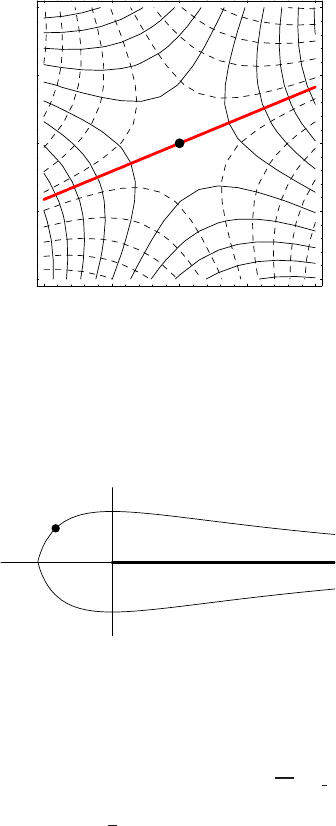
Figure 3.3 illustrates the path of steepest descent for the particular case z 101 ,
for which ΘΠ/ 4 ΦΠ/ 8. Contours for the real and imaginary parts of zgt,z
are indicated by solid and dashed lines, the saddle point is labeled by t
0
, and the path of
steepest descent is shown as a thick line. The complete contour in the t plane begins at
the origin and is approximated by this line in a region surrounding t
0
that is large enough
to accumulate most of the integral, and then approaches the positive real axis, t !
, from above. In fact, by using the more general integral representation of the gamma
function, given by
Az
1
Exp2Πz1
C
t
z1
t
t (3.32)
for the positive contour indicated in Fig. 3.4 (recall Eq. 2.100)), one can demonstrate that
the same asymptotic approximation also applies when Rez < 0. One simply deforms the
contour to pass through the saddle point t
0
z with the proper slope. This generalization
is left as an exercise for the reader.
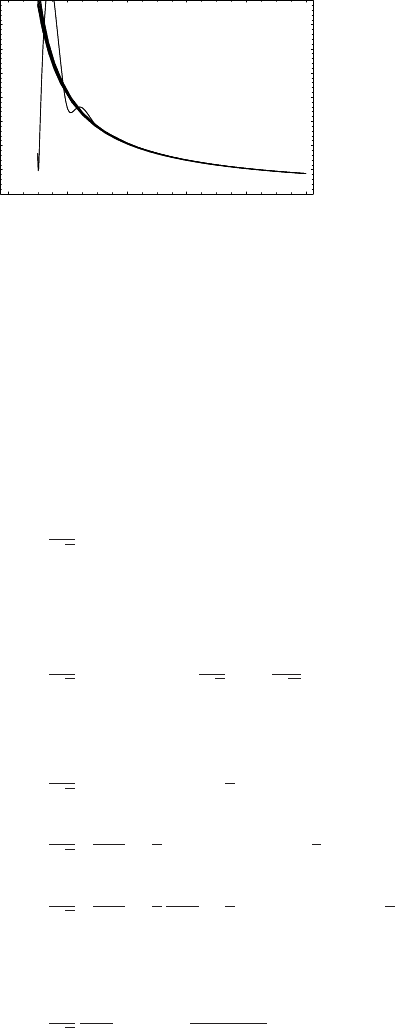
The accuracy of this approximation is illustrated in Fig. 3.5, which was produced using
the code below. Curves are shown for 0 Θ2Π in steps of Π/8. Interest-
ingly, the approximation remains successful even for rather small r, except in the immedi-
ate vicinity of ΘΠwhere the poles in Az are found; this is the curve which stands out.
3.3 Partial Integration 101
9 9.5 10 10.5 11
9
9.5
10
10.5
11
t
0
Figure 3.3. Portion of a contour for the integral representation of A101 near the saddle point
for t
0
. The heavy curve shows the path of steepest descent while level curves of u and v are shown
as thin solid and dashed curves, respectively.
Re#t'
Im#t'
t
0
Figure 3.4. A contour for Eq. (3.32) that passes through a saddle point t
0
for Rez < 0.
Sometimes results of this type have broader applicability than suggested by the assump-
tions employed in their derivation.
PlotEvaluate
Table
Abs
1
2Π z
z
1
2
z
/ Gammaz
/.z r
Θ
,
Θ,0,2Π,
Π
8
, r, 1, 10, PlotRange Automatic, 0, 0.08,
Frame True, FrameLabel "r", "relative error"
3.3 Partial Integration
Suppose that a function is defined by an integral of the form
f z
z
gt,zt or f z
z
0
gt,zt (3.33)
where the independent variable appears in one of the limits of integration. Repeated inte-
gration by parts can then generate a series in z leaving a remainder term in the form of an
102 3 Asymptotic Series
0 2 4 6 8 10
r
0.01
0.02
0.03
0.04
0.05
0.06
0.07
0.08
Relative error
Figure 3.5. Accuracy of asymptotic approximation to Ar
<
. Curves are shown for 0 Θ2Π in
steps of Π/ 8; only the curve for ΘΠis clearly separated for small r.
integral that is hopefully much smaller in the limit z!. One example should suffice to
illustrate the method.
3.3.1 Example: Complementary Error Function
The complementary error function
erfcx
2
Π
x
t
2
t (3.34)
representing the fraction of the area in the wings of a Gaussian probability distribution is
important in statistics. It is useful to re-express this function as
erfcx
2
Π
x
t
2
t
1
Π
x
2
w
w
w
(3.35)
and then integrate by parts repeatedly to obtain
erfcx
1
Π
w
1/ 2
w
x
2
1
2
x
w
w
w
3/ 2
1
Π
x
2
x
1
2
w
3/ 2
w
x
2
3
2
x
w
w
w
5/ 2
1
Π
x
2
x
1
2
x
2
x
3
3
4
w
5/ 2
w
x
2
5
2
x
w
w
w
7/ 2
(3.36)
The pattern should now be achingly clear. Thus, we write
erfcx
1
Π
x
2
x
3
4
4
4
4
4
5
1
n
k1
2k 1!!
2x
2
k
6
7
7
7
7
7
8
(3.37)
where n should be chosen to give the best approximation for specified x.
3.3 Partial Integration 103
0 10 20 30 40
k
1. 10
9
1. 10
7
0.00001
0.001
0.1
a
k
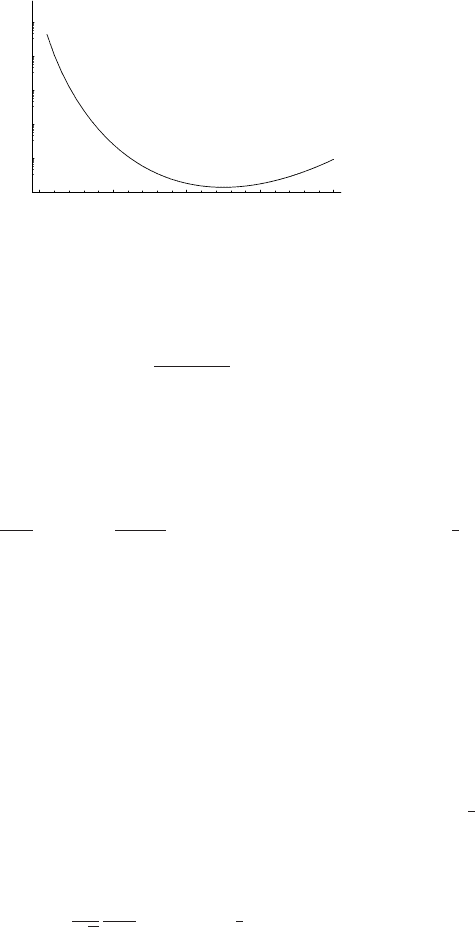
Figure 3.6. Convergence for erfc5.
Let
S
n
n
k1
a
k
,a
k
2k 1!!
2x
2
k
(3.38)
represent a sequence of partial sums. For any finite x the sequence eventually diverges
because the terms a
k
begin to grow for k>k
max
. The optimum number of terms is given
by
a
k1
a
k
< 1
2k 1
2x
2
< 1 k
max
Max
0, Floor
x
2
1
2
(3.39)
where Floorx is the largest integer less than or equal to x. Figure 3.6, showing a
k
, demon-
strates that for x 5 the first term already provides 2 significant figures while the accuracy
of the optimum sum is better than 10 significant figures. It is also clear that accuracy is
lost if too many terms are taken.
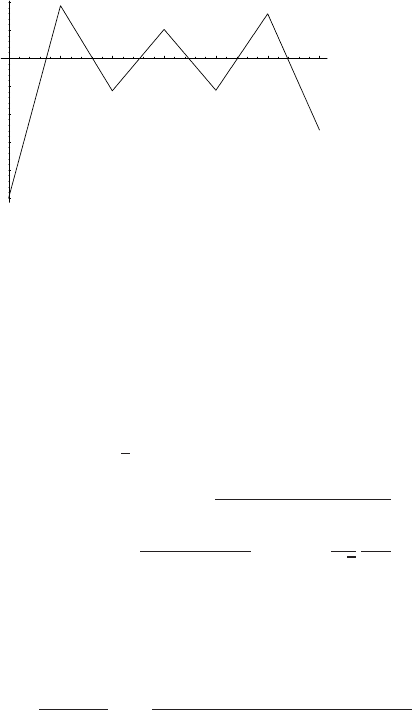
However, Fig. 3.7 plotting terms a
k
for x 2, for which k
max
3, suggests that this
approximation is limited to a few percent accuracy if x is as small as 2. These characteris-
tics illustrate the basic nature of asymptotic expansions.
A better approximation is available for series whose terms alternate in sign. Although
the term a
4
is slightly too large in the figure above, we expect that S
3
is slightly too small
and we expect that a better approximation will be given by S
3
1
2
a
4
. Thus, it would appear
that the best asymptotic approximation is obtained by averaging partial sums for k
max
and
k
max
1 terms, such that
erfcx
1
Π
x
2
x
1 S
k
max
1
2
a
k
max
1
(3.40)
although we do not have a formal proof of that hypothesis. This technique of optimizing
an asymptotic approximation is sometimes called Richardson extrapolation. The follow-
ing function evaluates our asymptotic approximation to erfcx. Richardson
extrapolation is used by default, but can be disabled by including the option Extrapola-
104 3 Asymptotic Series
2 3 4 5 6 7
k
0.125
0.1
0.075
0.05
0.025
0.025
0.05
a
k
Figure 3.7. Convergence for erfc2.
tion ! False.
Clearerfc
OptionserfcExtrapolate True
er fcx_,opts___RuleModulekmax, sum, extrapolate,
extrapolate Extrapolate/.opts/.Optionser fc
kmax Floorx
2
1
2
sum Ifkmax > 0, 1 Plus@@
2Rangekmax1!!
2x
2
Rangekmax
Ifextrapolate,
2kmax 1!!
22x
2
kmax1
,0,1
1
Π
x
2
x
sum
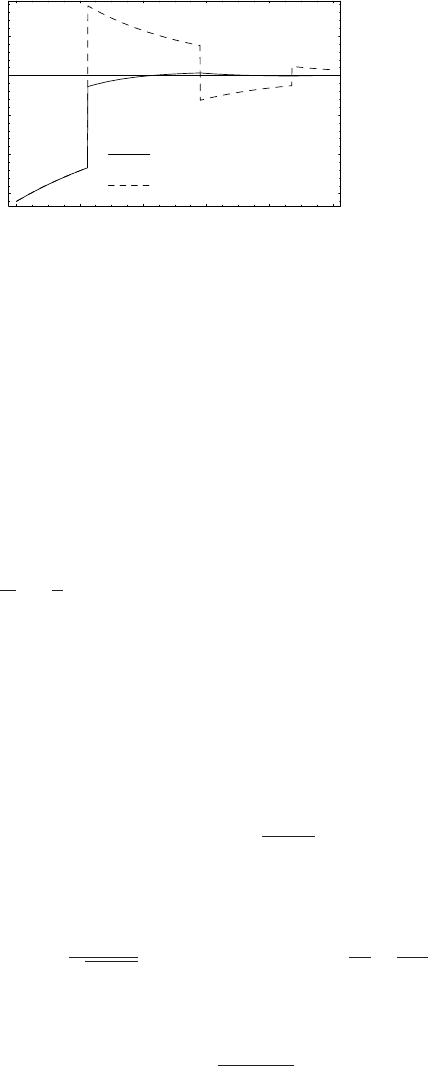
The improvement obtained by extrapolation is illustrated in Fig. 3.8, which was pro-
duced by the code below. Extrapolation clearly improves the approxima-
tion, which is better than 1 % for x>1.3. The approximation is poor for x<1, but
improves rapidly.
Plot1
er fcx
Erfcx
,1
er fcx,Extrapolate False
Erfcx
,
x, 1, 2, PlotRange All, PlotStyle , Dashing0.02, 0.02,
Frame True, FrameLabel "x", "relative error",
PlotLabel "asymptotic approximation to er fcx",
PlotLegend "with extrapolation", "without extrapolation",
LegendPosition 0.2, 0.4,
LegendSize 0.7, 0.3, LegendShadow None
3.4 Expansion of an Integrand
If the function is defined in terms of a definite integral
f z
b
a
gt,zt (3.41)
3.4 Expansion of an Integrand 105
1 1.2 1.4 1.6 1.8 2
x
0.3
0.2
0.1
0
0.1
Relative error
with extrapolation
without
extrapolation
Figure 3.8. Asymptotic approximation to Erfcx.
where a and b are fixed, while the integrand gt,z is amenable to asymptotic expansion
with respect to z, the expansion for f z can be generated by integration term by term. This
method is most useful when each term is sufficiently localized with respect to t that the
limits of integration can be extended without appreciable change in the integral. Again,
one example should suffice to illustrate the method.
3.4.1 Example: Modified Bessel Function
Without deriving this integral representation at this time, we can use
I
0
x
2
2
2
Π
x
2
/ 2
Π/ 2
0
Expx
2
Sint
2
t (3.42)
to derive an asymptotic approximation to the modified Bessel function of the first kind with
order 0, namely I
0
x. This integral representation is convenient because as x increases the
integral becomes increasingly dominated by small t, which permits extension of the upper
limit to with little error. Hence, we consider the integral
f x
Π/ 2
0
Expx
2
Sint
2
t (3.43)
and use a change of variables
w Sintw Costt
1 w
2
t (3.44)
to write
f x
1
0
x
2
w
2
1 w
2
w
1
0
w
x
2
w
2
1
w
2
2
3w
4
8
,,,
(3.45)
or
f x
1
0
w
x
2
w
2
3
4
4
4
4
4
5
1
k1
2k 1!!
2
k
k!
w
k
6
7
7
7
7
7
8
(3.46)