
Kelly J.J. Graduate Mathematical Physics, With MATHEMATICA Supplements
Подождите немного. Документ загружается.

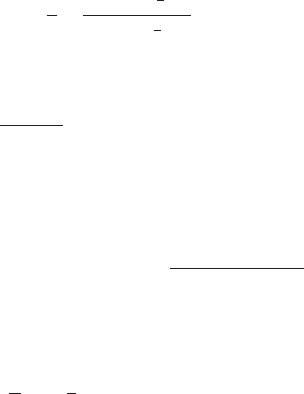
56 1 Analytic Functions
3. Applications of de Moivre’s theorem
Show that
CosnΘ CosΘ
n
n
2
CosΘ
n2
SinΘ
2
n
4
CosΘ
n4
SinΘ
4
... (1.270)
SinnΘ
n
1
CosΘ
n1
SinΘ
n
3
CosΘ
n3
SinΘ
3
... (1.271)
4. Lagrange’s trigonometric identity
Prove:
n
k0
CoskΘ
1
2
Sin
n
1
2
Θ
2Sin
Θ
2
(1.272)
Hint: first prove
n
k0
z
k
1 z
n1
1 z
(1.273)
5. Quadratic formula
a) Prove that
az
2
bz c 0 z
b
2
4ac
1/ 2
b
2a
(1.274)
applies even when a, b, c are complex. Why did we not use a sign in front of the
square root?
b) Use the quadratic formula to determine all roots of the equation Sinz2. (Hint:
Sinz
1
2
w
1
w
where w
z
.)
6. Assorted trigonometric equations with complex solutions
Find all solutions to the following equations assuming that a, b are real numbers and that
a > 1, b > 1. Express your results in the form z x y where x, y are real-valued
expressions that do not involve trigonometric functions and be sure to consider all cases.
a) Cosza
b) Coszb
7. Series RLC circuit
A circuit contains resistance R, inductance L, and capacitance C in series with a generator
of electromotive force t
0
CosΩt.LetIt represent the current flowing in the
circuit and Qt the charge stored in the capacitor. It is useful to express the physical
quantities
tRe
ˆ
Ωt
,ItRe
ˆ
I
Ωt
,QtRe
ˆ
Q
Ωt
(1.275)
in terms of complex phasors
ˆ
,
ˆ
I, and
ˆ
Q that represent both the magnitudes and relative
phases for sinusoidal time dependencies.

Problems for Chapter 1 57
a) Use Kirchhoff’s laws to derive a phasor generalization of Ohm’s law,
ˆ
ˆ
I
ˆ
Z, where
the impedance
ˆ
Z Z
Φ
is generally complex. Express the modulus, Z, and the phase,
Φ, of the complex impedance in terms of the real parameters of the circuit.
b) Show that the power averaged over a cycle is given by
¯
P
1
2
Re
ˆ
I
ˆ
and evaluate
this quantity in terms of real parameters. Show that
¯
PΩ exhibits a resonance and
determine its position and full width at half maximum (FWHM). Sketch
¯
PΩ and
ΦΩ together.
8. Smith chart
The complex impedance Z R X for an AC circuit is decomposed into resistive and
reactive components, R and X, where R>0 and <X<. Smith proposed a repre-
sentation
W u v
Z 1
Z 1
(1.276)
that maps the right half-plane for Z onto the unit disk for W. Determine the mappings for
lines of constant R and lines of constant X. Sketch illustrative samples of each.
9. Bilinear mapping
Study the bilinear mapping
w
az b
cz d
,ad bc 0 (1.277)
by determining the images in the w-plane of representative lines and circles in the z-plane.
10. Component functions
Develop explicit expressions for the real and imaginary components, ux, y and vx, y for
the following functions of z x y.
a) f zz
2
1
1/ 2
b) gzz 1
1/ 2
z 1
1/ 2
11. Inverse trigonometric functions
Prove:
arcsinzlog
z
1 z
2
1/ 2
(1.278)
arccoszlog
z
z
2
1
1/ 2
(1.279)
arctanz
2
log
z
z
(1.280)
This can be done by expressing equations of the form z Sin f in exponential form,
substituting w
f
, solving for w, and deducing fz. Determine the branch cuts needed
to specify the principal branch of each function.
12. An identity
Prove: ArcTan
2z
z
2
1
2ArcCotz

58 1 Analytic Functions
13. Principal value for an imaginary power
Suppose that
Η
a 1
a 1
b
(1.281)
where a, b are real.
a) Show that this quantity is real and find a simple expression for its principal value.
b) Determine the position and magnitude of any discontinuities.
14. Derivative wrt z
Show that a function f x, y of two real variables can be expressed as a function gz, z
of the complex variable z x y and its complex conjugate z
x y. Then show
that the requirement (g/(z
0 is equivalent to the Cauchy–Riemann equations for the
components of f and argue that an analytic function is truly a function of a single complex
variable, instead of two real variables.
15. Analyticity of conjugate functions
Suppose that f z is analytic in some region.
a) Under what conditions is gz f z
analytic in the same region?
b) Under what conditions is hz f z
analytic?
c) Under what conditions is wz f z
analytic?
16. Completion of analytic functions
Which of the following functions ux, y are the real parts of an analytic function f z with
z x y?Ifux, yRe f z, determine f z.
a) u x
3
y
3
b) u x
2
y
2
y
17. Analyticity for the sum, product, quotient, or composition of two functions
Suppose that f
1
zu
1
x, y v
1
x, y and f
2
zu
2
x, yv
2
x, y are analytic functions
of z xy. Show that f
1
f
2
, f
1
f
2
, f
1
/f
2
, and f
1
f
2
z are analytic functions under appro-
priate conditions by demonstrating consistency with the Cauchy–Riemann equations. Be
sure to specify the requisite conditions for each case.
18. Equipotentials and streamlines for exponential function
Sketch the equipotentials ux, y and streamlines vx, y for w
z
where z x y and
w u v.
19. Equipotentials and streamlines for Tanh
Evaluate and sketch the equipotentials and streamlines for the hyperbolic tangent.
20. Cauchy–Riemann equations in polar form
Suppose that z x y r
Θ
is expressed in polar form and let f zR
<
where Rr,Θ
and <r, Θ are real functions of r and Θ. Derive Cauchy–Riemann equations relating
(R
(r
to

Problems for Chapter 1 59
(<
(Θ
and
(R
(Θ
to
(<
(r
for differentiable functions. (Hint: consider infinitesimal displacements
z
r
and z
Θ
in the ˆr and
ˆ
Θ directions.)
21. Circular average of analytic function
Demonstrate that if f z is analytic within the disk z z
0
R then the average value of
f z
0
r
Θ
on any circle z z
0
r<Ris equal to the value at its center, f z
0
.
22. Maximum modulus principle
Prove that, if f z is analytic and not constant within a region R, then f z does not have
a maximum within the interior of R. Hence, if f is analytic and not constant within R, f
must reach its maximum value on the boundary of R.
23. Extrema of harmonic functions
Suppose that ux, y is harmonic and not constant within region R. Prove that ux, y has
no extrema (neither maximum nor minimum) within R; hence, its extrema must be found
on the boundary of R. [Hint: apply the maximum modulus principle to
f z
where f is
analytic within R.]
24. Absence of extrema in f for analytic functions
If f z is analytic in domain D, demonstrate that f z has no extrema in D. Hint: use
the Taylor series representation to show that no neighborhood z z
0
<rcontains an
extremum.
25. An application of the Cauchy integral formula
Suppose that f z is analytic on and within the simple closed positive contour C. Evaluate
the following integrals.
a)
1
2Π
C
tft
t
2
z
2
t
b)
1
2Π
C
t
2
z
2
t
2
z
2
f tt
26. Derivatives of analytic functions
Assume that f z is analytic on and within a positive simple closed contourC that encloses z.
Use induction to prove
f
n
z lim
$z!0
f
n1
z $z f
n1
z
$z
n!
2Π
C
w
f w
w z
n1
(1.282)
where f
n
is the n
th
derivative of f .
27. Fundamental theorem of integral calculus
Prove the fundamental theorem of integral calculus: If f z is analytic in a simply con-
nected domain D that includes z
0
and z, then
Fz
z
z
0
f tt (1.283)
is also analytic in D and f zFz/ z.

60 1 Analytic Functions
28. Poisson integral formula
a) Suppose that f z is analytic within the disk zr a. Prove
f z
1
2Π
C
3
4
4
4
4
4
5
f s
s z
f s
s
a
2
z
6
7
7
7
7
7
8
s (1.284)
where C is a circle of radius a centered on the origin. Then deduce the Poisson integral
formula
f
r
Θ
a
2
r
2
2Π
2Π
0
f a
Φ
a
2
r
2
2ar CosΦ Θ
Φ (1.285)
b) Suppose that we know the electrostatic potential Ψ on the surface of a long cylinder as
the real part of an analytic function (consider only two spatial dimensions). Obtain a
general formula for the potential at any point within the cylinder. Compare the poten-
tial at the origin with the mean-value theorem. Note that, although a formal proof is
not required, the Poisson integral formula can be applied for any function that is har-
monic within C except for a finite number of jump discontinuities upon C.
c) As a specific illustration, compute the interior potential given that Ψa
Φ
has the
constant value V for Φ
1
ΦΦ
2
and is zero on the rest of the cylinder. Display
the angular dependence for a representative selection of r values for some choice of
Φ
2
Φ
1
.
29. Uniform convergence of power series
Suppose that the power series f
n
z
n
k0
a
k
z
k
converges absolutely such that f z
lim
n!
f
n
z for z <R. Show that f
n
z converges uniformly in any subdisk zB<R.
30. Convergence of series representation for
z
Demonstrate explicitly that the series
k0
z
k
/k! is absolutely convergent for all z and that
it is uniformly convergent in zR for any finite R. Can one properly claim uniform
convergence for all z?
31. Sharpened ratio test
a) The integral test can be used to established absolute convergence of the series repre-
sentation of the Riemann zeta function
Ζz
n1
n
z
(1.286)
when Rez > 1. Use the Weierstrass theorem to prove that Ζz is analytic for Rez >
1. (This function has an important role in number theory and often appears in theoret-
ical physics. It can be extended to most of the complex plane by analytic continuation,
but that is beyond the scope of this problem.)
b) Use this result to obtain a sharpened form of the ratio test that states when the ratio of
successive terms takes the form
a
n1
a
n
1
s
n
(1.287)
for large n, the series converges absolutely if s>1.

Problems for Chapter 1 61
c) Prove the existence of Euler’s constant
Γlim
n!
3
4
4
4
4
4
5
n
k1
1
k
Logn
6
7
7
7
7
7
8
(1.288)
32. Laurent series
For each of the following functions, construct a complete set of Laurent series about the
specified point and specify their convergence regions.
a) f z
1
z1z2
about z 0
b) fz
2z
z
2
1
about z 2
c) f z
1
z
2
1
1/ 2
about z 0
d) fzSin
z
1
z
about z 0
33. Laurent expansion for z
2
Log
z
1z
a) Define a single-valued branch for
f zz
2
Log
z
1 z
(1.289)
and specify the region where your definition is real.
b) What is the nature of the singularity at infinity?
c) Construct a Laurent expansion for z > 1.
34. Some trigonometric series based upon a Laurent series
Evaluate the Laurent series for z a
1
where 1 <a<1 in the region z >a. Then use
z !
Θ
to compute
m1
a
m
CosmΘ and
m1
a
m
SinmΘ.
35. Grounded cylinder normal to uniform external field
a) Suppose that an infinitely long conducting cylinder of radius a is grounded. The cylin-
der is subjected to a uniform external electric field directed perpendicular to its sym-
metry axis. Use an analytic function to evaluate and sketch the equipotential surfaces
and the net electric field. (Hint: expand @zΦzΨz as a Laurent series around
the origin and determine the coefficients using the appropriate boundary conditions.)
b) A two-dimensional incompressible fluid flows around an infinite cylinder whose axis
is normal to the plane of motion. At large distances the velocity field is uniform.
Evaluate and sketch the streamlines near the cylinder using an analytic function.
36. Isolated singularities
Classify the isolated singularities for each of the following functions. Be sure to consider
the point at ,usingz ! 1/wwith w ! 0.
a)
z
2
1 z

62 1 Analytic Functions
b)
1 Cosz
z
c) z
1/z
d)
z
z
2
0
2
37. Singularity sequence
Identify and classify the singularities of
f z
1
Sin1/z
(1.290)
Is the singularity at the origin isolated? Is it a branch point?
38. Residues
Locate the poles for each of the following functions and evaluate their residues.
a)
z 1
z
2
z 2
b) Tanhz
c)
z
z
2
Π
2
d)
1
z
n
z
1
(integer n)
39. Pole expansions
Develop pole expansions for the following functions, being sure to verify that the necessary
conditions are satisfied.
a) Cotz
b) Cscz
40. Product expansions
Develop product expansions for the following functions, being sure to verify that the nec-
essary conditions are satisfied.
a) Cosz
b) Sinhz
41. Product expansion for even functions
Suppose that f z is entire and is even, such that f z f z, and that its roots are all
simple. Also assume that, except for simple poles, its logarithmic derivative is bounded at
infinity such that the product expansion of f z converges.
a) Show that the product expansion can be expressed in the form
f z f 0
n1
3
4
4
4
4
5
1
z
z
n
2
6
7
7
7
7
8
(1.291)
where f z
n
0 and where the product includes only one member of each pair of
roots.

Problems for Chapter 1 63
b) Show that
f
''
0
f 0
2
n1
1
z
2
n
(1.292)
f
4
0
f 0
3
f
''
0
f 0
2
12
n1
1
z
4
n
(1.293)
c) Apply these results to f zSinz/zand evaluate the following sums:
n1
n
2
n1
n
4
(1.294)
42. Contour integration of logarithmic derivative
Suppose that f z is analytic within a domain D containing the positive simple closed
contour C. The function Φz f
'
z/fz is known as the logarithmic derivative of f .Let
I
1
2Π
C
Φzz (1.295)
a) Suppose that z
0
is the only zero of f within D and is of order m. Show that I m if C
encloses z
0
.
b) Evaluate I assuming that f
'
z0inD and that C encloses N roots of f but that
f z0onC.
43. Argument principle
a) Suppose that f z is analytic and nonzero on the positive simple closed contour C
and that it is meromorphic in the domain D contained within C. The function Φz
f
'
z/fz is known as the logarithmic derivative of f . Prove that
1
2Π
C
Φzz N
0
N
p
(1.296)
where N
0
is the number of zeros and N
p
is the number of poles in D where each
accounts for multiplicity (e.g., a double root or double pole counts twice).
b) Show that
C
Φzz $
C
argf 2ΠN
0
N
p
(1.297)
measures the change in the argument of f z as z moves around C. (Hint: consider the
image C !Aunder the mapping w f z.)
44. Rouchés theorem
Prove that if f z and gz are both analytic on and within the simple closed contour C and
gz < f z on C, then f z and f zgz have the same number of zeros within C.

2 Integration
Abstract. Contour integration provides very powerful methods for evaluating inte-
grals. We also consider several useful tricks that are more elementary but sometimes
unfamiliar. Finally, integral representations are introduced for a variety of functions.
2.1 Introduction
Integration in closed form is rapidly becoming a lost art. Unlike differentiation, whose
clear rules permit direct if tedious evaluation, integration often relies upon trial and error
with many dead ends. In the heroic era of theoretical physics, cleverness in changing vari-
ables or choosing contours was revered, but now practically any integral that can be done
in closed form may be found in standard compilations, such as Gradshteyn and Ryzhik, or
in mathematical software, such as . Although some skill in symbolic integra-
tion is still needed for traditional examinations, for most physicists its usefulness beyond
the PhD qualifier examination is rather limited, unless you happen to be teaching a course
that still relies on the methodology of the nineteenth century. Nevertheless, compilations
are not entirely complete and software packages are not perfect. Furthermore, traditional
integration methods remain useful for developing insightful approximations to integrals
that cannot be evaluated fully in closed form. Numerical methods provide answers but
limited insight. Therefore, in this chapter we briefly present some of the most useful sym-
bolic techniques. We also discuss integral representations of analytic functions.
2.2 Good Tricks
Presumably integration by parts and variable transformations are too familiar to merit
discussion here, but there are several other elementary methods that are quite valuable
but with which students are generally less familiar.
2.2.1 Parametric Differentiation
Often when one integral is known, an entire family of related integrals can be developed
by differentiating with respect to a parameter in the integrand. For example, given
I
0
Λ
0
Λx
x
1
Λ
(2.1)
the entire family
I
n
Λ
0
x
n
Λx
x
(
(Λ
n
I
0
Λ
n!
Λ
n1
(2.2)
Graduate Mathematical Physics. James J. Kelly
Copyright © 2006 WILEY-VCH Verlag GmbH & Co. KGaA, Weinheim
ISBN: 3-527-40637-9