
Kelly J.J. Graduate Mathematical Physics, With MATHEMATICA Supplements
Подождите немного. Документ загружается.

6 1 Analytic Functions
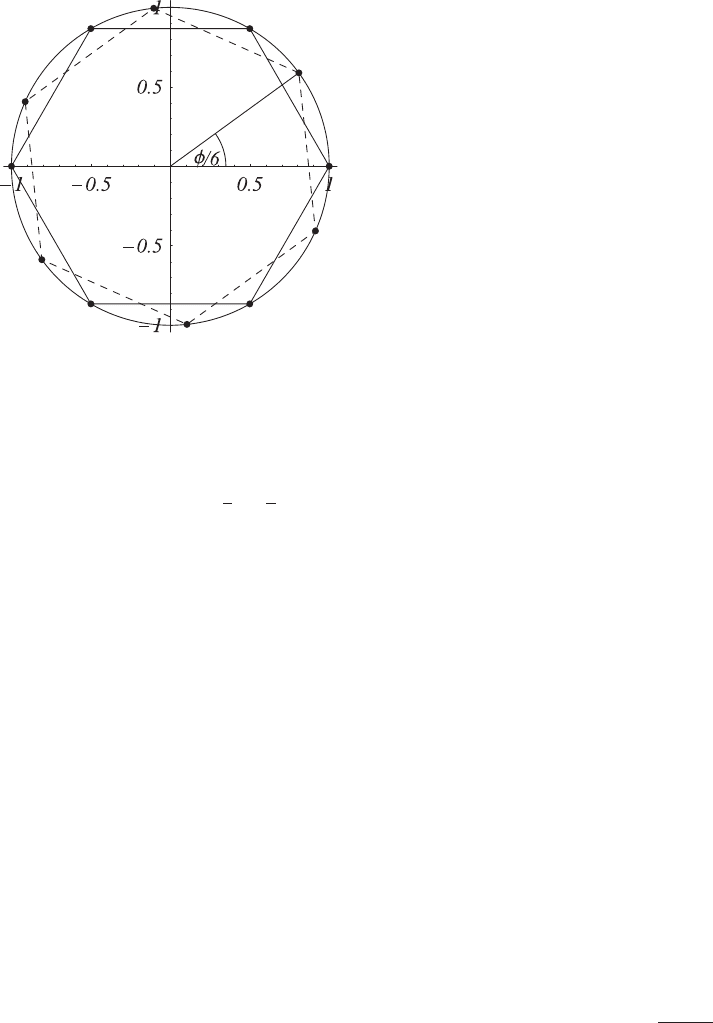
Figure 1.4. Solid: 6th roots of 1, dashed: 6th roots of
Φ
.
A better definition is provided by a quadrant-sensitive extension of the usual arctangent
function
ArcTanx, yArcTan
y
x
Π
2
1 Signx Signy (1.24)
that returns values in the range (Π, Π). (Unfortunately, the order of the arguments is
reversed between Fortran and Mathematica.) Therefore, we define the principal branch
of the argument function by
ArgzArgx yArcTanx, y (1.25)
where Π < ArgzΠ.
However, the polar representation of complex numbers is not unique because the phase Θ
is only defined modulo 2Π. Thus,
argzArgz2Πn (1.26)
is a multivalued function where n is an arbitrary integer. Note that some authors distinguish
between these functions by using lower case for the multivalued and upper case for the
single-valued version while others rely on context. Consider two points on opposite sides
of the negative real axis, with y ! 0
infinitesimally above and y ! 0
infinitesimally
below. Although these points are very close together, Argz changes by 2Π across the
negative real axis.
A discontinuity of this type is usually represented by a branch cut. Imagine that the
complex plane is a sheet of paper upon which axes are drawn. Starting at the point (r,0) one
can reach any point z x, y by drawing a continuous circular arc of radius r
x
2
y
2
and we define argz as the angle subtended by that arc. This function is multivalued
because the circular arc can be traversed in either direction or can wind around the origin an
1.1 Complex Numbers 7
x
y
Argx,0
Π
Argx,0
Π
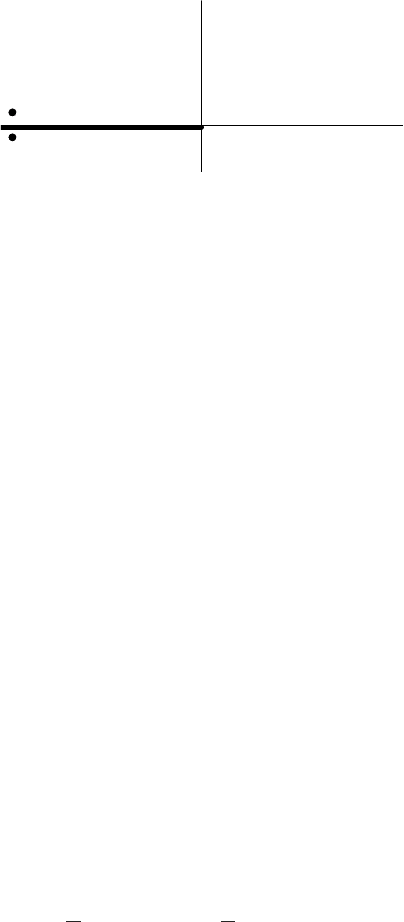
Figure 1.5. Branch cut for Argz.
arbitrary number of times before stopping at its destination. A single-valued version can be
created by making a cut infinitesimally below the negative real axis, as sketched in Fig. 1.5,
that prevents a continuous arc from subtending more than Π radians. Points on the nega-
tive real axis are reached by positive (counterclockwise) arcs with Argz, 0 Π while
points infinitesimally below the negative real axis can only be reached by negative arcs
with Argz, 0
! Π.Thus,Argz is single-valued and is continuous on any path
that does not cross its branch cut, but is discontinuous across the cut.
The principal branch of the argument function is defined by the restriction Π <
ArgzΠ. Notice that one side of this range is open, represented by <, while the other
side is closed, represented by . This notation indicates that the cut is infinitesimally below
the negative real axis, such that the argument for negative real numbers is Π, not Π.This
choice is not unique, but is the nearly universal convention for the argument and many
related functions. The distinction between < and many seem to be nitpicking, but atten-
tion to such details is often important in performing accurate derivations and calculations
with functions of complex variables.
Many functions require one or more branch cuts to establish single-valued definitions;
in fact, handling either the multivaluedness of functions of complex variables or the dis-
continuities associated with their single-valued manifestations is often the most difficult
problem encountered in complex analysis. Although our choice of branch cut for Argz
is not unique (any radial cut from the origin to would serve the same purpose), it is
consistent with the customary definitions of ArcTan, Log, and other elementary func-
tions to be discussed in more detail later. The single-valued version of a function that
is most common is described as its principal branch. For many functions there is con-
siderable flexibility in the choice of branch cut and we are free to make the most conve-
nient choice, provided that we maintain that choice throughout the problem. For example,
in some applications it might prove convenient to define an argument function with the
range
3Π
4
< MyArgz
5Π
4
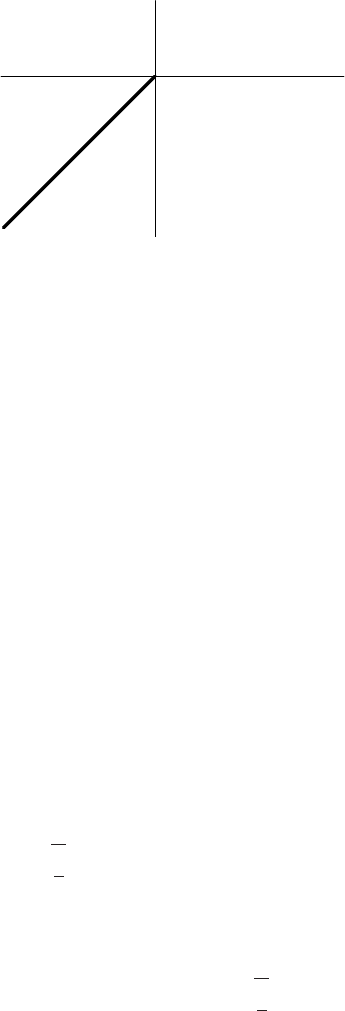
using the branch cut shown in Fig. 1.6. Consider the point
z
1
1, 1 for which the standard argument function gives Argz
1
3Π/ 4 while our
new argument function gives MyArgz
1
5Π/ 4. These functions are obviously different
because the same input gives different output, but both represent precisely the same ray in
the complex plane. Therefore, we should consider the specification of the branch cuts as
an important part of the definition of a single-valued function and recognize that different
8 1 Analytic Functions
x
y
Figure 1.6. Branch cut for MyArg.
choices of cuts lead to related but different functions.
It is important to recognize that, because of discontinuities across branch cuts, simple
algebraic relationships that apply to multivalent functions of complex variables, often do
not pertain to their monovalent cousins. For example, using the polar representation of the
product of two complex numbers we find
z
1
z
2
r
1
r
2
Exp
Θ
1
Θ
2
z
1
z
2
z
1
z
2
argz
1
z
2
argz
1
argz
2
(1.27)
but this relationship for the phase does not necessarily apply to the principal branch
because
Argz
1
z
2
argz
1
z
2
2Πn
argz
1
argz
2
2Πn
Argz
1
Argz
2
2Πn n
1
n
2
(1.28)
where n must be chosen to ensure that Π < Argz
1
z
2
Π. Often the price of single-
valuedness is the awkwardness of discontinuities.
1.2 Take Care with Multivalued Functions
Ambiguities in the definitions of many seemingly innocuous functions require consider-
able care. For example, consider the common replacement
1
z
?
" z
1/ 2
(1.29)
that one often makes without thinking. Is this apparent equivalence correct? Compare the
following two methods for evaluating these quantities when z !1.
z 1 z
1
1
1
z
(1.30)
z
Π
z
1/ 2
Π/ 2
(1.31)

1.2 Take Care with Multivalued Functions 9
Both calculations look correct, but their results differ in sign. These expressions are not
always interchangeable! One must take more care with multivalued functions.
If we represent the complex number z in Cartesian form z x y where x, y are real,
then
1
z
1
x y
x y
x
2
y
2
(1.32)
If x<0 and y ! where is a positive infinitesimal, then z is just above and z
1
is
just below the usual cut in the square-root function (below the negative real axis). Conse-
quently, Argz and Argz
1
differ by 2Π and the arguments of
1/z and z
1/ 2
differ by
Π, a negative sign, in the immediate vicinity of the negative real axis. It is usually not a
good idea to use the surd (square-root) symbol for complex variables – for real numbers
that symbol is usually interpreted as the positive square root, but for negative or complex
numbers we should employ a fractional power and define the branch cut explicitly. Then, if
we define Π < ArgzΠwith a cut infinitesimally below the negative real axis the same
cut would be implied for fractional powers and the value of z
1/ 2
determined using polar
notation would be unambiguous on the negative real axis. Furthermore, 1/z
1/ 2
z
1/ 2
applies everywhere in the cut z-plane without the sign ambiguity encountered above. Of
course, the sign discontinuity across the cut is still present – it is an essential feature of
such functions.
Let us examine the square-root function, w f zz
1/ 2
, in more detail. When z is a
positive real number, the square-root function maps one z onto two values of w
x.
Similar behavior is expected for complex z because there are always two solutions to the
quadratic equation w
2
z. In polar notation
z r
Θ
,z w
2
w
r Exp
Θ
2
nΠ
(1.33)
where, by convention,
r represents the positive square root for real numbers and where
n 0, 1 yields two distinct possibilities. Thus, the image of one point in the z-plane is two
points in the w-plane. If we define w u v, the component functions ux, y and vx, y
can be obtained by solving the equations
x u
2
v
2
y 2uv (1.34)
Substituting v ! y/2u and solving the quadratic equation for u
2
, we find
4u
4
4u
2
x y
2
0 u
2
x
x
2
y
2
2
u
x
2
y
2
x
2
(1.35)
where the positive root is required in u
2
to ensure real u. Then, solving for v and rational-
izing the expression under the square root, we obtain
v
y
2u
y
2
2
x
2
y
2
x
y
x
2
y
2
x
2y
2
(1.36)
10 1 Analytic Functions
Re#z
1s2
'
2
1
0
1
2
x
2
1
0
1
2
y
0
0.5
1
1.5
2
1
0
1
x
Im#z
1s2
'
2
1
0
1
2
x
2
1
0
1
2
y
1
0
1
2
1
0
1
x
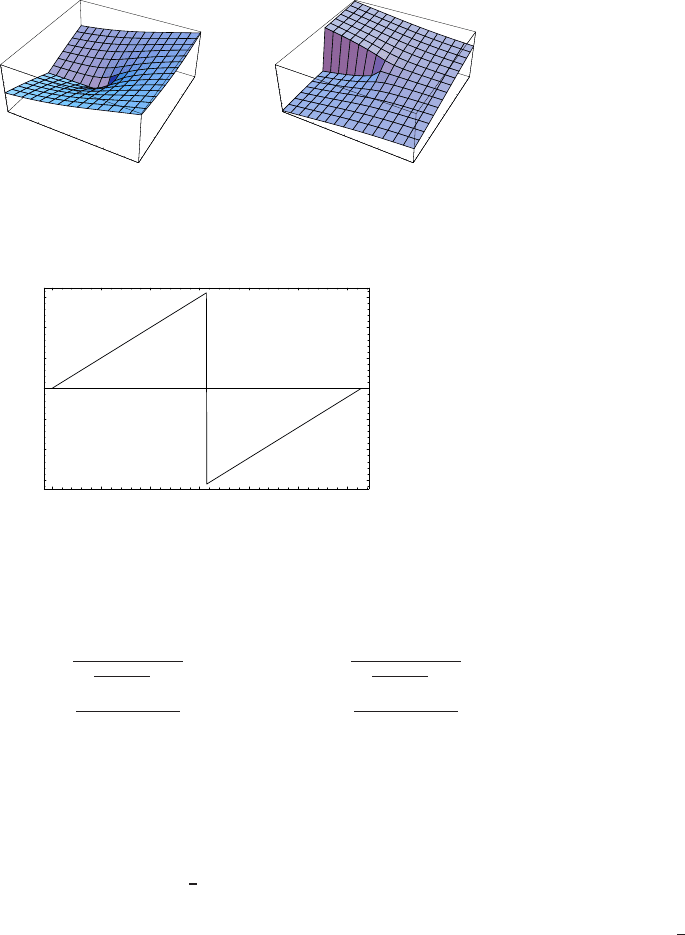
Figure 1.7. Real and imaginary components of z
1/ 2
.
0 1 2 3 4 5 6
T
1.5
1
0.5
0
0.5
1
1.5
Arg#
r
r Æ
ÇT
'
Figure 1.8. Dependence of Argz
1/ 2
upon polar angle.
Finally, taking the positive root of y
2
, we obtain
u
x
2
y
2
x
2
v Signy
x
2
y
2
x
2
(1.37)
where the relative sign between u and v is determined by the sign of y. Note that there
are only two, not four, solutions. The principal branches of the component functions are
plotted in Fig. 1.7, where it is customary, though arbitrary, to select the positive branch of
u so that positive square roots are obtained on the positive real axis. Similar figures are
obtained for other positive nonintegral powers, rational or irrational.
Notice that v Im
z is discontinuous on the negative real axis. The real part is
continuous, but its derivative with respect to y is discontinuous on the negative real axis.
Consider the image of a circular path z r
Θ
,0Θ2Π under the mapping w
z.
The argument of w changes abruptly from Π to Π as the negative real axis is crossed from
above, as sketched in Fig. 1.8.
In order to define a well-behaved monovalent function, we must include in the defi-
nition of f a rule for selecting the appropriate output value when the mapping z ! w is
multivalent. The customary solution is to introduce a branch cut along the negative real

1.2 Take Care with Multivalued Functions 11
axis by restricting the range of the argument of z to Π < ΘΠand agreeing not to cross
the cut in the z-plane. Thus, Sqrt and Arg employ the same branch cut, shown in Fig. 1.5.
We imagine that the cut is infinitesimally below the negative real axis so that the argument
of negative real numbers is Π and x<0
x
x. The discontinuity in Argz
Α
across the branch cut depends upon Α. The end points of the branch cut are known as
branch points at which discontinuities first open. Here, the most important branch point is
at z 0, but one often says that there is also a branch point at . This somewhat sloppy
language means that for large z the branch cut is parametrized by z R
Θ
with R !,
but the choice of Θ remains arbitrary; here we happened to choose ΘΠ.
Next consider the slightly more complicated function
f z
z
2
1
1/ 2
z 1z 1
1/ 2
(1.38)
Our experience with the square root suggests that we must pay close attention to the points
z 1 that are the branch points for z 1
1/ 2
. By factoring the argument of the square
root and choosing ranges for the phase of each factor according to
z
1
z 1 r
1
Θ
1
, Π < Θ
1
Π (1.39)
z
2
z 1 r
2
Θ
2
, Π < Θ
2
Π (1.40)
we obtain a single-valued version defined by
f
1
z
r
1
r
2
Exp
Θ
1
Θ
2
2
kΠ
,k0, 1 (1.41)
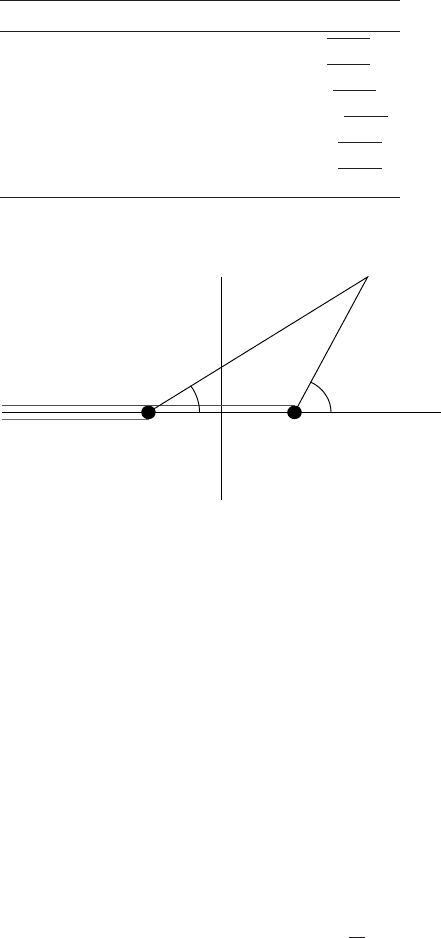
and the branch cuts indicated in Fig. 1.9. The principal branch is defined, somewhat arbi-
trarily, by k 0 because that gives a positive root for z on the real axis with x>1. The two
heavy points show the branch points in the two factors z 1
1/ 2
and the lines anchored
by those points show the associated branch cuts. Here we decided to draw both branch
cuts to the left, as is customary for Argz or z
1/ 2
, such that both polar angles are defined
in the range Π < Θ
1,2
Π. Since it is clear that any discontinuities will be found along
the real axis where the two phases may be discontinuous, the structure of the function can
be investigated using strategically chosen points on both sides of the real axis labeled a– f
in the figure and its accompanying Table 1.1. This table shows that f
1
z is discontinuous
across the portion of real axis between the two branch points, namely 1 <x<1, but
is continuous elsewhere. In effect, the overlapping branch cuts cancel each other in the
region x<1 because, at least for this function, the discontinuity is simply a sign change;
however, the behavior of overlapping cuts is not always this simple.
Alternatively, if we define the phases according to
z
1
z 1 r
1
Θ
1
, 0 Θ
1
< 2Π (1.42)
z
2
z 1 r
2
Θ
2
, Π < Θ
2
Π (1.43)
we obtain another version
f
2
z
r
1
r
2
Exp
Θ
1
Θ
2
2
kΠ
,k0, 1 (1.44)
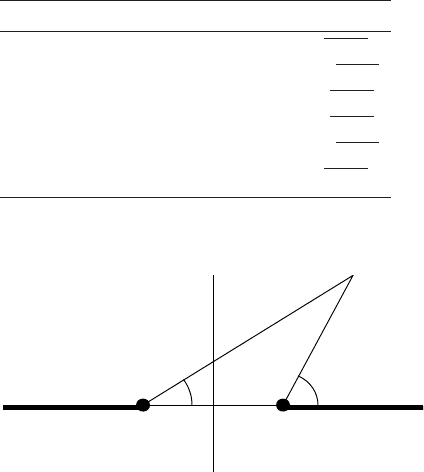
in which the cut in z
1/ 2
1
is now directed toward the right while the cut in z
1/ 2
2
remains to the
left; these cuts are illustrated in Fig. 1.10. The same selection of trial points now produces
12 1 Analytic Functions
Table 1.1. Selected values of f
1
z defined by Eq. (1.41).
Point xyΘ
1
Θ
2
f
1
z
ax>1 00
x
2
1
bx>1 00
x
2
1
c 1 <x<1 Π 0
1 x
2
d 1 <x<1 Π 0
1 x
2
ex<1 ΠΠ
x
2
1
fx<1 Π Π
x
2
1
x
y
a
b
c
d
e
f
T
1
T
2
+z1/
1s2
+z1/
1s2
Figure 1.9. Branch cuts for f
1
z defined by Eq. (1.41).
Table 1.2 that shows that f
2
z is continuous for 1 <x<1 but is discontinuous every-
where else on the real axis. Although their algebraic definitions are the same, f
1
z and
f
2
z are clearly different functions, fraternal twins that are distinguished by their branch
cuts. The choice of cuts is a fundamental aspect of the definition of a single-valued ver-
sion of an inherently multivalued function; the definition is not complete until the cuts are
specified. For any particular application the most appropriate version may depend upon
other aspects of the problem, such as physical boundary conditions, or may be chosen for
convenience. If one is most interested in small values of z it will probably be more con-
venient to choose f
2
z, but for large values f
1
z is probably preferable, but consistency
must be maintained through any particular problem. Furthermore, although the two ver-
sions suggested here are the most common, they do not exhaust the possibilities.
The moral of this somewhat belabored exercise is that one must be very careful in
manipulating expressions involving complex variables and avoid making unintentional
assumptions about the phases of various subexpressions. Most people tend to be very care-
less with phases, automatically replacing
s
2
by s without knowing whether s is positive
or negative or complex. Similarly, many people complain that often does
not perform simplifications that are perceived to be obvious. The reason for this is that
hates to make mistakes and will not make unjustified assumptions about
1.3 Functions as Mappings 13
Table 1.2. Selected values of f
2
z defined by Eq. (1.44).
Point xyΘ
1
Θ
2
f
2
z
ax>1 00
x
2
1
bx>1 2Π 0
x
2
1
c 1 <x<1 Π 0
1 x
2
d 1 <x<1 Π 0
1 x
2
ex<1 ΠΠ
x
2
1
fx<1 ΠΠ
x
2
1
x
y
a
b
c
d
e
f
T
1
T
2
Figure 1.10. Branch cuts for f
2
z defined by Eq. (1.44).
whether a variable is real or, if it is, about its sign – it assumes that all variables are com-
plex unless told otherwise. The Simplify function has an option that permits the user to
specify permissible assumptions, such as one variable is real, another positive, a third a
negative integer, etc. When you take responsibility for these assumptions,
will usually go much further in simplifying your expressions. Often it still will not reach
the elegant representation that one might find in a textbook, but its manipulations will be
correct and that is what matters most.
1.3 Functions as Mappings
A function f maps the complex variable z x, y into a complex image w u, v accord-
ing to rules specified in the definition w f z. Thus, f maps points in the complex z-plane
onto points in the complex w-plane, a mapping of ! . For a single-valued function the
image of a point is a point, but for a multiple-valued function the image of a point may
be a set of points. For continuous functions, the image of a line segment (arc) in the input
plane will be one or more arcs in the output plane. Often considerable insight into the prop-
erties of a function may be obtained by examining the images of coordinate lines (lines
of constant x or constant y). Below we analyze the mappings produced by some familiar
functions.
14 1 Analytic Functions
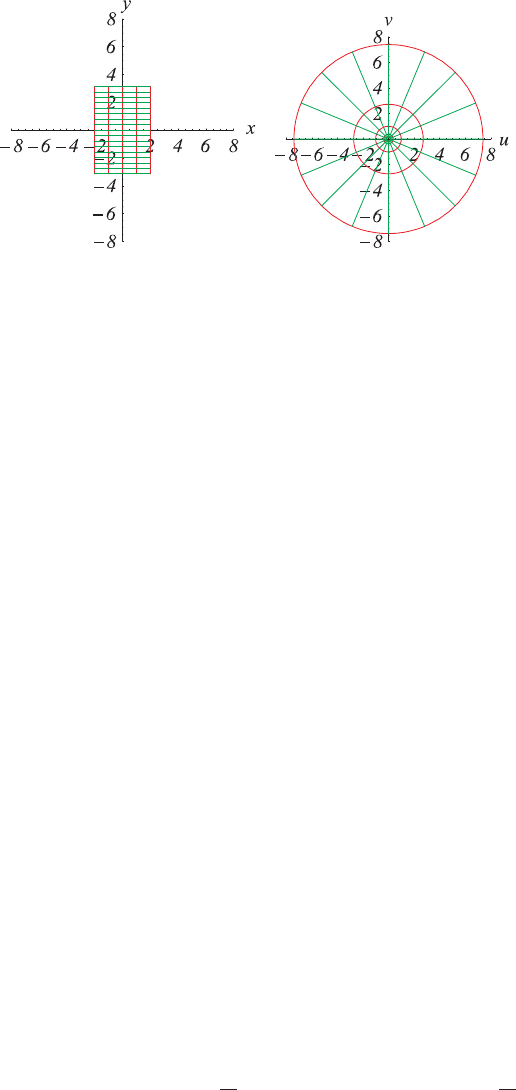
Figure 1.11. Mapping: u v
xy
. Lines of constant y are mapped onto radial lines while lines
lines of constant x are mapped onto circles in the w-plane.
1.3.1 Mapping: w
z
The exponential function is defined by the mapping
w
z
x
CosySiny
u v ux, y
x
Cosy vx, y
x
Siny
(1.45)
The image of a grid of coordinate lines is sketched in Fig. 1.11. Lines of constant y are
mapped into radial lines, while lines of constant x are mapped into circles. The origin, with
x 0, is mapped onto the unit circle. Increasingly positive x x
0
> 0, mapped onto circles
of exponentially increasing radius
x
0
, and increasingly negative x x
0
< 0 mapped onto
exponentially tighter circles, practically indiscernible in this figure. Thus, the images of
the coordinate lines remain orthogonal, but the mapping severely distorts distances.
It is important to recognize that the mapping produced by the exponential function is
many-to-one because
Expz 2ΠkExpz for integer k (1.46)
is periodic, so that infinitely many input points z z
0
2Πk are mapped onto the same
image point. Thus, any strip yy
0
Πin the z-plane is mapped onto the entire w-plane and
neighboring strips would replicate the covering of the w-plane. Consequently, the inverse
function z logw is many-valued because it represents a one-to-many mapping. By
convention, we define the principal branch of the logarithm function
LogzLogz Argz with Π< ArgzΠ (1.47)
by limiting the phase y Argw to the strip Π <yΠby means of a branch cut along
the negative real axis, as indicated by the thick line in Fig. 1.12. With this convention one
obtains the following principal values:
Log10Log
Π
2
Log1Π Log
Π
2
(1.48)
1.3 Functions as Mappings 15
x
y
u
v
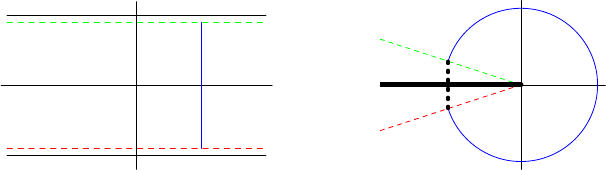
Figure 1.12. Mapping: uv Expxy. The mapping of any strip yy
0
Πcovers the w-plane.
The branch cut for the inverse mapping is shown in the w-plane.
One might imagine the w-plane as a circular paper disk with a cut from its edge to the
center, which prevents a continuous curve to be drawn crossing the cut. A vertical line
segment in the z-plane between y Π and y Π is mapped onto a circular
arc between ArgwΠ and ArgwΠ. Although the two ends of the arc
approach other from opposite sides of the branch cut as ! 0
,theydiffer in phase by 2Π.
Therefore, although the branch cut permits the inverse function z Logw to be defined
as a single-valued mapping w ! z, that function is discontinuous across the branch cut.
Often single-valuedness comes only at the expense of discontinuities.
Neighboring strips y
n
y
0
nΠ simply remap the entire w-plane. One might imagine
an infinite collection of w-planes, called Riemann sheets, stacked on top of each other such
that curves which cross the branch cut move from one Riemann sheet to the next. The
index n then identifies a particular Riemann sheet, with the principal branch represented
by n 0. Thus, it is useful to distinguish between a multivalued log and a single-valued
Log defined by
w
z
z logwlogw argw
logw Argw2Πn Logw2Πn
(1.49)
As a curve winds around the origin of the w-plane in a counterclockwise sense, the
argument increases continuously and each time one crosses the branch cut one moves
from one sheet to the next and increments the winding number n by one unit. Clockwise
winding decrements n, which is permitted to be negative also. Furthermore, the choice
y
0
0 is not unique and other choices would rotate the branch cut in the w-plane. The
single-valued function produced by the most common choice of branch cut is described as
the principal branch, but for some problems it may become convenient to make a different
choice. However, the branch cuts used for Arg, Log, and related functions are correlated
and must be chosen consistently throughout a particular calculation.
Physics calculations normally must produce a unique answer that can be compared
with a measurable quantity, such that physical functions must be based upon single-valued
functions. Similarly, if one is to compute the value of an expression using a computer
program, there must be a unique result. Numerical methods cannot tolerate multivalued
expressions – the programmer must provide an unambiguous prescription for selecting the