
Kelly J.J. Graduate Mathematical Physics, With MATHEMATICA Supplements
Подождите немного. Документ загружается.

46 1 Analytic Functions
C
C
2
C
1
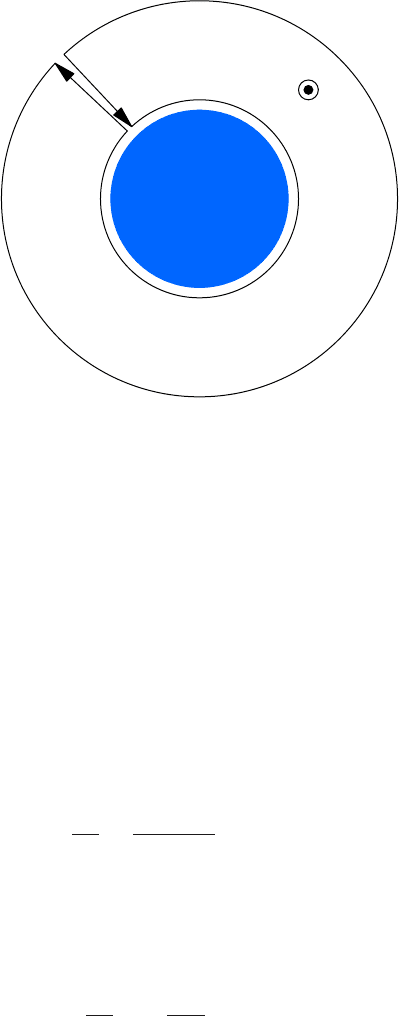
Figure 1.21. To develop the Laurent series, a small contour C within an analytic region is stretched
toward the limits of the region of analyticity, indicated by C
1
and C
2
, with the aid of contour wall.
1.13 Laurent Series
1.13.1 Derivation
A more general expansion which is useful in an analytic region that surrounds a nonana-
lytic region is provided by the Laurent series.
Theorem 16. Laurent series: If fz is analytic throughout the region R
1
< z z
0
<R
2
,
it can be represented by an expansion
f z
n
a
n
z z
0
n
(1.206)
with coefficients
a
n
1
2Π
C
f zz
z z
0
n1
(1.207)
computed using any simple counterclockwise contour C within the analytic region.
If R
1
! 0 and coefficients with n<0 vanish, then the Laurent series reduces to the
Taylor series.
Suppose that C is a small contour surrounding an interior point z, such that
f z
1
2Π
C
s
f s
s z
(1.208)
according to the Cauchy integral formula. As shown in Fig. 1.21, we can stretch C to
the limits of the annulus without changing the integral because the integrand is analytic

1.13 Laurent Series 47
throughout that region. Recognizing that the opposing segments of the contour wall cancel,
we obtain
f z
1
2Π
R
2
s
f s
s z
1
2Π
R
1
s
f s
s z
(1.209)
where R
1
and R
2
denote counterclockwise circles at the inner and outer borders of the
analytic annulus. For the outer integral we employ the expansion
s z
1
s z
0
1
1
z z
0
s z
0
1
s z
0
1
n0
z z
0
s z
0
n
(1.210)
while for the inner integral
s z
1
z z
0
1
1
s z
0
z z
0
1
z z
0
1
n0
s z
0
z z
0
n
(1.211)
such that
2Π f z
n0
z z
0
n
R
2
s
f s
s z
0
1n
n0
z z
0
1n
R
1
sfss z
0
n
(1.212)
Both integrands are analytic throughout the annulus and are independent of z. Hence, these
integrals can be evaluated using any simple closed path within the analytic region. There-
fore, we may combine the two terms into a single expression
f z
n
a
n
z z
0
n
(1.213)
a
n
1
2Π
C
z
f z
z z
0
n1
(1.214)
representing the Laurent expansion. One can also show that the Laurent expansion about
a specific z
0
is unique within its analytic annulus.
1.13.2 Example
The function
f z
1
z
2
1 z
(1.215)
has singular points at z 0, 1. Suppose that we evaluate the Laurent coefficients using
contour integration
a
n
1
2Π
C
s
f s
s
n1
R
n2
2Π
2Π
0
Θn2
1 R
Θ
Θ (1.216)

48 1 Analytic Functions
on a circle with s R
Θ
and s s Θ.ForR<1 we can expand the integrand to obtain
R<1 a
n
R
n2
2Π
k0
R
k
2Π
0
Expk n 2Θ Θ (1.217)
Nonvanishing coefficients then require k n 2 and k 2 0 n 22, such that
0 < z < 1 f z
n0
z
n2
(1.218)
Alternatively, for R>1weuse1 z
1
z
1
1 z
1
1
to obtain
R>1 a
n
R
n3
2Π
k0
R
k
2Π
0
Expk n 3Θ Θ (1.219)
for which nonvanishing coefficients require k n 3 and k 2 0 n 3, such that
z > 1 f z
n0
z
n3
(1.220)
Although the Laurent theorem provides an explicit formula for the coefficients, evalu-
ation of the contour integrals is often difficult and one seeks simpler alternative methods.
In this case we can use the partial fractions
1
z
2
1 z
1
z
2
1
z
1
1 z
(1.221)
and
z < 1
1
1 z
n0
z
n
(1.222)
z > 1
1
1 z
1
z1 z
1
n1
z
n
(1.223)
to obtain the same results without integration. In other cases we may be able to convert a
known Taylor series into a Laurent series. For example,
Log1 z
n1
n1
z
n
n
for z < 1 (1.224)
Log
1 z
1
n1
n1
z
n
n
for z > 1 (1.225)
where the latter is valid in the largest annulus that excludes the branch cut 1 x 1on
the real axis.

1.13 Laurent Series 49
1.13.3 Classification of Singularities
Suppose that f z is singular at z
0
but analytic at all other points in a neighborhood of z
0
;
f is then said to have an isolated singularity at z
0
. A function that is analytic throughout
the finite complex plane except for isolated singularities is described as meromorphic.
Meromorphic functions include entire functions, such as Exp, that have no singularities in
the finite plane and rational functions that have a finite number of poles. Functions, such
as Log, that require branch cuts are not meromorphic.
The Laurent expansion about an isolated singularity takes the form
f z
n
a
n
z z
0
n
(1.226)
If a
m
0forsomem<0 while all a
n<m
0, then z
0
is classified as a pole of order m
and the coefficient a
1
is called the residue of the pole. A simple pole has m 1. If the
function appears to have a singularity at z
0
but all a
m
vanish for m<0, z
0
is described as
a removable singularity because the function can be made analytic simply by assigning a
suitable value to f z
0
. For example, z 0 is a removable singularity of
f z
Sinz
z
n0
n
2n 1!
z
2n
(1.227)
because with the assignment f 01 the function is continuous and its Laurent series
reduces to a simple Taylor series.
If the Laurent expansion has nonvanishing coefficients for arbitrarily large negative
n !and the inner radius vanishes, then it has an essential singularity at z
0
. According
to Picard’s theorem, essential singularities have the nasty property that f z takes any,
hence all, values in any arbitrarily small neighborhood infinitely often with possibly one
exception. For example,
1/z
n0
z
n
n!
(1.228)
has an essential singularity at the origin. The equation w
1/z
is satisfied by
w
1/z
z
1
Logw
Log wArgw2nΠ
1
(1.229)
for any integer n. By choosing n sufficiently large, one can make z as small as desired.
Thus, although
1/z
0, the one exception, all other values of w are obtained infinitely
often in a neighborhood of z ! 0, as expected from Picard’s theorem.
Singularities in f z at z are classified according to the behavior of f
1
z
at z 0.
Thus,
z
has an essential singularity at , while z
n
is analytic at if n is a positive
integer.

50 1 Analytic Functions
1.13.4 Poles and Residues
Although the Laurent coefficients are defined in terms of an integral, it is usually easier to
compute the coefficients using a derivative formula similar to that for the Taylor series. If
f z is analytic near z
0
except for an isolated m-pole at z
0
, we define an auxiliary function
Φzz z
0
m
f z
nm
a
n
z z
0
mn
(1.230)
that is analytic within z z
0
<Rwhere R is the radius of convergence for the Laurent
series. The coefficients can then be obtained by differentiation, whereby
a
n
1
m n!
mn
z
mn
Φz
zz
0
(1.231)
This result can be written more succinctly as
a
n
Φ
mn
z
0
m n!
(1.232)
where Φ
k
z
0
denotes the k
th
derivative of Φz evaluated at z
0
. This formula is similar to
that for the Taylor series, except that f is replaced by Φ and the index is shifted, and reduces
to the Taylor coefficients for an analytic function with m 0. However, this method is not
useful at an essential singularity where m .
Often we require only the residue of f at z
0
. For a simple pole we identify the residue
as
m 1 a
1
Φz
0
lim
z!z
0
z z
0
f z (1.233)
while for an m-pole one obtains
m>1 a
1
Φ
m1
z
0
m 1!
(1.234)
For example, consider
f z
z
n
qz
z
n
az
2
bz c
(1.235)
where we assume that n 2 0, a 0, and that a, b, c are real. (Other cases can be treated
separately.) The two poles at the roots of the denominator
z
b
b
2
4ac
2a
(1.236)
are distinct unless the discriminant b
2
4ac happens to vanish. We can then write
f z
a
1
z
n
z z
1
z z
2
Ρ
i
a
1
z
n
i
z
i
z
j
(1.237)

1.14 Meromorphic Functions 51
where Ρ
i
is the residue at pole z
i
and z
j
is the other pole. If there happens to be a double
pole, we find
z
1
z
2
z
0
a
1
z
a
1
z
n
z
0
a
1
nz
n1
0
a
1
n
b
2a
n1
(1.238)
An important special case is provided by functions of the form
f z
pz
qz
with qz
0
0 q
'
z
0
0pz
0
0 (1.239)
where the simple pole at z
0
is a zero of qz. The Taylor expansion of qz then takes the
form
qz*q
'
z
0
z z
0
(1.240)
such that the residue of f z at z
0
becomes
a
1
pz
0
q
'
z
0
(1.241)
For example, the function
f z
az
z
1
z
k
2k 1Π,R
k
az
k
(1.242)
has poles at odd-integer multiples of Π with residues easily determined using q
'
z
k
1.
1.14 Meromorphic Functions
1.14.1 Pole Expansion
If a function fz only has isolated singularities, it is described as meromorphic.Forsim-
plicity suppose that these singularities are simple poles at z
n
where the index lists the poles
in order of increasing distance from the origin. The behavior near a simple pole can be
represented by z * z
n
f z*
b
n
zz
n
. Thus, the function
g
n
z f z
n
k1
b
k
z z
k
(1.243)
is analytic in a disk zR
n
where the radius R
n
encloses n poles. According to the Cauchy
integral formula, we may write
g
n
z
1
2Π
C
n
g
n
s
s z
s
1
2Π
C
n
f s
s z
s
1
2Π
n
k1
b
k
C
n
s
s z
s z
k
(1.244)
where C
n
is a circle, zR
n
, that encloses n poles without any poles being on the contour
itself. For any z z
k
we can use partial fractions to express the second contribution in a

52 1 Analytic Functions
form
C
n
s
s zs z
k
C
n
s
s z
k
C
n
s
s z
0 (1.245)
where cancellation between equal residues is apparent. Furthermore, if z z
k
we also find
C
n
s
s z
k
2
0 (1.246)
and conclude that
g
n
z
1
2Π
C
n
f s
s z
s (1.247)
for z within C
n
.
Next let
M
n
max
f
R
n
Θ
(1.248)
represent the largest modulus found on the circle C
n
, such that
g
n
z
M
n
R
n
R
n
z
(1.249)
bounds g
n
.If f is bounded such that R
n
!with finite M
n
, we can construct a sequence
of g
n
functions which are also bounded as z!. Thus, the function
gzlim
n!
g
n
z (1.250)
is analytic and bounded in the entire complex plane. According to Liouville’s theorem,
such a function must be constant! Hence, we can write
f zg
k1
b
k
z z
k
(1.251)
and all that remains is to determine the value of the constant g
.Using
f 0g
k1
b
k
z
k
g
f 0
k1
b
k
z
k
(1.252)
we finally obtain the Mittag–Leffler theorem.
Theorem 17. Mittag–Leffler theorem: Suppose that the function f z is analytic every-
where except for isolated simple poles, is analytic at the origin, and that there exists a
sequence of circles C
k
zR
k
,k 1,n where each C
k
encloses k poles within radius
R
k
. Furthermore, assume that on these circles f is bounded as R
n
!. The function can
then be expanded in the form
f z f 0
n1
b
n
z z
n
b
n
z
n
(1.253)
where b
n
is the residue for pole z
n
.

1.14 Meromorphic Functions 53
Unlike Laurent expansions for which the choice of z
0
can be somewhat arbitrary, the
pole expansion for meromorphic functions depends only upon intrinsic properties of the
function itself. Although the present version places significant restrictions on the function,
generalizations can often be made fairly easily. For example, if f z has a pole at the origin,
one can apply the theorem to the closely related function gz f z z
0
where z
0
is any
convenient point where f z is analytic. Similarly, if M
n
- R
m1
n
for large R
n
, one can
employ an expansion of the form
f z
m
k1
f
k
0
z
k
k!
n1
b
n
z z
n
z
z
n
m1
(1.254)
Poles of higher order can be accommodated also, but we forego detailed analysis here.
Pole expansions appear in many branches of physics. If f z represents the response
of a dynamical system to some driving force, the poles generally represent resonances or
normal modes of vibration while the residues represent the coupling of the driving force
to those normal modes. Pole expansions can also be used to sum infinite series.
1.14.2 Example: Tanz
The function Tanz has simple poles at z
n
n
1
2
Π with residue b
n
1 for integer n,
both positive and negative. Thus, circles C
n
of radius R
n
nΠ enclose 2n poles without
singularities on the contours. One can show that M
n
! 1asn !. Hence, Tanz fulfills
all requirements for application of the Mittag–Leffler theorem. The pole expansion can
now be expressed as
Tanz
n
1
z
n
1
2
Π
1
n
1
2
Π
(1.255)
n0
1
z
n
1
2
Π
1
n
1
2
Π
1
z
n
1
2
Π
1
n
1
2
Π
(1.256)
such that
Tanz
n0
2z
n
1
2
Π
2
z
2
(1.257)
With the substitution z ! sΠ/ 2, we obtain the partial fraction representation
Π
4s
Tan
sΠ
2
1
1 s
2
1
9 s
2
1
25 s
2
... (1.258)
Expressions of this type can often be used to sum infinite series. For example, from
lim
s!0
Π
4s
Tan
sΠ
2
Π
2
8
(1.259)
one immediately obtains
k0
1
2k 1
2
Π
2
8
(1.260)

54 1 Analytic Functions
Then using
k1
1
k
2
1
k1
1
2k
2
k1
1
2k 1
2
3
4
k1
1
k
2
k0
1
2k 1
2
(1.261)
we find
k1
1
k
2
Π
2
6
(1.262)
1.14.3 Product Expansion
If f z is an entire function, its logarithmic derivative Φz f
'
z/fz is a meromorphic
function with poles at the roots of f z. If these roots are simple, the corresponding poles
in Φ will also be simple. Near a simple root we express f z in the form
z * z
n
f z*z z
n
p
n
zΦz*
1
z z
n
(1.263)
where p
n
z is smooth and nonvanishing near z
n
. Hence, the poles of the logarithmic deriv-
ative all have residue b
n
1. Provided that Φ is suitably bounded at , we can now use
the pole expansion of Φ to write
Log f
z
Φ
0
n1
1
z z
n
1
z
n
(1.264)
Log f z Log f 0 zΦ
0
n1
Logz z
n
Logz
n
z
z
n
(1.265)
where Φ
0
f
'
0/f0. Exponentiating and simplifying this expression, we obtain the
product expansion
f z
f 0
Exp
z
f
'
0
f 0
n1
1
z
z
n
z
/
z
n
(1.266)
where the z
n
are the roots of f z. Like the pole expansion of meromorphic functions,
the product expansion of entire functions depends only upon intrinsic properties of the
function. Expansions of this type are often useful in symbolic manipulations, but generally
converge too slowly to be useful for numerical evaluations.
1.14.4 Example: Sinz
Although Sinz is an entire function with simple poles at z
n
nΠ, we cannot employ
the product expansion directly because Φ
0
is not finite. However, this difficulty is easily
circumvented by considering instead the function
f z
Sinz
z
ΦzCotz
1
z
, Φ00 (1.267)

Problems for Chapter 1 55
The positive and negative roots can be accommodated by using two products
Sinz
z
n1
1
z
nΠ
z
nΠ
n1
1
z
nΠ
z
nΠ
(1.268)
and combining factors pairwise to obtain
Sinz
z
n1
1
z
nΠ
2
Sinzz
n1
1
z
nΠ
2
(1.269)
This form displays all the roots of Sinz and is, in effect, a completely factored represen-
tation of its Taylor series.
Problems for Chapter 1
1. Complex number field
In mathematics, a field is defined as a set containing at least two elements on which
two binary operations, denoted addition () and multiplication () satisfy the following
conditions:
1. completeness and uniqueness of addition: 9a, b , c a b is unique
2. commutative law of addition: a b b a
3. associative law of addition: a bc a b c
4. a c b c a b
5. existence of identity element for addition: 9a, b , :x % ax b :0 % a0 a
6. completeness and uniqueness of multiplication: 9a, b , c a b is unique
7. commutative law of multiplication: a b b
a
8. associative law of multiplication: a bc a b c
9. a c b c c 0 a b
10. existence of identity element for multiplication: 9a, b , :x 0 % a x b
:1 % a 1 a
11. distributive law: a b ca b a c
The real numbers obviously form a field with respect to ordinary addition and multi-
plication, but it is not immediately obvious that the complex numbers form a field with
respect to the extended definitions of addition and multiplication. To demonstrate that
is a field, you must identify the identity elements for addition and multiplication and must
verify that each of the 11 conditions set forth above is satisfied.
2. Triangle inequalities
Prove the triangle inequalities: z
1
z
2
z
1
z
2
z
1
z
2
.