
Kenneth E. Gonsalves, Craig R. Halberstadt, Cato T. Laurencin, Lakshmi S. Nair. Biomedical Nanostructures
Подождите немного. Документ загружается.

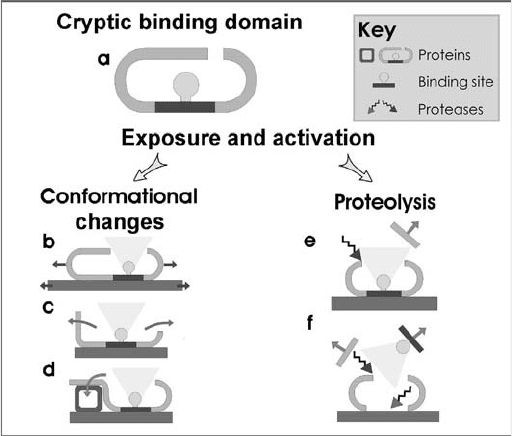
9.3.4.2 Cryptic Sites Binding domains are also found encoded within the
structures of ECM molecules. These domains, known as cryptic sites, are a result
of convoluted protein folding and are not exposed on the protein surface
(Fig. 9.5) [31, 108, 109]. The unmasking and activation of these sites occurs
through structural modifications of ECM molecules that result from conforma-
tional changes or proteolytic cleavage. The conformational changes may be
elicited by mechanical distortions and/or binding to other ECM molecules or cell
membrane receptors, whereas proteolytic cleavage occurs during ECM
degradation in processes like remodeling. Once exposed by either method, these
cryptic sties become available for action. For example, conformational changes
due to allosteric binding appear to reveal cryptic tenascin-binding sites on
fibronectin molecules [110]. Binding with tenascin interferes with the cell adhesive
properties of fibronectin and in turn influences cellular adhesion. Similarly, the
proteolytically derived fragments from the noncollagenous domains (NC1) of
basement membrane collagens (types IV, XV, and XVIII) also appear to act as
regulators of biological activities such as angiogenesis [111]. Therefore, the
spatial and temporal presentation of these binding domains ultimately depends
on constituent molecule composition, mechanical distortions, as well as matrix
assembly and turnover.
FIGURE 9.5 Mechanisms of cryptic site exposure. (a) Representation of protein
structure encoded with a cryptic domain. Domains can be exposed through
conformational changes due to (b) mechanical distortions, (c) surface adsorption, and
(d) interactions with other proteins; or proteolytic cleavage that can (e) reveal hidden
domains and may (f) release them as fragments, enabling the transport of signals into
the local microenvironment. (Modified from Reference 7 with permission from AAAS).
246
BIOMEDICAL NANOSTRUCTURES
9.3.4.3 Underlying Surface Chemistry ECM components also serve as a
substrate for displaying signaling ligands. There are a variety of chemical
signaling pathways through which cells receive information about the surfaces
they contact and these generally involve the hierarchical assembly of molecular
signaling molecules [69]. Numerous signaling ligands exhibit an environmental
sensitivity to underlying surface chemistry. During adsorption processes, cell-
secreted ECM proteins exhibit this sensitivity through conformational changes,
which alter their receptor binding affinities. For example, integrin-binding
specificities for adsorbed fibronectin were found to correlate with underlying
surface chemistry [112]. Fibronectin conform ational structure was altered in a
manner that shifted the balance of preferential binding of one integrin over
another. Surfaces predominant in OH- and NH
2
-termineated groups were
found to preferentially bind alpha5-beta1integrins, while COOH- and CH
3
-
terminated surfaces were found to bind both alpha5-beta1 and alphav-beta3
integrins. These differences in binding specificity were in turn transmitted to
cells. The OH- and NH
2
-terminated surfaces were found to upregulate
osteoblast-specific gene expression, alkaline phosphatase enzymatic activity,
and matrix mineralization compared with surfaces presenting COOH and CH
3
groups. Thus, surface-dependent differences in integrin binding enable the
modulation of gene expression, ultimat ely allowing cells to sense structure and
in turn regulate their own functions accordingly.
9.3.4.4 Topography In addition to molecular composition, surface
topography is also capable of modulating cellular behavior. Termed
topographic reaction, the reaction of cells to topography has been well
documented in the literature for micrometer-scale features [113]. Recently,
studies have explored topographic reactions at the nanoscale to investigate
features with dimensions more relevant to native ECMa three-dimensional
structure exhibiting a rich complex topography of nanometer-scaled features,
made up of interconnecting nanopores, fibers (10300 nm in diameter), and
nanoridges.
Topographic reactions including cell orientation, adhesion, motility, and
morphology are elicited from micro- to nanoscale structures and these typically
involve the activation of tyrosine kinases, cytoskeletal condensation, and further
downstream modulation of gene expression [113]. Topographical scale
(nanometer to micrometer range) is not the only topographical feature that
modulates cellular behavior. The order and symmetry of the structures can also
play a role [114]. Ordered structures occur naturally within the ECM, ranging
from the highly ordered 67 nm repeat banded structure on collagen fibrils in the
direction parallel to the fiber axis [115] to the collagen fibrils organized as aligned
fibers in tendon ECM [42]. Cells appear to be able to distinguish between
topological orders and symmetries, suggesting that interfacial forces between
cells and ECM constituents may be organized by the nanostructures [116]. For
example, the three-dimensional organization of the ECM environment also
influences cell morphology and adhesion. Cell morphology and adhesion affect
ECM INTERACTIONS WITH CELLS FROM THE MACRO- TO NANOSCALE 247
gene expression and alter the protein expression of integrins, which in turn are
important regulators of cell survival [117, 118]. It is likely that cells, which are
sensitive to nanoscale features, require the full context of the three-dimensional
nanofibrous matrix to maintain their phenotypic morphology and establish
natural behavior patterns.
The nanoscale size of the ECM structures also means that overall surface
area within the ECM is substantially larger relative to a comparable flat or
microsized surface. This gives the matrix structure a larger surfa ce area
for storage and display of signaling molecules, which in turn increases the
binding sites available for interactions with cell surface receptors. In ad dition
to the increased surface area, the porosity of the structure also contributes to
the diffusion and active transport of components, passage for cells, and the
possibility of filtering functions.
The biological implications of topography are wide reaching and suggest
that ECM components, whi ch ultimately determine topographic features,
modulate cellular behavior through ligandreceptor-mediated intracellular
signaling pathways [31].
9.3.5 Environmental StressesMechanical Stresses
Cells within the ECM are constantly exposed to mechanical signals that can be
induced through contractile forces of resident cells (i.e., actomysin contrac-
tility) or a variety of environmental factors (i.e., shear stresses produced by
blood flow) [119]. These mechanical signals act at the interfaces between the
cells and ECM and their bidirectional transduction modulates processes, that
determine gene and protein expression [120]. The process by which physical
signals are converted into the biochemical signals that cause cellular responses
is called mechanotransduction. Mechanotransduction events span macro- to
molecular size scales [3, 121] and this requires the coordination of the highly
interconnected network of ECM molecules, cell surface receptors, and cell
cytoskeleton in order to mediate the transmission of external forces to the cell
nucleus via intracellular signaling pathways. The conversion of mechanical
stresses into discrete signaling pathways is based on the molecular properties of
cellECM contacts known as adhesion complexes. Application of intrinsic or
extrinsic forces to these structures dramatically affects their assembly
(maintained under a certain level of stress and disintegrate upon relaxation)
and triggers adhesion-mediated signaling. Cell surface receptors are critical
components to these structures.
9.3.6 Cell Surface Receptors
ECM constituents are recognized by a diverse variety of cell surface receptors.
Numerous molecules are believed to function as cell surface receptors, such as
transmembrane glycoproteins [122, 123], proteoglycans [124], and glycolipids.
These receptors respond to a diverse set of structural and informational cues in
248 BIOMEDICAL NANOSTRUCTURES
the ECM and their interactions lead to direct or indirect control of cellular
activities such as adhesion, migration, differentiation, proliferation, gene
expression, and apoptosis. Of the various cell surface molecules, integrin
transmembrane receptors are the most prominent cell surface receptors in
cellECM engagement.
9.3.6.1 Integrins Integrins are heterodimeric transmembrane molecules
composed of alpha and beta subunits that recognize and bind to specific ECM
ligands [125]. These subunits have large extracellular domains with transmem-
brane segments and short intracellular tails. Several isoforms of the alpha and
beta subunits exist and integrin-binding specificity is dictated by the particular
combination of these subunits. However, there exists a considerable overlap in
binding specificity; that is, integrins can bind to several different types of
ligands and many of those ligands are recognized by multiple integrins [126].
This suggests that in addition to mediating attachments to particular ECM
proteins, different integrins perform multiple signaling functions. Over 24
distinct integrin receptors have been identified and these mediate interactions
with ECM constituents and other cells [127].
9.3.6.2 Cell AdhesionAdhesion Complexes The binding of ligands
to the integrin extracellular domains leads to receptor conformation changes
[128] and integrin clustering, which in turn initiate intracellular signaling
pathways that regulate the formation of adhesion complexes. Integrin-
mediated adhesions appear in different forms, including focal adhesions, focal
complexes, and fibrillar adhesions [129]. Adhesion complexes link the ECM
proteins with the actin cytoskeleton inside the cell and play an important role
in governing the processes of cell survival [130]. Their assembly takes place in
an ordered fashion indicating a hierarchical process that incorporates active
feedback from cellsfrom increased/decreased protein expression to cytoske-
letal driven spatial rearrangement of receptors and ligands.
9.3.6.3 Integrin Signaling In addition to cell adhesion, integrins also
trigger many intracellular signaling pathways, including the activation of Rho-
family GTPases as well as an array of protein and lipid kinases [129, 131, 132].
Signal transduction pathways are complex and poorly understood, but often
involve a bidirectional flow of signaling information between the ECM,
cytoskeleton, and nucleus [4]. In this cross talk, integrins are able to influence
cell cycle progression, cell survival, and gene expression in addition to their
effects on cell adhesion and morphology [122, 131, 133]. For exampl e, alpha5-
beta1 integrins, which are fibronectin receptors, suppress apoptotic cell death
by triggering the B-cell lymphoma 2(Bcl-2) pathway and inducing the
expression of the antiapoptotic protein Bcl-2 [134].
There are numerous signaling molecules native to adhesion sites that are
also involved in growth factor and cytokine signaling pathways, suggesting
overlapping pathways. The cross talk between soluble mediators and integrin
ECM INTERACTIONS WITH CELLS FROM THE MACRO- TO NANOSCALE 249
receptors enables the transduction of information about the extracellular
microenvironment to cells and the subsequent control of cell behavior and
survival in an intimately integrated fashion [123]. This exchange occurs at
many levels, ranging from multiple inputs into common pathways to
colocalization, where different types of receptors influence each other’s
activity. For instance, integrin-activated EGF receptors are capable of
amplifying integrin signal s [135]. In the absence of EGF receptor ligands,
integrins can induce EGF receptor tyrosine phosphorylation, leading to
downstream signaling (i.e., Shc phosphorylation and MAP kinase activation).
This activation is important in anchorage-dependent cell survival, as it is
sufficient to prevent apoptosis induced by cellmatrix detachment. Therefore,
one must consider adhesion receptors and soluble mediator receptors as part of
an integrated system, where integrins incorporate spatial signals provided by
the matrix with those from soluble mediators.
9.3.7 Guided Activities of CellsECM Remodeling
ECM regulation of cell behavior is a complex process that involves the
bidirectional flow of signals to and from the ECM and resident cells. Through
receptor-mediated signaling and the mobilization of soluble signaling
molecules, the ECM is able to mediate signals to migrating, proliferating,
and differentiating cells. An excellent example of this is ECM remodeling.
9.3.7.1 ECM Remodeling ECM remodeling is extremely important for
development, homeostasis, and wound repair. It is an intricately balanced
process that is highly regulated by a complex network of enzymes and
inhibitors. The ECM is constantly undergoing changes in response to intrinsic
and extrinsic stimuli and these alterations in ECM microenvironment in turn
help guide cellular activities such as migration, proliferation, and different ia-
tion. Although, the structural and functional changes differ in response to
different stimuli, a few key mechanistic features are common to tissue
remodellingthe synthesis and deposition of ECM components and proteo-
lytic breakdown [136]. Numerous proteases are involved in matrix remodeling;
however, the most prominent are those of the matrix metalloproteinase (MMP)
family.
Synthesized as secreted or transmembrane zymogens, these ECM-degrading
enzymes share common activation mechanisms and functional domains [137].
They are generally grouped based on their perceived ECM protein specificity:
collagenases, gelatinases, stromelysins, and matrilysins; however, these groups
do present considerable amount of overlap between MMP specificities. MMP
activity is primarily controlled through transcription, proenzyme activation, or
enzyme activity inhibition by an array of inhibitors [138]. Activation largely
occurs outside the cells [139], with numerous growth factors, cytokines, and
physical cellular interactions providing cues that either induce or repress
cellular transcription of metalloprotease genes [140]. For example, MMP cell
250 BIOMEDICAL NANOSTRUCTURES
surface localization is one mechanism that controls MMP activity. Evidence
suggests that cell surface association may be necessary for optimal MMP
function. Indeed, MMPs have been shown to localize around cellular
extensions and then lose their proteolytic activity when expressed in secreted
form [141]. By linking MMP activity to locales of physical contacts between
cells and the ECM, proteolytic activity may be concentrated at crucial sites. In
essence, this provides cells with a means to control ECM degradation.
MMPs can influence cellular behavior by controlling cell adhesion through
several mechanisms: changes in ECM structure, release and activati on of
soluble signaling molecules, and/or the potential activation or inactivation of
cell surface receptors. For instance, pro teolytic degradation processes that
occur during remodeling permit cellular invasion by removing structural
barriers within the ECM. Proteolytic activity may also influence migratory
activity as matrix remodeling can lead to the dynamic exposure of cryptic sites
previously unrecognizable by cell surface receptors. MMP-2 cleavage of
laminin-5 has been shown to generate promi gratory (integrin-binding sites)
cryptic fragments that lead to the migration of breast epithelial cells [142]. In
addition, MMP disruption of the matrix can also induce apoptosis in
anchorage-dependent cells [143], subsequently playing an important role in
normal physiological death in tissues.
Remodeling events also have the potential to control cellular phenotype by
altering growth factor availab ility instead of directly affecting the cellECM
interactions. By affecti ng the mobilization and/or activation of ECM
sequestered growth factors, proteases can influence differentiation. For
example, the binding of TGF-beta to decorin enables decorin to serve as a
reservoir for growth factors. During degrada tion by various MMPs, the
sequestered TGF-beta is made available to carry out its biological functions
such as indu cing differentiation and suppressing MMP expression [144]. A
feedback mechanism is present in this process as MMP-mediated activation
and release of TGF-beta also acts to limit further MMP expression and
consequently TGF-beta release [138].
9.4 CONCLUSIONS
This chapter has considered recent advances in our knowledge of hierarchical
ECM structures and cellmatrix interactions. Through a description of the
main ECM constituents and structures, integrin cell surface receptors, and
their role in the stimulation of various signaling pathways, an increased
appreciation for the diversity and importance of the ECM in regulating
development and physiological functioning is elucidated. In particular, the
ability of the ECM to supply signaling cues that guide cellular responses
ranging from gene expression to cell adhesion.
With respect to the ECM structures, the major finding has been the explosion
in the elucidation of the number and categories of ECM constituents and binding
ECM INTERACTIONS WITH CELLS FROM THE MACRO- TO NANOSCALE 251
domains. Many of these appear to have evolved in response to particular
evolutionary pressures, permitting organisms to function in specialized environ-
ments. Although the identification of matrix constituents is of importance, the
identification and characterization of protein domain functions is also important.
ECM proteins have a large number of domains with each domain seemingly
capable of mediating interactions with cells and other macromolecules.
Despite recent advances, we are still a long way from understanding many
of the dynamic mechanisms by which information is revealed in response to
changes within the local microenvironment. Complicating our understanding
is the diversity among cryptic motifs, the many types of cell surface receptors,
and the complexity of cell signaling pathways. Additionally, the predominant
focus has been placed on integrin cell surface receptors and their interactions;
however, this should neither obscure the importance of other classes of receptors,
nor should it distract from other aspects of cellmatrix interactions.
The study of fundamental matrix biology has implications for tissue
engineering and biomedical nanostructures. By increasing our understanding
of cellmatrix interactions from the macro- to nanolength scale, it may be
possible to develop nanostructured biocomposities that effectively control the
temporal and spatial signals presented to cells. A key challenge, however, will
be to capture the degree of complexity that is required to functionally replicate
the ECM of natural tissues. Advances in fundamental matrix biology,
nanofabrication, synthetic molecular self-assembly, and recombinant DNA
technologies should help realize this goal by enabling the generation of
materials that can provide enhanced three-dimension al tissue context maps of
molecular and structural information.
ACKNOWLEDGMENTS
The authors would like to thank Dr. Gavin Jell for constructive comments
on the manuscript. SM would also like to acknowledge the Institute of Biomedical
engineering (Imperial college London) and the Natural Sciences and Engineering
Research Council of Canada (NSERC) for providing funding support.
REFERENCES
1. Lukashev ME and Werb Z. ECM signalling: orchestrating cell behaviour and
misbehaviour. Trends Cell Biol 1998;8:437441.
2. Aumailley M and Gayraud B. Structure and biological activity of the extracellular
matrix. J Mol Med 1998;76:253265.
3. Pizzo AM, Kokini K, Vaughn LC, Waisner BZ, Voytik-Harbin SL. Extracellular
matrix (ECM) microstructural composition regulates local cellECM biomecha-
nics and fundamental fibroblast behavior: a multidimensional perspective. J Appl
Physiol 2005;98:19091921.
252
BIOMEDICAL NANOSTRUCTURES
4. Roskelley CD, Srebrow A, Bissell MJ. A hierarchy of ECM-mediated signalling
regulates tissue-specific gene expression. Curr Opin Cell Biol 1995;7:736747.
5. Wallner EI, Yang Q, Peterson DR, Wada J, Kanwar YS. Relevance of
extracellular matrix, its receptors, and cell adhesion molecules in mammalian
nephrogenesis. Am J Physiol 1998;275:F467F477.
6. Zagris N. Extracellular matrix in development of the early embryo. Micron
2001;32:427438.
7. Stevens MM and George JH. Exploring and engineering the cell surface interface.
Science 2005;310:11351138.
8. Provenzano PP and Vanderby R Jr. Collagen fibril morphology and organization:
implications for force transmission in ligament and tendon. Matrix Biol 2006;
25:7184.
9. Ayad S, Boot-Handford R, Humphries MJ, Kadler KE, Shuttleworth A. The
Extracellular Matrix Facts Book. Academic Press; London: 2004; p 1163.
10. Kolkman JA and Stemmer WP. Directed evolution of proteins by exon shuffling.
Nat Biotechnol 2001;19:423428.
11. Gerhart J and Kirschner M. Conditionality and Compartmentalization. Cells,
Embryos, and Evolution: Toward a Cellular and Developmental Understanding of
Phenotypic Variation and Evolutionary Adaptability. Blackwell Science; Malden:
1997; p 238295.
12. Alberts B, et al. Molecular Biology of the Cell. Garland Science; New York:
2002;11463.
13. Myllyharju J and Kivirikko KI. Collagens and collagen-related diseases. Ann
Med 2001;33:721
14. Reichardt LF. Extracellular matrix molecules introduction. In: Kreis T, Vale R,
editors. Guidebook to the Extracellular Matrix, Anchor, and Adhesion Proteins.
2nd ed. Oxford University Press:New York;1999. p 335344.
15. Aszodi A, Bateman JF, Gustafsson E, Boot-Handford R, Fassler R. Mammalian
skeletogenesis and extracellular matrix: what can we learn from knockout mice?
Cell Struct Funct 2000;25:7384.
16. Brooke BS, Karnik SK, Li DY. Extracellular matrix in vascular morphogenesis
and disease: structure versus signal. Trends Cell Biol 2003;13:5156
17. Behonick DJ and Werb Z. A bit of give and take: the relationship between the extra-
cellular matrix and the developing chondrocyte. Mech Dev 2003;120:13271336.
18. Toole BP and Linsenmayer TF. Newer knowledge of skeletogenesis: macromolecular
transitions in the extracellular matrix. Clin Orthop Relat Res 1977;258278.
19. Erlebacher A, Filvaroff EH, Gitelman SE, Derynck R. Toward a molecular
understanding of skeletal development. Cell 1995;80:371378.
20. Hall BK and Miyake T. All for one and one for all: condensations and the
initiation of skeletal development. Bioessays 2000;22:138147.
21. Karsenty G and Wagner EF. Reaching a genetic and molecular understanding of
skeletal development. Dev Cell 2002;2:389406.
22. Leipzig ND and Athanasiou KA. Cartilage Regeneration. In: Wnek G, Bowlin
GL, editors. Encyclopedia of Biomaterials and Biomedical Engineering. Marcell
Dekker, Inc.; New York: 2004. p 283291.
ECM INTERACTIONS WITH CELLS FROM THE MACRO- TO NANOSCALE 253
23. Knudson CB and Knudson W. Cartilage Proteoglycans. Semin Cell Dev Biol
2001;12:6978.
24. Dudhia J. Aggrecan, aging and assembly in articular cartilage. Cell Mol Life Sci
2005;62:22412256.
25. Faury G. Functionstructure relationship of elastic arteries in evolution:
from microfibrils to elastin and elastic fibres. Pathol Biol (Paris) 2001;49:310
325.
26. Raines EW. The Extracellular matrix can regulate vascular cell migration,
proliferation, and survival: relationships to vascular disease. Int J Exp Pathol
2000;81:173182.
27. Handford PA, Downing AK, Reinhardt DP, Sakai LY. Fibrill: from domain
structure to supramolecular assemblyMatrix Biol 2000;19:457470.
28. Reinhardt DP, Chalberg SC, Sakai LY. The structure and function of fibrillin.
Ciba Found Symp1995; 192:128143.
29. Rosenbloom J, Abrams WR, Mecham R. Extracellular matrix 4: the elastic fiber.
FASEB J 1993;7:12081218.
30. van der Rest M and Garrone R. collagen family of proteins. FASEB J 1991;5:
28142823.
31. Abrams GA, Goodman SL, Nealey PF, Franco M, Murphy CJ. Nanoscale
topography of the basement membrane underlying the corneal epithelium of the
rhesus macaque. Cell Tissue Res 2000;299:3946.
32. Myllyharju J and Kivirikko KI. Collagens, modifying enzymes and their
mutations in humans, flies and worms. Trends Genet 2004;20:3343.
33. Kietly CM and Grant ME. The collagen family: structure, assembly, and
organization in the extracellular matrix. In: Royce PM, Steinmann B, editors.
Connective tissue and its heritable disorders. 2nd ed., New York: WileyLiss;
2002; p 159221.
34. Exposito JY, Cluzel C, Garrone R, Lethias C. Evolution of collagens. Anat Rec
2002;268:302316.
35. Ricard-Blum S and Ruggiero F. The collagen superfamily: from the extracellular
matrix to the cell membrane. Pathol Biol (Paris) 2005;53:430442.
36. Prockop DJ and Kivirikko KI. Collagens: molecular biology, diseases, and
potentials for therapy. Annu Rev Biochem 1995;64:403434.
37. Haralson MA and Hassell JR. The extracellular matrixan overview. In:
Haralson MA, Hassell JR, editors. Extracellular Matrix: A Practical Approach.
Oxford University Press; New York: 1995; p 130.
38. Lodish H, et al. Integrating cells into tissues. Molecular Cell Biology. 5th ed.,
W. H. Freeman and Company; New York: 2003; p 197243.
39. Koch M, et al. A novel marker of tissue junctions, collagen XXII. J Biol Chem
2004;279:2251422521.
40. Pollard TD and Earnshaw WC. Extracellular matrix molecules. Cell Biology.
Saunders; New York: 2002; p 485506.
41. Blaschke UK, Eikenberry EF, Hulmes DJ, Galla HJ, Bruckner P. Collagen XI
nucleates self-assembly and limits lateral growth of cartilage fibrils. J Biol Chem
2000;275:1037010378.
254
BIOMEDICAL NANOSTRUCTURES
42. Zhang G, et al. Development of tendon structure and function: regulation of
collagen fibrillogenesis. J Musculoskelet Neuronal Interact 2005;5:521.
43. Kassner A, et al. Molecular structure and interaction of recombinant human type
XVI collagen. J Mol Biol 2004;339:835853.
44. Kassner A, et al. Discrete integration of collagen XVI into tissue-specific collagen
fibrils or beaded microfibrils. Matrix Biol 2003;22:131143.
45. Kuhn K. Basement membrane (type IV) collagen. Matrix Biol 1995;14:439445.
46. Keene DR, Sakai LY, Lunstrum GP, Morris NP, Burgeson RE. Type VII collagen
forms an extended network of anchoring fibrils. J Cell Biol 1987;104: 611621.
47. Chen M, Keene DR, Costa FK, Tahk SH, Woodley DT. The carboxyl terminus
of type VII collagen mediates antiparallel dimer formation and constitutes a new
antigenic epitope for epidermolysis bullosa acquisita autoantibodies. J Biol Chem
2001;276:2164921655.
48. Franzke CW, Bruckner P, Bruckner-Tuderman L. Collagenous transmembrane
proteins: recent insights into biology and pathology. J Biol Chem 2005;280:
40054008.
49. Garrone R. Evolution of metazoan collagens. Prog Mol Subcell Biol 1998;21:
119139.
50. Vrhovski B and Weiss AS. Biochemistry of tropoelastin. Eur J Biochem
1998;258:118
51. Li B and Daggett V. Molecular basis for the extensibility of elastin. J Muscle Res
Cell Motil 2002;23:561573.
52. Rodgers UR and Weiss AS. Cellular Interactions With Elastin. Pathol Biol (Paris)
2005;53:390398.
53. Francis G, John R, Thomas J. Biosynthetic pathway of desmosines in elastin.
Biochem J 1973;136:4555.
54. Kielty CM, Sherratt MJ, Shuttleworth CA. Elastic fibres. J Cell Sci 2002;115:
28172828.
55. Floquet N, et al. Structural characterization of VGVAPG, an elastin-derived
peptide. Biopolymers 2004;76:266280.
56. Senior RM, et al. Val-Gly-Val-Ala-Pro-Gly, a repeating peptide in elastin, is
chemotactic for fibroblasts and monocytes. J Cell Biol 1984;99:870874.
57. Raman R, Sasisekharan V, Sasisekharan R. Structural insights into biological
roles of proteinglycosaminoglycan interactions. Chem Biol 2005;12:267277.
58. Taylor KR and Gallo RL. Glycosaminoglycans and their proteoglycans: host-
associated molecular patterns for initiation and modulation of inflammation.
FASEB J 2006;20:922.
59. Toole BP. Hyaluronan: from extracellular glue to pericellular cue. Nat Rev
Cancer 2004;4:528539.
60. Lander AD. Extracellular matrix molecules: proteoglycans. In: Kreis T, Vale R,
editors. Guidebook to the Extracellular Matrix, Anchor, and Adhesion Proteins.
2nd ed. Oxford University Press; New York: 1999; p 351356.
61. Iozzo RV and Murdoch AD. Proteoglycans of the extracellular environment: clues
from the gene and protein side offer novel perspectives in molecular diversity and
function. FASEB J 1996;10:598614.
ECM INTERACTIONS WITH CELLS FROM THE MACRO- TO NANOSCALE 255