
Kenny Anthony. The Rise of Modern Philosophy: A New History of Western Philosophy. Volume 3
Подождите немного. Документ загружается.

seemed to eat away the foundation of all religious morality. The variety of
opinions among moralists upon important issues, which pious people
might well reagrd as a scandal, turns out, on the probabilists’ assumptions,
to be a great boon. ‘I now see the purpose’, he says to a Wctional Jesuit, ‘of
the conXicts of opinion between your Doctors on every topic. One of them
will always serve your turn, and the other will do you no harm’ (LP V. 51).
Some casuists went so far as to say that an opinion could be made probable
by being propounded even by a single moralist, provided he was a person of
weight. This meant, as Pascal saw it, that any Johnny-come-lately who had
got himself a chair in moral theology could overturn the teaching of all
the Fathers of the Church.
In his attack on the laxity which, he alleged, Jesuit confessors encour-
aged in their clients, one of the targets that Pascal singled out for attack was
the practice of ‘direction of intention’. The imaginary Jesuit in his book
says: ‘Our method of direction consists in proposing to onesel f, as the end
of one’s actions, a permitted object. So far as we can we turn men away
from forbidden things, but when we cannot prevent the action at least we
purify the intention.’ Thus, for instance, it is allowable to kill a man in
return for an insult, even though the Bible tells us not to return evil for
evil. ‘All you have to do is to turn your intention from the desire for
vengeance, which is criminal, to the desire to defend one’s honour, which
is permitted.’ Duelling is prohibited, but if one is challenged one may turn
up at the place designated, not with the intention of Wghting a duel, but to
avoid being thought a coward; and then, if threatened by one’s opponent,
one may of course kill him in self-defence.
Such direction of intention, obviously enough, is simply a performance
in the imagination which has little to do with genuine intention, which is
expressed in the means one chooses to one’s ends. It was this doctrine, and
Pascal’s attack on it, which brought into disrepute the doctrine of double
eVect, according to which there is an important moral distinction between
the intended and unintended eVects of one’s action. If the theory of
double eVect is combined with the practice of direction of intention, it
becomes no more than a hypocritical cloak for the justiWcation of the
means by the end.
There was, however, hypocrisy on both sides of this controversy over
casuistry. Pascal, in the Provinicial Letters, poses as a man of the world shocked
by the excessive laxity of Jesuit confes sors. In fact, as a Jansenist, he saw not
ETHICS
256
only the Jesuits, but any moralists willing to make the slightest concession
to human weakness, as tools of Satan. He and his friends at Port Royal saw
themselves as a small privileged elect, chosen to walk on the diYcult path
to salvation while the great mass of mankind hurtled on its way to
damnation.
There is an odd similarity between Port Royal in the seventeenth
century and Bloomsbury in the twentieth century. In each case a small
group of upper-class intellectuals—ascetics in the one case, hedonists
in the other—saw themselves as uniquely enlightened in a world of
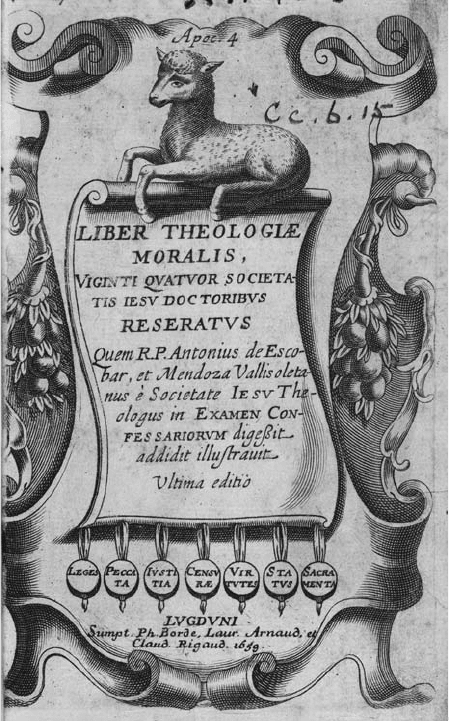
The title page of
Escobar’s Moral
Theology, a notorious
classic of casuistry
ETHICS
257
philistines. Eac h group contained writers of great literary skill, and each
group fostered artists of talent. On the fringe of each group there stood out
a great mathematical philosopher: Bertrand Russell in the case of Blooms-
bury; Blaise Pascal in the case of Port Royal. Each group Xared for a while in
the limelight, and then gradually faded into obscurity, leaving behind a
musty odour of exquisite spiritual snobbery.
Spinoza’s Ethical System
No one could ever accuse Spinoza of having belonged to a clique. A solitary
thinker of great intellectual courage, he devised an elaborate, elegant, and
demanding ethical system. Like Descartes, he gives an important role in
ethics to the detailed examination of the passions, which occupies the third
book of the Ethics. But both the philosophical substructure and the prac-
tical conclusions of his analysis of the emotions are very diVerent from
Descartes’, so that the resulting ethical system is unlike any other of
modern times.
The metaphysical basis of Spinoza’s ethical system is a principle of
existential inertia. Everything, so far as it can by its own power, endeavours
to persevere in its own being. This self-perpetuating endeavour in each
thing constitutes its very essence (Eth, 75). Applied to men and women, this
general principle means that the fundamental motive of human action is
self-preservation. Desire is deWned by Spinoza as the self-conscious endeav-
our to preserve the existence of soul and body. We are conscious not only
of this appetite for existence, but also of any increase or diminution in our
powers of action: consciousness of such an increase constitutes pleasure;
consciousness of diminution constitutes pain (Eth, 77). Desire, pleasure, and
pain are the three fundamental human drives: all the other emotions, such
as love, hatred, hope, and fear, are derived from them.
There are, however, two diVerent kinds of emotions, passive and active.
There are passive emotions, or pas sions, in which we ‘toss to and fro like
waves of the sea driven by contrary winds’ (Eth, 103). In the passive
emotions, modiWcations of the body give rise to corresp onding ideas in
the mind—ideas which will be inadequate and confused. But there are also
active emotions arising from the mind’s own endeavour to increase its
understanding by conceiving clear and distinct ideas. Active emotions are
ETHICS
258
derivable only from desire and pleasure; pain, which is the mark of a
reduction in human power, physical and mental, cannot give rise to an
active emotion. Actions arising from active emotions are expressions of
strength of character ( fortitudo). Strength of character, when it is expressed
in self-perserving actions, is called ‘courage’ (animositas); when expressed in
actions aiming at the good of others, it is called ‘nobility’ (generositas).
The notion of nobility, which is introduced at the end of Book Three of
the Ethics, appears at Wrst sight to conXict with the ruthlessly egoistical
analysis of the passions which occupies most of the book. We are told, for
instance, ‘He who conceives that someone he hates is in pain will feel
pleasure’ (Eth, 82), and that ‘if we conceive that anyone delights in an object
that only one person can possess, we will try to prevent the person in
question from gaining possession of it’ ( Eth, 87). Apparently cynical remark s
of this kind are often shrewd: for instance, ‘if a man begins to hate what he
once loved but loves no more, he will regard it with greater hatred than
if he had never loved it’ (Eth, 90). But only a rare remark prepares the way
for the notion of nobility: for instance, ‘Hatred is increased when it is
reciprocated, but hatred can be destroyed by love’ (Eth, 93).
The reconciliation of egoism and altruism is carried out by Spinoza in
the fourth and Wfth books of the Ethics: ‘On Human Bondage’ and ‘On
Human Freedom’. The overarching theme of these books is this: we are in
bondage to the extent that we feel passive emotions, and we are free to the
extent that we feel active emotions. An emotion ceases to be a passion once
we achieve a clear and distinct idea of it, which means an understanding of
its causes. Paradoxically, the key to liberation is the appreciation of the
necessity of all things. We cannot avoid being determined, but moral
progress consists in the replacement of external determination by internal
determination. What we need to do is to take a God’s eye view of the whole
necessary natural scheme of things, seeing it ‘in the light of eternity’.
Not all passions can be turned into emotions, but those that cannot may
be eliminated. Hatred, for instance, is a passive emotion, bein g a form of
pain. But once I understand that the actions of others are determined, I will
cease to feel hatred to those that do me harm. The passions of diVerent
people may conXict with each other, but people who are guided by reason and
feel emotion rather than passion will Wnd themselves in agreement
(Eth, 132). Self-preservation remains the underlying drive, prior to any
virtue (Eth, 127). Nonetheless, we ought to want virtue for its own sake,
ETHICS
259
for there is nothing more useful for us which might serve as its goal. This is
how egoism and altruism are to be reconciled. There is scope for nobility
when self-preservation is enlightened by the realization of one’s own place
as a part of the great whole which is Nature:
To man there is nothing more useful than man—nothing, I repeat, more
excellent for preserving their being can be wished for by man, than that all should
so in all points agree that the minds and bodies of all should form, as it were, one
single mind and one single body, and that all should, with one consent seek what
is useful to them all. Hence, men who are governed by reason—that is, who seek
what is useful to them in accord with reason—desire for themselves nothing,
which they do not also desire for the rest of mankind, and consequently are just,
faithful, and honourable in their conduct. (Eth, 125)
In ‘On Human Bondage’ Spinoza goes through the emotions, telling us
which ones are good and which are bad (‘good’ and ‘bad’ for him, of course,
simply mean what is conducive or non-conducive to self-preservation).
Mirth, for instance, is a good thing, which we cannot have too much of;
melancholy, however, is always bad (Eth, 138). (Spinoza recommends music
as a cure for melancholy (Eth, 115).) Desires for non-competitive goods
should be preferred to desires for goods that can be possessed by one person
only. The highest good is one that is common to all who follow virtue, one
in which all can equally rejoice. ‘The mind’s highest good is the knowledge
of God, and the mind’s highest virtue is to know God’ (Eth, 129). God, of
course, is for Spinoza the same as Nature, and the more we increase our
knowledge of Nature the more we rejoice. This joy, accompanied by the
thought of God as cause, is called by Spinoza ‘the intellectual love of God’.
Spinoza’s ideal human, a free person absorbed in the intellectual love of
God, is no less subject to determinism than someone who is in bondage to the
basest passions. The diVerence is that the free man is determined by causes
that are internal, not external, and that are clearly and distinctly perceived.
One of the eVects of the clear and distinct perception of the human condition
is that time ceases to matter. Past, present, and future are all equal to each
other. We naturally think of the past as what cannot be changed, and the
future as being open to alternatives. But in Spinoza’s deterministic universe,
the future is no less Wxed than the past. The diVerence, therefore, between
past and future should play no part in the re X ections of a wise man: we
should not worry about the future nor feel remorse about the past.
ETHICS
260
One passion which must altogether disappear in a free man is the passion
of fear. Fear can never be a rational emotion; its object is future evil, and for
Spinoza both the future and evil are ultimately unreal. The free man has
only positive motives: he eats well and takes healthy exercise because he
enjoys doing so, not in order to postpone his death. ‘A free man thinks of
death least of all things; and his wisdom is a meditation not on death but
on life’ (Eth, 151).
It is diYcult not to admire the beauty of Spinoza’s ethical writing; it is
equally diYcult to accept it as oVering a real guide to living. Spinoza is a
victim of his own success: he has woven his ethics so tightly to his metaphysics
that it is diYcult to swallow the one without the other. Bertrand Russell,
who totally rejected Spinoza’s metaphysics, but thought him the one really
admirable human being in the history of philosophy, made a gallant eVort
to draw a practical moral from the Ethics:
Spinoza’s principle of thinking about the whole, or at any rate about larger
matters than your own grief, is a useful one. There are even times when it is
comforting to reXect that human life, with all that it contains of evil and suVering,
is an inWnitesimal part of the life of the universe. Such reXections may not suYce
to constitute a religion, but in a painful world they are a help towards sanity and
an antidote to the paralysis of utter despair. (HWP, 562)
Hume on Reason, Passion, and Virtue
For Spinoza, as for Socrates in the ancient world, all wrongdoing is a result
of ignorance: vicious conduct is ultimately a failure of reason. At the
opposite pole stands David Hume: for him, reason has nothing at all to
do with the distinction between right and wrong, between virtue a nd vice.
Reason’s only function is a technical one: to assist us in the achievement of
the goals set by our passions. In the evaluation of our goals, reason has no
place. ‘’Tis not contrary to reason to prefer the destruction of the whole
world to the scratching of my Wnger. ’Tis not contrary to reason for me to
chuse my total ruin, to prevent the least uneasiness of an Indian or
person totally unknown to me’ (T, 416). Reason can neither adjudicate
nor control passion; a passion can be conquered only by another, stronger,
passion. Why then do people—and not only philosophers—talk so much
about the con Xict between reason and passion? Hume’s answer is that they
mistake for reason what is actually a gentle, non-violent, passion:
ETHICS
261
There are certain calm desires and tendencies which, tho’ they be real passions,
produce little emotion in the mind, and are more known by their eVects than by
the immediate feeling or sensation. These desires are of two kinds; either certain
instincts originally implanted in our natures, such as benevolence and resentment,
the love of life, and kindness to children; or the general appetite to good, and
aversion to evil, consider’d merely as such. When any of these passions are calm,
and cause no disorder in the soul, they are very readily taken for the determin-
ations of reason. (T, 417)
Moral judgements are calm passions of this kind: they are not ideas, but
impressions. Morality is more properly felt than judged of. Virtue gives us
pleasure, and vice pain: ‘An action or sentiment or character is virtuous or
vicious; why? because its view causes a pleasure or uneasiness of a particular
kind.’ But of course not every action or person or thing that gives us
pleasure is virtuous: wine, women, and song may be pleasant but the
pleasure they give is not the special pleasure taken by the moral sense.
Well, what are the marks of the particular kind of pleasure involved in
favourable moral judgement? Hume oVers two: that it should be disinter-
ested and that it should involve approbation. These seem insuYcient to
mark oV moral from aesthetic judgement. Surely we need to distinguish
one from the other if morality is not simply to be a matter of taste.
Hume oVers us no general criterion adequate to di Verentiate moral
judgement, but proceeds to investigate individual virtues. The two most
important are benevolence and justice. Benevolence is universally admired:
we all esteem those who relieve the distressed, comfort the aZicted, and
are generous even to strangers. But in a natural state, benevolence extends
only to those who in one way or another are close to us. ‘There is no such
passion in human minds, as the love of mankind, merely as such, inde-
pendent of personal qualities, of services, or of relation to ourself ’ (T, 481).
Benevolence alone, then, cannot be the foundation of justice; of our
obligation to repay our debts even to strangers and enemies. We must
conclude that justice is not a natural virtue, but an artiW cial one.
Human beings are impotent outside society; but society is unstable unless
social rules are observed, in particular property rights. What we need is a
convention entered into by all members of society to leave everyone
in possession of the external goods acquired by their fortune and
industry. Justice is founded therefore on utility, on self-interest broadly
interpreted:
ETHICS
262
Instead of departing from our own interest, or from that of our nearest friends, by
abstaining from the possessions of others, we cannot better consult both these
interests, than by such a convention; because it is by that means we maintain
society, which is so necessary to their well-being and subsistence, as well as to our
own. (T, 489)
It is because it is based on a convention, entered into for the sake of utility,
that justice is an ‘artiWcial virtue’.
Natural virtues, such as meekness, charity, clemency, or generosity, are
not based on utility, but arise from a more fundamental feature of human
nature: sympathy. The passions of each human being are reXected in other
human beings, as strings resonate in harmony. A diVerence between
natural and artiW cial virtues is this: that individual acts of benevolence do
good, whereas it is only the entire system of justice that promotes happi-
ness. ‘Judges take from a poor man to give to a rich; they bestow on the
dissolute the labour of the industrious; and put into the hands of
the vicious the means of harming both themselves and others. The
whole scheme, however, of law and justice is advantageous to the society.’
It is because of this advantage to society that we esteem justice; but justice is
only a means to an end:
Now as the means to an end can only be agreeable, where the end is agreeable; and
as the good of society, where our own interest is not concerned, or that of our
friends, pleases only by sympathy: It follows, that sympathy is the source of the
esteem which we pay to all the artiWcial virtues. (T, 577)
In an appendix to the second Enquiry, Hume takes some pains to argue
against those who claim that benevolence is only a disguised form of self-
love. Even animals show disinterested benevolence; so why should we
doubt the genuineness of human gratitude and friendship and maternal
love? In thus rejecting the long philosophical tradition of eudaimon-
ism—the thesis that the ultimate goal of all one’s actions is one’s
own happiness—Hume was, probably unwittingly, following in the
footsteps of his compatriot Duns Scotus.7 But whereas Scotus thought
that the innate motive independent of self-love was a love of justice,
Hume saw the motive of benevolence as even more deeply rooted in
human nature.
7 See vol. II, p. 272.
ETHICS
263
Kant on Morality, Duty, and Law
Kant, although he presented a very diVerent system of ethics, agreed with
Hume in the rejection of eudaimonism. Happiness, he argues in the
Groundwork, cannot be the ultimate purpose of morality:
Suppose now that for a being possessed of reason and will the real purpose of
nature were his preservation, his welfare, or in a word his happiness. In that case
nature would have hit on a very bad arrangement by choosing reason in the
creature to carry out this purpose. For all the actions he has to perform with this
end in view, and the whole rule of his behaviour, would have been mapped out for
him far more accurately by instinct; and the end in question could have been
maintained far more surely by instinct than it ever can be by reason. (G, 395)
The overarching concept in Kantian morality is not happiness, but duty.
The function of reason in ethics is not to inform the will how best to
choose means to some further end; it is to produce a will that is good in
itself, and a will is good only if it is motivated by duty. Good will, for Kant,
is the only thing that is good without qualiW cation. Fortune, power,
intelligence, courage, and all the traditional virtues can be used to bad
ends; even happiness itself can be corruptin g. It is not what it achieves that
constitutes the goodness of a good will; good will is good in itself alone:
Even if, by some special disfavour of destiny, or by the niggardly endowment of
stepmotherly nature, this will is entirely lacking in power to carry out its
intentions, if by its utmost eVort it still accomplishes nothing, and only good
will is left . . . even then it would still shine like a jewel for its own sake as
something which has its full value in itself. (G, 394)
Good will is the highest good and the condition of all other goods,
including happiness.
If a will is good only when motivated by duty, we must ask what it is to
act out of duty. A Wrst answer is to say that it is to act as the moral law
prescribes. But this is not enough. Kant distinguishes between acting in
accordance with duty, and acting from the motive of duty. A grocer who
chooses honesty as the best policy, or a philanthropist who takes delight in
pleasing others, may do actions that are in accord with duty. Such actions
conform to the moral law, but they are not motivated by reverence for it.
Actions of this kind, however correct and amiable, have, according to Kant,
no moral worth. Worth of character is shown only when someone does
ETHICS
264
good not from inclination but from duty. A man who is wholly wretched
and longs to die, but preserves his own life solely out of a sense of duty—
that is Kant’s paradigm of good willing (G, 398).
Happiness and duty, therefore, are for Kant not just diVerent but
conXicting motives. Aristotle had taught that people were not really
virtuous as long as virtuous action went against the grain. His paradigm
of a virtuous man was somebody who thoroughly enjoyed carrying out his
virtuous endeavours. But for Kant it is the painfulness of well-doing that is
the real mark of virtue. If virtue brings happiness, that must only be as a by-
product. ‘The more a cultivated reason concerns itself with the aim of
enjoying life and happiness, the farther does man get away from true
contentment’ (G, 395). We should not take the Bible seriously when it tells
us to love our neighbour: it is cold, unfeeling, charitable assistance that is
really commanded (G, 399).
The way to test whether one is acting out of a sense of duty is to inquire
into the maxim, or principle, on which one acts; that is to say, the
imperative that guides one’s action. An imperative may take a hypothetical
form: ‘If you wish to achieve so-and-so, act in such-and-such a way.’ Such
an imperative enjoins an action as a means to a particular end. Thus, the
maxim of the honest grocer may be the hypothetical imperative: ‘If you
wish to keep your customers, do not overcharge them.’
A person who acts out of duty, however, is obeying not a hypothetical
imperative, but a categorical imperative, which commands: ‘No matter
what you wish to achieve, act in such-and-such a way.’ The categorical
imperative of duty is an overarching imperative which discriminates
between virtuous and vicious hypothetical imperatives. It is thus formu-
lated by Kant: ‘Act only according to a maxim which you can at the same
time will to become a universal law.’
Kant gives several examples to illustrate the operation of the categorical
imperative. Suppose that I am tempted to get out of a diYculty by making
a promise I have no intention of keeping, and I then wonder whether such
a lying promise can be reconciled with duty:
I have then to ask myself ‘Should I really be content that my maxim (the maxim of
getting out of a diYculty by a false promise) should hold as a universal law (one
valid both for myself and others)? And could I really say to myself that every one
may make a false promise if he Wnds himself in a diYculty from which he can
extricate himself in no other way?’ I then become aware at once that I can indeed
ETHICS
265