
Kenny Anthony. The Rise of Modern Philosophy: A New History of Western Philosophy. Volume 3
Подождите немного. Документ загружается.

will to lie, but I can by no means will a universal law of lying; for by such a law
there could properly be no promises at all. (G, 403)
A second example is this. A well-to-do person is asked to help some others
who are suVering hardship. He is tempted to respond: ‘What does this
matter to me? Let everyone be as happy as Heaven wills or as he can make
himself. I won’t do him any harm, but I won’t help him either.’ But when
he considers the categorical imperative he comes to realize that he cannot
will ‘never harm but never help’ as a universal maxim because in many
situations he will himself need help and sympathy from others (G, 423).
These two examples illustrate two diVerent ways in which the categorical
imperative operates. In the Wrst case, the vicious maxim cannot
be universalized because its universalization leads to contradiction: if no
one keeps promise s, there is no such thing as promising. In the second case,
there is nothing self-con tradictory in the idea of no one ever helping
anyone else; but no one could rationally will to bring about such a
situation. Kant says that the two diVerent kinds of case correspond to
two diVerent kinds of duties: strict duties (like that of not lying) and
meritorious duties (such as that of helping the needy) (G, 424).
Kant argues that the categorical imperative rules out suicide. But it is
not clear how it does so, in the formulation he has given. There is nothing
self-contradictory in the prospect of universal suicide; and someone dis-
gusted with the human race might well applaud the prospect. Kant has,
however, a diVerent formulation of the categorical imperative which does
not appeal to universalizability: ‘Act in such a way that you always treat
humanity, whether in your own person or in the person of any other,
never simply as a means, but always at the same time as an end.’ This
formulation is more eVective in ruling out suicide, since it can be argued
that to take one’s own life is to use one’s own person as a means of bringing
to an end one’s discomfort and distress. It also clearly rules out slavery, and
in On Perpetual Peace Kant argues that it rules out aggressive wars. However, it
is hard to see exactly what else it excludes, since we all every day make use,
as means to our own ends, of other people from dustmen to solicitors. We
need more enlightenment about what it is to treat people ‘at the same time
as an end’.
What Kant tells us is that as a human being I am not only an end in
myself, but a member of a kingdom of ends. In rationally choosing my
maxims, I am proposing universal laws; but so too is every other rational
ETHICS
266
being. Universal law is law which is made by rational wills like mine. ‘There
arises’, Kant tells us, ‘a systematic union of rational beings under common
objective laws—that is a kingdom.’ A rational being is subject only to
laws that are made by himself and yet are universal: the moral will is
autonomous, giving to itself the laws that it obeys. In the kingdom of ends,
we are all both legislators and subjects. The idea of the autonomy of the
moral will is very attractive; but one wonders how Kant can be so conWdent
that the operation of all the diVerent rational choices of maxim will
produce a single system of universal laws. Can we, as he cheerfully tells
us to do, ‘abstract from the personal diVerences between rational beings,
and also from all the content of their private ends’ (G, 433)?
‘In the kingdom of ends’, Kant tells us, ‘everyt hing has either a price or a
worth’. If it has a price, something else can be put in its place as a fair
exchange; if it is beyond price and is unexchangeable, then it has worth.
There are two kinds of price: market price, which is related to the
satisfaction of need, and fancy price, which is related to the satisfaction of
taste. Morality is above and beyond either kind of price:
Morality, and humanity so far as it is capable of morality, is the only thing which
has worth. Skill and diligence in work have a market price; wit, imagination, and
humour have a fancy price; but Wdelity to promises and benevolence based on
principle (not on instinct) have an intrinsic worth. (G, 435)
Kant made room, in the kingdom of e nds, for a sovereign or head who was
(like the members) a legislator, but who (unlike the members) was not
subject to law and did not act out of duty. This sovereign is no doubt God,
but he is given no special role in the determination of the moral law. Kant’s
successors in later centu ries, who have been attracted by the idea of the
autonomous will as the moral legislator, have quietly dropped the sover -
eign, and turned the kingdom of ends into a republic of ends, in which no
legislator is privileged over any other.
Hegel’s Ethical Synthesis
We noticed earlier that Kant’s ethics stood at an opposite pole from
Aristotle’s. For Aristotle the overarching ethical concept was that of
happiness, which was the ultimate goal of every fully rational human
ETHICS
267
action. Kant dethroned happiness and put in its place duty, the necessary
motive of any action of moral worth. For Aristotle virtue was exhibited in
the joy that a good man took in his good actions; for Kant the measure of
virtue was the cost in painful eVort of its exercise.
Hegel saw Aristotelian ethics and Kantian ethics as thesis and antithesis
to which he should oVer a synthesis. Like Aristotle he saw the foundation
of ethics as a concept of human Xourishing; but he deWned this in
terms of free self-actualization, which accorded with Kant’s emphasis
on the autonomy of the moral life. Unlike Kant, however, he gave
pride of place in moral theory not to the notion of duty, but the
notion of right: in Hegel, as in Aristotle, obedience to law takes second
place to the free expression of what is best in each person’s human
nature.
Hegel’s great innovation in moral philosophy was that he injected a
social and historical element into the notion of ‘human nature’. The aims
and capacities which an individual can pursue and develop depend on the
social institutions within which she lives, and these institutions will vary in
diVerent places and times. Rights, which are the basic elements in Hegel’s
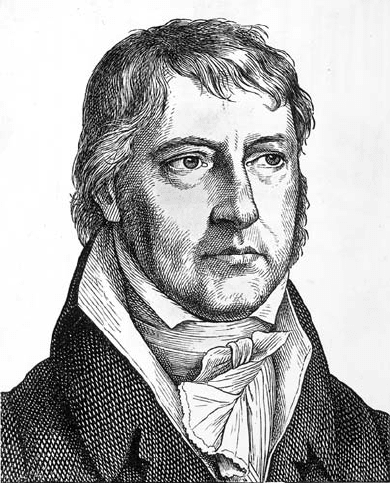
In this portrait Hegel radiates
the self-confidence
appropriate to a philosopher
whose thought represented
the highest point of human
self-consciousness
ETHICS
268
ethics, are claims to exercise one’s individual choice within an ‘external
sphere’—and this sphere is to a large extent deWned by the form of
the society to which one belongs. Hegel demonstrates this in a famous
passage of the Phenomenology of Spirit which sets out how individual self-
consciousness develops as a consciousness of one’s role in relation to
others. The example of a social relation he chooses to illustrate the point
is that of master and slave.
Initially a master is fully self-conscious, but sees his slave as a mere thing.
The slave is conscious of his master, but sees his own self only in his
relation to the master’s purposes. The master recognizes selfhood only in
himself, and the slave recognizes it only in his master. However, as the slave
is set to work to produce beneWts for the master, the relationship changes.
As his labour transforms matter into useful products, the slave becomes
aware of his own power, but Wnds his goals still limited by the master’s
commands. The master, on the other hand, sees his own self-consciousness
as limited through his inability to W nd a responsive self-consciousness in
the slave. The relationship denies to each of them a full measure of self-
consciousness (PG, 178–96).
Hegel traces through history attempts to remove the obstacles to self-
consciousness set by the master–slave relationship. Stoicism encouraged
people to accept their social position as a matter of cosmic necessity, to be
accepted with tranquillity: both the slave Epictetus and the Emperor
Marcus Aurelius embraced Stoicism. But looking within and turning
one’s back on society does not really resolve the contradictions implicit
in the master–slave relationship. It leads on to the second form of false
consciousness, the sceptical attitude which outwardly conforms to society’s
demands while inwardly denying the reality of the norms which society
proclaims. The contrast between inner and outer attitudes becomes
intolerable, and consciousness passes into a third false stage, which Hegel
calls ‘The Unhappy Consciousness’, and which he regards as typical of
medieval Christendom.
In the unhappy consciousness the contradictions of the master–slave
relationship are recreated within a single individual self. A person is
conscious of a gap between an ideal self and his own imperfect self, the
latter a false self, the former a true but as yet unrealized self. The ideal self is
then projected into another world and identiWed with a God of which the
actual self is no part. Thus a person’s consciousness is divided, and he
ETHICS
269
becomes ‘alienated’ from it. This concept of alienation—of treating as alien
something with which by rights one should identify—was to have a
powerful future among Hegel’s disciples.
All such forms of false consciousness represent an attempt to inter-
iorize a problem that can only be solved by a change in social institu-
tions. The realization of this is what accounts for the emphasis that Hegel
places on rights. A person has an inalienable right to life and to freedom
from slavery, and to a minimum of personal property; only societies that
protect these rights can provide a context for individual human Xourish-
ing (PR, 46).
Rights are necessary because an individual person can only express herself
as a free spirit by giving herself an external sphere of freedom. A right is an
entitlement to property interpreted in a broad sense; for Hegel, a person’s
body, life, and liberty are his property no less than material things. Some
rights, like the right to the products of one’s labour, can be given up; but no
one can relinquish her total freedom by accepting slavery.
Besides rights to property Hegel recognizes two other forms of right:
rights of contract and rights of punishment. The former are embodied in
the civil law, and the latter in the criminal law. Hegel’s view of punishment
is retributive: it is an annulment of wrongdoing, implicitly willed by the
criminal himself since his crime was itself a violation of the universal will
(PR, 99–100).
The theory of rights, important though it is for Hegel, is only one of
three sections of his ethics. The other two are the theory of morality
(Moralitat) and of uprightness (Sittlichkeit) . Morality incorporates the Kantian
elements of Hegel’s system, and uprightness the Aristotelian elements.
Morality is deWned largely in formal terms; uprightness is described in
more concrete examples. Morality is related to duty, and uprightness is
related to virtue.
For Hegel, morality is concerned mainly with the motives of the moral
agent. Hegel distinguishes between purpose (Absicht) and intention (Vorsatz).
The purpose is the overarching motive that relates an action to my welfare;
the intention is the immediate end to which I choose a means. (Thus, in
taking a particular medication my intention might be to lower my chol-
esterol level; my purpose is to keep in good health.) Intention is, for Hegel,
deWned in terms of knowledge: unforeseen consequences of my actions are
ETHICS
270
not intentional. A good purpose is essential if an action is to be morally
good.
Hegel resembles Kant in the emphasis he places on the importance of
purpose, or ultimate motive. But he does not agree with him that duty is
the only morally worthy purpose, and he does not appeal to the principle
of universalizability as the criterion of moral acceptibility. Kant’s formula
of universal law, he complains, allows in some highly suspect maxims
(PR, 148).
The mere belief that one’s purpose is good does not suYce to render an
action morally correct. Following one’s conscience is indeed necessary, but
not suYcient, for virtuous behaviour. Hegel stands at a distance from those
subjectivists, before him and after him, who have claimed that the indi-
vidual conscience is the ultimate court of appeal. Here, as elsewhere, Hegel
is well aware of the social context of private judgement.
When we turn to the third section of Hegel’s ethical system, uprightness,
the social element becomes clearly dominant. For uprightness consists of
self-harmony in one’s social life; it concerns the concrete, external aspect of
ethical behaviour, and this must take place in an institutional setting. This
section of the Philosophy of Right examines the nature of three social struc-
tures in which individuals Wnd themselves: the family, civil society, and the
state. Its exposition belongs, therefore, rather to the succeeding chapter on
political philosophy than to the present chapter on ethics.
The period covered by this volume is an instructive one for anyone who
wishes to inquire to what extent metaphysics is a guide to ethics. Of the
great seventeenth-century metaphysicians, Descartes produced an ethical
system which, despite the recent respectful attention of scholars, is gener-
ally reg ard as too jejune to be a key to life, while Spinoza devised an ethics
which is so closely interwoven with his metaphysics that it can give
guidance only to those who share his cosmic outlook. On the other
hand, two great philosophers of the eighteenth century still exercise
substantial inXuence on moral philosophy, precisely because their ethics
stands at a distance from metaphysics. Hume insisted that moral prescrip-
tions should be quite separate from any judgements of fact, whether
physical or (if such were possible) metaphysical: an ‘ought’ never followed
from an ‘is’. Kant, on the other hand, though the greatest metaphysician of
ETHICS
271
them all, created a moral system that demands no commitment whatever
to other areas of his philosophy. Despite, or perhaps because of, this his
contribution to moral philosophy went far beyond that of any other of the
philosophers we have been considering. His ethics of duty remains to this
day the main competitor to the eudaimonistic virtue ethics of Plato and
Aristotle, and to the consequentialist utilitarian ethics that became the
most inXuential moral system of much of the nineteenth and twentieth
centuries.
ETHICS
272

9
Political Philosophy
Machiavelli’s Prince
T
wo works of the decade 1511–20 mark the beginning of modern
political philosophy: Machiavelli’s Prince and More’s Utopia. Both
books are very diVerent from the typical scholastic treatise which seeks
to derive, from Wrst principles, the essence of the ideal state and the
qualities of a good ruler. One is a brief, stylish, how-to manual; the other
is a work of romantic fantasy. The two works stand at opposite ends of the
political spectrum. A Machiavellian prince is an absolute autocrat, while
Utopia holds out a blueprint for democratic communism. For this reason,
the two treatises can be regarded as setting out the parameters for subse-
quent debate in political philosophy.
It should be said, however, that The Prince was not Machiavelli’s only
political work. He also wrote discourses on Livy in which he set out recipes
for republican government parallel to his recipes for monarchical rule. In
the course of those discourses he enunciates the following principle:
When a decision is to be taken on which the whole safety of one’s country
depends, no attention should be paid either to justice or injustice, to kindness
or cruelty, to praise or shame. All other considerations should be set aside, and
that course adopted which will save the life and preserve the freedom of one’s
country.1
Salus populi suprema lex—‘the welfare of the people is the highest law’—was
not a wholly new doctrine. Cicero had proclaimed it in theory and acted
1 Quoted in Janet Coleman, A History of Political Thought from the Middle Ages to the Renaissance
(2000), p. 248.
on it in practice. In The Prince, however, it is not only the welfare of the
state, but also the welfare of its ruler, which trump all other consider-
ations. The autocratic ruler can, in the appropriate circumstances, ignore
legality, morality, and public opinion.
Drawing on his experience as a n oYcial and diplomat, and on his
reading of ancient history, Machiavelli describes how provinces a re won
and lost and how they can best be kept under control. If a prince is to tak e
over a state that has been free and self-governing, he must destroy it
utterly; otherwise the memory of liberty will always goad the subjects
into rebellion. Once in power a prince must strive to appear, rather than to
be, virtuous. He should desire to be accounted merciful rather than cruel,
but in reality it is safer to be feared than to be loved.
But in order to feared, it is not necessary to make oneself hated. A prince
may be feared without being hated:
so long as he does not meddle with the property or with the women of his citizens
and subjects. And if constrained to put any to death, he should do so only when
there is reasonable justiWcation and manifest cause. But above all, he must abstain
from the property of others. For men will sooner forget the death of their father
than the loss of their patrimony. (P, ch. 17)
Nothing is more important for a prince than to appear to have the virtues
of mercy, good faith, humanity, integrity, and piety, and he should never
let a word leave his mouth which is not full of those estimable qualities.
But in fact, in order to preserve the state, he will frequently be constrained
to violate faith and to sin against charity, humanity, and religion. More
people will see and hear his admirable professions than will feel the pain of
his unscrupulous practice, and thus he will maintain his rule and win his
subjects’ praise (P, ch. 18).
In particular, a prince need not keep a promise when keeping it is
hurtful to him and when the reason s for the promise have been removed.
He should imitate a fox, no less than a lion, and he will never lack for
plausible reasons to cloak a br each of faith. But how will anyone believe
princes who constantly break their word? History shows that it is simply a
matter of skill in deception. Anyone who has a mind to deceive will have
no trouble Wnding people who are willing to be deceived.
The cool cynicism of Machiavelli’s teaching is impressive. Not only does
he recommend to princes absolute unscrupulousness; his advice is based on
274
POLITICAL PHILOSOPHY
the assumption that all their subjects are gullible and guided solely by
self-interest. Some have been shocked by the book’s immorality; others
have found its lack of humbug refreshing. Few, however, have been
persuaded to admire the models held up by Machiavelli, such as Pope
Alexander VI and his son Cesare Borgia. Alexander is prais ed as the arch
dissembler: ‘No man was ever more eVective in making promises, or bound
himself by more solemn oaths, or observed them less.’ Cesare, who worked
by bribery and assassination to appropriate central Italy for the Borgias, and
failed to do so only through an unpredictable piece of ill-luck, is saluted as
a paradigm of political skill: ‘Reviewing thus all the actions of the Duke,
I Wnd nothing to blame; on the contrary it seems proper to hold him as an
example to be imitated’ (P, ch. 18).
The history of the papal states under the Borgia pope, or under his
enemy and successor the warrior Pope Julius II, is hard to reconcile with
the brief chapter of The Prince devoted to ecclesiastical princedoms. Princes
who are churchmen, Machiavelli says, have states that they do not defend
and subjects that they do not govern; yet their undefended states are not
taken from them, and their ungoverned subjects do not and cannot think
of throwing oV their allegiance. ‘Accordingly, only such princedoms are
secure and happy’ (P, ch. 11).
More’s Utopia
It is hard to know whether this remark was meant ironically, or was a
shameless pitch to secure employment in Rome under the new Medici
Pope Leo who had succeeded Julius. The passage Wnds a parallel in More’s
Utopia, where it is observed that treaties are always solemnly observed in
Europe, partly out of reverence for the sovereign ponti Vs:
Which, like as they make no promises themselves, but they do very religiously
perform the same, so they exhort all princes in any wise to abide by their promises;
and them that refuse or deny so to do, by their pontiWcal power and authority
they compel thereto. (U, 116)
Here the intention must surely be ironical. More was willing to die in
defence of the papal oYce; but he was not willin g to deceive himself about
the perWdy of some of its sixteenth-century holders.
275
POLITICAL PHILOSOPHY