
Kenny Anthony. The Rise of Modern Philosophy: A New History of Western Philosophy. Volume 3
Подождите немного. Документ загружается.

Direct, oblique, and ironical criticism of vicious practices and institutions
is a regula r feature of Utopia. The work—a dialogue between More, just
returned from a diplomatic mission to Flanders, Peter Gilles, the town
clerk of Antwerp, and a Wctitious navigator named Raphael Hythlodaye—
is divided into two books. In the Wrst of these, social crit icism is direct and
pointed; in the second, a mocking mirror is held up to reveal the distor-
tions of contemporary society.
Hythlodaye, we are told in the Wrst book, had been a Portuguese compan-
ion of the navigator Amerigo Vespucci, from whom the newly discovered
continent of America had taken its name. Left behind by Vespucci in Brazil, he
had travelled home via India and had visited many diVerent countries, of
which the most remarkable had been Utopia. More and Gilles are anxious
to hear him describe it, but before doing so Hythlodaye makes some obser-
vations about practices in England. The execution of thieves, he complains, is
too harsh a penalty and insuYcient as a deterrent to those for whom
starvation is the only alternative to robbery. It is altogether unjust that one
man should suVer the loss of his life for the loss of someone else’s money.
Theft should be attacked by removing its cause, which is poverty. This is due
to the avarice of noblemen, drones who live on the labour of others: they
drive out poor farmers to enclose land for sheep-rearing, which puts up the
price of both wool and food.
Hythlodaye presents two arguments against the death penalty for theft.
First, it is a violation of the divine command ‘Thou shalt not kill’. Second:
Everyone knows how absurd and even dangerous to the commonwealth it is that
a thief and a murderer should receive the same punishment. Since the robber sees
that he is in as great danger if merely condemned for theft as if he were convicted
of murder as well, this reason alone impels him to murder one whom other-
wise he would only have robbed . . . There is greater safety in putting the man out
of the way and greater hope of covering up the crime if he leaves no one left to tell
the tale. (U, 30)
This argument was to be repeated by reformers until the death penalty for
theft was abolished by Parliament in the nineteenth century.2 But it is the
second rather than the Wrst book of Utopia that was to make More famous:
for it is there that we read the description of the Wctitious commonwealth.
2 See, for instance, Macaulay’s Notes on the Indian Penal Code,inhisCollected Works (London, 1898),
XI.23.
276
POLITICAL PHILOSOPHY
‘Utopia’ is a Latin transliteration of a Greek name. The Latin ‘U’ may
represent a Greek ı, in which case the name means ‘Nowherel and’. Or it
may represent a Greek "ı, in which case the name means ‘Happyland’. The
ambiguity is probably intentional.
Utopia is an island, shaped like a crescent moon, 500 miles long and 200
across at its broadest part. It contains Wfty-four cities of 6,000 households
apiece, each with its own agricultural hinterland. The farms are worked by
the city-dwellers who are sent according to a rota, in batch es of twenty, to
spend two-year stints in the country. Every year each city sends three
elders to meet in a senate in the capital, Amaurot. As described, Amaurot
resembles More’s London, with one startling diVerence: there is no such
thing as privacy or private property. All houses are open and no door is
ever locked.
Every citizen, male or female, in addition to farming learns a craft such
as clothworking or carpentry. Only scholars, priests, and elected magis-
trates are exempt from manual labour There are no drones, and everyone
must work, but the working day is only six hours long. How do the
Utopians satisfy their needs while working so few hours? It is easy to
work this out if you consider how many people in Europe live in idleness:
First, almost all the women which be the half of the whole number: or else, if the
women be somewhere occupied, there most commonly in their stead the men be
idle. Besides this, how great and how idle a company is there of priests and
religious men, as they call them; put thereto all rich men, specially all landed
men, which commonly be called gentlemen and noblemen—take into this
number also their servants: I mean all that Xock of stout bragging swashbucklers.
Join to them also sturdy and valiant beggars, cloaking their idle life under the
colour of some disease or sickness. (U, 71–2)
Work in Utopia is made light not only by the many hands, but by the
simplicity of the needs they serve. Buildings, being communal, are well
maintained and do not need constant alteration at the whim of new
owners. Clothes do not demand great labour in their manufacture, since
Utopians prefer coarse and sturdy wear of undyed cloth.
A big diVerence between Utopia and Plato’s Republic is that the family
household is the primary unit of society. Girls, when they grow up, move to
the household of their husbands, but sons and grandsons remain in the
same household under the rule of the oldest parent so long as he is Wtto
govern it. No household may contain less than ten or more than sixteen
277
POLITICAL PHILOSOPHY
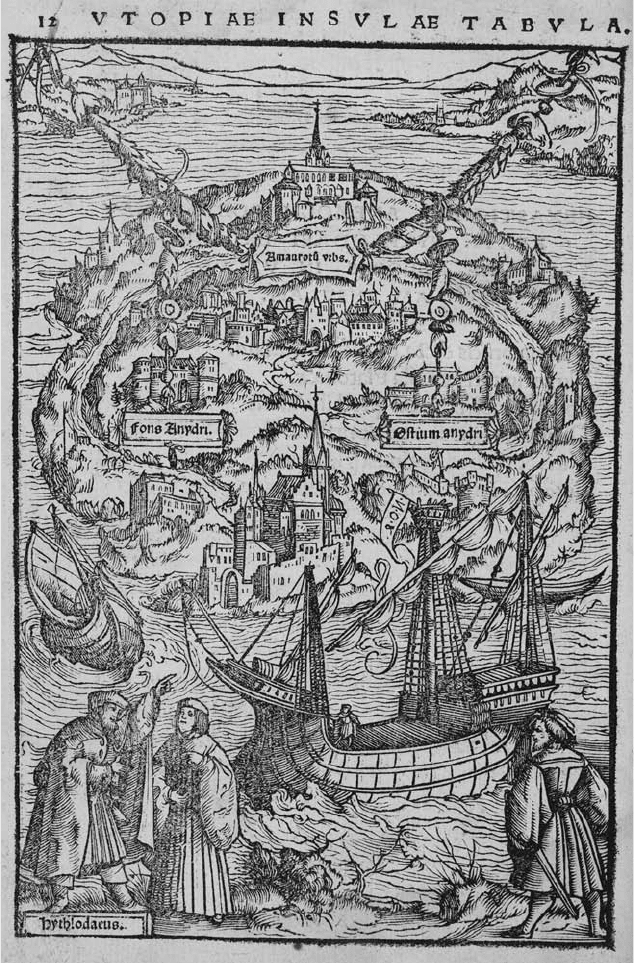
Frontispiece of the first edition of More’s Utopia
POLITICAL PHILOSOPHY
278
adults; excess numbers are transferred to other households who have fallen
below quota. If the number of households in the city exceeds 6,000, families
are transferred to smaller cities. If every city in the island is fully manned, a
colony is planted overseas. If the natives there resist settlement, the Uto-
pians will establish it by force of arms, ‘for they c ount this the most just
cause of war, when any people holdeth a piece of ground void and vacant
to no good and proWtable use, keeping others from the use and possession of
it which, notwithstanding, by the law of nature, ought thereof to be
nourished and relieved’ (U, 76).
Each household, as has been said, is devoted to a single craft. The house-
holds’ produce is placed in storehouses in the city centre from which
any householder can carry away, free of charge, whatever he needs. The
Utopians make no use of money; they employ gold and silver only to make
chamber pots and fetters for criminals. Internal travel is regulated by
passport; but any authorized traveller is warmly welcomed in other cities.
But no one, wherever he may be, is fed unless he has done his daily stint
of work.
The women of the households take turns in preparing meals, which are
eaten in a common hall, with the men sitting with their backs to the wall
facing the women on the outer benches. Nursing mothers and children
under Wve eat apart in a nursery; the children over Wve wait at table. Before
dinner and supper a passage is read from an edifying book; after supper
there is music and spices are burnt to perfume the hall. ‘For they be much
inclined to this opinion: to think no kind of pleasure forbidden, whereof
cometh no harm’ (U, 81).
Utopians indeed are no ascetics, and they regard bodily mortiWcation for
its own sake as something perverse. However, they honour those who live
selXess lives performing tasks that others reject as loathsome, such as road-
building or sick-nursing. Some of these people practise celibacy and are
vegetarians; others eat Xesh and live normal family lives. The former, they
say, are holier, but the latter are wiser.
Males marry at twenty-two and females at eighteen. Premarital inter-
course is forbidden, but before the marriage ‘a grave and honest matron
showeth the woman, be she maid or widow, naked to the wooer; and likewise
a sage and discreet man exhibiteth the wooer naked to the woman’. A man
would not buy a colt without thorough inspection, the Utopians argue, so
it is the height of foolishness to choose a partner for life without having
279
POLITICAL PHILOSOPHY
seen more than a face (U, 110). In principle, marriage is lifelong, but adultery
may break a marriage and in that case the innocent, but not the adulterous,
spouse is allowed to remarry. Adultery is severely punished and if repeated
incurs the death penalty. On rare occasions, divorce by consent is permitted.
Apart from family law, the Utopians have few laws and no lawyers.
Their laws are stated simply enough to need no interpretation, and they
think it better that a man should plead his own case and tell the same story
to the judge that he would tell to his own attorney.
The Utopians are not paciWsts, but they regard war as a matter of
necessity rather than of glory: it is justiWed in order to repel invaders or
to liberate peoples oppressed by tyranny. If a Utopian is killed or maimed
anywhere, they send an embassy to determine the facts and demand the
surrender of wrongdoers; if this is refused, they forthwith declare war. But
they prefer to win a war by bribery or assassination rather than by battle
and bloodshed; if a pitched battle abroad cannot be avoided they employ
foreign mercenaries to Wght it for them. In wars of defence in the home-
land, husbands and wives stand in battle side by side. ‘It is a great reproach
and dishonesty for the husband to come home without his wife, or the wife
without her husband’ (U, 125).
The Wnal chapter of Hythlodaye’s account concerns Utopian religion.
Most Utopians worship a ‘godly power, unknown, everlasting, incompre-
hensible, inexplicable, far above the capacity and reach of man’s wit’, which
they call ‘the father of all’. Utopians do not impose their religious beliefs on
others, and toleration is the rule. A Christian convert who proselytized
with hellWre sermons was arrested, tried, and banished, ‘not as a despiser of
religion, but as a seditious person and raiser up of dissension among the
people’ (U, 133). But toleration has limits: anyone who professes that the
soul perishes with the body is condemned to silence and forbidden to hold
public oYce. Suicide on private initiative is not permitted, but the incur-
ably and painfully sick may, after counselling, take their own lives. Reluc-
tance to die is taken as a sign of a guilty conscience, but those who die
cheerfully are cremated with songs of joy. When a good man dies ‘no part
of his life is so oft or gladly talked of, as his merry death’.
There are priests in Utopia—persons of extraordinary holiness ‘and
therefore very few’. There are thirteen, in fact, in every city, elected by
popular vote in secret ballot. Women as well as men may become priests,
but only if they are widows of a certain age. The male priests marry the
280
POLITICAL PHILOSOPHY
choicest wives. Priests, male and female, take charge of the education of
children, have the power to excommunicate for immoral behaviour, and
serve as chaplains to the army. On great festivals they wear vestments made
from birds’ feathers, like those of American Indian chiefs. The service
culminates in a solemn prayer in which the worshippers thank God that
they belong to the happiest commonwealth and profess the truest of all
religions (U, 145).
Like the Platonic Republic, Utopia alternates attractive features with
repellent ones, and mixes practicable institutions with lunatic devices. Like
Plato, M ore often leaves his readers to guess how far he is proposing serious
political reforms, and how far he is simply using fantasy to castigate the
follies and corruption of actual society.
Just and Unjust Wars
When discussing the Utopians’ attitude to war, More states: ‘Their one and
only object in war is to secure that which, had it been obtained beforehand,
would have prevented the declaration of war’ (U, 120). Such a maxim would
rule out all demands for unconditional surrender, and other forms of
mission creep. But More, who was himself involved as a politician in
more than one of Henry VIII’s wars, did not work out systematically the
ethical principles which make the diVerence between just and unjust wars.
This was done later in the century by the Jesuit theologian Francisco
Suarez.
Suarez, developing ideas to be found in Aquinas, summarizes the classic
theory of the just war as follows:
For war to occur honourably several conditions must be observed, which can be
reduced to three heads. First, it must be declared by a lawful authority; second,
there must be just cause and title; third, the proper means and proportion must be
observed in its inception, prosecution and victory. (De Caritate, 13. 1.4)
The condition of lawful authority means, for Suarez, that wars may be
waged only by sovereign governments. Individuals and groups within a
state have no right to settle their diVerences by force of arms. The pope,
however, as a supranational authority, has the right to intervene to settle
disputes between Christian sovereigns.
281
POLITICAL PHILOSOPHY
Two kinds of just cause are recognized by Suarez. If one’s country
is attacked, one has the right to defend it in arms. But it can also be
legitimate to wage an oVensive war: a sovereign may order an attack on
another state if that is the only way to remedy a grave injustice to oneself
or one’s allies. But hostilities may be initiated only if there is good hope of
victory; otherwise the recourse to arms will fail to remedy the injustice
which provided the initial ground for war.
The third condition has three elements. Before beginning war, a sover-
eign must oVer the potential enemy the opportunity to remedy the evil
complained of. Only if he fails to do so may he be attacked. In the course of
the war, only such violence must be used as is necessary to achieve victory.
After the war, compensation and just punishment may be exacted, and
wartime wrongdoers may be executed.
The second of these elements, Suarez says, rules out deliberate attacks
on innocent people. But who are the innocent? Suarez gives a deWnition
that is narrower than that of some of his successors. Children, women, and
those unable to bear arms are declared innocent by the natural law, and
positive law rules out attacks on ambassadors and clerics. But all others,
Suarez maintains, are legitimate targets. ‘All other persons are considered
guilty, for human judgement looks upon those able to take up arms as
having actually done so’ (13.7.10). Suarez accepts too that in war it is likely
that some innocent people will be killed as part of the collateral damage
inXicted in the course of an attack. What is ruled out is the deliberate
targeting of the innocent.
Suarez sees his rules as primarily binding on sovereigns: it is they who
have the duty to satisfy themselves that, on the balance of probabilities, the
war they are contemplating is a just one. A regular soldier, ordered to Wght,
can assume that the war is just unless it is manifestly unjust; and even
a mercenary volunteer can put the burden of the inquiry on to the
commander of his brigade.
Suarez’s teaching on the morality of warfare was taken over without
acknowledgement and given much wider circulation by Hugo Grotius,
a polymath Dutch lawyer and diplomat who published in 1625 a celebrated
treatise, De Iure Belli et Pa cis (‘On the rights and wrongs of war and peace’).
This set the doctrine of the just war in the context of a moral theory which
was deliberately designed to be detachable from the notion of divine law.
This did not at all mean that Grotius was an unbeliever, but his experience
282
POLITICAL PHILOSOPHY
of the wars of religion, and the frustration of his own eVorts in aid of
Christian uniWcation, led him to conclude that particular religious belief s
were an unreliable foundation for a sound international order.
Hobbes on Chaos and Sovereignty
Suarez and Grotius saw warfare as a sometimes necessary deviation from a
natural order in which states would coexist harmoniously within a con-
sensual moral framework. The most famous political philosopher of
the seventeenth century, Thomas Hobbes, had a directly contrary view
of the nature of politics: the natural state of free human beings was one of
perpetual warfare, and it was the prime task of the moral philosopher to
justify the consent of individuals to live in peaceful subjection to a
government. To this he devoted his masterpiece Leviathan.
Hobbes draws a sombre picture of the natural condition of m ankind.
Men are roughly equal in their natural powers of body and mind. ‘From
this equality of ability, ariseth equality of hope in the attaining of our ends.
And therefore if any two men desire the same thing, which nevertheless
they cannot both enjoy, they become enemies.’ Whether they are seeking
pleasure, or aiming simply at self-preservation, men Wnd themselves in
competition with each other. Each man distrusts his competitors and fears
attack, so he seeks by anticipation to overpower them. Each man seeks
praise from his companions, and resents any sign of dispraise. ‘So that in
the nature of man, we Wnd three principal causes of quarrel. First, com-
petition; secondly diYdence; thirdly glory’ (L, 82–3).
Unless and until there is a common power to keep men in awe, there
will be constant quarrelsome and unregulated competition for goods,
power, and glory. This can be described as a state of war: a war of every
man against every man. In such conditions, Hobbes says, there can be no
industry, agriculture, or commerce:
no knowledge of the face of the earth; no account of time; no arts; no letters; no
society; and, which is worst of all, continual fear and danger of violent death; and
the life of man, solitary, poor, nasty, brutish and short. (L, 84)
Some readers may think this picture too gloomy; surely there was never
such a time of universal war. Perhaps not throughout the world, Hobbes
283
POLITICAL PHILOSOPHY
admits, but we can see instances of it in contemporary America; and even
in civilized countries, men are always taking precautions against their
fellows. Let the reader consider that ‘when taking a journey, he arms
himself, and seeks to go well accompanied; when going to sleep, he locks
his doors; when even in his house, he locks his chests; and this when he
knows there be laws and public oYcers’ (L, 84).
Hobbes insists that in describing the primeval state of war, he is not
accusing human beings in their natural state of any wickedness. In the
absence of laws there can be no sin, and in the absence of a sovereign there
can be no law. In the state of nature, the notions of right and wrong, or
justice and injustice, have no place. ‘Where there is no common power, there
is no law: where no law, no injustice. Force, and fraud, are in war the two
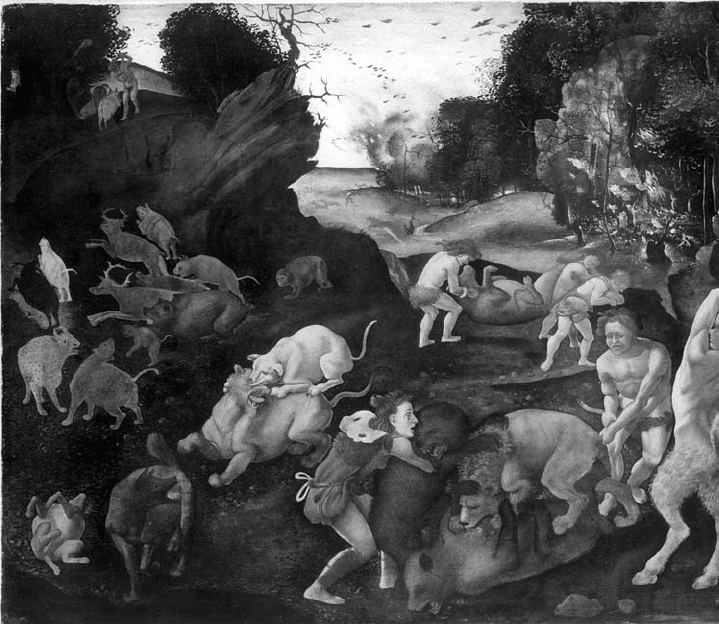
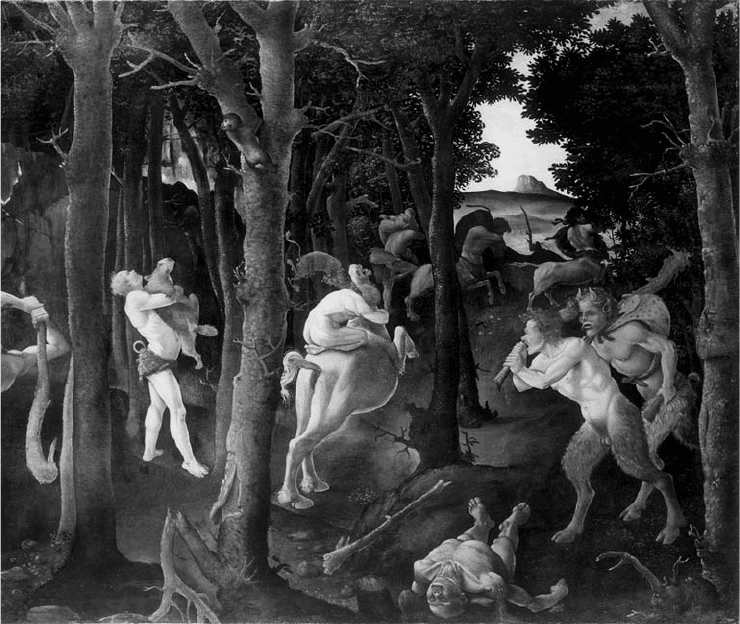
Piero di Cosimo’s representation of a state of mankind when life was nasty, brutish,
and short
284
POLITICAL PHILOSOPHY
cardinal virtues.’ Likewise, there is no property or ownership, ‘but only that
to be every man’s, that he can get; and for so long, as he can keep it’ (L, 85).
Philosophers are accustomed to speak of a natural law (lex naturalis) and a
right of nature (ius naturale). It is important, Hobbes insists, to distinguish
between laws and rights. A right is a liberty to do or forbear doing something.
A law is a command to do or forbear something. In a state of nature there are,
strictly speaking, neither laws nor rights. But there are ‘laws of nature’:
principles of rational self-interest; recipes for maximizing the chances of
survival. And because there is a necessity of nature that each man desires his
own good, there is a right of nature that every man may preserve his own life
and limbs with all the power he has. Since he has a right to this end, he has a
right to all necessary means to it, including a right to the bodies of others (L,87).
285
POLITICAL PHILOSOPHY