
Kenny Anthony. The Rise of Modern Philosophy: A New History of Western Philosophy. Volume 3
Подождите немного. Документ загружается.

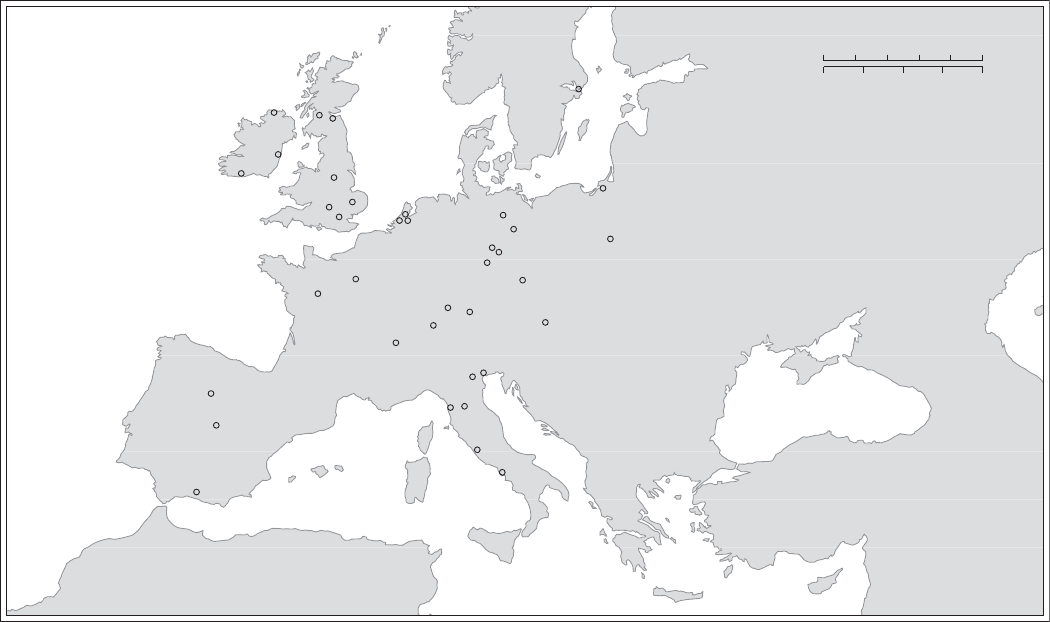
Cloyne
Dublin
Derry
Glasgow
Edinburgh
London
Oxford
Chatsworth
Cambridge
Madrid
Valladolid
Granada
Pisa
Rome
Florence
Naples
Venice
Padua
Geneva
Zurich
Paris
la Fleche`
Vienna
Augsburg
Prague
Tübingen
Leipzig
Halle
Jena
Berlin
Warsaw
Königsberg
Stockholm
Wittenburg
Utrecht
Amsterdam
Leiden
500100 200 300 4000 miles
0 200 400 600 800 km
INTRODUCTION
T
his is the third volume of a projected four-volume history of phil-
osophy from the beginnings to the present day. The W rst volume,
Ancient Philosophy (2004), described the early centuries of philosophy in
classical Greece and Rome. The second volume, Medieval Philosophy (2005),
took the story from the conversion of St Augustine to the humanist
Renaissance. This volume takes up the narrative from the beginning of
the sixteenth century to the beginning of the nineteenth ce ntury. A Wnal
volume is planned to cover the history of philosophy from the age of Karl
Marx and John Stuart Mill up to the present day.
The present volume has the same structure as the two previous vol-
umes. In the Wrst three chapters I oVer a chr onological survey of the
philosophical thinkers of the period. In the remaining chapters I oVer a
thematic treatment of their contribution to the discussion of particular
philosophical topics of abiding importance. Some readers are interested in
the history of philoso phy principally because of the light it sheds on the
people and societies of the past. Other readers study the great dead
philosophers in order to seek illumination on themes of current philo-
sophical inquiry. By structuring the book in this way I hope to cater for the
needs of both sets of readers. Those whose primary interest is historical
may focus on the chronological survey, referring where necessary to the
thematic sections for ampliWcation. Those whose primary interest is philo-
sophical will concentrate rather on the thematic sections of my volumes,
referring back to the chronological surveys to place particular issues in
context.
The audience at which these volumes are primarily aimed is at the level
of second- or third-year undergraduate study. However, many of those
interested in the history of philosophy are enrolled in courses that are not
necessarily philosophical. Accordingly, I try not to assume a familiarity
with contemporary philosophical techniques or terminology. Again, with
the exception of the original texts of the thinkers of the period I have not
included in the bibliography works in languages other than English.
I endeavour also to avoid jargon and to write suYciently clearly for my
history to attract those who read philosophy not for curricular purposes
but for their own enlightenment and entertainment.
This has been the easier to do since in the case of many of my historical
subjects I write of necessity as an amateur rather than as a professional. In
an age when the academic study of past philosophers has expanded
exponentially, no one person can read more than a fraction of the vast
secondary literature that has proliferated in recent years around every one
of the thinkers discussed in this volume. I have myself contributed to the
scholarly discussion of some of the great philosophers of the early modern
age, in particular Descartes; and I have published monographs on some of
the subjects covered by my thematic chapters, such as the philosophy
of mind and the philosophy of religion. But in compiling the bibliography
for the volume I was made aware how vast was the extent of material I have
not read in comparison with the amount that I am familiar with.
Any single author who attempts to cover the entire history of philoso-
phy is quickly made aware that in matters of detail he is at an enormous
disadvantage in comparison with the scholars who have made individual
philosophers their Weld of expertise. By compensation, a history written by
a single hand may be able to emphasize features of the history of philoso-
phy that are less obvious in the works of committees of specialists, just as
an aerial photograph may bring out features of a landscape that are almost
invisible to those close to the ground.
To someone approaching the early modern period of philosophy from
an ancient and medieval background the most striking feature of the age is
the absence of Aristotle from the philosophic scene. To be sure, in the
period covered by this volume the study of Aristotle continued in the
academic establishment, and at Oxford University there has never been a
time since its foundation when Aristotle was not taught. But the other
striking characteristic of our period, which marks it oV from both the
Middle Ages and the twentieth century, is that it was a time when
philosophy was most energetically pursued not within universities but
outside them. Of all the great thinkers of the seventeenth and eighteenth
centuries, none before WolV and Kant held professorships of philosophy.
Both good and evil consequences resulted when philosophy turned its
back on Aristotle. For philosophy in the broad sense—philosophy as it was
understood during most of our period, to include the physical sciences as
INTRODUCTION
xii
‘natural philosophy’—the removal of Aristotle’s dead hand was a great
boon. Aristotle’s physics was hopelessly erroneous, and had been shown to
be so as early as the sixth century of our era; the deference that was paid
to it during the Middle Ages was a great brake on scientiWc progress. But for
philosophy in the narrow sense—philosophy as it is now practised as a
distinct discipline in universities—there were losses as well as gains result-
ing from the abandonment of Aristotle.
Our period is dominated by two philosophical giants, one at its begin-
ning and one at its end, Descartes and Kant. Descartes was a standard-
bearer for the rebellion against Aristotle. In metaphysics he rejected the
notions of potentiality and actuality, and in philosophical psychology he
substituted consciousness for rationality as the mark of the mental. Hobbes
and Locke founded a school of British empiricism in reaction to Cartesian
rationalism, but the assumptions they shared with Descartes were more
important than the issues that separated them. It took the genius of Kant
to bring together, in the philosophy of human understanding, the diVerent
contributions of the senses and the intellect that had been divided and
distorted by both empiricists and rationalists.
The hallmark of Cartesian dualism was the separation between mind
and matter, conceived as the separation of consciousness from clockwork.
This opened an abyss that hampered the metaphysical enterprise during
the period of this volume. On the one hand, speculative thinkers erected
systems that placed ever greater strains on the credulity of the common
reader. Whatever may be the defects of Aristotle’s hylomorphism, his
substances—things like cats and cabbages—did at least have the advantage
of undoubted existence in the ever yday world, unlike unknowable sub-
strata, monads, noumena, and the Absolute. On the other hand, thinkers
of a more sceptical turn deconstructed not only Aristotelian substantial
forms, but primary and secondary qualities, material substances, and
eventually the human mind itself.
In the introduction to his lectures on the history of philosophy Hegel
warns against dull histories in which the succession of systems are repre-
sented simply as a number of opinons, errors, and freaks of thought. In
such works, he says, ‘the whole of the history of Philosophy becomes a
battleWeld covered with the bones of the dead; it is a kingdom not merely
formed of dead and lifeless individuals, but of refuted and spiritually dead
systems, since each has killed and buried the other’ (LHP, 17).
INTRODUCTION
xiii
Though I try to record faithfully the opinions of the successive philo-
sophers of my period, I hope that this volume will not fall under Hegel’s
censure. I believe that despite handicapping themselves by throwing away
some of the most valuable tools that philosophy had forged for itself in
Antiquity and in the Middle Ages, the philosophers of this period made
many contributions of permanent value, which are identiWed and described
in the thematic chapters. In the course of the book I hope to trace the
graph of both the gains and the losses. There is much to be learnt, I believe,
from studying even the vagaries of those whom Hegel calls ‘heroes of
thought’. Great philosophers in every age have engendered great errors: it
is no disrespect to them to try to expose some of the confusions to which
they appear to have succumbed.
The division into themes in this volume diVers from that in the previous
volumes in two ways. First, there is no special chapter devoted to logic and
language, since philosophers in our period made no contribution in these
areas at all comparable to that of the Middle Ages or that of the nineteenth
and twentieth centuries. (It is true that the period contains one logician of
genius, Leibniz; but his logical work had little impact until the nineteenth
century.) Second, there is for the Wrst time a chapter devoted to political
philosophy. It is only from the time of Machiavelli and More that the
political institutions of the age begin to bear suYcient similarity to those
under which we live now for the insights of political philosophers to be
relevant to contemporary discussions. The chapter on physics is briefer
than in previous volumes, because with Newton the history of physics
becomes part of the history of science rather than the history of philoso-
phy, leaving to philosophers , for a while at least, the abstract treatment of
the notions of space and time.
I am indebted to Peter MomtchiloV and his colleagues at Oxford
University Press, and to three anonymous readers for improving an earlier
draft of this volume.
INTRODUCTION
xiv

1
Sixteenth-Century Philosophy
Humanism and Reform
T
he decade beginning in 1511 can well be regarded as the high point of
the Renaissance. In the Vatican Raphael was frescoing the walls of the
papal apartments, while Michelangelo covered the ceiling of the Sistine
Chapel with his paintings. In Florence the Medici family, exiled since the
time of the reformer Savonarola, returned to power and patronage. One of
the oYcers of the former republic, Niccolo
`
Machiavelli, now under house
arrest, used his enforced leisure to produce a classic text of political
philosophy, The Prince, which oVered rulers frank advice on the acquisition
and retention of power. Renaissance art and Renaissance ideas travelled
northward as far as Germany and England. A colleague of Michelangelo’s
designed Henry VII’s tomb in Westminster Abbey and the foremost scholar
of the age, the Dutchman Desiderius Erasmus, lectured at Cambridge early
in the reign of his son Henry VIII. Erasmus was a frequent guest at the house
of Thomas More, a lawyer about to begin a politi cal career that would
make him, brieXy, the most powerful man in England after the king.
Erasmus and More and their friends propounded in Northern Europe
the humanist ideas that had taken root in Italy in the previous century.
‘Humanism’ at that time did not mean a desire to replace religious values
with secular human ones: Erasmus was a priest who wrote best-selling
works of piety, and More was later martyred for his religious beliefs.
Humanists, rather, were people who believed in the educational value of
the ‘humane letters’ (literae humaniores) of the Greek and Latin classics. They
studied and imitated the style of classical authors, many of whose texts had
been recently rediscovered and were being published thanks to the newly
developed art of printing. They believed that their scholarship, applied to
ancient pagan texts, would restore to Europe long-neglected arts and
sciences, and, applied to the Bible and to ancient Church writers, would
help Christendom to a purer and more authentic understanding of Chris-
tian truth.
Humanists valued grammar, philology, and rhetoric more highly than
the technical philosophical studies that had preoccupied scholars during
the Middle Ages. They despised the Latin that had been the lingua franca of
medieval universities, far removed in style from the works of Cicero and
Livy. Erasmus had been unhappy studying at the Sorbonne, and More
mocked the logic he had been taught at Oxford. In philosophy, both of
them looked back to Plato rather than to Aristotle and his many medieval
admirers.
More paid a compliment to Plato by publishing, in 1516, a Wctional
blueprint for an ideal commonwealth. In More’s Utopia, as in Plato’s
Republic, property is held in common and women serve alongside men in
the army. More, writing in an age of exploration and discovery, pretended
that his state actually existed on an island across the ocean. Like Plato,
however, he was using the description of a Wctional nation as a vehicle for
theoretical political philo sophy and for criticism of contemporary society.1
Erasmus was more sceptical about Plato as a guide to politics. In the
teasing Praise of Folly that he dedicated to More in 1511 he mocks Plato’s
claim that the happiest state will be ruled by philosopher kings. History
tells us, he says, ‘that no state has been so plagued by its rulers as when
power has fallen into the hands of some dabbler in philosophy’ (M, 100).
But when, in the same year as Utopia, he published his Instruction to a Christian
Prince, he did little but repeat ideas to be found in Plato and Aristotle. For
this reason his treatise of political philosophy has never achieved the
renown of Machiavelli’s or of More’s.
Erasmus was more interested in divinity than in philosophy, and he
cared more for biblical studies than for speculative theology. Scholastics
like Scotus and Ockham, he complained, merely choked with brambles
paths that had been made plain by earlier thinkers. Among the great
Christian teachers of the past his favourite was St Jerome, who had
translated the Bible from Hebrew and Greek into Latin. Erasmus worked
1 The political philosophy of Machiavelli and More is discussed at length in Ch. 9 below.
SIXTEENTH-CENTURY PHILOSOPHY
2
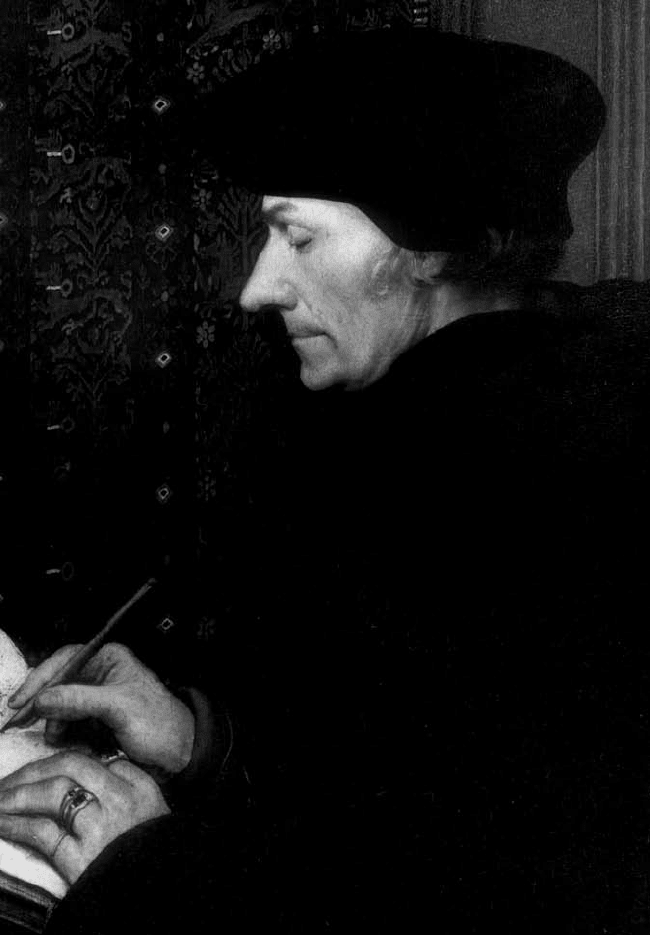
Desiderius Erasmus in Holbein’s portrait in the Louvre
SIXTEENTH-CENTURY PHILOSOPHY
3
for some years annotating the Latin New Testament, and then decided to
produce a Latin version of his own to amend corruptions which had crept
into the accepted text (‘the Vulgate’) and, where necessary, to improve on
Jerome himself. In 1516 he published his new Latin version along with his
annotations, and almost as an appendix, he added a Greek text of the New
Testament—the W rst one ever to be printed. In his Latin version, in striving
for Wdelity to the Greek original, he did not hesitate to alter even the most
beloved and solemn texts. The Wrst words of the fourth Gospel, In principio
erat verbum, became In principio erat sermo: what was in the beginning was not
‘the Word’ but ‘the Saying’.
Erasmus’ Latin version was not generally adopted, though passages of it
can still be read in the chapel windows of King’s College Cambridge.
However, the Greek text he published was the foundation for the great
vernacular testaments of the sixteenth century, beginning with the monu-
mental German version published in 1522 by Martin Luther.
Luther was an Augustinian monk, as Erasmu s had been until released by
papal dispensation from his monastic commitments. Like Erasmus, Luther
had made a close study of St Paul’s Epistle to the Romans. This had made
him question fundamentally the ethos of Renaissance Catholicism. The year
after the publication of Erasmus’ New Testament Luther issued, in the
University of Wittenberg, a public denunciation of abuses of papal authority,
in particular of a scandalously promoted oVer of an indulgence (remission of
punishment due to sin) in return for contributions to the building of the
great new church of St Peter’s in Rome.
Erasmus and More shared Luther’s concern about the corruption of
many of the higher clergy: they had both denounced it in print, Erasmus
pungently in a satire on Pope Julius II, More with ironic circumspection in
Utopia. But both were alienated when Luther went on to denounce large
parts of the Catholic sacramental system and to teach that the one thing
needful for salvation is faith, or trust in the merits of Christ. In 1520 Pope
Leo X condemned forty-one articles taken from Luther’s teaching, and
followed this up with an excommunication after Luther had burnt the Bull
of Condemnation. King Henry VIII, with some help from More, published
an Assertion of the Seven Sacraments, which earned him the papal title ‘Defender
of the Faith’.
Erasmus strove in vain to dampen down the controversy. He tried to
persuade Luther to moderate his language, and to submit his opinions for
SIXTEENTH-CENTURY PHILOSOPHY
4
judgement to an impartial jury of scholars. On the other hand, he ques-
tioned the authenticity of the papal bull of condemnation and he
persuaded the emperor Charles V to give Luther a hearing at the Diet of
Worms in 1521. But Luther refused to recant and was placed under the ban
of the empire. Pope Leo died and was succeeded by a Dutch schoolfriend of
Erasmus, who took the name Adrian VI. The new pope urged Erasmus to
take up his pen against the reformers. Very reluctantly, Erasmus agreed,
but his book against Luther did not appear until 1524, by which time Pope
Adrian was dead.
Sin, Grace, and Freedom
The ground Erasmus chose for battle was Luther’s position on the freedom
of the will. This had been the subject of one of the theses which had been
nailed to the door at Wittenberg in 1517. Among the propositions con-
demned by Leo X was ‘freewill after sin is merely an empty title’. In
response, Luther reinforced his assertion. ‘Free will is really a Wction and
a label without reality, because it is in no man’s power to plan any evil or
good’ (WA VII.91).
In his Diatribe de Libero Arbitrio Erasmus piles up texts from the Old and
New Testament and from Church doctors and decrees to show that
human beings have free will. His constant theme is that all the exhort-
ations, promises, commands, threats, reproaches, and curses to be found in
the Scriptures would lose all point if it was necessity, and not free will, that
determined good or evil acts. Questions of Bible interpretation dominate
both Erasmus’ book and Luther’s much longer reply, De Servo Arbitrio.
Philosophically, Erasmus is unsubtle. He refers to, but does not improve
upon, Valla’s dialogue on free will. He repeats commonplaces of centuries
of scholastic debate which are inadequate responses to the problem of
reconciling divine foreknowledge with human freedom—he insists, for
instance, that even humans know many things that will happen in the
future, such as eclipses of the sun. A theory of free will that leaves us no
freer than the stars in their courses is not a very robust answer to Luther.
But Erasmus is anxious to avoid philosophical complications. It is a piece of
irreligious curiosity to inquire, as the scholastics did, whether God’s
foreknowledge is contingent or necessary.
SIXTEENTH-CENTURY PHILOSOPHY
5