
Kenny Anthony. The Rise of Modern Philosophy: A New History of Western Philosophy. Volume 3
Подождите немного. Документ загружается.

How do we know that there are such things as spirits? ‘We comprehen d
our own existence by inward feeling or reXexion, and that of other spirits
by reason,’ Berkeley tells us; but it is hard to see how he can consistently
say either of these things. The only things that I can perceive or reXect
upon are ideas; and Berkeley tells us that nothing could be more absurd
than to say ‘I am an idea or notion’. And the line of reasoning by which he
seeks to establish the existence of other minds is br oken-backed.
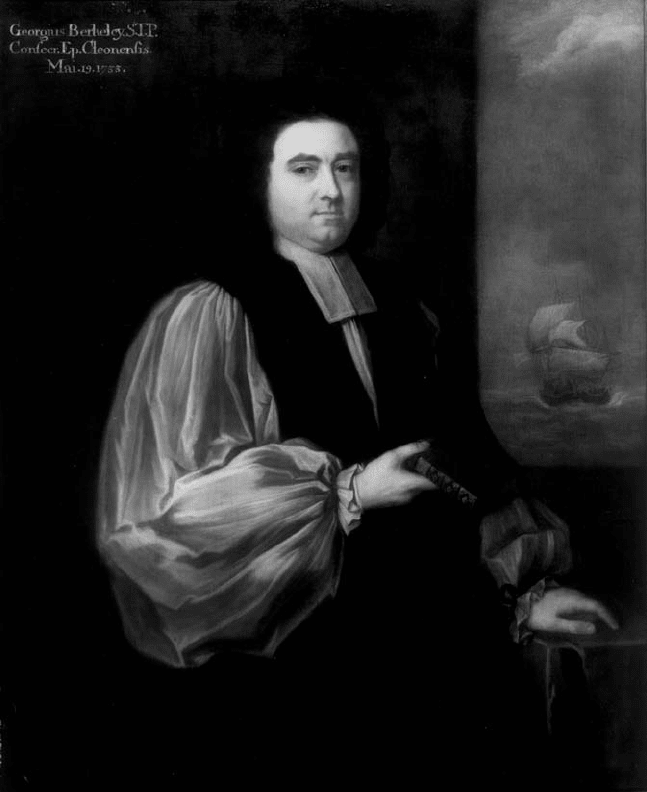
This portrait of Berkeley as Bishop of Cloyne alludes also to his transatlantic ambitions
MIND AND SOUL
236
According to Berkeley, when I am looking at my wife, I do not see her at
all. All I see is a collection of my own ideas that I have constantly observed
in conjunction with each other. I know her existence and that of other
people, he tells us, because ‘I perceive several motions, changes, and
combinations of ideas, that inform me there are certain particular agents
like myself, which accompany them, and concur in their production .’ But
the ideas I see are my ideas, not my wife’s ideas; and the ideas for which she
provides the substratum are her ideas, to which I have no possible access.
Berkeley cannot claim that she ‘concurs in the production’ of my ideas.
No one other than myself or God can cause me to have an idea.
Berkeley’s account of causation is minimalist. When we speak of one
thing as cause and another as eVect we are talking of relations between
ideas. ‘The connexion of ideas does not imply the relation of cause and
eVect, but only of a mark or sign with the thing signiWed. The Wre which
I see is not the cause of the pain I suVer on my approaching it, but the mark
that forewarns me of it.’ But how can the ideas which constitute my
perception of my wife inform me either of her ideas, which I can never
perceive, or of her spirit, which even she does not perceive? The problem of
other minds was a damnosa hereditas which Berkeley bequeathed to following
phenomenalists.
Hume, however, was to show that empiricism presents us with a
problem not only about the minds of others but also about our own
minds. Solipsism—the belief that only one’s own self really exists—was
always the logical conclusion of empiricism, implicit in the thesis that the
mind knows nothing e xcept its own perceptions. Hume drew out this
implication more candidly than previous empiricists, but he went further
and reached the conclusion that even the self of solipsism is an illusion.
Since Descartes and Locke, philosophers had conceived sensation not as
a transaction between a perceiver and an object in the external world, but as
the private perceiving by the mind of some interior perception, impression,
or idea. Seeing a horse is really observing a horse-like visual sense-datum;
feeling a teddy bear is really observing a teddy-like tactile sense-datum.
The relation between a thinker and his thoughts is that of an inner eye to
an inner art gallery. Hume follows wholeheartedly in this tradition and
endeavours to give purely internal accounts of the diVerences between
diVerent mental activities, events, and states. This comes out particularly
clearly in his account of the passions.
MIND AND SOUL
237
The relation between a passion and the mind to which it belongs is
conceived by Hume as the relation of perceived to perceiver. ‘Nothing’, he
writes, ‘ is ever present with the mind but its perceptions or impressions
and ideas ...Tohate, to love, to think, to feel, to see; all this is nothing but
to perceive’ (T, 67). One might draw from the passage the idea that loving a
woman is one way of perceiving a woman, just as seeing a woman is one
way of perceiving a woman; but that is not what Hume means at all.
What is perceived when a passion is felt is the passion itself. The mind
is represented as an observer which perceives the passions which are
present to it.
The self as thus conceived is essentially the subject of such inner
observation: it is the eye of inner vision, the ear of inner hearing; or rather,
it is supposed to be the possessor of both inner eye and inner ear and
whatever other inner organs of sensation may be demanded by empiricist
epistemology. It was Hume who had the courage to show that the self, as
thus conceived, was a chimera. Empiricism teaches that nothing is real
except what can be discovered by the senses, inner or outer. The self, as
inner subject, clearly cannot be perceived by the outer senses. But can it be
discovered by inward observation? Hume, after the most diligent investi-
gation, failed to locate the self:
Whenever I enter most intimately into what I call myself, I always stumble on some
particular perception or other, of heat or cold, light or shade, love or hatred, pain
or pleasure. I never catch myself at any time without a perception and never can
observe anything but the perception ...If anyone upon serious and unprejudic’d
reXection, thinks he has a diVerent notion of himself, I must confess I can reason no
longer with him. All I can allow him is, that he may well be in the right as well as I,
and that we are essentially diVerent in this particular. He may, perhaps, perceive
something simple and continu’d, which he calls himself; though I am certain there
is no such principle in me. (T, 252)
The imperceptibility of the self is a consequence of the concept of it as an
inner sensor. We cannot taste our tongue, or see our eyes: the self is an
unobservable observer, just as the eye is an invisible organ. But, as Hume
shows, the empiricist self vanishes when subjected to systematic empiricist
scrutiny. It is not discoverable by any sense, whether inner or outer, and
therefore it is to be rejected as a metaphysical monster. Berkeley had
maintained that ideas inhered in nothing outside the mind; Hume shows
that there is nothing inside the mind for them to inhere in. There is no
MIND AND SOUL
238
impression of the self, and no idea of the self; there are simply bundles of
impressions and ideas.
Hume showed that the inner subject was illusory, but he did not expose
the underlying error which led the empiricists to espouse the myth of the
self. The real way out of the impasse is to reject the thesis that the mind
knows nothing but its own ideas, and to accept that a thinker is not a
solitary inner perceiver, but an embodied person living in a public world.
Hume was right that he had no self other than himself; but he was himself
not a bundle of impressions, but a portly human being in the midst
of eighteenth-century society.
It might be thought that a bundle of impressions was so diVerent from
any kind of active agent that it would be idle to discuss whether or not it
enjoyed free will. However, Hume goes on to address the topic of liberty
and necessity, quite oblivious to his oYcial philosophy of mind. (This is his
custom when pursuing a diYcult philosophical agenda—an agreeable
inconsistency for which we may be grateful.) His general thesi s is that
human decisions and actions are necessitated by causal laws no less than
the operations of lifeless natural agents, and are equally predictable:
Were a man, whom I know to be honest and opulent, and with whom I live in
intimate friendship, to come into my house, where I am surrounded with my
servants, I rest assured that he is not to stab me before he leaves it in order to rob
me of my silver standish ...Amanwhoatnoon leaves his purse full of gold on the
pavement at Charing Cross may as well expect that it will Xy away like a feather as
that he will Wnd it untouched an hour after. (E, 91)
Whatever we do, Hume maintains, is necessitated by causal links between
motive, circumstance, and action. Class, among other things, is a great
determinant of character and behaviour: ‘The skin, pores, muscles and
nerves of a day-labourer are diVerent from those of a man of quality: So are
his sentiments, actions and manners.’ Hume’s insistence on determinism
leads him to some implausible conclusions: that a group of labourers
should go on strike is for him as unthinkable as that an unsupported
heavy body will not fall.
Although he believes that human actions are determined, Hume is willing
to accept that we do enjoy a certain liberty. Like some of his successors, he
was a ‘compatibilist ’, someone who maintains that freedom and determin-
ism are compatible with each other if rightly understood. Our natural
MIND AND SOUL
239
reluctance to accept that our actions are necessitated, he believes, arises
from a confusion between necessity and constraint:
Few are capable of distinguishing betwixt the liberty of spontaneity, as it is call’d in
the schools, and the liberty of indiVerence; betwixt that which is oppos’d to violence,
and that which means a negation of necessity and causes. The Wrst is even the most
common sense of the word; and as ’tis only that species of liberty, which it
concerns us to preserve, our thoughts have been principally turn’d towards it,
and have almost universally confounded it. (T, 408)
Experience exhibits our liberty of spontaneity: we often do, unconstrained,
what we want to do. But experience cannot provide genuine evidence
for liberty of indiVerence, that is, the ability to do otherwise than we in fact
do. We may imagine we feel such a liberty within ourselves, ‘but a spectator
can common ly infer our actions from our motives and character; and even
when he cannot, he concludes in general, that he might, were he perfectly
acquainted with every circumstance of our situation and temper, and the
most secret springs of our complexion and disposition’ (T, 408).
Such talk of ‘secret springs’ of action is one indication that in discussing
this issue Hume has forgotten his oYcial theory of mind and his oYcial
theory of causation. Indeed, his very deWnition of the human will seems
incompatible with them. ‘By the will I mean nothing but the internal impression
we feel and are conscious of, when we knowingly give rise to any new motion of our body, or new
perception of our mind’(T, 399). Given his view of causation, we must wonder
what right Hume has to talk of our ‘giving rise’ to motions and perceptions.
But if we replace ‘we knowingly give rise to any new motion’ with ‘any new
motion is observed to arise’, the deWnition no longer looks at all appropriate.
Kant’s Anatomy of the Mind
The anatomy of the mind, as described by Kant, contains many traditional
elements. He made a distin ction between the intellect and the senses, and
between inner sense and the Wve outer senses. These distinctions, although
rejected by some philosophers, had remained commonplaces since the
Middle Ages. Kant’s only innovation so far was to give novel epistemo-
logical functions to traditional faculties. But he went on to draw new
distinctions, and to bring new insights to bear on the philosophy of mind.
MIND AND SOUL
240
In the Critique of Judgement Kant divides the faculties of the human mind
into: (a) cognitive powers; (b) powers of feeling pleasure and pain; and
(c) powers of desire. By ‘cognitive powers’ are meant, in this context,
intellectual powers, and here Kant makes a threefold distinction between
understanding (Verstand), reason (Vernunft), and judgement (Urteil). Under-
standing is the legitimate operation of the intellect in the conceptualiza-
tion of experience. That is something that we know from the Wrst critique,
where too ‘Reason’ is used as a technical term for the illegitimate operation
of the intellect in transcendental speculation. In the second critique a
positive role is given to reason as the arbiter of ethical behaviour.
The function of judgement, however, is not clear from the earlier critiques.
Previous philosophers had used the word (as Kant himself often does) to
mean an assent to a proposition of any kind. In the third critique Kant
concentrates on judgements of aesthetic taste. We thus arrive at a trinity
of faculties: one (the understanding) which has truth as its object; one (the
practical reason) which has goodness as its object; and one (the judgement )
which has as its object the beautiful and the sublime (M, 31V.).
All the operations of the intellect are accompanied by self-consciousness.
Kant spells this out most fully in the case of the understanding. The
conceptualization of experience involves the union of all the items of
awareness in a single consciousness. In a diYcult, but original and pro-
found, section of the Wrst critique entitled ‘The original synthetic unity of
apperception’ Kant analyses what is meant by speaking of the unity of self-
consciousness (B, 132–43).
It is not possible for me to discover that something is an item of my
consciousness. It is absu rd to think of me as being faced with an item
of consciousness, then going on to wonder to whom it belongs, and then
concluding upon inquiry that it belongs to none other than myself.
Through reXection I may become aware of many features of my conscious
experience (is it painful? is it clear? etc.) but I cannot become aware that it is
mine. The self-conscious discoveries that one can make about one’s percep-
tions are called by Kant ‘apperceptions’. The point that one does not rely
on experience to recog nize one’s consciousness a s one’s own is stated thus
by Kant: one’s ownership of one’s own consciousness is not an empirical
apperception, but a ‘transcenden tal apperception’.
What unites my experiences in a single consciousness is not experience
itself; in themselves my experiences are, as Kant says ‘many coloured and
MIND AND SOUL
241
diverse’. The unity is created by the a priori activity of the understanding
making a synthesis of intuitions, combining them into what Kant calls ‘the
transcendental unity of apperception’. But this does not mean that I have
some transcendental self-knowledge. The original unity of apperception
gives me only the concept of myself; for any actual self-awareness, experi-
ence is necessary.
Kant agrees with Descartes that the thought ‘I think’ must accompany
every other possible thought. Self-consciousness is inseparable from thought,
because self-consciousness is necessary to think of thinking, and in advance
of experience we attribute to things those properties which are the neces-
sary conditions of our thinking of them. However, Kant disagrees sharply
with the conclusions that Descartes drew from his Cogito. In the section of
the transcendental dialectic entitled ‘The paralogisms of Pure Reason’ he
makes a sustained attack upon Cartesian psychology, and indeed upon
a priori and rational psychology in general.
Whereas empirical psychology deals with the soul as the object of inner
sense, rational psychology treats of the soul as the thinking subject.
Rational psychology, Kant says, ‘professes to be a science built upon the
single proposition I think’. It purports to be a study of an unknown X,
the transcendental subject of thinking, ‘the I or he or it (the thing) that
thinks’ (A, 343–5).
Our natural drive to go beyond the limits of merely empirical psychology
leads us into fallacies—Kant calls them ‘paralogisms’ or bogus syllogisms.
He lists four paralogisms of pure reason which can be crudely summarized
as follows: (1) from ‘Necessarily the thinking subject is a subject’ we
conclude ‘The thinking subject is a necessary subject’; (2) from ‘Dividing
up the ego makes no sense’ we conclude ‘The ego is an indivisible substance;
(3) from ‘Whenever I am conscious, it is the same I who am conscious’ we
conclude ‘Whenever I am conscious, I am conscious of the same I’; (4) from
‘I can think of myself without my body’ we conclude ‘Without my body
I can think of myself ’.
In each paralogism, a harmless analytical proposition is converted, by
logical sleight of hand, into a contentious synthetic a priori proposition. On
the basis of the paralogisms rational psychology concludes that the self is
an immaterial, incorruptible, personal, immortal entity.
The rational proof of the immortality of the soul is nothing but
delusion. But that does not mean that we cannot believe in a future life
MIND AND SOUL
242
as a postulate of practical reason. In the present life happiness is clearly not
proportioned to virtue; so if we are to be motivated to behave well, we
must believe that the balance will be redressed in another life elsewhere.
The refutation of rational psychology, Kant claims, is a help, not a
hindrance, to faith in an afterlife. ‘For the merely speculative proof has
never been able to exercise any inXuence upon the common reason of
men. It so stands upon the point of a hair, that even the schools preserve it
from falling only so long as they keep it unceasingly spinning round like a
top’ (B, 424).
The positive element in Kant’s philosophy of mind that has had the
longest-lasting inXuence is his treatment of freedom and determinism. His
contribution to this topic is placed not in the section of the Wrst critique
devoted to rational and empirical psychology, but among the antinomies
that purport to show the incoherence of attempts to survey the cosmos as
a whole. The third antinomy relates the idea of the world as a single
determinist system to the belief in the possibility of free uncaused action.
The topic of this antinomy was later eloquently laid out by Tolstoy at the
end of War and Peace:
The problem of freewill from earliest times has occupied the best intellects of
mankind and has from earliest times appeared in all its colossal signiWcance. The
problem lies in the fact that if we regard man as a subject for observation from
whatever point of view—theological, historical, ethical or philosophic—we Wnd
the universal law of necessity to which he (like everything else that exists) is
subject. But looking upon man from within ourselves—man as the object of our
own inner consciousness—we feel ourselves to be free.
The laws of necessity taught us by reason, Tolstoy thought, forced us to
renounce an illusory freedom and recognize our unconscious dependence
on universal law.
Kant, on the other hand, thought that determinism and freedom could
be reconciled. In the third antinomy, unlike the Wrst two antinomies, both
thesis and antithesis, if properly interpreted, are true. The thesis is that
natural causality is not suYcient to explain the phenomena of the world;
in addition to determining causes we must take account of freedom and
spontaneity. The antithesis argues that to postulate transcendental freedom
is to resign oneself to blind lawlessness. As Tolstoy was to put it, ‘If one
man only out of millions once in a thousand years had the power of acting
freely, i.e. as he chose, it is obvious that one single free act of that man in
MIND AND SOUL
243
violation of the laws would be enough to prove that laws governing all
human action cannot possibly exist.’
Kant, like Tolstoy, was a determinist, although he was not a hard deter-
minist but a soft determinist. That is to say, he believed that determinism
was compatible with human freedom and spontaneity. The human will, he
said, is sensuous but free: that is to say, it is aVected by passion but not
necessitated by passion. ‘There is in man a power of self-determination,
independently of any coercion through sensuous impulses.’ But the exer-
cise of this power of self-determination has two aspects: empirical (percep-
tible in experience); and intelligible (graspable only by the intellect). Our
free agency is the intelligible cause of sensible eVects; and these sensible
phenomena are also part of an unbroken series that unfolds in accordance
with unchangeable laws. To reconcile human freedom with deterministic
nature Kant says that nature operates in time, whereas the human will
belongs to a non-phenomenal self that transcends time.
Throughout the centuries theologians had sought to reconcile human
freedom with the omniscience of God by saying that God’s knowledge was
outside time. It was a novelty for a philosopher to seek to reconcile human
freedom with the omnipotence of Nature by saying that human freedom
was outside time. It is indeed diYcult to reconcile Kant’s claim that the
human will is atemporal with the examples he himself gives of free action,
such as his rising from the chair at his desk. But an impressive line of
philosophers up to the present day have sought, like Kant, to show that
freedom and determinism are compatible with each other. It is surely
correct that causal explanation (‘I knocked him over because I was pushed’)
and explanation by reasons (‘I knocked him over to teach him a lesson’) are
two radically diVerent types of explanation, e ach irreducible to the other.
Kant was surely right to emphasize this diVerence and to believe that it must
be the basis of any reconciling project.
The reconciliation between freedom and determinism takes a baroque
form in the metaphysics of Hegel. Individual human choices such as
Caesar’s decision to cross the Rubicon are actually determined by the
world-spirit, who uses ‘the cunning of Reason’ to give eVect to its purposes.
But the necessity that operates at the level of the individual is an expression
of the highest form of freedom, for freedom is the essential attribute of
spirit and its ever increasing expression is the guiding force of history.
MIND AND SOUL
244
When Hegel speaks of the world-spirit his references to it are not mere
metaphors for the operation of impersonal historical forces. Hegel’s spirit
resembles Kant’s transcendental unity of apperception in bein g the subject
of all experience, which cannot itself be an object of experience. Kant was
content to assume that there will be a separate such focus in the life of each
individual mind. But what ground, Hegel might ask, is there for such an
assumption? Behind Kant’s transcendental self stands the Cartesian ego;
and one of the Wrst critics of Descartes’ cogito put the pertinent question:
how do you know that it is you who are thinking, and not the world-soul
that thinks in you? Hegel’s spiri t is meant to be a centre of consciousness
prior to any individual consciousness. One spirit thinks severally in
the thoughts of Descartes and in the thoughts of Kant, perhaps rather as
I, as a single person, can simultaneously feel toothache and gout in
diVerent parts of myself. But it is diYcult to accommodate within either
empirical or analytic psychology a spirit whose behavioural expression is
the entire universe. Rather than a philosophy of mind, Hegel oVers us a
Philosophy of Mind.
In respect of the philo sophy of the human mind, the thinker who made
the most signiWcant contribution in our period was undoubtedly Kant.
Throughout the seventeenth and eighteenth centuries, philosophy of
mind was made subordinate to epistemology, in consequence of the
Cartesian pursuit of certainty. In the course of this pursuit, Descartes
and the rationalists undervalued the role of the senses, and the British
empiricists eliminated the role of the intellect. It took the overarching
genius of Kant to put together a gain what the partisan energies of his
predecessors had shattered, and to give an account of the human mind
that did justice to its various faculties. In his work epistemology and
philosophical psychology once again meet together, as they had done in
the best work of the Middle Ages.
MIND AND SOUL
245