
Kenny Anthony. The Rise of Modern Philosophy: A New History of Western Philosophy. Volume 3
Подождите немного. Документ загружается.


8
Ethics
H
istories of ethics often skim swiftly over the sixteenth century. In the
high Middle Ages moral philosophy was presented in commentaries
on Aristotle’s Nicomachean Ethics and in treatises on the natural or revealed
law of God. In Aquinas’ Summa Theologiae both elements are combined, but
the system is structured around the concept of virtue rather than around
the concept of law. It was Aquin as’ successors, from Duns Scotus onward,
who gave the theory of divine law the central place in presentations of
Christian morality.1 But the medieval tradition in ethics suVered a shock,
from which it never recovered, under the impact of the Reformation and
the Counter-Reformation.
Both Luther and Calvin emphasized the depravity of human nature in
the absence of the divine grace that was oVered only through Christianity.
For them, the path to human salvation and happiness lay through faith,
not through moral endeavour, and there was little scope for any philo-
sophical system of ethics. Aristotle was the enemy, not the friend, of the
only possible good life. As for other ancient sages, their teaching could not
lead to virtue; as Augustine had insisted, the best it could do was to add a
certain splendour to vice.
Catholics did not agree that human possibilities for goodness had been
totally extinguished by the Fall, and the Council of Trent declared it
a heresy to say that all deeds of non-Christians were sinful. But the
disciplinary regulations of that council gave Catholic moral theology a
new direction which took it far away from Aquinas’ synthesis of Aristotelian
and Augustinian ethics. A decree of 1551, strengthening a rule of the
1 See vol. II, pp. 263–77.
Lateran Council of 1215, laid down that all Catholics must make regular
confession to a priest. It made a distinction between two classes of sin,
mortal and venial: mortal sins were more serious, and if unrepented
rendered the sinner liable to the eternal punishments of hell. Under the
new rule, a penitent was bound to confess all mortal sins according to their
species, number, and circumstances. Henceforth, Catholic moralists
focused less on considera tion of the virtues than on the speciWcation and
individuation of diVerent kinds of sin, and the listing of aggravating or
mitigating circumstances.
Casuistry
The decree of Trent fostered a whole new ethical discipline: the science of
casuistry. Casuistry in general is the application of moral principle to
particular decisions; in particular to ‘cases of conscience’ where such
principles might appear to conXict with each other. In the broad sense,
any expert advice given to resolve a particular moral dilemma might count
as an exercise of casuistry: for instance, the guidance given to the Emperor
Charles V by a group of theologians on the treatment of his new American
subjects, or the counsel given to King Charles I by Archbishop Laud on the
legality of the impeachment of the Earl of StraVord. But when contem-
poraries and historians talked of casuistry they commonly had in mind the
textbooks and manuals, produced in abundance in the sixteenth and
seventeenth centuries, which dealt not with actual decisions, but with
imaginary cases, as a guide to confessors and spiritual directors in their
dealings with the penitent and the devout.
Although manuals of casuistry were written by theologians from many
diVerent religious orders, casuistry became and remained specially associated
with the newly founded Counter-Reformation order of the Jesuits, the
Society of Jesus. While the Jesuit system of training made provision for
more scholarly students to study the moral system of Aquinas, those
destined for non-academic work learnt their ethics through the study of
cases of conscience, reading manuals of casuistry, listening to lectures from
casuists, and practising pastoral care through case conferences. Jesuits were
much in demand as confessors, in particular to the great and the good; in
1602 the general of the order felt obliged to issue a special instruction On the
ETHICS
247
Confession of Princes. Thus casuistry acquired political as well as ethical
importance.
During the sixteenth century the casuists had to face a number of novel
moral problems. One of the most important was the relationship of
Christians to the original inhabitants of the newly discovered continent of
America. Were the Spanish and Portuguese colonists entitled to annex the
lands of the indigenous peoples and make them their slaves? The Emperor
Charles V called a conference of theologians at Valladolid in 1550 to discus s
the issue. His imperial historiographer, Sepulveda, basing his theories on
Aristotle’s teaching that some men were better Wtted to serve than to rule,
and were therefore natural slaves, argued that American Indians, who lived
a life of rudeness and inferiority, and were ignorant of Christianity, could
justly be enslaved and forcibly converted. This position was controverted on
the spot by the missionary Bartolome de las Casas, and forcefully attacked in
publications by two of the most inXuential Spanish theologians of the age,
the Dominican Francisco de Vitoria and the Jesuit Franscisco Suarez.
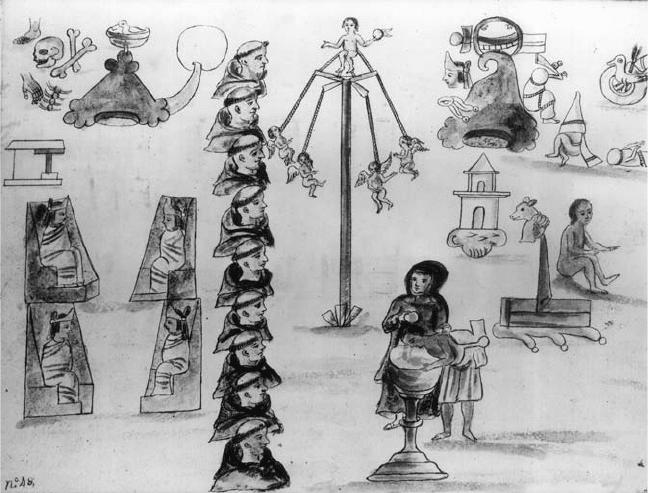
This illustration to the Codex Azcatitla shows an Indian being baptized amid a throng
of tonsured friars
ETHICS
248
In his posthumously published treatises, De Indis (1557), Vitoria Wrst of all
defended St Thomas’ teaching that the forcible conversion of the heathen
was unjust, and went on to deny that either the pope or the emperor had
any jurisdiction over the Indians. The Indians, he maintained, had owner-
ship and property rights just as if they were Christians: they constituted a
genuine political society, and their civil arrangements showed that they
enjoyed the full use of reason:
There is a certain method in their aVairs, for they have polities which are
orderly arranged, and they have deWnite marriage and magistrates, overlords,
laws, and workshops, and a system of exchange, all of which call for the use of
reason.2
He concluded that there was no justiWcation for conWscating the land and
possessions of these heathen peoples on the pretext that they had no
genuine ownership of their property. The Jesuit Suarez took a similar
line in his discussion of the rights and wrongs of war.3
The expansion of overseas exploration and international trade in the
sixteenth century forced casuists to examine the ethics of the methods by
which maritime ventures were Wnanced. On the basis of certain biblical
texts, and of an Aristotelian analysis of the nature of money, Thomas
Aquinas had issued a severe condemnation of the taking of interest on
loans.4 There was however an important diVerence, recognized by Aquinas,
between two ways of Wnancing a project. One was by making a loan to an
entrepreneur (to be repaid to the lender whether the venture succeeds or
not); the other was by buying a share in the enterprise (where the W nancier
bears part of the risk of failure). The Wrst was usury, and it was wicked. The
second was partnership, and it was honourable (ST 2.2. 78. 2 ad 5).
The prohibition on usury was maintained througho ut the Middle Ages:
it was repeated by St Antoninus, who in the Wfteenth century was arch-
bishop of Florence, a city that was by then home to gr eat banking houses
such as the Medici. Antoninus did, however, allow a charge to be made
upon a loan in one particular case: if delay in repayment of a loan had led
2 De Indis Recenter Inventis, 1.23; quoted by Bull et al., Hugo Grotius and International Relations (Oxford:
Oxford University Press, 1990), p. 46.
3 See below, p. 281. It is sad that the views of las Casas, Vitoria, and Suarez did not have more
eVect on the actual practice of Christian colonizers.
4 See vol. II, p. 271.
ETHICS
249
to unforeseen loss to the lender (given the technical name damnum emergens).
This was seen as compensation for damage inXicted, rather than interest on
the loan itself. But this minor relaxation of the prohibition led, over the
next century, to its total emasculation at the hands of the casuists.
The Wrst step was the introduction of the notion of opportunity cost.
One of the things one gives up when making a loan is the possibility of
making proWt from an alternative use of the money. So damnum emergens is
joined by lucrum cessans (cessation of gain) as a title to reimbursement. The
expansion of capitalism during the sixteenth century multiplied the
opportunities for alternative investment, and so casuists were able to
argue that in almost every case there would be present one or other of
these justiWcations for charging interest.
The casuists’ logic was surely, on their own terms, very dubious. The
money which I lend you I could indeed put to other uses: I could lend it to
someone else, or I could invest it in a partnership. But on the Wrst
supposition, the only gain I am losing by lending to you is a gain which
would itself be unlawful, namely, the taking of usury. And on the second
supposition, it is not at all sure that I am losing anything by making you
the loan. My alternative venture might go wrong and so far from making a
proWt, I would lose my capital as well. You may turn out to have been
doing me a good turn by borrowing from me.
Nonetheless, casuists, some of them hired as consultants by the major
banking houses, came out with ever more complicated schemes to cir-
cumvent the prohibition on usury. The Duke of Bavaria, in whose domin-
ions such schemes were highly popular, proposed the following case for
consideration by a commission of Jesuits in 1580. It is worth quoting in its
own terms, for it is framed in the typical format of a ‘case of conscience’:
Titius, a German, loans Sympronius a sum of money. Sympronius is a person of
means, and the money is lent to him for no speciWc purpose. The conditions are
that Titius is to receive annually Wve Xorins for every hundred lent, and afterwards
have the whole capital back. There is no danger to the capital, and Titius must get
his 5%, whether or not Sympronius makes a proW t. 5
The question proposed was: is this contract lawful? The commissioners
returned a highly qualiWed reply, but on its basis the Jesuit order declared
5 Quoted by Jonsen and Toulmin, The Abuse of Casuistry (Berkeley: University of California
Press, 1988), p, 189.
ETHICS
250
the contract morally licit. Henceforth the prohibition on usury was a dead
letter among Roman Catholics.
Mysticism and Stoicism
The heyday of casuistry was the century from 1550 to 1650. During that
period volumes of casuistry were not, of course, the only guides to life that
were published. On the one hand, there were many manuals of devotion
which included practical moral advice; on the other hand, some writers
urged the merits of ancient ethical texts. As examples of these two tenden-
cies we may consider St John of the Cross and Rene
´
Descartes.
St John of the Cross (1542–91), the spiritual direct or of St Teresa of Avila,
who reformed the Carmelite order, was a poet and mystic. His work The
Dark Night of the Soul describes the long and painful ascent which leads to
union with God. He describes the ecstasy of the goal in terms of incom-
prehensible rapture, but he makes clear that the way towards it is through
suVering and self-discipline. First one must enter the dark night of the
senses; but this is only a kindergarten of preparation for the dark night of
the soul, which is itself only the Wrst stage of the mystical ascent. It is thus
that he sets out the Wrst steps of the spiritual life:
Strive always to prefer, not that which is easiest, but that which is most diYcult;
Not that which is most delectable, but that which is most unpleasing;
Not that which gives most pleasure, but rather that which gives least
Not that which is restful, but that which is wearisome...
In order to arrive at having pleasure in everything,
Desire to have pleasure in nothing.
In order to arrive at possessing everything
Desire to possess nothing.
In order to arrive at being everything,
Desire to be nothing.
St John’s treatise was the most severe of sixteenth-century devotional
guides, and was clearly addressed to a cloistered minority. But similar
teaching, in a more emollient form, was presented by the French bishop
St Francis de Sales, in his Introduction to the Devout Life (1608), the Wrst manual
of piety aimed at lay people living a secular life in the world.
ETHICS
251
Descartes, although an observant Catholic, drew the inspiration of his
morality from quite diVerent sources. When he was embarking on his
project of all-embracing doubt, he safeguarded himself by drawing up a
provisional code of morality, consisting of three principal maxims: Wrst, to
obey the laws and customs of his country; second, to be resolute in action
once he had taken a decision; third, ‘to try always to conquer myself rather
than fortune; to change my desires, rather than the order of the world’. This,
he says, ‘was the secret of those philosophers of old who could withdraw
from the dominion of fortune, and, amid suVering and poverty, could
debate whether their Gods were as happy as they’ (AT VI.26; CSMK I.124).
Observing Catholic practice appears only as a subdivision of ‘obeying the
laws and customs of my country’: it is to ancient Stoicism that the young
Descartes looks for ethical guidance. It was the same ten years later when
he was corresponding with Princess Elizabeth. He repeated his three
maxims, and to instruct her on the nature of true happiness, he recom-
mended a reading of Seneca’s De Vita Beata. In his letters of moral advice, he
constantly stresses the role of reason in the moderation of the passions,
which make us believe certain goods to be more desirable than they are.
‘The true function of reason’, he wrote, ‘in the conduct of life is to examine
and consider without passion the value of all perfections of body and soul
that can be acquired by our conduct, so that since we are commonly
obliged to deprive ourselves of some goods in order to acquire others, we
shall always choose the better’ (AT IV.286; CSMK III.265).
Descartes worked up some of the ideas of his correspondence with
Elizabeth into a Treatise on the Passions. This is as much an exercise in
speculative physiology as in moral philosophy: an understanding of the
bodily causes of our passions, Descartes believed, was a valuable aid to our
bringing them under rational control. The detailed examination of the
passions, he believed, was the one area in which his own moral philosophy
was superior to that of the ancients (AT XI.327–8; CSMK I.328–9).
The passion whose description brings out most fully Descartes’ moral
ideals is the passion of ge
´
ne
´
rosite
´
, which deWes exact translation into English.
The ge
´
ne
´
reux is no doubt generous, but he is much more than that: he is, we
might say with a degree of anachronism, the perfect gentleman. Such
people, Descartes tells us:
are naturally led to do great deeds, and at the same time not to undertake
anything of which they do not feel themselves capable. And because they esteem
ETHICS
252
nothing more highly than doing good to others and disregarding their own self-
interest, they are always perfectly courteous, gracious and obliging to everyone.
Moreover, they have complete command over their passions. In particular they
have mastery over their desires, and over jealousy and envy, because everything
they think suYciently valuable to be worth pursuing is such that its acquisition
depends solely on themselves. (AT XI.448; CSMK I.385)
Pascal against the Jesuits
Descartes’ ge
´
ne
´
reux, tranquil, aloof, and self-suYcient, lives in a diVerent
world from the penitents of the casuists, wallowing in a sea of sin and
craving advice and absolution from their confessors. But by the time of The
Passions of the Soul the casuists had brought themselves into great disrepute,
which came to a climax with the publication of Pascal’s Lettres Provinciales in
1655. There were three practices commended by casuists which Pascal was
not alone in regarding as scandalous: equivocation, probabilism, and the
direction of intention. We will consider each in turn.
Traditional Christian teaching strictly forbade lying: Augustine and
Aquinas agreed that deliberately stating a falsehood was always sinful. It
was not always obligatory to utter the whole truth, but even to save the life
of an innocent person, one must never tell a lie. This doctrine appeared
harsh to many in the sixteenth century. In the England of Queen Elizabeth
it was a capital crime for a priest or Jesuit to enter the country, and
Catholic missionaries had to move about secretly, often concealing them-
selves in hideaways in country mansions. If government oYcials raided a
house in search of priests, was it lawful for the host to deny that there was a
priest in the house?
In 1595 the leader of the English Jesuits, Father Henry Garnet, in an
anonymous pamphlet entitled A Treatise of Equivocation or Against Lying and
Fraudulent Dissimulation, answered this question in the aYrmative. The master
or mistress of the house should say ‘There is no priest in the house,’ and
mean ‘There is no priest in the house about whom anyone is bound to tell
you.’ This was not a lie, he argued, because a lie was a case of saying one
thing while believing another. In this case, the spoken proposition did
correspond to the proposition in the mind of the speaker; it was simply
that the utterance revealed only part of it. But it was common ground
ETHICS
253
among theologians that one did not have to tell the whole truth when that
would damage an innocent third party. Hence, equivocation of this kind
was perfectly lawful.
Garnet’s version of equivocation shocked many of his fellow casuists.
Others had been prepared to defend equivocation in the sense of giving an
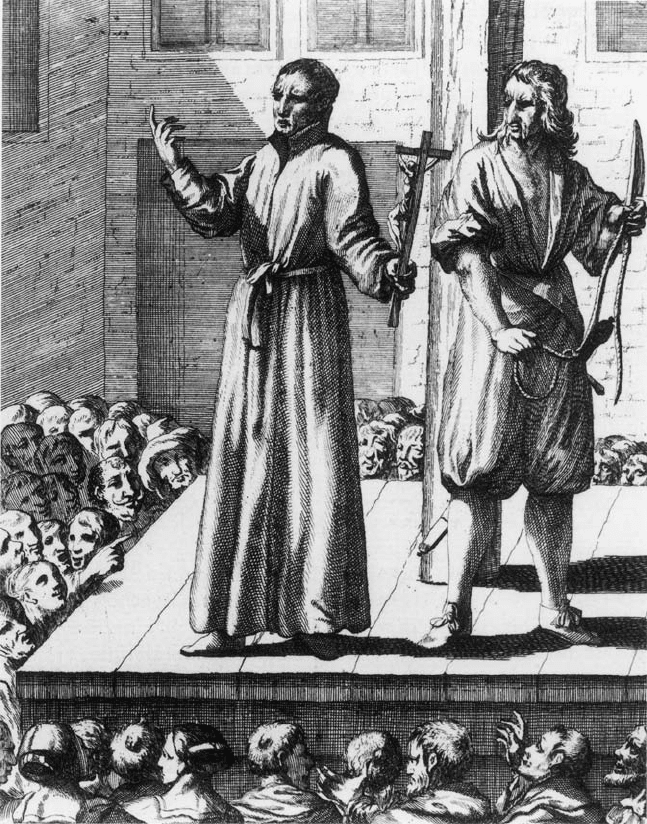
Fr Henry Garnet S.J. on the scaf fold before being executed for complicity in the
Gunpowder Plot
ETHICS
254
answer which contained words which were genuinely ambiguous. But it
was a diVerent matter to alter completely the natural sense of a spoken
sentence by a totally private addition or subtraction of words (‘mental
reservation’ as it came to be called). Equivocation of this kind, many
felt, was worse than lying, piling hypocrisy upon deceit. After he had
been tried and executed for complicity in the Gunpowder Plot of 1605,
Garnet became for English Protestants the paradigm of the deceitful Jesuit.
In Shakespeare’s Macbeth, after the murder of Duncan, a drunken porter
imagines he is keeper of the gates of hell. Among those who knock to be
admitted:
Faith, here’s an equivocator, that could swear in both the scales against either
scale, who committed treason enough for God’s sake, yet could not equivocate to
Heaven: O, come in, equivocator. (II.iii)
Garnet’s defence of mental reservation was a minority opinion even
among casuists. But there was a second-order moral principle, widely held
by casuists, which gave a special signiWcance to minority opinions. Suppose
that moralists disagree with each other whether a particular action is sinful
or not: is it lawful to perform it? One school of thought answered that one
must take the least dangerous course, and refrain; that was called ‘tutior-
ism’, from the Latin word tutior meaning ‘safer’. Another school of thought
said that one could perform the action only if a majority of authorities
regarded it as lawful. This was ‘probabiliorism’, which maintained that one
must follow the more probable opinion. But there was a third theory,
popular with many casuists, which held that even a less probable opinion
could lawfully be followed, provided that it was probable at all. To be
‘probable’ it was suY cient that the opinion was maintained by someone in
a position of authority, even though he might have the majority of experts
against him. This was the doctrine of ‘proba bilism’. It was Wrst propounded
in 1577 by a Dominican commentator on St Thomas, Bartolomeo Medina
of Salamanca, who wrote ‘if an opinion is probable, it is licit to follow it,
even though the opposite opinion is more probable’.6
The use of probabilism was perhaps not so very diVerent from the
common practice in business and politics today of shopping around
among lawyers until one Wnds one who is willing to advise that the course
of action one has decided on is perfectly legal. But to thinkers like Pascal it
6 Quoted in Jonsen and Toulmin, p. 164.
ETHICS
255