
Kenny Anthony. The Rise of Modern Philosophy: A New History of Western Philosophy. Volume 3
Подождите немного. Документ загружается.

Theologians have commonly distinguished between creation and con-
servation. In the beginning, God created heaven and earth, and from day to
day he keeps heaven and earth in being. But his conservation of the universe
does not involve fresh acts of creation: beings, once created, have by
themselves a tendency to keep on existing, unless interf ered with. They
have a kind of existential inertia.
Descartes rejected this, when, in the third Meditation, he was inquiring
about his own origin:
All the course of my life may be divided into an in Wnite number of parts, none of
which is in any way dependent on the other; and thus from the fact that I was in
existence a short time ago it does not follow that I must be in existence now,
unless some cause at this instant, so to speak, produces me anew. (AT VII.50;
CSMK II.334)
One’s life is not a continuous duration, but rather is built up out of
instants, in the way in which movement in the cinema is built out of a
series of stills. The cause that Descartes has in mind in this passage is, of
course, God. So for him there is no distinction between creation and
conservation: at each moment I am created anew by God. In physics,
Descartes opposed atomism; since matter was identical with extension,
and extension was inWnitely divisible, there could be no indivisible parts
of matter. But the doctrine of continuous creation seems to involve a
certain metaphysical atomism: history is built up out of an inWnite number
of time slices, each of which is quite independent of its predecessor and its
successor.
The passage we have been considering occurs in the third Meditation
when Descartes was oVering a proof of God’s existence from the occur-
rence in his own mind of an idea of God.2 But in the Wfth Meditation he oVers
adiVerent proof of God’s existence, which since the time of Kant has been
famous under the title ‘the ontological argument’. The argument was
already adumbrated in the Discourse on Method:
I saw quite well that, assuming a triangle, its three angles must be equal to two
right angles; but for all that, I saw nothing that assured me that there was any
triangle in the real world. On the other hand, going back to an examination of my
idea of a perfect Being, I found that this included the existence of such a Being; in
2 See p. 37 above.
306
GOD
the same way as the idea of a triangle includes the equality of its three angles to two
right angles . . . Consequently, it is at least as certain that God, the perfect Being in
question, is or exists, as any proof in geometry can be. (AT VI.36; CSMK I.129)
Expanding on this in the Wfth Meditation, Descartes says that reXecting on
the idea he has of God, a supremely perfect being, he clearly and distinctly
perceives that everlast ing existence belongs to God’s nature. Existence can
no more be taken away from the divine essence than the sum of the angles
can be taken away from a Euclidean triangle. ‘It is not less absurd to think
of God (that is, a supremely perfect being) lacking existence (that is, lacking
a certain perfection) than to think of a hill without a valley’ (i.e. an uphill
slope without a downhill slope).
To see that this argument is not a simple begging of the question of
God’s existence, we have to recall that Descartes believed in a Platonic
world of essences independent both of the real world and the world of the
mind.3 ‘When I imagine a triangle, it may be that no such Wgure exists
anywhere outside my thought, or never has existed; but there certainly is
its determinate nature, its essence, its form, which is unchangeable and
eternal. This is no Wgment of mine, a nd does not depend on my mind.’
Theorems can be proved about triangles whether or not anything in the
world is triangular; similarly, therefore, theorems could be stated about
God in abstraction whether or not there exists any such being. One such
theorem is that God is a totally perfect being, that is, he contains all
perfections. But existence itself is a perfection; hence, God, who contains
all perfections, must exist.
The vulnerab le point in the argument is the claim that existence is a
perfection. This was siezed upon by Pierre Gassendi, author of the Wfth set
of Objections to the Meditations. ‘Neither in God nor in anything else is
existence a perfection, but rather that without which there are no perfec-
tions . . . Existence cannot be said to exist in a thing like a perfection; and if a
thing lacks existence, then it is not just imperfect or lacking perfection, it is
nothing at all.’ Descartes had no ultimately convincing answer to this
objection, and it was later to be pressed home conclusiv ely by Immanuel
Kant and Gottlob Frege.4
3 See p. 185 above.
4 See below, p. 325.
307
GOD
Pascal and Spinoza on God
Continental philosophers in the century of Descartes moved on from his
treatment of God’s existence in two diVerent directions. Blaise Pascal
abandoned the quest for a demonstration: our natural reason was so
limited and so corrupt that any such attempt must be futile. Instead, he
urged informal considerations that should prompt us to believe in the
absence of proof. Baruch Spinoza, on the other hand, oVered his own
version of the ontological arg ument, giving it the most thoroughly for-
malized presentation it had ever received.
Pascal admits that by the natural light of reason we are incapable not
only of knowing what God is, but even if there is a God at all. But the
believer is not left without resource. He addresses the unbeliever thus:
Either God exists or not. Which side shall we take? Reason can determine nothing
here. An inWnite abyss separates us, and across this inWnite distance a game is being
played, which will turn out heads or tails. Which will you bet? (P, 680)
You, the unbeliever, perhaps prefer not to wager at all. But you cannot
escape: the game has already begun and all have a stake. The chances, so far
as reason can show, are equal on either side. But the outcomes of the
possible bets are very diVerent. Suppose you bet your life that God exists. If
you win, God exists, and you gain inWnite happiness; if you lose, then God
does not exist and wh at you lose is nothing. So the bet on God is a good
one. But how much should we bet? If you were oVered three lives of
happiness in return for betting your present life, it would make sense to
take the oVer. But in fact what you are oVered is not just three lifetimes but
a whole eternity of happiness, so the bet must be inWnitely attractive. We
have been assuming that the chances of winning or losing a bet on God are
Wfty-Wfty. But the proportion of in Wnite happiness, in comparison with
what is on oVer in the present life, is so great that the bet on God’s
existence is a solid proposition even if the odds against winning are
enormous, so long as they are only Wnite.
Is it true, as Pascal assumes, that one cannot suspend judgement about
the existence of God? In the absence of a convincing proof either of theism
or of atheism, is not the rational position that of the agnostic, who refuses
to place a bet either way? Pascal claims that this is tantamount to betting
against God. That may be so, if in fact there is a God who has commanded
308
GOD
us under pain of damnation to believe in him; but that should be the
conclusion, not the starting point of the discussion.
What is it, in fact, to bet one’s life on the existence of God? For Pascal, it
meant leading the life of an austere Jansenist. But if reason alone can tell us
nothing about God, how can we be sure that that is the kind of life that he will
reward with eternal happiness? Perhaps we are being invited to bet on the
existence, not just of God, but of the Jansenist God. But then the game is no
longer one in which there are only two possible bets: someone may ask us to
bet on the Jesuit God, or the Calvinist God, or the God of Islam. Pascal’s
ingenious apologetic does not succeed in its task; but it does draw attention to
the fact that it is possible to have good reasons for believing in a proposition
that are quite separate from reasons that provide evidence for its truth. This
consideration was to be developed in more elaborate ways by later philo-
sophers of religion such as Søren Kierkegaard and John Henry Newman.
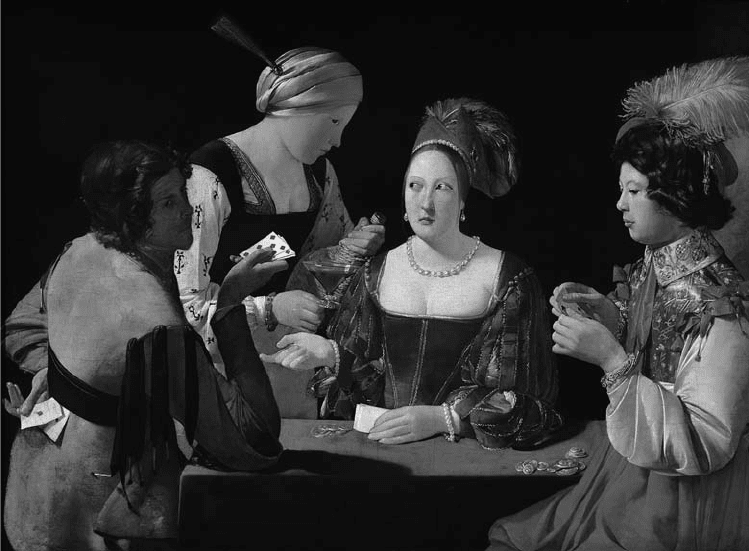
In Pascal’s time gambling was highly fashionable. It would have been rash, however, to bet in the
company represented in this genre painting by George de la Tour
309
GOD
Spinoza, on the other hand, was not at all a betting man: he liked his
reasons as cut and dried as possible. The existence of God, he believed,
could be shown to be as plain to see as the truth of any proposition in
Euclid. To show this he presented his own version of the ontological
argument, set out in geometrical form, in the Wrst book of his Ethics.
Proposition 11 of that book reads: ‘God, a substance consisting of inWnite
attributes, each of which expresses an eternal and inWnite essence, neces-
sarily exists.’ The description here given of God is derived from the sixth of
the series of deWnitions set out at the beginning of the book.
The proof of proposition 11 is by reductio ad absurdum:
If you deny this, conceive, if you can, that God does not exist. Therefore (by Axiom 7)
his essence does not involve existence. But this (by Proposition 7) is absurd. Therefore,
God necessarily exists. Q.E.D. (Eth,7)
If we look up Axiom 7, we Wnd that it says that if a thing can be conceived
as non-existing its essence does not involve existence. Proposition 7 is more
controversial: existence is part of the natu re of a substance. To prove this,
Spinoza tells us that a substance cannot be produced by anything else,
and so must be its own cause; that is to say, its essence must involve
existence. But why cannot a substance be produced by something else—by
another substance? We are referred to Proposition 5 (there cannot be two
or more substances with the same attribute) and to Proposition 3 (if A is
to be the cause of B, A must have something in common with B). These in
turn rest on DeWnition 3, the initial deWnition of substance as ‘that which is
in itself and is conceived by itself, so that its concept can be formed
independently of the concept of any other thing’ (Eth, 1).
Two elements in Spinoza’s argument are counterintuitive. Are we not
surrounded in life by cases of substances giving rise to other substances,
most conspicuously living things generating other living things? And why
should we accept the claim that if B is the cause of A, then the concept of B
must be part of the concept of A? It is not possible to know what lung cancer
is without knowing what a lung is, but is it not possible to know what lung
cancer is without knowing what the cause of lung cancer is? Spinoza is
identifying causal relationships and logical relationships in a manner that is
surely unwarranted. But it is not, of course, inadvertent: the equivalence of
the two kinds of consequence, logical and causal, is a key element of his
310
GOD
metaphysical system. But it is not argued for: it is smuggled in through the
original de W nition of substance.
Spinoza’s initial set of deWnitions includes also a novel deWnition of God
as containing an inWnite number of attributes. Sin ce we are told that we can
only know two of these attributes, namely thought and extension, these
inWnite attributes play little further part in the system. Once Spinoza has
proved to his satisfaction the existence of God he goes on to derive a number
of properties of God that belong to traditional theism: God is inWnite,
indivisible, unique, eternal, and all-comprehending; he is the Wrst eYcient
cause of everything that can fall within his compreh ension, and he is the
only entity in which essence and existence are identical (Eth, 9–18). But he
also describes God in hig hly unorthodox ways. Although in the Tractatus he
had campaigned against anthropomorphic concepts of God, he nonetheless
states that God is extended, and therefore is something bodily (Eth, 33). God
is not a creator as envisaged in the Ju daeo-Christian tradition: he does not
choose to give existence to the universe, but everything that there is follows
by necessity from the divine nature. He is free only in the sense that he is not
determined by anything outside his own nature, but it was not open to him
not to create or to create a world di Verent from the one that we have (Eth,
21–2). He is an immanent and not a transcendent cause of things, and there
is no such thing as the purpose of creation.
Spinoza’s innovations in natural theology are summed up in the equa-
tion of God with Nature. Although the word was not invented until the
next century, his theism can be called ‘pantheism’, the doctrine that God is
everything and everything is God. But, like every other element in his
system, ‘Nature’ is a subtle concept. Like Bruno, Spinoza distinguishes Natura
Naturans (literally, ‘Nature Naturing’, which we may call ‘active nature’) and
Natura Naturata (‘Nature Natured’, which we may call ‘passive nature’). The
inWnite attributes of the single divine substance belong to active nature; the
series of modes that constitute Wnite beings belong to passive nature. Just as
the Wnite beings that make up the tapestry of the universe cannot exist or be
conceived without God, so too God cannot exist or be conceived of without
each of these threads of being. Most signiWcantly, we are told that intellect
and will belong not to active nature but to passive nature. Hence, God is not
a personal God as devout Jews and Christians believed.
Does this mean that God does not love us? Spinoza, as we have seen,
believed that intellectual love for God was the highest form of human
311
GOD
activity. But he went on to say that a man who loves God should not
endeavour that God should love him in return. Indeed, if you want God to
love you, you want him to cease to be God (Eth, 169–70). However, God can
be said to love himself, and our love of God can be seen as one expression of
this self-love. In this sense God’s love for men is exactly the same thing as
men’s intellectual love of God.
The Optimism of Leibniz
When Leibniz visited Spinoza in 1676 one of the topics they discussed was
Descartes’ ontological argument for the existence of God. Descartes had
argued that God is by deWnition a being who possesses all perfections; but
existence is a perfection, therefore God possesses existence. Leibniz thought
this argument had a dubious premiss: how can we know that the idea of a
being possessing all perfections is a coherent idea? He wrote a paper for
Spinoza in which he tried to make good this defect. He deWned a perfection
as a ‘simple quality which is positive and absolute’. Incompatibility, he
argued, could only arise between complex qualities which, when analysed,
might be shown to contain contradictory elements. But a simple quality is
unanalysable. Accordingly, there is nothing impossible in the notion of
a being containing all simpl e qualities, that is to say an ens perfectissimum
(G VII.261–2).
Leibniz, having added this rider, accepted the ontological argument. He
did not question the idea that existence is a perfection—the premiss that, to
Gassendi at the time, and to many philosophers from Kant to the present
day, has seemed the really vulnerable point in Descartes’ reasoning. This is
surprising, for as we have seen in his own system existence is something
quite diVerent from all the predicates that attach to a subject and constitute
its deWnition.5
Leibniz gives a new twist also to the cosmological proof which argues to
God as the Wrst cause of the universe. He does not assume that a series of
Wnite causes must itself be a Wnite series: he says, for instance, that an
inWnity of shapes and movements, present and past, form part of the
eYcient cause of his writing the Monadology. But each element in this series
5 See above, p. 197.
312
GOD
is a contingent entity which does not have in itself a suYcient reason for its
existence. The ultimate reason must be found outside the series, in a
necessary being, and this we call God (G VI.613). Clearly, this argument
stands or falls with the principle of suYcient reason.
Leibniz oVers two other proofs of God’s existence, one traditional and one
novel. One is the argument from eternal truths, which goes back to St
Augustine.6 It runs as follows. Minds are the regions in which truths dwell;
but logical and mathematical truths are prior to human minds, so they must
have a locus in an eternal divine mind. The second, new, argument depends on
the theory of the pre-established harmony: ‘This perfect harmony of so many
substances that have no communication with each other can only come
from a common cause’ (G IV.486). This argument, of course, will convince
only those who have accepted Leibniz’s system of windowless monads.
Unlike Spinoza, Leibniz believed that God was totally distinct from
nature, and that he had freely created a world of free creatures. Before
deciding to create, God surveys the inWnite number of possible creatures.
Among the possible creatures there will be many possible Julius Caesars;
among these there will be one Julius Caesar who crosses the Rubicon and
one who does not. Each of these possible Caesars acts for a reason, and
neither of them will be necessitated to act. When, therefore, God decides to
give existence to the Rubicon-crossing Caesar he is making actual a freely
choosing Caesar. Hence, our Caesar c rossed the Rubicon freely.
What of God’s own choice to give existence to the actual world we
live in, rather than the myriad other possible worlds he might have
created? Leibniz answers that God, as a rational agent, chose to create the
best of all possible worlds. In the eighth chapter of the Wrst part of his
Theodicy he says that God’s supreme wisdom, conjoined with inWnite
goodness, could not have failed to choose the best. A lesser good is a
kind of evil, just as a lesser evil is a kind of good; so God must have chosen
the best world under pain of having done evil. If there were no best world,
he would not have chosen to create at all. It may appear that a world
without sin and suVering would have been better than ours, but that is an
illusion. If the slightest existing evil were lacking in the present world, it
would be a diVerent world. The eternal truths demand that physical and
moral evil are possible, and therefore many of the inWnitely many possible
6 See vol. II, pp. 278–80.
313
GOD
worlds will contain them. For all we can show to the contrary, therefore,
the best of all worlds is among those that contain evils of both kinds
(G VI.107V ).
Leibniz was not the Wrst to claim that our world was the best possible—
already in the twelfth century Abelard had maintained that God had no
power to make a better world than the one he had made.7 But Leibniz
distinguished his position from Abelard’s by saying that other worlds
besides the actual one are possible—metaphysically possible. The necessity
which obliged God to choose the best world was a moral, not a metaphys-
ical, necessity: he was determined not by any lack of power, but by the
inWnity of his goodness. Thus Leibniz can claim, in the Discourse (D, 3), that
God creates the world freely: it is the highest liberty to act perfectly,
according to sovereign reason. God acts freely because although he cannot
create anything but the best he need not have created at all.
Leibniz believed that his theory solved the traditional problem of evil:
why does an omnipotent and loving God permit sin and suVering? He
points out that not all things that are possible in advance can be made
actual together: as he puts it, A and B may each be possible, but A and B
may not be compossible. Any created world is a system of compossibles,
and the best possible world is the system that has the greatest surplus of
good over evil. A world in which there is free will that is sometimes sinfully
misused is better than a world in which there is neither freedom nor sin.
Thus the existence of evil in the world provides no argument against the
goodness of God.
One is inclined to make to the ‘optimism’ of Leibniz the kind of
objection that he made to Descartes’ ontological argument. How do we
know that ‘the best of all possible worlds’ expresses a coherent notion?
Leibniz himself oVered a proof that there was no such thing as the fastest of
all possible motions. If there is such a velocity, imagine a wheel rotating at
such a rate; if you stick a nail in the wheel to project out from its
circumference, the nail will rotate even faster, which shows the absurdity
of the notion (G IV. 424). If the alleged best possible world contains evil E,
can we not imagine a world similar in all other respects but lacking E? And
if God is omnipotent, how could it be impossible for him to bring such a
world into being?
7 See vol. II, p. 296.
314
GOD
The God of Berkeley
We have seen that Leibniz found much to approve in Berkeley’s early
writings. The admiration, however, does not seem to have been recipro-
cated. Berkeley was scornful of Leibniz’s ontological argument for the
existence of God. On the other hand he oVered a new proof of his
own—a ‘direct and immediate demonstration’ of the being of God—
which could be regarded as a gigantic expansion of the argument from
eternal truths borrowed by Leibniz from St Augustine. In the dialogue,
having established to his satisfaction that sensible things cannot exist
otherwise than in a mind or spirit, he continues:
Whence I conclude, not that they have no real existence, but that, seeing they
depend not on my thought, and have an existence distinct from being perceived by
me, there must be some other Mind wherein they exist. As sure, therefore, as the
sensible world really exists, so sure is there an inWnite omnipresent Spirit who
contains and supports it. (BPW, 175)
Thus, not only do the august truths of logic and mathematics dwell as
ideas in the mind of God, so does the most everyday empirical truth, such
as the fact that there is a ladybird walking across my desk at this moment.
Berkeley is not simply saying that God knows such humble truths—that
had long been the majority opinion among theologians. He is saying that
the very thing that makes such a proposition true is nothing other than a
set of ideas in God’s mind—God’s idea of the ladybird and God’s idea of my
desk. This was indeed an innovation . ‘Men commonly believe that all
things are known or perceived by God, because they believe the being of
a God, whereas I on the other side immediately and necessarily conclude
the being of a God, because all sensible things must be perceived by Him’
(BPW, 175).
If we grant to Berkeley, for the sake of argument, that the sensible world
consists only of ideas, there still seems to be a Xaw in his proof of God’s
existence. One cannot, without fallacy, pass from the premiss ‘There is no
Wnite mind in which everything exists’ to the conclusion ‘therefore there is
an inWnite mind in which everything exists’. It could be that whatever
exists exists in some Wnite mind or other, even though no Wnite mind is
capacious enough to hold every existent. Few would be convinced by the
following parallel argument. ‘All humans are citizens; there is no nation
315
GOD