
Kenny Anthony. The Rise of Modern Philosophy: A New History of Western Philosophy. Volume 3
Подождите немного. Документ загружается.

variable, and contingent items in the world of experience to provide the
necessary stable grounding for our fragile and X eeting cosmos.
However, Kant has a further criticism of the cosmological argument
which is independent of his claim that it is the ontological argument in
disguise. All forms of the cosmological argument seek to show that a series
of contingent causes, however prolonged, can be completed only by a
necessary cause. But if we ask whether the necessary cause is, or is not, part
of the chain of causes, we are faced with a dilemma. If it is part of the chain ,
then we can ask, in its case as in others, why it exists. But we cannot
imagine a supreme being saying to itself ‘I am from eternity to eternity, and
outside me there is nothing save what is through my will, but whence then am
I?’ (A, 613). On the other hand, if the necessary being is not part of the
chain of causation, how can it account for the links in the chain that end
with the existence of myself ?
The argument for God’s existence that Kant treats most gently is the
physico-theological proof, which he says must always be mentioned with
respect and which he himself states with great eloquence:
This world presents to us such an immeasurable spectacle of variety, order,
purpose and beauty, shown alike in its inWnite extent and in the unlimited
divisibility of its parts, that even with such knowledge as our weak understanding
can acquire we encounter so many marvels immeasurably great that all speech
loses its force, all numbers their power to measure, our thoughts lose all precision,
and our judgement of the whole dissolves into an amazement whose very silence
speaks with eloquence. Everywhere we see a chain of eVects and causes, of
ends and means, regularity in coming into and going out of existence. Nothing
has of itself come into the condition into which we Wnd it, but always points
behind itself to something else as its cause; and this in its turn obliges us to make
the same inquiry. The whole universe would thus sink into the abyss of nothing-
ness unless over and above this inWnite chain of contingencies one assumed
something to support it—something that is original and independently self-
subsistent, and which not only caused the origin of the universe but also secures
its continuance. (A, 622)
The argument thus presented seems to combine several of the traditional
proofs of God’s existence—the argument to a Wrst cause, for instance, as
well as the argument from design. There is no doubt that everywhere in the
world we Wnd signs of order, in accordance with a determinate purpose,
apparently carried out with great wisdom. Since this order is alien to the
326
GOD
individual things which constitute the world, we must conclude that it
must have been imposed by one or more sublime wise causes, operating not
blindly as nature does, but freely as humans do. Kant raises various
diYculties about the analogies that the argument draws beteween the
operation of nature and the artiWce of human skill; but his real criticism
of the proof is not to deny its authority but to limit its scope. The most the
argument can prove is the existence of ‘an architect of the world who is
always very much hampered by the adaptability of the material in which he
works, not a creator of the world to whose idea everything is subject’. Many
religious believers would be very content to have established beyond
reasonable doubt the existence of such a grand architect.
However, Kant did not say his last word about God in the Critique of Pure
Reason. In his second critique he sets out a number of postulates of practical
reason; assumptions that must be made if obedience to the moral law is to
be made a rational activity. The postulates turn out to be the same as the
traditional topics of natural metaphysics: God, freedom , and immortality.
We have an obligation to pursue perfect goodness, which includes both
virtue and happiness. We can only have an obligation to pursue something
if it is possible of achievement: ‘Ought’, Kant said memorably, ‘implies can.’
But only an all-powerful, omniscient God could ensure that virtue and
happiness can coincide—and even such a God can do so only if there is a
life after the present one. Hence, it is morally necessary to assume the
existence of God.
Kant insists that there is no inconsistency between this claim and his
denial in the Wrst critique that speculative reason could prove the existence
and attributes of God. The postulation of God’s existence demanded by the
moral life is an act of faith. Already in a preface to the Wrst Critique Kant had
marked out the di Verence between the two approaches to theology, and
claimed that his critical approach to metaphysics was actually a necessary
condition of a morally valuable belief in God’s existence:
I cannot even assume God, freedom and immortality for the sake of the necessary
practical use of my reason unless I simultaneously deprive speculative reason of its
pretension to extravagant insights . . . Thus I have to deny knowledge in order to
make room for faith. The dogmatism of metaphysics—the idea that it is possible to
make progress in the subject without criticizing pure reason—is the true source of
that dogmatic unbelief which is at odds with morality. (B)
327
GOD
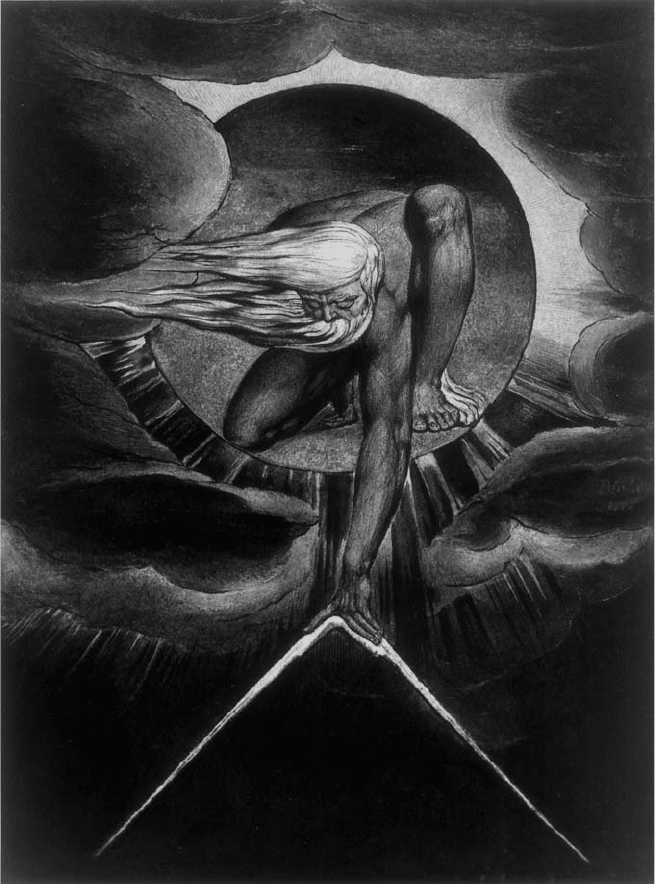
The architect of the cosmos, portrayed in William Blake’s The Ancient of Days
328
GOD
Kant’s postul ation of God as a condition of moral behaviour is an elabor-
ation of a strategy Wrst laid out by Pascal, namely, that we should believe
that God exists not because we have reason to think that ‘God exists’ is
true, but because it is a proposition that is good for us to believe.
The Absolute of Hegel
Hegel was fond of using Christian language. For instance, he divides the
history of Germany into three periods: the period up to Charlemagne,
which he calls the Kingdom of the Father; the period from Charlemagne to
the Reformation, which he calls the Kingdom of the Son; and Wnally
the period from the Reformation to the Prussian monarchy, which is the
Kingdom of the Holy Ghost or Spirit. From time to time he refers to
the absolute as God and his statement that the absolute is the Thought
that thinks itself recalls a phrase of Aristotle that was often employed by
Christian thinkers as an approach to a deWnition of God. But on examin-
ation it turns out that the absolute is something very diVerent from the
Christian God.
God as conceived by Christian tradition is an eternal, unchanging, being
whose existence is quite independent of the existence of the world and
of human beings. Before Adam and Abraham existed, God already existed
in the fullness of self-awareness. Hegel’s absolute, on the other hand, is
a spirit who lives only through the lives of human beings, and the self-
awareness of the absolute is brought about by the reXection of philosophers
in the everyday world. Spirit, however, is not simply reducible to the
totality of human thinking; the absolute has purposes which are not
those of any human thinker and which human activity unconsciously
serves. But the spirit’s plan of the universe is not something imposed from
outside by a transcendent creator; it is an internal evolution programmed
by a cosmic equivalent of DNA.
Hegel saw his system as a rational, scienti W c, presentation of truths
conveyed symbolically by religion. Philosophy and religion covered the
same area as each other:
The objects of philosophy are upon the whole the same as those of religion. In
both the object is Truth, in that supreme sense in which God and God only is the
GOD
329
Truth. Both in like manner go on to treat of the Wnite worlds of Nature and the
human Mind, with their relation to each other and to their truth in God.
In both philosophy and religion mankind aims to make its own the
universal cosmic reason: religion does this by worship; philosophy by rational
reXection.
Initially, religion presents us with myths and images. Thus in classical
Antiquity Homer and Hesiod created the pantheon of Greek gods and
goddesses. The Wrst reaction of philosophy to myth and image is to explode
their pretensions to literal truth: thus Plato denounces the theology of the
poets and the sculptors. This pattern repeats itself in other cultures. The
Jewish and Christian narratives, for instance, are mocked by the philo-
sophers of the Enlightenment. But this antagonism between religion and
anti-religious philosophy is superseded in the true, Hegelian, philosophy
which accepts both faith and reason as diVerent methods of presenting a
single eternal truth.
What philosophy presents in thought, religion presents in images. What
appears in Hegel’s system as the objectiWcation of the concept in Nature
is presented in the great monotheistic religions as the free creation of a
world by a transcendent God. The Hegelian insight that the Wnite spirit is
a moment in the life of inWnite spirit is expressed in Christ ianity by the
doctrine that in Christ God became incarnate in a human being. But
philosophy does not render religion superXuous: ‘The form of Religion is
necessary to Mind as it is in and for itself; it is the form of truth as it is for all
men, and for every mode of consciousness.’ Hegel proudly proclaimed that
he was a Lutheran and intended to remain one (LHP, I.73).
Hegel’s attitude to Christian doctrines, then, was one of sympathetic
condescension. So too was his attitude to traditional proofs of the existence
of God. But if God is the absolute, and the absolute is all being, then God’s
existence hardly needs proof. That is Hegel’s version of the ontological
argument. ‘It would be strange’, he wrote, ‘if the concrete totality we call
God were not rich enough to include so poor a category as being, the very
poorest and most abstract of all’ (Logic 1975, 85). For him, the real proof of
the existence of God is the Hegelian system itself in its entirety.
The early modern period was a testing time for natural theology. It
underwent criticism not only from philosophers who became increasingly
GOD
330
sceptical of elements of religious tradition, but also from theologians who
wished to downgrade the claims of natural religion to make room for faith.
The Enlightenment philosophers sought to downgrade and perhaps elim-
inate the input of theological doctrines into the areas of epistemology,
psychology, biology, ethics, and politics. The French Revolution and its
aftermath led European thinkers to re-evaluate both traditional religion
and the Enlightenment programme. In the nineteenth century, as we will
observe in the next volume, this led to both an intensiWca tion of the
challenge to religion from admirers of the sciences, and a reactive response
from the religious intelligentsia.
GOD
331
CHRONOLOGY
1513 Machiavelli’s Prince
1516 More’s Utopia
1520 Papal condemnation of Luther
1540 Foundation of the Jesuits
1543 Copernicus publishes heliocentrism
1545–63 Council of Trent
1561 Murder of Ramus
1569 Montaigne’s Essays
1588 Molina’s Concordia
1600 Burning of Giordano Bruno
1605 Bacon’s Advancement of Learning
1625 Grotius’ On War and Peace
1638 Galileo’s Two New Sciences
1641 Descartes’ Meditations
1650 Death of Descartes
1651 Hobbes’ Leviathan
1662 Death of Pascal
1677 Publication of Spinoza’s Ethics
1686 Leibniz’s Discourse on Metaphysics
1687 Newton’s Principia Mathematica
1690 Locke’s Essay and Treatises of Civil Government
1713 Berkeley’s Three Dialogues
1714 Leibniz’s Monadology
1739 Hume’s Treatise
1750 Montesquieu’s Spirit of the Laws
1764 Reid’s Common Sense
1764 Rousseau’s Social Contract
1781 Kant’s Critique of Pure Reason
1785 Kant’s Groundwork of the Metaphysic of Morals
1804 Fichte’s Wissenschaftslerhe
1807 Hegel’s Phenomenology of Spirit
1831 Death of Hegel
LIST OF ABBREVIATIONS
AND CONVENTIONS
General
HWP Bertrand Rusell, History of Western Philosophy
PASS Supplementary Proceedings of the Aristotelian Society
ST Thomas Aquinas, Summa Theologiae, cited by part, question, and
article
CHSCP The Cambridge History of Seventeenth-Century Philosophy, ed. D. Garber
and M. Ayers
Luther
E Erasmus-Luther: Discourse on Free Will, ed. E. F. Winter (London:
Constable, 1961), cited by page
WA Weimarer Ausgabe, the standard edition of his works.
Machiavelli
P Il Principe, cited by chapter
Montaigne
ME Essais, cited by page in the Flammarion edition of 1969
More
U Utopia, cited by page in the edition of E. Surtz (New Haven,
Conn.: Yale University Press, 1964)
Ramus
L Peter Ramus: The Logike 1574 (Menton: Scolar Press, 1970), cited by
page
Suarez
DM Disputationes Metaphysicae ¼ vol. 25 of Opera Omnia (Hildesheim:
Olms, 1965), cited by disputation, section, and article
Bacon
B Oxford Authors Bacon, cited by page
Descartes
AT The standard edition of Adam and Tannery, cited by volume and
page
CSMK The 3-volume standard English translation, cited by volume and
page
Hobbes
L Leviathan, cited by page in the Oxford World Classics edition, ed.
J. C. A. Gaskin
G Human Nature and De Corpore Politico, ed. J. C. A. Gaskin (Oxford
World Classics, 1994), cited by page
Locke
E Essay on Human Understanding, cited by page in the Oxford edition by
P. H. Nidditch
T Two Treatises on Government, cited by page in the Yale University
Press edition of 2003
Pascal and Malebranche
EM Essai de la Metaphysique, ibid.
LP Lettres Provinciales, ed. H. F. Stewart (Manchester: Manchester
University Press, 1919), cited by page
P Pascal’s Pense
´
es, cited by the number in the Oxford World Classics
edition
R de V De la Recherche de la Verite
´
in Oeuvres Comple
`
tes de Malebranches, ed.
Andre
´
Robinet (Paris: Vrin, 1958–84)
TNG Malebranche’s Treatise on Nature and Grace, cited by page of the
Oxford translation of 1992
Spinoza
CPS The Cambridge Companion to Spinoza, ed. D. Garett (Cambridge:
Cambridge University Press, 1996)
E References are given by page to Curley’s Penguin translation of
the Ethics (1996)
Ep References are to the letters edited by A. Wolf
LIST OF ABBREVIATIONS AND CONVENTIONS
334
Leibniz
A The Leibniz Clarke Correspondence, ed. H. G. Alexander (Manchester:
Manchester University Press, 1956)
D References to the Discourse on Metaphysics are to the Manchester
edition of 1988
G References are given by volume and page to the Gerhardt edition
of the complete works.
T Theodicy, trs. E. M. Huggard (Lasalle, Ill.: Open Court Press, 1985)
Berkeley
BPW References are given by page to Berkeley’s Philosophical Writings, ed.
D. A. Armstrong (New York: Collier Macmillan, 1965)
Hume
T Treatise of Human Nature, ed. S. Bigge and P. H. Nidditch; references
are given by book, part and, section.
E Enquiry Concerning Human Understanding, by the same editors; refer-
ences are given by page numbers
W Hume on Religion, ed. R. Wollheim (London: Collins, 1963)
Smith and Reid
I Thomas Reid, Inquiry and Essays, ed. R. E. Beanblossom and K.
Lehrer
TMS Adam Smith, Theory of Moral Sentiments (Oxford: Oxford University
Press, 1976), cited by page
The Enlightenment
PD Voltaire, Philosophical Dictionary, ed T. Besterman (Harmonds-
worth: Penguin, 1971), cited by page
EL Montesquieu, Esprit des lois, ed. G. Truc (Paris: Payot, 1945 )
Rousseau
SC References to the Social Contract are by chapter and paragraph
Kant
A Reference by page number to the first edition of the Critique of Pure
Reason
LIST OF ABBREVIATIONS AND CONVENTIONS
335