
Kenny Anthony. The Rise of Modern Philosophy: A New History of Western Philosophy. Volume 3
Подождите немного. Документ загружается.

state of which everyone is a citizen; therefore there is an international state
of which everyone is a citizen.’
Perhaps Berkeley is really intending to argue that if things existed only in
Wnite minds, their existence would be patchy and intermittent. The horse
in his stable would exist while he was looking at it, and again when his
groom was attending to it, but would go out of existence in between
whiles. Only if there is an inWnite, omnipresent, omnitemporal mind will
continuous existence be guaranteed. This is the theme of a famous pair of
limericks in which Ronald Knox tried to summarize Berkeley’s contention:
There was a young man who said, ‘God
Must think it exceedingly odd
If he Wnds that this tree
Continues to be
When there’s no one about in the Quad.’
Reply:
Dear Sir, your astonishment’s odd
I am always about in the Quad.
And that’s why the tree
Will continue to be
Since observed by
Yours faithfully,
GOD.
The God whose existence is allegedly proved by Berkeley’s route seems
diVerent in an important respect from the God of traditional theism. If
objects when perceived by no Wnite spirit are kept in existence by God’s
perceiving them, there must be in God’s mind ideas of all perceptible
things—not only objects like desks and ladybirds, but also colours, shapes,
smells, pleasures, pains, and all kinds of sense-data. But Christian thinkers
had commonly denied that God enjoyed sense-experience. The psalmist
asked: ‘Is the inventor of the ear unable to hear? The creator of the eye
unable to see?’ These rhetorical ‘questions expecting the answer no’ were
given a ‘yes’ answer by Thomas Aquinas and a multitude of other theolo-
gians. Commenting on the text ‘the eyes of the Lord are on the just,’
Aquinas wrote, ‘Parts of the body are ascribed to God in the scriptures by a
metaphor drawn from their functions. Eyes, for exampl e, see, and so when
316
GOD
‘‘God’s eye’’ is spoken of, it means his power to see, even though his seeing
is an intellectual and not a sensory activity’ (Ia 3.1 ad 3).
For Aristotelians it was clear that God had no senses or sensory experi-
ence, because in order to see, hear, feel, taste, or otherwise sense it was
essential to have a body, and God had no body. However, since Descartes
had made popular the idea that the key element in human sensation was in
fact a purely mental event, the matter was no longer so clear-cut. But
Berkeley is anxious to avoid the conclusion that God has sense-experience.
In the third dialogue Hylas, the opposition spokesman, says that it
would follow from Berkeley’s theory that God, the perfect spirit, suVers
pain, which is an imperfection. Berkeley’s mouthpiece, Philonous, replies as
follows:
That God knows or understands all things, and that he knows, among other
things, what pain is, even every sort of painful sensation, and what it is for
creatures to suVer pain, I make no question. But that God, though he knows
and sometimes causes painful sensations in us, can himself suVer pain, I positively
deny ...Nocorporeal motions are attended with the sensations of pain or pleasure
in His mind. To know everything knowable is certainly a perfection; but to endure
or suVer or feel anything by sense is an imperfection. The former, I say, agrees to
God, but not the latter. God knows, or hath, ideas; but His ideas are not conveyed
to him by sense as ours are. (BPW, 202–3)
It is diYcult to see how this is consistent with Berkeley’s epistemol ogy.
Among the ideas we encounter are those of hot and cold, sweet and sour. If
all ideas are ideas in the mind of God, then these ideas are somehow in the
mind of God. If God nonetheless does not feel sensations, then the
possession of such ideas is insuYcient for sensation. But if that is so, then
Berkeley’s account of ordinary human sensation is quite inadequate.
Hume on Religion
Unlike Berkeley , Hume made a lasting, if negative, contribution to natural
theology. His critical observations on the arguments for the existence of
God, and his discussion of the role of miracles in establishing the authority
of a revelation, have remained points of departure for both theist and
atheist philosophers of religion. We may consider Wrst the essay on miracles
317
GOD
which was inserted as section ten of the Inquiry, having no counterpart in
the earlier Treatise.
A miracle, for Hume, is a violation of a law of nature: he gives as examples
of miracles a dead man coming back to life, or the raising of a house or ship
into the air. Surprisingly, he does not deny that miracles are possible—
he does not, like some of his followers, argue that if an apparently miracu-
lous event were proved to have happened that would not show that a law
had been violated, but that we had oversimpliWed our statement of the
law. What he is really interested in is not whether miracles can be done,
but whether they can be seen to be done. For his target is the use of
miracles by apologists to claim supernatural authorization of a particular
religious message.
The Wrst part of the essay ends with the following statement:
No testimony is suYcient to establish a miracle unless the testimony be of such a
kind that its falsehood would be more miraculous, than the fact, which it
endeavours to establish . . . When anyone tells me that he saw a dead man restored
to life, I immediately consider with myself whether it be more probable that this
person should either deceive or be deceived, or that the fact, which he relates,
should really have happened . . . If the falsehood of his testimony would be more
miraculous than the event which he relates; then, and not till then, can he
pretend to command my belief or opinion. (W, 212)
Hume is not ruling out that a miracle could be proved, any more than he
ruled out that a miracle could happen. Indeed, he tells us that given the
appropriate unanimity of testimony, he would himself be prepared to
believe what he regards as a miracle, namely, a total darkness over the
whole earth for eight days. We may Wnd this surp rising. On his own
deWnition a miracle is a violation of the laws of nature, and someone’s
being deceived or deceiving could never be a violation of a law of nature;
therefore the evidence against a miracle must always be stronger than the
evidence for it. But we must remember that according to Hume’s account
of the human will, a human action can be just as much a violation of a law
of nature as any physical event.
Hume is surely right that if it is claimed that an event E has happened
which is a violation of a law of nature, then the probability that E
happened must be in inverse proportion to the evidence that if E happened
it would be a violation of the law. For the evidence that if E happened it
318
GOD
would be a violation of the law is eo ipso evidence that E didn’t happen. But
surely Hume must have overstated his case. Otherwise it would never be
possible for scientists to correct a mistaken belief about a natural law. Faced
with a claim by a colleague that his experiments have revealed a counter-
example to the law, they should, on Hume’s showing, discount the evidence
on the grounds that it would be less of a miracle for the experimenter to be
lying or mistaken than for the law to be violated.
In the second part of the essay Hume oVers three de facto arguments to
show that miracles never have been established on evidence full enough to
meet his standards. First, he states categorically that no miracle has been
suYciently attested by suYciently good witnesses who have much to lose
and can be easily detected if fraudulent. Second, he evokes the credulity of
the human race, as shown in the numerous imposture miracles subse-
quently detected. Third, he maintains that supernatural and miraculous
stories abound chieXy among ignorant and barbarous nations. Each of
these contentions can be, and has been, contested on straightforward
historical grounds.
More interesting is his fourth argument, which is based on the un-
doubted fact that miracles are claimed to have been wrought in aid of
religions which contradict each other. If a miracle proves a doctrine to be
revealed by God, and consequently true, a miracle can never be wrought
for a contrary doctrine. Hence, every story of a miracle wrought in support
of one particular religion must be a piece of evidence against any story of a
miracle wrought in favour of a diVerent religion.
Hume considers three examples to illustrate his point: the cure of a blind
and lame man by the emperor Vespasian, reported in Tacitus; Cardinal de
Retz’s account of a man who grew a second leg by rubbing an amputated
stump with holy oil; and the miracles wrought a t the tomb of a devout
Jansenist, the Abbe
´
Paris. The three cases are of uneven interest: the evidence
for the Wrst two miracles is no more than a few hundred words, but for the
third there are volumes and volumes of authenticated testimony. Hume
describes the events thus:
The curing of the sick, giving hearing to the deaf, and sight to the blind, were
everywhere talked of as the usual eVects of that holy sepulchre. But what is more
extraordinary: many of the miracles were immediately proved on the spot, before
319
GOD
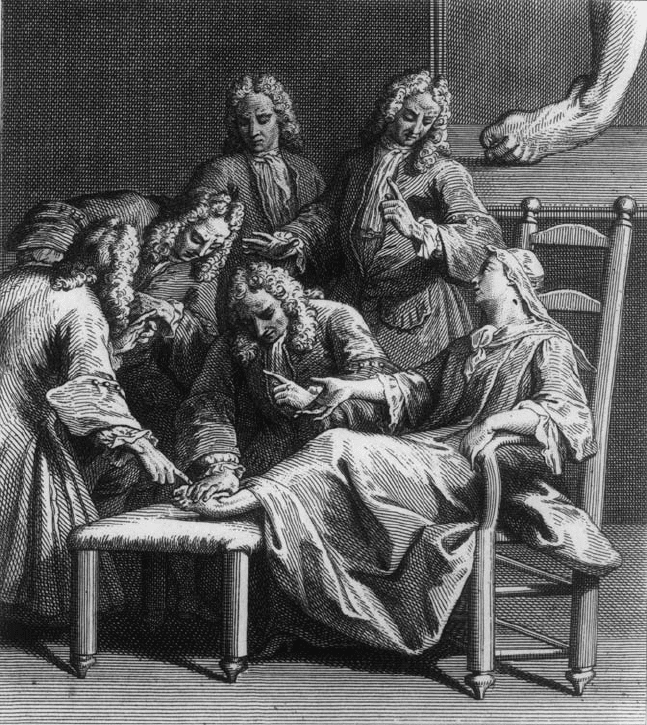
judges of unquestioned integrity, attested by witnesses of credit and distinction, in
a learned age, and on the most eminent theatre that now is in the world. (W, 220)
Hume’s picture is a little overdraw n, and is not quite consistent with his
earlier point that miracles are only reported in barbarous contexts. But
historians of undoubted Catholic piety conWrm the main lines of his
account of these miracles wrought in support of a heresy that had been
repeatedly condemned by the popes. It seems to me that this W nal argu-
ment does establish Hume’s case that a miracle cannot be proved in such a
One of the Jansenist healings cited by Hume in his treatise on miracles
320
GOD
way as to be the foundation of a religion. Not, of course, that theists have
ever thought that it could be so, in the sense of showing that God exists;
they have only claimed that if we know from elsewhere that God exists we
know that he is almighty and that it is in his power to work miracles,
perhaps in order to authenticate one sect rather than another.
Do we know of God from other sources—from the traditional argu-
ments, for instance? Hume believed that there was no being whose non-
existence implied a contradiction: accordingly, he had little sympathy with
the ontological argument for the existence of God. But he makes no direct
onslaught on it; his most relevant remarks occur in the section of the
Treatise in which he is trying to establish the nature of belief. In arguing that
belief was not an idea, he claimed that when, after conceiving something,
we conceive it is existent, we add nothing to our Wrst idea:
Thus when we aYrm, that God is existent, we simply form the idea of such a
being, as he is represented to us; nor is the existence, which we attribute to him,
conceiv’d by a particular idea, which we join to the idea of his other qualities, and
can again separate and distinguish from them . . . When I think of God, when I
think of him as existent, and when I believe him to be existent, my idea of him
neither encreases nor diminishes. (T, 94)
It is correct that believing and conceiving need not diVer in content: if I
believe that God exists and you do not we are disagreeing, in Hume’s terms,
about the same idea. But having a thought about God and believing that
God exists are two quite diVerent things—an atheist who says ‘if there is a
God, then he is a brute or braggart’ expresses, in his if-clause, the thought
that God exists without assenting to it. And Hume is wrong to say that
there is no concept of existence distinct from the concept of the existing
thing—if that were so, how could we judge that something does not exist?
But it is true, and important, that the concept of existence is quite a
diVerent kind of concept from the concept of God or the concept of a
unicorn. To say that unicorns exist is to make a statement of a quite
diVerent logical form from the statement that unicorns are diYcult to
tame. Hume’s insight here was given more precise and accurate form by
later philosophers such as Kant and Frege, who used it in a deWnitive
demolition of the ontological argumen t.
The argument from design is treated more fully and respectfully by
Hume. His Dialogues Concerning Natural Religion feature three characters,
321
GOD
Cleanthes, Philo, and Demea. It is a tribute to Hume’s skill in composition
that it is not easy to identify which of the three is the spokesman for his own
views. Of the three, Demea is the character presented least sympathetically ;
but scholars have been willing, on both internal and external grounds, to
identify both Philo and Cleanthes as mouthpieces for their author. It is
remarkable that both of them take seriously the argument from design.
In the second part, Cleanthes compares the universe to a great mac hine
divided into an inWnite number of smaller machines:
All these various machines, and even their most minute parts, are adjusted to each
other with an accuracy, which ravished into admiration all men, who have ever
contemplated them. The curious adapting of means to ends, throughout all
nature, resembles exactly, though it much exceeds, the productions of human
contrivance; of human designs, thought, wisdom and intelligence. Since there-
fore the eVects resemble each other, we are led to infer, by all the rules of analogy,
that the causes also resemble; and that the Author of Nature is somewhat similar
to the mind of man; though possessed of much larger faculties, proportioned to
the grandeur of the work, which he has executed. (W, 116)
Philo is critical of this argument, but he too, in the Wnal section of the
dialogues, and after a detailed presentation of the problem of evil as a
counterbalance to the argument from design, is willing to say that a divine
being ‘discovers himself to reason in the inexplicable contrivance and
artiWce of Nature’ (W, 189). But his assent to natural theology is very
guarded. He is willing to agree that the cause or causes of order in the
universe probably bear some remote analogy to human intelligence; but
his agreement is hedged about with conditions. However, provided: (1) that
‘this proposition be not capable of extension, variation or more particular
explication’; (2) that ‘it aVord no inference that aVects human life or can be
the source of any action or forbearance’; and (3) that ‘the analogy,
imperfect as it is, can be carried no farther than to the human intelligence’,
then he is prepared to accept the conclusion of the argument from design.
‘What can the most inquisitive, contemplative, and religious man do more
than give a plain, philosophical assent to the proposition as often as it
occurs; and believe that the arguments on which it is established exceed the
objections which lie against it’ (W, 203).
This probably represents Hume’s own position. It is clear that Hume
enjoyed annoying the clergy, and that he detested Christianity itself,
despite the ironical compliments to it which he scatters throughout his
322
GOD
works. But with respect to the existence of God he was an agnostic, not an
atheist. It was not until the triumph of Darwinism in the next century that
an atheist could feel conWdent that he had an eVective antidote to the
argument from design.
Kant’s Theological Dialectic
The third chapter of Kant’s transcendental dialectic is entitled ‘The Ideal of
Pure Reason’: its principal topic is a critique of rational theology, the
attempt to establish by pure reason the existence of a transcendent God.
Kant begins with the claim that all possible proofs of God’s existence must
fall into one of three classes. There are ontological arguments, which take
their start from the a priori concept of a supreme being; there are cosmo-
logical proofs, which argue from the general nature of the empirical world;
and there are proofs based on particular natural phenomena, which we
may call ‘physico theological proofs’. In every kind of proof, Kant says,
reason ‘stretches its wings in vain, to soar beyond the world of sense by the
mere might of speculative thought’ (M, 346).
The ontological argument, as Kant sets it out, begins with a deWnition of
God as an absolutely necessary being. Such a being is a thing whose non-
existence is impo ssible. But can we really make sense, he asks, of such a
deWnition? Necessity really belongs to propositions, not to things; and we
cannot transfer the logical necessity of a proposition such as ‘a triangle has
three angles’ and make it a property of a real being. Logical necessity is only
conditional necessity; nothing is absolutely necessary:
To suppose the existence of a triangle and not that of its three angles is self-
contradictory; but to suppose the non-existence of both triangle and angles is
perfectly admissible. The same holds true of the concept of an absolutely necessary
being. If you think away its existence, you think away the thing itself with all its
predicates, and there is no question of any contradiction. (M, 348)
If the ontological argument is valid, then ‘God exists’ is an analytic
proposition: ‘exist’ is a predicate that is tacitly contained in the subject
‘God’. But Kant insists that all statements of real existence are synthetic:
we cannot derive actual reality from pure concepts. We might object
that we can at least argue from concepts to non-existence: it is because
323
GOD
we grasp the concepts square and circle that we know there are no square
circles. If ‘square circles do not exist’ is analytic, why not ‘there is a
necessary being’?
Kant’s real objection to the ontological argument is not that ‘God exists’
is a synthetic proposition, but that it is not a subject–predicate proposition
at all. ‘God is omnipotent’ contains two concepts linked by the copula
‘is’. But:
If I take the subject, God, with all its predicates including omnipotence and say
‘God is’ or ‘There is a God’ I add no new predicate to the concept of God, I merely
posit or aYrm the existence of the subject with all its predicates: I posit the object
corresponding to my concept. (M, 350)
Existential propositions do not, in fact, always ‘posit’, because they may
occur as subclauses in a larger sentence (as in ‘If there is a God, sinners will
be punished’). But it is true that neither the aYrmation nor the suppos-
ition of God’s existence adds anything to the predicates that make up
the concept of God. This point is correct whether or not any particular
concept of God is coherent or not (as Kant thought necessary being was not).
Even if we allow that God is possible, there remains the point that Kant
memorably expressed by saying that a hundred real dollars contain no
more than a hundred possible dollars.
Echoing Hume, Kant says: ‘By however many predicates we may think
a thing—even if we completely determine it—we do not make the least
addition to the thing when we further declare that this thing is. Other-
wise it would not be exactly the same thing that exists, but something
more than we had thought in the concept; and we could not, therefore,
say that the exact object of my concept exists’ (M, 350). It must always
be illegitimate to try to build existence—even possible existence—into the
concept of a thing. Existence is not a predicate that can enter into such
a concept.
Abelard in the twelfth century, and Frege in the nineteenth century,
urged us to rephrase statements of existence so that ‘exists’ does not even
look like a predicate. ‘Angels exist’ should be formulated as ‘Some things
are angels’. This has the advantage that it does not make it appear that
when we say ‘Angels do not exist’ we are Wrst positing angels and then
rejecting them. But it does not settle the issues surrounding the onto-
logical argument, because the problems about arguing from possibility to
324
GOD
actuality return as questions about what counts as ‘something’: are we
including in our consideration possible as well as actual objects? Thus some
recent philosophers have tried to restate the ontological argument in a
novel way, by including possible objects within the range of discussion.
A necessary being, they argue, is one that exists in all possible worlds. So
deWned, a necessary being must exist in our world, the actual world. Our
world would not exist unless it were possible; so if God exists in every
possible world he must exist in ours.
Kant is surely right to insist that whether there is something in reality
corresponding to my concept of a thing cannot itself be part of my concept.
A concept has to be determined prior to being compared to reality, other-
wise we would not know which concept was being compared and found to
correspond, or maybe not correspond, to reality. That there is a God cannot
be part of what we mean by ‘God’; hence, ‘there is a God’ cannot be an
analytic proposition and the ontological argument must fail.
However, Kant overestimated the force of his criticism. He maintained
that the refutation of the ontological argument carried with it the defeat of
the much more popular proof of God’s existence from the contingency of
the world. That argument is briskly set out by Kant:
If anything exists, an absolutely necessary being must also exist. Now I, at least,
exist. Therefore an absolutely necessary being exists. The minor premise contains
an experience, the major premise the inference from their being any experience at
all to the existence of the necessary. The proof therefore really begins with
experience and is not wholly a priori ontological. For this reason, and because the
object of all possible experience is called the world, it is entitled the cosmological
proof. (A, 605)
Kant argues that the appeal to experience here is illusory; the force of the
cosmological derives only from the ontological argument. For what is
meant by ‘necessary being’? Surely, a being in whom essence involves
existence, that is to say, a being whose existence can be established by the
ontological argument. But here Kant ignores the possibility of a diVerent
deWnition of ‘necessary being’ as meaning a being which can neither come
into nor go out of existence, and which cannot suVer change of any kind.
Such in fact was the standard account of necessary being given by medieval
philosophers who, like Kant, rejected the ontological argument. Such a
being may well be regarded as suYciently diVerent from the caused,
325
GOD