
Kenny Anthony. The Rise of Modern Philosophy: A New History of Western Philosophy. Volume 3
Подождите немного. Документ загружается.

of civilization are likely to assume that the chains are those of social
institutions, and that we are about to be encouraged to reject the social
order. Instead, we are told that it is a sacred right which is the basis of all
other rights. Social institutions, Rousseau now thinks, liberate rather than
enslave.
Like Hobbes and Locke, Rousseau begins with a consideration of human
beings in a state of nature. His account of such a state is, in accordance with
his earlier thoughts about the noble savage, more optimistic than Hobbes’.
In a state of nature men are not necessarily hostile to each other. They are
motivated by self-love, to be sure, but self-love is not the same as egoism:
it can be combined, in both humans and animals, with sympathy and
compassion for one’s fellows. In a state of nature a man has only simple,
animal, desires: ‘the only goods he acknowledges in the world are food,
a female, and sleep; the only ills he fears are pain and hunger’. These desires
are not as inherently competitive as the quest for power in more sophis-
ticated societies.
Rousseau agrees with Hobbes, against Locke, that in a state of nature
there are no property rights and therefore neither justice nor injustice. But
as society develops from its primitive state, the lack of such rights begins to
be felt. Economic cooperation and technical progress make it necessary
to form an association for the protection of individuals’ persons and
possessions. How can this be done while allowing each member of the
association to remain as free as he was before? The Social Contract provides
the solution by presenting the concept of the general will.
The general will comes into existence when ‘each of us puts his person
and all his power in common under the supreme direction of the general
will, and, in our corporate capacity, we receive each member as an indivis-
ible part of the whole’ (SC 1. 6). This compact creates a public person, a
moral and collective body, the state or sovereign people. Every individual is
both a citizen and a subject: as a citizen he shares in the sovereign authority,
and as subject owes obedience to the laws of the state.
Rousseau’s sovereign, unlike Hobbes’ sovereign, has no existence inde-
pendent of the contracting citizens who compose it. Consequently, it can
have no interest independent of theirs: it expresses the general will and it
cannot go wrong in its pursuit of the public good. Men lose their natural
liberty to grasp whatever tempts them, but they gain civil liberty, which
permits the stable ownership of property.
296
POLITICAL PHILOSOPHY
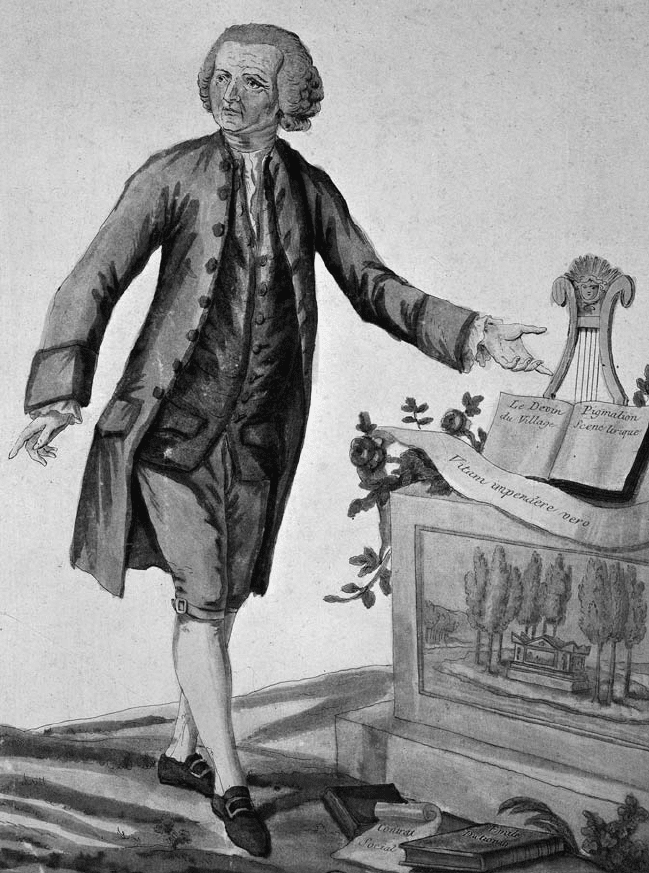
In this contemporary etching Rousseau appears more proud of his opera, Le Devin du
Village, than of the Social Contract, which is tossed to the ground
297
POLITICAL PHILOSOPHY
But what is the general will, and how is it to be ascertained? It is not
the same as the unanimous will of the citizens: Rousseau distinguished
between ‘the general will’ and ‘the will of all’. An individual’s will may go
contrary to the general will. ‘There is often considerable diVerence between
the will of all and the general will. The latter is concerned only with the
common interest, the former with interests that are partial, being itself
but the sum of particular wills’ (SC 3. 3). Should we say then that the
general will should be identiWed with the will of the majority of the
citizens? No, the deliberations of a popular assembly are by no means
infallible: voters may suVer from ignorance, or be swayed by individual
self-interest.
It appears to follow that even the general will is not ascertainable even
by a referendum, and this seems to make it a n abstraction of no practical
value. But Rousseau believed that it could be determined by plebiscite on
two conditions: Wrst, that every voter was fully informed, and second, that
no two voters held any communication with each other . The second
condition is laid down to prevent the formation of groups smaller than
the whole community. ‘It is essential,’ Rousseau wrote, ‘if the general will is
to be able to express itself, that there should be no partial society within the
State, and that each citizen should think only his own thoughts’ (SC 2. 3).
So not only political parties but religious groups also must be banned if the
general will is to Wnd expression in a referendum. It is only within the
context of the entire community that the diVerences between the self-
interest of individuals will cancel out and yield the self-interest of the
sovereign people as a whole.
Rousseau is no devotee in principle of the separation of powers. The
sovereignty of the people, he says, is indivisible: if you separate the powers
of the legislative and executive branches you make the sovereignty chi-
merical. However, a practical division of responsibility follows from his
requirement that the sovereign people should legislate only on very
general matters, leaving executive power concerning particular issues in
the hands of a government which is an intermediary between subjects and
sovereign. But the government must always act as a delegate of the people,
and ideally a popular assembly should meet at regular intervals to conWrm
the constitution and to renew or terminate the mandate of the holders of
public oYce.
298
POLITICAL PHILOSOPHY
The type of arrangement here proposed by Rousseau seems practicable
only in a Swiss canton or a city-state like Geneva. But he insisted, like
Montesquieu, that one cannot specify a single form of government as
appropriate to all circumstances. However, an issue of much wider appli-
cation is raised by the theory of the general will. A citizen in a Rousseauian
state gives his consent to all the laws, including those that are passed in
spite of his opposition (SC 4. 2). What, in such a polity, are the rights of
dissident minorities?
Rousseau says that the social compact tacitly includes an undertaking
that whoever refuses to submit to it may be constrained by his fellow
citizens to conform to it. ‘This means nothing other than that he shall be
forced to be free.’ If I vote against a measure which then triumphs in a poll,
this shows that I was mistaken about where my true good, and my genuine
freedom, were to be found. But the freedom that an imprisoned malefactor
enjoys is only the rather rare W ed freedom to be a reluctant expression of the
general will.
In spite of his concern with the general will, Rousseau was not a whole-
hearted supporter of democracy in practice. ‘If there were a people of gods,
they would govern themselves democratically. But a government of such
perfection is not suitable for human beings’ (SC 3. 4). In a direct democracy
where rule is by popular assembly, government is likely to be fractious and
ineYcient. Better have an elective aristocracy in which the wise govern the
masses: ‘there is no point in getting twenty thousand men to do what a
hundred select men can do ever better’ (SC 3. 4). Aristocracy demands fewer
virtues in the citizens than democracy does—all that it requires is a spirit of
moderation in the rich and of contentment in the poor. Naturally, the rich
will do most of the governing: they have more time to spare.
This seems a tame and bourgeois conclusion to a book that began by
calling mankind to throw oV its chains. Nonetheless, the concept of the
general will had an explosive revolutionary potential. Examined closely,
the notion is theoretically incoherent and practically vacuous. It is not true
as a matter of logic that if A wills A’s good and B wills B’s good, then A and
B jointly will the good of A and B. This remains true, however well
informed A and B may be, because there may be a genuine, unavoidable
incompatibility between the goods of each.
It is precisely the diYculty of determining what the general will
prescribes that made the notion of the general will such a powerful tool
299
POLITICAL PHILOSOPHY
in the hands of demagogues. Robespierre at the height of the French
revolutionary terror could claim that he was expressing the general will,
and forcing citizens to be free. Who was in a position to contradict him?
The conditions Rousseau laid down for the general will’s expression were
that every citizen should be fully informed and that no two citizens should
be allowed to combine with each other. The Wrst condition could never be
fulWlled outside a communit y of gods, and the second condition of its
nature demands a totally tyranny to enforce.
For better or worse, the Social Contract became the bible of revolutionaries,
and not only in France; Rousseau’s inXuence was enormous. Napoleon,
never one to underestimate his own importance, attributed to Rousseau an
equal responsibility with himself for the gigantic changes that Europe
underwent as the eighteenth c entury turned into the nineteenth. ‘Who
can tell’, he asked as he approached death, ‘whether the world would be
a better place if Rousseau and I had never lived?’
Hegel on the Nation-State
Rousseau’s notion of the general will was taken up, in diVerent ways, by
Kant and Hegel. Kant sought to give it a non-mythical form as a universal
consensus of moral agents each legislating universal laws for themselves
and for all others. Hegel transformed it into the freedom of the world-spirit
expressing itself in the history of mankind.
There seems a vast diVerence, Hegel realized, between his thesis of the
evolution of the spirit into ever greater freedom and self-cons ciousness,
and the dismal spectacle presented by actual history. He accepted that
nothing seemed to happen in the world except as the result of the self-
interested actions of individuals; and he was willing to describe history as
the slaughterhouse in which the happiness of peoples, the wisdom of states,
and the virtues of individuals are sacriWced. But the gloom, he maintained,
is not justi W ed; for the self-inter ested actions of individuals are the only
means by which the ideal destiny of the world can be realized. ‘The Ideal
provides the warp, and human passions the woof, of the web of history.’
Human actions are performed in social contexts, and self-interest need
not be egoistic. One can Wnd self-fulWlment in the performance of social
roles: my love of my family and my pride in my profession contribute to
300
POLITICAL PHILOSOPHY
my happiness without being forms of selWshness. Conversely, social
institutions are not a restraint on my freedom: they expand my freedom
by giving a wider scope to my possibilities of action. This is true of the
family, and it is true also of what Hegel calls ‘civil society’—voluntary
organizations such as clubs and businesses. It is true above all of the state,
which provides the widest scope for freedom of action, while at the same
time furthering the purposes of the world-spirit (Weltgeist).
Ideally, a state should be so organized that the private interests of the
citizens coincide with the common interests of the state. In respect of history,
states and peoples themselves count among the individuals who are, uncon-
sciously, the instruments by which the world-spirit achieves its object. There
are also some unique Wgures, great men like Caesar or Napoleon, who have
a special role in expressing the will of the world-spirit, and who see the
aspects of history which are ripe for development in their time.
Such people, however, are the exception, and the normal development
of the world-spirit is through the spirit of particular peoples or nations, the
Volksgeist. That spirit shows itself in the culture, religion, and philosophy of
a people, as well as in its social institutions. Nations are not necessarily
identical with states—indeed, when Hegel wrote, the German nation had
not yet turned itself into a German state—but only in a state does a nation
become self-conscious of itself.
The creation of the state is the high object for which the world-spirit uses
individuals and peoples as its instruments. A state for Hegel is not just
a coercive instrument for keeping the peace or for protecting property: it is
a platform for new and higher purposes which extend the liberty of individ-
uals by giving a new dimension to their lives. The state, as the incarnation
of freedom, exists for its own sake. All the worth, all the spiritual reality which
the individual citizen possesses, he possesses only through the state. For only
by participating in social and political life is he fully conscious of his own
rationality, and of himself as a manifestation, through the folk-spirit, of the
world-spirit. The state, Hegel says, is the divine Idea as it exists on earth.
The divine Idea, however, is not yet fully realized. The German spirit,
Hegel believed, was the spirit of a new world in which absolute truth would
be realized in unlimited freedom. But even the kingdom of Prussia was not
the last word of the world-spirit. Given Hegel’s constant preference for
wholes over their parts, one might expect that in his scheme of things
nation-states would eventually give way to a world-state. But Hegel
301
POLITICAL PHILOSOPHY
disliked the idea of a world-state, because it would take away the oppor-
tunity for war, which was a necessary stage in the dialectic of history. War,
for him, was not just a necessary evil, but had a positive value as a reminder
of the contingent nature of Wnite existence. It was ‘the condition in
which we have to take seriously the vanity of temporal goods and things’
(PR, 324). Accordingly, Hegel attacked Kant’s quest for perpetual peace.
The future of humanity, Hegel predicted, lay neither in Germany nor in a
united world, but rather in America, ‘where, in the ages that lie before us,
the burden of the world’s history shall reveal itself ’—perhaps in a great
continental struggle between North and South.
The history of Germany for a century and more after Hegel’s death
brought upon his political philosophy a barrage of obloquy. His gloriWca-
tion of the state as an end in itself, his belief in the cosmic role of the
German people, and his positive evaluation of warfare can hardly avoid a
share of the responsibility for the two World Wars that disWgured the
twentieth century. It is true that the Prussian model that he commended
was a constitutional monarchy, and that the nationalism he preached was
at some remove from the totalitarian racism of the Nazis. Nonetheless, his
philosophical career, like Rousseau’s, is a reminder of the disastrous
consequences that can Xow from Xawed metaphysics. One can believe
that the state has an intrinsic value of its own only if we think of it as in
some way personal, and indeed a higher form of person than an ordin ary
human individual. And one can rationally believe this only if one accepts
some version of Hegel’s metaphysical doctrine that there is a world-spirit
whose life is lived through the interplay between the folk-spirits that
animate the nation-states.
For those who are interested in the history of philosophy for the sake of
the light it can cast on contemporary concerns, the period from Machia-
velli to Hegel is the heyday of political philosophy. The political institu-
tions of the ancient and medieval world are too distant from our own for
the re X ections upon them of ancient and medieval philosophers to have
much to oVer to contemporary political philosophy. On the other hand, as
we shall see in the next volume, the political evaluations of the great
philosophers of the nineteenth century owe as much to the nascent
disciplines of economics and sociology as they do to the conceptual
concerns that remain as the abiding core of pure political philosophy.
302
POLITICAL PHILOSOPHY

10
God
Molina on Omniscience and Freedom
T
he problem of reconciling human freedom with God’s foreknowledge
of human actions had baZed all the great scholastics of the Middle
Ages. Thomas Aquinas maintained that God foresaw what we would do
because all our actions were present to him in the single moment of
eternity. Duns Scotu s complained that this solution would work only if
time was fundamentally unreal. Instead, he proposed that God knew
creatures’ actions by knowing what he himself had decreed from all
eternity. Ockham objected that such knowledge would provide foreknow-
ledge of human actions only if our actions were predetermined and
therefore unfree. He himself oVered no solution to the problem: divine
foreknowledge was just a dogma to be blindly believed. Peter de Rivo had
tried to preserve freedom while accepting divine omniscience by denying
that future contingent propositions had any truth-value to be known even
by God; but this was a weasel way out and was condemned by the Church.
Lorenzo Valla, Erasmus, and Luther were no better able than their prede-
cessors to reconcile liberty and omniscience. All were reduced to quoting
the Paulin e text with which every theologian sooner or later admits his
baZement on this topic: ‘Oh, the depth of the riches both of the wisdom
and knowledge of God! How unsearchable are his judgments and his ways
past Wnding out!’ (Rom 11: 35).1
A novel and highly ingenious solution to the problem was proposed at
the end of the sixteenth century by the Jesuit Luis Molina. Molina agreed
1 See vol. II, pp. 298–301.
with Ockham in rejecting the acc ounts of Aquinas and Scotus, and he
accepted the Church teaching that future contingent propositions had
truth-values. His innovation was to suggest that God’s knowledge of the
future depended on God’s knowledge of the truth-values of counterfactual
propositions. God knows what any possible creature would freely do in any
possible circumstances. By knowing this and by knowing which creatures
he will create and which circumstances he will himself bring about, he
knows what actual creatures will in fact do.
Molina made a distinction between three kinds of divine knowledge. First,
there is God’s natural knowledge, by which he knows his own nature and all
the things that are possible to him either by his own action or by the action of
free possible creatures. This knowledge is prior to any divine decision about
creation. Then there is God’s free knowledge: his knowledge of what will
actually happen after the free divine decision to create certain free creatures
and place them in certain particular circumstances. Between these two kinds
of knowledge there is God’s ‘middle knowledge’: that is, his knowledge of
what any possible creature will do in any possible circumstances. Because
middle knowledge is based on creatures’ own hypothetical decisions, human
autonomy is upheld; becaus e middle knowledge is, prior to the decision to
create, God’s omniscience about the actual world is preserved.
What Molina called ‘circumstances’, or ‘orders of events’, later philo-
sophers have called ‘possible worlds’. So Molina’s theory is essentially that
God’s knowledge of what will happen in the actual world is based on his
knowledge of all possible worlds plus his knowledge of which possible world
he has decided to actualize. Before creating Adam and Eve God know that
Eve would yield to the serpent and Adam would yield to Eve. He knew this
because he knew all kinds of counterfactuals about Adam and Eve: he knew
what they would do in every possible world. He knew, for instance, whether
Adam, if tempted by the serpent directly rather than via Eve, would still
have eaten the forbidden fruit . The weak point in Molina’s solution is his
assumption that all counterfactual propositions—propositions of the form
‘If A were to happen, B would happen’—have truth-values. Undoubtedly,
some such propositions, e.g. ‘if the earth were to crash into the sun, human
life would cease to exist,’ are true; other such propositions, e.g. ‘if the Great
Pyramid were hexagonal, it would have seventeen sides,’ are false; but when
we ascribe truth-values to such propositions we do so on the basis of logical
or natural laws. Matters are diVerent when we construct counterfactuals
304
GOD
about free agents. There is no general principle of conditional excluded
middle which runs ‘Either (if A were to happen B would happen), or (if A
were to happen B would not happen’).
Descartes, in answer to a query from Princess Elizabeth, oVered a recon-
ciliation between divine foreknowledge and human freedom that in some
ways resembles Molina’s. He wrote:
Suppose that a King has forbidden duels, and knows with certainty that two
gentlemen of his kingdom who live in diV erent towns have a quarrel, and are so
hostile to each other that if they meet nothing will stop them from Wghting. If this
King orders one of them to go on a certain day to the town where the other lives,
and orders the other to go on the same day to the place where the Wrst is, he
knows with certainty that they will meet, and Wght, and thus disobey his
prohibition: but none the less, he does not compel them, and his knowledge,
and even his will to make them act thus, does not prevent their combat when they
meet being as voluntary and free as if they had met on some other occasion and he
had known nothing about it. And they can be no less justly punished for
disobeying the prohibition. Now what a King can do in such a case, concerning
certain free actions of his subjects, God, with His inWnite foresight and power does
infallibly in regard to all the free actions of all men. (AT IV.393; CSMK III.282)
Descartes does not, however, say like Molina that God knows what our
actions will be because he has already seen what we would do in all possible
worlds; he goes on to say that God knows what we will do because he has
determined what desires he will give us and what circumstances he will
place us in. But this takes away the point of the parallel with the king of his
parable. It is only because all the other actions of the duellists that have
formed their characters are independent of the king’s desires and control
that he can plausibly be said not to be responsible for their Wnal duel, and
to be entitled to punish them for disobeying his prohibition. If every action
of every human being is stage-managed by God just as much as the Wnal act
in the duellists’ drama it is hard to see how God himself can avoid being
responsible for sin.
Descartes’ Rational Theology
Descartes’ principal contributions to philosophical natural theology are in
two diVerent areas. First, he refashioned the traditional concept of creation.
Second, he revived a version of the ontological argument of God’s existence.
305
GOD