
Kerry J., Butler P. Smart Packaging Technologies for Fast Moving Consumer Goods
Подождите немного. Документ загружается.

OTE/SPH OTE/SPH
JWBK126-11 JWBK126-Kerry March 3, 2008 20:30 Char Count= 0
208 Smart Packaging Technologies for Fast Moving Consumer Goods
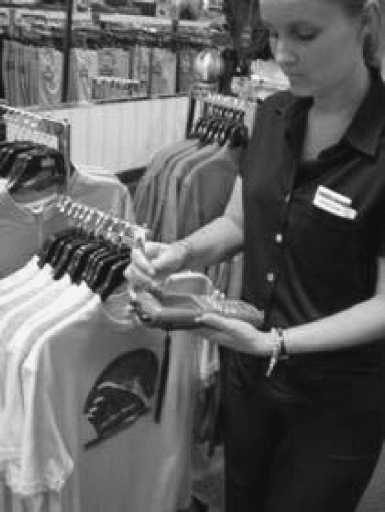
Figure 11.15 Bar code scanning.
world. These printing hubs routinely finalise the printing process by adding to each label,
details about the style size and colour of the garment for which the label is intended. They
also add the standard bar code.
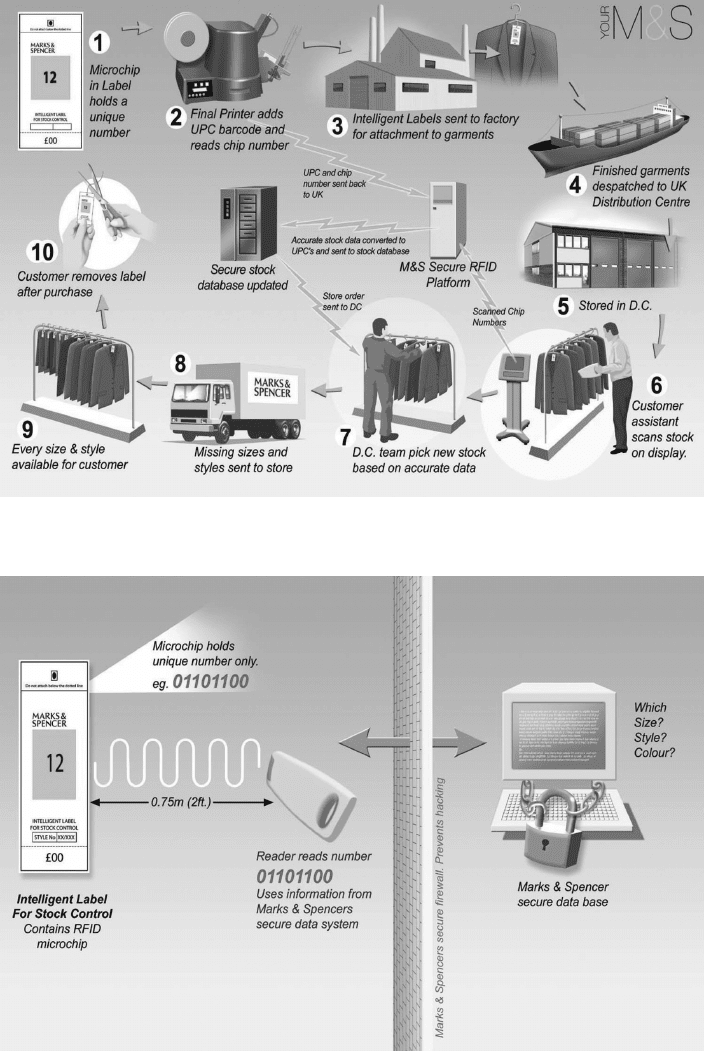
The special characteristics of the RFID label printer are that it also reads the unique
number on the RFID chip. It then creates a data file that associates the garment information
with the unique chip number and sends this combined packet of information back to M&S’s
central secure RFID data base in the UK. Whenever the label is scanned at any point in
the supply chain or in store it is only the unique number that is read, but the central data
base is able to translate this number into garment details using the association information
provided from the printer in the hubs (Figure 11.16).
Another important characteristic of this approach is that no garment information can be
obtained directly from the label. This offers a further degree of privacy protection for the
customer as it is not possible to obtain any useful information about a customer’s purchase
habits by scanning discarded labels, as these only contain the unique number (Figure 11.17).
From the beginning, M&S has tried hard to inform its customers about the new use of
this technology. For any new technology to succeed, consumers need to be engaged and
reassured that the benefits outweigh any real or perceived disadvantages. In particular M&S
has engaged in an open dialogue with many of the groups concerned about privacy, which
has occasionally come up as an issue with various applications of RFID.
We all have a right to privacy and this is enshrined in the UK Data Protection Act.
Privacy is best seen as a tradable right which means we all trade a little of our privacy for
OTE/SPH OTE/SPH
JWBK126-11 JWBK126-Kerry March 3, 2008 20:30 Char Count= 0
Improving Customer Service 209
Figure 11.16 How the intelligent label is used for stock control.
Figure 11.17 The Intelligent Label.
OTE/SPH OTE/SPH
JWBK126-11 JWBK126-Kerry March 3, 2008 20:30 Char Count= 0
210 Smart Packaging Technologies for Fast Moving Consumer Goods
the convenience of using credit cards or for feeling more protected in the streets. This does
not mean however that we are willing to give it up just to make life easier for commercial
organizations.
At Marks & Spencer we aim to demonstrate that we use technology in a responsible way
for the benefit of our customers. We have found that a policy of openness with our customers
coupled with a clear explanation of why and how we are using technology works well. For
example we do not scan the RFID tags at till points, they do not emit signals or contain
batteries and they can be removed at any point during the purchasing process. The label
clearly states ‘Intelligent Label for Stock Control’, which is exactly the purpose for which
they are being used. If the customer returns the garments without the intelligent labels this
does not prevent them obtaining a refund. Additionally, stores using the technology have an
explanatory leaflet available for customers and our privacy policy is shown on the corporate
web site.
In summary M&S can demonstrate that RFID technology can make a significant contri-
bution to increasing business efficiency and improving customer service. We firmly believe
that it is an important technology that will positively influence operations at many more
retailers in the future.

OTE/SPH OTE/SPH
JWBK126-12 JWBK126-Kerry March 15, 2008 17:55 Char Count= 0
12
Smart Packaging Technologies
for Beverage Products
Maurice G. O’Sullivan and Joseph P. Kerry
12.1 Introduction
The beverage industry has always been quick to adopt new technologies as they relate
to innovative packaging solutions. Today, beverages are more than simply products that
quench your thirst and there is much activity in adding nutrient and ‘wellness’ components
to beverages. Milk-based and juice-based beverages, which continue to grow in popularity,
are seen as the ideal carriers of such components. The development of beverage lines where
flavour, as well as other organoleptic properties, needs to be created or controlled is equally
another important area of development in the beverage industry. In the future, nanotech-
nology promises to yield new solutions to key challenges for the beverage industry, just as
it is likely to impact the food industry. Research and development underway includes the
development of functional beverages, nutrient delivery systems and methods for optimizing
beverage appearance, such as colour, flavour and consistency (ElAmin, 2006).
A relatively new and growing area for fragrances is the use of smart packaging as a novel
marketing tool for bringing products to the consumers’ attention, particularly in food and
beverage packaging (Markarian, 2006). Also, as people increasingly ignore commercials
and spread their attention across many types of media, traditional television, radio and print
advertising is losing effectiveness, and marketers are looking for new ways to get noticed.
One promising way appears to be targeting as many of the five senses as possible via
the package itself (Webb Pressler, 2006). Issues pertaining to luxury, high-end, beverage
products such as reinforcement of consumer appeal, tamper evidence, counterfeiting and
brand protection, are also highly topical areas of interest within the beverage industry. Many
Smart Packaging Technologies for Fast Moving Consumer Goods Edited by Joseph Kerry and Paul Butler
© 2008 John Wiley & Sons, Ltd. ISBN: 978-0-470-02802-5
OTE/SPH OTE/SPH
JWBK126-12 JWBK126-Kerry March 15, 2008 17:55 Char Count= 0
212 Smart Packaging Technologies for Fast Moving Consumer Goods
of these issues are being addressed through the use of smart packaging technologies and
these are presented in the following sections.
12.2 Gas Release Packaging
One of the most widely adopted forms of innovative packaging is the gas-releasing ‘widget’
developed originally for canned and bottled beer products, such as Guinness (Robertson,
2006). This technology was developed to give the consumer the draught beer experience
in the comfort of their own home, with the beer having a thick and creamy head. The
function of the widget is to release CO
2
from some of the beer in order to create the head.
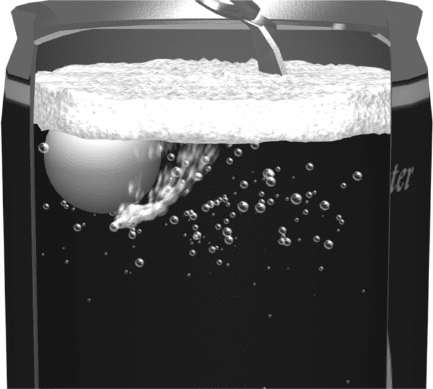
The widget consists of a hollow nitrogen gas-containing plastic sphere, 3 cm in diameter,
with a tiny hole in it. The sphere is added to the can before the can is sealed, and floats
on the surface of the beer, with the hole just slightly below the surface (Anon., 2007a).
Prior to sealing the can, a small shot of liquid nitrogen is added to the beer; this evaporates
during the rest of the canning process and pressurizes the can. As pressure increases in
the can, beer is slowly forced into the sphere through the hole, compressing the nitrogen
inside the sphere. When the can is opened, the pressure inside the can immediately drops
and the compressed gas inside the sphere forces beer out through the tiny hole into the
additional surrounding beer (Figure 12.1). This agitation causes a chain reaction of bub-
ble formation throughout the beer, and the CO
2
that is dissolved in the beer forms tiny
bubbles that rise to the surface, forming the head. The presence of dissolved nitrogen al-
lows smaller bubbles to be formed with consequent greater creaminess of the subsequent
head (Anon., 2007a). This is because the smaller bubbles need a higher internal pressure
to balance the greater surface tension, which is inversely proportional to the radius of the
Figure 12.1 A widget operating in a can of stout. Reproduced with permission from Packaging
Materials and Technologies Ltd.
OTE/SPH OTE/SPH
JWBK126-12 JWBK126-Kerry March 15, 2008 17:55 Char Count= 0
Smart Packaging Technologies for Beverage Products 213
bubbles. Achieving this higher pressure is not possible just with dissolved carbon dioxide
because the much greater solubility of this gas compared with nitrogen would create an
unacceptably large head. The result, when the can is then poured out, is a surging mixture
in the glass of very small gas bubbles and liquid, just as is the case with certain types
of draught beer. Not only does the nitrogen make the beer creamier, and produce a bet-
ter head, it also protects against oxidation. The brewer can therefore permit the beer to
be less carbonated (Anon., 2007a). The ‘canned draught’ products have levels of carbon-
ation similar to those in cask-conditioned ales, and less than half those in some bottled
beers.
Apart from Guinness, other breweries have since come up with their own widget designs
that were introduced to draught beer in 1992, lager in 1994, and cider in 1997. In 2002
canned milk coffee containing a widget was marketed (Robertson, 2006). The Kenco Ice
Cappio coffee drink from Kraft Foods was launched in this innovative container in the
UK in 2002. When the can was opened, the widget produced a creamy head of froth
on the beverage (Anon., 2003a). This technology also lends itself to application in other
segments such as mixed milk drinks and milk shakes, yoghurt drinks and coffees. For
Kenco Ice Cappio, Ball Packaging Europe also inserted plastic capsules in 0.25-litre cans.
A relatively new cappuccino cocktail is focused on the Ball Packaging Europe can: ‘Cafe
Kiss’ is a cappuccino drink, with a lacing of vodka, which was launched on the United
Kingdom market in a 200-ml Slimline can in 2006. A capsule (widget) inside the can
ensures the typical cappuccino froth head when the can is opened. The coffee cocktail,
aimed at the 25- to 45-year-old group of consumers, is currently on sale in selected bars
and clubs and also from the British retail chains Tesco and Spar (Anon., 2006a).
Future developments of the widget may incorporate elements of nanotechnology, for
example,the external surface of the widget could be expected to provide a site for nucleation,
or a liquid or activeagent could be encapsulated within the widget. The widget could prolong
bubble release and create other ‘theatre effects’ during opening and consumption (ElAmin,
2006).
12.3 Flavour Release Packaging
Packaging devices may also be used to release aroma or flavour into beverage products at the
point of consumption, and to create or maintain product intensity and quality. Companies are
incorporating scents directly into plastic bags and bottles, so a consumer can smell shampoo
or chocolate without opening the top. Newly developed scented ink, meanwhile, is allowing
advertisementsand catalogues to capture a consumer’s attention with an unsuspecting whiff,
using a technology beyond your father’s scratch-‘n’-sniff (Webb Pressler, 2006). Fragrances
and deodorants for plastics are used in a variety of applications and are playing a growing
role in marketing food and beverage packaging and in consumer products for the home
(Markarian, 2006). Olfactory scientists say that using scent is smart marketing. Of all the
human senses, smell has the most direct pathway to the emotional centre of the brain (Webb
Pressler, 2006).
The incorporation of aromas into the polymer material can be used to attract consumers
when the package is opened, and also to balance any detrimental effects of aroma loss
(Koontz, 2006). AddMaster recently developed a chocolate fragrance masterbatch for use
OTE/SPH OTE/SPH
JWBK126-12 JWBK126-Kerry March 15, 2008 17:55 Char Count= 0
214 Smart Packaging Technologies for Fast Moving Consumer Goods
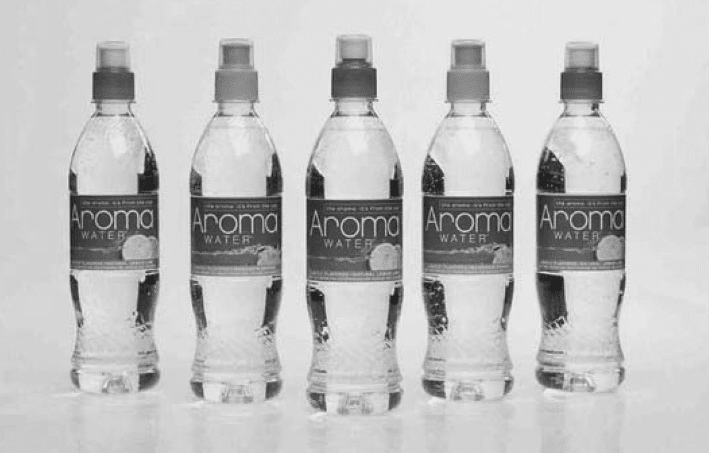
Figure 12.2 Aroma Water, LLC, licenses the technology from ScentSational Technologies to
produce Aroma Water
TM
. The cap emits an aroma (lemon-lime or mandarin orange scent)
that tricks the taste buds into believing the water is flavoured. Used with kind permission of
ScentSational Technologies (www.Scentt.com).
in polyethylene packaging of chocolate-flavoured, milk-based, drinks that is intended to
create an ‘in-store awareness’ of the product (Markarian, 2006). Also, a new aroma- and
flavour-releasing technology for packaging is being tested in consumer trials for bottled
water and nutritional food packaging applications in the US (Anon., 2003b). US company,
ScentSational Technologies, is behind the product, which is also known as ScentSational
(Figure 12.2).
This patented brand-enhancing flavourpackaging incorporates aromatic qualities directly
into closures (Todd, 2003). Pasteurization generally burns off what’s known as top notes,
or the aroma notes in beverages traditionally associated with freshness (Todd, 2003). Also,
while aromas in packaged foods can break down and start to smell different, the ones
ScentSational uses stay fresh because the molecules are, essentially, encased in plastic
(Webb Pressler, 2006). ScentSational puts these top notes back in by taking food grade
flavours that are FDA-approved Generally Recognized As Safe (GRAS) and mixing them
with polymers at the time of injection moulding and adding them to the plasitol liners of
metal closures (Todd, 2003). The plastic gradually gives off aroma ‘volatiles’ that last about
a month and give scent to whatever food or liquid is nearby (Webb Pressler, 2006).
In the polyethylene terephthalate (PET) bottled water trial, the technology is incorporated
into the lid. Other applications could include flavoured and scented bowls for ready to
eat cereals, soup and instant meals, flavoured bottles for nutraceutical applications and
flavoured lids for dairy product packaging (Anon., 2003b). ScentSational’s technology is
OTE/SPH OTE/SPH
JWBK126-12 JWBK126-Kerry March 15, 2008 17:55 Char Count= 0
Smart Packaging Technologies for Beverage Products 215
based on the premise that foods and beverages contained in packaging that smells better
will taste better. The technology works using the science of taste. With the exception of
sweet, sour, bitter, salt and Umami, all other taste is a result of the sense of smell. When
someone drinks a beverage, the liquid creates vapours inside the mouth that travel up the
retro-nasal canal where it eventually hits the olfactory bulb. It is here that these flavour
vapours are interpreted as taste by the brain (Todd, 2003).
NutriSystem, a leading marketer of weight management products, recommends that users
of its products drink at least eight 8-ounce glasses of water daily to help flush out toxins
produced when body chemistry changes as weight is lost (Anon., 2004b). To make the chal-
lenge a little easier, the companysells a water bottle fitted with a closure infused with another
product produced by ScentSational Technologies. This product, CompelAroma
r
technol-
ogy, encapsulates substances within the structure of a plastic package that emit an aroma
during heating, after opening. This gives the water added to the bottle taste, even though no
flavourants are added (Anon, 2004b). A Pennsylvania based beverage firm, Aroma Water,
LLC, licenses the technology from ScentSational Technologies to produce Aroma Water
TM
in either a lemon-lime or mandarin orange scent. Both ‘flavors’ are approved by the Food
and Drug Administration (Figure 12.2). The aroma of a particular flavour can affect the
sense of taste. For NutriSystem, CompelAroma
r
is added to the closure of the water bottle
as it is injection moulded. The closure emits an aroma (currently lemon, peach or berry) that
in effect deceives the taste buds into believing the water is flavoured, enhancing the con-
sumer’s enjoyment of water without adding calories, sweeteners or preservatives (Anon.,
2004b).
A recent innovation to make milk more popular with children has been developed by
Unistraw Intl. Pty Ltd, Australia. This company has been engaged for the last seven years
in perfecting a milk-flavouring solution that is mess-free, convenient, wholesome and tasty
(Mohan, 2006). The patented Unistraw
TM
system enables flavour ‘beads’ to be dissolved
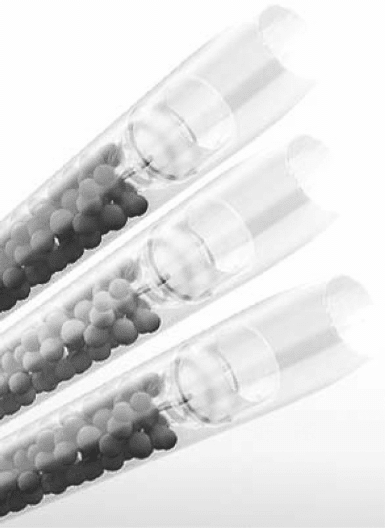
in a beverage as the liquid passes through the straw. The system has three elements, a
straw, filters and flavour beads (Figure 12.3). The system’s first component, the straw, is
made from transparent, recyclable, food-grade polypropylene (PP), mixed with a food-
grade plasticiser/toughener that prevents the straw from cracking or splitting. The straw
measures approximately 0.26 inches in diameter and is 7.08 in long. Filters are heat-welded
into both ends of the straw and use a patented cone shape that allows an optimal flow of
liquid through the straw, while keeping the company’s UniBead flavour beads inside (Figure
12.3). Each straw holds approximately 4 g of UniBeads, which are 0.08–in diameter, round
beads that can be dissolved into a beverage to add flavour, vitamins or other ingredients.
The UniBeads are manufactured at Unstraw’s facility in New South Wales, using processes
and equipment developed by the company (Mohan, 2006). In Australia, the straw is sold
under the brand name ‘Sipahh
TM
’. These milk flavouring straws were designed for the
5–15 year old target market. The original launch flavours of chocolate, banana, caramel
and strawberry have already been joined by toffee apple, cookies and cream, and choc-
mint, Other applications envisioned for the Unistraw
TM
system include the delivery of
vitamins and other nutrients, nutraceuticals and bioactive ingredients or pharmaceuticals
into beverages (Mohan, 2006). Already on sale in a number of countries around the world,
Sipahh
TM
is expected to be on sale in more than 80 countries during 2007 (Anon., 2007c).
Another positive feature is that the product is free of preservatives and artificial aromatic
substances and is made exclusively from natural colourings (Bornholdt, 2006). Sipahh
TM
OTE/SPH OTE/SPH
JWBK126-12 JWBK126-Kerry March 15, 2008 17:55 Char Count= 0
216 Smart Packaging Technologies for Fast Moving Consumer Goods
Figure 12.3 The patented Unistraw
TM
system, which enables flavour ‘beads’ to be dissolved
in a beverage as the liquid passes through the straw. The system has three elements, a straw,
filters and flavour beads. The straw is sold under the brand name ‘Sipahh
TM
’. Used with
permission of Unistraw International Limited.
fits perfectly into the global trend towards healthier and convenient products that deliver
nutritional benefits in a fun and novel way (Anon., 2007c).
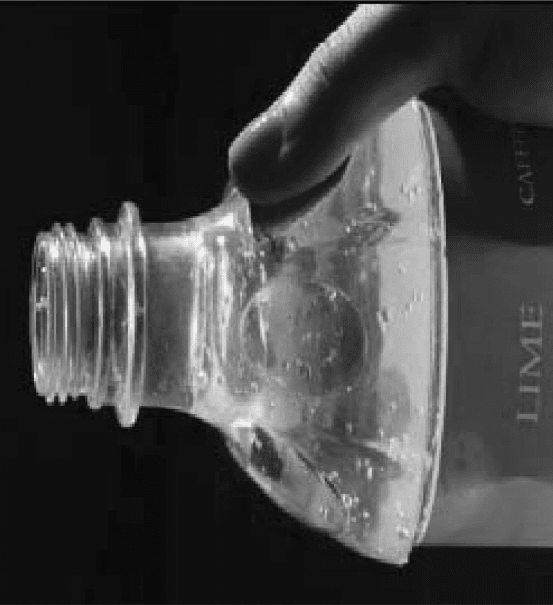
Choice enabled packaging (patent pending) is now being marketed by IPIFINI, Inc., a
Boston based innovative consumer technology company, for flavour and aroma additions
into liquids (Figures 12.4 and 12.5). Ipifini’s technology allows consumers the ability to
personalize their products at the point of use. As well as giving users choice, it can be
used to deliver products that are susceptible to degradation when blended with the other
material or stored in the bulk container. Depression of a button containing the additive
pushes the flavour into the bulk product. Previous innovations have suffered from being
susceptible to tampering on the supermarket shelf, but this range of products has a method
for overcoming this (LeGood and Clarke, 2006). For carbonated drinks, only when the
pressure is released can the flavour be added. Alternatively, the buttons can be screened as
part of the packaging design. Some advantages of these products could be the provision of
multiple flavour choices for each can and the choice given to the consumer, by pressing a
button on the can, as to which flavour they would like to try. This also allows the consumer
the possibility of exploring multiple combinations of these flavours (LeGood and Clarke,
2006).
OTE/SPH OTE/SPH
JWBK126-12 JWBK126-Kerry March 15, 2008 17:55 Char Count= 0
Smart Packaging Technologies for Beverage Products 217
Figure 12.4 Pictured is the Choice enabled packaging (patent pending) which is now being
marketed by IPIFINI, Inc. (www.ipifini.com) for flavour and aroma additions into liquids.
As well as giving users choice, it can be used to deliver products that are susceptible to
degradation when blended with the other material or stored in the bulk container. Patent
pending. Reproduced with permission from IPIFINI (www.ipifini.com).
12.4 Nutrient Release Packaging
As well as adding flavours directly to beverages, products have been developed that add a
segregated nutrient that otherwise cannot be preserved in liquid solutions. In effect they only
become added at the point just before consumption. TheBall packaginggroup hasdeveloped
‘Fresh Can
r
’, which is geared toward the health, wellness, and sports drink markets.
Developed jointly by Ball Packaging Europe (BPE) and Degussa FreshTech Beverages
LLC, FreshCan
r
Wedge technology is a patented delivery system that enables dry sensitive
ingredients, such as vitamins, to be dispensed into a canned beverage only when the can is
opened (Mohan, 2006). With Fresh Can
r
, sensitive substances such as vitamins, probiotic
additives, or trace elements, can be stored in a can in a dry state and remain unmixed with
the beverage until the can is opened (Anon., 2005a). This technology is a patented beverage
can that was specifically developed to contain an air- and water-tight plastic container called