
Kerry J., Butler P. Smart Packaging Technologies for Fast Moving Consumer Goods
Подождите немного. Документ загружается.

OTE/SPH
JWBK126-13 JWBK126-Kerry March 3, 2008 13:26 Char Count= 0
238 Smart Packaging Technologies for Fast Moving Consumer Goods
When released, the valve cleanly cuts off the product flow and then reseals. This unique
self-sealing valve offers quick and easy one-handed access with a smooth, even product
flow to allow controlled dosage, and allows squeezy sauce bottles to be developed in the
now-familiar inverted format.
13.4 Improving Convenience for On-the-go Food and Drink Consumption
Less inclination and time to cook in the home means eating out more often, a trend that is
most advanced in the USA, where meals eaten away from home account for almost half of
the food budget, nearly double the proportion spent in 1970. Unfortunately in conjunction
with the car culture and distances travelled, it has also spawned the hugely undesirable
practice of eating and drinking in cars. In the USA, the car is fast becoming an integral
part of places to eat and drink. According to a University of Michigan research paper,
almost 10 % of all meals in America are now eaten in a car, but figures as high as 20 %
have also been quoted. Eating or drinking in a moving vehicle is not very smart, but it is
a phenomenon that is occurring with growing frequency. What will also likely grow is the
use of the stationary car as a place to eat.
Such growing demand presents packaging opportunities for well designed, easy-to-open
and dispose of packaging appropriate for the stationary vehicle environment. Examples in-
clude smart packaging, such as self-heating and self-cooling beverage containers, discussed
later in this chapter, and innovative packaging designs that permit a one-handed meal that
fits easily into a car cup holder to be consumed without creating a mess. These trends are
all part of an overall picture of increasingly hectic lifestyles that is creating a demand for
new food and beverage products packaged in a way that offers user convenience.
To meet these challenges, many lightweight, single-serve containers that are easily con-
sumed on-the-go are being developed. Soup is a favourite with packaging designed for
on-the-go portability with an easy-open, microwaveable, package that provides a quick
meal; a self-heating smart packaging for soup under the Chef Jay brand is commercial in
the USA. Other examples include grab ‘n go squeezable yogurt in a tube, and fruit to go in
single-serve easy peel clear plastic bowls.
13.5 Adding New Convenience Functionality – Self-Heating and
Self-cooling Packaging
It is a statement of the obvious perhaps that when smart packaging brings cost to the
consumer – as it clearly does in self-heating and self-cooling forms of packaging – it must
also bring useful and valued functionality that the consumer is prepared to pay for. For this
type of smart packaging the functionality is obvious and it is not difficult to appreciate the
usefulness of a self-heating or self-cooling beverage for today’s busy consumer, engaged
in seemingly permanent on-the-go lifestyle activities, leisure pursuits and perpetual travel.
The challenge is to create low-cost heating or cooling technologies that can be conveniently
incorporated into packaging, are reliable, effective and do not have a great environmental
impact. From a technical point-of-view, there is a range of options available to heat or cool
packages, and their key characteristics will now be considered.
OTE/SPH
JWBK126-13 JWBK126-Kerry March 3, 2008 13:26 Char Count= 0
Consumer Benefits and Convenience Aspects 239
13.5.1 Self-Heating Technologies
The only viable form of heat engine for self-heating is an exothermic chemical reaction. A
number of options is available with varying degrees of heat output, but the most reactive
are also the most dangerous, using potentially toxic chemicals and producing undesirable
gaseous by-products. The exothermic chemical reaction of choice for consumer packaging
is lime reacting with water because it generates substantial heat output. Lime is cheap and
readily available, and the by-products of the reaction are environmentally acceptable. An
alternative reaction is the hydrolysis of calcium chloride, which has the advantage of no
reaction by-products but generates a lower heat output.
One of the most successful self-heating beverage containers was launched in the UK
in 2001 in test markets, as a joint venture between Crown Cork and Seal, Thermotics
Development and Nestl´e. The product ‘Hot When You Want’ Nescaf´e canned coffee heated
about 200 ml of hot coffee, with an occasional shake, to around 40
◦
C above ambient in
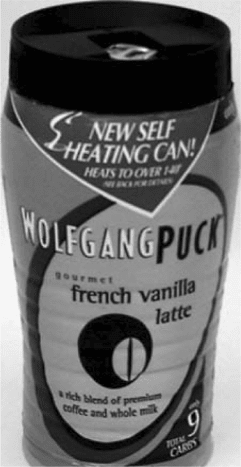
about 3 minutes. More recently, there has been a major launch of self-heating gourmet
lattes in the USA, with a range of 10-ounce Wolfgang Puck gourmet lattes being available
through Kroger grocery stores in 32 states (Figure 13.5). Based on the calcium oxide/water
reaction, the container is portable, fits into a cup holder and heats the coffee to around
145
◦
F (63
◦
C) in 6 minutes and stays hot for 30 minutes. The foam insulated label permits
printing in up to six colours.
In many Mediterranean countries, small quantities of strong espresso coffee drunk at
medium warm, not boiling temperatures is the beverage of choice. Caldo Caldo, an Italian
Figure 13.5 Wolfgang Puck gourmet lattes come in a range of four flavours and rely on the
exothermic reaction between calcium oxide and water for their self-heating.
OTE/SPH
JWBK126-13 JWBK126-Kerry March 3, 2008 13:26 Char Count= 0
240 Smart Packaging Technologies for Fast Moving Consumer Goods
development, uses the exothermic reaction between anhydrous calcium chloride and water.
When the substances are mixed, heat swirls around the aluminium cup and is conducted into
the beverage. The consumer shakes the container for 40 seconds before peeling off the lid
and a temperature rise of around 23
◦
C is achieved. This beverage is a niche market product
sold across Europe in sports venues, motorway rest areas and many other outlets. Hot drink
variants are coffee, cappuccino, chocolate, coffee with grappa, and tea with lemon.
When it comes to food, spin-off technology from the military MRE programmes using
highly reactive exothermic reactions based on magnesium oxidation or the reaction between
potassium permanganate and glycerine has created a niche but growing market for self-
heating food products for emergency services and the outdoors sector.
The increasingly convenience-orientated domestic market requires a means to heat all
types of food and beverages including high viscosity liquids and solid products, i.e. thick
soups, snacks including wraps, fajitas, stuffed pitta bread, ready meals, pasta, rice and
stews. To date, the technologies for self-heating have been confined to lime/water reactions,
where heat output is lower but the reaction is safer. Heating times can be long for solid
food products since heat is transferred from the heating source to the product purely by
conduction.
By ensuring that excess water is present with the lime/water reaction, a new heat transfer
process is being developed by Thermotic Developments – that of direct steam heating. This
highly efficient system transfers heat to the product by injecting steam directly into and
through the food. Steam is a very effective medium for transferring energy with 1 g steam
theoretically possessing 2 kJ of energy.
13.5.2 Self-Cooling Technologies
Notions of self-chilling packaging continue to excite investors and marketers alike, and the
brief sounds easy. ‘Design a self-cooling device for beverages such as colas, beer and fruit
juice of 330 and 500 millilitre capacity that will decrease the temperature from the existing
value to around 4
◦
C in a convenient (say 3 minute) time period. Do this at a moderate on-
cost and without compromising existing environmental considerations, safety, portability
or recycling and untold riches will be yours’.
Technology choices in practice boil down to two – endothermic chemical reactions and
heat pump technology using water vapour as the heat transfer fluid. Forms of gaseous high
pressure expansion can provide effective and rapid cooling but can quickly be ruled out on
environmental and safety grounds.
Endothermic reactions tend to be weak but this has not stopped the commercialisation
in Italy of self-cooling coffee – ‘Freddo Freddo’ which employs the endothermic reaction
between sodium thiosulfate pentahydrate and water. By contrast water evaporation can be
a powerful cooling process, as stepping out of the shower on a cold day demonstrates. The
evaporation of 10 ml of water can theoretically cool 330 ml of water by 18
◦
C.
For single serve containers, the technically viable heat pump technology has not yet
become commercial. High cost and lack of reliability appear to be the key factors, but
the technology is finding commercial success in party keg sizes of beer. The German CS-
Metallbau Company has developed the world’s first self-chilling refillable keg using zeolite
heat pump technology. The technology is licensed to Cool-System Bev. GmbH and is being
OTE/SPH
JWBK126-13 JWBK126-Kerry March 3, 2008 13:26 Char Count= 0
Consumer Benefits and Convenience Aspects 241
used by Germany’s Tucher Br¨au brewery for 20-litre take home kegs of beer in refillable
stainless steel kegs.
13.5.3 Future Outlook
For self-heating packaging, technical developments are expected to continue with the focus
being on lime/water and calcium chloride/water chemical reactions with the provision of
a temperature control feedback system so the devices create a maximum temperature for
the drink regardless of the ambient temperature. Thermochromic temperature labels will be
incorporated to indicate when a product is hot. Costs will come down and product quality
will go up, so the future is promising, particularly for direct steam heating.
It is predicted that individual self-cooling beverages will be reasonably commonplace by
2010. This will require the development of cost-effective miniaturised ‘drop-in’ modules
using heat pump technology where the heat produced inside the beverage container can be
absorbed by phase change materials.
The global market for beverage cans is estimated to be approximately 400 billion pieces
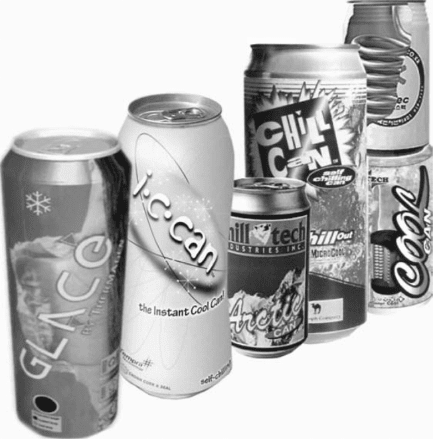
per year and is projected to grow by about 10 % every year. The lure of a cost-effective self-
cooling beverage can has resulted in many unsuccessful ventures so far (Figure 13.6), but
the vision remains strong, and the market penetration of the self-cooling can, as forecast by
prominent market research organizations and beverage companies, will probably increase
to about 5 % of total can consumption while the unit price of the self-cooling can is expected
to fall to around 20–25 cents. If this happens, world market share of the self-cooling can
Figure 13.6 Field of opportunities or graveyard of dreams for self-cooling beverage
containers?
OTE/SPH
JWBK126-13 JWBK126-Kerry March 3, 2008 13:26 Char Count= 0
242 Smart Packaging Technologies for Fast Moving Consumer Goods
will be 20 billion cans per year and amount to about US$3.5 billion per year. Whether this
is a field of opportunity or a graveyard of dreams for investors remains to be seen.
13.6 Improving Openability in Packaging
‘Wrap rage’ is the new term that has been coined to describe the build-up of frustration
that can occur when packaging is difficult to open, but frustration is only one problem – it
can lead to consumers suffering injury as they resort to the use of knives and other sharp
implements to open difficult packaging. Hard-to-open packaging discriminates against the
weak and is a real barrier to consumer choice and negatively affects repeat purchasing.
The situation is becoming dire. In the USA, Consumer Reports looks annually at the
most difficult to open packages and awards the dubious honour of ‘Oyster Awards’ for the
worse culprits, generally won each year by the ubiquitous welded hard-plastic clamshell
packaging for consumer goods. In the UK, the consumer magazine Health Which? contacted
1000 readers to ask if they experienced problems with food and drink packaging. Of the
235 respondents, the noteworthy finding was that 45 % reported avoiding particular types
of packaging because they find them difficult or impossible to open.
Designing easier-to-open packaging is generally not rocket science, just good design,
which adds little if anything to the package costs. The underlying philosophy of ‘design-
for-all’ is the introduction of changes – often very small changes – into the designs of
consumer products so that the greatest number of members of society can use them. These
small design changes made with consumer openability in mind, fit into the category of
smarter packaging.
An example is the packaging industry’s recent introduction of a new range of easy-
to-drink- from closures for beverage and water bottles, carried by athletes and cyclists.
With one hand, a sportsperson can open these tops by pulling them with his/her teeth,
squeeze a shot of drink into their mouths, and close the bottle again by pushing the tops
against the chin. There has been a significant adoption of this type of drink container by the
elderly and disabled because of this mode of operation. This example illustrates the wider
opportunities that are available for introducing minor design changes to provide significant
gains for consumers, in the application of the ‘design-for-all principle’.
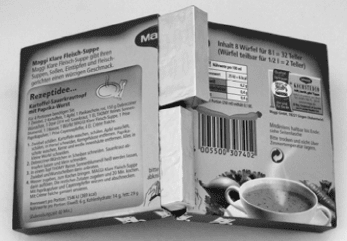
Simple designs tend to be the best, and packaging for Nestl´e Maggi range of bouillon
cubes, available in Germany is a good example of great design at zero on-cost. The flat
cardboard pack is perforated across one of the flat sides and down the corresponding two
edges. A sharp tap along the back of this line hinges open the pack, allowing individual
cubes to be easily removed, and the pack to be reclosed (Figure 13.7).
The message is that small design changes can make large differencesto openability. Rigid
containers are sometimes difficult to grip and nearly all package closures are round so they
are difficult to grip without resorting to the variety of opening aids presently available on
the market. Some packages have ‘non-round’ tops on products such as paper-whitener so
that able-bodied people can get a better grip when the top sticks to its base. The German
company Gerresheimer has developed a cap that is designed to improve handling for elderly
or infirm users. Viewed from above, the cap looks like a plus sign with arms reaching out
from the centre of the cap. This design greatly reduces the force required to open the
OTE/SPH
JWBK126-13 JWBK126-Kerry March 3, 2008 13:26 Char Count= 0
Consumer Benefits and Convenience Aspects 243
Figure 13.7 A package can be easy to open through ‘smart’ design. Tapping this soup bouillon
pack on a hard surface breaks the pack in half so it can easily be hinged open to remove a
single portion.
container. Bottles can also be stood cap side down, allowing the user more effectively to
empty viscous materials.
Squeezeopen
TM
is an innovative design solution to many of the problems of openability.
The closure consists of a lid that is a press snap fit onto a base that serves as the container
and opening is performed simply by gently squeezing the lid’s sides and releasing the
pressure. A multipurpose inner symmetrical ramp system guides and joins the components
together (creating an effective seal) when the lid is pressed onto the base and helps to force
the components apart when the lid sides are compressed.
Finally the metal can has made great strides in openability with ring-pull, easy-open, ends
appearing on more and more products. Metal closures on vacuum-packaged products in
glass jars remain an openability obstacle to many consumers but technology is available to
solve even this problem, as developed by Metalgrafica Rojek SA, a family-owned business
based in Sao Paulo, Brazil. The innovative Rojek closure fits both cans and glass jars and
has a peelable elastomer seal over a small aperture in the top of the closure. Pulling the seal
releases the vacuum and the container can then easily be opened, without the requirement
of great manual strength or any opening devices like can openers or knives.
In the future, developments in low peel-force adhesives and structures, even smart pack-
ages that are self-opening, butstill tamper-proof,are likely. Asan example,the incorporation
of smart adhesives in bonded, rather than mechanically seamed ends, might allow the de-
velopment of ends that open via debonding of the adhesive on application of current from
a small battery pack. Such adhesives have been developed, e.g. the electrically disbonding
epoxy system, ElectRelease™. Alternatively, we might envisage a shape memory material
acting as a metal rubber band to retain an end or closure that vents or opens automatically
with change in temperature, e.g. on microwave heating. Other convenience-driven smart
packaging concepts that improve ease of use are being considered, such as the development
of ‘dial-a-dose’ smart caps and closures that allow the safe dispensing of exact controlled
quantities of product, e.g. pharmaceuticals, cleaners, and other potentially hazardous ma-
terials. As always however, there is a fine line between ‘easy to open’ and ‘easy to tamper
with’.
OTE/SPH
JWBK126-13 JWBK126-Kerry March 3, 2008 13:26 Char Count= 0
244 Smart Packaging Technologies for Fast Moving Consumer Goods
13.7 Making Packaging Reusable for Other Functions
Smart packaging could just be simply a great package design that works well for its original
purpose but provides additional convenience and usefulness once it is empty. Not only
would this give consumers a new benefit, but would also support sustainability via reuse
and reduce the amount of packaging going to waste.
Packaging like this that has outlived its intended primary function lives on in almost every
household, whether as empty glass jam jars to hold dirty paintbrushes or empty yoghurt
pots in which to plant seeds. Elements of structural design can be used to design packaging
to be creatively reused by consumers, or that could be part of the product – say an electronic
dispenser that can be refilled. For example, a freezer pack could be made collapsible after
emptying to become a freezer thermometer; the secondary packaging from a radio could
be turned into an auxiliary speaker – both environmentally sound approaches.
The opportunities are many, the examples today are few. Clearly, for everyday packaging
there is a limit to reuse, since how many yoghurt pots to use as seed germinators does
one household need? Nevertheless for items purchased on special occasions, there is the
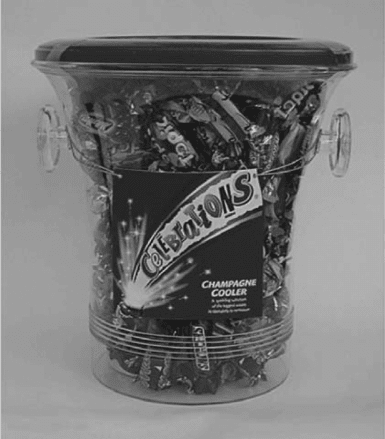
possibility of the packaging fulfilling dual purposes. Take for example a large container
of chocolates for Christmas, normally packed in a tinplate container or plastic tub that is
frequently discarded after use. One manufacturer has combining the initial container for
chocolates with a reusable champagne or wine cooler, see Figure 13.8, a play on the brand
name ‘Celebrations’.
Figure 13.8 Smart packaging design can give new life to the package once the contents have
been used. This plastic tub of chocolates when empty can be used as a wine cooler.
OTE/SPH
JWBK126-13 JWBK126-Kerry March 3, 2008 13:26 Char Count= 0
Consumer Benefits and Convenience Aspects 245
In the future it is expected that tear-offs will become greatly valued thanks to smart
packaging technology. Increasingly they will consist of electronic devices that cost 10
dollars or more to buy separately not so long ago, such as radios, wristwatches, calculators
and many other things. In 2002, it was reported that a patent had been granted for a
disposable paper cellphone and that backing from General Electric had been agreed to
commercialise them. Initially they would have conventional components but be cheap
enough to be disposable. For example, the cellphone would come with 60 minutes talk time
for someone travelling perhaps to a foreign country or needing a mobile phone for some
emergency. Perhaps that could be a tear-off on the packaging of travel products.
13.8 Summary
Of all the drivers for the development of smart consumer packaging, user convenience is
king. Within user convenience, packaging must play to one or more of three key central
themes – save me time, save me money, or support me by making things easier for me
in my life. Consumers are tired of packs that make demands on their time and attention,
they want first and foremost improvements that save time, are easy to use and reduce stress
on an already busy life. Increasingly hectic lifestyles are creating new consumer demands
that rely heavily on packaging that is lightweight, portable, easy-to-open without the aid
of tools, but also resealable. Even on it’s final journey to the rubbish or recycling box, if
the packaging is not reusable, the package ideally should crush easily, or be easily cleaned
and safe to handle – if not, this provides one last negative memory for the consumer.
Societal trends will impact on packaging as in other consumer products in many different
ways. The overall picture is one of increasingly hectic lifestyles that are creating a demand
for new food and beverage products and innovative packaging, particularly in terms of
user convenience. On-the-go as a way of life seems to show no signs of abating and in all
likelihood, consumers will become even more mobile and time pressured. In this brave new
world, untapped opportunities exist for smart packaging to offer new and improved levels
of consumer benefits and convenience.
Reference
W. Chan Lim and Ren´ee Mauborgne (2000) Harvard Business Review, September/October,
p. 130.

OTE/SPH OTE/SPH
JWBK126-14 JWBK126-Kerry March 15, 2008 18:46 Char Count= 0
14
Smart Packaging Technologies
used with Aerosol and Household
Cleaning Sprays
Lindsey Gaunt
14.1 Introduction
The advantagesof electrostatic spraying, whether the spray is liquid droplets or dry powders,
are well known, well documented and exploited in such applications as crop spraying, spray
painting and ink-jet printers. Improvements in efficiency and performance arise through
higher transfer efficiency, a more even distribution on the target, and the coating of surfaces
not in the direct line of fire as a result of a phenomenon known as wrap-around. There are
inevitably also disadvantages, although almost exclusively associated with the increased
cost, complexity and bulk of the equipment required. To deliver the required level of charge
in industrial applications a power supply is used, charging the spray by either induction
or corona. This limiting factor can be overcome by exploiting natural charge separation
phenomena to deliver a spray with sufficient electrostatic charge to achieve the benefits
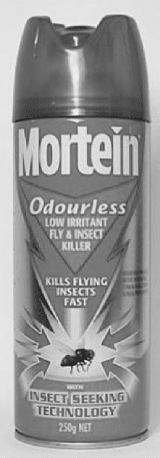
of electrostatic spraying. This has been implemented in a commercial insecticide aerosol
spray, shown in Figure 14.1. The electrostatic charge associated with the aerosol droplets
results in substantially increased deposition of the droplets onto insects in flight and a
subsequent improvement in product performance.
In this chapter, some fundamental processes of electrostatics are introduced to give
a background to the advantages of electrostatic spraying and to explain natural charge
separation phenomena. The natural charge separation phenomena of frictional charging
and flow electrification are exploited to achieve passive charging of sprayable products,
Smart Packaging Technologies for Fast Moving Consumer Goods Edited by Joseph Kerry and Paul Butler
© 2008 John Wiley & Sons, Ltd. ISBN: 978-0-470-02802-5
OTE/SPH OTE/SPH
JWBK126-14 JWBK126-Kerry March 15, 2008 18:46 Char Count= 0
248 Smart Packaging Technologies for Fast Moving Consumer Goods
Figure 14.1 Commercial insecticide aerosol spray incorporating passive electrostatic tech-
nology. Used with permission from Packaging Materials & Technologies Ltd.
such as aerosols and household cleaning sprays. Passive charging does not require a power
supply or battery to impart high levels of charge to sprays, and thus allows application in
a wide range of products, especially those for the consumer market. Some examples are
also given of the benefits achieved by implementing the technological concepts described
in various areas.
14.2 Electrostatic Spraying
The advantages of electrostatic spraying arise from the attractive forces between the charged
droplet or particle and the target surface. Coulomb’s law states that the magnitude of force
between two electrical charges depends on the magnitudes of the charges and their spatial
separation, as shown in Figure 14.2. The magnitude of the force, F, between point charge
q and point charge q
located at distance r is given by:
F = qq
/4πεε
0
r
2
In electrostatic spraying, the best case scenario exists where the target surface is oppo-
sitely charged to that on the spray particles, as in Figure 14.3(a). The forces of coulombic
attraction increase deposition efficiency. In the next best scenario the target surface is con-
ducting and earthed. In this instance, as the charged particle nears the surface, a charge
equal in magnitude and opposite in sign is induced in the target, and is indeed an image of
the approaching charge. For this reason the term ‘image charge force’ is coined to describe
this scenario, which is illustrated in Figure 14.3(c). Where the target surface is conducting