
Kojeve Alexandre. Introduction to the Reading of Hegel: Lectures on the Phenomenology of Spirit
Подождите немного. Документ загружается.

Philasophg
and W isilorn
remains in
idenrtty with bbnself
because
he passes through
the
totality
of others,
and he is
closed
up
in
himself
because
he
closes
up the
totality of others in
himself. Which
(according
to
the
Pbe-
noruenology)
means,
quite
simply, that
the
only
man who can
be
Wise
is a
Citizen
of the uniaersal
aLnJ homogeneous State-that s
to
say, the
Srate of the Tun
Aller und
leder,
in which each man
exists only
through
and
for
the
whole,
and the
whole exists
through and for
each man.
The absolute
Knowledge
of
the
Wise Man who realizes
perfect
self-consciousnes
is an
enswer to
the
question,
"What
am Il"
The
Wise
Man's real
existence
must therefore
be
"circular"
(that
is
to
say, for
Hegel,
he must be
a
Citizen of the
universal
and homo-
geneous State) in
order
that
the knowledge
rhar
reveals
this exist-
ence
may
itself
be
circular-i.e.,
an absolute
truth,
Therefore: only
the
Citizen of
the
perfect Stare can
realize absolute Knowledge.
Inversely,
since
Hegel
supposes
that
every
man
is
a Philosopher-
that
is,
made
so
as to become
conscious
of
what
he is
(at
least,
it
is
only
in
these men
that Hegel
is interested,
and only
of
them that
he
qpeaks)*a
Citizen
of the
perfect State always eventually under-
stands himself
in
end by
a circular-i.e.,
absolute-knowledge.
This conception
entails a.
very
imporrant
consequence: Wisdom
can be
realized,
according
to Hegel,
only at the end
of History.o
This too
is universally
undersrood.
It
was
allr'avs known
that
for
Hegel,
not only
dois the coming
of
Wisdom complete
His-
tory,? but
also
thar this coming
is
possible
only
at the
end
of
History.
This is
known,
but
why this
is true is not
always
very
well
understood.
And
one
cennot underscand
this as long
as
one
does
not know
that
the
Wise
Man must necessarilv
be
Citizen of
the
unhtersal (i.e.,
nonexpandible)
tnd homogenioas
(i.e.,
non-
transformable)
State. And
one
cannor know
this
until one
has
understood
rhat
this State is
nothing other
than the real basis
(the
"substructure") of the
circularity
of
the absolute
System: the
e
For
according
to the
endyses
of
the
Pbenonmology,
drc
Stete
in
question
necessarily
marks
the
end of the
history
of humanity
(that
is, of
humrnity
that
is
*lf-conscious
or
aspires
to this
consciousness),
r
Which is
trivial,
fot
if
eoerytbing
is
known, there
is actually
no
longer
any
means
of
mahing
progress
or of
changing
(that
is,
for
the
Pbilosopber;
but only
for
him
does this
problem
exist).
95
INTRODUCTION
TO
TIIE NEADTNC
OF
HECEL
Citizen of
this
Srare,
as active
Citizen,
realizcs
the
circularity
that
he
reaeals,
as
contemplative
Wise
Man, through
his
System.s
Therefore,
for
Hegel
there
is
a double criterion
for
ihe
realiza-
tion
of.Wisdom:
on
the one
hand,
the
universality
and homogeneity
of
the State
in
which
the
Wise
Man
lives;
and
on the
othei hand,
the
circularity
of his
Knowledge.
On
the
one hand,
IN rhe
phe-
nomenology,
Hegel has
described
the perfect
State: the reader
need
only
observe
the
hisrorical
reality
in order
ro
see rhat this
State
is
real,
or
at least
to be
convinced
of its
imminent realization.
On
the
other
hand,
BY the
Pbenomenology,
Hegel
has shown
that his
knowledge
is
circular.
And
that
is
why he
believed he could
assert
that
he actually
realized
in
his
person
the ideal
of all
Philosophy-
that is,
the ideal
of
Wisdom.
What is our
attitude
with
respect
to all thisl
I said
that
we
are
faced
with
three, and
only
three,
possibilities.
I believe
we can
eliminate
the first without
discussioi.
First, be-
cause
strictly
speaking,
it cannot
be discussed;
end
next, because
t!1
very
fact
of our
study
of
the Phmommolagy
proves
thar
silent
serisfzction
(to
which
this
first
possibiliry
finally reduces)
a
Staning
from
this
conception, we
understand
Hegel's attitude toward
plato.
According
to Hegel,
Plato was
right
in denying
the
possibility
of the
Wise
Maa.
For
Plato's
"Ided"
Sate
(which
according to Hegel, moreover,
merely
reflects
the
real
State of
his time)
is
not
the
universal
and homogeneous
State;
the
Citizen
of this State,
therefore,
is not
"circular," and hencc the
lrrowl-
edge
of this
Citizen, which
reveals
his
Citizen's
realiry, is not
circular
either.
Accordingly,
the attempt
to assetr
the
possibility
of the
Wise
Man
within
this
imperfect
State
made
it
necessary
to transform
the
very
ided
of
Wisdom
into
the
caricacure of
the Scoic
and
Skeptic
"Wise
Man." Hegel
has
shovrn in
the
Pbmonenology
that
these would-be
"Wise
Men" ere
nft at dl
conscious
of
themselves,
And
as
soon as
such
a
becomes self-conscious,
he
immedi-
ately
sees thet he
does not realize
perfection.
He
even
sees
thet he
cannot
realize it.
And thus
it
is
thag becoming
a
Christian, he thinks that
perfection
has
been
realized ourside
of
the
World
and
Man, by
God.
Thus,
the
would-be
"Wise Man," having become a
Christian,
rediscovers
the Platonic, or
better.
theological,
conception. Btthe te-discooet
Plttoi therefore he is
more conscious
than
Plato, That
is
to say,
he knows ashy
he cannot be
a Wise
Men;
he knows
that
he cannot
be
a Wise
Man
beceuse
the
Stare in which
he exiss is not
perfect.
He
cen
then have
the
idea
of a
perfect
State and ty to realizc
it.
And at the
moment
he
does
this,
he will become
(by
ceasing to
be
a Platonist
and
a Chris-
tian) a Hegelian;
more
execdy-he
will
be
Heget
the rcal
Wilr- Mar\
the nrc-
cessfzl
Aristotelian, Stoic,
end Skeptic. If
you
please,
this is Plato
agtin:
Hegelian
philosophy
is t
theo-logy;
however, its
God
is
the Wisc
Man.
96
Philasoplw
ardWrsilon
does not
tempt
us overmuch.
Therefore
only one
serious dilemma
remains
for
us, the
dilemma:
Plato or
Hegel-that iso
in the
final
analysis,
the dilemmat
Theo-logy
or
Philo+ophy.
Now, we
are faced
with
a fact.
A man who is
clearly
not mad.
named
Hegel,
claims to
have
realized
Wisdom.
Thereflre,
before
deciding
for or
against
Philosophy
or
Theology-that is,
for
or
against
the
assertion of
the
impossibility
of
realizing
Wisdom-
we
must
see
whether
or not
Hegel was
right
in
asserting
that he
is
a Wise
Man, whether
through
his very biing
he has
not already
sealed
once
for
all the
question
that interests us.
And in
order
to
resolve
this
question we must
see:
(
r
)
if the
crurent
-state
of
things
acually
corresponds
to what
for Hegel
is
the
perfecr State
and
the
end
of
History;
and
(z)
if
Hegel's
Knowledge
is truly
circular.
The answer
to the
first
question
seems very
easy
at
fint sight-
the
perfect
Statel Possible,
of course,
but
wi are-indeed
far?om
it.
However,
ar the
time
of
writing
the
Phenornenology
in
rgo6,
Hegel,
too, knew
full
well
that
the State
was
nor
yet
realized
in
deed in
all
its
perfection.
He
only
asserted
that the germ
of this
State
was
present in
the
World
and
that the
necesary
and
suffi-
cient
conditions
for
its
growth
were
in existence.
Now,
can we
with
cenainry
deny
the
presence of
such a
germ and
such
condi-
tions
in
our
Worldl
And
even
if
we
wantedlo
deny
it,
we
would
not
succeed
in settling
once
for
all
the
question of
Hegelian
Wis-
dom.
For
we
certainly
cannot
assert,
bn
the
basis
6f
"rt"-pt,
**dtqqae,
that
the
State in
question
is impossible
in
princi[Ie.
Now
i{
this
State is
possible,
Wisdom
is also
possible.
And then
no
need
to
abandon
Philosophy
and take
flight
into
some
Religion
or
other;
hence
no need
to
subordinate
thi
consciousness
th-at
I
have
of
myself
to
a coming
to consciousnes
of what
I am
not: of
God,
or
of
some
inhuman
perfection
(esthetic
or other),
or
of
race,
people,
or
netion.
Whaq
then,
does
the
fact
that
the
perfect
State
foreseen
by
Y:gd
is.not
yet realized
mean
for
us?
In
these
conditions
Hegelt
philosophy,
especially
the
anthropology
of
the
pbenomenol1gy,
c€ases
to be
a trutb,
since it
does
not
reveal
a
reality.
But it
is
not
thereby
necessarily
an
error.
It would
be
an error
onv
ir it
could
be
proved
that
rhe universal
and homogeneous
srate
thar he
has
in
view
is
impossible.
But
this
cannot
6e
proved. Now,
what is
97
INTNODUCTION
TO TEE NEADTNC
OF '{ECEL
neither
an error
nor a
truth is an
idea, or,
if
you
prefer,
an
ideal.
This idea
can
be
transformed into
mtth only
by negating
action,
which
will
destroy
the World
that
does not
correspond
tothe idea
and
will
create
by this very
destruction
the
World
in
conformity
with
the
ideal.
In other
words, one
can accept
the
anthropology
of
the
Pbmomenology,
even with
the
knowledge
that
the
perfJ&
man
(the
Wise
i\{an) with
whom
it
is finally
concerned is
not yet
realized,
only
on
the
condition
that one wents
rc act
with
a
view
to
the
realization
of
the
Hegelian
State that is indispensable
to the
existence
of this
man-to
act,
or at least rc accept
and
"justify"
such an
ection,
if it
is
done by someone,
somewhere.
However,
this
by
no means
exemprc us
from studying
the
second
Hegelian
criterion,
thet
of circularity.
Still
less,
given
that it is infnitely
more important
then
the
first.
In
the first
case+nd
of
History
perfect
State-what is involved
is
a
verification
of
fact,
that
is
to say, of something
essentially
uncertain.In
the
second-circulariry-what
is
involved
is a logical,
rational
analysis, in
which
no divergence of
opinion is
possible.
Accordingly,
if
we see
thar Hegel's
system actually
is cirCular, we
m-ust
conclude
in spite
of appearances (and
perhaps even in spite
of
common
sense) that
History
is completed
and consequently
that
the
State in
which
this
system
could be
realized
is the
perfeit
State.
This, by
rhe
way,
is
what
Hegel himself
did, as we know.
After
the
fall
of Napoleon,
he
declared that the
Prussian State
(which,
in other
respects,
he detests) was
the
definitive
or
perfect
State.
And he
could
not do otherwise,
given that
he was convinced
of
the circularity
of his
system.
Therefore,
the whole
question
for us reduces
to
this:
if
the
Phenomenology
is actually
circular, we must
accepr it ouuight,
along with
everything
that
follows
from it; if
it is
not,
we must
consider
it as
a hypothetical-deductive
whole, and
verify all the
hypotheses
end
deductions
one by one.o
One must
begin,
therefore,
by studying
the
Pbenomenology
e
Moreover,
it
is not
zuficient
drat the
Phmomettology be
circulrr:
the
Logic
(otthe
EncXclofaedia)
mux
be so, too;
end,
what
is
much
more
irr,portant,
the
System in
is
enthety,
thet is
to say,
the entirety of. the
phenomenology
and the
Encyclopaedk,
must
also be
circular,
Now, it
is
precisely
there
that the
non-
circularity
of Hegcl's
system
is
perfecdy
obvious.
But
here
I
can say
so
only in
passing
and
without
proof.
98
?hilosophg
andWisdonr
from
the
point of
view
of its
circularity.
However, before
doing
this, one
must:
(
r
)
know what
this requirement of circularity
means; and
(z)
understand
why
the
rruly
rrue, absolute truth can
onlv
be
circular.
99
A
NOTE
ON
ETERNITY,
TIME,
AND
THE
CONCEPT
Complete
Tert
of the
Sirth
tfuough Eighth
Leciures
of
the Acailemic
Year r39&rg9
SIXTH
LECTURE
To speak of
the
appearance
of
Science in
the
concrere reality of
the historical
World
makes it
necessary
to speak
of a before-and
an
after-that
is, of
a
becoming,
and
consequently
of Tirne.
In
asking
the
question
of the
relation
berween
Stienci and objective
Reality,
therefore,
one must
ask the
quesrion
of the
relation berween
Science and'fime.
And
this
is what
Hegel does in
the Second
Stage
of
the
Second
Section of
the
Second Part of
Chapter
VIil.
The
problem that
we are
tackling
here is far
from new.
One
can
even
sey that
it has
been
asked
as long as
philosophy has existed.
lndeed,
all
philosophies
have
sought,
and
generally claim to have
found,
the uuth,
or
at least
some
ffuths. Now,
truth in the strict
sense
of
the term
is
supposed
to
be a
thing
that
cennot be
either
modified
or
denied:
it is,
as
we sey,
"universally and necessarily"
vafid-i.e.,
it
is not subiect
to changes; it
is,
as
we also
sry,
eternal
or nontemporal.
On the other
hand,
there is
no doubt thar
ir
is
f
ound
at a ceftain
moment
of time
and that it exists
in time, because
it exists
through
and
for Man
who
lives in the
World.
Therefore,
to
pose
the
oroblem
of
truth, even
partial
truth, is neassarily
to
pose
the
problem of
time,
or
more
panicularly, the
problem
of
the relation
berween
time and
the eternal or berween
time and
the
intemporal.
And this
is the
problem thar
Hegel
poses
and
resolves
in
the "Second
Srage" in
question.
To
use Hegel's
terrns,
we
cen
call the coherent
whole of
con-
too
A
Note on
Eterr&rl, Thro, orrd
tlc
Concept
cepnul
understanding
that
lays claim
to the
truth-Begriff,
Con-
cepl
And,
indeed,
the truth is
always
a
"concepr"
in
the broad
s91se, that is
to
say,
a coherenr
whole
of,
words
having
a
meaning.
Then
we cen
pose
the
problem by asking
what the lehtions aie
between
the
Concept
and Time.
Hegel answers
this
question in the
very first
words
of
the
Second
Stage;
and one
mu$
say
that he answers
it
in
quite an unexpected
manner.
This is what
he
says
(page
55S,
lines rerr):
"DiieZeit
ist
der
Begriff
selbst,
der da,'st"
("Tirne
's
the Concepr itself,
which is
there
[in
empirical
existence]").
And it must
be under-
lined that
in
writing
this suange
sentence,
Hcgel
weighed
his
words
carefully.
For he
abeedy
said
exactly the
samt thingin
the Preface
to
the Phenomenolocy,
where we
read
(page
3e,
lines
33-37):
"Wa
die
Zeit betriftr
. ,
. so ist
sie der
daseiende Begrifi
selbst"
("In
what
concerns
Time,lit
must
be
said
that] it is
the Concept
itself
which
exists
empirically").
It
is
very
clen:
"Die
Zeit
ist der
daseiende
Begriff selbst.,,
And
at the seme
time,
it is
quite incomprehensible.
In order
to under-
stand better
what
Hegel means,
ir is
useful
briefly to review
the
solutions
to
the
problem
that
Plato
and
Aristotie,
Spinoza and
Kant
proposcd before
him.
This
is what
I
am
going
to
do
in
the
sixth
through
eighth
lecttues.
_
The
problem
is
to
establish
a
positive or
negative relation
beween
the.Colceptand
Time.
Now,
it is
obvious
that there is only
e very
limited
number
of
possibilities
here,
as the following
iormulas
show:
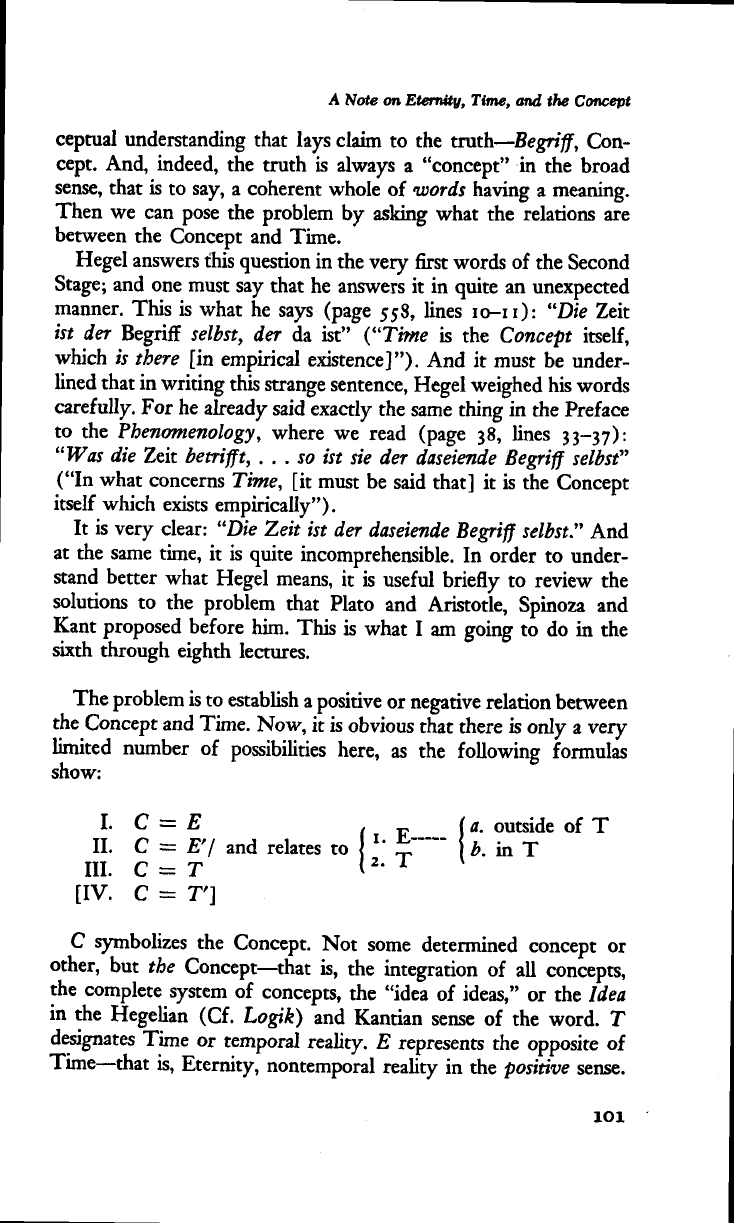
I. C=E
, F
(a.outsideofT
II. C
:
E,l
and relates
.
I i' +--- [a.
i"
r
m. C=T
(o'^
lff.
C
=
T']
C
qymbolizes_the
Concept.
Not
some
determined
concepr or
other,
but
rbe
Concept-that
is,
the
integration
of
all
concepts,
the
complete
sysrem
of
concepm,
the
',ide-a
of ideas,"
or the
ider
in
the
Hegelian
(Cf,
Logik)
and
Kandan
sense
of the word.
T
designates
Time
or
temporal
realiry.
E
represents
the
opposite
of
Time-that
is,
Eternity,
nontemporal
realiry
in the
pasirioe
sense.
tol
INTRODUCTION
TO
THE
READTNG
OF
IIEGEL
f,'5ignifies
"eternal,"
as opposed
to
,,Eterniry."
(Just
x
this
table
iq.
without.
being
Being,
thi
Concept
can
bi conceived
es
eternal
witho'r
being
Erernity:
it
"panicipites"
in Eternity,
it
is an
erernal
function
of
Eternity,
and
so
on;
bot Eternity
itsltr
is
somethinE
other
than
the
Concept.)
Finally,
7,
is
the
.,temporel,,'
distinl
guished
from
Time
itielf
as the
"erernel" is
distinguished
from
Eternity.
The
formulas,
then,
can
be
read
as
follows.
First
possibility:
the
Concept
rs
Eterniqy.
Hence
it
is related
to
nothing:
it
is oL_
viously
nor related
to
Time;
and it
is not
related
to Eter:nity
either,
:i1:.
tI
is
Eternity.
This
is
parmenides'
position.
(But
since
the
fully
developed
and
ruly
underscood
pannenidean
point of
view
is known
to us
only
through
Spinoza,
it is
of him
thai
I shall
speak
in. discusing
this.posibiliryl.
rnird
possibirity:
the
conceit
is
Time,
and
hence
ii
reldted'neither
to
-Eternity-nor
to
Time;
this
is
Hegel's-p-osition.
Possibilities
I
and
III,
beingidentifications,
can-
not
be
subdivided.
on the
other
hand,
possiiility
I/ is
subdivided
into
two
possibilities,
the
first of
which
has in
rurn
rwo variants;
thus
three
posible
ry-pas
of
ghllosophy
are obtained,
and
all
philoso-
phres-_other
than
those
of
Parmenides-Spinoza
and
Hegel
can
actually
be
divided
up
emong
these
rhree
types.t
There
is
still
possi&r
lity
IVl.
the
concept is
te*poral.
But
this is
no longer
e,,philosophical
possibility.
Foi
this
(skeptical)
type
of
tfough.t
makes
all
philosophy
impoisible
by
denying
the'very
idea
ot
truth:
berng
temporll,
the concepr
essentially
changes;
ihat is
to- sal
thar
there
rs
no definitiae
knowledge,
hente
no
iue
knowl_
gdge-
i1
the
proper
sense
of
the
word.
pisibitity
I1l,
on
the
other
hand,
is.compatible
with
the idea
of truth;
for
if everything
that
is rz
Time
(i.e.,
everything
that
rs temporal)
always
,lfrogrr,
Time
itself
does
not
change.
-
pnce again,
then,
the
second
possibility
divides
into
two.
Since
it is eternal,
and
not
Eternity
,
the
concept is rerated
to somerhing
r
At
least
with
regard
to
the
problem
that interests
us.
This
problem,
more-
over'
expresses
the
essential
content
of every
philosophy,
so thai
it
can be
said
that
in
general
there are
only
five ineducibre-i.e,
essentialry
difierent-philo-
soghicel
rypes:
an impossible
rype
(posibitiry
I:
parmenides-spinoza);
three
relatively possible,
but
insu{ficient
rypes
(possibility
II:
plato,
Aristotle,
Kanr);
and a true
rype,
which,
by the
way,
needs
to
be
det:eloped,
rc
be
realizedi
f.oi
I
personally
believe
that
this has
not
yet
been done
(Hegel
and
Hcidegger
repre-
sent this
third
possibiliry).
toz
A Note
on Etanttg, Tinc, atd tlw Corcept
otber
than itself.
Whence two variants:
(r)
the encient
or
pegen
variant,
according
to which the eterndl
Concept
is
related
to
Eternity;
a
variant
clearly formulated
by
Plato
and Aristotle
(who
agree on
this
point); and
(z)
the
modern or
Judaeo-Christian
varient,
clearly formulated
by
Kant: the
eternal
Concept is related
to Time.
The first
variant in turn implies
two
posible
rypes:
(
r
)
the eternal
Concept
releted
to Eternity which
is
outside
of
Time
(Plato);
and
(z)
the
eternal
Concept relared toEterrrtry
in
Time
(Aristotle).2
The universe of
ideas,
the idea of ideas-this
in
Plato
is what in
Hegel
is called Begriff,
Concept
(or
in the Logik,
Idea). The
World of
phenomena is what
Hegel
calls Dasein empirical
Ex-
istence.
To simplify,
then,
ler us speak of
"Concept"
and of
"Existence." Existence is
essentially
cbange-thar is,
a temporal
entity.
On
the other
hand,
there is change
only in
Existence-
that is,
Existence
is not only
temporal,
but
Time itself.
The
Con-
cept,
on
the other
hand, does
not-essentially-chmge.
There-
fore it is
essentially
something
other
thtn
temporal, and other
than
Time.
Hence
it would
be tempting
to
say with
Parmenides
(and
Spinoza)
thar
it is
Eternity.
But
Plato
does nor sey
so; for
he
believes
he
has discovered
that
the
Concept
(i.e.,
the
Logos, the
usord<r
discourse
endowed
wirh
a
meaning)
s
reloted
ro
some-
thing
that is
other
than
the
Concept
(or
the
word) itself.
(Here
is
the
point
where
Plato, and
Platonizing
philosophers from Plato
to
Kant, must
be
attacked, if
one
wants
to avoid
the disagreeable
anthropological
consequences
implied
by
their
philosophies).
Therefore
the
Concept is
not Eterniry.
It
is
merely
eiernal.
botrse-
quently
one
must
pose
the
problem of
the reldtions
berween
the
eternal
Concept on
the
one hand,
and
Time and
Eternity on the
other.
Let
us
first state
a
fact of
which
Plato is not ignorant:
real,
empirically
existing
man
ufters
discourses
that have
a
meaning.
Therefore:
concepts,
and
consequently
the
integral
Concepq
su6-
z
It
is obvious
thar
the second
(the
modern)
vrrient
cennot be
subdivided in
the same
way
as
the 6rst
(the
encient),
beceuse
there can
be no Time m Etemiry.
However,
there
have
been
Christian
philosophers
who--explicitly
or implicitly-
made
this
assertion;
but
either they
made meaningtess plays
on words,
or
else-
unewares-they
realized
the Hegelian
(or
atheistic)
rype
of
philosophy.
103
INTRODUCTION
TO THE
READING
Or.
IIECEL
sist in
time,
whtre
being
by
definition
eternal-i.e,
something
esentially
other
than
time. (They
exist
in
change;
but,
since
the|
do not
"h"lg::
they
are necesarily
something
oiher
than
changej.
f.f
we
symbolize
temporal
existence
(Man
in
the
World)
b-y
a
line,
we mu$
represent
the
Concept
by a
ingular
point onthis
line,
this
point is,essentially
otber
then
the
other
pointi of the
line
(see
Figure
r
).
Now
for
Plato,
the
Concept
is- related
to
something
other
than itself.
(It
is on
this
point that
plato
criticized
pai-
menides-Spinoza;it
is on this
point that
Hegel
criticizes
plaro
and
all other.
philosophers:
for
him,
as
for
Parmenides-Spinoza,
the
Concept s related
to
nothing,
excepr
to
itself
)
. Now,
being
eternal,
the-
Concepr
must
be related
to
-Etemity,
says
plato.
(-Aristotle
follows
him
in
this;
but Kant
opposes it
and iays
that
the eternal
Concept is related
to
Time).
But,
Plato says,
Etirnity
can
only
be
oatside
of
Time
(which
is denied
by
Aristotle.
who discovers
E.ternity
inTme).
Therefore,
*"
rn*t
complete
our schema
in
the
manner
indicated
by
Figure
z.
_
Let
us
go funher.
The
appearance
of
concep$,
and
even
of
tbe
C.ongept, in
exisrence
is not
a unique
phenomenon.
In any
cese,
the
Concept
can eppear
at
any
momint
-of
time whatsoever.
Hence
the line.
that
s)rmbo-lizes
existence
implies
seaeral
eternar
singurar
points.
(Figure
f
).
Now
by definition,
Eternity-i.e.,
the
Jntiry
to which
the
Concept is related-is
always
the
sdme;
and
the reli-
tion
of
the
Concept to
rhis encicy
is also
always
the same.
There-
fore:
at eaery
instent
of
time
(of
the existence
of
Man in
the
World)
rhe
same
relation
to one
and
the same
extratemporal
entity
I
possible.
If we want
to symbolize
Plato's
conception-,
we
must
therefore
modify
our
schema
in
the
manner
indicated
by
Figure
4.
Thus
we
find the
schema
of
the
metaphysics
of
the Timaeus:
a circular
time,
the
circularity
of
whictr
(and
the circulariqy
of
what,-being
temporal,
is
iz
time)
is determined
by
the relation
of
what
is in
Time
to what
is
outside
of Time.
And
-at
the
same time
we find
the
famous
"central point" that
a
Christian theology
(i.e.,
in my
view,
a variant
of
Platonism)
must necessarily
intioduce
into
the
Hegelian
circle
that
symbolizes
absolute
or circular knowl-
edg_e_.
The
circle thus
drawn
can
obviously symbolize
the
totality
of Knoasledge:
both
of
Knowledge relating
io
Man in
the
(tem-
poral) World;
and of
Knowledge
relating to
what is
outside
of
Lo4