
Kojeve Alexandre. Introduction to the Reading of Hegel: Lectures on the Phenomenology of Spirit
Подождите немного. Документ загружается.

A Notp
or, Eternttg,
Tlma,
otd ttu
Corcept
Therefore,
the Aristotelian
System explains
Man's
biological
existence
but
not
his
truly
human-i.e.,
historical---existence.
And
we
see
this
even better
by
turning
to the
anthropological
level-
that
is, by
posing
the
problem of.
freedom.
To
be
sure,
Aristotle
talks
about freedom.
But evervone
talls
about
freedom.
EvenSpinoza!
But if it is
nor to
be
a
word-game,
if the
true
notion
of
freedom
(made
explicit
in
the Hegeliaricon-
ception,
T
i! ir
formulated
in
the
pbenomenology)
iJsought,
it
must
be
admitted
that it is
not
compatible
with
Aiistotle's
S!*em.
As a maner
of
fact,
wg know
that ihis
System
excludes,
by
defini-
tion, a creartae
God.
(By
definirion,
for
Eterniry
in
Time
,igrrifi"r,
etemhy
of
the
World, refiir-n,
end, eternal
return.)
Now,-where
gher3-s
no
place
for
God's
creative
acrion,
there
is still
less
place
for
Man's
creative
action:
Man
undergoes
History,
but
does not
create it;
therefore
he is
not
free
in
Tiire.
on this"point,
Arisrotle
does
not
go beyond
Plato.
But
his
System
is
still
iess
acceptable
than
the
Platonic
system,
for
it
exciudes
even
the
transc;tdent
free
act.
In fact,
since
Eternity
is
in
Time,
and
the
eternar
concepr
is,related
tg
E1e1ni1y
iz
Time,
all
possibility
of
going
outside
of
Time
is
excluded.
One is
outside
of
Ti*"
o"ty
Uyi
being ;z
Time.
A temporal
existence
that
one
could
choose
outside
of rlme
would.
be
conceptually
unknoasable,
because
it would
not be
etemal
in
Tirne, whereas
rhe
Concepr
can
be
related
only
to rn
Eternity
in
Time.
In short:
to
the extent
that
Man
changesj
he
does
not know;
end
not
knowing,
he
is not
free
(by
definitiin);
and
to
the
e*teni
that
he
knotts,
he
does
not
change
and
hence
is'not
free
either,
in
the
usual
sense
of
the word.
Indeed,
for
Aristotle
as for
plato,
one
can
have
an
absolute
_K1o1teag.e.of
Man
"$y
!y
relating
Man
to
Eternicy.
The indi-
vidual
soul
is
too
small
io
be
knowi,
pl"to
says
in
tie
Repubric:
to know
it,
one
must see
it
enlarged-that
is,
one
must
"ona.*_plate the
City.
Now
for
Aristotli,
plaro's
erernal
Srate is
but
a
utopia;
in
actual
fact,
all
States
sooner
or later
change
and
perishf
hence
rhere
is
no
absolute
poriticar
Knowredge
rerat"ing
, L"i
ii
the.posible-forms
of
the State.
But,
happily,
tirr.
is
a ilosed
cycle
in
the
transformation
of
States,
which
i eiemally
repeated.
it'";;_
fore
this
cycle
can
be understood
concepruatty;
ia
by
speakine
of iq
one
can
grasp
the
difierent
stares
and
tvtan trimsJtrirtt""gi
115
INTiODUCTION
TO
TBE
NEADING
OF EIGAL
con:epts:
Jo _br
sure.
But if
all
this is
rrue, History
has nothing
to do
with
what is
called
"Histol'y" todal;
and in this
Hisrori,
Men
is anything
but
free.
Jherefgrg,
by replacing
g€omerry
with
biology,
the
Aristotelian
variant
of
the
Platonic
System
explains
Man as
animel, but
does
not
explain
him
as historical
and
fiee individual;
it docs not
ev€n
explain
him-as
Plato
did-as
fallen
Angel.
-
Alongpr{"
the
great
philosophies
there have
alwayn
boen
more
or
less
barbaric
or
barbarized
theories.
The
platonic-Aristotelian
no-
tion
of the
Concept has
also
been
barbarized:
either by
a vulgar
and
abzurd
denial,
or by
a
distoned
ecceprance.
The
aulgm
denial
conststs
in
sapng
that the
Concept,
far
from
L:-g
:.Tn"l,
is
iust
as rempora[
es any
other
thing existing
in
Time.
It is
our
possibility
IV, of
which
I shall
not speak, since
it
logs lyay-with
the
very
idea of
e tnue
or
genuine
Knowledge.
It is
Skepticism
or
Relativism,
which Plato
dinounced
under
t-he
name-
of
"Sophistic";
which
Kant
criticized,
calling
it
.,Empiri-
cisrn"l
and
which
Husserl
quite recently
denounced
oncr
tio""
under
the name
of
"\chologism." Let us speak
no further
about
it.
Let
us rather
say
a few
words
about
the
distorted
ilcceptance,
which
is
no
less absurd,
although
les
oboiously
absurd.
people
who
hold
this
view
conrinue
ro
sey that
the
Concept is etemal.
pry
while
being
eternal, it
is
in Time;
which
meens,
they say,
that
it is
related
to what
is in
Time-i.e.,
to
the temporaL
(Not
to
Time,-but
t9
the rernporal-i.e.,
ro
whar
is
tn
Tirie.) And being
related
to the
temporal,
it is
related
to it in
Time,
existing-in
Time-bef ore
the
temporal
properly so-called.
It
is the
well-known
notion
of
the
a
priori
or
the
"innate idea"
that
precedes
experience.
-
Thls
"apriorism"
(called
"Dogmadsm"
by
Kant)
is
what
the
famous
6rst
sentence
of the
Introduction
to'the
Critiryte of Pure
Reryon
is direcred
against:
there is
no doubt,
Kant says
(more
or
fess),
thal experience-i.e.,
the
temporal
realiry-always
precedes
h
-ri-g
the
concept
that
appears
in time
as my
Knowledge. And
indeed
there
can
be no
possible
doubt on
this subject.-Vulgar
npl9fu
begins
from
a
supposed
fact
and
ends
in
a
truly
un-
tenable
conception:
on the
gnoseological
level rs well
as
on
the
anthropological
level
(where
the
notorious
"free
will" is
discussed),
116
A
Note on Eternltg,
Time, atd
tle
Corcqt
One need only
develop
this Apriorism
somewhat in
order to
come
either to
SJ<eptichm
or Relativism,
or
to Kant; or,
finally,
ro rhe
renrrn
to
Plato
and
Aristotle.
{ag
likc
every
philosopher worthy
of
the name,
knows
full
well
that
the
Concept
can neither
be
defned
as
temporal,
nor
be
related
to
the
remporal
(which,
by
the way,
emounti
to
the
same
:ling)i
for
him,
asJor Plato
and
Aristotle,'the
Concept s
eternal.
Now bejlg
eternal
and
not
Eternity,
the
Concept must
be related
to
something,
arnd,
reloted
in
the strict
sense of
the
term-that
is,
r9lat1{
to
something
other
than
itself.
But,
seeing
the
difficulties
that
Plato and
Aristotle
encounrered
by relating
ihe .tern"l
con-
cept
to
Eterniry,
Kant had
the
unheard-of
audacity
to relate
it
to
Time
(and
not,
of
course,
to
the
temporal-i.e.i
to
what is iz
Time).
The whole
Kantian
conception
is
summed
up
in
this cerebrated
sentence:
"without intuition
the
concept
is empty;
without
the
concept
intuition
is
blind."
But
before
speaking
of
this
Kantian
formula,
I
want
to
mendon
in
a
few
words
anorher
solution
to
the
problem,
namely,
Spinoza's.
.
Ar
I_
have
already
said,
Spinoza's
system
is
the
perfect incarna-
tion
of
the
absurd. (And
that
is
whv,
when
one
tii"s to
,,realize,,
his
thought,
as we.s:ry,
one
experiences
the
same
feeling
of
dizzi_
ness
as
when
one
is
faced
with
a
paradox
of formal
lJgic
or
set
theory.)
,
Noy,
a
particularly
curious
thtng:
absolute
ertor
or
absurdity
tt,
"11
must.be,-jusr
as
"circular', as
the
truth.
Thus,
Spinoza;s
(and
Parmenides')
absolute
Knowledge
mu$
be
symbolizia
Uy
"
closed
circle
(withour,a
cenrral
polnt,
of coors.;,
Figure
'rz.
l{::$
if.Sgiy3a
says
that
the
Concept
is
Eternity,
wherel
i.g;i
says
that
it
is
Time,
they
have
this
much
in
common,
the
conce"ot
is
not
a
relaionship.
(Oi,
if
you
like,
it
is in
relation
orrly
to
;r*ffll
Being
and
(conceptual)
Thought
are
one
and
the
same
thine.
Parmerudes
said.
Thought
(or
the
Concept)
is the
attribute
Jf
Substance,
which
is
noi
difierent
from
its
'aruibute,
Spi"o-
,"yr.
Therefore,
in
both
cases-rhat
is,
in
parmenides_dpirioz"
,ri'i,
Hegel-rhere
is
no "reflecrion',
on
Being.
In
both
cases,
Being
itself
is
what
reflects
on itself
in
and
th.o"ugh,
or_beffer
i.;:;
r17
INTRODUCTION
TO
THE
READINC
OF HECEL
Concept.
Absolute
Knowledge
thar
reflects
the totality of
Being,
.theSfore,_p
just
as
closed
in itself,
iust
as
',circuler,"
as
Being itsJf
in
its totality:
there is
nothing
ootiide
of
the Knowledge,
ai rhere
is
nothing
outside
of
Being.
But
there is
an essential
-difierence:
Parmenides-Spinoza's
Concept-Being
is
Eternity,
whereas Hegel's
Concept-Being
is Time.
Consequenily,
Spinozist absolute
Knowl-
1dge,
too,
must De
Eternity.
That
is to
iay that it musr
exclude
Time.
In other words:
there
is no
need
of
'Time
ro
realize
it; the
Ethics
must
be
thought,
written,
and read
,'in
a trice."
And that
is
the
thing's
absurdiry.
[Plotinus,
however,
acceprs
this conse-
quence.]
This
absurdity
was
already
denounced
by Plato in his
par-
menides.If
Being
is
truly
one
(or
more
exactly,
the One)-i.e.,
if
it excludes
diversity,
all
diversiry-and
therifore
all
change-
i.e.,
if it is
Eternity
th* annuls
Time-if,
I say, Being
is the One,
a
men
could
not
speak
of
it,
Plato
remarls.
Indeed, Discourse
would
have
to be
iust
es one
^s
the
Being that it reveals,
and
there-
fore
could
not
go beyond
the single
wird
"one." And
even
that.
.
. . For
Time is
srill
the
crucial
qu€srion. Discourse
must
be
intemporal:
now, if
he has
not
the
time, man cannot
even
pro-
nounce
a
single
word.
If
Being is
one, or,
what
amounts to- the
same
thing,
if the
Concept is
Ererniry,
"absolure
Knowledge,'
reduces
for
Man
to absolute
silence.rr
I say: for
Man.
That is,
for the
speaking
being that
lives in Time
and
needs
time in
order
to
live and
to
speak
(i.e.,
in order
to
think
by
means
of the
Concept).
Now,
as we
have seen,
the
Concept
as
sacb is
not
(or
at least
does not
seem to
be) necessarily
attachid
to
Time.
The universe
of
Concepts or of
Ideas can
be'conceived
of
as a universe
of Diseourse:
esi
en eternal
Discourse, in
which
all
the elements
coexist.
fThis
is
what Plotinus
says.] And as a
mafter of
fact, there
are
(it
seems) nontempor^l
relations,
between
Concepts:
all Euclid's
rheorems,
for example, exist
simulraneously
within
the
entirery
of his
axioms.
[And
Plotinus insists on this
fact.]
Hence
there
would
be
a nontemporil
Dscourse.r2
The
idea
of
theSpinozist
System,
then,
is
not abiurd:
quite simply, it is the
idea
of absolute
Knowledge.
Whar
is
absurd
is that
tliir System
is
11
Plato
ecceps
this:
the One
is inefiable,
12
Just
as
there are nontemporal
movernents,
as Descartes
corrrcdy rremarks.
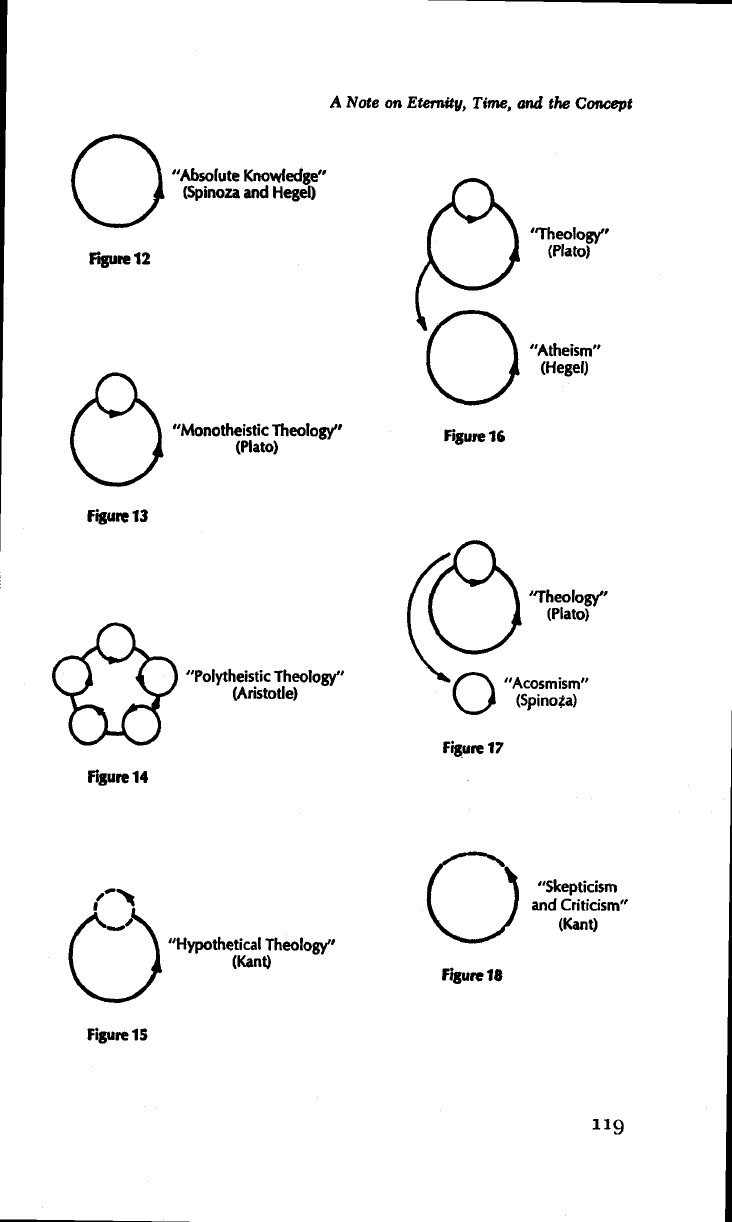
A Note
on Eten&g,
Time, ord tlw
Corrcept
"Abrclute
Knowledge"
(Spinoza
and Hegel)
"Monotheistic
Theolog/'
"Polytheistic
Theologtr/'
(Aristotle)
0''?'?Br'
Ot*,:ii'
ffure16
/A
l l
-
\'Th*togy'
t\ )
(Prato)
\
\6
"Acosmism,,
\l
(spinoJa)
figore 17
,'-\
-\,,Hyporh.ricalrheotos/,
\-/
(Kan
Iigutt 15
"Skepticism
and Criticism"
(KanD
r19
INTRODUCTION
TO
TIIE
READINC
OF EEGTL
suppoTd
to have
been fabricated
by a,
man, who
in
actual
fact
needed
time
in
order
to
fabricate
it.
[Accordingly,
in
plotinus,
this
system
belongs
to
the
eternal
Intelligence.]
6i eke, again:
the
System
can
exist
outside
of
Time;
but,
starting
from
-temporal
existence,
there is
no access
to this
System.
(The
Spinozist
Sy:stem
is
Hegel's
Logik,
for which
there
would
not
and iould noi be
a
Phenmnmology
that
"leads"
to it;
or
else,
it
is
Descartes'
System,
to
which
one
could
not
find ecces
through
a, Discouise on
Method.)
The Ethics
is
made in
accordance
with
a
method of which
an
eccount
cannot
be
given in human
language.
For
the
Ethics
ex-
plains everything,
except
the possibiliqr
foi
e man living
in time
to
write ir.
And if
the Phenomenology
explains
why
the
Loglk
lppears
at
a certain
momenr
of
history
and
not at another,
the
Ethics
proves
the
imposibility
of
its own
eppearance
et
any
mo-
ment
of time
whatsoever.
In short,
the
Ethics could have
been
written,
if
it
is tru.e,
only
by God
himself;
and,
let
us
rake care
to
note-by
a
nonincarnated
God.
Therefore,
the
difference
berween
Spinoza
and
Hegel can be
formulated
in
the
following
wey:
Hegel-becomes
God by thinking
or
writing
the
Logik;
or,
if
you
like,
it is
by becoming
God
that
he
writes
or
thinks it.
Spinoza,
on
the
othei
hand,
must
&e
God
from
all eternity in
order
to be able
to write
or think
hs
Ethics.
Now, if
a
being thrt
becomes
God in time
can be
called
"God"
only
provided that it uses
this
tenn
as a
metaphor
(a
correct meta-
phor,
by
the way),
the being
that has always
been
God is God
in
the
proper and
strict
sense of
the word.
Therefore,
to
be a
Spinozist is
actually
to replace
God
the
Father
(who
has no
Son,
incidentally)
by
Spinoza,
while
maintaining the
notion of
divine
transcendence
in
all its rigor;
it is
to
say that
Spinoza is the
uan-
scendent
God who
speals,
to be sure,
to human
beings,
but who
speaks
to
them
as eternal
Gad.
And
this,
obviously,
is the
height of
absurdity:
to take
Spinoza seriously
is acrually
to
be--or m be-
come-mad.
Spinoza, like
Hegel,
identifies
Man
(that
is to say, the Wise
Man) and
God. It seems,
then, that in both
cases it could be said
indifferently
either
that there
is nothing
other than
God,
or
thar
there
is nothing
other
than
Man. Now in
point
of
fact,
the
two
asertions
are nor
identical,
and
if
the
first is
accepted
by
Spinoza,
L20
A
Note on Etm*tg,
Time,
atd
tle Corrz,ept
only
the second
expresses
Hegel's
thought. And
that
is what
Hegel
means
by
sayrng
that Spinoza's
System is not a
pen-rheism,
but an
a-cosmism:
it is
the
Universe or
the totaliry of
Being
reduced
to
God alone,
but
to a God
without
World and without
men. And
to
say
this is to
say
that
everything that is
change,
becoming,
time,
does
not
exist for
Science.
For if
the Ethics is, in fact,
concerned
with
these
thingp,
how
or
why
they eppear
in it is not known.
With
the use
of our
symbolic
circles,
then,
the difference
between
Hegel's
and
Spinoza's
Systems can
be represented
in the
following
manner:
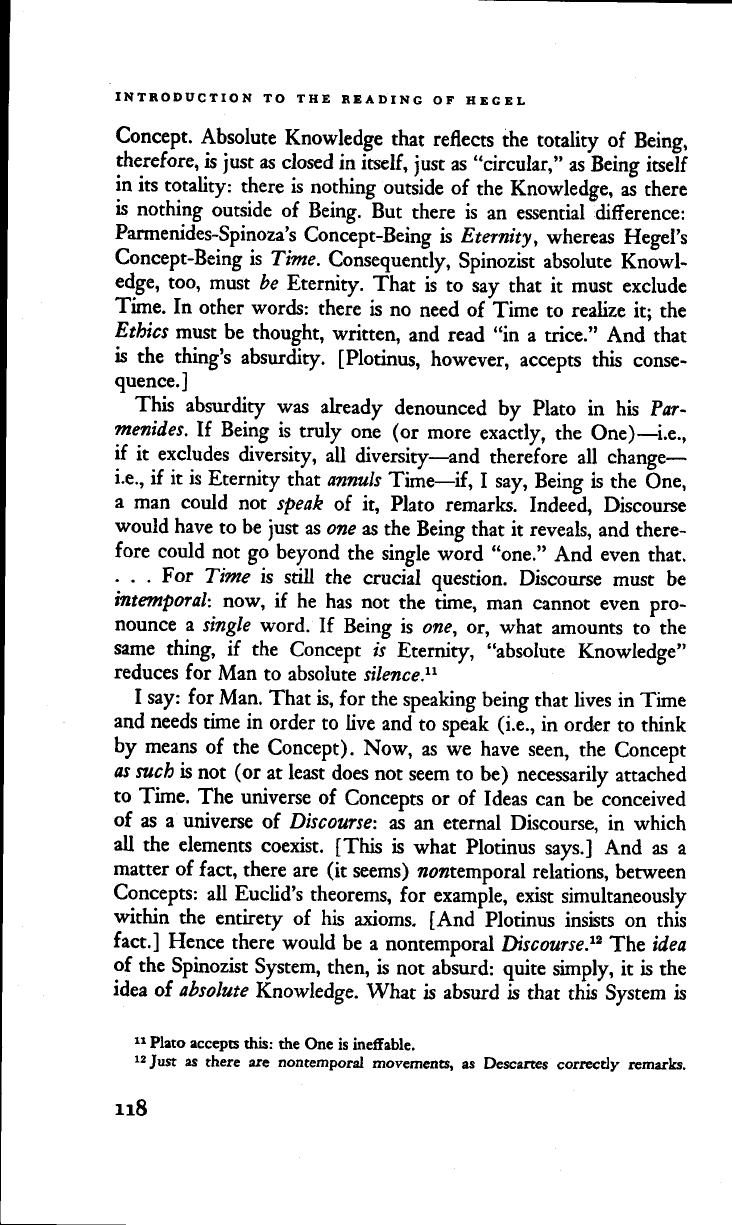
Let
us start
with
the
theistic
System.
In
its
pure
form,
it is
Plato's
System.
But in
general it symbolizes
posibiliry II
(see
Figure
r3).
For Arisrotle,
several
small
circles
must
be-inscribed
in the
large
circle
to
symbolize
the relation
of Eterniry
and
Time
(Figurg
r4); but
these
circles ought
to have
6tted together; in
the
end,
there
would again
be
the
Plaronic
symbol with
only one
small
circle. (That
is to
sey:
all truly
coherent
theism is
a mono-
theism.)
As
for
Kant, the
same
symbol
can
serve; but
the
small
circle
must
be
drawn
with
a dotted
line,
to show that
Kant's
theology
has,
for
him,
only
the
value
of an
,.as
if"
(Figure
r5). In
tfto.r,.
the
s)'mbol
of
the
theistic
System
is
valid for eiery
S1'srem
that defines
the
Concept *
tn etirnal
entity in
relation't
o
,ome-
thing
otber
than itsef,
no
matter
whether
this other thing
is
Eternity
in
Time
or
oumide
of
Time, or
Time itself.
But lei
us
return
to
-Spinoza.
Starting
with
the
theistic system,
Hegel
does
away
with
the
small
circle
(reduced
beforehand,
by
his
prede-
cessors,
to
a single
point):
see
Figure
16.
Spinoza, on
the-other
hand,
does-away
with
the large
ciicle,
see
Figure
17.
.
H"l":
ttre
lyrr_rb9l
is
the
Jame
in
both .aies,
"
homogeneous
closed
circle.
And
this
is
important.
For
we
see
that it is
sifhcient
:o {:iy
that
the
Concept
s
a
relation
with
smnetbing
other
thrn
itself in
order
to
ser
up
the ideal
of
absolute*rhat
i!,
circulm-
Knovledge.
And
indeed,
if
the
Concept is
related
to another
realitS
an
bolated
concepr_can
be established
as
true
by
adequa-
tion
to
this
autonomous
riality.
In
this
case
there erc
pirtial
ficts,
or
even
partial
trurhs.
But
if
the
concept is
revealed
Being
itself,
it
can
be established
es
rrue only
througti
itserf.
The
proof
iiself
no
l9nge1
differs
from
that
which
has
to-be
proved.
Ana
tnis
means
that
the
truth
is
a
"Sysrem,"
as
Hegel
says.
The
word
,.system"
t2r
INTNODUCTION
TO
TgE
NEAD!NC
OF IIECEL
is
not found
in.spinoza.
But the
thing
itself
is
there.
setting
aside
P.armenides,
Spinoza
is
the
only
phitosopher
who
understoJd
that
the
principle
of all
or nothing-is-valid
fbr
Knowledge:
either
one
knows
eaerything,
or else
oie
knoa:s
nothing;
for-one
sees
that
oye
tntly
knows
something
only by
seeing
that one
knows
eeer!-
thing.
And
that is
why
ihe snrdy
of
Spinoza is
so
instructive,
despite.the
abnrdity
of'his
point
oi
view.'spinoze
sets up
the ideai
of.
total,.ot
"systemadc,t' oi
"circular,"
Knowledge.
However,
bis
ly*"-
is
imposible
in
Time.
And
Hegel's
whJe effort
consists
in.creating
1
Spinozist
System
which
Jan
be
written
by
e man
["jp_il
a,
bistorical
World.
And
that is
why,
while admitting
with
Spino"a
that
the
Concept is
not a relation,
Hegel
identifiei
f
n-* with-Ererniry,
but
with
Time.
(On
this
subJect
see the
Preface
to
the
Pbenommology,
pp.
ryft..)
We shall
see later
what
this means.
For
the moment,
I want
to
underline
once
more
that the
symbols
of both
sysrems
are
identical.
They
differ
only
in their
souice
(which
is
noi seen
in
the
drew-
ing):
doin-g
away
with
the
small
or
the large circle.
And
again,
this
indeed
corresponds
to
the
realiry.
It is
understandable
th'"t
"
temporal
Knowledge
could
finally
embrace the totality
of
becom-
ing.
But
it
is not
understandable
that
rn
etemal
Knowledge
could
absorb
e,verything
that is
in Time:
for the
simple
."r.oi
that
it
would
absorb
us ourselves.
It
would
be the
absolute
Knowledge
of
Beanrsstsein,
which
would
have
completely
absorb ed
Selbit-
bewusstsein.
And
this, obviously,
is absurd.
.I.shall
sto_p
here.
To
know
what
the
identification
of
the
Concrept
with
Eterniry
means,
one
must read
the
whole
Etbics.
Let
us
proceed,
or rerunn,
to
Kant.
Kant agrees
with
Plato
and
Aristotle
(in
opposition
to
par-
menides-Spinoza
and
Hegel)
that
the Concept ts-
in eternal
enutlr
in
relotion
with
something
other
than itself.
However,
he reletes
this
eternal
Concept not
to Eterniry,
but
to Time.
.
We can
sey,
moreover,
that Kant
defines
the
Concept
u a
rela-
aaa-precisely
because
he sees
the
impossibility of
Spiriozism
(iust
as
Plato had
done to
avoid
the
impossibiliry
of Eleat[isrn).
perhaps
he
did not
read
Spinoza.
But
in
rhe
"Transcendental
Deduction
bf
the
Categories"
and in
the
"schematismus" he
says why
the
122
A Ntu
on
Et6&V, Tlne,
alnd, llu Corcopt
Spinozist
conception of
Knowledge is
imposible: it
is
impossible,
beceuse for
us-that is,
for 1nx1-"'yffiout intuition
the concept
is empry."
The
Parmenidean-Spinozist
(and
Hegelian)
Concept,
which
is
not in relation
with
a Being othn
than itself, but which li
Being
rey-eafing
itself
to imelf-this
Parmenidean-Spinozist
Concept is
called
the
"transcendental
I" or the tanscendentale
Syntbes{s il*
Appercepion
in
Kant.
"Transcendental" in
Kant
means: that
which makes experiencc
posible.
Now,
experience
is
essentially temporal,
nd
everytbing
that is
temporal
belongs
to the
domain
of experience.
"Tran-
scendental,"
therefore,
meens:
that which
makeJ
the temporel
as
f-.p-41ossible.
Kant
says
thar the
transcendenral
entiry
is
"before"
Time
or
"outside of"
Time.
Hence
the uanscendenial
is
"et€mal"
or,
as
Kant
himself
seys,
d
prioriithis
is
to
say
that it
pre-
cedes
"the
temporal
taken
as temporal.,'
To say
itrat
there is
epistEmE,
absolute
Knowledge,
trullrue
ruth, is
io s"y
that there
are
universally
and
necesarily
valld
concepts-that
is,
concepts
that on
the one
hand
are
valid
at taery
miment
of
time, and bn
the other
htnd,
ercfu.de
Time
from
themselves
(that
is,
can
never
be
modifcd);
rherefore,
ir is
to say
that
rhere
are a
priori,
or
transcendental,
or etemal,
concep$.
Now,
the
eternal
Concept
(like
every
eternal
entity)
is
not
3telnal
iT
Td-9y
itself.
k ii eternal
by
iis
coming
from'Eternity,
by its
orig-in.-Now,
the origin
of
the
eternal
ConJepr
is
the
.,tran_
scendental
I"
or
the
"transcendental
Synthesis."
ihis
I or
this
Synthesis,
rherefore,
is
not
etemal;
it
is
Eterniqy.
Therefore,
Kant's
transcendental
self-consciousness
is
parmenides'
subsrance
con-
*jy".d
of
as_spiritual
subject-that
is,
God.
It is
the
real
Eternity,
which
reveals
itself
to itself
in
and
by
the
concept. It
is the
,oor!.
of
all
Being
revealed
by
the
Concept,
and
the
ioor""
of
all
con_
ceptual
reaehtion
of Being;
ir
is
rhi eternal
source
of
all
remporal
Being.
Howevcr,
Kant
says,
we
men
can
sey
of the
"transcendental
I"
that
it
is
and
that
it
is one;
but
that
is
ail we can
say
of
it.
In other
words,
Kant
accepts
the
platonic
cridque
of
parrnenides:
if
the
Concep_t.rj
Et:TolI,
then
absolute
Knowiedge
reduces
to
the single
word
"Ey" or
"6rr"
and
there
is no
possibl"birrourrr. (MoreovZr,
r23
ININODUCTION
TO TEE
NEADTNG
O!
E!C!L
strictly
qpeaking,
one
qrnnor
even
sny of
the
"uenscendental
I"
that it
is
and
that
it s one.
For,
as we shall
soon
see,
the
cate-
gories
of
Being
and
Quantity
cannor
be applied
in
this
case. There-
fore,
the
most
that
can be
said is
that
ii'is
,,something',
and
not
No.thingTgl;
but
one
-Tryol
say
that
it is a,
thing
havi-ng
such
or
such.qualities;
_n9w,
this
Being, of
which on"
c"n
onl/say
that
i-t
is,
is
a Serz
whictr,
as Heg;el
will
say,
does not
difier
from
lilichtr,
from
Nothingness.)
The
Parmenidean-Spinozist
System
is
therefore
imposible,
Kant
says.
The esential
self-conscious
uniry of
Eterniry
has
twelve
aspe€ts,
which
are
the twelve
famous
categories-concepts.
These
twelve-
Tp."F
o{
Eternity
are obviously
eiernal;
they',,precede"
everything
that is
in
Time,
they are
.'before"
Time;
hence
they
are valid
et
every
moment
of
Time, and, since
they
exclude
Tirn;,
chey
cannot
be
modi6ed;
they are t
prioi.
Now,
Parmenides'
and
Spinoza's
error
(or
illusion)
consisted
in
this:
they
believed
rhat
the eternal
which
contes
from
Eternity reaeals
this eterniry
by
determining
it-that
ir,
by
qualifying
it.
For
Parmenidei
and
Spinoza,
the
concepts-categories
are artributes
of
the
One which
is,
and can
be attibuted
to
it.
Now
for Kant, none of
this
holds
true.r8
None
of
this
holds true,
because
it is imposible.
And
at
the
end
of
$
16
of
the second
edition
of the
Critique of
Pue ReasonKrnt
explains
why.
A
determination
of
Eterniry
by
the
eternal concepw-categories
yould
be
posible
only by
an
(Jnderstanding
(Versrazd)
"through
the Sef-Consciousnes
of
which," he says,
"the
whole
Manifild
(das
Mannigfalrige)
would
be
given at
the
same time"l
or else,
again:
by an
Understanding
zuch that
the
obiects
of irs
representa-
tions exist
through
the
sole
fact of the existence
of these
representa-
tions themselves;
in
other
words-by
r
diaine
(or
"archerypal")
Understanding.
For in
point of fact,
the being
which,
by thinking
of itself
,
thinlcs
of e,uerytbing
that can be
thought,
and
which
creltes
the objects
thought
by the
sole
act
of thinking
of them,
is
God.
Hence
Spinoza
was
right
to give the name
"God"
ro
Parmenides'
tv-6v
which coincides
with the
Concept that
reveals
rs
For
Plotinus, they
crnnot be
rtoibuted to the
One. But they can
be
attributed
to
thc
Onc-which-is,
which
for
him
is
the *cond Hypostasis:
Intelligrnce or the
iateUigible
Cosmos.
r24