
Kojeve Alexandre. Introduction to the Reading of Hegel: Lectures on the Phenomenology of Spirit
Подождите немного. Документ загружается.

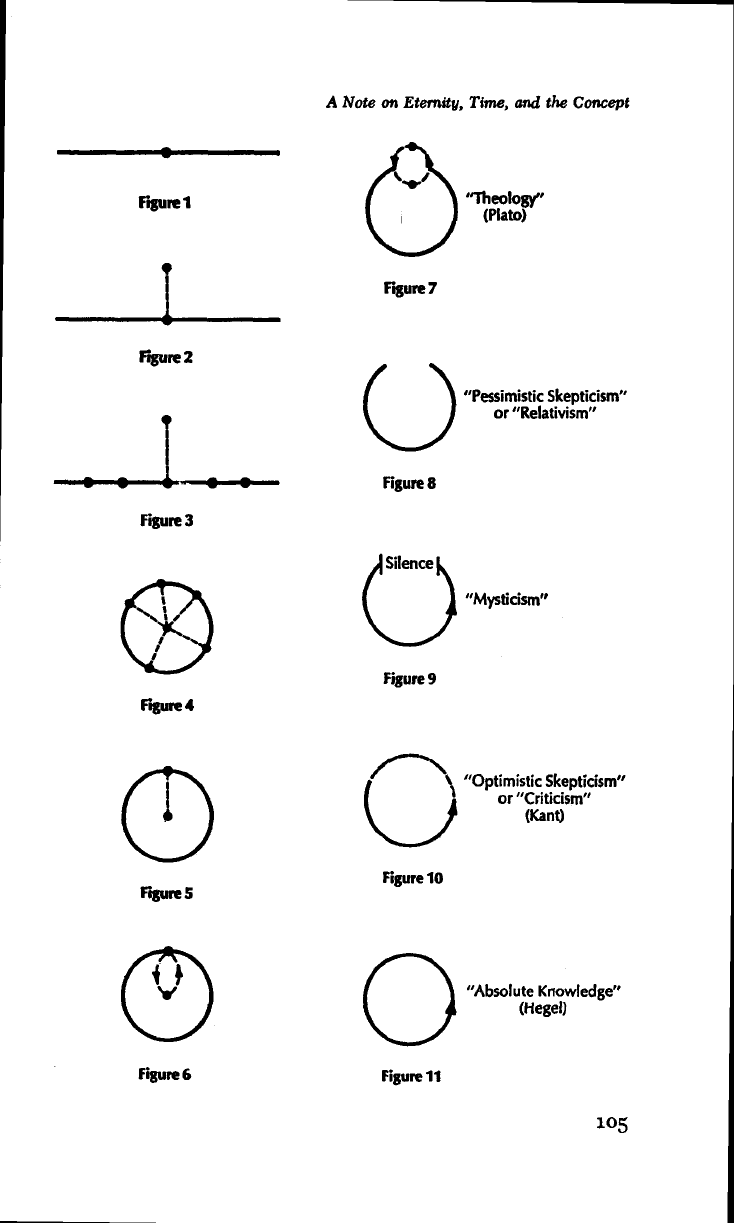
ANote oa Etenftv, Tlmc, ard tho
Concept
"Pessimistic
Skepticism"
or
"Relativism"
"Mpticismr
figurc1
?
I
I
I
Egurc2
O
FigurrS
,^.
i \
"optimistic
Skepticism',
ft
t
or"Critici$m"
\-/
Figure
10
"Absolute
Knowledge"
(Hegel)
105
INTRODUCTTON
TO
THE
NEADINC
OT
HEGEL
this Knowledge-that
is, outside
of Man
who
exists in
the
World
and outside
of
the
World
that
implies
existing
(i.e.,
ternporal)
Man.
This
-"cenrral
point"
(which-necessarily-appears
once
the
concept is
interpreted
as t relationship
with
so*"ihing
other
thtn
the
concept-that
is, once
the element
of
transcendelnce
is
inuo-
duced
into
Knowledge)
has
been
called
God.
Funhennore,
we
have
seen
that
this
tleistic
schema
has
no specificafly
christian
asp_ect,
since
we derived
it
from
the
platonic-
conception.t
.
Let-us
say,
then,
that the
"central
point" is
God. lVe
can
do so
since
for
Plato
the tv
dvo06v,
symboliied
by
this
point, is also
dctis.
But
the name
makes
no
difference.
Let us
""ther
see what
the
thing
means.
And
to
this
end, let
us
transform
the
drawing,
that
is
to say,
make
it
more
precise.
.
First,
let us
simplify.
The
Concepr can
be repeated
in
time.
But
its
repetition
does not
change
it,
nor
does it change
its relation
to
Eternity;-
in
a word,
it changes
nothing.
Hence
i.
""r,
do
away
with
all
the
radii
of
the
circle,
except
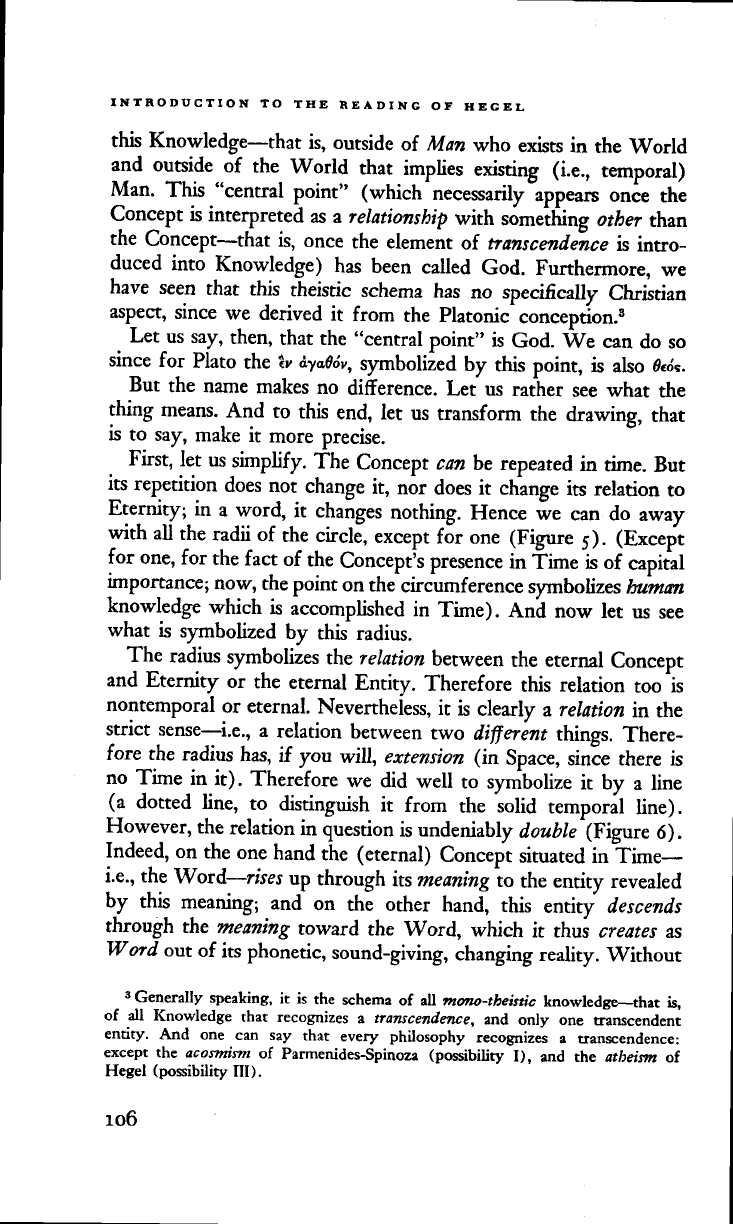
f6r one (Figure
5).
(Except
for one,
for
the
fact
of
the
Concept;,
pr.r.n""
i"
ii-" ;" of
c"pit'"t
imporcance;
now,
the point
on the
circumference
symbohzes
fuinmt
knowledge
which
is
accomplished
in
Time).
Anh
now let
us see
what
is
symbolized
by
this
radius.
The
radius
symbolizes
the relation
between
the eternal
Concept
and
Eternity
or
the
eternal
Entity.
Therefore
this reration
too'is
nontemporal
or eternal.
Nevenheiess,
ir
is
clearlv
a. relation
in the
strict
sense-i.e.,
a
relation
between
two
differinr
things.
There-
fore the
radius
has,
if
you
will, ectension (in
Space,
sirrie there is
no
Time
in it).
Therefore
we did
well
to symbolize
it by
a line
(a
dotted
line,
to
distinguish
it
from
the
solid
temporal
line).
However,
the
relation
in
quesrion
is undeniably
double'(Figure
6).
Indeed,
on
the
one
hand
the
(eternal)
Concept
situated in Time-
i.e., the
Word-rises
up
through
itsmeaning
to
the entiry revealed
b.y
thtg
meaning;.and
on
the other
hand,
this
entiry descends
through
the
meaning
toward
the
Word,
which
it thui
crearcs as
Word
out
of
its
phonetic,
sound-giving,
changing
reality.
Without
s
Generally
speeking,
it is
the
schema
of il
mono-theistic
knowledge-that
is,
of all
Knowledge
that recognizes
a
transcendenee,
and
only one
transcendeni
entiry.
And one
can say
that
every
philosophy
recognizes
a transcendence:
except the
acosmimt
of
Parmenides-spinoze
(possibility
I), and the atbeimt
of
Hegel
(possibility
III).
ro6
A
Note on Etemttg, Time, and tfu
Corcept
the Word, Eterniry would
not
be
represented in
Time,
end
con-
sequently it would
not be
accessible to
Man. And
without Eternity,
the Word would
have no
meaning
and
would
not raise
Man above
Time
and
change;
there would be no
mttb for Man.
(Or,
taking
, concept
as en example
of
the
Concept: the anrd
"Dog"
reveals
the essence
of
the dog, and
without this word
this
esence would
not be revealed
to men;
but
the essence
of
the dog is what realizes
the
meaning
of
the word;
the
dog is what
allows man to develop
the
,uord
"Dog"
into
a
judgment,
saying:
"the
dog is
an
animal
with
four feet,
covered
with hair, etc.")
Generally speaking, there
is a movement
from
the word
to the thing, and
a
rerurn from the
thing to
the
word. And
it
is
only
this double relation
that consti-
tutes
the trath
or the revelation
of reality,
that
is
ro
sey, the
Con-
cept in
the
proper
sense. And on
the orher hand,
this double rela-
tion exhausts
the truth
or the
Concept: the
(erernal)
Concept
is
related
only
to Eternity,
and
Eternity reveals
itself exclusively
through
the
Concept.
Hence,
even
though they
are
in
Time, they
nonetheles
have
no
relations
with
Time and the temporal.
There-
fore
the
double, or
better,
circular,
relation
of the
(eternal)
Con-
cept
and
Eterniry
cuts tbrougb
the temporal
circle.
Change as
change
remains
inaccessible
to
the
Concept. In
other
words,
ihere
is no
truth
in
the temporal,
either before
or after the
Concept.
ThloySh
the
Concepc
one
can
rise
from
the temporal
to Ererniry;
and
then one
can fall back
to the
temporal.
But
ifter the fall
one
is
exactly
what
one
was
before.
[n order
to live
in
the
Concept-
that is,
in
the
truth-it
is necessary
to live
oatside
of
Time
in
the
eternal
circle.In
other
words,
the Lternal circle
of absolute
knowl-
edge,
even though
it
is
in Time,
has no
relation
to Time;
and
the
entirety
of
Knowledgeis
absolute
only
to the extent
that it
implies
an eternal
circle
which
is related
only
to
Eterniry. And
that is
w]ry
we
must
represent
the Platonic
conception
of
aLsolute
Knowl-
edge-in
the
manner
indicated
by
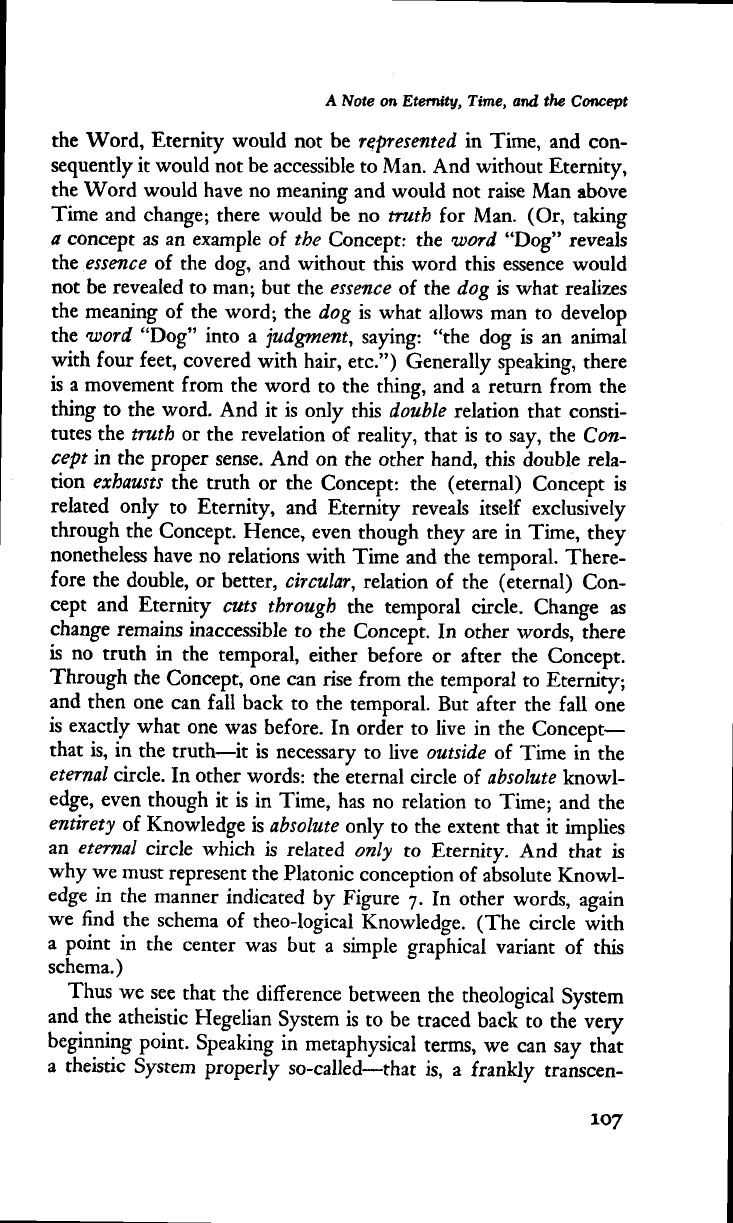
Figure
f.
In
other
words,
again
we
find
the schema
of
theo-logical
Knowledge. (The
circle with
a
point
in
the
center was
bur
a simple
graphical
variant
of this
schema.)
Thus
we see
rhat
the
difference
between
the
rheological
System
and.the
atheistic
legelian
System
is to be
traced
back
to the
very
beginning
point.
Speaking
in metaphysical
terms,
we
can
say
rhat
a theistic
System
properly
so-callid-that
is, a
frankly
transcen-
107
INTRODUCTION
TO
TITE
READINC
OF
HECEL
denmlisr
and
mono-theistic,system-results
as
soon
as the
Concept
(i.e.,
absolute
Knowledge)
is
defned
es en eterndl
entity
that
^is
related
to
Eternity,
Eterniry
being
outside
of
Time.
Let us
see
what
this
means
foi
the
temporal
World
of
phe_
nomena.
understanding
of
this world
(and
o]
Man who
rives
in it)
is.
symbolizea
by tl9
large
circle.
So, let us
rake away
the
small
circle
of
the eternal
concept
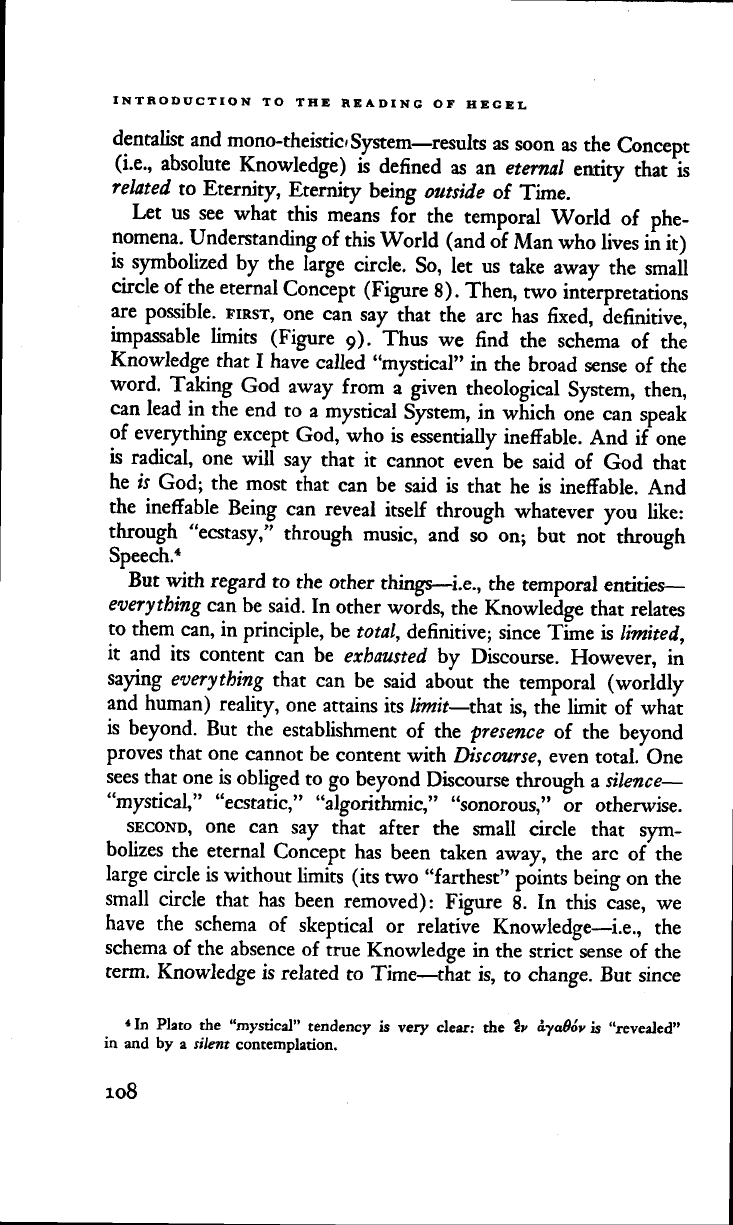
(Figure
g).
Then,
two
intirpretations
are
posible.-
FTRST,
one can
say
that
the
arc
has
fixed, iefinitive,
impassable
limits (Figure
9).-Thus
we
find
the schema
of the
Knowledge
thac
I have
called
,,m1ntical,'in
the
broad
sense
of the
word.
Taking
God
away
from
i
given theological
System,
rhen,
can
lead
in
the
end to_a
mystical
System, in
wf,ich
one can
speak
of
everything
except
God,'who
is
issentially
inefiable.
And if one
is
radical,
one
will
say
that it
cannor
euetr b" said
of
God
that
he is
God;
the
most
that
can be
said is
that
he is
ineffable.
And
the
ineffable
Being
can reveal
itself
through
whatever
you like:
lho"S-
h_
"ecstasy,"
through
music,
and
so on;
but
noi
through
Speech.a
But
wjth regard
to
the other
things-i.e.,
the
temporal
entities-
eaerything
can
be said.
In
other
woids,
the Knowledge
that relates
to
them can,
in
principle,
be
total,
definitive;
since
Time
is
limited,
it
and
its content
can
be
erbaasted
bv
Discourse.
However. in
t"flg
eaerything
that
can
be
said
about the
temporal
lworidty
and
human)
reality,
one
aftains
its
timit-that
is,
thi
limit of what
is
beyond.
But
the
establishment
of
the
presence
of
the
beyond
proves
that one
cannot
be
content
with
Discottrse,
even
total.-One
sees
that one
is
obliged
to go
beyond
Discourse
through t ilence-
"mysticalrt'
"ecstaticr"
"algorithmig"
"sonofousr" or otherwise.
sEcoND,
one
can
say that
after
the
small
circle that
srrm-
bolizes
the eternal
Concept has
been taken
away,
the arc of'the
large
circle
is
without
limits
(its
rwo
"farrhest" points
being on the
small
circle
that
has
been
removed):
Figure
A. In this C"se, we
have
the
schema
of
skeptical
or
relative
Knowledge-i.e.,
rhe
schema
of
the
absence of
true
Knowledge
in
the strict-sense
of
the
term.
Knowledge
is
related
to Time-that
is,
to change. Bur
since
rln
Plato
the
"mysticd"
tendency
is
very clear:
the
2v
&yo06v
is.teveded"
in
and by
t silent
contempletion.
ro8
ANap on
Eternitg,
Time,
atd tlv Corcept
Time
is now
without limits,
change
never stops. Hence there
is
no
eternal or
definitive
Knowledge: there is
no epist?mE,
there
is only
dora. But in another way, even in
this case,
one can sey
that
the
circle is closed.
Then the ideal of
Hegelian absolute Knowledge-
that is,
circular
Knowledge-is set up
(cf.
Figure
rr). But this
ideal forever remains an ideal:
the circle of
real
Knowledge
is
never actually closed
(Figure
ro).
It
is
the
optimistic
form
of
skepticism. It is the skepticism
of the
eternal
"why,"
of humaniry
"that
always
learns,"
that ceaselessly
marches
on
like an
individual
man
toward
an
end
that it
will
never attain. And the truth rcmains
It[fx1ft"-xgcording
to
the definition
of
the
Devil
in
"Le
Puits
de
Sainte Claire." It
is also the "eternal
task"
(easige
Aufgabe) of
Kantian Criticism. In the two variants of
skeptical
knowledge,
then,
philosophy
as a road that
actually leads to Wisdom
is
obviously impossible.
InverselR through
the
introduction
of
the
eternal
Concept-
i.e., discursive tuth-into
a
given
"mysdcal"
or
"skeptical"
Sys-
tem,
e
theo-loeical
System
is
always obtained,
even if
the
term
God
does
not explicirly
enter into it.
For in
this
case
the truth
would
necessarily reveal
a
Being situated outside
of
Time-that
is, outside
of
the World
and
Man.
Well then,
once
more,
what
does
the theological
(not
the
mysti-
cal or skeptical)
Sysrem mean
for understanding
of the temporal
World?
In
principle,
everything
can
be
said
about the World and Man.
Knowledge that relates
to them is
total. However, in
itself, Knowl-
edge relating
to Time
and the temporal
remains relative:
it is
a
doxa.
Only
by
relating
it in its
entirery
to
ercrnnl
Knowledge
related to
Eterniry
can one
say something
defniiae about
the
temporal.
LET
us
coNsrDER THE
woRLD.
In
theological
language
(in
the
narrow
sense
of
the
term) one must
say thet
events in
the
World,
as well
as
the
World
itself,
are
contingent:
hence
there
is no
absolute
Kno,utledge
relating
to
them.
But if,
pn
impossible,
Gad's designs
and
His
creative will
were known,
there
could
be a
true Science
of
the
World.
Speaking
in
symbolic
theological
terrns,
one
can-sey
that
there
is
Science relating
ro
the World only to
the
extent that
this
World
implies geometrical
elements.
Indeed,
Kant
109
INTRODUCTION
TO
TIIE
NEADTNC
OF
trBGEL
showed
us
that
if algorithm
is to
be transformed
into
Discornse,
it
must
be related
either
to
Time
or to
Space.
Here, since
its
being
related
to
Time
is excluded
by definirion,
it can
be related
only
t6
Space
(which,
in
this
conception,
is a
Space outside
of
Time).
And indeed,
one
can
speak
of
geometry:
,,the
circle',
b also
t
anrd
that has.a-.me-a1ing
(and
one
cxn
sdy what
it
is), as
opposed
to a
nonspatialized
integral,
for
example,
which
can
be
expressed
only
by
an
algorithm.
Therefore,
the-theological
System
can fabricate
a, retl-geomety,
that
is
to
say, a, geornetrical
physics, and
nothing
else.
Now,
this
physics can
tell
us that
the eanh
is round,
bw
lt
qrnnot
tell us
why it
atrracm
heavy
objects
(because
the
force
of
att-rection,
like every
force,
is
not
only'a
spatial, but
also an
essen-
tially
temporal
phenomenon);
and consCquenrly,
it
cirnnor
say
what
the
eefth
is
* Eartb-t
planet
on which
trees grow and
man
lives.
As FoR
rvreN
himself,
the
case is
the same
for him.
There is
true
Science
concerning
him
only
to rhe
extenr
rhat he is
relared
to
Eternity
.
I
cen
proae
the
exisrence of
God: it
is an
eternal
rruth.
But I.cannot
prove my existence
on
the same
grounds, unless
I
conceive-
of
myself
es
en
eternal
idea in
God.
As for me
in
my
temporal-or
worldly
existence,
I can know
nothing.
Moreovei,
absolute
Knowledge
related
to Eternity
is
precisell what
makes
tn abs-olute
Knowledge
relating
to
the temporal
imposible.
Let us
take
Christian
theology
as an example.
Wtrat truly
matters
for
rhe
Chrisdan is
to
know
wherher
he is
saved
or damned in
consequence
of his_
worldly
or temporal
existence.
Now,
the analysis
of th"
eternal
concept
that
reveals
God shows
that this
cannot be
known,
that
this
c:ln
never be
known.
If the
Christian
does
not
want
ro be
"mystical,"
-
that
is,
to renounce
Discourse
completely,
he
must
necesarily
be
skeptical
with respect
to his temporal
existence.
Do
what he
will,
he
will
not
be certain
chat he is-acting
well.5
In short, in
the theological
Sysrem
there is
an absolute
Knowl-
edge
in
and through
Beususstsein,
but
there is
no absolute
Knowl-
edge
through
and in
Se/Dsr-bewusstsein.
.
Finally,
we
can
presenr
the
theological
Sysrem in
its anthropo-
Iogical
aspect
by explaining
the
significance in
it of
the
idea-
of
*#J..
the
Christian edmits
that
God's decision
is
in
conformity
with
humen
lro
A Note on Eternity, Time, atd
the
Corwept
human
freedom
(that
is to
sey, the idea of
Man
himself, since man
without freedom
is but
an
animal).
We do
not
need
to define
freedom here.0
We all
have
"an
idea of
what it is,"
as
we
say; even
if we do
not
know
how to define
freedom.
And the
"idea"
that
we have of it is
sufFcient
to enable
us to say
this:
The
free
act is situated,
so
ro
spea,k,
outside
of
the
line of
tem-
poral evolution.
The hic et nunc,
represented by a
point
on this
line, is determined,
fired,
defined
by
the
past
which,
through
it,
determines
the future as
well.
The bic et
nanc
of
the
free act, on
the other
hand, is unexplainable,
on the basis
of
its
past;
it is not
fixed
or determined
by it.
Even
while existing
in
space-time,
the
being
endowed
with freedom
must be
able to detach
itself from
the hic et
nunc,
to
rise
aboae
it, to
take up
a
position
in relation
to
it.
But the free
act is related
to
the
hic et
nanc:
it
is effected in
given determined
conditions.
That is
ro say: the content of
the
hic
et rrunc
must be
preserved, while
being'detacbed
from the bic
et
nunc.
Now,
that
which
preserves the content
of a perceprion
whife
deraching
it
from
the hic
et
nunc of
sensation is
precisely
the
Concept
or
the Word that
has
a meaning.
(Thrs
table is bound
to
the
hic et nunc;
but
the meaning
of
the uords
"rhis
table"
exists
everywhere
and always).
And
that is
why everyone
agrees
that
only
a
speaking
being can
be
free.?
As
for
Plato,
who believes
that virtue
can
be taught, and
taught
through
dialectic-i.e.,
through
Discourse--obviouJy
the
free ict,
for
him,
has
the
same nature
as the
act of
conceptual undersrand-
ing:
for him,
they
are
but
two
complemenrary
asp""tr of
one and
tne
same
ttung.
Now,
for
Plato
the
Concept is
()
etemal,
and
(z)
itis related
t9
Eteyity,
which
(3)
is
outside
of Time.
The application of
this
definition
of the
Concept
ro
the
free
act leads
io
the
following
results:
-
Just
as
the
Concept
is
not related
to the
temporal
reality
in which
doxa
reigrx,
so
the free
acr,
too, is
impossible
\n tbis r""li.y.
In
and
oln
poinr
of fact,
either
this word
hes
no
meaning,
or else it
is the Negatfuitlt
of which
Hegel
speaks,
and which
a Dcscartes
end
a Kant
had in view without
speaking
of
it
erlplicidy.
Bur no
mafter,
?
Hegel, it
is true,
reverses
this assenion
and says
that only
a
free
being
cen
speak; but he
too maintains
the
close
connection
between
language
end
freJdom.
l1l
INTNODUCTION
TO
THE
READTNG Otr
IIEGEL
by
the free
act, man
relares
himself
to
something that is
situated
outside
of
Time.
That is,
as Plato
says in
his
well-known
mwh:
the soul cbooses
im
destiny
before its'birth.
There is choice,hince
freedom.
But
this
choice
is
made outside of
temporal existence,
which
existence
is
absolutely determined
in its
evolution.
In
his
myth
Plato adopts
the
idea
of
..t.*prychosis:
the
choice
can
be
repeated,
and
the
choices
differ
among themselves. But in
truth,
this
hypothesis
does
nor
fir
in
well with the entirery of
the
Platonic
system,
in
which the
nontemporal admits
of no variations.
Accordingly,
fairly
soon one
comes to the
(gnostic
and
Christian)
conception
of
e unique
choice,
fixed by
the
rclation
bctween
the
extra-temporal
Eternity
(or
God)
and the free agent.
It
is the idea
of the
Angel
who
decides
once
and
for
all, and outside of
time
properly so-called,
for
or
against
God, and
becomes
a
"virtuous"
Angel
or a forever
"fallen" Angel or Devil.8
Generally
speaking,
this
whole
conception
does not manage
to
gxplain
temporal
exisrence
xs sach)
that
is,
as History.
Historyhere
is always
a comedy,
and
not
a tragedy: the
tragic is before or
after,
and in
eny
case
outside
of,
temporal life;
this life itself realizes
e
program
fixed
beforehand
and therefore,
taken in
itself,
has nefuher
any
meaning
nor any
value.
In
conclusion,
then,
this can
be said: every system of
theo-
logical
absolute
Knowledge
sees in
the
Concept
zn
eternal
entity,
which
is related
to
Eternity.
And inversely, tbh conception
of the
Concept
necessarily
leads
in
the
end, once developed,
to a theo-
logical
Knowledge.
If, as
in Plato, Eterniry
is
situated outide of
Time,
the
System
is
rigorously
mono-theistic and
radically
tran-
scmdmtalist:
the being
of
God is essentidlly different
from
the
being
of him
who
speaks
of
God; and
this
divine Being
is
abso-
lutely
one
and
unique,
that
is
ro say, it
is eternally identical to
itself
or it
excludes
all change.
In relation
to the
natural
World, this System
gives
a
purely
s
This
conception
dso
comes
to light in
the dogma
of
original
sin:
in
Adam,
man,
in
his entirery,
freely
decides
once
and
for all. Here the
act is in time;
but
it is not
related
to time;
it is related
to
dre
eternal commendment
of God, this
God
being
oatside
of
time, As
for the
freedom
of
man
properly
so-called-ir
is
the
smmbling
block
of
all theology,
and
panicularly
of Chtistian
theology.
Even if
divine elecdon
is
a cooperation
with man
(which
in
itself is
quite
"heretical"),
human
ac$
are
iudged
dl at once
by
God, so ther freedom remains
a unique
act, situated
outside
of
time
and related
to
Eternity.
Lt2
A
Note or
Etemity, Time,
atd tlw Cottcept
geontettical
theory,
which
can at
most operare
with
the
notion
of
purely incorporeal
"movement"
(as
Descartes
does),
but not with
the notion
of
force:
this
System admits kinematics
or
phoronomy,
but excludes
dynamics.
Consequendy, it
does not
explain biologicil
phenomena,
in
which
Time is
consfituent.
And in
lehtion
to the
human
World,
this
System
at
best
explains "angelic"
existence,
but
deprives historical
life,
that is,
Man's
temporal existence,
of
any
meaning and
value.
SEVENTH
LECTURE
I
have
discussed
ar
some length
the Platonic
concepdon,
which
corresponds
to
possibility
II,
t,
a.
Let
us
now
move
on
to Arisrotle-that
is,
to
posibiliry
II,
r,
D.
Aristotle
saw
Plato's
dificulties.
And
at
the
same
dme
he made
e
greet
S:o":t
Just
like
Plato,
Aristotle
defines the
Concept as
eternal.
That is,
he
defnes
it
as a relation
to
something else.
hnd
this
something
else for
him,
as
for
plato,
is
not Time
bit
Eternitv.
(EpistanE
exists
only
in
the cosmos
in
which
there are
ideas-i.e.,
eternal
enrities,
having
Eterniry
as
their
topos.)
But
Aristotle
saw
what
Plato
seems
not
to have
seen;
namely,
that
Eterniry
is
not
outtide
of
Time,
but
in
Time.
Ar
the
very
least,
there
i,
,orn.-
thing
eternal
in
Time.
In fact,
Plato
reasoned
as
follows:
All
real
dogs
change;
the
gonc:pt
"dog,"
on the
other
hand,
remains
identicalio
itselfithere-
fore
it
mu$
be related
to
an Eterniry
siruated
outside
of
real
dogs-
that
s,
outside
of
Tim_e.
(This
Etirnity
is
the
,,idea,,
of
dog,"and
co1sequently,
in
the
final
analysis,
thi
Idea of
ideas.)
To
-whicn
Aristotle
answered:
to
be suri,
the
concept
,,dog"
is retated
to
Eterniry;.but
Eternirysubsists
in
Time;
f6r
if re-al
dogs
change,
rbe
real.dog-+hat
p,
the
species,,dog,'-6o",
"ot "t""g".
Si;""
the
qpecies
is etemal,
even
though
it
is
lhced
inTime,
it ii possible
to
relate
the
concept
to
Erernity
iniime.
Therefore
theie
is
an
1r3
IIE READTNC
OT EEGEL
absolute Knowledge
relating
to the
temporal World, to
the extent
that this World
implies
Eternity.
In
other
words, Plato
forgot
that
in Heracleitus'
river
there are
perrnanent eddies. Fint
of all, they
ere the animals
and
the plants.
The
eternal
or immutable
axis of
the
"eddies"
is the relas
or
the
entelechy;
and this
same entelechy
is what
appears, in
relation
ro
the Concept,
as
the Idea
of the
"eddy."
But there are also
planetsn and
finally rhe Cosmos.
Hence
Aristotle says:
Time itself is
eternal.
It is circular,o
but
the
circle
is
gone around
agein and again,
erernally.ro
Therefore the Cosmos
has the
same
stmctrue as does
the
animal. The Aristotelian
System
thus
gives an explanation of
life
and a biological conception of the
World.
Theologically
speaking,
the conception
that relates the eternal
Concept to
Eternity inTime
equals Polytheivn.
To be sure, Aris-
rctle
is too far removed
from
the totemic mentality
to
esseft that
animals and
plants
ere
gods. But when
he says
that
the
planets
are
gods,
he maintains
a
greater agreemenr with his
qystem than does
Plato
u'ith
his.
But, all thingp
considered,
the
difierence
is not very
important:
mono- or
poly-theism-in
both
cases
u/e are dealing
with
a
tbeo-logpcal
knowledge.
The cosmic revolution
is
eternally
repeated;
and it is solely
because
there
'ts
tn
etemal
repetition
thar
there is an absolute
Knowledge relating
to
the
Cosmos.
Now,
it is
one and
the same
Eternity
that manifests itself
in and
through
the
eternal
return
of
Time.
In
other
words, there is a supreme
god,
the God
properly
so-called,
who
maintains the
Cosmos
in irs
iden-
tiry and thus
makes
conceptual
Knowledge possible.
And, while
manifesting
itself through
the course of
Time, this divine Eterniry
differs essentially
from
everything
thar is
iz
Time. At most, man
can speak of
himself
roo, taken
as species, when
he spealcs
of
God.
[t
remains
nonetheles
true
that the difference's essential berween
him,
taken as historical
individual,
and the
erernal
God
of
whom
he
speals.
Once more,
then,
as
in
Plato,
it is an
absolute Knowledge
of. Bewusstsein,
arnd,
not of
Selbst-Bewu.sstsein.
(For
the
species
has no
Selbst-Beuusstsein,
no Selbst or
Self; at the most, it says
ttwertt
but
not
ttl.tt)
e
As in Hcgel.
ro
Wherers
io
Hegel thc circuit is mlde
only once.
rr4