
Kosevich A.M. The crystal lattice
Подождите немного. Документ загружается.

86
2 General Analysis of Vibrations of Monatomic Lattices
It follows from (2.11.10) and also from (2.11.1) that A
xz
(k)=A
yz
(k)=0,and
in this case the vibrations with the displacement vector u in the xO y plane are inde-
pendent of the vibrations with the displacement vector u, parallel to the Oz-axis, i. e.,
perpendicular to the layers.
The vibration o f the vector u in the plane of the layer has two branches in the
strongly anisotropic dispersion law. Since these vibrations are not of main interest the
long-wavelength (ak
x
1, ak
y
1) dispersion law for one of these branches will be
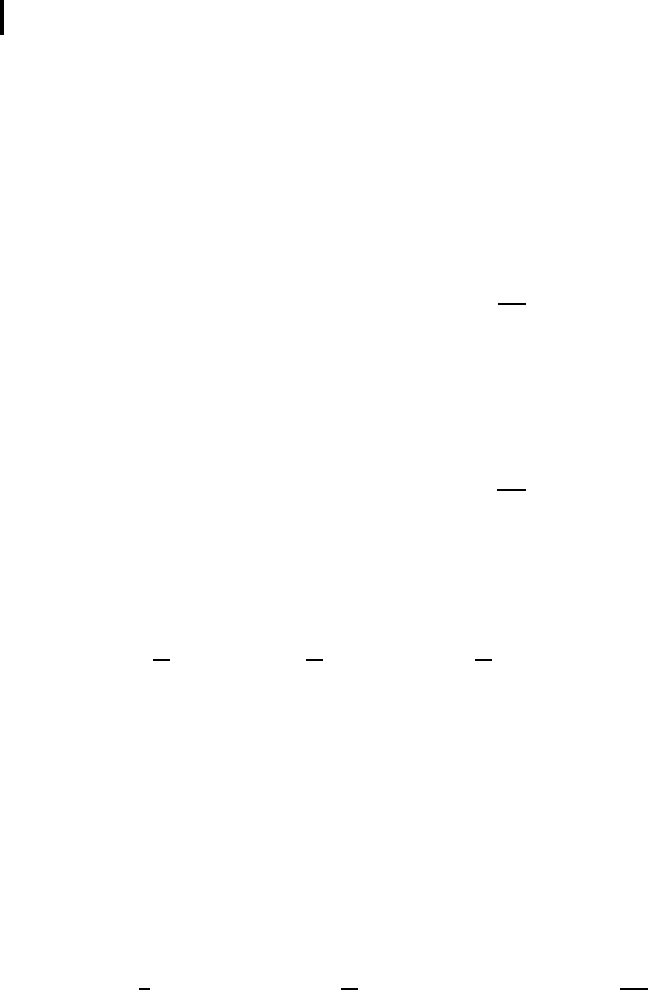
written in a simpler form, analogous to (2.10.4)
ω
2
=
1
(k) ≡ s
2
0
k
2
x
+ k
2
y
+ ω
2
1
sin
2
bk
z
2
, (2.11.11)
where s
0
∼|α
3
|a
2
/m, ω
2
1
∼|α
1
|/m (s
0
/b)
2
.
Consider the third type of vibrations, bending. The dispersion law for such vibra-
tions is written as mω
2
= A
zz
(k) .
Assuming in (2.11.9) i, j = z and performing simple calculations, we have
mω
2
=
∑
n
1
=0
α
zz
(n
1
)[cos kr(n) −1] −4α
2
sin
2
bk
z
2
. (2.11.12)
From the assumption |α
2
||α
3
|∼|α
zz
(n
1
)|, hence (2.11.12) gives a strongly
anisotropic dispersion law with two characteristic frequenc ies ω
0
and ω
1
determined
by the relations
6
ω
2
0
= −
1
m
∑
n
1
=0
α
zz
(n
1
) ≈
1
m
α
zz
(0), ω
2
2
= −
4
m
α
2
, ω
2
ω
0
.
The relation η
2
=(ω
2
/ω
0
)
2
∼|α
2
/α
3
|1 is the main small parameter that allows
one to separate out the bending-type vibrations. For graphite η
2
is equal to several per
cent.
We derive from (2.11.12) the dispersion law for the bending waves at small fre-
quencies when ω ω
0
. At such frequencies the cosines in the first sum of the r.h.s.
of the formula (2.11.12) can be expanded in powers of ak
x
and ak
y
, using only a few
terms of the expansion. Two characteristic frequencies of different order of magnitude
available in the dispersion law require that terms up to the fourth power of ak
x
and
ak
y
be retained in such an expansion:
mω
2
= −
1
2
∑
n
1
α
zz
(n
1
)[kr(n)]
2
+
1
4!
∑
n
1
α
zz
(n
1
)[kr(n)]
4
−4α
2
sin
2
bk
z
2
.
Taking into account the symmetry of the second- and fourth-rank tensors in the
presence of the six-fold symmetry axis, we write down the dispersion law for long-
6) It is clear that α
2
< 0, otherwise the vibration frequency would not remain
real for k
x
= k
y
= 0 and k
z
→ 0.
2.11 “Bending” Waves in a Strongly Anisotropic Crystal
87
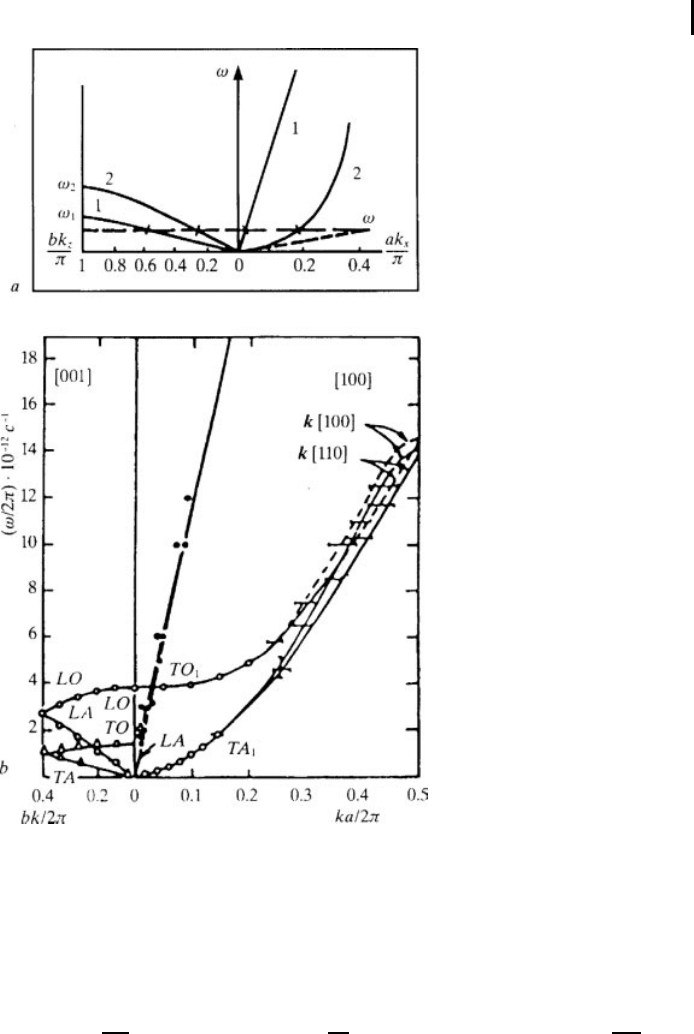
Fig. 2.4 Dispersion laws of a strongly anisotropic layered crystal:
(
a
) general scheme; (
b
) experimental curves for graphite (Nicklow et al.
1972). In the upper part of the curves, the dependence on the direction
of k in the basal plane is indicated.
wavelength vibrations in the form
mω
2
=
a
2
2m
∑
n
1
α
zz
(n
1
)n
2
x
k
2
⊥
+
a
4
24
∑
n
1
α
zz
(n
1
)n
4
x
k
4
⊥
+ ω
2
2
sin
2
bk
z
2
,
where k
2
⊥
= k
2
x
+ k
2
y
, and the first term allows us to take the relation (2.11.5) directly
into account.
88
2 General Analysis of Vibrations of Monatomic Lattices
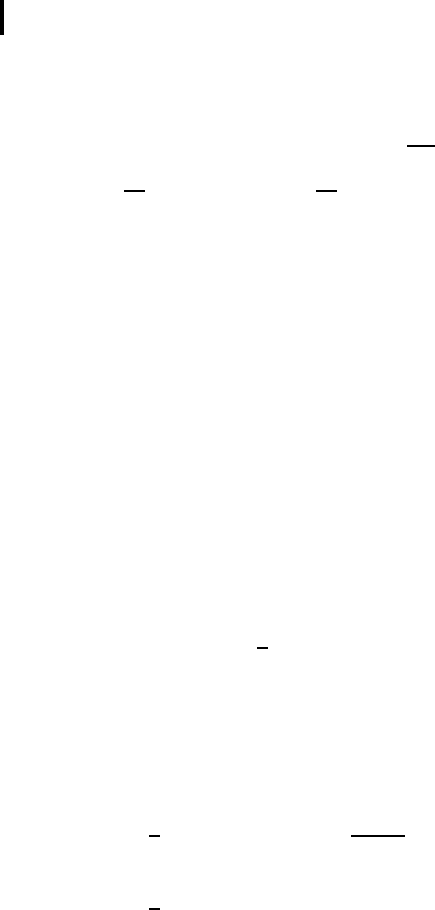
Let us use (2.11.5) and simplify the formula for the dispersion law by introducing
new notations
ω
2
=
1
(k) ≡ s
2
⊥
k
2
⊥
+ A
2
a
2
k
4
⊥
+ ω
2
2
sin
2
bk
z
2
;
s
2
⊥
= −
α
1
m
b
2
∼ ω
1
b
2
, A
2
=
a
4
24
∑
n
1
α
zz
(n
1
)n
4
x
∼ ω
0
a
2
s
2
⊥
.
(2.11.13)
The dispersion law graphs (2.11.13), (2.11.11) for the two main directions (Ok
x
and Ok
z
, Fig. 2.4a) have different peaks in reciprocal space, so that the scales of units
of the quasi-wave vector components k
x
and k
z
are not the same. The curves 1 refer
to the u-vector vibrations along the layer and the curves 2 to the u-vector vibrations
transverse to the layers.
To illustrate the genuine dispersion laws of strongly anisotropic crystals, in Fig. 2.4b
we show the graphs of the calculated and experimentally established dependencies
ω = ω
z
(k) for graphite. Since graphite has a diatomic lattice, Fig. 2.4b gives not
only acoustic (A), but also the optical (O) vibration branches (Chapter 3).
2.11.1
Problem
Find the canonical transformations that allow a transformation from complex normal
coordinates to real ones and to reduce (2.6.8) to the form
H =
1
2
∑
kα
Y
2
α
(k)+ω
2
α
(k)X
α
(k)
(2.11.14)
where X
α
(k) and Y
α
(k) are the real normal coordinates and the generalized momenta
Y
α
(k)=X
α
(k) conjugated to them.
Solution.
Q
α
(k)=
1
2
X
α
(k)+X
α
(−k)+
i
ω
α
(k)
[Y
α
(k) −Y
α
(−k)]
;
P
α
(k)=
1
2
{Y
α
(k)+Y
α
(−k) −iω
α
(k)[X
α
(k) − X
α
(−k)]}.
(2.11.15)

3
Vibrations of Polyatomic Lattices
3.1
Optical Vibrations
A polyato mic crystal lattice is different from a monatomic one in that its unit cell
contains more than one atom. In other words, the number of mechanical degrees of
freedom per unit cell of a polyatomic lattice is necessarily more than three.
The last point introduces not only quantitative but also qualitative changes in the
spectrum of crystal v ibrations. The specific features of poly a tomic lattice vibrations
will first be studied for a very simple model.
Let us consider the vibrations of an atomic crystal with a densely packed hexagonal
lattice or a crystal with the NaCl structure (Fig. 0.2). The unit cell of the lattice of
such crystals has two atoms, i. e., six degrees of freedom. It is convenient to introduce
the vector of displacement of the center of mass of a pair of atoms, u(n),i.e.,the
center of mass of a unit cell (three degrees of freedom), and the vector of a relative
displacement of atoms in a pair, ξ(n) (three degrees of freedom).
In terms of these displacements, we can write explicitly the energy (or the La-
grangian function) of a vibrating crystal. However, we shall not write this value di-
rectly in the general form, but confine ourselves to a scalar model. Now this model
cannot be called “scalar”, since we have to operate with two scalar functions u(n) and
ξ(n),whereξ(n) mean, e. g., changes in the distance between the atoms of a chosen
pair. Thus we should actually transform a scalar model to a two-component one.
Assuming that the displacements of the centers of mass of the unit cells u(n) and
the relative displacements of atom pairs ξ(n) are small, we represent the potential
energy of crystal vibrations in the form corresponding to a harmonic approximation
U =
1
2
∑
α
1
(n − n
)u(n)u(n
)+
1
2
∑
α
2
(n − n
)ξ(n)ξ(n
)
+
∑
β(n − n
)u(n)ξ(n
) ,
(3.1.1)
The Crystal Lattice: Phonons, Solitons, Dislocations, Superlattices, Second Edition. Arnold M. Kosevich
Copyright
c
2005 WILEY-VCH Verlag GmbH & Co. KGaA, Weinheim
ISBN: 3-527-40508-9
90
3 Vibrations of Polyatomic Lattices
where the new matrices of atomic force constants α
1
(n) , α
2
(n) and β(n) are intro-
duced. Evidently, the matrices α(n) may be chosen to be symmetric α(n)=α(−n)
but the latter is invalid for the matrix β(n). One can easily construct a model in which
the matrix β( n) responsible for the interaction of displacements of two types, also has
a similar symmetry.
The kinetic energy of a diatomic lattice has the standa rd form
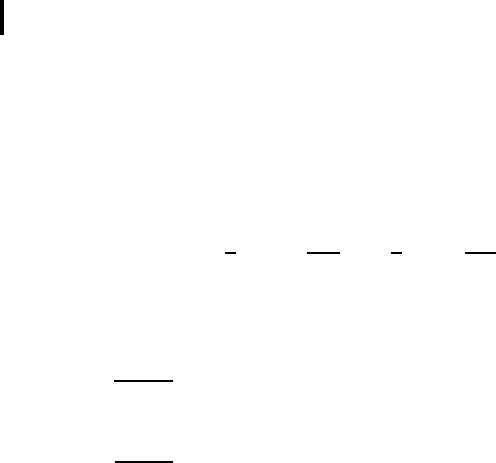
K =
1
2
∑
M
du
n
dt
2
+
1
2
∑
µ
dξ
n
dt
2
, (3.1.2)
where M is the unit cell mass; µ is the reduced mass of a pair of atoms. Using (3.1.1),
(3.1.2) it is easy to obtain the equations of motion o f the crystal
M
d
2
u(n)
dt
2
= −
∑
n
[α
1
(n − n
)u(n
)+β(n −n
)ξ(n
)],
µ
d
2
ξ(n)
dt
2
= −
∑
n
[α
2
(n − n
)ξ(n
)+β(n −n
)u(n
)].
(3.1.3)
From (3.1.3), we can immediately derive the constraints imposed on the α
1
(n) and
β(n) matrix elements that result from the invariance of the energy of a crystal with
respect to its motion as a single whole. Indeed, assuming ξ(n)=0 and u(n)=u
0
=
const we get
∑
α
1
(n)=0,
∑
β
1
(n)=0. (3.1.4)
We note that the matrix elements of α
2
are not related by a condition such as (3.1.4)
since even the homogeneous relative displacement of atoms in all pairs increases the
crystal energy. However, the matrix elements of α
2
as well as the elements of α
1
and β
obey a set of inequalities provid ing the positiveness of the energy (3.1.1) for arbitrary
u(n) and ξ(n ). In particular,
α
2
(0) > 0, α
1
(0)α
2
(0) > β
2
(0) . (3.1.5)
Just as in the case of a monatomic lattice, it is natural to seek a solution to (3.1.3)
in the form of vibrations running through a crystal with the given frequency
u(n)=u
0
e
i(kr(n)−ωt)
, ξ(n)=ξ
0
e
i(kr(n)−ωt)
. (3.1.6)
Substituting (3.1.6) into (3.1.3) and performing simple transformations, we get
A
1
(k) − Mω
2
u
0
+ B(k)ξ
0
= 0,
B
∗
(k)u
0
+
A
2
(k) −µω
2
ξ
0
= 0,
(3.1.7)
where
A(k)=
∑
n
α(n)e
−ikr (n)
, B(k)=
∑
n
β(n)e
−ikr (n)
. (3.1.8)

3.1 Optical Vibrations
91
The compatibility condition homogeneous equations (3.1.7) for the two unknowns
u
0
and ξ
0
A
1
(k) − Mω
2
B(k)
B(k) A
2
(k) − µω
2
= 0,
considered as an equation for finding the squares of the possible vibration frequencies
at fixed k transforms to the second-degree algebraic equation, then becomes
A
1
(k) − Mω
2
A
2
(k) −µω
2
= |B(k)|
2
. (3.1.9)
Thus, each value of the quasi-wave vector in our model of a polyatomic lattice
corresponds to two frequencies ω = ω
α
(k) , α = 1, 2, i. e., the dispersion law has
two branches of the dependencies ω on k. The typical distinctions between these two
branches can be shown on considering their limiting pro perties.
The most essential differences are observed at small k (ak 1). In this case,
as we have already seen in sect.1, expansion of the function A
1
(k) in powers of the
quasi-wave vector starts with the qu adratic terms
A
1
(k)=Ms
2
0
k
2
.
Due to the above-mentioned properties o f the matrix α
2
(n) the expansion of the
function A
2
(k) starts with a zero term and does not contain the first power of k
A
2
(k)=A
2
(0) − b( κ)k
2
,
where, by definition,
A
2
(0)=
∑
α
2
(n)=µω
2
0
= 0, k = kκ, (3.1.10)
and
b(κ)=
1
2
3
∑
α,β=1
(κa
α
)(κa
β
)
∑
n
α
2
(n)n
α
n
β
.
Finally, to simplify the analysis, we assu me that the matrix β(n) is symmetric
β(n)=β(−n). Then, using (3.1.4), we have
B(k)=−
1
2
3
∑
α,β=1
κa
α
κa
β
∑
n
β(n)n
α
n
β
k
2
.
Hence, |B(k)|
2
∼ (ak)
4
at ak 1 and, in the main approximation with respect to
the small parameter ak (3.1.9) is split into two independent ones
ω = ω
2
1
(k) ≡ s
2
0
(k)k
2
; (3.1.11)
ω = ω
2
2
≡ ω
2
0
− (b(κ)/µ)k
2
, ω
2
0
= A
2
(0)/µ. (3.1.12)

92
3 Vibrations of Polyatomic Lattices
The dispersion law (3.1.11) gives the above-discussed dispersion of sound vibra-
tions. Indeed, substitute (3.1.11) into (3.1.7 ) and perform the limit transition k → 0.
Since A
2
(0) = 0 we h ave ξ
0
= 0. Thus, under long-wave vibrations with the
dispersion law (3.1.11), the unit cell centers of mass vibrate with the relative po-
sition of atoms in a pair remaining unchanged. Therefore, using (3.1.6), we get
u(n)=u
0
e
iωt
, ξ(n)=0.
A feature of the dispersion law (3.1.12) is that the corresponding vibrations with an
infinitely large wavelength have the finite frequency ω
0
. It follows from (3.1.7) that
at k = 0 this vibration is
u(n)=0, ξ(n)=ξ
0
e
−iωt
. (3.1.13)
Under such crystal vibrations the centers of mass of the unit cells are at rest and the
motion in the lattice is reduced to relative vibrations inside the unit cells. The presence
of vibrations such as (3.1.13) distinguishes a diatomic crystal lattice from a monatomic
one.
For arbitrary k, the form of the dispersion law is strongly dependent on the dynam-
ical matrix properties. In simple models it is generally observed that ω
1
(k) < ω
2
(k) .
The dependence ω = ω
α
(k) along a certain “good” direction in the reciprocal lat-
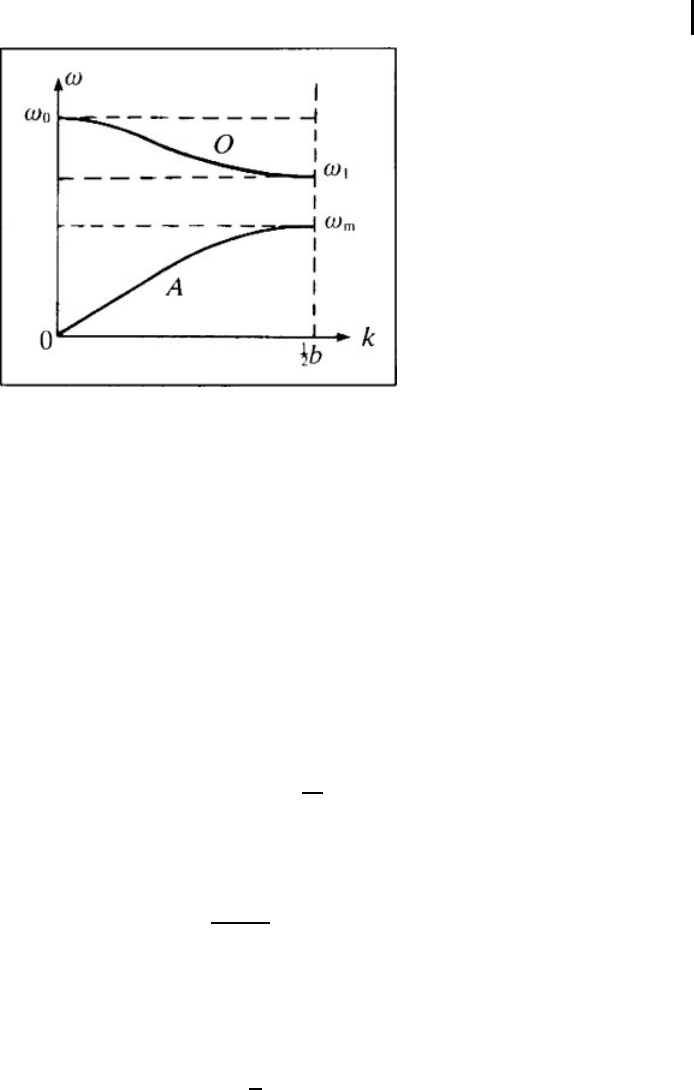
tice has the form of a plot in Fig. 3.1, where b is the period of a reciprocal lattice
in the chosen direction. The low-frequency branch of the dispersion law ( ω < ω
m
)
describes the acoustic vibrations, and the high-frequency one (ω
1
< ω < ω
2
)theop-
tical vibrations of a crystal. Thus, the polyatomic crystal lattice, apart from acoustic
vibrations (A) also has optical vibrations (O).
The generally accepted name for high-frequency branches of the vibrations is ex-
plained by the fact that in many crystals they are optically observed. In the NaCl ion
crystal, the unit cell contains two different ions whose relative displacement changes
the dipole moment of the unit cell. Consequently, the vibrations connected with rela-
tive ion displacements interact intensively with an electromagnetic field and may, thus,
be studied by optical methods.
When ω
1
(k) < ω
2
(k) for a fixed direction of k, the spectrum of optical vibra-
tion frequencies is separated by a finite gap from the spectrum of acoustic vibration
frequencies. However, it is possible that for some k the condition ω
1
(k) > ω
2
(k)
is fulfilled. Then, in k-space there are points of degeneracy where the acoustic and
optical vibration frequencies coincide and the plots of two branches are tangential or
intersect. The simplest plot of the dispersion law for a diatomic lattice is given in
Fig. 3.1 (
1
2
b indicates the Brillouin zone boundary).
Regardless of the complicated form of the dispersion law for the optical branch,
the corresponding frequencies always lie in a band of finite width and its ends are
generally the extremum points for the function ω = ω
2
(k) . The latter means that the
dispersion law near the ends of the optical band is quadratic.
The characteristic optical vibration frequencies have the same order of magnitude
as the limiting freque ncy of acoustic vibrations, i. e., ω
0
∼ ω
1
∼ ω
m
∼ 10
13
s
−1
.
3.1 Optical Vibrations
93
Fig. 3.1 Acoustic and optical branches of the dispersion law.
But in the crystal due to some specific physical reasons the frequencies of some optical
vibrations may increase markedly. In particular, this may occur in so-called molecular
crystals.
Let us consider a crystal lattice of two-atom molecules positioned at its sites. The
optical branch of vibrations of such a crystal describes intramolecular motions weakly
dependent on intermolecular interactions. These motions are characterized by fre-
quencies close to the eigenfrequencies of a free molecule. Then, ω
0
∼ ω
1
ω
m
, ω
0
− ω
1
ω
0
and the optical branch of vibrations has a narrow high-lying
frequency range.
Let ξ(n) be a coordinate of intramolecular vibrations at the point n. Then the as-
sumption o f a strong atomic interaction inside a molecule is reduced to the conditions
α
2
(0) |α
2
(n)|, α
2
(0)
µ
M
|α
1
(n)|; α
2
(0) |β
2
(n)|, n = 0.
Under these conditions the equations for intramolecular vibrations with frequencies
ω ∼ ω
0
have the form
µ
d
2
ξ(n)
dt
2
= −
∑
n
α
2
(n − n
)ξ(n
), (3.1.14)
and reduce to the equations for one scalar quantity ξ(n).
Thus, a scalar model may also be used for qualitative analysis of th e optical lattice
vibrations. For this, it suffices to replace the requirement (3.1.4) for the matrix α
1
(n)
with the condition
1
µ
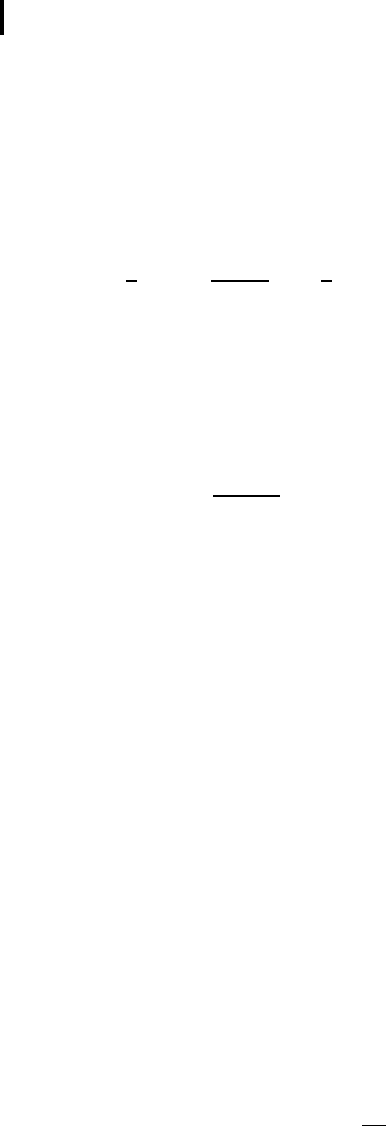
∑
α
2
(n)=ω
2
0
= 0, (3.1.15)
determining the long-wavelength limit for the frequency of optical vibrations.
94
3 Vibrations of Polyatomic Lattices
3.2
General Analysis of Vibrations of Polyatomic Lattice
We now consider the complete equations of three-dimensional vibrations of a crystal
whose unit cell contains q atoms. We number different atoms in one unit cell by the
index s and denote by u
s
(n) the displacement vector of the s-thatominaunitcell
with number-vector n,e.g.,the(n, s atom). The Lagrangian function of small crystal
vibrations is
L =
1
2
∑
m
s
du
s
(n)
dt
2
−
1
2
∑
α
ik
ss
(n − n
)u
i
s
(n)u
k
s
(n
), (3.2.1)
where the matrix of atomic force constants has the obvious properties
α
ik
ss
(n)=α
ki
s
s
(−n), i, k = 1, 2, 3, (3.2.2)
and a summation over all indices is assumed. The equations of motion are obtained
from (3.2.1) by the usual method
m
s
d
2
u
i
s
(n)
dt
2
= −
∑
n
,s
α
ik
ss
(n − n
)u
k
s
(n
), (3.2.3)
The invariance of (3.2.1) relative to the motio n of a crystal as a whole (u
k
s
(n)=u
k
0
)
leads to the following constraints imposed on the force matrix elements
∑
n,s
α
ik
ss
(n)=
∑
n,s
α
ik
ss
(n)=0. (3.2.4)
The relations (3.2.4) follow directly from (3.2.3). For stationary vibrations with the
frequency ω,wehave
∑
n
,s
α
ik
ss
(n − n
)u
k
s
(n
) − ω
2
m
s
u
i
s
(n)=0. (3.2.5)
We choose the solution to (3.2.5) as above in the form
u
s
(n)=u
s
e
ikr (n)
, s = 1, 2, 3, . . ., q,
and get for u
s
the following system of homogeneous algebraic equations
∑
s
A
ij
ss
(k)u
j
s
− ω
2
m
s
u
i
s
= 0, (3.2.6)
in which
A
ij
ss
(k)=
∑
n
α
ij
ss
(n)e
−ikr (n)
.
Transform (3.2.5), (3.2.6) to a canonical form of the equations of some eigenvalue
problem. For this we introduce instead of the displacement vectors, the new variables
v
s
(n)=
√
m
s
u
s
(n) ,
3.2 General Analysis of Vibrations of Polyatomic Lattice
95
and denote
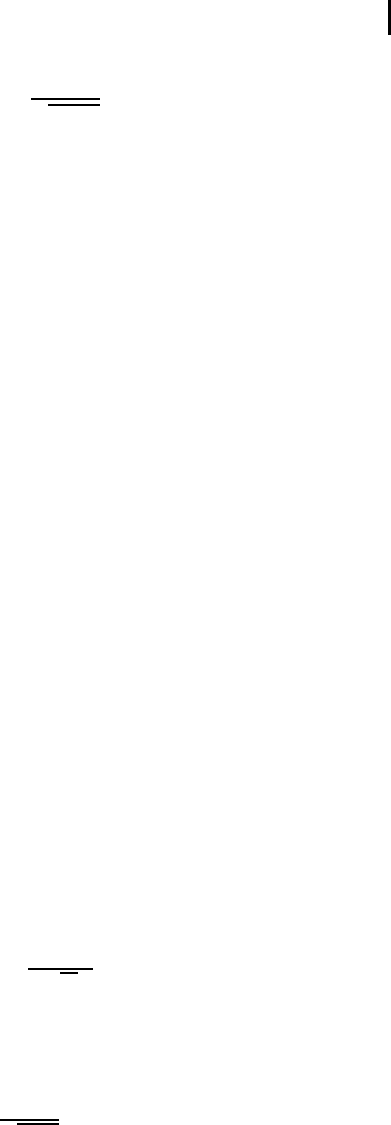
˜
A
ss
=
A
ss
√
m
s
m
s
. (3.2.7)
The symbolic matrix form of vibration equations both in the site, (3.2.5), and the
k-representation (3.2.6) reduces to the standard one
ω
2
v −
˜
Av = 0, (3.2.8)
where v stands for a column of 3q elements;
˜
A is the quadratic (3q ×3q)matrix.
The compatibility condition for the system (3.2.8) determines the relationship be-
tween the vibration frequency ω and the quasi-wave vector k
Det
ω
2
I −
˜
A(k)
= 0. (3.2.9)
Since (3.2.8) is an equation o f degree 3q with respect to ω
2
, its roots determine 3q
branches of the dispersion law for crystal vibrations.
To denote the displacements corresponding to different branches of vibrations, we
write the solution to (3.2.8) in the form
v
s
(n, t)=e
s
(k, α)e
i(kr(n)−ωt)
, (3.2.10)
where α is the number of a branch of vibrations; e
s
(k, α) is the unit vector of polar-
ization of this branch. Equation (3.2.9) means that atoms with different numbers s,
i. e., atoms belonging to various sublattices (various Bravais lattices) can vibrate in
different ways.
We impose on the real polarization vectors the requirement e
s
(k, α)=e
s
(−k, α)
and choose them so as to satisfy the following normalization conditions
q
∑
s=1
e
s
(k, α)e
s
(k, α
)=δ
α,α
. (3.2.11)
The orthogonality (3.2.11) of polarization vectors belonging to different branches of
vibrations generalizes the properties (1.3.2) of polarization vectors of a monatomic lat-
tice and realizes the linear independence of the proper solutions (3.2.10). We separate
the time multiplier e
iωt
and determine the normalized solutions (3.2.10) by analogy
with (1.3.3)
ϕ
kα
(n, s)=
e
s
(k, α)
√
N
e
ikr (n)
,
implying standard normalization conditions such as (1.3.4).
Coming back to the eigenvibrations of the crystal it is necessary to remember
(3.2.7). Therefore, the eigenvibrations of a complex lattice have the form
ψ
kα
(n, s)=
1
√
Nm
s
e
s
(k, α)e
ikr (n)
. (3.2.12)