
Kosevich A.M. The crystal lattice
Подождите немного. Документ загружается.

76
2 General Analysis of Vibrations of Monatomic Lattices
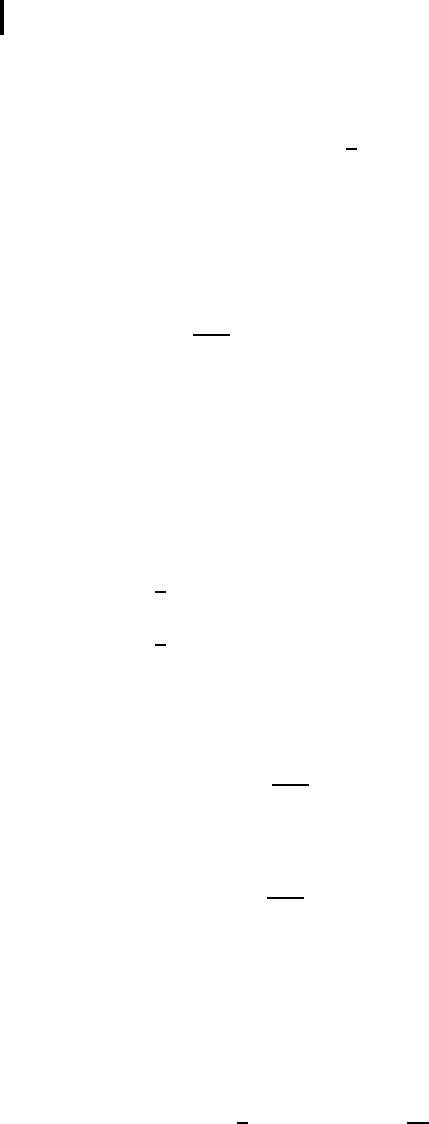
Expanding the function u(r
) as a series near the point r(x
1
, x
2
, x
3
) retaining only
the second-order terms in |x
k
(n) − x
k
(n
)|:
u
k
(r
)=u
k
(r)+(x
l
− x
l
)∇
l
u
k
(r)+
1
2
(x
l
− x
l
)(x
m
− x
m
)∇
l
∇
m
u
k
(r). (2.8.3)
Here we introduced the notation ∇
iφ
≡ ∂φ/∂x
i
; it will often be used later.
We now make use of the fast decay of coefficients α(n) with increasing n and
substitute the expansion (2.8.3) into (1.8.2), taking no account of the terms with higher
space derivatives of the displacements:
m
∂
2
u
i
∂t
2
= c
ik
u
k
+ c
ikl
∇
l
u
k
+ c
iklm
∇
l
∇
m
u
k
. (2.8.4)
The constant coefficients on the r.h.s. of (1.8.4) are defined by the force matrix
elements as:
c
ik
= c
ki
= −
∑
n
α
ik
(n)=0;
c
ikl
=
∑
n
α
ik
(n − n
)[x
l
(n) − x
l
(n
)] = −
∑
n
α
ik
(n)x
l
(n)=0;
c
iklm
= −
1
2
∑
n
α
ik
(n − n
)[x
l
(n) − x
l
(n
)][x
m
(n) − x
m
(n
)]
= −
1
2
∑
n
α
ik
(n)x
l
(n)x
m
(n) .
(2.8.5)
Thus, to describe the long-wave (slowly varying in space) crystal displacements we
have the following system of second-order differential equations in partial derivatives
m
∂
2
u
i
∂t
2
= c
iklm
∇
l
∇
m
u
k
. (2.8.6)
Equation (2.8.6) coincides in its notation with the dynamical equation of elasticity
theory
ρ
∂
2
u
i
∂t
2
= λ
iklm
∇
k
∇
l
u
m
, (2.8.7)
where ρ = m/V
0
is the mean mass density in a crystal (V
0
is the unit cell volume).
The coefficients on the r.h.s. of (2.8.7) that give the crystal elastic moduli tensor
have, however, known symme try with respect to a permutation of the first and second
pairs of indices.
Comparing (2.8.6), (2.8.7) we see that for these equations to be the same, the fol-
lowing equality should hold:
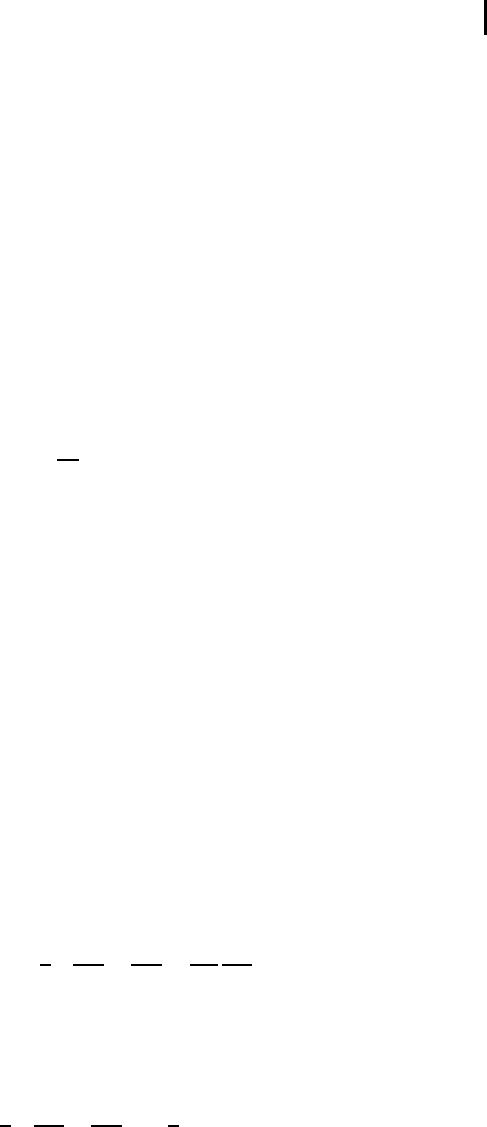
1
2
(λ
iklm
+ λ
ilkm
)=
1
V
0
c
imkl
. (2.8.8)
2.9 The Theory of Elasticity
77
The relation (2.8.8) will not be inconsistent only in the presence of the symmetry
c
iklm
= c
lmik
. (2.8.9)
The property (2.8.9) do es n ot follow immediately from the definition (2.8 . 5) and
imposes additional constraints on the force matrix elements of a crystal. We make use
of (2.8.5) and write these constraints as
∑
α
ik
(n)x
l
(n)x
m
(n)=
∑
α
lm
(n)x
i
(n)x
k
(n) . (2.8.10)
It is clear that the conditions (2.8.10) are actually the result of the invariance of
crystal energy relative to a hard rotation of the type (2.1.7).
By imposing the constraints (2.8.10) on the matrix of atomic force constants we
provide for the symmetry (2.8.9). This allows us to establish a relation between the
tensors λ
iklm
and c
iklm
, by solving the relation (2.8.8) for the elastic modulus tensor:
λ
iklm
=
1
V
0
c
imkl
+ c
kmil
−c
lmki
. (2.8.11)
The equality (2.8.11) determines the cry stal moduli through the atom force con-
stants, i. e., gives an exact relationship between macroscopic mechanical monocrystal
characteristics and microscopic crystal lattice properties.
2.9
The Theory of Elasticity
The transformation from crystal lattice equations (2.8.1 ) to those of elasticity theory
(2.8.7) is accomplished by changing the model of the substance construction. We
go over from a discrete structure to a continuum, i. e., the lattice is replaced by a
continuous medium. This radical change from a microscopic description of a crystal
to a macroscopic one entails new concepts, terms and relations.
For a macroscopic (or continuum) description of crystal deformation, the concept of
a displacement vector u as a function of coordinates r(x, y , z) an d time t: u = u(r, t)
is normally used. Using space derivatives of the displacement vector, the strain tensor
(i, k = 1, 2, 3) is written as
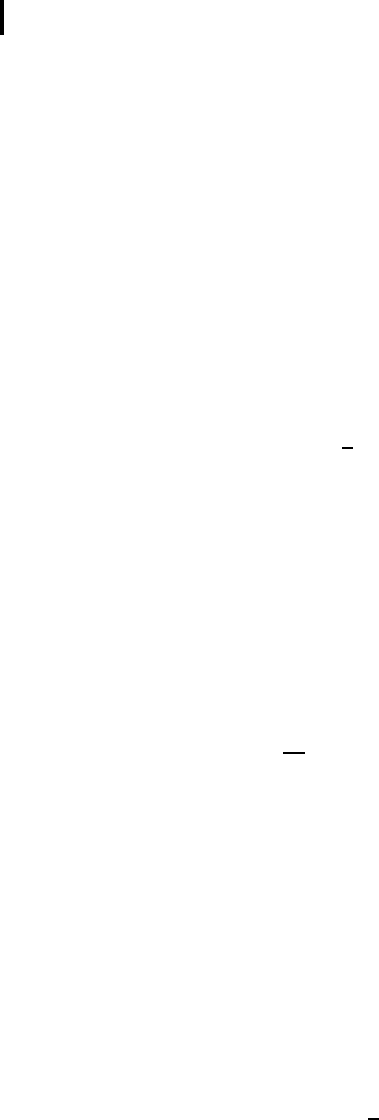
ik
=
1
2
∂u
i
∂x
k
+
∂u
k
∂x
i
+
∂u
l
∂x
i
∂u
l
∂x
k
. (2.9.1)
The latter is the main geometrical characteristic of the deformed state of a medium.
The tensor
ik
defined by (2.9.1) is sometimes called the finite strain tensor,andthe
part that is linear in displacements,
ik
=
1
2
∂u
i
∂x
k
+
∂u
k
∂x
i
≡
1
2
(∇
i
u
k
+ ∇
k
u
i
) , (2.9.2)
78
2 General Analysis of Vibrations of Monatomic Lattices
is the small strain tensor. The linear elasticity theory that we will be co ncerned with
is based on the definition of the strain tensor (2.9.2).
Six different elements of the strain tensor (2.9.2) cannot be absolutely independent
since all of them are generated by differentiating three components of displacement
vectors. Indeed the strain tensor components
ik
are related by differential relations
known as the Saint Venant compatibility conditions:
e
ilm
e
kpn
∇
l
∇
p
mn
= 0. (2.9.3)
All the components of the tensor of homogeneous deformations (independent of the
coordinates) can, however, be arbitrary.
In addition to the strain tensor (2.9.2), often the distortion tensor u
ik
= ∇
i
u
k
whose
symmetrical part determines the tenso r
ik
introduced. The antisymmetric part of th e
distortion tensor gives the vector ω o f the local crystal lattice rotation due to deforma-
tion:
ω =
1
2
curl u. (2.9.4)
The sum of diagonal elements o f the tensor
ik
, i. e., the value of e
kk
equals the
relative increase in the volume element under deformation. Consequently, the total
change in the volume as a result of deformation ∆V can be written as
∆V =
kk
dV . (2.9.5)
The time derivative of the vector u determines the velocity of displacements v =
∂u/∂t. If a crystal is deformed but retains its continuity (no breaks, cracks, cavities,
etc.) the displacement velocity satisfies the continuity equation
∂ρ
∂t
+ div ρv = 0, (2.9.6)
where ρ is the crystal density (the mass of a unit volume).
The forces of internal stresses arising under crystal deformation are characterized
by the symmetric stress tensor σ
ik
; the force that acts on unit area is
F
i
= σ
ik
n
0
k
,
where n
0
is the unit vector normal to the area. If the area concerned is chosen on an
external body surface then F equals the force created by external loads.
In the case of hydrostatic crystal compression under the pressure p the tensor σ
ik
reads
σ
ik
= −pδ
ik
. (2.9.7)
On the basis o f (2.9.7)
p
0
= −
1
3
σ
kk
(2.9.8)
2.9 The Theory of Elasticity
79
is called the mean hydrostatic pressure when the stress tensor does not coincide with
(2.9.7) and describes a more complex crystal state. When the tensor σ
ik
is different
from (2.9.7) displacement stresses are present, which are usually characterized by the
deviator tensor:
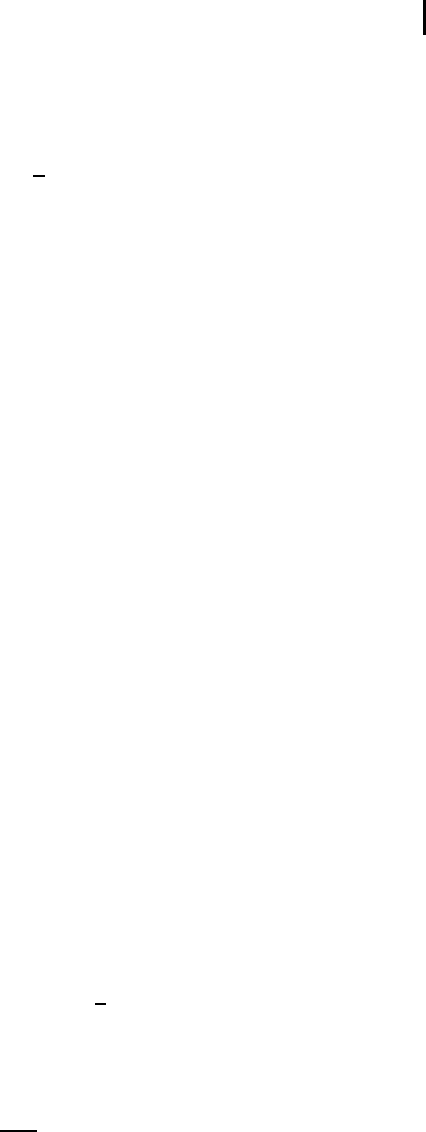
σ
ik
= σ
ik
−
1
3
δ
ki
σ
ll
= σ
ik
+ δ
ik
p
0
. (2.9.9)
If the crystal deformation is purely elastic, the stresses are related linearly to strains
ik
by the generalized Hooke’s law:
σ
ik
= λ
iklm
lm
, (2.9.10)
where λ
iklm
is the tensor of crystal elasticity moduli. For a cubic crystal, there are
three independent elastic moduli (or stiffness constants):
λ
1
= λ
1111
= λ
2222
= λ
3333
, λ
2
= λ
1122
= λ
1133
= λ
2233
;
G = λ
1212
= λ
1313
= λ
2323
. (2.9.11)
In an isotropic approximation these three moduli are related through λ
1
−λ
2
−2G =
0. Therefore, the tensor λ
iklm
for an isotropic medium reduces to two independent
moduli that can be represented, for example, by the Lamé coefficients λ = λ
2
and G:
λ
iklm
= λδ
ik
δ
lm
+ G(δ
il
δ
km
+ δ
im
δ
kl
). (2.9.12)
The coefficient G in (2.9.11), (2.9.12) often denoted by µ is called the shear mod-
ulus and relates the nondiagonal (“oblique”) elements of the σ
ik
and
ik
tensors in an
isotropic medium and in a cubic crystal
σ
ik
= 2G
ik
, i = k. (2.9.13)
Note that there is an obvious relation b etween the mean hydrostatic pressure p
0
and
the relative compression of an isotropic medium or a cubic crystal. From (2.9.10)–
(2.9.12), we have
σ
ll
= 3K
ll
, (2.9.14)
where K is the modulus of hydrostatic compression that, in a cubic crystal, is found
from
3K = λ
1
+ 2λ
2
, (2.9.15)
and, in an isotropic medium, from
K = λ +
2
3
G. (2.9.16)
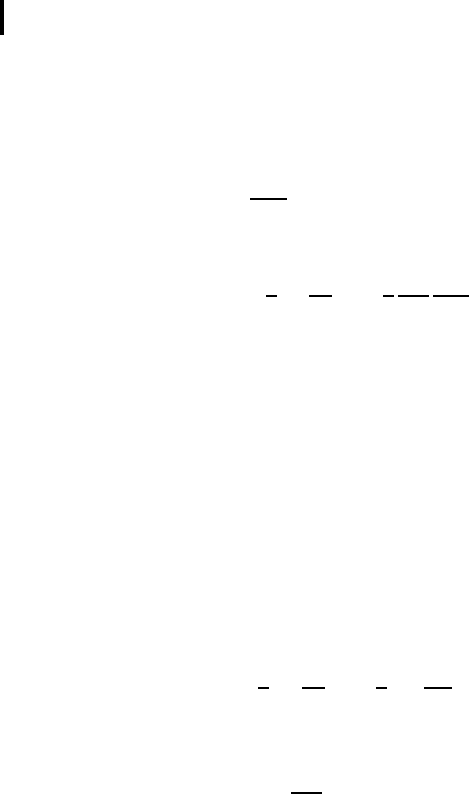
To determine the deformed and stressed crystal states in the presence of bulk forces,
it is necessary to solve the following equation for an elastic medium
ρ
∂
2
u
i
∂t
2
= ∇
k
σ
ki
+ f
i
, (2.9.17)
80
2 General Analysis of Vibrations of Monatomic Lattices
where the vector f describes the density of bulk forces acting on a crystal (the mean
force applied to a crystal unit volume), and the tensor σ
ik
is related to the strains
through Hooke’s law (2.9.10).
The dynamics of a free elastic field ( f = 0) is described by
ρ
∂
2
u
i
∂t
2
−λ
iklm
∇
k
∇
l
u
m
= 0. (2.9.18)
Equation (2.9.18) corresponds to the Lagrangian function
L =
1
2
ρ
∂u
∂t
2
−
1
2
∂u
k
∂x
i
∂u
m
∂x
l
dV . (2.9.19)
Equation (2.9.18) and the corresponding Lagrangian function, even in an isotropic
case, are rather comp licated. One of the difficulties in solving (2.9.1 8) for the three
components of the displacement vector u is the following. Equation (2.9.18) is similar
to a wave equation. In transforming to normal vibrations we can reduce it to three
wave equations. But the latter describe the waves prop agating with different velocities.
Even in an isotropic approximation the elastic field has two different characteristic
wave velocities (the velocities of longitudinal and transverse waves). This very much
complicates the solution of dynamic problems.
To simplify the equations reflecting the main physical properties of an elastic
medium, we formulate the analog of the scalar model for an elastic continuum, i. e.,
we introduce a scalar elastic field. We take as a generalized field coordinate the scalar
value u(r, t) and assume the Lagrangian function of this field to be
L =
1
2
ρ
∂u
∂t
2
−
1
2
G
∂u
∂x
i
2
dV . (2.9.20)
The equation for the field motion stemming from (2.9.20) is
ρ
∂
2
u
∂t
2
− G∆u = 0, (2.9.21)
where ∆ is the Laplace operator (∆ = ∇
2
k
). This is an ordinary equation of the waves
propagation with the acoustic dispersion law:
ω
2
= s
2
k
2
, s = G/ρ. (2.9.22)
The main disadvantage of (2.9.21) as a model equation for crystal dynamics is its
scalar character, which does not allow one to describe transverse elastic vibrations.
2.10
Vibrations of a Strongly Anisotropic Crystal (Scalar Model)
We write the dispersion law for monatomic lattice vibrations with interatomic nearest-
neighbor interactions in an explicit form, using a scalar model that enables us to find
2.10 Vibrations of a Strongly Anisotropic Crystal (Scalar Model)
81
the dependence of vibration frequencies on the quasi-wave vector through the simplest
elementary functions. It turns out that for crystal directions where it is possible to dis-
tinguish longitudinal and transverse vibrations a scalar model describes the crystal
longitudinal vibrations well. This can be explained as follows. There is no polariza-
tion of displacements in a scalar model and the only vector characteristic of a normal
vibration is vector k. Therefore, the atomic displacements described by such a model
can be associated only with the quasi-wave vector direction.
Going over to the formulation of a concrete problem, we simplify a model to de-
scribe in detail some interesting physical properties of a vibrating crystal, in particular,
the vibrations of strongly anisotropic crystal lattices.
As an example of such an anisotropic model we consider a tetragonal lattice with
different interactions of the nearest atoms in the basal plane (xO y) and along the four-
fold axis (z). Choosing naturally the translation vectors, we denote |a
1
| = |a
2
| =
a, |a
3
| = b. The neighboring atom interaction in the basal plane will be described by
the force matrix element α
1
and the interaction along the axis z by the element α
2
.On
the basis of the relation (2.1.10), we have
α
0
+ 4α
1
+ 2α
2
= 0. (2.10.1)
Since α
0
= α(0) > 0, it follows from (2.10.1) that 2α
1
+ α
2
< 0. We assume that
α
1
< 0 and α
2
< 0.
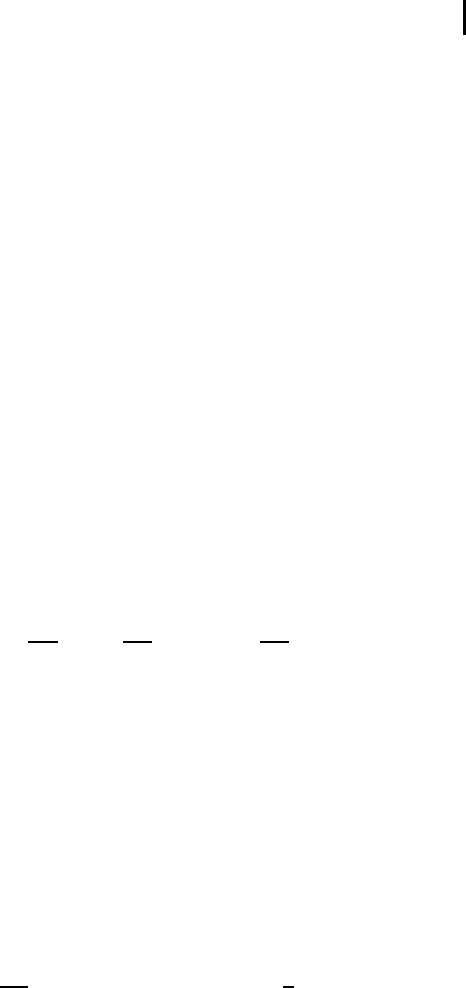
The dispersion law (2.2.10) for the lattice concerned is written as
ω
2
(k)=ω
2
1
sin
2
ak
x
2
+ sin
2
ak
y
2
+ ω
2
2
sin
2
ak
z
2
, (2.10.2)
where ω
2
1
= −4α
1
/m and ω
2
2
= −4α
2
/m.
We assume the atomic interaction in the basal plane to be much stronger than that
along the four-fold axis:
ω
1
ω
2
. (2.10.3)
This assumption transforms a tetragonal lattice into a crystal lattice with a layered
structure, whose separate atom layers are interrelated weakly. The formula (2.10.2)
for such a crystal determines an extremely anisotropic dispersion relation, which is
well shown in the low-frequency part of the vibration spectrum.
Consider the frequencies ω ω
1
(e. g., ω ≤ ω
2
) for which the formula (2.10.2)
is much simplified
ω
2
= s
2
1
k
2
⊥
+ ω
2
2
sin
2
ak
z
2
; k
2
⊥
= k
2
x
+ k
2
y
, s
2
1
=
1
4
a
2
ω
2
1
, (2.10.4)
where s
1
has a meaning of a sound velocity in the basal plane.
In view of the conditio n (2.1 0.3), we keep the second term in the r.h.s. of (2.1 0.4)
unchanged, in so far as the assumption ω ω
1
does not imply that bk
z
is small.
Thus, we take into account that at comparatively low frequencies the quasi-wave vec-
tor component along the z-axis may be large.
82
2 General Analysis of Vibrations of Monatomic Lattices
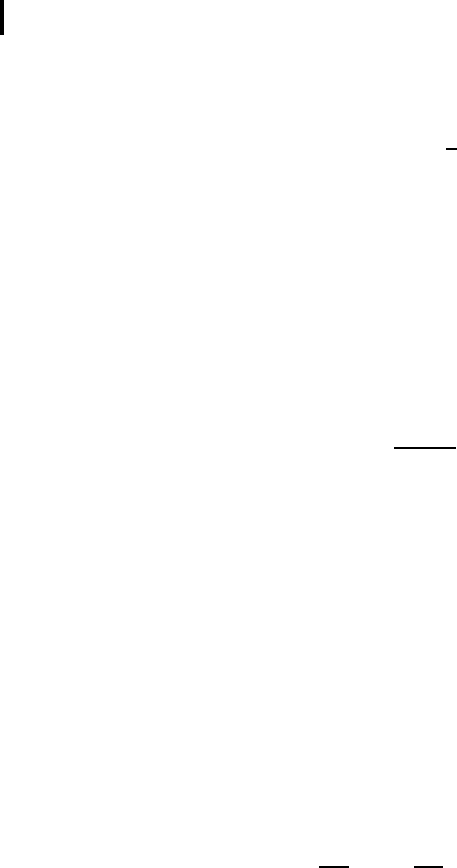
Within the long-wave limit when bk
z
1, (2.10.4) gives the dispersion law of
sound vibrations in an anisotropic medium
ω
2
= s
2
1
k
2
⊥
+ s
2
2
k
2
z
; s
2
2
=
1
2
b
2
ω
2
2
, (2.10.5)
where s
2
is the sound velocity along the z-axis.
If the lattice parameters a, b are little different (have the same order o f magnitude),
the sound velocity in the basal plane of a “layered” crystal will be much larger than
that in a p erpendicular direction (s
2
s
1
).
Equation (2.10.4) is also simplified in the case when the vibration frequencies have
the range
ω
2
ω ω
1
. (2.10.6)
For such frequencies the second term in (2.10.4) should not be taken into account,
and the dispersion relation reduces to
ω = s
1
k
⊥
≡ s
1
k
2
x
+ k
2
y
, (2.10.7)
which coincides with the dispersion relation for sound vibrations in a two-dimensional
elastic medium. Hence, under the conditions (2.10.6) the frequency of vibrations of
a three-dimensional “layered” crystal is independent of the wave-vector component
along the direction perpendicular to its “layers”.
Along with a “layered” crystal, one can consider a crystal model with a “chain”
structure where one-dimensional chains of atoms weakly interact one with another. In
order to obtain this model it suffices to assume
ω
1
ω
2
. (2.10.8)
Then the results stated above are easily transformed by changing the numbers 1 and 2
and also the components k
i
and k
z
.
In particular, at frequencies ω ≤ ω
1
the dispersion relation (2.10.2) reduces to
ω
2
= ω
1
sin
2
ak
x
2
+ sin
2
ak
y
2
+ s
2
2
k
2
z
.
In the long-wave limit (ak
⊥
1) we come again to (2.10.5), and in the frequency
range ω
1
ω
2
the dispersion law of vibrations of such a crystal coincides with the
dispersion law of elastic vibrations of a one-dimensional system
ω = s
2
k
z
,
i. e., the vibration frequency is independent of the wave-vector projection onto the
plane perpendicular to the direction of a strong interaction between atoms.

2.11 “Bending” Waves in a Strongly Anisotropic Crystal
83
2.11
“Bending” Waves in a Strongly Anisotropic Crystal
We consider a crystal with a simple hexagonal lattice in which the atoms interact in
different ways in the basal plane xOy and along the six-fold axis Oz. We assume
the crystal structure to be layered and the atom interaction in the plane xOy to be
much larger than the atom interaction in neighboring basal planes. In describing the
vibration of such “layered” crystal one can proceed from the model that takes exact
account of the strong interaction between all atoms lying in the basal plane, and the
weak interaction of neighboring atomic layers is taken into account in the nearest-
neighbor approximation along the six-fold axis.
A crystal with a ch ain structure may be considered simultaneously. A crystal with
such a structure co nsists of weakly interacting parallel linear chains. In the model
proposed, this corresponds to the fact that the atomic interaction along the six-fold
axis is much stronger that the interaction between neighboring chains (or the nearest
neighbors in the plane xOy).
An example o f a chemical element th at has three possible crystalline forms (ap-
proximately isotropic, layered and chain) is carbon. It exists in the form of diamond
(an extremely hard crystal with a three-dimensional lattice), in the form of graphite
(layered crystal) and in the form of carbene (a synthetic polymer chain structure).
For definiteness the following arguments are given for a layered crystal and intended
for the model formulated above. The latter makes it p ossible to qualitatively describe
the acoustic vibrations in graphite – a layered hexagonal crystal with very weak in-
teractions between the layers
4
. The atomic forces between the neighboring layers in
graphite are almost two orders less that the nearest-neighbor interaction forces within
the layer.
Let a and b be interatomic distances in the xOy plane and along the Oz-axis, respec-
tively. The vector n
1
represents a set of two-dimensional number vectors connecting
any one of the atoms with all remaining atoms in the same basal plane, n
3
is the unit
vector of the Oz-axis. Then nonzero elements of the matrix α
ik
(n) in our model are
represented by α
ik
(n
1
) and α
ik
(n
2
). Making use of the obvious force matrix sym-
metry in a hexagonal crystal, we write the elements α
ik
(n
3
) responsible for the weak
atomic layer interaction as fo llows
α
ik
(n
3
)= α
1
δ
ik
, i, k = 1, 2,
α
zz
(n
3
)= α
2
, α
xz
(n
3
)=α
yz
(n
3
)=0.
(2.11.1)
Concerning the spectrum of acoustic vibrations of graphite we note that the param-
eter α
2
is generally larger than α
1
,andα
2
is determined mainly by central forces
|α
1
||α
2
|, (2.11.2)
(for graphite α
2
≈ 10α
1
≈ 0.610
4
dyn/cm).
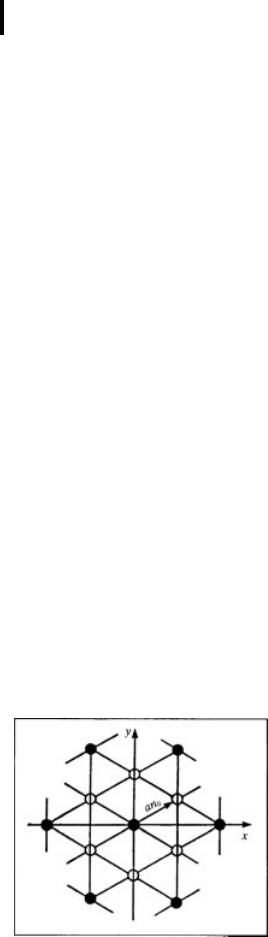
4) Graphite has a complex lattice with atoms positioned in a separate basal
plane as shown in Fig. 2.2.
84
2 General Analysis of Vibrations of Monatomic Lattices
To characterize the strong interaction in the basal plane, we introduce the notation
α
3
= α
zz
(n
0
),wheren
0
is the unit vector directed from an atom to any one of its six
nearest neighbors in the plane xOy (Fig. 2.2). It may also be assumed that
α
ik
(n
0
) ∼ α
zz
(0) ∼ α
3
, i, k = 1, 2. (2.11.3)
For graphite α
3
∼ 10
5
dyn/cm.
Now the assumption of a layered crystal structure can be formulated in the form of
a quantitative ratio establishing a hierarchy of interatomic interactions
|α
1
||α
2
||α
3
|. (2.11.4)
We note an important property of anisotropic crystal vibrations whose displace-
ment vector u is perpendicular to the strong interaction layers (perpendicular to the
xOy plane). For a very weak layer interaction, these vibrations should resemble the
bending waves in the noninteracting layers
5
, so that they may tentatively be referred to
as “bending” vibrations. Simultaneously, assuming strong anisotropy of interatomic
interactions (2.9.4) and the same order of the lattice constant values (a ∼ b), it is im-
possible in describing the “bending” vibrations to include only the nearest-neighbor
interaction in the basal plane. Noting that the character of the bending vibrations is
primarily determined b y the force matrix elemen ts α
zz
(n
1
), we take into account the
conditions (2.8.10) imposed on the A(n) matrix elements, putting i, k = x or i, k = y
and l, m = z:
2α
1
b
2
=
∑
n
1
α
zz
(n
1
)x
2
(n
1
)=
∑
n
1
α
zz
(n
1
)y
2
(n
1
). (2.11.5)
Fig. 2.2 Choice of the nearest neighbors in the basis plane of an
hexagonal crystal
By keeping in (2.11.5) the summation over the vectors n
0
only, we get the equality
2α
1
b
2
= 3α
3
a
2
, (2.11.6)
5) The need to take into account the bending wave type of vibrations in lay-
ered crystals with a weak interlayer interaction was first indicated by Lifshits
(1952).
2.11 “Bending” Waves in a Strongly Anisotropic Crystal
85
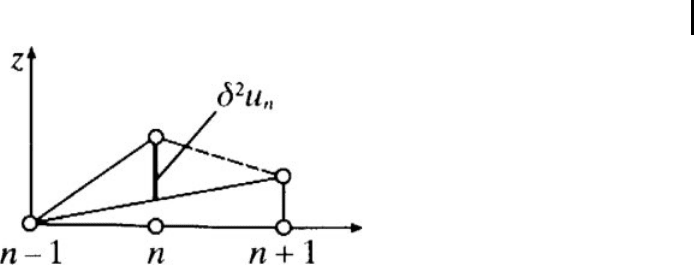
Fig. 2.3 Second difference in atom displacements that determines the
bend energy.
which is impossible when the requirements a ∼ b and |α
1
| I |α
3
| are satisfied
simultaneously.
Thus, such a model for a layered crystal with interaction between nearest neighbors
only is in fact intrinsically inconsistent. To describe a crystal lattice with a charac-
teristic layered structure having “bending” waves it is necessary, while keeping the
relations such as (2.11.4), to take into account more distant interatomic interactions in
the basal plane. The physical meaning of this assertion is easily understood if we con-
sider the limiting case of noninteracting layers possessing bend rigidity. Analyzing
one atomic layer allows one to conclude that the interaction of atoms displaced along
the Oz-axis (Fig. 2.3) is determined by the difference of relative pair displacements of
at least three atoms rather than by the relative displacement of two neighboring atoms.
The atomic interaction energy under bending vibrations of the plane layer depends on
δu
n
=(1/2)[(u
n
− n
n−1
) − (u
n+1
−u
n
)] = u
n
−(1/2)(u
n−1
+ u
n+1
).
We now turn to (2.11.5) and note that it does not contradict the assumption of a
strong anisotropy of a crystal. This is due to the fact that the elements of the matrix
α
zz
(n
1
) describing the interaction not only between nearest neighbors in the plane
xOy can be quantities of the same order of magnitude and have opposite signs. The
signs of each of them satisfy the condition
∑
n
α
zz
(n) ≡ α
zz
(0)+
∑
n=0
α
zz
(n
1
)+2α
zz
(n
3
)=0. (2.11.7)
Taking into account the inequality (2.11.4), we conclude from (2.11.7) that
∑
n=0
α
zz
(n
1
) < 0. (2.11.8)
To find the dispersion law of the vibrations, we calculate the tensor functions
A
ij
(k)=
∑
n
α
ij
(n)e
−ikr (n)
≡
∑
n=0
α
ij
(n)[cos kr (n) −1] . (2.11.9)
Assume that
α
zz
(n
1
)=α
yz
(n
1
)=0. (2.11.10)