
Krantz W.B. Scaling Analysis in Modeling Transport and Reaction Processes: A Systematic Approach to Model Building and the Art of Approximation
Подождите немного. Документ загружается.

FILM AND PENETRATION THEORY APPROXIMATIONS 153
That is, the thickness of the region of influence near the lateral boundary is
equal to the vertical length scale. This implies that an approximate analysis that
ignores lateral heat conduction will begin to incur significant error when x
∗
≡
x/W = δ
t
/W = H/W. Note in Figure 4.2-2 that the percentage error in the dimen-
sionless temperature begins to increase markedly when x
∗
< 0.1forH/W = 0.1
(H
2
/W
2
= 0.01) and when x
∗
< 0.316 for H/W = 0.316 (H
2
/W
2
= 0.1). Hence,
we see that scaling analysis not only determines the criterion for when lateral con-
duction can be ignored, but also provides a measure of the region near the lateral
boundaries wherein this assumption breaks down.
A similar scaling analysis can be done to determine when three-dimensional heat
conduction in a rectangular block can be simplified to a two- or one-dimensional
problem. The criteria for ignoring axial conduction in a long thin solid cylinder
or radial conduction in a short wide cylinder can also be determined using an
analogous scaling analysis. These are considered in the practice problems at the
end of the chapter.
4.3 FILM AND PENETRATION THEORY APPROXIMATIONS
Now that the procedure for
◦
(1) scaling analysis has been illustrated in detail,
we use this method to explore the various approximations made in classical heat-
transfer modeling. The first problem that we consider is unsteady-state one-
dimensional heat conduction in a solid that has constant physical properties and
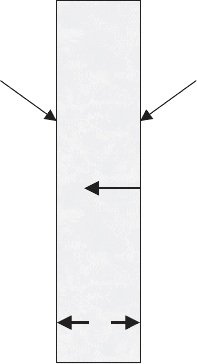
a thickness H as shown in Figure 4.3-1. This solid is initially at a constant
H
x
T = T
0
T = T
0
t ≤ 0
T = T
1
t > 0
Figure 4.3-1 Unsteady-state one-dimensional heat conduction in a solid with constant
physical properties and thickness H .

154 APPLICATIONS IN HEAT TRANSFER
temperature T
0
; however, one surface of this solid is then raised to a temper-
ature T
1
while the other surface is maintained at T
0
. We use scaling analysis
to explore what approximations might be made to simplify this heat-transfer
problem.
We begin by writing the thermal energy equation given by equation (F.1-2) in
the Appendices appropriately simplified for the conditions defined in the problem
statement along with the initial and boundary conditions (step 1):
∂T
∂t
= α
∂
2
T
∂x
2
(4.3-1)
T = T
0
at t ≤ 0, 0 ≤ x ≤ H (4.3-2)
T = T
1
at x = 0,t>0 (4.3-3)
T = T
0
at x = H (4.3-4)
where α ≡ k/ρC
p
is the thermal diffusivity in which k the thermal conductivity,
ρ the mass density, and C
p
the heat capacity at constant pressure. Equation (4.3-
2) is the given initial temperature condition. Equations (4.3-3) and (4.3-4) are the
prescribed constant temperatures at the two boundaries. This is a nontrivial problem
to solve, due to the unsteady-state heat transfer and the finite thickness of the solid.
We use
◦
(1) scaling to explore when these describing equations might be simplified
to permit a tractable solution.
We begin by defining dimensionless variables involving unspecified scale factors
(steps 2, 3, and 4):
T
∗
≡
T − T
r
T
s
; x
∗
≡
x
x
s
; t
∗
≡
t
t
s
(4.3-5)
Note that we have introduced a reference factor for the temperature since it is not
naturally referenced to zero. We then introduce these dimensionless variables into
the describing equations and divide through by the coefficient of one term in each
equation that we believe should be retained (steps 5 and 6):
x
2
s
αt
s
∂T
∗
∂t
∗
=
∂
2
T
∗
∂x
∗2
(4.3-6)
T
∗
=
T
0
− T
r
T
s
at t
∗
≤ 0, 0 ≤ x
∗
≤
H
x
s
(4.3-7)
T
∗
=
T
1
− T
r
T
s
at x
∗
= 0,t
∗
> 0 (4.3-8)
T
∗
=
T
0
− T
r
T
s
at x
∗
=
H
x
s
(4.3-9)
Now let us proceed to determine the scale factors (step 7). The dimension-
less temperature can be bounded to be
◦
(1) by setting the groups containing the

FILM AND PENETRATION THEORY APPROXIMATIONS 155
temperature scale and reference factors in equations (4.3-7) or (4.3-9) and (4.3-8)
equal to 1 and zero, respectively, to obtain
T
∗
=
T
0
− T
r
T
s
= 0 ⇒ T
r
= T
0
(4.3-10)
T
∗
=
T
1
− T
r
T
s
= 1 ⇒ T
s
= T
1
− T
0
(4.3-11)
The scale factor for the dimensionless time variable for unsteady-state problems is
often the observation or contact time; that is, t
s
= t
o
, the particular time at which
the process is being considered. The manner in which the length scale factor is
determined depends on the observation time. Let us assume that the dimensionless
groups containing the length scale in equations (4.3-7) or (4.3-9) determine x
s
.
Although this bounds the dimensionless spatial coordinate to be
◦
(1), it does not
necessarily bound the dimensionless temperature derivative to be
◦
(1). Indeed, the
temperature derivative could involve a much shorter length scale during the early
stages of heat transfer when the conduction has not penetrated very far into the
solid. However, let us assume that
H
x
s
= 1 ⇒ x
s
= H (4.3-12)
Substitution of the scale and reference factors defined by equations (4.3-10)
through (4.3-12) into the describing equations yields
H
2
αt
o
∂T
∗
∂t
∗
=
1
Fo
t
∂T
∗
∂t
∗
=
∂
2
T
∗
∂x
∗2
(4.3-13)
T
∗
= 0att
∗
≤ 0, 0 ≤ x
∗
≤ 1 (4.3-14)
T
∗
= 1atx
∗
= 0,t
∗
> 0 (4.3-15)
T
∗
= 0atx
∗
= 1 (4.3-16)
The nature of this unsteady-state heat-transfer process is characterized by the
dimensionless group in equation (4.3-13), which is referred to as the Fourier num-
ber for heat transfer, Fo
t
. The physical significance of the Fourier number for heat
transfer is that it is the ratio of the contact time available for heat transfer t
o
divided
by the characteristic time H
2
/α required for heat conduction through the thickness
H ;thatis,
Fo
t
≡
αt
o
H
2
=
observation or contact time
characteristic time for conduction
(4.3-17)
Now let us explore possible simplifications of the describing equations (step 8).
Note that if Fo
t
1, the unsteady-state term becomes insignificant; hence, the heat

156 APPLICATIONS IN HEAT TRANSFER
transfer can be assumed to be steady-state; that is,
Fo
t
≡
αt
o
H
2
1 ⇒ steady-state heat transfer (4.3-18)
Note that a large Fourier number in this problem ensures that the heat transfer
is truly steady-state, in contrast to quasi-steady-state. The latter implies that the
unsteady-state term in the energy equation is negligible but that the problem is still
unsteady-state, due to time dependence that enters through the boundary conditions.
Quasi-steady-state heat transfer is considered in a subsequent section. If Fo
t
∼
=
10,
the error incurred in assuming steady state when determining quantities such as
the heat flux into the solid at x = 0 will be on the order of 10%; if Fo
t
∼
=
100, the
error will be reduced to approximately 1%. However, unless the Fourier number is
very large, the error incurred in predicting point quantities such as the temperature
at x = H could be quite large. Note that since heat is penetrating from the face at
x = 0 toward the face at x = H , the solid in the region closer to x = 0 receives
more heat than the region nearer to x = H and therefore heats up more quickly.
For this reason the error incurred in predicting the local temperature for moderate
values of the Fourier number will be greater for planes nearer to x = H .
Let us now consider the special case of where Fo
t
=
◦
(1), that is, when its
value is essentially equal to 1. In this case the heat transfer is inherently unsteady
state; however, the thermal penetration is through the entire thickness H of the
solid; hence, H is the appropriate length scale to ensure that the dimensionless
temperature derivative is
◦
(1). Scaling permits estimating the time required for the
heat penetration to reach the face at x = H ; this will be denoted by t
H
and is
determined as
Fo
t
≡
αt
H
H
2
= 1 ⇒ t
H
=
H
2
α
(4.3-19)
Now let us explore another possible approximation that can be made in the
describing equations. If Fo
t
◦
(1), the contact time is so short that the thermal
penetration will be confined to a region of influence or boundary layer whose
thickness is less than H . Scaling can be used to determine the thickness of this
region of influence. However, to do so, it is necessary to rescale the problem since
the length scale over which the temperature experiences a characteristic change is
no longer H . Let us denote the thickness of this region of influence by δ
t
;thatis,
our length scale is now x
s
= δ
t
. The dimensionless describing equations now are
given by
δ
2
t
αt
s
∂T
∗
∂t
∗
=
∂
2
T
∗
∂x
∗2
(4.3-20)
T
∗
=
T
0
− T
r
T
s
at t
∗
≤ 0, 0 ≤ x
∗
≤
H
δ
t
(4.3-21)
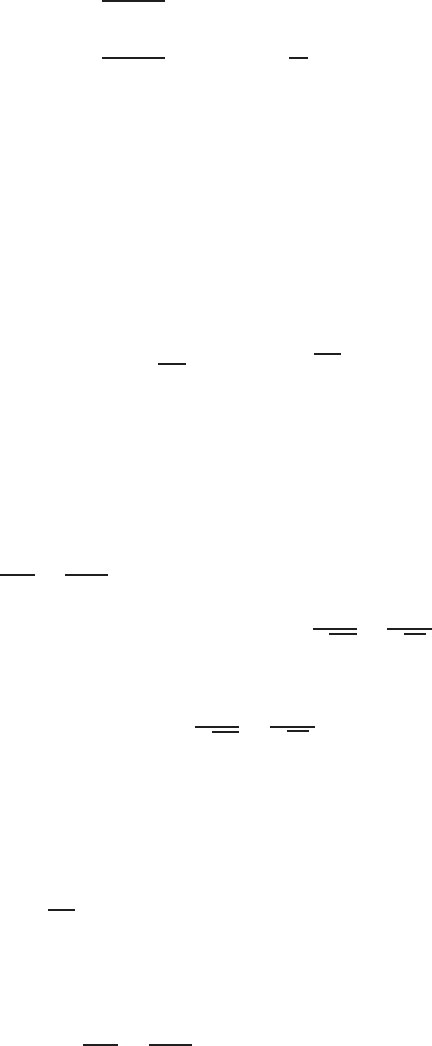
FILM AND PENETRATION THEORY APPROXIMATIONS 157
T
∗
=
T
1
− T
r
T
s
at x
∗
= 0,t
∗
> 0 (4.3-22)
T
∗
=
T
0
− T
r
T
s
at x
∗
=
H
δ
t
(4.3-23)
Equations (4.3-21) through (4.3-23) indicate that our reference and scale temper-
atures are still determined by equations (4.3-10) and (4.3-11). Moreover, due to
the unsteady-state, the characteristic time again will be the observation time t
o
.
However, since this is inherently unsteady-state heat transfer, the unsteady-state
term and the conduction term in equation (4.3-20) must balance each other and be
of
◦
(1). To ensure this, we set the dimensionless group multiplying the unsteady-
state term in equation (4.3-20) equal to 1; this then provides an estimate for δ
t
,the
thickness of the region of influence:
δ
2
t
αt
o
= 1 ⇒ δ
t
=
√
αt
o
(4.3-24)
Note that equation (4.3-24) implies that the thickness of the region of influence or
boundary-layer thickness increases with time. Note also that when t = t
H
= H
2
/α,
we obtain δ
t
= H ; that is, the limiting value of δ
t
is H, as expected.
Equation (4.3-24) implies that our describing equations can be written as
∂T
∗
∂t
∗
=
∂
2
T
∗
∂x
∗2
(4.3-25)
T
∗
= 0att
∗
≤ 0, 0 ≤ x
∗
≤
H
√
αt
o
=
1
√
Fo
t
(4.3-26)
T
∗
= 1atx
∗
= 0,t
∗
> 0 (4.3-27)
T
∗
= 0atx
∗
=
H
√
αt
o
=
1
√
Fo
t
(4.3-28)
Note that if the Fourier number is very small, the thermal penetration thickness δ
t
will be much less than the thickness of the solid H ; therefore, the heat transfer will
be confined to a thin boundary layer or region of influence near x = 0; that is,
Fo
t
≡
αt
o
H
2
1 ⇒ heat transfer is contact-time limited (4.3-29)
If Fo
t
1, it is reasonable to write the describing equations as
∂T
∗
∂t
∗
=
∂
2
T
∗
∂x
∗2
(4.3-30)

158 APPLICATIONS IN HEAT TRANSFER
T
∗
= 0att
∗
≤ 0, 0 ≤ x
∗
< ∞ (4.3-31)
T
∗
= 1atx
∗
= 0,t
∗
> 0 (4.3-32)
T
∗
= 0asx
∗
→∞, 0 ≤ t
∗
< ∞ (4.3-33)
This set of simplified equations admits an exact analytical solution via the method
of combination of variables (this is also referred to as a similarity solution)in
the form
T
∗
=
T − T
0
T
1
− T
0
= 1 − erf
1
2
x
∗
= 1 − erf
x
√
4αt
o
(4.3-34)
where erf is the error function that is tabulated in standard references.
4
Note that
T
∗
= 0.01 when x
∗
= 3.64, which implies that x = 3.64
√
αt
o
= 3.64δ
t
. Hence,
we see that the exact solution for the unsteady-state thermal penetration confirms
our scaling analysis result; that is, it predicts that the dimensionless tempera-
ture becomes essentially zero at a distance that is essentially (within a multiplicative
constant of order one) equal to the thickness of the region of influence that we
identified via scaling analysis.
Scaling analysis for this problem revealed the full spectrum of contact time
behavior for a heat-transfer problem that can be characterized in terms of the
magnitude of the Fourier number. In summary, if
Fo
t
1 ⇒
the contact time is long relative to the conduction time
steady-state heat transfer
(4.3-35)
Fo
t
=1 ⇒
the contact and conduction times are equal
unsteady-state heat-transfer between boundaries
(4.3-36)
Fo
t
1 ⇒
the contact time is short relative to the conduction time
unsteady-state heat transfer in a thin boundary layer
(4.3-37)
In general, a model for a heat- (or mass-) transfer process based on assuming that
the contact time for a conductive (or diffusive) heat- (or mass-) transfer process is
long in comparison to the characteristic time for heat conduction (or species diffu-
sion) is referred to as a film theory model. The latter terminology is commonly used
in mass-transfer modeling but less commonly in heat transfer. A model for a heat-
(or mass-) transport process based on assuming that the contact time for a conduc-
tive (or diffusive) heat- (or mass-) transfer process is very short in comparison to
4
M. Abramowitz and I. A. Stegun, eds., Handbook of Mathematical Functions with Formulas,
Graphs, and Mathematical Tables, National Bureau of Standards Applied Mathematics Series 55, U.S.
Government Printing Office, Washington, DC, 1964.

SMALL BIOT NUMBER APPROXIMATION 159
the characteristic time for heat conduction (or species diffusion) is referred to as
a penetration theory model. Film theory and penetration theory are used to model
complex heat- (and mass-) transfer processes that preclude obtaining tractable ana-
lytical or numerical solutions. These models are particularly useful in determining
heat- and mass-transfer coefficients for high-mass-transfer flux conditions. That is,
the heat- and mass-transfer coefficients determined from correlations in the litera-
ture in general are valid only in the limit of very low-mass-transfer fluxes; indeed,
correlating these coefficients for high-mass-transfer flux conditions would involve
taking vastly more data and a far more complex correlation involving additional
dimensionless groups. However, these heat- and mass-transfer coefficients for low-
mass-transfer fluxes can be corrected for high-flux conditions using film theory and
penetration theory; the former is used for long contact times, whereas the latter is
used for very short contact times. The procedure for doing this is discussed by
Bird et al.
5
4.4 SMALL BIOT NUMBER APPROXIMATION
The two problems considered in Sections 4.2 and 4.3 involved only conductive
heat transfer in a single phase. In this example we consider convective heat transfer
involving two phases. Convection implies heat transfer by bulk flow coupled with
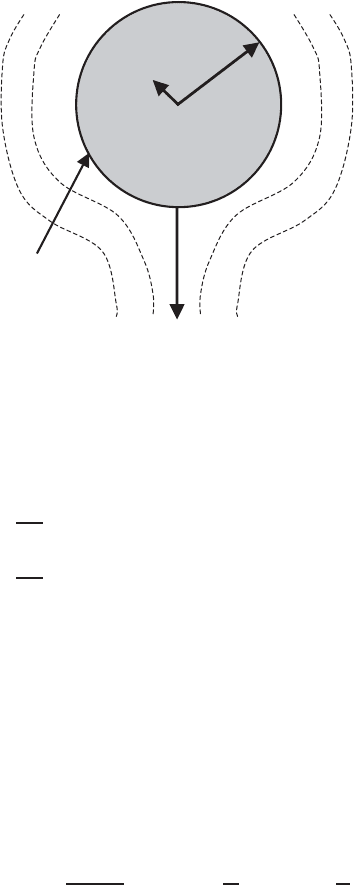
heat conduction. Consider a solid sphere initially at temperature T
0
, having constant
physical properties, radius R, and falling at its constant terminal velocity U
t
through
a viscous liquid whose constant temperature is T
∞
>T
0
, as shown in Figure 4.4-1.
As a result of contact with the hot liquid, the temperature of the sphere gradually
will increase. We characterize the heat transfer in the liquid via a lumped-parameter
approach; that is, we assume that the heat transfer in the liquid can be described
by a heat-transfer coefficient h. The latter can be obtained from correlations for
the Nusselt number, a dimensionless heat-transfer coefficient, as a function of the
Reynolds number for flow over a sphere that are available in standard references.
6
Since we are representing the heat transfer in the liquid phase via a heat-
transfer coefficient, describing equations need to be written only in the con-
ducting solid sphere. The thermal energy equation in spherical coordinates given
by equation (F.3-2) in the Appendices appropriately simplified for the conditions
defined in the problem statement and the associated initial and boundary conditions
are given by (step 1)
∂T
∂t
= α
1
r
2
∂
∂r
r
2
∂T
∂r
(4.4-1)
T = T
0
at t ≤ 0, 0 ≤ r ≤ R (4.4-2)
5
R. B. Bird, W. E. Stewart, and E. L. Lightfoot, Transport Phenomena, 2nd ed., Wiley, Hoboken, NJ,
2002, pp. 703–708.
6
See, for example, Bird et al., Transport Phenomena, 2nd ed., p. 439.
160 APPLICATIONS IN HEAT TRANSFER
r
R
−q
r
= h(T
∞
− T)
U
t
Viscous liquid at
temperature T
∞
Solid sphere
Figure 4.4-1 Solid sphere with constant physical properties, radius R, and initial temper-
ature T
0
falling at its terminal velocity U
t
in a viscous liquid whose temperature is T
∞
such
that T
∞
>T
0
.
∂T
∂r
= 0atr = 0,t>0 (4.4-3)
k
∂T
∂r
= h(T
∞
− T) at r = R, t > 0 (4.4-4)
where α ≡ k/ρC
p
is the thermal diffusivity. Equation (4.4-2) is the given initial
temperature condition. Equation (4.4-3) is a boundary condition frequently used
when there is a point or axis of symmetry; it states that the temperature is at an
extremum (in this case a minimum) at the center of the sphere. Equation (4.4-4)
states that the heat-transfer flux from the surrounding liquid must be equal to the
conductive heat flux into the solid sphere at its surface.
Define the following dimensionless variables involving unspecified scale and
reference factors (steps 2, 3, and 4):
T
∗
≡
T − T
r
T
s
; r
∗
≡
r
r
s
; t
∗
≡
t
t
s
(4.4-5)
Note that we have introduced a reference factor for the temperature since it is
not naturally referenced to zero. Introduce these dimensionless variables into the
describing equations and divide through by the coefficient of one term in each
equation that should be retained (steps 5 and 6):
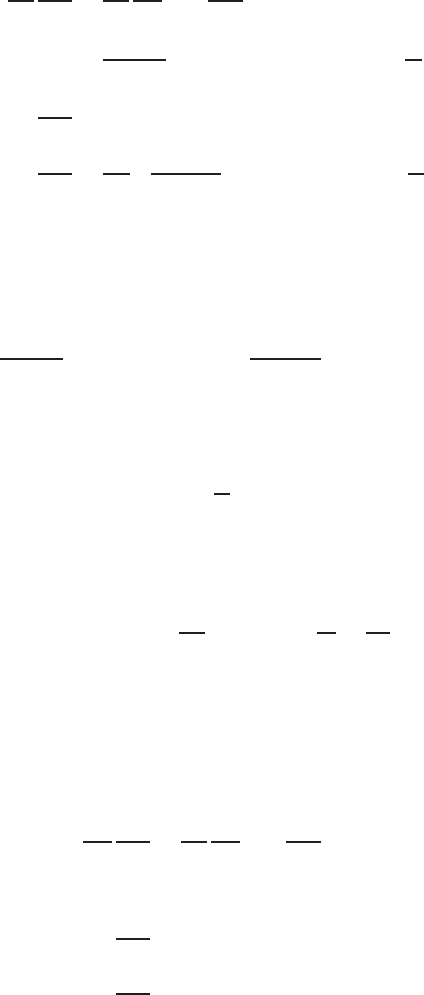
SMALL BIOT NUMBER APPROXIMATION 161
r
2
s
αt
s
∂T
∗
∂t
∗
=
1
r
∗2
∂
∂r
∗
r
∗2
∂T
∗
∂r
∗
(4.4-6)
T
∗
=
T
0
− T
r
T
s
at t
∗
≤ 0, 0 ≤ r
∗
≤
R
r
s
(4.4-7)
∂T
∗
∂r
∗
= 0atr
∗
= 0,t
∗
> 0 (4.4-8)
∂T
∗
∂r
∗
=
hr
s
k
T
∞
− T
r
T
s
− T
∗
at r
∗
=
R
r
s
,t
∗
> 0 (4.4-9)
We can bound the dimensionless temperature to be
◦
(1) by setting the dimen-
sionless group in equation (4.4-7) equal to zero to determine the reference temper-
ature and by setting the dimensionless temperature ratio in equation (4.4-9) equal
to 1 to determine the temperature scale (step 7); that is,
T
0
− T
r
T
s
= 0 ⇒ T
r
= T
0
;
T
∞
− T
0
T
s
= 1 ⇒ T
s
= T
∞
− T
0
(4.4-10)
We can bound the dimensionless radial coordinate to be
◦
(1) by setting the dimen-
sionless group containing r
s
in equation (4.4-7) or (4.4-9) equal to 1; that is,
R
r
s
= 1 ⇒ r
s
= R (4.4-11)
There are two possible time scales, the observation time t
o
and the characteristic
time dictated by the dimensionless group in equation (4.4-6) given by
r
2
s
αt
s
= 1 ⇒ t
s
=
r
2
s
α
=
R
2
α
(4.4-12)
The time scale given by equation (4.4-12) is appropriate when this is inherently an
unsteady-state heat-transfer problem for which both terms in equation (4.4-6) must
be retained.
If we choose the observation time as our characteristic time, we obtain the
following dimensionless describing equations:
1
Fo
t
∂T
∗
∂t
∗
=
1
r
∗2
∂
∂r
∗
r
∗2
∂T
∗
∂r
∗
(4.4-13)
T
∗
= 0att
∗
≤ 0, 0 ≤ r
∗
≤ 1 (4.4-14)
∂T
∗
∂r
∗
= 0atr
∗
= 0,t
∗
> 0 (4.4-15)
∂T
∗
∂r
∗
= Bi
t
(1 − T
∗
) at r
∗
= 1,t
∗
> 0 (4.4-16)
162 APPLICATIONS IN HEAT TRANSFER
where Fo
t
≡ αt
o
/R
2
is the thermal Fourier number, which is the ratio of the obser-
vation time to the characteristic time for heat conduction, and where Bi
t
≡ hR/k
is the thermal Biot number, which is the ratio of the total heat transfer external to
the sphere to the conductive heat transfer within the sphere.
7
For steady-state to
be achieved, we must have
Fo
t
1 ⇒ t
o
R
2
α
(4.4-17)
If the condition given by equation (4.4-17) is satisfied, the unsteady-state term in
equation (4.4-13) can be ignored. Integration of the steady-state form of equation
(4.4-13) subject to the boundary condition given by equation (4.4-15) implies that
the temperature gradient is zero throughout the sphere; this is turn implies that
the temperature is constant throughout the sphere. To satisfy the boundary condi-
tion given by equation (4.4-16), we must have T
∗
= 1 throughout the sphere; this
implies that T = T
∞
throughout the sphere. This result should not be surprising
since steady-state implies that the sphere has come to thermal equilibrium with the
surrounding liquid. Note that satisfying the steady-state condition occurs at earlier
times as the Biot number increases, corresponding to improved heat transfer in the
liquid phase.
If we choose the time scale given by equation (4.4-12), our dimensionless ther-
mal energy equation assumes the form
∂T
∗
∂t
∗
=
1
r
∗2
∂
∂r
∗
r
∗2
∂T
∗
∂r
∗
(4.4-18)
The solution to equation (4.4-18) can be simplified for the special case of very
small Biot numbers, that is, for Bi
t
1. For this case equation (4.4-16) implies
that the dimensionless temperature gradient within the sphere is negligibly small,
thereby implying that the temperature within the sphere is uniform. Hence, equation
(4.4-18) can be integrated as follows:
1
0
∂T
∗
∂t
∗
4πr
∗2
dr
∗
=
1
0
1
r
∗2
∂
∂r
∗
r
∗2
∂T
∗
∂r
∗
4πr
∗2
dr
∗
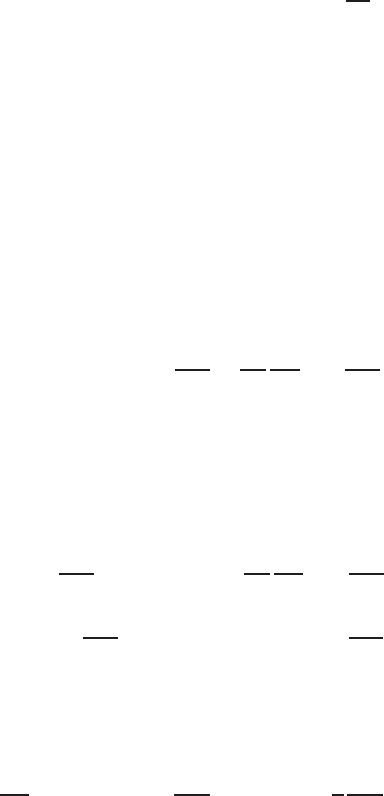
(4.4-19)
1
0
∂T
∗
∂t
∗
r
∗2
dr
∗
=
Bi
t
(1−T
∗
)
0
∂
r
∗2
∂T
∗
∂r
∗
(4.4-20)
Use of Liebnitz’s rule given in Appendix H in the Appendices to integrate the first
term and the fact that the temperature is essentially uniform within the sphere for
very small Biot numbers then yields
d
dt
∗
1
0
T
∗
r
∗2
dr
∗
=
dT
∗
dt
∗
1
0
r
∗2
dr
∗
=
1
3
dT
∗
dt
∗
= Bi
t
(1 − T
∗
) (4.4-21)
7
Do not confuse the Biot number with the Nusselt number; they are defined similarly and represent the
ratio of convective to conductive heat transfer; however, in contrast to the Biot number, the Nusselt
number involves the ratio of convective to conductive heat transfer in the fluid phase.