
Krantz W.B. Scaling Analysis in Modeling Transport and Reaction Processes: A Systematic Approach to Model Building and the Art of Approximation
Подождите немного. Документ загружается.


INSTANTANEOUS REACTION REGIME 373
the limiting reactant, component B is not necessarily reduced to zero; moreover,
it diffuses over the full thickness of the microscale liquid layer and reacts with
component A over the thickness δ
r
. The minimum concentration of component B
can again be estimated from our scaling analysis and is given by equation (6.5-2).
The mass-transfer flux is increased for the fast relative to the slow or intermediate
reaction regimes, as shown by the steeper slope of the concentration profile for
component A at y = 0.
6.7 INSTANTANEOUS REACTION REGIME
As the reaction rate increases in the fast reaction regime, the concentration of
component B at the gas–liquid interface continues to decrease. For sufficiently fast
irreversible reaction conditions, it is reduced to zero. An estimate of the reaction
rate required to achieve this condition can be obtained from our reference factor
for component B given by equation (6.5-2):
c
Br
=ˆc
B
−
κR
m
A
δ
2
m
D
BS
= 0 ⇒ R
m
A
=
D
BS
ˆc
B
κδ
2
m
(6.7-1)
When the reaction rate is increased from this value, component B becomes the
rate-limiting reactant in the vicinity of the gas–liquid interface; that is, there is
a region near the gas–liquid interface wherein there is no reaction, due to the
depletion of component B. Hence, the reaction will occur only in the region
wherein both components A and B have concentrations greater than zero. Equa-
tion (6.6-2) indicates that the thickness of the region wherein the chemical reaction
occurs decreases to zero as the reaction rate become infinite. This limiting condition
is referred to as the instantaneous reaction regime, for which the criterion is
R
m
A
δ
2
m
D
AS
(c
◦
A
−ˆc
A
)
→∞⇒instantaneous reaction regime (6.7-2)
This condition implies that the irreversible reaction is so fast that the two reacting
components cannot coexist anywhere in the microscale element. When instanta-
neous reaction conditions prevail, the resistance to mass transfer in the liquid phase
is greatly reduced. Hence, it is possible for the mass transfer on the microscale to
become gas-phase controlled. If the mass transfer remains liquid-phase controlled,
the interfacial concentration of component A will remain at c
◦
A
and the reaction
plane will be in the liquid phase; this is referred to as the inner-reaction domain
of the instantaneous reaction regime. However, if the mass transfer becomes gas-
phase controlled, the interfacial concentration of component A will become zero
and the reaction plane will be at the gas–liquid interface; this is referred to as the
surface-reaction domain of the instantaneous reaction regime. Figure 6.3-1 shows
that for the inner-reaction domain of the instantaneous reaction regime the reac-
tion plane separates a region in which component A is diffusing in the absence of

374 APPLICATIONS IN MASS TRANSFER WITH CHEMICAL REACTION
any B from a region in which component B is diffusing in the absence of any A.
However, for the surface-reaction domain of the instantaneous reaction regime the
concentration of component A remains at zero throughout the microscale element,
owing to the extremely fast reaction that consumes it at the interface between the
two phases. In addition, the concentration of component B becomes zero at the
gas–liquid interface. Figure 6.3-1 shows that the mass-transfer flux is increased for
the instantaneous relative to the slow, intermediate, and fast reaction regimes, as
indicated by the steeper concentration gradient of component A at y = 0. How-
ever, the surface-reaction domain of the instantaneous reaction regime provides
the fastest absorption since the resistance to mass transfer in the liquid becomes
negligible in comparison to that in the gas phase.
The inner-reaction domain of the instantaneous reaction regime is no longer
described by equations (6.3-3) through (6.3-7) since the homogeneous reaction
term does not appear in the describing equations. Moreover, the concentrations of
both components are forced to zero at the reaction plane as shown in Figure 6.3-1.
Since the instantaneous reaction is confined to a reaction plane, the mass transfer
again becomes diffusion-limited; that is, the diffusion of the two components occurs
within the liquid layer thickness defined by δ
m
. The resulting describing equations
then are given by (step 1)
∂c
A
∂t
= D
AS
∂
2
c
A
∂y
2
(6.7-3)
∂c
B
∂t
= D
BS
∂
2
c
B
∂y
2
(6.7-4)
c
A
= 0,c
B
=ˆc
B
at t = 0 (6.7-5)
c
A
= c
◦
A
at y = 0 (6.7-6)
c
A
= 0,c
B
= 0aty = L(t) (6.7-7)
c
B
=ˆc
B
at y = δ
m
(6.7-8)
The initial condition given by equation (6.7-5) states that for an instantaneous
reaction component A, the limiting reactant cannot be present in the bulk liquid,
whereas component B has a concentration dictated by the local position in the
absorber. Equation (6.7-6) states that the equilibrium concentration of component
A is maintained at the interface. Equation (6.7-7) states that the concentrations
of both reactants are zero at the instantaneous reaction front. Equation (6.7-8)
states that component B has its bulk concentration at the edge of the liquid layer
in the microscale element. An auxiliary condition is needed to locate L(t),the
instantaneous position of the reaction plane; that is, the instantaneous reaction case
involves a moving boundary problem. Consider an integral species balance on
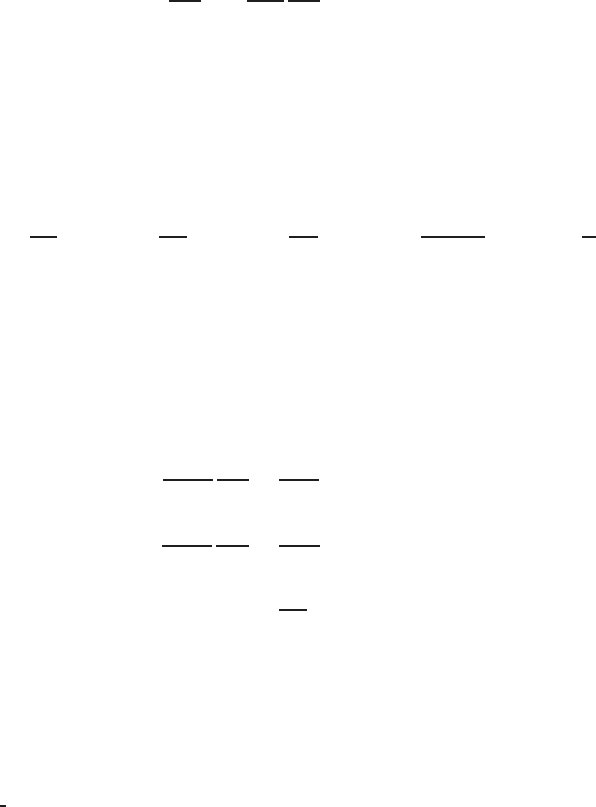
component A:
d
dt
L
0
c
A
dy = N
A
|
y=0
+
1
κ
d
dt
δ
m
L
c
B
dy (6.7-9)
INSTANTANEOUS REACTION REGIME 375
Equation (6.7-9) states that the change in the concentration of component A in
the liquid layer of the microscale element is equal to the rate at which it diffuses
in from the gas phase minus the rate at which it is consumed by the irreversible
instantaneous chemical reaction; the latter is equal to the change in the concentra-
tion of component B (a negative number) divided by the stoichiometric coefficient
for the chemical reaction. Equation (6.7-9) can be rearranged using Leibnitz’s rule
for differentiation of an integral given by equation (H.1-2) in the Appendices and
equations (6.7-3) and (6.7-4) to obtain the following auxiliary condition for deter-
mining the instantaneous location of the reaction plane
6
:
D
AS
∂c
A
∂y
=−
D
BS
κ
∂c
B
∂y
at y = L (6.7-10)
Note that velocity of the moving boundary does not appear in equation (6.7-10)
because the concentrations of both A and B are zero at the reaction plane. Our describ-
ing equations for instantaneous reaction conditions then are given by equations (6.7-
3) through (6.7-8) and equation (6.7-10).
Introduce the following dimensionless variables containing unspecified scale and
reference factors (steps 2, 3, and 4):
c
∗
A
≡
c
A
c
As
; c
∗
B
≡
c
B
c
Bs
; y
∗
A
≡
y
y
As
; y
∗
B
≡
y −y
Bs
y
Bs
; t
∗
≡
t
t
s
(6.7-11)
We do not need to introduce reference factors for c
A
and c
B
since they are naturally
referenced to zero. We have introduced a reference length factor for component B
since its diffusion occurs only on one side of the reaction front. Substitute these
dimensionless variables into the describing equations and divide through by the
dimensional coefficient of one term in each equation (steps 5 and 6):
y
2
As
D
AS
t
s
∂c
∗
A
∂t
∗
=
∂
2
c
∗
A
∂y
∗2
A
(6.7-12)
y
2
Bs
D
BS
t
s
∂c
∗
B
∂t
∗
=
∂
2
c
∗
B
∂y
∗2
B
(6.7-13)
c
∗
A
= 0,c
∗
B
=
ˆc
B
c
Bs
at t
∗
= 0 (6.7-14)
6
In some formulations of the instantaneous reaction problem, an additional condition that is based
on the fact that the moving boundary is a plane having constant concentration is used to obtain an
equation that relates the velocity of the reaction front dL/dt to the ratio of the partial derivatives of
the concentration ∂c
A
/∂t and ∂c
A
/∂y. However, this condition is redundant since it is embodied in
equation (6.7-10). Indeed, the time dependence of L can be obtained by demanding that the solution
to equations (6.7-3) through (6.7-8) satisfy equation (6.7-10). Note, however, that we will see that our
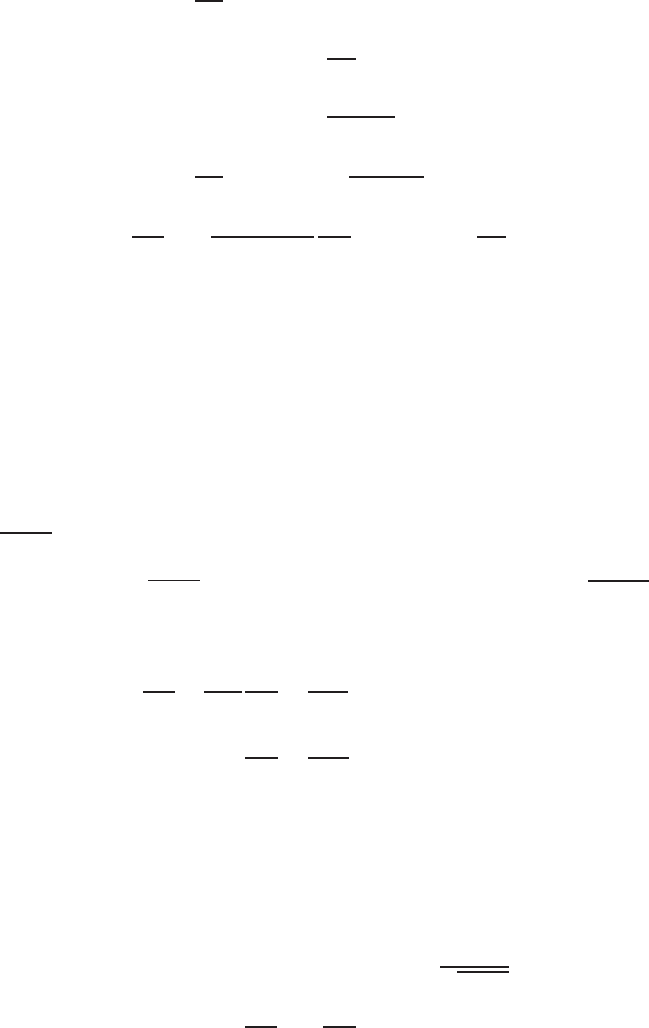
scaling analysis gives us the time dependence of L to within a multiplicative constant of (1):thatis,
L ∝
√
t.
376 APPLICATIONS IN MASS TRANSFER WITH CHEMICAL REACTION
c
∗
A
=
c
◦
A
c
As
at y
∗
= 0 (6.7-15)
c
∗
A
= 0aty
∗
A
=
L
y
As
(6.7-16)
c
∗
B
= 0aty
∗
B
=
L − y
Br
y
Bs
(6.7-17)
c
∗
B
=
ˆc
B
c
Bs
at y
∗
B
=
δ
m
− y
Br
y
Bs
(6.7-18)
∂c
∗
A
∂y
∗
A
=−
D
BS
c
Bs
y
As
κD
AS
c
As
y
Bs
∂c
∗
B
∂y
∗
B
at y
∗
A
=
L
y
As
(6.7-19)
We again set appropriate dimensionless groups equal to zero or 1 to determine
the reference and scale factors, respectively (step 7). The concentration scales are
obtained by setting c
◦
A
/c
As
= 1andˆc
B
/c
Bs
= 1toobtainc
As
= c
◦
A
and c
Bs
=ˆc
B
,
respectively. Since this is inherently an unsteady-state problem, the characteris-
tic time is the observation time t
o
. Careful consideration must now be given to
determining the proper scales for y
As
and y
Bs
. Note that for an instantaneous
reaction, we expect that L δ
m
since the reaction is limited by depletion of
component B, which must diffuse to the reaction front. Hence, we set the dimen-
sionless group in equation (6.7-16) equal to 1 to obtain y
As
= L. Since the two
terms in equation (6.7-13) must balance, we set y
2
Bs
/D
BS
t
o
= 1toobtainy
Bs
=
√
D
BS
t
o
. Since the diffusion of component B is inherently unsteady-state, the two
terms in equation (6.7-19) must balance; thus, we set D
BS
c
Bs
y
As
/κD
AS
c
As
y
Bs
=
D
BS
ˆc
B
L/κD
AS
c
◦
A
√
D
BS
t
o
= 1, thereby obtaining L = (κD
AS
c
◦
A
/ ˆc
B
)
√
t
o
/D
BS
.
When these scale and reference factors are substituted into the describing equations,
we obtain
κc
◦
A
ˆc
B
2
D
AS
D
BS
∂c
∗
A
∂t
∗
=
∂
2
c
∗
A
∂y
∗2
A
(6.7-20)
∂c
∗
B
∂t
∗
=
∂
2
c
∗
B
∂y
∗2
B
(6.7-21)
c
∗
A
= 0,c
∗
B
= 1att
∗
= 0 (6.7-22)
c
∗
A
= 1aty
∗
= 0 (6.7-23)
c
∗
A
= 0aty
∗
A
= 1 (6.7-24)
c
∗
B
= 0aty
∗
B
= 0 (6.7-25)
c
∗
B
= 1aty
∗
B
=
δ
m
− L
√
D
BS
t
o
(6.7-26)
∂c
∗
A
∂y
∗
A
=−
∂c
∗
B
∂y
∗
B
at y
∗
A
= 1 (6.7-27)

SCALING THE MACROSCALE ELEMENT 377
Now let us consider how the dimensionless describing equations can be
simplified (step 8). The boundary condition given by equation (6.7-26) can be
applied at infinity if the following condition is satisfied:
δ
m
− L
√
D
BS
t
o
1 (6.7-28)
This condition will be satisfied for relatively short contact times. The unsteady-
state term in equation (6.7-20) can be dropped if the following condition is
satisfied:
κc
◦
A
ˆc
B
2
D
AS
D
BS
1 (6.7-29)
This condition will be satisfied if the nonlimiting reactant is present in consider-
able excess relative to the reactant that is being absorbed, since in most cases one
would expect D
AS
∼
=
D
BS
. If the condition given by equation (6.7-29) is satisfied,
a quasi-steady-state linear concentration profile of component A is obtained. One
can then solve equation (6.7-21) via a penetration theory approach if the condition
given by equation (6.7-28) is satisfied.
6.8 SCALING THE MACROSCALE ELEMENT
In Section 6.3 we focused on scaling the describing equations for the microscale
element. The mass-transfer flux determined for the microscale analysis will become
a homogeneous source or sink term in the describing equations for the macroscale
that we consider now. The analysis for the macroscale is greatly simplified for
the fast and instantaneous reaction regimes, since they reduce the concentration of
the absorbing component to its reaction equilibrium value, which is zero for an
irreversible reaction. Since the latter concentration will prevail on the macroscale
everywhere in the contacting device, no further reaction can occur. However,
the concentration of the nonlimiting reactant, component B, is depleted on the
macroscale, due to its consumption by the chemical reaction on the microscale.
However, as we will see in Section 6.14, the mass-transfer flux of the absorbing
component can be obtained without having to solve for the concentration profile
of the liquid-phase reactant.
Consider now the slow reaction regime for which no reaction occurs on the
microscale and there is no diffusive flux of component B. However, there is a
diffusive flux N
A
of component A from the gas into the liquid phase. This has
the effect of being a point source of component A and a point sink of compo-
nent B on the macroscale. We assume that conditions are laterally uniform so that
the bulk concentrations of components A and B change only in the axial direc-
tion in Figure 6.2-1. Consider a molar balance on components A and B over a
control volume consisting of a differential slice of the bubble column z that is
378 APPLICATIONS IN MASS TRANSFER WITH CHEMICAL REACTION
convected at the average axial velocity of the liquid, as shown in Figure 6.2-1
(step 1):
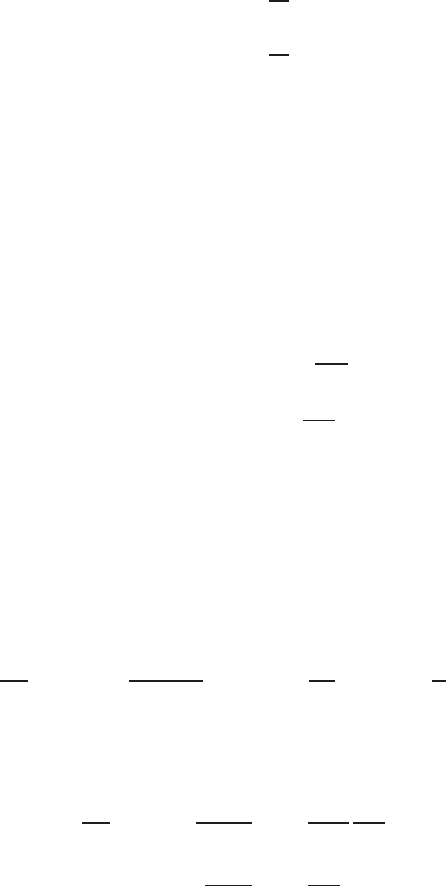
N
A
az − R
A
φa z =
d
dt
( ˆc
A
φa z) (6.8-1)
−κR
A
φa z =
d
dt
(ˆc
B
φa z) (6.8-2)
where a is the interfacial area per unit volume of the contacting device, φ the
volume of liquid per unit interfacial area, R
A
the rate of production (moles/volume
·time) of component A by the homogeneous chemical reaction, κ the stoichio-
metric coefficient for the chemical reaction, and d/dt denotes the total deriva-
tive.
7
In the slow reaction regime N
A
can be obtained directly from k
•
L0
,the
mass-transfer coefficient for purely diffusive transfer in the liquid phase via the
equation
N
A
= k
•
L0
(c
◦
A
−ˆc
A
) (6.8-3)
Hence, equations (6.8-1) and (6.8-2) can be written as
k
•
L0
(c
◦
A
−ˆc
A
) − R
A
φ = φ
∂ ˆc
A
∂t
(6.8-4)
−κR
A
=
∂ ˆc
B
∂t
(6.8-5)
The initial conditions required to solve equations (6.8-4) and (6.8-5) are given
by
ˆc
A
= 0, ˆc
B
=ˆc
B0
at t = 0 (6.8-6)
that is, we are assuming that the nonreacting solvent that enters the bubble column
contains only liquid component B at an initial concentration ˆc
B0
.
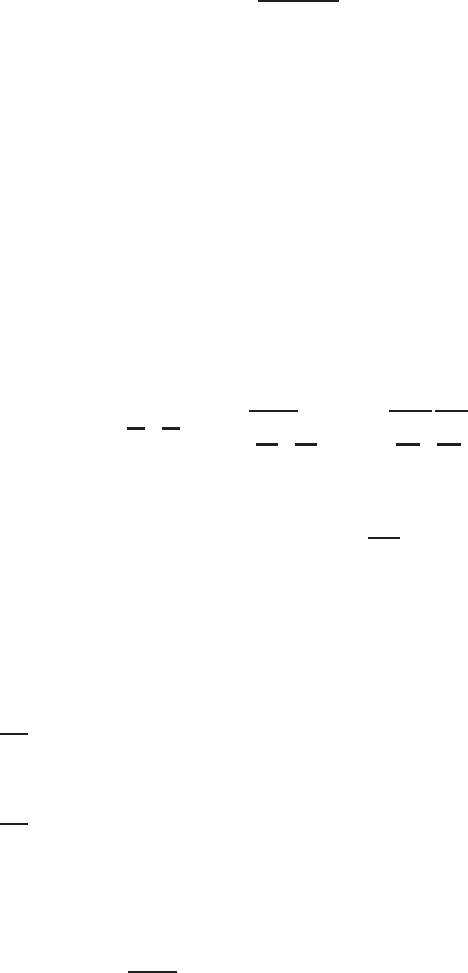
Introduce the following dimensionless variables and scale factors (steps 2, 3,
and 4):
ˆc
∗
A
≡
ˆc
A
ˆc
As
;ˆc
∗
B
≡
ˆc
B
−ˆc
Br
ˆc
Bs
; R
∗
A
≡
R
A
R
s
; t
∗
≡
t
t
s
(6.8-7)
Introduce these variables into equations (6.8-4) through (6.8-6) and divide through
by the coefficient of one term in each equation to obtain the following dimensionless
describing equations (steps 5 and 6):
c
◦
A
ˆc
As
−ˆc
∗
A
−
R
s
φ
k
•
L0
ˆc
As
R
∗
A
=
φ
k
•
L0
t
s
∂ ˆc
∗
A
∂t
∗
(6.8-8)
−
κR
s
t
s
ˆc
Bs
R
∗
A
=
∂ ˆc
∗
B
∂t
∗
(6.8-9)
7
In a convected coordinate system, one takes the total derivative of an extensive quantity such as the
total number of moles, but the partial derivative of an intensive quantity such as the molar concentration;
the partial derivative with respect to the temporal coordinate is evaluated at a fixed value of the spatial
coordinate in the convected coordinate system.
SCALING THE MACROSCALE ELEMENT 379
ˆc
∗
A
= 0, ˆc
∗
B
=
ˆc
B0
−ˆc
Br
ˆc
Bs
at t
∗
= 0 (6.8-10)
Note that we have divided through by the coefficient of the first term in equa-
tion (6.8-4) since this term must be retained if component A is transferred from the
gas to the liquid phase. Equation (6.8-8) indicates that the dimensionless concen-
tration can be bounded of
◦
(1)ifwesetc
◦
A
/ ˆc
As
= 1 in order to obtain ˆc
As
= c
◦
A
.
The appropriate time scale is the observation or contact time t
o
that is required for
the liquid to flow through the bubble column. The dimensionless reaction rate is
bounded to be
◦
(1) by again choosing its scale factor to be some characteristic
maximum value R
m
A
, which could be determined if the reaction rate were speci-
fied. Setting the dimensionless group in equation (6.8-10) equal to 1 indicates that
ˆc
Bs
=ˆc
B0
−ˆc
Br
. When this scale is substituted into the dimensionless group in
equation (6.8-9) and the latter is set equal to −1 (because R
m
A
< 0), we obtain
ˆc
Br
=ˆc
B0
− κR
m
A
t
o
. Substituting these scale and reference factors into the describ-
ing equations then yields the following set of dimensionless describing equations
for the macroscale element (step 7):
(1 −ˆc
∗
A
)
mass transfer
from microscale
to macroscale
−
R
m
A
φ
k
•
L0
c
◦
A
R
∗
A
chemical reaction
=
φ
k
•
L0
t
o
∂ ˆc
∗
A
∂t
∗
accumulation in
convected system
(6.8-11)
R
∗
A
=
∂ ˆc
∗
B
∂t
∗
(6.8-12)
ˆc
∗
A
= 0, ˆc
∗
B
= 1att
∗
= 0 (6.8-13)
Now let us consider how the describing equations for the macroscale element can
be simplified (step 8). These equations again involve three characteristic time scales:
t
o
∼ contact or residence time in the bubble column (6.8-14)
φ
k
•
L0
∼ characteristic time for interphase mass transfer on the macroscale
(6.8-15)
c
◦
A
R
m
A
∼ characteristic time for reaction on the macroscale (6.8-16)
Consider first the case where the characteristic time for reaction is extremely long
compared to that for interphase mass transfer. This corresponds to purely physical
absorption in the absence of any chemical reaction for which the criterion is
R
m
A
φ
k
•
L0
c
◦
A
∼
=
0 ⇒ purely physical absorption (6.8-17)
Now let us consider the more interesting case for which chemical reaction
occurs. Note that the accumulation or unsteady-state term in equation (6.8-11) is
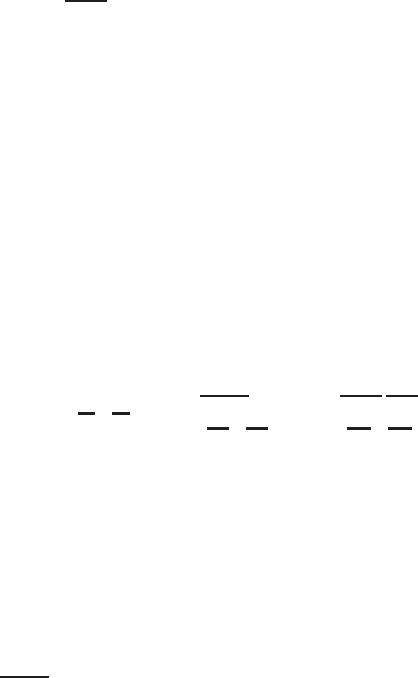
380 APPLICATIONS IN MASS TRANSFER WITH CHEMICAL REACTION
equal to the difference between the rate of mass transfer from the microscale to the
macroscale and the rate at which the transferring component is consumed by the
chemical reaction. Although both the mass transfer and reaction terms can be large,
their difference can be quite small under some conditions that we will now explore.
The accumulation or unsteady-state term will be very small when the following
criterion is satisfied:
φ
k
•
L0
t
o
1 ⇒ species accumulation is very small (6.8-18)
Equation (6.8-18) implies that the time scale for interphase mass transfer is much
shorter than the residence time in the contacting device. When the criterion given by
equation (6.8-18) is satisfied, it means that the mass transfer and reaction terms are
nearly equal in magnitude such that their difference is very small. This approxima-
tionisreferredtoasthequasistationary hypothesis. The quasistationary hypothesis
is rigorous for a continuous stirred tank reactor (CSTR), within which there is
a uniform concentration. However, it is an approximation for contactors such as
packed columns, for which the concentration changes with axial position.
6.9 KINETIC DOMAIN OF THE SLOW REACTION REGIME
Now let us assume that the quasistationary hypothesis applies, in which case we
can write equation (6.8-11) as follows:
(1 −ˆc
∗
A
)
mass transfer
from microscale
to macroscale
−
R
m
A
φ
k
•
L0
c
◦
A
R
∗
A
chemical reaction
=
φ
k
•
L0
t
o
∂ ˆc
∗
A
∂t
∗
accumulation in
convected system
1 (6.9-1)
Let us first consider the case for which the characteristic time for mass transfer
from the microscale to macroscale is much shorter than the characteristic time for
reaction. This means that component A is transferred from the gas to the liquid
phase much faster than it can be consumed by the chemical reaction. This is
referred to as the kinetic domain of the slow reaction regime.
8
The criterion for its
applicability is
R
m
A
φ
k
•
L0
c
◦
A
1 ⇒ kinetic domain of the slow reaction regime (6.9-2)
Since the mass transfer and reaction terms in equation (6.9-1) must nearly balance,
the kinetic domain of the slow reaction regime implies that ˆc
∗
A
∼
=
1orthatˆc
A
∼
=
c
◦
A
;
that is, the bulk liquid is maintained nearly at the thermodynamic equilibrium
concentration for component A. The driving force for the chemical reaction then
is proportional to c
◦
A
for an irreversible reaction.
8
The kinetic domain of the slow reaction regime is often referred to as the kinetic regime of the slow
reaction regime; the terminology used here is preferred because it more clearly indicates that the domain
is a subcategory of the regime.

IMPLICATIONS OF SCALING ANALYSIS FOR REACTOR DESIGN 381
6.10 DIFFUSIONAL DOMAIN OF THE SLOW REACTION REGIME
Let us again assume that the quasi-stationary hypothesis applies so that equa-
tion (6.9-1) applies. Now consider the case for which the characteristic time for
mass transfer from the microscale to macroscale is much longer than the charac-
teristic time for reaction. This means that component A is transferred from the gas
to the liquid phase much slower than it is consumed by the chemical reaction. This
is referred to as the diffusional domain of the slow reaction regime.
9
The criterion
for its applicability is the following:
R
m
A
φ
k
•
L0
c
◦
A
1 ⇒ diffusional domain of the slow reaction regime (6.10-1)
For the diffusional domain of the slow reaction regime, it would appear that the
reaction term is much larger than the mass-transfer term in equation (6.9-1). How-
ever, since these two terms must nearly balance, we conclude that R
∗
A
1. This in
turn implies that the driving force for the chemical reaction must be very small (i.e.,
ˆc
∗
A
∼
=
0); that is, the chemical reaction is sufficiently fast so that it maintains the
bulk concentration at the reaction equilibrium concentration. This in turn implies
that the driving force for mass transfer from the microscale to the macroscale is c
◦
A
for an irreversible reaction. It might seem contradictory that the chemical reaction
is fast enough in the diffusional domain of the slow reaction regime to reduce the
bulk concentration to zero, whereas in the intermediate reaction regime for which
the reaction is faster, the bulk concentration is not necessarily reduced to zero. In
the intermediate reaction regime the reaction occurs on the microscale and therefore
steepens the concentration gradient of component A at the gas–liquid interface and
increases the mass-transfer coefficient from that for purely physical absorption.
In contrast, the mass-transfer coefficient for the diffusional domain of the slow
reaction regime is the same as that for purely physical absorption. The faster mass-
transfer rate in the intermediate regime relative to the diffusional domain of the
slow reaction regime corresponds to a steeper concentration gradient of component
A at y = 0inFigure6.3-1.
6.11 IMPLICATIONS OF SCALING ANALYSIS FOR REACTOR
DESIGN
The scaling analysis that we have applied to the microscale–macroscale modeling
of mass transfer with chemical reaction can be used to develop a set of design
precepts for selecting the optimal reactor. These will be determined by considering
how the process parameters affect the total absorption rate per unit volume N
A
a.
We will proceed from the slowest to the fastest reaction conditions. Hence, let
us first consider purely diffusional mass transfer in the absence of any chemical
9
The diffusional domain of the slow reaction regime is often referred to as the diffusional regime of
the slow reaction regime.

382 APPLICATIONS IN MASS TRANSFER WITH CHEMICAL REACTION
reaction for which the mass-transfer rate per unit volume of reactor is given by
N
A
a = k
•
L0
a(c
◦
A
−ˆc
A
) for purely physical absorption (6.11-1)
Correlations for k
•
L0
, the mass-transfer coefficient for purely physical absorption, in
terms of the Sherwood number or Nusselt number for mass transfer are available
in the literature for many contacting geometries. If the contact time is long in
comparison to the diffusion time, a film theory model applies and the mass-transfer
coefficient for purely physical absorption is given by equation (6.3-25); that is,
k
•
L0
=
D
AS
δ
m
steady-state physical absorption (6.11-2)
If the contact time is short in comparison to the diffusion time, a penetration theory
model applies and the mass-transfer coefficient for purely physical absorption is
given by equation (6.3-29); that is,
k
•
L0
=
D
AS
t
o
unsteady-state physical absorption (6.11-3)
Equation (6.11-1) implies that the total absorption rate per unit volume for purely
physical absorption is:
•
Proportional to the interfacial area
•
Independent of the liquid-phase holdup φa
•
Proportional to the mass-transfer coefficient k
•
L0
that characterizes the transport
between the microscale and macroscale elements
•
Proportional to the overall driving force for the absorbing component
These considerations indicate that appropriate contactors for purely physical absorp-
tion are packed columns that provide large interfacial area (i.e., large values of a),
good hydrodynamics (i.e., high Reynolds numbers) to promote large mass-transfer
coefficients (i.e., large values of k
•
L0
), and maintain large overall driving forces
(i.e., large values of c
◦
A
−ˆc
A
are maintained by avoiding global mixing). On the
other hand, contactors such as stirred tanks are not appropriate since they have
low interfacial area and promote large scale mixing that reduces the overall driving
force for mass transfer.
Now let us consider the kinetic domain of the slow reaction regime. For this
domain the chemical reaction is very slow on both the micro- and macroscales.
This means that the mass-transfer coefficient for transfer from the microscale to
the macroscale is the same as for mass transfer in the absence of chemical reac-
tion. On the macroscale the kinetic domain of the slow reaction regime means
that the reaction is so slow that the local bulk fluid is nearly at the thermody-
namic equilibrium concentration c
◦
A
. Since the mass-transfer and chemical reaction
terms in equation (6.9-1) must nearly balance if the quasi-stationary hypothesis is